

ASTM F2848-21
(Specification)Standard Specification for Medical-Grade Ultra-High-Molecular-Weight Polyethylene Yarns
General Information
- Abstract
ABSTRACT
This specification describes the required properties and the procedures to be followed for testing ultra-high molecular weight polyethylene (UHMWPE) yarns intended for use in medical devices or components of medical devices, such as sutures and ligament fixations. UHMWPE filament and yarn requirements cover compositional requirements, physical requirements, mechanical requirements, and biocompatibility requirements. Residual production liquids shall be determined by gas chromatography or other suitable, validated analytical methods for the specific materials used to produce the yarn.
SCOPE
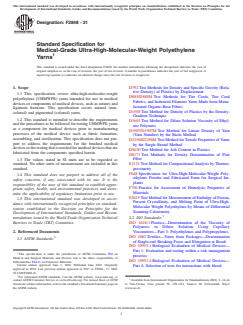
1.1 This specification covers ultra-high-molecular-weight polyethylene (UHMWPE) yarns intended for use in medical devices or components of medical devices, such as sutures and ligament fixations. This specification covers natural (non-colored) and pigmented (colored) yarns.
1.2 This standard is intended to describe the requirements and the procedures to be followed for testing UHMWPE yarns as a component for medical devices prior to manufacturing processes of the medical device such as fabric formation, assembling, and sterilization. This specification does not purport to address the requirements for the finished medical devices or the testing that is needed for medical devices that are fabricated from the components specified herein.
1.3 The values stated in SI units are to be regarded as standard. No other units of measurement are included in this standard.
1.4 This standard does not purport to address all of the safety concerns, if any, associated with its use. It is the responsibility of the user of this standard to establish appropriate safety, health, and environmental practices and determine the applicability of regulatory limitations prior to use.
1.5 This international standard was developed in accordance with internationally recognized principles on standardization established in the Decision on Principles for the Development of International Standards, Guides and Recommendations issued by the World Trade Organization Technical Barriers to Trade (TBT) Committee.
- Status
- Published
- Publication Date
- 31-May-2021
- Technical Committee
- F04 - Medical and Surgical Materials and Devices
- Drafting Committee
- F04.11 - Polymeric Materials
Buy Documents
ASTM F2848-21 - Standard Specification for Medical-Grade Ultra-High-Molecular-Weight Polyethylene Yarns
REDLINE ASTM F2848-21 - Standard Specification for Medical-Grade Ultra-High-Molecular-Weight Polyethylene Yarns
Overview
ASTM F2848-21: Standard Specification for Medical-Grade Ultra-High-Molecular-Weight Polyethylene Yarns defines the requirements and testing procedures for ultra-high-molecular-weight polyethylene (UHMWPE) yarns used in medical devices or their components, such as surgical sutures and ligament fixation devices. This internationally recognized ASTM standard addresses both natural and pigmented UHMWPE yarns, focusing specifically on component-level material properties prior to device manufacturing, including compositional, physical, mechanical, and biocompatibility requirements.
Meeting this standard ensures that UHMWPE yarns are safe and consistent for downstream medical device production, helping manufacturers comply with regulatory and quality management systems such as ISO 13485 and U.S. FDA requirements.
Key Topics
Core Requirements of ASTM F2848-21 include:
- Compositional Requirements:
- Defines maximum permissible limits for residual production liquids, additives, and colorants, with compliance to global safety guidelines (e.g., ICH Q3C(R3), FDA 21 CFR).
- Physical Properties:
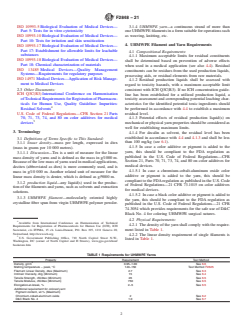
- Standardizes density, linear density (dtex), melting temperature, and intrinsic viscosity for UHMWPE yarns to ensure consistency and performance.
- Mechanical Properties:
- Specifies minimum tensile strength, tensile modulus, and elongation-at-break, establishing benchmarks for durability and suitability in medical applications.
- Biocompatibility Testing:
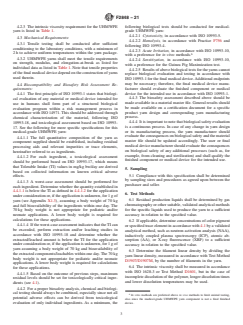
- Outlines required biosafety evaluations for cytotoxicity, hemolysis, irritation, and sensitization following ISO 10993 series standards.
- Emphasizes chemical characterization and toxicological risk management as part of a comprehensive biological evaluation process.
- Quality Assurance and Certification:
- Requires production under certified quality management systems (e.g., ISO 13485 or CFR 820).
- Documentation must include test results, manufacturing information, and traceability details.
Applications
Practical Uses for Medical-Grade UHMWPE Yarns:
- Sutures and Ligament Repair:
- UHMWPE yarns are widely used in high-strength surgical sutures and orthopedic ligament repair implants, offering wear resistance and high tensile properties.
- Medical Textiles and Braided Devices:
- These yarns are a critical component in braided medical textiles, meshes, and advanced wound closure systems where biocompatibility and mechanical strength are required.
- Device Component Manufacturing:
- Material certified to ASTM F2848-21 ensures consistent input for downstream manufacturing processes, including weaving, knitting, assembling, and device sterilization.
- Clinical Reliability:
- Compliance supports regulatory submissions and enhances patient safety by reducing the risk of adverse biological reactions.
- Global Trade and Regulatory Acceptance:
- Leveraging international consensus, this standard helps medical device producers gain acceptance in regulated markets worldwide.
Related Standards
Additional standards and references to support compliance:
- Referenced ASTM Standards:
- ASTM D792, D1505: Density
- ASTM D2256, D885: Tensile Properties
- ASTM D1907: Linear Density of Yarn
- ASTM F748, F2625: Physical and thermal properties
- ASTM F648: UHMWPE powder and forms for surgical implants
- ASTM F756: Hemolytic assessment
- International Standards:
- ISO 10993 series: Biological evaluation of medical devices (parts 1, 4, 5, 10, 17, 18)
- ISO 13485: Quality management for medical devices
- ISO 14971: Risk management in medical devices
- Regulatory Guidance:
- FDA 21 CFR Parts 70, 71, 73, 74, 80: Color additives for medical devices
- ICH Q3C(R3): Impurities – residual solvents
- Suggested Related Standard:
- ASTM F648 for UHMWPE powder and fabricated forms
Keywords: UHMWPE yarn, medical-grade polyethylene, ASTM F2848, surgical suture material, ligament fixation, biocompatibility, medical device component, medical textile, quality management, ISO 10993, ISO 13485.
Relations
- Effective Date
- 15-Mar-2024
- Effective Date
- 15-Mar-2020
- Effective Date
- 01-Jul-2018
- Effective Date
- 01-May-2018
- Effective Date
- 01-Jan-2018
- Effective Date
- 01-Mar-2017
- Effective Date
- 15-May-2014
- Effective Date
- 01-Dec-2013
- Effective Date
- 01-Jul-2013
- Effective Date
- 01-Aug-2012
- Effective Date
- 01-Jul-2012
- Effective Date
- 01-Dec-2010
- Effective Date
- 01-Dec-2010
- Effective Date
- 15-Sep-2010
- Refers
ASTM D1505-10 - Standard Test Method for Density of Plastics by the Density-Gradient Technique - Effective Date
- 01-Jul-2010
Buy Documents
ASTM F2848-21 - Standard Specification for Medical-Grade Ultra-High-Molecular-Weight Polyethylene Yarns
REDLINE ASTM F2848-21 - Standard Specification for Medical-Grade Ultra-High-Molecular-Weight Polyethylene Yarns
Get Certified
Connect with accredited certification bodies for this standard

BSI Group
BSI (British Standards Institution) is the business standards company that helps organizations make excellence a habit.

TÜV Rheinland
TÜV Rheinland is a leading international provider of technical services.

TÜV SÜD
TÜV SÜD is a trusted partner of choice for safety, security and sustainability solutions.
Sponsored listings
Frequently Asked Questions
ASTM F2848-21 is a technical specification published by ASTM International. Its full title is "Standard Specification for Medical-Grade Ultra-High-Molecular-Weight Polyethylene Yarns". This standard covers: ABSTRACT This specification describes the required properties and the procedures to be followed for testing ultra-high molecular weight polyethylene (UHMWPE) yarns intended for use in medical devices or components of medical devices, such as sutures and ligament fixations. UHMWPE filament and yarn requirements cover compositional requirements, physical requirements, mechanical requirements, and biocompatibility requirements. Residual production liquids shall be determined by gas chromatography or other suitable, validated analytical methods for the specific materials used to produce the yarn. SCOPE 1.1 This specification covers ultra-high-molecular-weight polyethylene (UHMWPE) yarns intended for use in medical devices or components of medical devices, such as sutures and ligament fixations. This specification covers natural (non-colored) and pigmented (colored) yarns. 1.2 This standard is intended to describe the requirements and the procedures to be followed for testing UHMWPE yarns as a component for medical devices prior to manufacturing processes of the medical device such as fabric formation, assembling, and sterilization. This specification does not purport to address the requirements for the finished medical devices or the testing that is needed for medical devices that are fabricated from the components specified herein. 1.3 The values stated in SI units are to be regarded as standard. No other units of measurement are included in this standard. 1.4 This standard does not purport to address all of the safety concerns, if any, associated with its use. It is the responsibility of the user of this standard to establish appropriate safety, health, and environmental practices and determine the applicability of regulatory limitations prior to use. 1.5 This international standard was developed in accordance with internationally recognized principles on standardization established in the Decision on Principles for the Development of International Standards, Guides and Recommendations issued by the World Trade Organization Technical Barriers to Trade (TBT) Committee.
ABSTRACT This specification describes the required properties and the procedures to be followed for testing ultra-high molecular weight polyethylene (UHMWPE) yarns intended for use in medical devices or components of medical devices, such as sutures and ligament fixations. UHMWPE filament and yarn requirements cover compositional requirements, physical requirements, mechanical requirements, and biocompatibility requirements. Residual production liquids shall be determined by gas chromatography or other suitable, validated analytical methods for the specific materials used to produce the yarn. SCOPE 1.1 This specification covers ultra-high-molecular-weight polyethylene (UHMWPE) yarns intended for use in medical devices or components of medical devices, such as sutures and ligament fixations. This specification covers natural (non-colored) and pigmented (colored) yarns. 1.2 This standard is intended to describe the requirements and the procedures to be followed for testing UHMWPE yarns as a component for medical devices prior to manufacturing processes of the medical device such as fabric formation, assembling, and sterilization. This specification does not purport to address the requirements for the finished medical devices or the testing that is needed for medical devices that are fabricated from the components specified herein. 1.3 The values stated in SI units are to be regarded as standard. No other units of measurement are included in this standard. 1.4 This standard does not purport to address all of the safety concerns, if any, associated with its use. It is the responsibility of the user of this standard to establish appropriate safety, health, and environmental practices and determine the applicability of regulatory limitations prior to use. 1.5 This international standard was developed in accordance with internationally recognized principles on standardization established in the Decision on Principles for the Development of International Standards, Guides and Recommendations issued by the World Trade Organization Technical Barriers to Trade (TBT) Committee.
ASTM F2848-21 is classified under the following ICS (International Classification for Standards) categories: 11.040.30 - Surgical instruments and materials; 83.080.20 - Thermoplastic materials. The ICS classification helps identify the subject area and facilitates finding related standards.
ASTM F2848-21 has the following relationships with other standards: It is inter standard links to ASTM F2625-24, ASTM E1131-20, ASTM D1907/D1907M-12(2018), ASTM D1601-18, ASTM D8171-18, ASTM F756-17, ASTM D885/D885M-10a(2014), ASTM F756-13, ASTM F648-13, ASTM D1601-12, ASTM D1907/D1907M-12, ASTM F2625-10, ASTM F648-10a, ASTM F648-10, ASTM D1505-10. Understanding these relationships helps ensure you are using the most current and applicable version of the standard.
ASTM F2848-21 is available in PDF format for immediate download after purchase. The document can be added to your cart and obtained through the secure checkout process. Digital delivery ensures instant access to the complete standard document.
Standards Content (Sample)
This international standard was developed in accordance with internationally recognized principles on standardization established in the Decision on Principles for the
Development of International Standards, Guides and Recommendations issued by the World Trade Organization Technical Barriers to Trade (TBT) Committee.
Designation:F2848 −21
Standard Specification for
Medical-Grade Ultra-High-Molecular-Weight Polyethylene
Yarns
This standard is issued under the fixed designation F2848; the number immediately following the designation indicates the year of
original adoption or, in the case of revision, the year of last revision. A number in parentheses indicates the year of last reapproval. A
superscript epsilon (´) indicates an editorial change since the last revision or reapproval.
1. Scope D792 Test Methods for Density and Specific Gravity (Rela-
tive Density) of Plastics by Displacement
1.1 This specification covers ultra-high-molecular-weight
D885/D885M Test Methods for Tire Cords, Tire Cord
polyethylene (UHMWPE) yarns intended for use in medical
Fabrics, and Industrial Filament Yarns Made from Manu-
devices or components of medical devices, such as sutures and
factured Organic-Base Fibers
ligament fixations. This specification covers natural (non-
D1505 Test Method for Density of Plastics by the Density-
colored) and pigmented (colored) yarns.
Gradient Technique
1.2 This standard is intended to describe the requirements
D1601 Test Method for Dilute Solution Viscosity of Ethyl-
and the procedures to be followed for testing UHMWPE yarns
ene Polymers
as a component for medical devices prior to manufacturing
D1907/D1907M Test Method for Linear Density of Yarn
processes of the medical device such as fabric formation,
(Yarn Number) by the Skein Method
assembling, and sterilization. This specification does not pur-
D2256/D2256M Test Method forTensile Properties ofYarns
port to address the requirements for the finished medical
by the Single-Strand Method
devicesorthetestingthatisneededformedicaldevicesthatare
D5630 Test Method for Ash Content in Plastics
fabricated from the components specified herein.
D8171 Test Methods for Density Determination of Flax
Fiber
1.3 The values stated in SI units are to be regarded as
standard. No other units of measurement are included in this E1131 Test Method for CompositionalAnalysis by Thermo-
gravimetry
standard.
F648 Specification for Ultra-High-Molecular-Weight Poly-
1.4 This standard does not purport to address all of the
ethylene Powder and Fabricated Form for Surgical Im-
safety concerns, if any, associated with its use. It is the
plants
responsibility of the user of this standard to establish appro-
F756 Practice for Assessment of Hemolytic Properties of
priate safety, health, and environmental practices and deter-
Materials
mine the applicability of regulatory limitations prior to use.
F2625 Test Method for Measurement of Enthalpy of Fusion,
1.5 This international standard was developed in accor-
Percent Crystallinity, and Melting Point of Ultra-High-
dance with internationally recognized principles on standard-
Molecular Weight Polyethylene by Means of Differential
ization established in the Decision on Principles for the
Scanning Calorimetry
Development of International Standards, Guides and Recom-
mendations issued by the World Trade Organization Technical 2.2 ISO Standards:
ISO 1628-3 Plastics—Determination of the Viscosity of
Barriers to Trade (TBT) Committee.
Polymers in Dilute Solution Using Capillary
Viscometers—Part 3: Polyethylenes and Polypropylenes
2. Referenced Documents
2 ISO 2062 Textiles—Yarns from Packages—Determination
2.1 ASTM Standards:
of Single-end Breaking Force and Elongation at Break
ISO 10993-1 Biological Evaluation of Medical Devices—
Part 1: Evaluation and testing within a risk management
This specification is under the jurisdiction of ASTM Committee F04 on
processs
Medical and Surgical Materials and Devices and is the direct responsibility of
ISO 10993-4 Biological Evaluation of Medical Devices—
Subcommittee F04.11 on Polymeric Materials.
Current edition approved June 1, 2021. Published June 2021. Originally Part 4: Selection of tests for interactions with blood
approved in 2010. Last previous edition approved in 2017 as F2848 – 17. DOI:
10.1520/F2848-21.
For referenced ASTM standards, visit the ASTM website, www.astm.org, or
contact ASTM Customer Service at service@astm.org. For Annual Book of ASTM Available from International Organization for Standardization (ISO), 1, ch. de
Standards volume information, refer to the standard’s Document Summary page on la Voie-Creuse, Case postale 56, CH-1211, Geneva 20, Switzerland, http://
the ASTM website. www.iso.ch.
Copyright © ASTM International, 100 Barr Harbor Drive, PO Box C700, West Conshohocken, PA 19428-2959. United States
F2848−21
ISO 10993-5 Biological Evaluation of Medical Devices— 3.1.4 UHMWPE yarn—a continuous strand of more than
Part 5: Tests for in vitro cytotoxicity one UHMWPE filaments in a form suitable for operations such
ISO 10993-10 Biological Evaluation of Medical Devices— as weaving, knitting, etc.
Part 10: Tests for irritation and skin sensitization
4. UHMWPE Filament and Yarn Requirements
ISO 10993-17 Biological Evaluation of Medical Devices—
Part 17: Establishment for allowable limits for leachable
4.1 Compositional Requirements:
substances
4.1.1 Maximum acceptable limits for residual constituents
ISO 10993-18 Biological Evaluation of Medical Devices—
shall be determined based on prevention of adverse effects
Part 18: Chemical characterization of materials
when used in a medical application (see also 4.4). Residual
ISO 13485 Medical Devices—Quality Management
constituents can be residues from the used production liquids,
Systems—Requirements for regulatory purposes
processing aids, or residual elements from raw materials.
ISO 14971 Medical Devices—Application of Risk Manage-
4.1.2 Residual production liquids shall be assessed with
ment to Medical Devices
regard to toxicity hazards, with a maximum acceptable limit
2.3 Other Documents: consistent with ICH Q3C(R3). If no ICH concentration guide-
ICH Q3C(R3) International Conference on Harmonisation
line has been established for a utilized production liquid, a
ofTechnicalRequirementsforRegistrationofPharmaceu- toxicity assessment and corresponding potential leaching char-
ticals for Human Use, Quality Guideline: Impurities:
acteristics for the identified potential toxic ingredients should
Residual Solvents be performed in accordance with 4.4 to establish a maximum
U.S. Code of Federal Regulations—CFR Section 21 Parts residual level.
70, 71, 73, 74, and 80 on color additives for medical 4.1.3 Potential effects of residual production liquid(s) on
devices mechanicalorphysicalyarnpropertiesshouldbeconsideredas
well for establishing maximum limits.
3. Terminology
4.1.4 For decalin as solvent, the residual level has been
established in accordance with 4.4 and 4.1.3 and shall be less
3.1 Definitions of Terms Specific to This Standard:
than 100 mg/kg (see 6.1).
3.1.1 linear density—mass per length, expressed in dtex
4.1.5 In case a color additive or pigment is added to the
(mass in grams per 10 000 metres).
yarn, this should be compliant to the FDA regulation as
3.1.1.1 Discussion—Tex is a unit of measure for the linear
published in the U.S. Code of Federal Regulations—CFR
mass density of yarns and is defined as the mass in g/1000 m.
Section 21, Parts 70, 71, 73, 74, and 80 on color additives for
Because of the low mass of yarns used in medical applications,
medical devices.
decitex (abbreviated as dtex) is more commonly used, and is
4.1.5.1 In case a chromium-cobalt-aluminum oxide color
mass in g/10 000 m. Another related unit of measure for the
additive or pigment is added to the yarn, this should be
linear mass density is denier, which is defined as g/9000 m.
compliant to the FDAregulation as published in the U.S. Code
3.1.2 production liquid—any liquid(s) used in the produc-
of Federal Regulations—21 CFR 73.1015 on color additives
tion of the filaments and yarns, such as solvents and extraction
for medical devices.
solutions.
4.1.5.2 In case a black color additive or pigment is added to
3.1.3 UHMWPE filament—molecularly oriented highly
the yarn, this should be compliant to the FDA regulation as
crystalline fiber spun from virgin UHMWPE polymer powder.
published in the U.S. Code of Federal Regulations—21 CFR
74.3054 which provides requirements for the safe use of D&C
Black No. 4 for coloring UHMWPE surgical sutures.
4.2 Physical Requirements:
Available from International Conference on Harmonisation of Technical
4.2.1 The density of the yarn shall comply with the require-
Requirements for Registration of Pharmaceuticals for Human Use (ICH), ICH
Secretariat, c/o IFPMA, 15 ch. Louis-Dunant, P.O. Box 195, 1211 Geneva 20, ment listed in Table 1.
Switzerland, http://www.ich.org.
4.2.2 The linear density requirement of single filaments is
U.S. Government Publishing Office, 710 North Capitol Street N.W.,
listed in Table 1.
Washington, DC (corner of North Capitol and H Streets), www.gpo.gov/about/
bookstore.htm
TABLE 1 Requirements for UHMWPE Yarns
Property Requirement Test Method
Density, g/cm 0.95–1.00 See 6.6
Melting temperature – peak, °C 140–150 Test Method F2625
Filament Linear Density, dtex (Maximum) 2.7 See 6.3
Intrinsic Viscosity, dl/g (Minimum) 15 See 6.4
Tensile Strength, cN/dtex (Minimum) 26 See 6.5
Tensile Modulus, cN/dtex (Minimum) 750 See 6.5
Elongation-at-break, % 2–5 See 6.5
Additional requirement for colored yarn:
Pigment content, wt.% (Maximum)
Chromium-cobalt-aluminum oxide 2 See 6.2
D&C Black No. 4 1.0 See 6.7
F2848−21
4.2.3 The intrinsic viscosity requirement for the UHMWPE following biological tests should be conducted for medical-
yarn is listed in Table 1. grade UHMWPE yarn:
4.4.2.1 Cytotoxicity, in accordance with ISO 10993-5.
4.3 Mechanical Requirements:
4.4.2.2 Hemolysis, in accordance with Practice F756 and
4.3.1 Tensile testing shall be conducted after sufficient
following ISO 10993-4.
conditioning to the laboratory conditions, with a minimum of
4.4.2.3 Acute Irritation, in accordance with ISO 10993-10,
2 h to achieve uniform temperatures within the yarn package.
with a preference for in vitro methods.
4.3.2 UHMWPE yarns shall meet the tensile requirements
4.4.2.4 Sensitization, in accordance with ISO 10993-10,
on strength, modulus, and elongation-at-break as listed for
with a preference for the Guinea Pig Maximization test.
individual data as listed in Table 1. Note that tensile properties
4.4.2.5 Resultsofabovebiologicaltestsfortheyarnscannot
of the final medical device depend on the construction of yarns
replace biological evaluation and testing in accordance with
used therein.
ISO 10993-1 for the final medical device.Additional endpoints
may be necessary; therefore, the final medical device manu-
4.4 Biocompatibility and Biosafety Risk Assessment Re-
facturer should evaluate the finished component or medical
quirements:
device for the intended use in accordance with ISO 10993-1.
4.4.1 The first principle of ISO 10993-1 states that biologi-
4.4.3 The biosafety assessment described above should be
cal evaluation of any material or medical device intended for
made available in a material master file. General results should
use in humans shall form part of a structured biological
be made available on a certification document for a specific
evaluation program within a risk management process in
product yarn design and corresponding yarn manufacturing
accordance with ISO 14971. This should be addressed through
process.
chemical characterization of the material, following ISO
4.4.4 It is important to note that biological safety evaluation
10993-18, and toxicological assessment based on ISO 10993-
is a continuous process. In case of any change in yarn design
17. See the following for more specific specifications for this
or its manufacturing process, the yarn manufacturer should
medical-grade UHMWPE yarn:
evaluatetheconsequencesonbiologicalsafetyandthematerial
4.4.1.1 The full quantitative composition of the yarn as
master file should be updated accordingly. The user or final
component supplied should be established, including residual
medicaldevicemanufacturershouldevaluatetheconsequences
processing aids and relevant impurities or trace elements,
on biological safety of any additional processes (such as, for
hereinafter referred to as ingredients.
example, from cleaning and sterilization) and shall qualify the
4.4.1.2 For each ingredient, a toxicological assessment
finished component or medical device for the intended use.
should be performed based on ISO 10993-17, which means
that Tolerable Intake (TI) values in mg/kg bw/day are derived
5. Sampling
based on collected information on known critical adverse
5.1 Compliance with this specification shall be determined
effects.
by sampling sizes and procedures as agreed upon between the
4.4.1.3 A worst-case assessment should be performed for
purchaser and seller.
each ingredient. Determine whether the quantity establi
...
This document is not an ASTM standard and is intended only to provide the user of an ASTM standard an indication of what changes have been made to the previous version. Because
it may not be technically possible to adequately depict all changes accurately, ASTM recommends that users consult prior editions as appropriate. In all cases only the current version
of the standard as published by ASTM is to be considered the official document.
Designation: F2848 − 17 F2848 − 21
Standard Specification for
Medical-Grade Ultra-High Molecular Weight Ultra-High-
Molecular-Weight Polyethylene Yarns
This standard is issued under the fixed designation F2848; the number immediately following the designation indicates the year of
original adoption or, in the case of revision, the year of last revision. A number in parentheses indicates the year of last reapproval. A
superscript epsilon (´) indicates an editorial change since the last revision or reapproval.
1. Scope
1.1 This specification covers ultra-high molecular weight ultra-high-molecular-weight polyethylene (UHMWPE) yarns intended
for use in medical devices or components of medical devices, such as sutures and ligament fixations. This specification covers
natural (non-colored) and pigmented (colored) yarns.
1.2 This standard is intended to describe the requirements and the procedures to be followed for testing UHMWPE yarns as a
component for medical devices prior to manufacturing processes of the medical device such as fabric formation, assembling, and
sterilization. This specification does not purport to address the requirements for the finished medical devices or the testing that is
needed for medical devices that are fabricated from the components specified herein.
1.3 The values stated in SI units are to be regarded as standard. No other units of measurement are included in this standard.
1.4 This standard does not purport to address all of the safety concerns, if any, associated with its use. It is the responsibility of
the user of this standard to establish appropriate safety and health practices and determine the applicability of regulatory
limitations prior to use.
1.4 This standard does not purport to address all of the safety concerns, if any, associated with its use. It is the responsibility
of the user of this standard to establish appropriate safety, health, and environmental practices and determine the applicability of
regulatory limitations prior to use.
1.5 This international standard was developed in accordance with internationally recognized principles on standardization
established in the Decision on Principles for the Development of International Standards, Guides and Recommendations issued
by the World Trade Organization Technical Barriers to Trade (TBT) Committee.
2. Referenced Documents
2.1 ASTM Standards:
D792 Test Methods for Density and Specific Gravity (Relative Density) of Plastics by Displacement
D885/D885M Test Methods for Tire Cords, Tire Cord Fabrics, and Industrial Filament Yarns Made from Manufactured
Organic-Base Fibers
D1505 Test Method for Density of Plastics by the Density-Gradient Technique
D1601 Test Method for Dilute Solution Viscosity of Ethylene Polymers
This specification is under the jurisdiction of ASTM Committee F04 on Medical and Surgical Materials and Devices and is the direct responsibility of Subcommittee
F04.11 on Polymeric Materials.
Current edition approved May 1, 2017June 1, 2021. Published July 2017June 2021. Originally approved in 2010. Last previous edition approved in 20162017 as
F2848F2848 – 17.–16. DOI: 10.1520/F2848–17.10.1520/F2848-21.
For referenced ASTM standards, visit the ASTM website, www.astm.org, or contact ASTM Customer Service at service@astm.org. For Annual Book of ASTM Standards
volume information, refer to the standard’s Document Summary page on the ASTM website.
Copyright © ASTM International, 100 Barr Harbor Drive, PO Box C700, West Conshohocken, PA 19428-2959. United States
F2848 − 21
TABLE 1 Requirements for UHMWPE Yarns
Property Test Method Requirement
Property Requirement Test Method
Density, g/cm Test Methods D792 or D1505 0.95 - 1.00
Density, g/cm 0.95–1.00 See 6.6
Melting temperature – peak, °C Test Method F2625 140 - 150
Melting temperature – peak, °C 140–150 Test Method F2625
Filament Linear Density, dtex (Maximum) 6.3 2.7
Filament Linear Density, dtex (Maximum) 2.7 See 6.3
Intrinsic Viscosity, dl/g (Minimum) 6.4 15
Intrinsic Viscosity, dl/g (Minimum) 15 See 6.4
Tensile Strength, cN/dtex (Minimum) 6.5 26
Tensile Strength, cN/dtex (Minimum) 26 See 6.5
Tensile Modulus, cN/dtex (Minimum) 6.5 750
Tensile Modulus, cN/dtex (Minimum) 750 See 6.5
Elongation-at-break, % 6.5 2 - 5
Elongation-at-break, % 2–5 See 6.5
Additional requirement for colored yarn:
Pigment content, wt.% (Maximum) 2
Chromium-cobalt-aluminum oxide 6.2
Pigment content, wt.% (Maximum)
Chromium-cobalt-aluminum oxide 2 See 6.2
D&C Black No. 4 1.0 See 6.7
D1907/D1907M Test Method for Linear Density of Yarn (Yarn Number) by the Skein Method
D2256/D2256M Test Method for Tensile Properties of Yarns by the Single-Strand Method
D5630 Test Method for Ash Content in Plastics
F748D8171 Practice for Selecting Generic Biological Test Methods for Materials and DevicesDensity Determination of Flax
Fiber
E1131 Test Method for Compositional Analysis by Thermogravimetry
F648 Specification for Ultra-High-Molecular-Weight Polyethylene Powder and Fabricated Form for Surgical Implants
F756 Practice for Assessment of Hemolytic Properties of Materials
F2625 Test Method for Measurement of Enthalpy of Fusion, Percent Crystallinity, and Melting Point of Ultra-High-Molecular
Weight Polyethylene by Means of Differential Scanning Calorimetry
2.2 ISO Standards:
ISO 1628-3 Plastics—Determination of the Viscosity of Polymers in Dilute Solution Using Capillary Viscometers—Part 3:
Polyethylenes and Polypropylenes
ISO 2062 Textiles—Yarns from Packages—Determination of Single-end Breaking Force and Elongation at Break
ISO 10993-1 Biological Evaluation of Medical Devices Part 1 – Devices—Part 1: Evaluation and testing within a risk
management processs
ISO 10993-4 Biological Evaluation of Medical Devices Part 4 – Devices—Part 4: Selection of tests for interactions with blood
ISO 10993-5 Biological Evaluation of Medical Devices Part 5 – Devices—Part 5: Tests for in vitro cytotoxicity
ISO 10993-10 Biological Evaluation of Medical Devices – Part Devices—Part 10: Tests for irritation and skin sensitization
ISO 10993-17 Biological Evaluation of Medical Devices Part 17 – Devices—Part 17: Establishment for allowable limits for
leachable substances
ISO 810993-18 Biological Evaluation of Medical Devices Part 18 – Devices—Part 18: Chemical characterization of materials
ISO 13485 Medical Devices – Quality Management Systems – Requirements Devices—Quality Management Systems—
Requirements for regulatory purposes
ISO 14971 Medical Devices – Application of risk managementDevices—Application of Risk Management to Medical Devices
2.3 Other Documents:
ICH Q3C(R3) International Conference on Harmonisation of Technical Requirements for Registration of Pharmaceuticals for
Human Use, Quality Guideline: Impurities: Residual Solvents
USU.S. Code of Federal Regulations—CFR sectionSection 21 Parts 70, 71, 73, 74, and 80 on color additives for medical
devices
3. Terminology
3.1 Definitions of Terms Specific to This Standard:
Available from International Organization for Standardization (ISO), 1, ch. de la Voie-Creuse, Case postale 56, CH-1211, Geneva 20, Switzerland, http://www.iso.ch.
Available from International Conference on Harmonisation of Technical Requirements for Registration of Pharmaceuticals for Human Use (ICH), ICH Secretariat, c/o
IFPMA, 15 ch. Louis-Dunant, P.O. Box 195, 1211 Geneva 20, Switzerland, http://www.ich.org.
U.S. Government Publishing Office, 710 North Capitol Street N.W., Washington, DC (corner of North Capitol and H Streets), www.gpo.gov/about/bookstore.htm
F2848 − 21
3.1.1 UHMWPE filament—molecularly oriented highly crystalline fiber spun from virgin UHMWPE polymer powder.
3.1.2 UHMWPE yarn—a continuous strand of more than one UHMWPE filaments in a form suitable for operations such as
weaving, knitting, etc.
3.1.1 linear density—mass per length, expressed in dtex (mass in grams per 10 000 metres).
3.1.1.1 Discussion—
Tex is a unit of measure for the linear mass density of yarns and is defined as the mass in g/1000 m. Because of the low mass of
yarns used in medical applications, decitex (abbreviated as dtex) is more commonly used, and is mass in g/10 000 m. Another
related unit of measure for the linear mass density is denier, which is defined as g/9000 m.
3.1.2 production liquid—any liquid(s) used in the production of the filaments and yarns, such as solvents and extraction solutions.
3.1.3 UHMWPE filament—molecularly oriented highly crystalline fiber spun from virgin UHMWPE polymer powder.
3.1.4 UHMWPE yarn—a continuous strand of more than one UHMWPE filaments in a form suitable for operations such as
weaving, knitting, etc.
4. UHMWPE Filament and Yarn Requirements
4.1 Compositional Requirements:
4.1.1 Maximum acceptable limits for residual constituents shall be determined based on prevention of adverse effects when used
in a medical application (see also 4.4). Residual constituents can be residues from the used production liquids, processing aids,
or residual elements from raw materials.
4.1.2 Residual production liquids shall be assessed with regard to toxicity hazards, with a maximum acceptable limit consistent
with ICH Q3C(R3). If no ICH concentration guideline has been established for a utilized production liquid, a toxicity assessment
and corresponding potential leaching characteristics for the identified potential toxic ingredients should be performed in
accordance with 4.4 to establish a maximum residual level.
4.1.3 Potential effects of residual production liquid(s) on mechanical or physical yarn properties should be considered as well for
establishing maximum limits.
4.1.4 For decalin as solvent, the residual level has been established in accordance with 4.4 and 4.1.3 and shall be less than 100
mg/kg (see 6.1).
4.1.5 In case a color additive or pigment is added to the yarn, this should be compliant to the FDA regulation as published in the
USU.S. Code of Federal Regulations - CFR section 21, partsRegulations—CFR Section 21, Parts 70, 71, 73, 74, and 80 on color
additives for medical devices.
4.1.5.1 In case a chromium-cobalt-aluminum oxide color additive or pigment is added to the yarn, this should be compliant to the
FDA regulation as published in the U.S. Code of Federal Regulations—21 CFR 73.1015 on color additives for medical devices.
4.1.5.2 In case a black color additive or pigment is added to the yarn, this should be compliant to the FDA regulation as published
in the U.S. Code of Federal Regulations—21 CFR 74.3054 which provides requirements for the safe use of D&C Black No. 4 for
coloring UHMWPE surgical sutures.
4.2 Physical Requirements:
4.2.1 The density of the yarn shall comply with the requirement listed in Table 1.
4.2.2 The linear density requirement of single filaments is listed in Table 1.
4.2.3 The intrinsic viscosity requirement for the UHMWPE yarn is listed in Table 1.
F2848 − 21
4.3 Mechanical Requirements:
4.3.1 Tensile testing shall be conducted after sufficient conditioning to the laboratory conditions, with a minimum of 2 h 2 h to
achieve uniform temperatures within the yarn package.
4.3.2 UHMWPE yarns shall meet the tensile requirements on strength, modulus, and elongation-at-break as listed for individual
data as listed in Table 1. Note that tensile properties of the final medical device depend on the construction of yarns used therein.
4.4 Biocompatibility and Biosafety Risk Assessment Requirements:
4.4.1 The first principle of ISO 10993-1 states that biological evaluation of any material or medical device intended for use in
humans shall form part of a structured biological evaluation program within a risk management process in accordance with ISO
14971. This should be addressed through chemical characterization of the material, following ISO 10993-18, and toxicological
assessment based on ISO 10993-17. See the following for more specific specifications for this medical-grade UHMWPE yarn:
4.4.1.1 The full quantitative composition of the yarn as component supplied should be established, including residual processing
aids and relevant impurities or trace elements;elements, hereinafter referred to as ingredients.
4.4.1.2 For each ingredient, a toxicological assessment should be performed based on ISO 10993-17, which means that Tolerable
Intake (TI) values in mg/kg bw/day are derived based on collected information on known critical adverse effects.
4.4.1.3 A worst-case assessment should be performed for each ingredient. Determine whether the quantity established in 4.4.1.1
is below the TI as defined in 4.4.1.2 for the application under consideration or, if the application is unknown, for 1 g of yarn (see
Appendix X1.3), assuming a body weight of 70 kg and full bioavailability of the ingredients within 1one day. The 70 kg 70 kg
body weight is not appropriate for pediatric and/or neonate applications. A lower body weight is required for calculations for these
applications.
4.4.1.4 If the worst-case assessment indicates that the TI can be exceeded, perform extraction and/or leaching studies in
accordance with ISO 10993–1810993-18 and determine whether the extracted/leached amount is below the TI for the application
under consideration or, if the application is unknown, for 1 g of yarn assuming a body weight of 70 kg and bioavailability of the
extracted components/leachables within 1one day. The 70 kg 70 kg body weight is not appropriate for pediatric and/or neonate
applications. A lower body weight is required for calculations for these applications.
4.4.1.5 Based on the outcome of previous steps, maximum residual levels should be set for toxicologically critical ingredients (see
4.1).
4.4.2 For a proper biosafety analysis, chemical and biological testing should always be combined, especially since not all potential
a
...