

ASTM E1980-11(2019)
(Practice)Standard Practice for Calculating Solar Reflectance Index of Horizontal and Low-Sloped Opaque Surfaces
General Information
- Abstract
SIGNIFICANCE AND USE
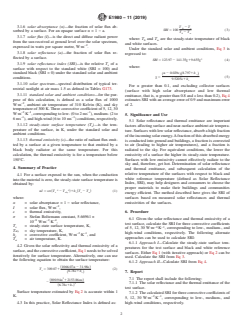
5.1 Solar reflectance and thermal emittance are important factors affecting surface and near-surface ambient air temperature. Surfaces with low solar reflectance, absorb a high fraction of the incoming solar energy. A fraction of this absorbed energy is conducted into ground and buildings, a fraction is convected to air (leading to higher air temperatures), and a fraction is radiated to the sky. For equivalent conditions, the lower the emissivity of a surface the higher its steady-state temperature. Surfaces with low emissivity cannot effectively radiate to the sky and, therefore, get hot. Determination of solar reflectance and thermal emittance, and subsequent calculation of the relative temperature of the surfaces with respect to black and white reference temperature (defined as Solar Reflectance Index, SRI), may help designers and consumers to choose the proper materials to make their buildings and communities energy efficient. The method described here gives the SRI of surfaces based on measured solar reflectances and thermal emissivities of the surfaces.
SCOPE
1.1 This practice covers the calculation of the Solar Reflectance Index (SRI) of horizontal and low-sloped opaque surfaces at standard conditions. The method is intended to calculate SRI for surfaces with emissivity greater than 0.1.
1.2 The values stated in SI units are to be regarded as standard. No other units of measurement are included in this standard.
1.3 This standard does not purport to address all of the safety concerns, if any, associated with its use. It is the responsibility of the user of this standard to establish appropriate safety, health, and environmental practices and determine the applicability of regulatory limitations prior to use.
1.4 This international standard was developed in accordance with internationally recognized principles on standardization established in the Decision on Principles for the Development of International Standards, Guides and Recommendations issued by the World Trade Organization Technical Barriers to Trade (TBT) Committee.
- Status
- Published
- Publication Date
- 31-Jul-2019
- Technical Committee
- D08 - Roofing and Waterproofing
- Drafting Committee
- D08.20 - Roofing Membrane Systems


Overview
ASTM E1980-11(2019): Standard Practice for Calculating Solar Reflectance Index of Horizontal and Low-Sloped Opaque Surfaces provides a reliable method to determine the Solar Reflectance Index (SRI) for building materials. This standard supports architects, engineers, and product manufacturers in evaluating and reporting the thermal performance of roof and pavement surfaces. By quantifying the SRI, users can compare how different surfaces reflect solar energy and radiate heat, enabling informed choices that contribute to energy efficiency and the mitigation of heat island effects.
The scope of ASTM E1980-11(2019) is limited to horizontal and low-sloped opaque surfaces (those with a slope less than 9.5 degrees) and materials with an emissivity greater than 0.1. The SRI calculation is based on measured solar reflectance and thermal emittance under standardized environmental conditions.
Key Topics
- Solar Reflectance: The proportion of the incident solar energy that a given surface reflects. Surfaces with high solar reflectance remain cooler under sunlight.
- Thermal Emittance: The effectiveness of a surface in emitting absorbed heat. Materials with high thermal emittance more effectively release heat energy to the environment.
- Solar Reflectance Index (SRI): A normalized index (from 0 for standard black to 100 for standard white) expressing a material’s ability to reject solar heat. SRI integrates both solar reflectance and thermal emittance under specified conditions.
- Standardized Environmental Conditions: All calculations use stated SI units and defined solar flux, ambient air temperature, and sky temperature for consistency and comparability.
- Material and Environmental Parameters: SRI varies according to surface properties (solar reflectance, thermal emissivity) and environmental factors (solar flux, wind speed, ambient and sky temperature).
- Application Procedures: The standard outlines methods for calculating the SRI using either iterative or direct mathematical approaches for different wind conditions (low, medium, high).
Applications
The ASTM E1980-11(2019) standard has broad applicability in sustainable building design and urban planning:
- Cool Roofing and Pavement Selection: SRI supports the specification and selection of roofing and paving materials that help maintain lower surface and ambient air temperatures.
- Building Codes and Green Certifications: Regulatory agencies and sustainability programs may reference SRI values to establish compliance for energy efficiency, LEED, or green building certifications.
- Urban Heat Island Mitigation: By choosing high-SRI materials, cities can reduce surface temperatures, lower cooling energy demand, and improve outdoor thermal comfort.
- Material Development and Testing: Manufacturers utilize SRI data to innovate and validate products designed for thermal performance in hot and sunny climates.
- Building Energy Modeling: SRI assists building professionals in estimating the impact of envelope materials on cooling loads and HVAC sizing.
Related Standards
Professionals working with the Solar Reflectance Index should consult associated ASTM standards for measurement and terminology consistency:
- ASTM E408: Test methods for measuring the total normal emittance of surfaces.
- ASTM E903: Test method for solar absorptance, reflectance, and transmittance using integrating spheres.
- ASTM E1918: Test method for field measurement of solar reflectance on horizontal and low-sloped surfaces.
- ASTM G173: Reference tables for solar spectral irradiances.
Conclusion
Implementing ASTM E1980-11(2019) for calculating the Solar Reflectance Index fosters data-driven decisions in construction and urban development. Using SRI values, designers, contractors, and policymakers can select appropriate surface materials that enhance energy efficiency, reduce environmental heat gain, and support sustainable objectives in today’s built environment.
Relations
- Effective Date
- 01-Jun-2008
- Effective Date
- 10-Jan-2003
Get Certified
Connect with accredited certification bodies for this standard

BSMI (Bureau of Standards, Metrology and Inspection)
Taiwan's standards and inspection authority.
Sponsored listings
Frequently Asked Questions
ASTM E1980-11(2019) is a standard published by ASTM International. Its full title is "Standard Practice for Calculating Solar Reflectance Index of Horizontal and Low-Sloped Opaque Surfaces". This standard covers: SIGNIFICANCE AND USE 5.1 Solar reflectance and thermal emittance are important factors affecting surface and near-surface ambient air temperature. Surfaces with low solar reflectance, absorb a high fraction of the incoming solar energy. A fraction of this absorbed energy is conducted into ground and buildings, a fraction is convected to air (leading to higher air temperatures), and a fraction is radiated to the sky. For equivalent conditions, the lower the emissivity of a surface the higher its steady-state temperature. Surfaces with low emissivity cannot effectively radiate to the sky and, therefore, get hot. Determination of solar reflectance and thermal emittance, and subsequent calculation of the relative temperature of the surfaces with respect to black and white reference temperature (defined as Solar Reflectance Index, SRI), may help designers and consumers to choose the proper materials to make their buildings and communities energy efficient. The method described here gives the SRI of surfaces based on measured solar reflectances and thermal emissivities of the surfaces. SCOPE 1.1 This practice covers the calculation of the Solar Reflectance Index (SRI) of horizontal and low-sloped opaque surfaces at standard conditions. The method is intended to calculate SRI for surfaces with emissivity greater than 0.1. 1.2 The values stated in SI units are to be regarded as standard. No other units of measurement are included in this standard. 1.3 This standard does not purport to address all of the safety concerns, if any, associated with its use. It is the responsibility of the user of this standard to establish appropriate safety, health, and environmental practices and determine the applicability of regulatory limitations prior to use. 1.4 This international standard was developed in accordance with internationally recognized principles on standardization established in the Decision on Principles for the Development of International Standards, Guides and Recommendations issued by the World Trade Organization Technical Barriers to Trade (TBT) Committee.
SIGNIFICANCE AND USE 5.1 Solar reflectance and thermal emittance are important factors affecting surface and near-surface ambient air temperature. Surfaces with low solar reflectance, absorb a high fraction of the incoming solar energy. A fraction of this absorbed energy is conducted into ground and buildings, a fraction is convected to air (leading to higher air temperatures), and a fraction is radiated to the sky. For equivalent conditions, the lower the emissivity of a surface the higher its steady-state temperature. Surfaces with low emissivity cannot effectively radiate to the sky and, therefore, get hot. Determination of solar reflectance and thermal emittance, and subsequent calculation of the relative temperature of the surfaces with respect to black and white reference temperature (defined as Solar Reflectance Index, SRI), may help designers and consumers to choose the proper materials to make their buildings and communities energy efficient. The method described here gives the SRI of surfaces based on measured solar reflectances and thermal emissivities of the surfaces. SCOPE 1.1 This practice covers the calculation of the Solar Reflectance Index (SRI) of horizontal and low-sloped opaque surfaces at standard conditions. The method is intended to calculate SRI for surfaces with emissivity greater than 0.1. 1.2 The values stated in SI units are to be regarded as standard. No other units of measurement are included in this standard. 1.3 This standard does not purport to address all of the safety concerns, if any, associated with its use. It is the responsibility of the user of this standard to establish appropriate safety, health, and environmental practices and determine the applicability of regulatory limitations prior to use. 1.4 This international standard was developed in accordance with internationally recognized principles on standardization established in the Decision on Principles for the Development of International Standards, Guides and Recommendations issued by the World Trade Organization Technical Barriers to Trade (TBT) Committee.
ASTM E1980-11(2019) is classified under the following ICS (International Classification for Standards) categories: 17.180.20 - Colours and measurement of light. The ICS classification helps identify the subject area and facilitates finding related standards.
ASTM E1980-11(2019) has the following relationships with other standards: It is inter standard links to ASTM G173-03(2008), ASTM G173-03e1. Understanding these relationships helps ensure you are using the most current and applicable version of the standard.
ASTM E1980-11(2019) is available in PDF format for immediate download after purchase. The document can be added to your cart and obtained through the secure checkout process. Digital delivery ensures instant access to the complete standard document.
Standards Content (Sample)
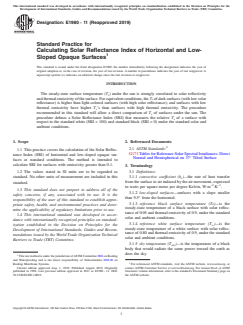
This international standard was developed in accordance with internationally recognized principles on standardization established in the Decision on Principles for the
Development of International Standards, Guides and Recommendations issued by the World Trade Organization Technical Barriers to Trade (TBT) Committee.
Designation: E1980 − 11 (Reapproved 2019)
Standard Practice for
Calculating Solar Reflectance Index of Horizontal and Low-
Sloped Opaque Surfaces
This standard is issued under the fixed designation E1980; the number immediately following the designation indicates the year of
original adoption or, in the case of revision, the year of last revision. A number in parentheses indicates the year of last reapproval. A
superscript epsilon (´) indicates an editorial change since the last revision or reapproval.
INTRODUCTION
The steady-state surface temperature (T ) under the sun is strongly correlated to solar reflectivity
s
and thermal emissivity of the surface. For equivalent conditions, the T of dark surfaces (with low solar
s
reflectance) is higher than light-colored surfaces (with high solar reflectance); and surfaces with low
thermal emissivity have higher T ’s than surfaces with high thermal emissivity. The procedure
s
recommended in this standard will allow a direct comparison of T of surfaces under the sun. The
s
procedure defines a Solar Reflectance Index (SRI) that measures the relative T of a surface with
s
respect to the standard white (SRI = 100) and standard black (SRI = 0) under the standard solar and
ambient conditions.
1. Scope 2. Referenced Documents
2.1 ASTM Standards:
1.1 This practice covers the calculation of the Solar Reflec-
G173 Tables for Reference Solar Spectral Irradiances: Direct
tance Index (SRI) of horizontal and low-sloped opaque sur-
Normal and Hemispherical on 37° Tilted Surface
faces at standard conditions. The method is intended to
calculate SRI for surfaces with emissivity greater than 0.1.
3. Terminology
1.2 The values stated in SI units are to be regarded as 3.1 Definitions:
3.1.1 convective coeffıcient (h )—the rate of heat transfer
standard. No other units of measurement are included in this
c
from the surface to air induced by the air movement, expressed
standard.
–2 –1
in watts per square metre per degree Kelvin, W·m ·K .
1.3 This standard does not purport to address all of the
3.1.2 low-sloped surfaces—surfaces with a slope smaller
safety concerns, if any, associated with its use. It is the
than 9.5° from the horizontal.
responsibility of the user of this standard to establish appro-
3.1.3 reference black surface temperature (T )—is the
priate safety, health, and environmental practices and deter- b
steady-state temperature of a black surface with solar reflec-
mine the applicability of regulatory limitations prior to use.
tance of 0.05 and thermal emissivity of 0.9, under the standard
1.4 This international standard was developed in accor-
solar and ambient conditions.
dance with internationally recognized principles on standard-
3.1.4 reference white surface temperature (T )—is the
w
ization established in the Decision on Principles for the
steady-state temperature of a white surface with solar reflec-
Development of International Standards, Guides and Recom-
tance of 0.80 and thermal emissivity of 0.9, under the standard
mendations issued by the World Trade Organization Technical
solar and ambient conditions.
Barriers to Trade (TBT) Committee.
3.1.5 sky temperature (T )—is the temperature of a black
sky
body that would radiate the same power toward the earth as
does the sky.
This test method is under the jurisdiction of ASTM Committee D08 on Roofing
and Waterproofing and is the direct responsibility of Subcommittee D08.20 on
Roofing Membrane Systems. For referenced ASTM standards, visit the ASTM website, www.astm.org, or
Current edition approved Aug. 1, 2019. Published August 2019. Originally contact ASTM Customer Service at service@astm.org. For Annual Book of ASTM
published in 1998. Last previous edition approved in 2011 as E1980 – 11. DOI: Standards volume information, refer to the standard’s Document Summary page on
10.1520/E1980-11R19.
the ASTM website.
Copyright © ASTM International, 100 Barr Harbor Drive, PO Box C700, West Conshohocken, PA 19428-2959. United States
E1980 − 11 (2019)
3.1.6 solar absorptance (α)—the fraction of solar flux ab- T 2 T
b s
SRI 5 100 (3)
sorbed by a surface. For an opaque surface α = 1 − a.
T 2 T
b w
3.1.7 solar flux (I)—is the direct and diffuse radiant power
where: T and T are the steady-state temperature of black
b w
from the sun received at ground level over the solar spectrum,
and white surfaces.
–2
expressed in watts per square metre, W·m .
Under the standard solar and ambient conditions, Eq 3 is
3.1.8 solar reflectance (a)—the fraction of solar flux re-
regressed to:
flected by a surface.
SRI 5 123.97 2 141.35χ19.655χ (4)
3.1.9 solar reflectance index (SRI)—is the relative T of a
s
where:
surface with respect to the standard white (SRI = 100) and
standard black (SRI = 0) under the standard solar and ambient ~α 2 0.029ε! 8.7971h
~ !
c
χ 5 (5)
conditions.
9.5205ε1h
c
3.1.10 solar spectrum—spectral distribution of typical ter-
For α greater than 0.1, and excluding collector surfaces
restrial sunlight at air mass 1.5 as defined in Tables G173.
(surface with high solar absorptance and low thermal
3.1.11 standard solar and ambient conditions—for the pur-
emittance, that is, α greater than 0.8 and ε less than 0.2), Eq 4
pose of this calculation, is defined as a solar flux of 1000
estimates SRI with an average error of 0.9 and maximum error
–2
W·m , ambient air temperature of 310 Kelvin (K), and sky
of 2.
temperature of 300 K. Three convective coefficient of 5, 12, 30
–2 –1 –1
W·m ·K , corresponding to low- (0 to 2 ms ), medium- (2 to
5. Significance and Use
–1 –1
6 ms ), and high-wind (6 to 10 ms ) conditions, respectively.
5.1 Solar reflectance and thermal emittance are important
3.1.12 steady-state surface temperature (T )—is the tem-
s
factors affecting surface and near-surface ambient air tempera-
perature of the surface, in K, under the standard solar and
ture. Surfaces with low solar reflectance, absorb a high fraction
ambient conditions.
of the incoming solar energy. A fraction of this absorbed energy
3.1.13 thermal emissivity (ε)—the ratio of radiant flux emit- is conducted into ground and buildings, a fraction is convected
...