

ASTM D4230-20
(Test Method)Standard Test Method for Measuring Humidity with Cooled-Surface Condensation (Dew-Point) Hygrometer
General Information
- Abstract
SIGNIFICANCE AND USE
5.1 Humidity information is important for the understanding of atmospheric phenomena and industrial processes. Measurements of the dew-point and calculations of related vapor pressures are important to quantify the humidity information.
SCOPE
1.1 This test method covers the determination of the thermodynamic dew- or frost-point temperature of ambient air by the condensation of water vapor on a cooled surface. For brevity, this is referred to in this test method as the condensation temperature.
1.2 This test method is applicable for the range of condensation temperatures from 60°C to −70°C.
1.3 This test method includes a general description of the instrumentation and operational procedures, including site selection, to be used for obtaining the measurements and a description of the procedures to be used for calculating the results.
1.4 This test method is applicable for the continuous measurement of ambient humidity in the natural atmosphere on a stationary platform.
1.5 The values stated in SI units are to be regarded as standard. No other units of measurement are included in this standard.
1.6 This standard does not purport to address all of the safety concerns, if any, associated with its use. It is the responsibility of the user of this standard to establish appropriate safety, health, and environmental practices and determine the applicability of regulatory limitations prior to use. For specific precautionary statements, see Section 8.
1.7 This international standard was developed in accordance with internationally recognized principles on standardization established in the Decision on Principles for the Development of International Standards, Guides and Recommendations issued by the World Trade Organization Technical Barriers to Trade (TBT) Committee.
- Status
- Published
- Publication Date
- 29-Feb-2020
- Technical Committee
- D22 - Air Quality
- Drafting Committee
- D22.11 - Meteorology
Buy Documents
ASTM D4230-20 - Standard Test Method for Measuring Humidity with Cooled-Surface Condensation (Dew-Point) Hygrometer
REDLINE ASTM D4230-20 - Standard Test Method for Measuring Humidity with Cooled-Surface Condensation (Dew-Point) Hygrometer
Overview
ASTM D4230-20 is the Standard Test Method for Measuring Humidity with Cooled-Surface Condensation (Dew-Point) Hygrometer, developed by ASTM International. This standard establishes procedures for determining the thermodynamic dew-point or frost-point temperature of ambient air through the condensation of water vapor on a cooled surface, known as the condensation temperature. Measuring dew-point temperature and deriving related vapor pressures is essential in monitoring air humidity for meteorological studies and a wide range of industrial processes.
The method covered by ASTM D4230-20 applies to condensation temperatures from 60°C to −70°C using commercially available dew-point hygrometers, specifically designed for stationary, continuous monitoring in natural atmospheric environments. All values are presented in SI units, ensuring consistency and international applicability.
Key Topics
- Dew-Point Measurement: Details procedures for measuring humidity by inducing condensation on a cooled mirror surface. The surface is cooled mechanically (often via thermoelectric devices) until dew or frost forms, and the temperature at which condensation begins is considered the dew- or frost-point.
- Instrumentation: Describes the necessary apparatus, including dew-point hygrometers, nonhygroscopic sample lines, optical condensate detection, temperature sensors (resistance thermometers, thermistors, or thermocouples), and control circuitry for condensate maintenance and contamination compensation.
- Operational Guidance: Covers site selection, continuous measurement protocols, air flow requirements (typically 1.1 liters per minute), calibration, sampling intervals, and maintenance (especially mirror cleaning).
- Calculation Methods: Provides formulas for computing saturation vapor pressure, mixing ratios, and relative humidity with respect to water and ice, based on measured dew-point data.
- Quality Control: Outlines precision, bias determination, and field/laboratory calibration methods to ensure measurement accuracy and repeatability.
Applications
Implementing ASTM D4230-20 delivers highly reliable humidity data, supporting critical decision-making in various contexts:
- Meteorology and Environmental Monitoring: Essential for weather stations, climate research, and atmospheric studies where accurate humidity readings are required for forecasting and model validation.
- Industrial Processes: Used in industries such as pharmaceuticals, food processing, electronics, HVAC, and other environments sensitive to humidity variations. Control of moisture is vital for quality assurance, safety, and process stability.
- Calibration and Standards Laboratories: Provides a reference method for calibrating secondary humidity sensors and validating electronic humidity measurement devices.
- Research and Development: Supports scientific investigations that require precise assessment of water vapor content and related thermodynamic parameters.
Related Standards
ASTM D4230-20 references and aligns with additional standards to ensure comprehensive atmospheric sampling and humidity measurement:
- ASTM D1356 - Terminology Relating to Sampling and Analysis of Atmospheres. Defines terms for consistency across related methods.
- ASTM D3631 - Test Methods for Measuring Surface Atmospheric Pressure. Provides protocols for accurate pressure measurement, necessary for humidity calculations.
- WMO Guide to Meteorological Instruments and Methods of Observation (WMO-No.8) - International reference for meteorological instrument practices and site selection.
Other relevant topics include dew-point, humidity control, vapor pressure calculations, condensation temperature, and calibration procedures. This standard supports best practices in humidity monitoring and is harmonized with World Trade Organization (WTO) technical barriers to trade (TBT) principles.
For the most current information and official documentation, always refer to the latest published ASTM standard at www.astm.org.
Relations
- Effective Date
- 01-Mar-2020
- Effective Date
- 01-Sep-2020
- Effective Date
- 15-Mar-2020
- Effective Date
- 01-Mar-2017
- Effective Date
- 15-Oct-2015
- Effective Date
- 01-Jul-2015
- Effective Date
- 01-Dec-2014
- Effective Date
- 01-May-2014
- Effective Date
- 15-Jan-2014
- Effective Date
- 01-Oct-2011
- Effective Date
- 01-Apr-2010
- Effective Date
- 01-Oct-2007
- Effective Date
- 01-May-2005
- Effective Date
- 01-Apr-2004
- Effective Date
- 10-Nov-2000
Buy Documents
ASTM D4230-20 - Standard Test Method for Measuring Humidity with Cooled-Surface Condensation (Dew-Point) Hygrometer
REDLINE ASTM D4230-20 - Standard Test Method for Measuring Humidity with Cooled-Surface Condensation (Dew-Point) Hygrometer
Frequently Asked Questions
ASTM D4230-20 is a standard published by ASTM International. Its full title is "Standard Test Method for Measuring Humidity with Cooled-Surface Condensation (Dew-Point) Hygrometer". This standard covers: SIGNIFICANCE AND USE 5.1 Humidity information is important for the understanding of atmospheric phenomena and industrial processes. Measurements of the dew-point and calculations of related vapor pressures are important to quantify the humidity information. SCOPE 1.1 This test method covers the determination of the thermodynamic dew- or frost-point temperature of ambient air by the condensation of water vapor on a cooled surface. For brevity, this is referred to in this test method as the condensation temperature. 1.2 This test method is applicable for the range of condensation temperatures from 60°C to −70°C. 1.3 This test method includes a general description of the instrumentation and operational procedures, including site selection, to be used for obtaining the measurements and a description of the procedures to be used for calculating the results. 1.4 This test method is applicable for the continuous measurement of ambient humidity in the natural atmosphere on a stationary platform. 1.5 The values stated in SI units are to be regarded as standard. No other units of measurement are included in this standard. 1.6 This standard does not purport to address all of the safety concerns, if any, associated with its use. It is the responsibility of the user of this standard to establish appropriate safety, health, and environmental practices and determine the applicability of regulatory limitations prior to use. For specific precautionary statements, see Section 8. 1.7 This international standard was developed in accordance with internationally recognized principles on standardization established in the Decision on Principles for the Development of International Standards, Guides and Recommendations issued by the World Trade Organization Technical Barriers to Trade (TBT) Committee.
SIGNIFICANCE AND USE 5.1 Humidity information is important for the understanding of atmospheric phenomena and industrial processes. Measurements of the dew-point and calculations of related vapor pressures are important to quantify the humidity information. SCOPE 1.1 This test method covers the determination of the thermodynamic dew- or frost-point temperature of ambient air by the condensation of water vapor on a cooled surface. For brevity, this is referred to in this test method as the condensation temperature. 1.2 This test method is applicable for the range of condensation temperatures from 60°C to −70°C. 1.3 This test method includes a general description of the instrumentation and operational procedures, including site selection, to be used for obtaining the measurements and a description of the procedures to be used for calculating the results. 1.4 This test method is applicable for the continuous measurement of ambient humidity in the natural atmosphere on a stationary platform. 1.5 The values stated in SI units are to be regarded as standard. No other units of measurement are included in this standard. 1.6 This standard does not purport to address all of the safety concerns, if any, associated with its use. It is the responsibility of the user of this standard to establish appropriate safety, health, and environmental practices and determine the applicability of regulatory limitations prior to use. For specific precautionary statements, see Section 8. 1.7 This international standard was developed in accordance with internationally recognized principles on standardization established in the Decision on Principles for the Development of International Standards, Guides and Recommendations issued by the World Trade Organization Technical Barriers to Trade (TBT) Committee.
ASTM D4230-20 is classified under the following ICS (International Classification for Standards) categories: 07.060 - Geology. Meteorology. Hydrology. The ICS classification helps identify the subject area and facilitates finding related standards.
ASTM D4230-20 has the following relationships with other standards: It is inter standard links to ASTM D4230-02(2012), ASTM D1356-20a, ASTM D1356-20, ASTM D3631-99(2017), ASTM D1356-15a, ASTM D1356-15, ASTM D1356-14b, ASTM D1356-14a, ASTM D1356-14, ASTM D3631-99(2011), ASTM D1356-05(2010), ASTM D3631-99(2007), ASTM D1356-05, ASTM D3631-99(2004), ASTM D1356-00a. Understanding these relationships helps ensure you are using the most current and applicable version of the standard.
ASTM D4230-20 is available in PDF format for immediate download after purchase. The document can be added to your cart and obtained through the secure checkout process. Digital delivery ensures instant access to the complete standard document.
Standards Content (Sample)
This international standard was developed in accordance with internationally recognized principles on standardization established in the Decision on Principles for the
Development of International Standards, Guides and Recommendations issued by the World Trade Organization Technical Barriers to Trade (TBT) Committee.
Designation: D4230 − 20
Standard Test Method for
Measuring Humidity with Cooled-Surface Condensation
(Dew-Point) Hygrometer
This standard is issued under the fixed designation D4230; the number immediately following the designation indicates the year of
original adoption or, in the case of revision, the year of last revision.Anumber in parentheses indicates the year of last reapproval.A
superscript epsilon (´) indicates an editorial change since the last revision or reapproval.
1. Scope 2. Referenced Documents
1.1 This test method covers the determination of the ther- 2.1 ASTM Standards:
modynamic dew- or frost-point temperature of ambient air by D1356Terminology Relating to Sampling and Analysis of
the condensation of water vapor on a cooled surface. For Atmospheres
brevity, this is referred to in this test method as the condensa- D3631Test Methods for Measuring Surface Atmospheric
tion temperature. Pressure
1.2 This test method is applicable for the range of conden-
3. Terminology
sation temperatures from 60°C to−70°C.
3.1 Definitions:
1.3 This test method includes a general description of the
3.1.1 Fordefinitionsofothertermsinthistestmethod,refer
instrumentation and operational procedures, including site
to Terminology D1356.
selection, to be used for obtaining the measurements and a
3.2 Definitions of Terms Specific to This Standard:
description of the procedures to be used for calculating the
3.2.1 nonhygroscopic material, n—material that neither ab-
results.
sorbs nor retains water vapor.
1.4 This test method is applicable for the continuous mea-
3.2.2 mirror (front surface), n—apolishedsurface,usuallya
surement of ambient humidity in the natural atmosphere on a
metallic surface, on which condensates are deposited.
stationary platform.
3.3 Symbols:
1.5 The values stated in SI units are to be regarded as
standard. No other units of measurement are included in this
e = vapor pressure of water vapor in moist air.
standard. e = saturation pressure of water vapor in equilibrium
i
with the plane surface of ice.
1.6 This standard does not purport to address all of the
e = saturation pressure of water vapor in equilibrium
w
safety concerns, if any, associated with its use. It is the
with the plane surface of water.
responsibility of the user of this standard to establish appro-
P = ambient pressure.
priate safety, health, and environmental practices and deter-
r = mixing ratio.
mine the applicability of regulatory limitations prior to use.
T = ambient air temperature.
For specific precautionary statements, see Section 8.
T = thermodynamic dew- or frost-point temperature.
d
1.7 This international standard was developed in accor-
RH = relative humidity with respect to ice.
i
dance with internationally recognized principles on standard-
RH = relative humidity with respect to water.
w
ization established in the Decision on Principles for the
Development of International Standards, Guides and Recom-
4. Summary of Test Method
mendations issued by the World Trade Organization Technical
4.1 The ambient humidity is measured with a dew- and
Barriers to Trade (TBT) Committee.
frost-point hygrometer.
This test method is under the jurisdiction of ASTM Committee D22 on Air
Quality and is the direct responsibility of Subcommittee D22.11 on Meteorology. For referenced ASTM standards, visit the ASTM website, www.astm.org, or
Current edition approved March 1, 2020. Published April 2020. Originally contact ASTM Customer Service at service@astm.org. For Annual Book of ASTM
approved in 1983. Last previous edition approved in 2012 as D4230–02 (2012). Standards volume information, refer to the standard’s Document Summary page on
DOI: 10.1520/D4230-20. the ASTM website.
Copyright © ASTM International, 100 Barr Harbor Drive, PO Box C700, West Conshohocken, PA 19428-2959. United States
D4230 − 20
4.2 The mirror or some other surface on which the conden- 7.2 Auxiliary Equipment:
sate is deposited is provided with the means for cooling and 7.2.1 Provision shall be provided for assuring air flow past
heating, detection of condensate, and the measurement of the the dewpoint mirror without changing the pressure in the
temperature of the mirror surface. mirror chamber more than 0.5% from the ambient pressure
surrounding the sensor.An air flow of approximately 1.1 litres
4.3 Calculationsofsaturationvaporpressureoverwaterand
per minute is recommended for typical chambers.
ice as functions of temperature are provided.
7.2.2 Readout instrumentation is available with the dew-
5. Significance and Use point hygrometer.
5.1 Humidityinformationisimportantfortheunderstanding
8. Precautions
of atmospheric phenomena and industrial processes. Measure-
ments of the dew-point and calculations of related vapor 8.1 Safety Precautions:
pressures are important to quantify the humidity information. 8.1.1 The hygrometer shall be packaged in a suitable
enclosure for application in industrial or outdoor environment.
6. Interferences
8.1.2 Electrical connectors and cables shall be suitable for
6.1 Thistestmethodisnotapplicableifotherconstituentsin the industrial or outdoor environment.
the atmosphere condense before water vapor.
8.1.3 Appropriatevoltagesurgeprotectioncircuitrymustbe
incorporated.
7. Apparatus
8.2 Technical Precautions:
7.1 Dew-point hygrometers, specifically designed for me-
8.2.1 The accuracy of a cooled-surface condensation hy-
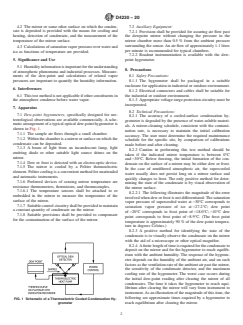
teorological observations are available commercially. A sche-
grometer is degraded by the presence of water-soluble materi-
maticarrangementofatypicalopticaldew-pointhygrometeris
als. A mirror-cleaning schedule, consistent with the contami-
shown in Fig. 1.
nation rate, is necessary to maintain the initial calibration
7.1.1 The sample air flows through a small chamber.
accuracy. The user must determine the required maintenance
7.1.2 Withinthechamberisamirrororsurfaceonwhichthe
schedule for the specific site, by comparison of calibrations
condensate can be deposited.
made before and after cleaning.
7.1.3 A beam of light from an incandescent lamp, light
8.2.2 Caution in performing this test method should be
emitting diode or other suitable light source shines on the
taken if the indicated mirror temperature is between 0°C
mirror.
and−30°C. Below freezing, the initial formation of the con-
7.1.4 Dew or frost is detected with an electro-optic device.
densate on the surface of a mirror may be either dew or frost.
7.1.5 The mirror is cooled by a Peltier thermoelectric
In the case of nonfiltered atmospheric air, the supercooled
element. Peltier cooling is a convenient method for unattended
water usually does not persist long on a mirror surface and
and automatic instruments.
quickly changes to frost. The only positive method for deter-
7.1.6 Preferred devices of sensing mirror temperature are
mining the state of the condensate is by visual observation of
resistance thermometers, thermistors, and thermocouples.
the mirror surface.
7.1.6.1 The temperature sensors shall be attached to or
8.2.2.1 The following illustrates the magnitude of the error
embedded in the mirror to measure the temperature of the
involvedwhendeworfrostisnotdifferentiated:Thesaturation
surface of the mirror.
vapor pressure of supercooled water at−30°C corresponds to
7.1.7 Suitablecontrolcircuitryshallbeprovidedtomaintain
saturation vapor pressure of ice at −27.2°C; dew point
a constant quantity of condensate on the mirror.
of−20°C corresponds to frost point of−18.0°C;−10°C dew
7.1.8 Suitable provisions shall be provided to compensate
point corresponds to frost point of−8.9°C. (The frost point
for the contamination of the surface of the mirror.
temperature is approximately 90% of the dew-point tempera-
ture in degrees Celsius.)
8.2.3 A positive method for identifying the state of the
condensate is to visually observe the condensate on the mirror
with the aid of a microscope or other optical magnifier.
8.2.4 Afinitelengthoftimeisrequiredforthecondensateto
deposit on the mirror and for the hygrometer to reach equilib-
rium with the ambient humidity. The response of the hygrom-
eter depends on the humidity of the ambient air, and on such
factorsastheventilationrateoftheambientairpastthemirror,
the sensitivity of the condensate detector, and the maximum
cooling rate of the hygrometer. The worst case occurs during
the initial dew-point reading after clearing the mirror of all
condensates. The time it takes the hygrometer to reach equi-
librium after clearing the mirror will vary from instrument to
instrument.Asanillustrationofthemagnitudeofthistime,the
following are approximate times required by a hygrometer to
FIG. 1 Schematic of a Thermoelectric Cooled Condensation Hy-
grometer reach equilibrium after clearing the mirror.
D4230 − 20
8.2.4.1 For dew points warmer than 0°C: 5 min after eter. Consult the manufacturer’s operating manual for calibrat-
clearing. ing the thermometer readout instrumentation.
8.2.4.2 For dew points 0°C to−20°C: 5 to 20 min after
10.2 The cooled-surface condensation (dew-point) method
clearing.
is considered to be an absolute or fundamental method for
8.2.4.3 For dew points−20°C to−40°C: 20 min to 1 h after
measuring humidity. This test method requires an accurate
clearing.
measurementofthetemperatureofthesurfaceofthedew-point
8.2.4.4 For dew points−40°C to−60°C:1hto2h after
mirror.Itisnotuncommonforthedew-pointtemperaturetobe
clearing.
more than 35°C colder than the ambient air temperature. To
8.2.4.5 For dew points−60°C to−70°C:2hto6h after
measure this temperature accurately, without being influenced
clearing.
by the warmer ambient and the colder heat-sink temperature,
8.2.5 The pressure differential between the mirror chamber
requires careful placement of the dew-point thermometer.
and the ambient shall not be greater than 0.5% of the ambient
pressure. For example, the difference shall not exceed 5 hPa at 10.3 Therefore, in addition to the temperature calibration of
thethermometer(see10.1),ahumiditycalibrationmustalsobe
an ambient pressure of 1000 hPa.
performedtoverifytheproperoperationofthehygrometer(see
NOTE 1—The hectopascal (hPa) is equivalent to the millibar (1).
Annex A1). The following are additional examples of factors
8.2.6 Thethermometermustmeasurethetemperatureofthe
that can affect the accuracy of the measurement: extraneous
mirror surface and not be influenced by the ambient air
thermally-induced voltage (emf), heat leakage through the
temperature.
thermometer leads, self-heating of the thermometer, poor
8.2.7 All materials, which come into contact with the
thermal contact, temperature gradient across the mirror, etc.
sample air before it reaches the dew-point mirror, shall be
nonhygroscopic. Metal, glass, polytetrafluoroethylene, or sta-
11. Procedure
bilized polypropylene are examples of suitable materials.
11.1 Selection of Sampling Site—Select sampling site as
Polyvinyl chloride tubing must be avoided.
indicated in 9.3 and also in 1.3.3 of the World Meteorological
9. Sampling Organization,GuidetoMeteorologicalInstrumentandObserv-
ing Practices (2).
9.1 Automatic dew-point hygrometers provide an output
which may be recorded continuously. Modern data loggers
11.2 Consult the manufacturer’s operating manual for
sample temperature-sensor output periodically, convert the
start-up procedures.
analog sensor signal to a digital form, and store the data. The
11.3 Perform necessary calibration as indicated in Section
proper sampling interval depends on the data application (see
10. The dew-point thermometer will not undergo large shifts
13.2).
(0.05°C) in calibration unless it is subjected to physical shock.
9.2 Locate a blower or pump, which can be used to move
If the thermometer read-out instrumentation is subjected to
the air sample through the mirror chamber, downstream of the
varying ambient
...
This document is not an ASTM standard and is intended only to provide the user of an ASTM standard an indication of what changes have been made to the previous version. Because
it may not be technically possible to adequately depict all changes accurately, ASTM recommends that users consult prior editions as appropriate. In all cases only the current version
of the standard as published by ASTM is to be considered the official document.
Designation: D4230 − 02 (Reapproved 2012) D4230 − 20
Standard Test Method offor
Measuring Humidity with Cooled-Surface Condensation
(Dew-Point) Hygrometer
This standard is issued under the fixed designation D4230; the number immediately following the designation indicates the year of
original adoption or, in the case of revision, the year of last revision. A number in parentheses indicates the year of last reapproval. A
superscript epsilon (´) indicates an editorial change since the last revision or reapproval.
1. Scope
1.1 This test method covers the determination of the thermodynamic dew- or frost-point temperature of ambient air by the
condensation of water vapor on a cooled surface. For brevity, this is referred to in this test method as the condensation temperature.
1.2 This test method is applicable for the range of condensation temperatures from 60°C to − 70°C.to −70°C.
1.3 This test method includes a general description of the instrumentation and operational procedures, including site selection,
to be used for obtaining the measurements and a description of the procedures to be used for calculating the results.
1.4 This test method is applicable for the continuous measurement of ambient humidity in the natural atmosphere on a stationary
platform.
1.5 The values stated in SI units are to be regarded as standard. No other units of measurement are included in this standard.
1.6 This standard does not purport to address all of the safety concerns, if any, associated with its use. It is the responsibility
of the user of this standard to establish appropriate safety safety, health, and healthenvironmental practices and determine the
applicability of regulatory limitations prior to use. For specific precautionary statements, see Section 8.
1.7 This international standard was developed in accordance with internationally recognized principles on standardization
established in the Decision on Principles for the Development of International Standards, Guides and Recommendations issued
by the World Trade Organization Technical Barriers to Trade (TBT) Committee.
2. Referenced Documents
2.1 ASTM Standards:
D1356 Terminology Relating to Sampling and Analysis of Atmospheres
D3631 Test Methods for Measuring Surface Atmospheric Pressure
3. Terminology
3.1 Definitions:
3.1.1 For definitions of other terms in this test method, refer to Terminology D1356.
3.2 Definitions of Terms Specific to This Standard:
3.2.1 nonhygroscopic material—material, n—material that neither absorbs nor retains water vapor.
3.2.2 mirror (front surface)—surface), n—a polished surface, usually a metallic surface, on which condensates are deposited.
3.3 Symbols:
e = vapor pressure of water vapor in moist air.
e = saturation pressure of water vapor in equilibrium with the plane surface of ice.
i
e = saturation pressure of water vapor in equilibrium with the plane surface of water.
w
P = ambient pressure.
r = mixing ratio.
T = ambient air temperature.
T = thermodynamic dew- or frost-point temperature.
d
This test method is under the jurisdiction of ASTM Committee D22 on Air Quality and is the direct responsibility of Subcommittee D22.11 on Meteorology.
Current edition approved April 1, 2012March 1, 2020. Published July 2012April 2020. Originally approved in 1983. Last previous edition approved in 20072012 as
D4230 – 02 (2007).(2012). DOI: 10.1520/D4230-02R12.10.1520/D4230-20.
For referenced ASTM standards, visit the ASTM website, www.astm.org, or contact ASTM Customer Service at service@astm.org. For Annual Book of ASTM Standards
volume information, refer to the standard’s Document Summary page on the ASTM website.
Copyright © ASTM International, 100 Barr Harbor Drive, PO Box C700, West Conshohocken, PA 19428-2959. United States
D4230 − 20
RH = relative humidity with respect to ice.
i
RH = relative humidity with respect to water.
w
4. Summary of Test Method
4.1 The ambient humidity is measured with a dew- and frost-point hygrometer.
4.2 The mirror or some other surface on which the condensate is deposited is provided with the means for cooling and heating,
detection of condensate, and the measurement of the temperature of the mirror surface.
4.3 Calculations of saturation vapor pressure over water and ice as functions of temperature are provided.
5. Significance and Use
5.1 Humidity information is important for the understanding of atmospheric phenomena and industrial processes. Measurements
of the dew-point and calculations of related vapor pressures are important to quantify the humidity information.
6. Interferences
6.1 This test method is not applicable if other constituents in the atmosphere condense before water vapor.
7. Apparatus
7.1 Dew-point hygrometers, specifically designed for meteorological observations are available commercially. A schematic
arrangement of a typical optical dew-point hygrometer is shown in Fig. 1.
7.1.1 The sample air flows through a small chamber.
7.1.2 Within the chamber is a mirror or surface on which the condensate can be deposited.
7.1.3 A beam of light from an incandescent lamp, light emitting diode or other suitable light source shines on the mirror.
7.1.4 Dew or frost is detected with an electro-optic device.
7.1.5 The mirror is cooled by a Peltier thermoelectric element. Peltier cooling is a convenient method for unattended and
automatic instruments.
7.1.6 Preferred devices of sensing mirror temperature are resistance thermometers, thermistors, and thermocouples.
7.1.6.1 The temperature sensors shall be attached to or embedded in the mirror to measure the temperature of the surface of the
mirror.
7.1.7 Suitable control circuitry shall be provided to maintain a constant quantity of condensate on the mirror.
7.1.8 Suitable provisions shall be provided to compensate for the contamination of the surface of the mirror.
FIG. 1 Schematic of a Thermoelectric Cooled Condensation Hygrometer
D4230 − 20
7.2 Auxiliary Equipment:
7.2.1 Provision shall be provided for assuring air flow past the dewpoint mirror without changing the pressure in the mirror
chamber more than 0.5 % from the ambient pressure surrounding the sensor. An air flow of approximately 1.1 litres per minute
is recommended for typical chambers.
7.2.2 Readout instrumentation is available with the dew-point hygrometer.
8. Precautions
8.1 Safety Precautions:
8.1.1 The hygrometer shall be packaged in a suitable enclosure for application in industrial or outdoor environment.
8.1.2 Electrical connectors and cables shall be suitable for the industrial or outdoor environment.
8.1.3 Appropriate voltage surge protection circuitry must be incorporated.
8.2 Technical Precautions:
8.2.1 The accuracy of a cooled-surface condensation hygrometer is degraded by the presence of water-soluble materials. A
mirror-cleaning schedule, consistent with the contamination rate, is necessary to maintain the initial calibration accuracy. The user
must determine the required maintenance schedule for the specific site, by comparison of calibrations made before and after
cleaning.
8.2.2 Caution in performing this test method should be taken if the indicated mirror temperature is between 0°C
and − 30°C.and −30°C. Below freezing, the initial formation of the condensate on the surface of a mirror may be either dew or
frost. In the case of nonfiltered atmospheric air, the supercooled water usually does not persist long on a mirror surface and quickly
changes to frost. The only positive method for determining the state of the condensate is by visual observation of the mirror surface.
8.2.2.1 The following illustrates the magnitude of the error involved when dew or frost is not differentiated: The saturation
vapor pressure of supercooled water at − 30°Cat −30°C corresponds to saturation vapor pressure of ice at − 27.2°C;at −27.2°C;
dew point of − 20°Cof −20°C corresponds to frost point of − 18.0°C; − 10°Cof −18.0°C; −10°C dew point corresponds to frost
point of − 8.9°C.of −8.9°C. (The frost point temperature is approximately 90 % of the dew-point temperature in degrees Celsius.)
8.2.3 A positive method for identifying the state of the condensate is to visually observe the condensate on the mirror with the
aid of a microscope or other optical magnifier.
8.2.4 A finite length of time is required for the condensate to deposit on the mirror and for the hygrometer to reach equilibrium
with the ambient humidity. The response of the hygrometer depends on the humidity of the ambient air, and on such factors as the
ventilation rate of the ambient air past the mirror, the sensitivity of the condensate detector, and the maximum cooling rate of the
hygrometer. The worst case occurs during the initial dew-point reading after clearing the mirror of all condensates. The time it takes
the hygrometer to reach equilibrium after clearing the mirror will vary from instrument to instrument. As an illustration of the
magnitude of this time, the following are approximate times required by a hygrometer to reach equilibrium after clearing the
mirror.
8.2.4.1 For dew points warmer than 0°C: 5 min after clearing.
8.2.4.2 For dew points 0°C to − 20°C:to −20°C: 5 to 20 min after clearing.
8.2.4.3 For dew points − 20°C to − 40°C:points −20°C to −40°C: 20 min to 1 h after clearing.
8.2.4.4 For dew points − 40°C to − 60°C:points −40°C to −60°C: 1 h to 2 h after clearing.
8.2.4.5 For dew points − 60°C to − 70°C:points −60°C to −70°C: 2 h to 6 h after clearing.
8.2.5 The pressure differential between the mirror chamber and the ambient shall not be greater than 0.5 % of the ambient
pressure. For example, the difference shall not exceed 5 hPa at an ambient pressure of 1000 hPa.
NOTE 1—The hectopascal (hPa) is equivalent to the millibar (1).
8.2.6 The thermometer must measure the temperature of the mirror surface and not be influenced by the ambient air temperature.
8.2.7 All materials, which come into contact with the sample air before it reaches the dew-point mirror, shall be nonhygroscopic.
Metal, glass, polytetrafluoroethylene, or stabilized polypropylene are examples of suitable materials. Polyvinyl chloride tubing
must be avoided.
9. Sampling
9.1 Automatic dew-point hygrometers provide an output which may be recorded continuously. Modern data loggers sample
temperature-sensor output periodically, convert the analog sensor signal to a digital form, and store the data. The proper sampling
interval depends on the data application (see 13.2).
9.2 Locate a blower or pump, which can be used to move the air sample through the mirror chamber, downstream of the
dew-point mirror. The airflow rate also depends on the data application and sampling environment.
9.3 Select the site or location so that the measurement data represents the water vapor content of the ambient atmosphere or
industrial environment being sampled. Local water vapor sources, including ponds, wet roads, and structures can influence the
ambient humidity. Avoid sources of airborne contaminants that can influence to condensation process on the mirror.
The boldface numbers in parentheses refer to the a list of references at the end of this method.standard.
D4230 − 20
9.4 The successful application of this test method requires that all the materials which come in contact with the sample air
upstream of the dew-point mirror be nonhygroscopic.
9.5 The materials which come in contact with the sample air upstream of the dew-point mirror might be wetted by rain, dew,
or frost; for example, dew forming on a surface in the early morning. Design the sampling system to minimize these deleterious
effects.
10. Calibration
10.1 Provide the calibration data for the thermometer, used for measuring the condensation temperature with the hygrometer.
Consult the manufacturer’s operating manual for calibrating the thermometer readout instrumentation.
10.2 The cooled-surface condensation (dew-point) method is considered to be an absolute or fundamental method for measuring
humidity. This test method requires an accurate measurement of the temperature of the surface of the dew-point mirror. It is not
uncommon for the dew-point temperature to be more than 35 °C35°C colder than the ambient air temperature. To measure this
temperature accurately, without being influenced by the warmer ambient and the colder heat-sink temperature, requires careful
placement of the dew-point thermometer.
10.3 Therefore, in ad
...