

ASTM D3274-09(2021)
(Test Method)Standard Test Method for Evaluating Degree of Surface Disfigurement of Paint Films by Fungal or Algal Growth, or Soil and Dirt Accumulation
General Information
- Abstract
SIGNIFICANCE AND USE
4.1 The growth of fungi in and on the surface of paint films represents a major cause of discoloration or disfigurement of painted surfaces. Because of their dark pigmentation, it is frequently difficult to distinguish fungi from dirt or soil particles.
4.2 Use of Pictorial Standards:
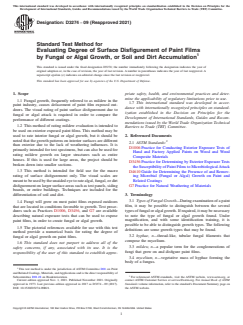
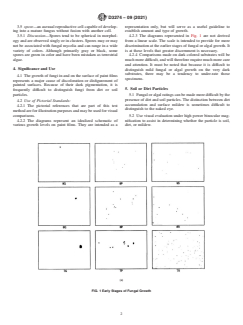
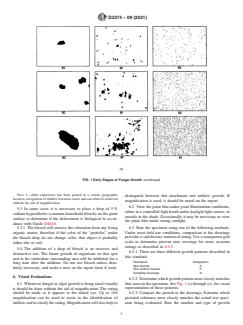
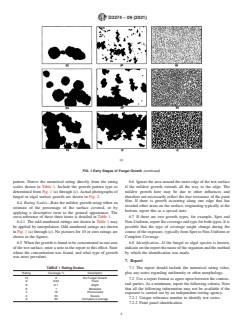
4.2.1 The pictorial references that are part of this test method are for illustration purposes and may be used for visual comparisons.
4.2.2 The diagrams represent an idealized schematic of various growth levels on paint films. They are intended as a representation only, but will serve as a useful guideline to establish amount and type of growth.
4.2.3 The diagrams represented in Fig. 1 are not derived from a linear scale. The scale is intended to provide for more discrimination at the earlier stages of fungal or algal growth. It is at these levels that greater discernment is necessary.
4.2.4 Comparisons made on dark colored substrates will be much more difficult, and will therefore require much more care and attention. It must be noted that because it is difficult to distinguish mild fungal or algal growth on the very dark substrates, there may be a tendency to under-rate those specimens.
SCOPE
1.1 Fungal growth, frequently referred to as mildew in the paint industry, causes defacement of paint film exposed outdoors. The visual rating of paint surface disfigurement due to fungal or algal attack is required in order to compare the performance of different coatings.
1.2 This method of rating mildew evaluation is intended to be used on exterior exposed paint films. This method may be used to rate interior fungal or algal growth, but it should be noted that the growth patterns on interior surfaces are different than exterior due to the lack of weathering influences. It is primarily intended for test specimens, but can also be used for rating mildew growth on larger structures such as entire houses. If this is used for large areas, the project should be broken down into smaller sections.
1.3 This method is intended for field use for the macro rating of surface disfigurement only. The visual scales are meant to be used by the unaided eye to rate algal, fungal, or dirt disfigurement on larger surface areas such as test panels, siding boards, or entire buildings. Techniques are included for the differentiation of soil and dirt.
1.4 Fungi will grow on most paint films exposed outdoors that are located in conditions favorable to growth. Test procedures such as Practices D1006, D3456, and G7 are available describing natural exposure tests that can be used to expose paint films, in order to create fungal or algal growth.
1.5 The pictorial references available for use with this test method provide a numerical basis for rating the degree of fungal or algal growth on paint films.
1.6 This standard does not purport to address all of the safety concerns, if any, associated with its use. It is the responsibility of the user of this standard to establish appropriate safety, health, and environmental practices and determine the applicability of regulatory limitations prior to use.
1.7 This international standard was developed in accordance with internationally recognized principles on standardization established in the Decision on Principles for the Development of International Standards, Guides and Recommendations issued by the World Trade Organization Technical Barriers to Trade (TBT) Committee.
- Status
- Published
- Publication Date
- 31-Oct-2021
- Technical Committee
- D01 - Paint and Related Coatings, Materials, and Applications
- Drafting Committee
- D01.28 - Biodeterioration
Overview
ASTM D3274-09(2021): Standard Test Method for Evaluating Degree of Surface Disfigurement of Paint Films by Fungal or Algal Growth, or Soil and Dirt Accumulation is an international standard developed by ASTM International. This test method provides procedures for visually evaluating and rating the degree of disfigurement of paint films caused by fungal (mildew), algal growth, and accumulation of soil or dirt. The method is primarily designed for paints exposed to outdoor conditions but may also be applied indoors, with considerations for differences in growth patterns.
Established under internationally recognized principles for standardization, ASTM D3274 is a vital tool for manufacturers, regulatory agencies, and independent laboratories to assess the durability and resistance of coatings against biological and environmental contaminants.
Key Topics
Surface Disfigurement Evaluation
- Disfigurement due to fungi, algae, dirt, or soil accumulation on paint films is identified and rated.
- Ratings are based on direct visual assessment, using reference pictorial scales provided in the standard.
Visual Rating and Pictorial Standards
- Pictorial references illustrate various levels and patterns of growth.
- Visual ratings are assigned by comparing tested surfaces with idealized diagrams, ensuring consistent evaluations at early and advanced stages.
- Numerical values are used to quantify the degree of contamination.
Differentiation Between Biological and Non-biological Contaminants
- Techniques are included for distinguishing fungal or algal growth from dirt or soil.
- Tools such as magnification and color-change tests (e.g., application of common bleach) may be used as needed.
Macro Rating Methodology
- Focus on rating visible changes on large surface areas, including test panels, siding boards, or entire buildings.
- No requirement for microscopic or laboratory analysis in the field evaluation.
Applications
The ASTM D3274-09(2021) standard is widely adopted in the following applications:
Paint and Coating Industry
- Used for product development and quality control to compare the performance of different exterior and interior paint formulations.
- Assists in selecting coatings with higher resistance to mildew, algae, and dirt accumulation, improving product marketability and lifespan.
Construction and Building Maintenance
- Essential for routine inspections of painted structures, such as houses, commercial buildings, and infrastructure, to assess maintenance needs and guide cleaning or repainting schedules.
Regulatory Compliance and Certification
- Provides a standardized method to meet regulatory requirements or customer specifications concerning the durability and cleanliness of painted or coated surfaces.
Research and Weathering Testing
- Supports natural exposure tests under controlled conditions as part of broader weathering studies on paint and coating materials.
Related Standards
When conducting evaluations under ASTM D3274, the following related ASTM standards may also apply:
- ASTM D1006 – Practice for Conducting Exterior Exposure Tests of Hand and Factory Applied Paints on Wood and Wood Composite Materials
- ASTM D3456 – Practice for Determining by Exterior Exposure Tests the Susceptibility of Paint Films to Microbiological Attack
- ASTM D4610 – Guide for Determining the Presence of and Removing Microbial (Fungal or Algal) Growth on Paint and Related Coatings
- ASTM G7 – Practice for Natural Weathering of Materials
Summary of Practical Value
Using ASTM D3274-09(2021) ensures a consistent, objective, and visual method for evaluating and reporting the degree of surface disfigurement due to fungi, algae, and environmental soiling on paint films. It helps manufacturers improve product performance, enables building professionals to maintain attractive and durable structures, and satisfies compliance with relevant standards in paint and coating evaluation. Integrating this test method with related standards provides a comprehensive framework for coatings performance testing and maintenance strategies.
Relations
- Effective Date
- 01-Jul-2018
- Effective Date
- 01-Jun-2013
- Effective Date
- 01-Aug-2012
- Effective Date
- 01-Jul-2009
- Effective Date
- 01-Jun-2008
- Refers
ASTM D1006-01(2006) - Standard Practice for Conducting Exterior Exposure Tests of Paints on Wood - Effective Date
- 01-Nov-2006
- Effective Date
- 01-Jan-2005
- Effective Date
- 01-Jun-2004
- Effective Date
- 10-Jun-2001
- Effective Date
- 10-Jun-2001
- Effective Date
- 10-Jul-1998
- Effective Date
- 10-Dec-1997
- Effective Date
- 01-Jan-1996
- Effective Date
- 27-Mar-1986
Frequently Asked Questions
ASTM D3274-09(2021) is a standard published by ASTM International. Its full title is "Standard Test Method for Evaluating Degree of Surface Disfigurement of Paint Films by Fungal or Algal Growth, or Soil and Dirt Accumulation". This standard covers: SIGNIFICANCE AND USE 4.1 The growth of fungi in and on the surface of paint films represents a major cause of discoloration or disfigurement of painted surfaces. Because of their dark pigmentation, it is frequently difficult to distinguish fungi from dirt or soil particles. 4.2 Use of Pictorial Standards: 4.2.1 The pictorial references that are part of this test method are for illustration purposes and may be used for visual comparisons. 4.2.2 The diagrams represent an idealized schematic of various growth levels on paint films. They are intended as a representation only, but will serve as a useful guideline to establish amount and type of growth. 4.2.3 The diagrams represented in Fig. 1 are not derived from a linear scale. The scale is intended to provide for more discrimination at the earlier stages of fungal or algal growth. It is at these levels that greater discernment is necessary. 4.2.4 Comparisons made on dark colored substrates will be much more difficult, and will therefore require much more care and attention. It must be noted that because it is difficult to distinguish mild fungal or algal growth on the very dark substrates, there may be a tendency to under-rate those specimens. SCOPE 1.1 Fungal growth, frequently referred to as mildew in the paint industry, causes defacement of paint film exposed outdoors. The visual rating of paint surface disfigurement due to fungal or algal attack is required in order to compare the performance of different coatings. 1.2 This method of rating mildew evaluation is intended to be used on exterior exposed paint films. This method may be used to rate interior fungal or algal growth, but it should be noted that the growth patterns on interior surfaces are different than exterior due to the lack of weathering influences. It is primarily intended for test specimens, but can also be used for rating mildew growth on larger structures such as entire houses. If this is used for large areas, the project should be broken down into smaller sections. 1.3 This method is intended for field use for the macro rating of surface disfigurement only. The visual scales are meant to be used by the unaided eye to rate algal, fungal, or dirt disfigurement on larger surface areas such as test panels, siding boards, or entire buildings. Techniques are included for the differentiation of soil and dirt. 1.4 Fungi will grow on most paint films exposed outdoors that are located in conditions favorable to growth. Test procedures such as Practices D1006, D3456, and G7 are available describing natural exposure tests that can be used to expose paint films, in order to create fungal or algal growth. 1.5 The pictorial references available for use with this test method provide a numerical basis for rating the degree of fungal or algal growth on paint films. 1.6 This standard does not purport to address all of the safety concerns, if any, associated with its use. It is the responsibility of the user of this standard to establish appropriate safety, health, and environmental practices and determine the applicability of regulatory limitations prior to use. 1.7 This international standard was developed in accordance with internationally recognized principles on standardization established in the Decision on Principles for the Development of International Standards, Guides and Recommendations issued by the World Trade Organization Technical Barriers to Trade (TBT) Committee.
SIGNIFICANCE AND USE 4.1 The growth of fungi in and on the surface of paint films represents a major cause of discoloration or disfigurement of painted surfaces. Because of their dark pigmentation, it is frequently difficult to distinguish fungi from dirt or soil particles. 4.2 Use of Pictorial Standards: 4.2.1 The pictorial references that are part of this test method are for illustration purposes and may be used for visual comparisons. 4.2.2 The diagrams represent an idealized schematic of various growth levels on paint films. They are intended as a representation only, but will serve as a useful guideline to establish amount and type of growth. 4.2.3 The diagrams represented in Fig. 1 are not derived from a linear scale. The scale is intended to provide for more discrimination at the earlier stages of fungal or algal growth. It is at these levels that greater discernment is necessary. 4.2.4 Comparisons made on dark colored substrates will be much more difficult, and will therefore require much more care and attention. It must be noted that because it is difficult to distinguish mild fungal or algal growth on the very dark substrates, there may be a tendency to under-rate those specimens. SCOPE 1.1 Fungal growth, frequently referred to as mildew in the paint industry, causes defacement of paint film exposed outdoors. The visual rating of paint surface disfigurement due to fungal or algal attack is required in order to compare the performance of different coatings. 1.2 This method of rating mildew evaluation is intended to be used on exterior exposed paint films. This method may be used to rate interior fungal or algal growth, but it should be noted that the growth patterns on interior surfaces are different than exterior due to the lack of weathering influences. It is primarily intended for test specimens, but can also be used for rating mildew growth on larger structures such as entire houses. If this is used for large areas, the project should be broken down into smaller sections. 1.3 This method is intended for field use for the macro rating of surface disfigurement only. The visual scales are meant to be used by the unaided eye to rate algal, fungal, or dirt disfigurement on larger surface areas such as test panels, siding boards, or entire buildings. Techniques are included for the differentiation of soil and dirt. 1.4 Fungi will grow on most paint films exposed outdoors that are located in conditions favorable to growth. Test procedures such as Practices D1006, D3456, and G7 are available describing natural exposure tests that can be used to expose paint films, in order to create fungal or algal growth. 1.5 The pictorial references available for use with this test method provide a numerical basis for rating the degree of fungal or algal growth on paint films. 1.6 This standard does not purport to address all of the safety concerns, if any, associated with its use. It is the responsibility of the user of this standard to establish appropriate safety, health, and environmental practices and determine the applicability of regulatory limitations prior to use. 1.7 This international standard was developed in accordance with internationally recognized principles on standardization established in the Decision on Principles for the Development of International Standards, Guides and Recommendations issued by the World Trade Organization Technical Barriers to Trade (TBT) Committee.
ASTM D3274-09(2021) is classified under the following ICS (International Classification for Standards) categories: 87.040 - Paints and varnishes. The ICS classification helps identify the subject area and facilitates finding related standards.
ASTM D3274-09(2021) has the following relationships with other standards: It is inter standard links to ASTM D3456-18, ASTM D4610-98(2013), ASTM D3456-86(2012), ASTM D4610-98(2009), ASTM D3456-86(2008), ASTM D1006-01(2006), ASTM G7-05, ASTM D4610-98(2004), ASTM D1006-01, ASTM D1006-93, ASTM D4610-98, ASTM G7-97, ASTM D3456-86(1996), ASTM D3456-86(2002). Understanding these relationships helps ensure you are using the most current and applicable version of the standard.
ASTM D3274-09(2021) is available in PDF format for immediate download after purchase. The document can be added to your cart and obtained through the secure checkout process. Digital delivery ensures instant access to the complete standard document.
Standards Content (Sample)
This international standard was developed in accordance with internationally recognized principles on standardization established in the Decision on Principles for the
Development of International Standards, Guides and Recommendations issued by the World Trade Organization Technical Barriers to Trade (TBT) Committee.
Designation: D3274 −09 (Reapproved 2021)
Standard Test Method for
Evaluating Degree of Surface Disfigurement of Paint Films
by Fungal or Algal Growth, or Soil and Dirt Accumulation
This standard is issued under the fixed designation D3274; the number immediately following the designation indicates the year of
original adoption or, in the case of revision, the year of last revision.Anumber in parentheses indicates the year of last reapproval.A
superscript epsilon (´) indicates an editorial change since the last revision or reapproval.
This standard has been approved for use by agencies of the U.S. Department of Defense.
1. Scope priate safety, health, and environmental practices and deter-
mine the applicability of regulatory limitations prior to use.
1.1 Fungal growth, frequently referred to as mildew in the
1.7 This international standard was developed in accor-
paint industry, causes defacement of paint film exposed out-
dance with internationally recognized principles on standard-
doors. The visual rating of paint surface disfigurement due to
ization established in the Decision on Principles for the
fungal or algal attack is required in order to compare the
Development of International Standards, Guides and Recom-
performance of different coatings.
mendations issued by the World Trade Organization Technical
1.2 This method of rating mildew evaluation is intended to
Barriers to Trade (TBT) Committee.
be used on exterior exposed paint films. This method may be
used to rate interior fungal or algal growth, but it should be
2. Referenced Documents
noted that the growth patterns on interior surfaces are different
2.1 ASTM Standards:
than exterior due to the lack of weathering influences. It is
D1006Practice for Conducting Exterior Exposure Tests of
primarily intended for test specimens, but can also be used for
Hand and Factory Applied Paints on Wood and Wood
rating mildew growth on larger structures such as entire
Composite Materials
houses. If this is used for large areas, the project should be
D3456Practice for Determining by Exterior Exposure Tests
broken down into smaller sections.
theSusceptibilityofPaintFilmstoMicrobiologicalAttack
1.3 This method is intended for field use for the macro D4610Guide for Determining the Presence of and Remov-
rating of surface disfigurement only. The visual scales are
ing Microbial (Fungal or Algal) Growth on Paint and
meanttobeusedbytheunaidedeyetoratealgal,fungal,ordirt Related Coatings
disfigurementonlargersurfaceareassuchastestpanels,siding
G7Practice for Natural Weathering of Materials
boards, or entire buildings. Techniques are included for the
differentiation of soil and dirt. 3. Terminology
3.1 Types of Fungal Growth—Duringexaminationofapaint
1.4 Fungi will grow on most paint films exposed outdoors
film, it may be possible to distinguish between the several
that are located in conditions favorable to growth. Test proce-
typesoffungaloralgalgrowth.Ifrequired,itmaybenecessary
dures such as Practices D1006, D3456, and G7 are available
to note the type of fungal or algal growth found. Under
describing natural exposure tests that can be used to expose
magnification, and with some identification training, it is
paint films, in order to create fungal or algal growth.
possible to be able to distinguish growth types. The following
1.5 The pictorial references available for use with this test
definitions are some growth types that may be found.
method provide a numerical basis for rating the degree of
3.2 hyphae, n—thread-like, tubular fungal filaments that
fungal or algal growth on paint films.
compose the mycelium.
1.6 This standard does not purport to address all of the
3.3 mildew, n—a popular term for the conglomerations of
safety concerns, if any, associated with its use. It is the
fungi that grow on and disfigure paint films.
responsibility of the user of this standard to establish appro-
3.4 mycelium, n—vegetative mass of hyphae forming the
body of a fungus.
This test method is under the jurisdiction of ASTM Committee D01 on Paint
and Related Coatings, Materials, andApplications and is the direct responsibility of
Subcommittee D01.28 on Biodeterioration. For referenced ASTM standards, visit the ASTM website, www.astm.org, or
Current edition approved Nov. 1, 2021. Published November 2021. Originally contact ASTM Customer Service at service@astm.org. For Annual Book of ASTM
approved in 1973. Last previous edition approved in 2017 as D3274–09 (2017). Standards volume information, refer to the standard’s Document Summary page on
DOI: 10.1520/D3274-09R21. the ASTM website.
Copyright © ASTM International, 100 Barr Harbor Drive, PO Box C700, West Conshohocken, PA 19428-2959. United States
D3274 − 09 (2021)
3.5 spore—an asexual reproductive cell capable of develop- representation only, but will serve as a useful guideline to
ing into a mature fungus without fusion with another cell. establish amount and type of growth.
3.5.1 Discussion—Spores tend to be spherical in morphol- 4.2.3 The diagrams represented in Fig. 1 are not derived
ogy and are observed singly or in clusters. Spores may or may from a linear scale. The scale is intended to provide for more
not be associated with fungal mycelia and can range in a wide discrimination at the earlier stages of fungal or algal growth. It
variety of colors. Although primarily gray or black, some is at these levels that greater discernment is necessary.
spores are green in color and have been mistaken as terrestrial 4.2.4 Comparisons made on dark colored substrates will be
algae. muchmoredifficult,andwillthereforerequiremuchmorecare
and attention. It must be noted that because it is difficult to
4. Significance and Use
distinguish mild fungal or algal growth on the very dark
substrates, there may be a tendency to under-rate those
4.1 The growth of fungi in and on the surface of paint films
specimens.
represents a major cause of discoloration or disfigurement of
painted surfaces. Because of their dark pigmentation, it is
5. Soil or Dirt Particles
frequently difficult to distinguish fungi from dirt or soil
particles. 5.1 Fungaloralgalratingscanbemademoredifficultbythe
presence of dirt and soil particles.The distinction between dirt
4.2 Use of Pictorial Standards:
accumulation and surface mildew is sometimes difficult to
4.2.1 The pictorial references that are part of this test
distinguish to the naked eye.
methodareforillustrationpurposesandmaybeusedforvisual
comparisons. 5.2 Use visual evaluation under high power binocular mag-
4.2.2 The diagrams represent an idealized schematic of nification to assist in determining whether the particle is soil,
various growth levels on paint films. They are intended as a dirt, or mildew.
(a)
FIG. 1 Early Stages of Fungal Growth
D3274 − 09 (2021)
(b)
FIG. 1 Early Stages of Fungal Growth (continued)
NOTE 1—After experience has been gained in a certain geographic
distinguish between dirt attachment and mildew growth. If
location,recognitionofmildewbecomeseasierandcanoftenbeachieved
magnification is used, it should be noted on the report.
without the aid of magnification.
6.2 View the paint film under good illumination conditions,
5.3 In some cases it is necessary to place a drop of 5%
eitherinacontrolledlightboothunderdaylightlightsource,or
sodium hypochlorite (common household bleach) on the paint
outside in
...