


ASTM D7264/D7264M-21
(Test Method)Standard Test Method for Flexural Properties of Polymer Matrix Composite Materials
Standard Test Method for Flexural Properties of Polymer Matrix Composite Materials
SIGNIFICANCE AND USE
5.1 This test method determines the flexural properties (including strength, stiffness, and load/deflection behavior) of polymer matrix composite materials under the conditions defined. Procedure A is used for three-point loading and Procedure B is used for four-point loading. This test method was developed for optimum use with continuous-fiber-reinforced polymer matrix composites and differs in several respects from other flexure methods, including the use of a standard span-to-thickness ratio of 32:1 versus the 16:1 ratio used by Test Methods D790 (a plastics-focused method covering three-point flexure) and D6272 (a plastics-focused method covering four-point flexure).
5.2 This test method is intended to interrogate long-beam strength in contrast to the short-beam strength evaluated by Test Method D2344/D2344M.
5.3 Flexural properties determined by these procedures can be used for quality control and specification purposes, and may find design applications.
5.4 These procedures can be useful in the evaluation of multiple environmental conditions to determine which are design drivers and may require further testing.
5.5 These procedures may also be used to determine flexural properties of structures.
SCOPE
1.1 This test method determines the flexural stiffness and strength properties of polymer matrix composites.
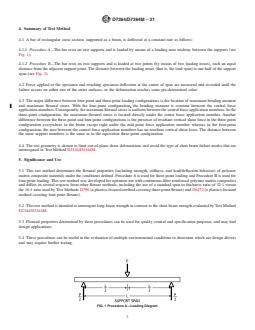
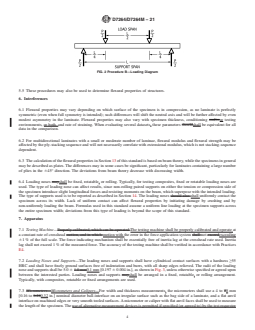
1.1.1 Procedure A—A three-point loading system utilizing center loading on a simply supported beam.
1.1.2 Procedure B—A four-point loading system utilizing two load points equally spaced from their adjacent support points, with a distance between load points of one-half of the support span.
Note 1: Unlike Test Method D6272, which allows loading at both one-third and one-half of the support span, in order to standardize geometry and simplify calculations, this standard permits loading at only one-half the support span.
1.2 For comparison purposes, tests may be conducted according to either test procedure, provided that the same procedure is used for all tests, since the two procedures generally give slightly different property values.
1.3 Units—The values stated in either SI units or inch-pound units are to be regarded separately as standard. The values stated in each system are not necessarily exact equivalents; therefore, to ensure conformance with the standard, each system shall be used independently of the other, and values from the two systems shall not be combined.
1.4 This standard does not purport to address all of the safety concerns, if any, associated with its use. It is the responsibility of the user of this standard to establish appropriate safety, health, and environmental practices and determine the applicability of regulatory limitations prior to use.
1.5 This international standard was developed in accordance with internationally recognized principles on standardization established in the Decision on Principles for the Development of International Standards, Guides and Recommendations issued by the World Trade Organization Technical Barriers to Trade (TBT) Committee.
General Information
- Status
- Published
- Publication Date
- 31-Dec-2020
- Technical Committee
- D30 - Composite Materials
- Drafting Committee
- D30.04 - Lamina and Laminate Test Methods
Relations
- Effective Date
- 01-Feb-2024
- Effective Date
- 01-Nov-2023
- Effective Date
- 01-Oct-2023
- Effective Date
- 01-Apr-2022
- Effective Date
- 01-Mar-2020
- Effective Date
- 01-Jan-2020
- Effective Date
- 15-Oct-2019
- Effective Date
- 01-Aug-2019
- Effective Date
- 15-Apr-2019
- Effective Date
- 15-Apr-2019
- Effective Date
- 01-Feb-2019
- Effective Date
- 01-Dec-2018
- Effective Date
- 01-Nov-2018
- Effective Date
- 15-Sep-2018
- Effective Date
- 01-Apr-2018
Overview
ASTM D7264/D7264M-21, the Standard Test Method for Flexural Properties of Polymer Matrix Composite Materials, is an essential international standard developed by ASTM for determining the flexural properties-including strength, stiffness, and load/deflection behavior-of continuous-fiber-reinforced polymer composites. This method defines procedures for evaluating the long-beam flexural strength and modulus under specified conditions, making it a critical tool in both quality control and materials engineering.
Flexural performance is key for specifying material properties in design and manufacturing processes, especially for advanced composites used in aerospace, automotive, construction, marine, and industrial applications. The standard prescribes two main loading procedures: three-point bending (Procedure A) and four-point bending (Procedure B), both using a standardized span-to-thickness ratio of 32:1 for reproducible and comparable results.
Key Topics
- Flexural Strength and Modulus: Quantification of maximum stress and modulus during bending, providing essential data for material selection and design.
- Test Methods:
- Procedure A: Three-Point Loading-Center loading on a simply supported beam for precise stress location at mid-span.
- Procedure B: Four-Point Loading-Two load points spaced at half the support span, creating a constant moment zone.
- Continuous-Fiber Composites Focus: Optimized for continuous-fiber-reinforced polymer matrix composites, differing from plastics-focused methods (e.g., ASTM D790, D6272) by geometry and test configuration.
- Environmental Assessment: Flexural testing under varying humidity and temperature conditions to evaluate environmental effects on composite performance.
- Quality Control and Specification: Intended for routine quality assurance, product specification, and design validation.
- Reporting Requirements: Specifies detailed reporting for all material and test parameters to ensure traceability and comparability.
Applications
ASTM D7264/D7264M-21 is widely used in industries where advanced composite materials are integral to safety, reliability, and performance. Typical applications include:
- Aerospace: Qualification of aircraft structural components made from composite laminates, ensuring compliance with stringent performance standards.
- Automotive: Comparison and specification of high-strength, lightweight components, such as structural beams or panels.
- Construction and Civil Engineering: Testing fiber-reinforced polymers (FRP) used in bridges, reinforcement, or panels subject to flexural loading.
- Marine and Industrial: Evaluating the integrity and durability of composite materials exposed to various environmental conditions.
Flexural property data guides designers in selecting materials for optimal performance under expected loading scenarios and service environments. The method also supports the assessment of new material formulations, layups, or processing variations.
Related Standards
To provide a comprehensive evaluation of composite materials, ASTM D7264/D7264M-21 references several other ASTM and ANSI standards, including:
- ASTM D790: Test Methods for Flexural Properties of Plastics and Electrical Insulating Materials (three-point bending).
- ASTM D6272: Test Method for Flexural Properties of Plastics by Four-Point Bending.
- ASTM D2344/D2344M: Test Method for Short-Beam Strength of Polymer Matrix Composites.
- ASTM D792, D2584, D2734, D3171: Density, constituent, and void content testing methods for composite characterization.
- ASTM D5229/D5229M: Moisture Absorption Properties and Conditioning of Polymer Matrix Composite Materials.
- ANSI Y14.5 and B46.1: Dimensioning, tolerancing, and surface texture standards.
Using ASTM D7264/D7264M-21 in conjunction with these related standards ensures a complete and accurate mechanical analysis of polymer matrix composites for both research and production environments.
Keywords: ASTM D7264/D7264M-21, flexural properties, polymer matrix composites, three-point bending, four-point bending, continuous-fiber composites, flexural strength, flexural modulus, standard test method, advanced composites testing.
Buy Documents
ASTM D7264/D7264M-21 - Standard Test Method for Flexural Properties of Polymer Matrix Composite Materials
REDLINE ASTM D7264/D7264M-21 - Standard Test Method for Flexural Properties of Polymer Matrix Composite Materials
Get Certified
Connect with accredited certification bodies for this standard

Smithers Quality Assessments
US management systems and product certification.

DIN CERTCO
DIN Group product certification.
Sponsored listings
Frequently Asked Questions
ASTM D7264/D7264M-21 is a standard published by ASTM International. Its full title is "Standard Test Method for Flexural Properties of Polymer Matrix Composite Materials". This standard covers: SIGNIFICANCE AND USE 5.1 This test method determines the flexural properties (including strength, stiffness, and load/deflection behavior) of polymer matrix composite materials under the conditions defined. Procedure A is used for three-point loading and Procedure B is used for four-point loading. This test method was developed for optimum use with continuous-fiber-reinforced polymer matrix composites and differs in several respects from other flexure methods, including the use of a standard span-to-thickness ratio of 32:1 versus the 16:1 ratio used by Test Methods D790 (a plastics-focused method covering three-point flexure) and D6272 (a plastics-focused method covering four-point flexure). 5.2 This test method is intended to interrogate long-beam strength in contrast to the short-beam strength evaluated by Test Method D2344/D2344M. 5.3 Flexural properties determined by these procedures can be used for quality control and specification purposes, and may find design applications. 5.4 These procedures can be useful in the evaluation of multiple environmental conditions to determine which are design drivers and may require further testing. 5.5 These procedures may also be used to determine flexural properties of structures. SCOPE 1.1 This test method determines the flexural stiffness and strength properties of polymer matrix composites. 1.1.1 Procedure A—A three-point loading system utilizing center loading on a simply supported beam. 1.1.2 Procedure B—A four-point loading system utilizing two load points equally spaced from their adjacent support points, with a distance between load points of one-half of the support span. Note 1: Unlike Test Method D6272, which allows loading at both one-third and one-half of the support span, in order to standardize geometry and simplify calculations, this standard permits loading at only one-half the support span. 1.2 For comparison purposes, tests may be conducted according to either test procedure, provided that the same procedure is used for all tests, since the two procedures generally give slightly different property values. 1.3 Units—The values stated in either SI units or inch-pound units are to be regarded separately as standard. The values stated in each system are not necessarily exact equivalents; therefore, to ensure conformance with the standard, each system shall be used independently of the other, and values from the two systems shall not be combined. 1.4 This standard does not purport to address all of the safety concerns, if any, associated with its use. It is the responsibility of the user of this standard to establish appropriate safety, health, and environmental practices and determine the applicability of regulatory limitations prior to use. 1.5 This international standard was developed in accordance with internationally recognized principles on standardization established in the Decision on Principles for the Development of International Standards, Guides and Recommendations issued by the World Trade Organization Technical Barriers to Trade (TBT) Committee.
SIGNIFICANCE AND USE 5.1 This test method determines the flexural properties (including strength, stiffness, and load/deflection behavior) of polymer matrix composite materials under the conditions defined. Procedure A is used for three-point loading and Procedure B is used for four-point loading. This test method was developed for optimum use with continuous-fiber-reinforced polymer matrix composites and differs in several respects from other flexure methods, including the use of a standard span-to-thickness ratio of 32:1 versus the 16:1 ratio used by Test Methods D790 (a plastics-focused method covering three-point flexure) and D6272 (a plastics-focused method covering four-point flexure). 5.2 This test method is intended to interrogate long-beam strength in contrast to the short-beam strength evaluated by Test Method D2344/D2344M. 5.3 Flexural properties determined by these procedures can be used for quality control and specification purposes, and may find design applications. 5.4 These procedures can be useful in the evaluation of multiple environmental conditions to determine which are design drivers and may require further testing. 5.5 These procedures may also be used to determine flexural properties of structures. SCOPE 1.1 This test method determines the flexural stiffness and strength properties of polymer matrix composites. 1.1.1 Procedure A—A three-point loading system utilizing center loading on a simply supported beam. 1.1.2 Procedure B—A four-point loading system utilizing two load points equally spaced from their adjacent support points, with a distance between load points of one-half of the support span. Note 1: Unlike Test Method D6272, which allows loading at both one-third and one-half of the support span, in order to standardize geometry and simplify calculations, this standard permits loading at only one-half the support span. 1.2 For comparison purposes, tests may be conducted according to either test procedure, provided that the same procedure is used for all tests, since the two procedures generally give slightly different property values. 1.3 Units—The values stated in either SI units or inch-pound units are to be regarded separately as standard. The values stated in each system are not necessarily exact equivalents; therefore, to ensure conformance with the standard, each system shall be used independently of the other, and values from the two systems shall not be combined. 1.4 This standard does not purport to address all of the safety concerns, if any, associated with its use. It is the responsibility of the user of this standard to establish appropriate safety, health, and environmental practices and determine the applicability of regulatory limitations prior to use. 1.5 This international standard was developed in accordance with internationally recognized principles on standardization established in the Decision on Principles for the Development of International Standards, Guides and Recommendations issued by the World Trade Organization Technical Barriers to Trade (TBT) Committee.
ASTM D7264/D7264M-21 is classified under the following ICS (International Classification for Standards) categories: 83.120 - Reinforced plastics. The ICS classification helps identify the subject area and facilitates finding related standards.
ASTM D7264/D7264M-21 has the following relationships with other standards: It is inter standard links to ASTM D883-24, ASTM D883-23, ASTM D2734-23, ASTM E456-13a(2022)e1, ASTM D5229/D5229M-20, ASTM D883-20, ASTM D3878-19a, ASTM D883-19c, ASTM D3878-19, ASTM D883-19a, ASTM D883-19, ASTM D883-18a, ASTM D883-18, ASTM D2584-18, ASTM D3878-18. Understanding these relationships helps ensure you are using the most current and applicable version of the standard.
ASTM D7264/D7264M-21 is available in PDF format for immediate download after purchase. The document can be added to your cart and obtained through the secure checkout process. Digital delivery ensures instant access to the complete standard document.
Standards Content (Sample)
This international standard was developed in accordance with internationally recognized principles on standardization established in the Decision on Principles for the
Development of International Standards, Guides and Recommendations issued by the World Trade Organization Technical Barriers to Trade (TBT) Committee.
Designation: D7264/D7264M − 21
Standard Test Method for
Flexural Properties of Polymer Matrix Composite Materials
This standard is issued under the fixed designation D7264/D7264M; the number immediately following the designation indicates the
year of original adoption or, in the case of revision, the year of last revision. A number in parentheses indicates the year of last
reapproval. A superscript epsilon (´) indicates an editorial change since the last revision or reapproval.
1. Scope 2. Referenced Documents
2.1 ASTM Standards:
1.1 This test method determines the flexural stiffness and
D790 Test Methods for Flexural Properties of Unreinforced
strength properties of polymer matrix composites.
and Reinforced Plastics and Electrical Insulating Materi-
1.1.1 Procedure A—A three-point loading system utilizing
als
center loading on a simply supported beam.
D792 Test Methods for Density and Specific Gravity (Rela-
1.1.2 Procedure B—A four-point loading system utilizing
tive Density) of Plastics by Displacement
two load points equally spaced from their adjacent support
D883 Terminology Relating to Plastics
points, with a distance between load points of one-half of the
D2344/D2344M Test Method for Short-Beam Strength of
support span.
PolymerMatrixCompositeMaterialsandTheirLaminates
D2584 Test Method for Ignition Loss of Cured Reinforced
NOTE 1—Unlike Test Method D6272, which allows loading at both
Resins
one-third and one-half of the support span, in order to standardize
geometry and simplify calculations, this standard permits loading at only
D2734 TestMethodsforVoidContentofReinforcedPlastics
one-half the support span.
D3171 Test Methods for Constituent Content of Composite
Materials
1.2 For comparison purposes, tests may be conducted ac-
D3878 Terminology for Composite Materials
cording to either test procedure, provided that the same
D5229/D5229M Test Method for MoistureAbsorption Prop-
procedure is used for all tests, since the two procedures
erties and Equilibrium Conditioning of Polymer Matrix
generally give slightly different property values.
Composite Materials
1.3 Units—The values stated in either SI units or inch-
D5687/D5687M Guide for Preparation of Flat Composite
pound units are to be regarded separately as standard. The
Panels with Processing Guidelines for Specimen Prepara-
values stated in each system are not necessarily exact equiva-
tion
lents; therefore, to ensure conformance with the standard, each
D6272 Test Method for Flexural Properties of Unreinforced
system shall be used independently of the other, and values
and Reinforced Plastics and Electrical Insulating Materi-
from the two systems shall not be combined. als by Four-Point Bending
D6856 Guide for Testing Fabric-Reinforced “Textile” Com-
1.4 This standard does not purport to address all of the
posite Materials
safety concerns, if any, associated with its use. It is the
E4 Practices for Force Verification of Testing Machines
responsibility of the user of this standard to establish appro-
E6 Terminology Relating to Methods of Mechanical Testing
priate safety, health, and environmental practices and deter-
E122 Practice for Calculating Sample Size to Estimate,With
mine the applicability of regulatory limitations prior to use.
Specified Precision, the Average for a Characteristic of a
1.5 This international standard was developed in accor-
Lot or Process
dance with internationally recognized principles on standard-
E177 Practice for Use of the Terms Precision and Bias in
ization established in the Decision on Principles for the
ASTM Test Methods
Development of International Standards, Guides and Recom-
E456 Terminology Relating to Quality and Statistics
mendations issued by the World Trade Organization Technical
2.2 Other Documents:
Barriers to Trade (TBT) Committee.
ANSI Y14.5-1999 Dimensioning and Tolerancing—
Includes Inch and Metric
1 2
This test method is under the jurisdiction of ASTM Committee D30 on For referenced ASTM standards, visit the ASTM website, www.astm.org, or
Composite Materials and is the direct responsibility of Subcommittee D30.04 on contact ASTM Customer Service at service@astm.org. For Annual Book of ASTM
Lamina and Laminate Test Methods. Standards volume information, refer to the standard’s Document Summary page on
Current edition approved Jan. 1, 2021. Published February 2021. Originally the ASTM website.
approved in 2006. Last previous edition approved in 2015 as D7264/D7264M – 15. Available from American National Standards Institute (ANSI), 25 W. 43rd St.,
DOI: 10.1520/D7264_D7264M-21. 4th Floor, New York, NY 10036, http://www.ansi.org.
Copyright © ASTM International, 100 Barr Harbor Drive, PO Box C700, West Conshohocken, PA 19428-2959. United States
D7264/D7264M − 21
ANSI B46.1-1995 Surface Texture (Surface Roughness,
Waviness and Lay)
3. Terminology
3.1 Definitions—Terminology D3878 defines the terms re-
lating to high-modulus fibers and their composites. Terminol-
ogy D883 defines terms relating to plastics. Terminology E6
definestermsrelatingtomechanicaltesting.TerminologyE456
and Practice E177 define terms relating to statistics. In the
FIG. 2 Procedure B—Loading Diagram
event of a conflict between terms, Terminology D3878 shall
have precedence over the other documents.
3.2 Definitions of Terms Specific to This Standard:
3.2.1 flexural modulus, n—the ratio of stress range to
4.2 Force applied to the specimen and resulting specimen
corresponding strain range for a test specimen loaded in
deflection at the center of span are measured and recorded until
flexure.
the failure occurs on either one of the outer surfaces, or the
3.2.2 flexural strength, n—the maximum stress at the outer
deformation reaches some pre-determined value.
surface of a flexure test specimen corresponding to the peak
4.3 The major difference between four-point and three-point
applied force prior to flexural failure.
loading configurations is the location of maximum bending
3.3 Symbols:
moment and maximum flexural stress. With the four-point
b = specimen width
configuration, the bending moment is constant between the
CV = sample coefficient of variation, in percent
central force application members. Consequently, the maxi-
chord
E = flexural chord modulus of elasticity
f
mum flexural stress is uniform between the central force
secant
E = flexural secant modulus of elasticity
f
application members. In the three-point configuration, the
h = specimen thickness
maximum flexural stress is located directly under the center
L = support span
force application member. Another difference between the
m = slope of the secant of the load-deflection curve
three-point and four-point configurations is the presence of
n = number of specimens
resultant vertical shear force in the three-point configuration
P = applied force
everywhere in the beam except right under the mid-point force
s = sample standard deviation
n-1
application member whereas in the four-point configuration,
x = measured or derived property
i
the area between the central force application members has no
x¯5 sample mean
resultant vertical shear force. The distance between the outer
δ = mid-span deflection of the specimen
support members is the same as in the equivalent three-point
ε = strain at the outer surface at mid-span of the specimen
configuration.
σ = stress at the outer surface at mid-span of the specimen
4.4 The test geometry is chosen to limit out-of-plane shear
deformations and avoid the type of short beam failure modes
4. Summary of Test Method
that are interrogated in Test Method D2344/D2344M.
4.1 Abar of rectangular cross section, supported as a beam,
is deflected at a constant rate as follows:
5. Significance and Use
4.1.1 Procedure A—The bar rests on two supports and is
5.1 This test method determines the flexural properties
loaded by means of a loading nose midway between the
(including strength, stiffness, and load/deflection behavior) of
supports (see Fig. 1).
polymer matrix composite materials under the conditions
4.1.2 Procedure B—The bar rests on two supports and is
defined. Procedure A is used for three-point loading and
loaded at two points (by means of two loading noses), each an
Procedure B is used for four-point loading. This test method
equal distance from the adjacent support point. The distance
was developed for optimum use with continuous-fiber-
between the loading noses (that is, the load span) is one-half of
reinforced polymer matrix composites and differs in several
the support span (see Fig. 2).
respects from other flexure methods, including the use of a
standard span-to-thickness ratio of 32:1 versus the 16:1 ratio
used by Test Methods D790 (a plastics-focused method cov-
ering three-point flexure) and D6272 (a plastics-focused
method covering four-point flexure).
5.2 This test method is intended to interrogate long-beam
strength in contrast to the short-beam strength evaluated by
Test Method D2344/D2344M.
5.3 Flexural properties determined by these procedures can
be used for quality control and specification purposes, and may
FIG. 1 Procedure A—Loading Diagram find design applications.
D7264/D7264M − 21
5.4 These procedures can be useful in the evaluation of 6.4 Loading noses shall be fixed, rotatable, or rolling.
multiple environmental conditions to determine which are Typically, for testing composites, fixed or rotatable loading
design drivers and may require further testing. noses are used. The type of loading nose can affect results,
since non-rolling paired supports on either the tension or
5.5 Theseproceduresmayalsobeusedtodetermineflexural
compression side of the specimen introduce slight longitudinal
properties of structures.
forces and resisting moments on the beam, which superpose
with the intended loading. The type of supports used is to be
6. Interferences
reported as described in Section 14. The loading noses shall
6.1 Flexural properties may vary depending on which sur-
uniformly contact the specimen across its width. Lack of
face of the specimen is in compression, as no laminate is
uniform contact can affect flexural properties by initiating
perfectly symmetric (even when full symmetry is intended);
damage by crushing and by non-uniformly loading the beam.
such differences will shift the neutral axis and will be further
Formulas used in this standard assume a uniform line loading
affected by even modest asymmetry in the laminate. Flexural
at the specimen supports across the entire specimen width;
properties may also vary with specimen thickness, condition-
deviations from this type of loading is beyond the scope of this
ing or testing environments, or both, and rate of straining.
standard.
When evaluating several datasets, these parameters shall be
equivalent for all data in the comparison. 7. Apparatus
6.2 For multidirectional laminates with a small or moderate 7.1 Testing Machine—The testing machine shall be properly
number of laminae, flexural modulus and flexural strength may calibrated and operate at a constant rate of crosshead motion
be affected by the ply-stacking sequence and will not neces- with the error in the force application system not exceeding
sarily correlate with extensional modulus, which is not 61 % of the full scale. The force indicating mechanism shall
stacking-sequence dependent. be essentially free of inertia lag at the crosshead rate used.
Inertia lag shall not exceed 1 % of the measured force. The
6.3 The calculation of the flexural properties in Section 13
accuracy of the testing machine shall be verified in accordance
of this standard is based on beam theory, while the specimens
with Practices E4.
in general may be described as plates. The differences may in
some cases be significant, particularly for laminates containing
7.2 Loading Noses and Supports—The loading noses and
a large number of plies in the 645° direction. The deviations supportsshallhavecylindricalcontactsurfaceswithahardness
from beam theory decrease with decreasing width.
≥55 HRC and shall have finely ground surfaces free of
FIG. 3 Example Loading Nose and Supports for Procedures A (top) and B (bottom)
D7264/D7264M − 21
indentation and burrs, with all sharp edges relieved. The radii D5229M. Chamber conditions shall be monitored either on an
of the loading nose and supports shall be 5.0 6 0.1 mm [0.197 automated continuous basis or on a manual basis at regular
6 0.004 in.], as shown in Fig. 3, unless otherwise specified or
intervals.
agreed upon between the interested parties. Loading noses and
7.6 Environmental Test Chamber—An environmental test
supports shall be arranged in a fixed, rotatable, or rolling
chamber is required for test environments other than ambient
arrangement. Typically, with composites, rotatable or fixed
testing laboratory conditions. This chamber shall be capable of
arrangements are used.
maintaining the test specimen at the required temperature
7.3 Micrometers and Calipers—For width and thickness
within 63°C[65 °F] and the required vapor level to within
measurements, the micrometers shall usea4to8mm [0.16 to
65 % relative humidity.
0.32 in.] nominal diameter ball-interface on an irregular
surface such as the bag side of a laminate, and a flat anvil
8. Test Specimens
interface on machined edges or very smooth tooled surfaces.A
8.1 Specimen Preparation—Guide D5687/D5687M pro-
micrometer or caliper with flat anvil faces shall be used to
vides recommended specimen preparation practices and shall
measure the length of the specimen. The use of alternative
be followed when practical.
measurement devices is permitted if specified (or agreed to) by
the test requestor and reported by the testing laboratory. The
8.2 Specimen Size is chosen such that the flexural properties
accuracy of the instrument(s) shall be suitable for reading to
are determined accurately from the tests. For flexural strength,
within 1 % or better of the specimen dimensions. For typical
the standard support span-to-thickness ratio is chosen such that
section geometries, an instrument with an accuracy of
failure occurs at the outer surface of the specimens, due only to
60.02 mm [60.001 in.] is adequate for thickness and width
the bending moment (see Notes 2 and 3). The standard
measurement, while an instrument with an accuracy of
span-to-thicknessratiois32:1,thestandardspecimenthickness
60.1 mm [60.004 in.] is adequate for length measurement.
is 4 mm [0.16 in.], and the standard specimen width is 13 mm
7.4 Deflection Measurement—Specimen deflection at the
[0.5 in.] with the specimen length being about 20 % longer
common center of the loading span shall be measured by a
than the support span. See Figs. 4 and 5 for a drawing of the
properly calibrated device having an accuracy of 61% or
standardtestspecimeninSIandinch-poundunits,respectively.
better of the expected maximum displacement. The device
For fabric-reinforced textile composite materials, the width of
shall automatically and continuously record the deflection
thespecimenshallbeatleasttwounitcells,asdefinedinGuide
during the test.
D6856. If the standard specimen thickness cannot be obtained
in a given material system, an alternate specimen thickness
7.5 Conditioning Chamber—When conditioning materials
at non-laboratory environments, a temperature/vapor-level- shall be used while maintaining the support span-to-thickness
ratio [32:1] and specimen width. Optional support span-to-
controlledenvironmentalconditioningchamberisrequiredthat
shall be capable of maintaining the required temperature to thickness ratios of 16:1, 20:1, 40:1, and 60:1 may also be used,
provided it is so noted in the report. Also, the data obtained
within 63°C[65 °F] and the required vapor level to within
63 % relative humidity, as outlined in Test Method D5229/ from a test using one support span-to-thickness ratio shall not
FIG. 4 Standard Flexural Test Specimen Drawing (SI)
D7264/D7264M − 21
FIG. 5 Standard Flexural Test Specimen Drawing (Inch-Pound)
be compared with the data from another test using a different 9. Number of Test Specimens
support span-to-thickness ratio.
9.1 Test at least five specimens per test condition unless
8.2.1 Shear deformations can significantly reduce the appar-
valid results can be gained through the use of fewer specimens,
ent modulus of highly orthotropic laminates when they are
such as in the case of a designed experiment. For statistically
tested at low support span-to-thickness ratios. For this reason,
significant data, the procedures outlined in Practice E122 shall
a high support span-to-thickness ratio is recommended for
be consulted. Report the method of sampling.
flexural modulus determinations. In some cases, separate sets
of specimens may have to be used for modulus and strength
10. Conditioning
determination.
10.1 The recommended pre-test specimen condition is ef-
NOTE 2—A support span-to-thickness ratio of less than 32:1 may be
acceptable for obtaining the desired flexural failure mode when the ratio fective moisture equilibrium at a specific relative humidity as
of the lower of the compressive and tensile strength to out-of-plane shear
established by Test Method D5229/D5229M; however, if the
strength is less than 8, but the support span-to-thickness ratio must be
testrequesterdoesnotexplicitlyspecifyapre-testconditioning
increased for composite laminates having relatively low out-of-plane
environment, conditioning is not required and the test speci-
shear strength and relatively high in-plane tensile or compressive strength
mens shall be tested as prepared.
parallel to the support span.
NOTE 3—While laminate stacking sequence is not limited by this test NOTE 4—The term moisture, as used in Test Method D5229/D5229M,
method, significant deviations from a lay-up of nominal balance and includes not only the vapor of a liquid and its condensate, but the liquid
symmetry may induce unusual test behaviors and a shift in the neutral
itself in large quantities, as for immersion.
axis.
10.2 The pre-test specimen conditioning process, to include
8.3 If specific gravity, density, reinforcement volume, or
specified environmental exposure levels and resulting moisture
void volume are to be reported, then obtain these samples from
content, shall be reported with the data.
the same panels as the test samples. Specific gravity and
10.3 If there is no explicit conditioning process, the condi-
density may be evaluated by means of Test Methods D792.
tioning process shall be reported as “unconditioned” and the
Volume percent of the constituents may be evaluated by one of
moisture content as “unknown.”
the matrix digestion procedures of Test Method D3171, or, for
certain reinforcement materials such as glass and ceramics, by
11. Procedure
the matrix burn-off technique of Test Method D2584. Void
content may be evaluated from the equations of Test Method 11.1 Condition the specimens as required. Store the speci-
mens in the conditioned environment until test time.
D2734 and is applicable to both Test Methods D2584 and
D3171.
11.2 Following final specimen machining and any
8.4 Labeling—Label the specimens so that they will be conditioning, but before testing, measure and record the
distinct from each other and traceable back to the raw material specimen width, b, and thickness, h, at the specimen mid-
and in a manner that will both be unaffected by the test and not section, and the specimen length, to the accuracy specified in
influence the test. 7.3.
D7264/D7264M − 21
11.3 Measure the span, L, accurately to the nearest 0.1 mm manifested as fiber micro-buckling or ply-level buckling.
[0.004 in.] for spans less than 63 mm [2.5 in.] and the nearest Ply-level buckling may result in, or be preceded by, delamina-
0.3 mm [0.012 in.] for spans greater than or equal to 63 mm tion of the outer ply.
[2.5in.].Usethemeasuredspanforallcalculations.SeeAnnex 11.7.1 Failure Identification Codes—Recordthemode,area,
A1 for info
...
This document is not an ASTM standard and is intended only to provide the user of an ASTM standard an indication of what changes have been made to the previous version. Because
it may not be technically possible to adequately depict all changes accurately, ASTM recommends that users consult prior editions as appropriate. In all cases only the current version
of the standard as published by ASTM is to be considered the official document.
Designation: D7264/D7264M − 15 D7264/D7264M − 21
Standard Test Method for
Flexural Properties of Polymer Matrix Composite Materials
This standard is issued under the fixed designation D7264/D7264M; the number immediately following the designation indicates the
year of original adoption or, in the case of revision, the year of last revision. A number in parentheses indicates the year of last
reapproval. A superscript epsilon (´) indicates an editorial change since the last revision or reapproval.
1. Scope
1.1 This test method determines the flexural stiffness and strength properties of polymer matrix composites.
1.1.1 Procedure A—A three-point loading system utilizing center loading on a simply supported beam.
1.1.2 Procedure B—A four-point loading system utilizing two load points equally spaced from their adjacent support points, with
a distance between load points of one-half of the support span.
NOTE 1—Unlike Test Method D6272, which allows loading at both one-third and one-half of the support span, in order to standardize geometry and
simplify calculations, this standard permits loading at only one-half the support span.
1.2 For comparison purposes, tests may be conducted according to either test procedure, provided that the same procedure is used
for all tests, since the two procedures generally give slightly different property values.
1.3 Units—The values stated in either SI units or inch-pound units are to be regarded separately as standard. Within the text, the
inch-pound units are shown in brackets. The values stated in each system are not necessarily exact equivalents; therefore, to ensure
conformance with the standard, each system mustshall be used independently of the other. Combiningother, and values from the
two systems may result in nonconformance with the standard.shall not be combined.
1.4 This standard does not purport to address all of the safety concerns, if any, associated with its use. It is the responsibility
of the user of this standard to establish appropriate safety safety, health, and healthenvironmental practices and determine the
applicability of regulatory limitations prior to use.
1.5 This international standard was developed in accordance with internationally recognized principles on standardization
established in the Decision on Principles for the Development of International Standards, Guides and Recommendations issued
by the World Trade Organization Technical Barriers to Trade (TBT) Committee.
2. Referenced Documents
2.1 ASTM Standards:
D790 Test Methods for Flexural Properties of Unreinforced and Reinforced Plastics and Electrical Insulating Materials
D792 Test Methods for Density and Specific Gravity (Relative Density) of Plastics by Displacement
D883 Terminology Relating to Plastics
D2344/D2344M Test Method for Short-Beam Strength of Polymer Matrix Composite Materials and Their Laminates
This test method is under the jurisdiction of ASTM Committee D30 on Composite Materials and is the direct responsibility of Subcommittee D30.04 on Lamina and
Laminate Test Methods.
Current edition approved April 1, 2015Jan. 1, 2021. Published May 2015February 2021. Originally approved in 2006. Last previous edition approved in 20072015 as
D7264/D7264M – 07.D7264/D7264M – 15. DOI: 10.1520/D7264_D7264M-15.10.1520/D7264_D7264M-21.
For referenced ASTM standards, visit the ASTM website, www.astm.org, or contact ASTM Customer Service at service@astm.org. For Annual Book of ASTM Standards
volume information, refer to the standard’s Document Summary page on the ASTM website.
Copyright © ASTM International, 100 Barr Harbor Drive, PO Box C700, West Conshohocken, PA 19428-2959. United States
D7264/D7264M − 21
D2584 Test Method for Ignition Loss of Cured Reinforced Resins
D2734 Test Methods for Void Content of Reinforced Plastics
D3171 Test Methods for Constituent Content of Composite Materials
D3878 Terminology for Composite Materials
D5229/D5229M Test Method for Moisture Absorption Properties and Equilibrium Conditioning of Polymer Matrix Composite
Materials
D5687/D5687M Guide for Preparation of Flat Composite Panels with Processing Guidelines for Specimen Preparation
D6272 Test Method for Flexural Properties of Unreinforced and Reinforced Plastics and Electrical Insulating Materials by
Four-Point Bending
D6856 Guide for Testing Fabric-Reinforced “Textile” Composite Materials
E4 Practices for Force Verification of Testing Machines
E6 Terminology Relating to Methods of Mechanical Testing
E18 Test Methods for Rockwell Hardness of Metallic Materials
E122 Practice for Calculating Sample Size to Estimate, With Specified Precision, the Average for a Characteristic of a Lot or
Process
E177 Practice for Use of the Terms Precision and Bias in ASTM Test Methods
E456 Terminology Relating to Quality and Statistics
E1309 Guide for Identification of Fiber-Reinforced Polymer-Matrix Composite Materials in Databases (Withdrawn 2015)
E1434 Guide for Recording Mechanical Test Data of Fiber-Reinforced Composite Materials in Databases (Withdrawn 2015)
2.2 Other Documents:
ANSI Y14.5-1999 Dimensioning and Tolerancing—Includes Inch and Metric
ANSI B46.1-1995 Surface Texture (Surface Roughness, Waviness and Lay)
3. Terminology
3.1 Definitions—Terminology D3878 defines the terms relating to high-modulus fibers and their composites. Terminology D883
defines terms relating to plastics. Terminology E6 defines terms relating to mechanical testing. Terminology E456 and Practice
E177 define terms relating to statistics. In the event of a conflict between terms, Terminology D3878 shall have precedence over
the other documents.
3.2 Definitions of Terms Specific to This Standard:
3.2.1 flexural modulus, n—the ratio of stress range to corresponding strain range for a test specimen loaded in flexure.
3.2.2 flexural strength, n—the maximum stress at the outer surface of a flexure test specimen corresponding to the peak applied
force prior to flexural failure.
3.2.2 flexural modulus, n—the ratio of stress range to corresponding strain range for a test specimen loaded in flexure.
3.3 Symbols:
b = specimen width
CV = sample coefficient of variation, in percent
chord
E = flexural chord modulus of elasticity
f
secant
E = flexural secant modulus of elasticity
f
h = specimen thickness
L = support span
m = slope of the secant of the load-deflection curve
n = number of specimens
P = applied force
s = sample standard deviation
n-1
x = measured or derived property
i
x¯5 sample mean
δ = mid-span deflection of the specimen
ε = strain at the outer surface at mid-span of the specimen
σ = stress at the outer surface at mid-span of the specimen
Available from American National Standards Institute (ANSI), 25 W. 43rd St., 4th Floor, New York, NY 10036, http://www.ansi.org.
D7264/D7264M − 21
4. Summary of Test Method
4.1 A bar of rectangular cross section, supported as a beam, is deflected at a constant rate as follows:
4.1.1 Procedure A—The bar rests on two supports and is loaded by means of a loading nose midway between the supports (see
Fig. 1).
4.1.2 Procedure B—The bar rests on two supports and is loaded at two points (by means of two loading noses), each an equal
distance from the adjacent support point. The distance between the loading noses (that is, the load span) is one-half of the support
span (see Fig. 2).
4.2 Force applied to the specimen and resulting specimen deflection at the center of span are measured and recorded until the
failure occurs on either one of the outer surfaces, or the deformation reaches some pre-determined value.
4.3 The major difference between four-point and three-point loading configurations is the location of maximum bending moment
and maximum flexural stress. With the four-point configuration, the bending moment is constant between the central force
application members. Consequently, the maximum flexural stress is uniform between the central force application members. In the
three-point configuration, the maximum flexural stress is located directly under the center force application member. Another
difference between the three-point and four-point configurations is the presence of resultant vertical shear force in the three-point
configuration everywhere in the beam except right under the mid-point force application member whereas in the four-point
configuration, the area between the central force application members has no resultant vertical shear force. The distance between
the outer support members is the same as in the equivalent three-point configuration.
4.4 The test geometry is chosen to limit out-of-plane shear deformations and avoid the type of short beam failure modes that are
interrogated in Test Method D2344/D2344M.
5. Significance and Use
5.1 This test method determines the flexural properties (including strength, stiffness, and load/deflection behavior) of polymer
matrix composite materials under the conditions defined. Procedure A is used for three-point loading and Procedure B is used for
four-point loading. This test method was developed for optimum use with continuous-fiber-reinforced polymer matrix composites
and differs in several respects from other flexure methods, including the use of a standard span-to-thickness ratio of 32:1 versus
the 16:1 ratio used by Test Methods D790 (a plastics-focused method covering three-point flexure) and D6272 (a plastics-focused
method covering four-point flexure).
5.2 This test method is intended to interrogate long-beam strength in contrast to the short-beam strength evaluated by Test Method
D2344/D2344M.
5.3 Flexural properties determined by these procedures can be used for quality control and specification purposes, and may find
design applications.
5.4 These procedures can be useful in the evaluation of multiple environmental conditions to determine which are design drivers
and may require further testing.
FIG. 1 Procedure A—Loading Diagram
D7264/D7264M − 21
FIG. 2 Procedure B—Loading Diagram
5.5 These procedures may also be used to determine flexural properties of structures.
6. Interferences
6.1 Flexural properties may vary depending on which surface of the specimen is in compression, as no laminate is perfectly
symmetric (even when full symmetry is intended); such differences will shift the neutral axis and will be further affected by even
modest asymmetry in the laminate. Flexural properties may also vary with specimen thickness, conditioning and/oror testing
environments, or both, and rate of straining. When evaluating several datasets, these parameters shouldshall be equivalent for all
data in the comparison.
6.2 For multidirectional laminates with a small or moderate number of laminae, flexural modulus and flexural strength may be
affected by the ply-stacking sequence and will not necessarily correlate with extensional modulus, which is not stacking-sequence
dependent.
6.3 The calculation of the flexural properties in Section 13 of this standard is based on beam theory, while the specimens in general
may be described as plates. The differences may in some cases be significant, particularly for laminates containing a large number
of plies in the 645° direction. The deviations from beam theory decrease with decreasing width.
6.4 Loading noses mayshall be fixed, rotatable, or rolling. Typically, for testing composites, fixed or rotatable loading noses are
used. The type of loading nose can affect results, since non-rolling paired supports on either the tension or compression side of
the specimen introduce slight longitudinal forces and resisting moments on the beam, which superpose with the intended loading.
The type of supports used is to be reported as described in Section 14. The loading noses should also shall uniformly contact the
specimen across its width. Lack of uniform contact can affect flexural properties by initiating damage by crushing and by
non-uniformly loading the beam. Formulas used in this standard assume a uniform line loading at the specimen supports across
the entire specimen width; deviations from this type of loading is beyond the scope of this standard.
7. Apparatus
7.1 Testing Machine—Properly calibrated, which can be operated The testing machine shall be properly calibrated and operate at
a constant rate of crosshead motion, and in which motion with the error in the force application system shall not exceedexceeding
61 % of the full scale. The force indicating mechanism shall be essentially free of inertia lag at the crosshead rate used. Inertia
lag shall not exceed 1 % of the measured force. The accuracy of the testing machine shall be verified in accordance with Practices
E4.
7.2 Loading Noses and Supports—The loading noses and supports shall have cylindrical contact surfaces with a hardness ≥55
HRC and shall have finely ground surfaces free of indentation and burrs, with all sharp edges relieved. The radii of the loading
nose and supports shall be 5.0 6 1.0 mm0.1 mm [0.197 6 0.004 in.], as shown in Fig. 3, unless otherwise specified or agreed upon
between the interested parties. Loading noses and supports mayshall be arranged in a fixed, rotatable, or rolling arrangement.
Typically, with composites, rotatable or fixed arrangements are used.
7.3 Micrometers—Micrometers and Calipers—For width and thickness measurements, the micrometers shall use a 4 to 78 mm
[0.16 to 0.280.32 in.] nominal diameter ball-interface on an irregular surface such as the bag side of a laminate, and a flat anvil
interface on machined edges or very smooth tooled surfaces. A micrometer or caliper with flat anvil faces shall be used to measure
the length of the specimen. The use of alternative measurement devices is permitted if specified (or agreed to) by the test requestor
D7264/D7264M − 21
FIG. 3 Example Loading Nose and Supports for Procedures A (top) and B (bottom)
and reported by the testing laboratory. The accuracy of the instrument(s) shall be suitable for reading to within 1 % or better of
the specimen dimensions. For typical section geometries, an instrument with an accuracy of 60.02 mm [60.001 in.] is
desirable60.02 mm [60.001 in.] is adequate for thickness and width measurement, while an instrument with an accuracy of 60.1
mm [60.004 in.] 60.1 mm [60.004 in.] is adequate for length measurement.
7.4 Deflection Measurement—Specimen deflection at the common center of the loading span shall be measured by a properly
calibrated device having an accuracy of 61 % or better of the expected maximum displacement. The device shall automatically
and continuously record the deflection during the test.
7.5 Conditioning Chamber—When conditioning materials at non-laboratory environments, a temperature/vapor-level controlled
temperature/vapor-level-controlled environmental conditioning chamber is required that shall be capable of maintaining the
required temperature to within 61°C [62°F]63 °C [65 °F] and the required vapor level to within 63 % relative humidity, as
outlined in Test Method D5229/D5229M. Chamber conditions shall be monitored either on an automated continuous basis or on
a manual basis at regular intervals.
7.6 Environmental Test Chamber—An environmental test chamber is required for test environments other than ambient testing
laboratory conditions. This chamber shall be capable of maintaining the test specimen at the required temperature within 63°C
[65°F]63 °C [65 °F] and the required vapor level to within 65 % relative humidity.
8. Test Specimens
8.1 Specimen Preparation—Guide D5687/D5687M provides recommended specimen preparation practices and shouldshall be
followed when practical.
8.2 Specimen Size is chosen such that the flexural properties are determined accurately from the tests. For flexural strength, the
standard support span-to-thickness ratio is chosen such that failure occurs at the outer surface of the specimens, due only to the
bending moment (see Notes 2 and 3). The standard span-to-thickness ratio is 32:1, the standard specimen thickness is 4 mm [0.16
in.], and the standard specimen width is 13 mm [0.5 in.] with the specimen length being about 20 % longer than the support span.
D7264/D7264M − 21
See Figs. 4 and 5 for a drawing of the standard test specimen in SI and inch-pound units, respectively. For fabric-reinforced textile
composite materials, the width of the specimen shall be at least two unit cells, as defined in Guide D6856. If the standard specimen
thickness cannot be obtained in a given material system, an alternate specimen thickness shall be used while maintaining the
support span-to-thickness ratio [32:1] and specimen width. Optional support span-to-thickness ratios of 16:1, 20:1, 40:1, and 60:1
may also be used, provided it is so noted in the report. Also, the data obtained from a test using one support span-to-thickness ratio
mayshall not be compared with the data from another test using a different support span-to-thickness ratio.
8.2.1 Shear deformations can significantly reduce the apparent modulus of highly orthotropic laminates when they are tested at
low support span-to-thickness ratios. For this reason, a high support span-to-thickness ratio is recommended for flexural modulus
determinations. In some cases, separate sets of specimens may have to be used for modulus and strength determination.
NOTE 2—A support span-to-thickness ratio of less than 32:1 may be acceptable for obtaining the desired flexural failure mode when the ratio of the lower
of the compressive and tensile strength to out-of-plane shear strength is less than 8, but the support span-to-thickness ratio must be increased for composite
laminates having relatively low out-of-plane shear strength and relatively high in-plane tensile or compressive strength parallel to the support span.
NOTE 3—While laminate stacking sequence is not limited by this test method, significant deviations from a lay-up of nominal balance and symmetry may
induce unusual test behaviors and a shift in the neutral axis.
8.3 If specific gravity, density, reinforcement volume, or void volume are to be reported, then obtain these samples from the same
panels as the test samples. Specific gravity and density may be evaluated by means of Test Methods D792. Volume percent of the
constituents may be evaluated by one of the matrix digestion procedures of Test Method D3171, or, for certain reinforcement
materials such as glass and ceramics, by the matrix burn-off technique of Test Method D2584. Void content may be evaluated from
the equations of Test Method D2734 and is applicable to both Test Methods D2584 and D3171.
8.4 Labeling—Label the specimens so that they will be distinct from each other and traceable back to the raw material and in a
manner that will both be unaffected by the test and not influence the test.
9. Number of Test Specimens
9.1 Test at least five specimens per test condition unless valid results can be gained through the use of fewer specimens, such as
in the case of a designed experiment. For statistically significant data, the procedures outlined in Practice E122 shouldshall be
consulted. Report the method of sampling.
10. Conditioning
10.1 The recommended pre-test specimen condition is effective moisture equilibrium at a specific relative humidity as established
FIG. 4 Standard Flexural Test Specimen Drawing (SI)
D7264/D7264M − 21
FIG. 5 Standard Flexural Test Specimen Drawing (Inch-Pound)
by Test Method D5229/D5229M; however, if the test requester does not explicitly specify a pre-test conditioning environment,
conditioning is not required and the test specimens mayshall be tested as prepared.
NOTE 4—The term moisture, as used in Test Method D5229/D5229M, includes not only the vapor of a liquid and its condensate, but the liquid itself in
large quantities, as for immersion.
10.2 The pre-test specimen conditioning process, to include specified environmental exposure levels and resulting moisture
content, shall be reported with the data.
10.3 If there is no explicit conditioning process, the conditioning process shall be reported as “unconditioned” and the moisture
content as “unknown.”
11. Procedure
11.1 Condition the specimens as required. Store the specimens in the conditioned environment until test time.
11.2 Following final specimen machining and any conditioning, but before testing, measure and record the specimen width, b, and
thickness, h, at the specimen mid–section,mid-section, and the specimen length, to the accuracy specified accuracy.in 7.3.
11.3 Measure the span, L, accurately to the nearest 0.1 mm [0.004 in.] for spans less than 63 mm [2.5 in.] and the nearest 0.3 mm
[0.012 in.] for spans greater than or equal to 63 mm [2.5 in.]. Use the measured span for all calculations. See Annex A1 for
information on the determination of and setting of the span.
11.4 Speed of Testing—Set the speed of testing at a rate of crosshead movement of 1.0 mm/min [0.05 in./min] for a speci
...
Questions, Comments and Discussion
Ask us and Technical Secretary will try to provide an answer. You can facilitate discussion about the standard in here.
Loading comments...