

ASTM D3381/D3381M-18
(Specification)Standard Specification for Viscosity-Graded Asphalt Binder for Use in Pavement Construction
General Information
- Abstract
ABSTRACT
This specification covers three sets of physical requirement limits for asphalt cements graded by viscosity at a specified temperature for use in pavement construction. The purchaser shall indicate the applicable table of limits. The cements shall be prepared from crude petroleum by suitable methods, and if needed, volume corrections should be made as well. The properties for which the materials shall be tested on and should conform to are water content, viscosity, penetration, Cleveland open cup flash point, solubility in trichloroethylene, ductility, and behavior during thin-film oven and rolling thin-film oven tests on residue.
SCOPE
1.1 This specification covers asphalt binders graded by viscosity at 60 °C [140 °F] for use in pavement construction. Four sets of limits are offered in this specification. The purchaser shall specify the applicable table of limits. In the event the purchaser does not specify limits, Table 1 shall apply. For asphalt binders graded by penetration at 25 °C [77 °F], see Specification D946/D946M. If needed, volume corrections for asphalt binders should be made according to Practice D4311/D4311M.
1.2 The values stated in either SI units or inch-pound units are to be regarded separately as standard. The values stated in each system may not be exact equivalents; therefore, each system shall be used independently of the other. Combining values from the two systems may result in nonconformance with the standard.
1.3 This international standard was developed in accordance with internationally recognized principles on standardization established in the Decision on Principles for the Development of International Standards, Guides and Recommendations issued by the World Trade Organization Technical Barriers to Trade (TBT) Committee.
- Status
- Published
- Publication Date
- 14-Dec-2018
- Technical Committee
- D04 - Road and Paving Materials
- Drafting Committee
- D04.40 - Asphalt Specifications
Buy Documents
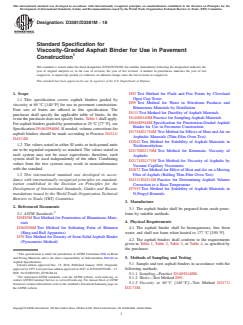
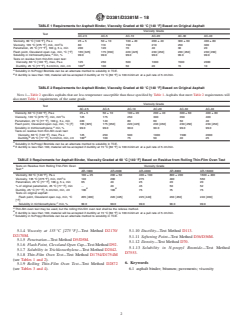


ASTM D3381/D3381M-18 - Standard Specification for Viscosity-Graded Asphalt Binder for Use in Pavement Construction
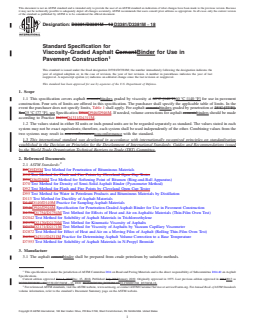
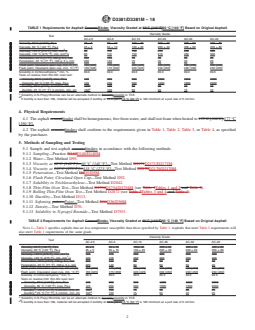

REDLINE ASTM D3381/D3381M-18 - Standard Specification for Viscosity-Graded Asphalt Binder for Use in Pavement Construction
Overview
ASTM D3381/D3381M-18: Standard Specification for Viscosity-Graded Asphalt Binder for Use in Pavement Construction provides a comprehensive set of requirements for asphalt binders used in paving applications. This international ASTM standard ensures that asphalt cements, which are viscosity graded at 60°C (140°F), meet stringent physical property requirements to maintain reliable performance in road and pavement construction. The specification includes multiple sets of grading limits, allowing flexibility based on regional needs and purchaser requirements.
ASTM D3381/D3381M-18 covers binders prepared from crude petroleum, establishing guidelines for production, volume correction, and verification through standardized test methods. Both SI and inch-pound units are recognized; however, the systems should not be combined in a single application to prevent non-conformance.
Key Topics
- Viscosity Grading: The standard defines asphalt binder grades by viscosity at 60°C (140°F). Four distinct sets of limits are presented, addressing various performance demands.
- Physical Property Requirements:
- Viscosity: Primary grading parameter at both 60°C and 135°C (275°F)
- Penetration: Tested at 25°C (77°F) to assess the binder's softness and flexibility
- Flash Point: Measured using the Cleveland open cup method for safe handling and application
- Solubility: Minimum solubility percentage in trichloroethylene (and optionally N-propyl bromide) verifies purity
- Ductility: Ensures elongation capacity at standard temperatures and pull rates
- Behavior During Aging: Evaluation through thin-film and rolling thin-film oven residue tests
- Water Content and Density: Additional checks for quality assurance
- Sampling and Testing: All materials must be sampled and tested according to referenced ASTM procedures, such as D2170, D2171 for viscosity and D113 for ductility.
- International Application: Includes grading tables intended for North and South American regions, providing broad global relevance.
- Purchaser Specification: The purchaser is responsible for indicating the applicable table of specification limits unless otherwise defaulting to Table 1.
Applications
ASTM D3381/D3381M-18 is critical in ensuring the durability and performance of roadways, airport runways, and other paved surfaces. Practical applications include:
- Road and Highway Construction: Ensures that asphalt binders deliver consistent, predictable performance under roadway stressors.
- Quality Control in Asphalt Production: Asphalt producers use the specification to maintain batch-to-batch consistency and product compliance.
- Asphalt Mixture Design: Used by civil engineers and materials specialists in selecting appropriate binder grades for climate and traffic conditions.
- Public Infrastructure Projects: Referenced by government agencies and contractors to comply with national and regional quality standards.
- Export and International Trade: Facilitates clear communication of binder requirements in cross-border pavement construction projects.
Related Standards
- ASTM D946/D946M - Specification for Penetration-Graded Asphalt Binder for Use in Pavement Construction: For binders graded by penetration at 25°C (77°F).
- ASTM D4311/D4311M - Practice for Determining Asphalt Volume Correction to a Base Temperature: Ensures accurate volume adjustments based on temperature.
- ASTM D140/D140M - Sampling Asphalt Materials: Provides guidelines for representative sample collection.
- ASTM D1754/D1754M and D2872 - Oven Aging Tests: Assess the effects of heat and air on asphalt binder performance.
- ASTM D2042 and D7553 - Solubility Tests: Used to verify binder purity and composition.
Adhering to ASTM D3381/D3381M-18 supports high-performance pavement construction by standardizing viscosity grading, ensuring safe and reliable asphalt binder selection, and facilitating global compliance in the civil engineering and construction industries.
Relations
- Effective Date
- 01-Dec-2023
- Effective Date
- 01-Oct-2023
- Effective Date
- 01-May-2020
- Effective Date
- 01-May-2020
- Effective Date
- 15-Dec-2019
- Effective Date
- 15-Dec-2017
- Effective Date
- 01-Jun-2016
- Effective Date
- 01-Dec-2015
- Effective Date
- 01-Jun-2015
- Effective Date
- 01-Jul-2014
- Effective Date
- 01-Jun-2014
- Effective Date
- 01-Jan-2013
- Effective Date
- 01-Nov-2012
- Effective Date
- 01-Aug-2012
- Effective Date
- 01-Aug-2012
Buy Documents
ASTM D3381/D3381M-18 - Standard Specification for Viscosity-Graded Asphalt Binder for Use in Pavement Construction
REDLINE ASTM D3381/D3381M-18 - Standard Specification for Viscosity-Graded Asphalt Binder for Use in Pavement Construction
Get Certified
Connect with accredited certification bodies for this standard

Zavod za gradbeništvo Slovenije (ZAG) - Inšpekcija
ZAG inspection body for construction products, structures, and materials.
Sponsored listings
Frequently Asked Questions
ASTM D3381/D3381M-18 is a technical specification published by ASTM International. Its full title is "Standard Specification for Viscosity-Graded Asphalt Binder for Use in Pavement Construction". This standard covers: ABSTRACT This specification covers three sets of physical requirement limits for asphalt cements graded by viscosity at a specified temperature for use in pavement construction. The purchaser shall indicate the applicable table of limits. The cements shall be prepared from crude petroleum by suitable methods, and if needed, volume corrections should be made as well. The properties for which the materials shall be tested on and should conform to are water content, viscosity, penetration, Cleveland open cup flash point, solubility in trichloroethylene, ductility, and behavior during thin-film oven and rolling thin-film oven tests on residue. SCOPE 1.1 This specification covers asphalt binders graded by viscosity at 60 °C [140 °F] for use in pavement construction. Four sets of limits are offered in this specification. The purchaser shall specify the applicable table of limits. In the event the purchaser does not specify limits, Table 1 shall apply. For asphalt binders graded by penetration at 25 °C [77 °F], see Specification D946/D946M. If needed, volume corrections for asphalt binders should be made according to Practice D4311/D4311M. 1.2 The values stated in either SI units or inch-pound units are to be regarded separately as standard. The values stated in each system may not be exact equivalents; therefore, each system shall be used independently of the other. Combining values from the two systems may result in nonconformance with the standard. 1.3 This international standard was developed in accordance with internationally recognized principles on standardization established in the Decision on Principles for the Development of International Standards, Guides and Recommendations issued by the World Trade Organization Technical Barriers to Trade (TBT) Committee.
ABSTRACT This specification covers three sets of physical requirement limits for asphalt cements graded by viscosity at a specified temperature for use in pavement construction. The purchaser shall indicate the applicable table of limits. The cements shall be prepared from crude petroleum by suitable methods, and if needed, volume corrections should be made as well. The properties for which the materials shall be tested on and should conform to are water content, viscosity, penetration, Cleveland open cup flash point, solubility in trichloroethylene, ductility, and behavior during thin-film oven and rolling thin-film oven tests on residue. SCOPE 1.1 This specification covers asphalt binders graded by viscosity at 60 °C [140 °F] for use in pavement construction. Four sets of limits are offered in this specification. The purchaser shall specify the applicable table of limits. In the event the purchaser does not specify limits, Table 1 shall apply. For asphalt binders graded by penetration at 25 °C [77 °F], see Specification D946/D946M. If needed, volume corrections for asphalt binders should be made according to Practice D4311/D4311M. 1.2 The values stated in either SI units or inch-pound units are to be regarded separately as standard. The values stated in each system may not be exact equivalents; therefore, each system shall be used independently of the other. Combining values from the two systems may result in nonconformance with the standard. 1.3 This international standard was developed in accordance with internationally recognized principles on standardization established in the Decision on Principles for the Development of International Standards, Guides and Recommendations issued by the World Trade Organization Technical Barriers to Trade (TBT) Committee.
ASTM D3381/D3381M-18 is classified under the following ICS (International Classification for Standards) categories: 93.080.20 - Road construction materials. The ICS classification helps identify the subject area and facilitates finding related standards.
ASTM D3381/D3381M-18 has the following relationships with other standards: It is inter standard links to ASTM D140/D140M-16(2023), ASTM D95-23, ASTM D946/D946M-20, ASTM D36/D36M-14(2020), ASTM D5/D5M-19a, ASTM D70-17, ASTM D140/D140M-16, ASTM D946/D946M-15, ASTM D140/D140M-15, ASTM D36/D36M-14, ASTM D140/D140M-14, ASTM D5/D5M-13, ASTM D92-12a, ASTM D2872-12, ASTM D2872-12e1. Understanding these relationships helps ensure you are using the most current and applicable version of the standard.
ASTM D3381/D3381M-18 is available in PDF format for immediate download after purchase. The document can be added to your cart and obtained through the secure checkout process. Digital delivery ensures instant access to the complete standard document.
Standards Content (Sample)
This international standard was developed in accordance with internationally recognized principles on standardization established in the Decision on Principles for the
Development of International Standards, Guides and Recommendations issued by the World Trade Organization Technical Barriers to Trade (TBT) Committee.
Designation:D3381/D3381M −18
Standard Specification for
Viscosity-Graded Asphalt Binder for Use in Pavement
Construction
This standard is issued under the fixed designation D3381/D3381M; the number immediately following the designation indicates the
year of original adoption or, in the case of revision, the year of last revision. A number in parentheses indicates the year of last
reapproval. A superscript epsilon (´) indicates an editorial change since the last revision or reapproval.
This standard has been approved for use by agencies of the U.S. Department of Defense.
1. Scope D92 Test Method for Flash and Fire Points by Cleveland
Open Cup Tester
1.1 This specification covers asphalt binders graded by
D95 Test Method for Water in Petroleum Products and
viscosity at 60 °C [140 °F] for use in pavement construction.
Bituminous Materials by Distillation
Four sets of limits are offered in this specification. The
D113 Test Method for Ductility of Asphalt Materials
purchaser shall specify the applicable table of limits. In the
D140/D140M Practice for Sampling Asphalt Materials
event the purchaser does not specify limits, Table 1 shall apply.
D946/D946M Specification for Penetration-Graded Asphalt
For asphalt binders graded by penetration at 25 °C [77 °F], see
Binder for Use in Pavement Construction
Specification D946/D946M. If needed, volume corrections for
D1754/D1754M Test Method for Effects of Heat andAir on
asphalt binders should be made according to Practice D4311/
Asphaltic Materials (Thin-Film Oven Test)
D4311M.
D2042 Test Method for Solubility of Asphalt Materials in
1.2 The values stated in either SI units or inch-pound units
Trichloroethylene
are to be regarded separately as standard. The values stated in
D2170/D2170M Test Method for Kinematic Viscosity of
each system may not be exact equivalents; therefore, each
Asphalts
system shall be used independently of the other. Combining
D2171/D2171M Test Method for Viscosity of Asphalts by
values from the two systems may result in nonconformance
Vacuum Capillary Viscometer
with the standard.
D2872 Test Method for Effect of Heat and Air on a Moving
1.3 This international standard was developed in accor- Film of Asphalt (Rolling Thin-Film Oven Test)
dance with internationally recognized principles on standard-
D4311/D4311M Practice for Determining Asphalt Volume
ization established in the Decision on Principles for the Correction to a Base Temperature
Development of International Standards, Guides and Recom- D7553 Test Method for Solubility of Asphalt Materials in
mendations issued by the World Trade Organization Technical
N-Propyl Bromide
Barriers to Trade (TBT) Committee.
3. Manufacture
2. Referenced Documents
3.1 The asphalt binder shall be prepared from crude petro-
2.1 ASTM Standards:
leum by suitable methods.
D5/D5M Test Method for Penetration of Bituminous Mate-
4. Physical Requirements
rials
D36/D36M Test Method for Softening Point of Bitumen
4.1 The asphalt binder shall be homogeneous, free from
(Ring-and-Ball Apparatus)
water, and shall not foam when heated to 177 °C [350 °F].
D70 Test Method for Density of Semi-Solid Asphalt Binder
4.2 The asphalt binders shall conform to the requirements
(Pycnometer Method)
given in Table 1, Table 2, Table 3,or Table 4, as specified by
the purchaser.
This specification is under the jurisdiction of ASTM Committee D04 on Road
5. Methods of Sampling and Testing
and Paving Materials and is the direct responsibility of Subcommittee D04.40 on
Asphalt Specifications.
5.1 Sample and test asphalt binders in accordance with the
Current edition approved Dec. 15, 2018. Published January 2019. Originally
following methods:
approved in 1975. Last previous edition approved in 2013 as D3381/D3381M – 13.
DOI: 10.1520/D3381_D3381M-18.
5.1.1 Sampling—Practice D140/D140M.
For referenced ASTM standards, visit the ASTM website, www.astm.org, or
5.1.2 Water—Test Method D95.
contact ASTM Customer Service at service@astm.org. For Annual Book of ASTM
5.1.3 Viscosity at 60 °C [140 °F]—Test Method D2171/
Standards volume information, refer to the standard’s Document Summary page on
the ASTM website. D2171M.
Copyright © ASTM International, 100 Barr Harbor Drive, PO Box C700, West Conshohocken, PA 19428-2959. United States
D3381/D3381M−18
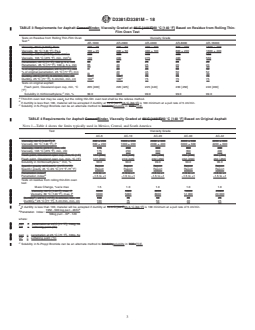
TABLE 1 Requirements for Asphalt Binder, Viscosity Graded at 60°C [140°F] Based on Original Asphalt
Viscosity Grade
Test
AC-2.5 AC-5 AC-10 AC-20 AC-30 AC-40
Viscosity, 60 °C [140 °F], Pa·s 25 ± 5 50 ± 10 100 ± 20 200 ± 40 300 ± 60 400 ± 80
Viscosity, 135 °C [275 °F], min, mm /s 80 110 150 210 250 300
Penetration, 25 °C [77 °F], 100 g, 5 s, min 200 120 70 40 30 20
Flash point, Cleveland open cup, min, °C [°F] 165 [325] 175 [350] 220 [425] 230 [450] 230 [450] 230 [450]
A
Solubility in trichloroethylene, min, % 99.0 99.0 99.0 99.0 99.0 99.0
Tests on residue from thin-film oven test:
Viscosity, 60 °C [140 °F], max, Pa·s 125 250 500 1000 1500 2000
B
Ductility, 25 °C [77 °F], 5 cm/min, min, cm 100 100 50 20 15 10
A
Solubility in N-Propyl Bromide can be an alternate method to solubility in TCE.
B
If ductility is less than 100, material will be accepted if ductility at 15 °C [60 °F] is 100 minimum at a pull rate of 5 cm/min.
TABLE 2 Requirements for Asphalt Binder
...
This document is not an ASTM standard and is intended only to provide the user of an ASTM standard an indication of what changes have been made to the previous version. Because
it may not be technically possible to adequately depict all changes accurately, ASTM recommends that users consult prior editions as appropriate. In all cases only the current version
of the standard as published by ASTM is to be considered the official document.
Designation: D3381/D3381M − 13 D3381/D3381M − 18
Standard Specification for
Viscosity-Graded Asphalt CementBinder for Use in
Pavement Construction
This standard is issued under the fixed designation D3381/D3381M; the number immediately following the designation indicates the
year of original adoption or, in the case of revision, the year of last revision. A number in parentheses indicates the year of last
reapproval. A superscript epsilon (´) indicates an editorial change since the last revision or reapproval.
This standard has been approved for use by agencies of the U.S. Department of Defense.
1. Scope
1.1 This specification covers asphalt cementsbinders graded by viscosity at 60°C [140°F]60 °C [140 °F] for use in pavement
construction. Four sets of limits are offered in this specification. The purchaser shall specify the applicable table of limits. In the
event the purchaser does not specify limits, Table 1 shall apply. For asphalt cementsbinders graded by penetration at 25°C [77°F].
See25 °C [77 °F], see Specification D946D946/D946M. If needed, volume corrections for asphalt cementsbinders should be made
according to Practice D4311D4311/D4311M.
1.2 The values stated in either SI units or inch-pound units are to be regarded separately as standard. The values stated in each
system may not be exact equivalents; therefore, each system shall be used independently of the other. Combining values from the
two systems may result in non-conformancenonconformance with the standard.
1.3 This international standard was developed in accordance with internationally recognized principles on standardization
established in the Decision on Principles for the Development of International Standards, Guides and Recommendations issued
by the World Trade Organization Technical Barriers to Trade (TBT) Committee.
2. Referenced Documents
2.1 ASTM Standards:
D5D5/D5M Test Method for Penetration of Bituminous Materials
D92 Test Method for Flash and Fire Points by Cleveland Open Cup Tester
D36D36/D36M Test Method for Softening Point of Bitumen (Ring-and-Ball Apparatus)
D70 Test Method for Density of Semi-Solid Asphalt Binder (Pycnometer Method)
D92 Test Method for Flash and Fire Points by Cleveland Open Cup Tester
D95 Test Method for Water in Petroleum Products and Bituminous Materials by Distillation
D113 Test Method for Ductility of Asphalt Materials
D140D140/D140M Practice for Sampling Asphalt Materials
D946D946/D946M Specification for Penetration-Graded Asphalt Binder for Use in Pavement Construction
D1754D1754/D1754M Test Method for Effects of Heat and Air on Asphaltic Materials (Thin-Film Oven Test)
D2042 Test Method for Solubility of Asphalt Materials in Trichloroethylene
D2170D2170/D2170M Test Method for Kinematic Viscosity of Asphalts
D2171D2171/D2171M Test Method for Viscosity of Asphalts by Vacuum Capillary Viscometer
D2872 Test Method for Effect of Heat and Air on a Moving Film of Asphalt (Rolling Thin-Film Oven Test)
D4311D4311/D4311M Practice for Determining Asphalt Volume Correction to a Base Temperature
D7553 Test Method for Solubility of Asphalt Materials in N-Propyl Bromide
3. Manufacture
3.1 The asphalt cementbinder shall be prepared from crude petroleum by suitable methods.
This specification is under the jurisdiction of ASTM Committee D04 on Road and Paving Materials and is the direct responsibility of Subcommittee D04.40 on Asphalt
Specifications.
Current edition approved June 1, 2013Dec. 15, 2018. Published July 2013January 2019. Originally approved in 1975. Last previous edition approved in 20122013 as
D3381/D3381M – 12.D3381/D3381M – 13. DOI: 10.1520/D3381_D3381M-13.10.1520/D3381_D3381M-18.
For referenced ASTM standards, visit the ASTM website, www.astm.org, or contact ASTM Customer Service at service@astm.org. For Annual Book of ASTM Standards
volume information, refer to the standard’s Document Summary page on the ASTM website.
Copyright © ASTM International, 100 Barr Harbor Drive, PO Box C700, West Conshohocken, PA 19428-2959. United States
D3381/D3381M − 18
TABLE 1 Requirements for Asphalt Cement,Binder, Viscosity Graded at 60°C [140°F]60 °C [140 °F] Based on Original Asphalt
Viscosity Grade
Test
AC-2.5 AC-5 AC-10 AC-20 AC-30 AC-40
Viscosity, 60°C [140°F], Pa·s 25 ± 5 50 ± 10 100 ± 20 200 ± 40 300 ± 60 400 ± 80
Viscosity, 60 °C [140 °F], Pa·s 25 ± 5 50 ± 10 100 ± 20 200 ± 40 300 ± 60 400 ± 80
Viscosity, 135°C [275°F], min, mm /s 80 110 150 210 250 300
Viscosity, 135 °C [275 °F], min, mm /s 80 110 150 210 250 300
Penetration, 25°C [77°F], 100 g, 5 s, min 200 120 70 40 30 20
Penetration, 25 °C [77 °F], 100 g, 5 s, min 200 120 70 40 30 20
Flash point, Cleveland open cup, min,°C [°F] 165 [325] 175 [350] 220 [425] 230 [450] 230 [450] 230 [450]
Flash point, Cleveland open cup, min, °C [°F] 165 [325] 175 [350] 220 [425] 230 [450] 230 [450] 230 [450]
A
Solubility in trichloroethylene, min, % 99.0 99.0 99.0 99.0 99.0 99.0
Tests on residue from thin-film oven test:
Viscosity, 60°C [140°F], max, Pa·s 125 250 500 1000 1500 2000
Viscosity, 60 °C [140 °F], max, Pa·s 125 250 500 1000 1500 2000
B
Ductility, 25°C [77°F], 5 cm/min, min, cm 100 100 50 20 15 10
B
Ductility, 25 °C [77 °F], 5 cm/min, min, cm 100 100 50 20 15 10
A
Solubility in N-Propyl Bromide can be an alternate method to Solubilitysolubility in TCE.
B
If ductility is less than 100, material will be accepted if ductility at 15°C [60°F]15 °C [60 °F] is 100 minimum at a pull rate of 5 cm/min.
4. Physical Requirements
4.1 The asphalt cementbinder shall be homogeneous, free from water, and shall not foam when heated to 177°C [350°F].177 °C
[350 °F].
4.2 The asphalt cementsbinders shall conform to the requirements given in Table 1, Table 2, Table 3, or Table 4, as specified
by the purchaser.
5. Methods of Sampling and Testing
5.1 Sample and test asphalt cementsbinders in accordance with the following methods:
5.1.1 Sampling—Practice D140D140/D140M.
5.1.2 Water—Test Method D95.
5.1.3 Viscosity at 60°C [140°F]—60 °C [140 °F]—Test Method D2171D2171/D2171M.
5.1.4 Viscosity at 135°C [275°F]—135 °C [275 °F]—Test Method D2170D2170/D2170M.
5.1.5 Penetration—Test Method D5D5/D5M.
5.1.6 Flash Point, Cleveland Open Cup—Test Method D92.
5.1.7 Solubility in Trichloroethylene—Test Method D2042.
5.1.8 Thin-Film Oven Test—Test Method D1754D1754/D1754M (see Table 1Tables 1 and 2 and Table 2).
5.1.9 Rolling Thin-Film Oven Test—Test Method D2872 (see Table 3Tables 3 and
...