

ASTM C1728-23
(Specification)Standard Specification for Flexible Aerogel Insulation
General Information
- Abstract
ABSTRACT
This specification covers the classification and performance of flexible aerogel thermal insulation. It indicates the mechanical, chemical, and property requirements of the flexible aerogel insulation, such as its thickness, density, and flexibility. It also lists the performance requirements for Types I, II, and III flexible aerogel insulation, and the acceptable dimensions and tolerances on flexible aerogel insulation sheets.
SCOPE
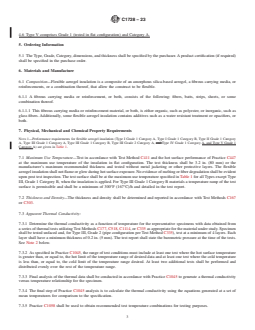
1.1 This specification covers the classification and performance of flexible aerogel thermal insulation. This will cover the range of continuous exposure operating temperatures from –321°F (–196°C) up to 1200°F (649°C).
1.2 For satisfactory performance, properly installed protective vapor retarders or barriers shall be used on below ambient temperature applications to reduce movement of moisture through or around the insulation to the colder surface. Failure to use a vapor retarder or barrier could lead to insulation and system non-performance.
1.3 The values stated in inch-pound units are to be regarded as standard. The values given in parentheses are mathematical conversions to SI units that are provided for information only and are not considered standard.
1.4 The following safety hazards caveat pertains only to the test methods described in this specification. This standard does not purport to address all of the safety concerns, if any, associated with its use. It is the responsibility of the user of this standard to establish appropriate safety, health, and environmental practices and determine the applicability of regulatory limitations prior to use.
1.5 This international standard was developed in accordance with internationally recognized principles on standardization established in the Decision on Principles for the Development of International Standards, Guides and Recommendations issued by the World Trade Organization Technical Barriers to Trade (TBT) Committee.
- Status
- Published
- Publication Date
- 31-Mar-2023
- Technical Committee
- C16 - Thermal Insulation
- Drafting Committee
- C16.23 - Blanket and Loose Fill Insulation
Overview
ASTM C1728-23, "Standard Specification for Flexible Aerogel Insulation," provides guidelines for classifying and evaluating the performance of flexible aerogel thermal insulation products. This standard is widely used in the thermal insulation industry due to the unique combination of flexibility and high insulating properties provided by aerogel materials. The specification addresses product requirements, performance criteria, and test methods for flexible aerogel insulation across a wide temperature range: from –321°F (–196°C) to 1200°F (649°C). Key considerations such as thickness, density, flexibility, water resistance, and thermal conductivity are detailed for various insulation types and applications.
Key Topics
Classification and Types
Flexible aerogel insulation is categorized into Types I through V, based primarily on maximum use temperature, with further subdivisions by grade and category regarding application and test configuration.Performance Requirements
The standard sets clear criteria for:- Maximum and minimum use temperatures
- Thermal conductivity at specified mean temperatures
- Density and thickness tolerances
- Mechanical properties such as compressive strength and flexibility (in accordance with specified ASTM test methods)
- Chemical properties such as water absorption, water vapor sorption, and corrosiveness
Installation Considerations
For applications below ambient temperature, the use of vapor retarders or barriers is mandated to prevent moisture ingress, ensuring optimal system performance.Testing and Compliance
Conformance is verified using recognized ASTM test methods for properties including compressive resistance, fungi resistance, linear shrinkage, and flame spread index.Workmanship and Quality Insulation materials covered by this standard must exhibit workmanship with no defects that would adversely affect their installation or service life.
Applications
Flexible aerogel insulation specified under ASTM C1728-23 is extensively used in:
- Industrial and Commercial Piping
Efficient thermal insulation for hot and cold service pipes, including cryogenic and high-temperature lines. - HVAC Systems Reducing energy loss in heating, ventilation, and air conditioning ductwork and equipment.
- Building Envelope and Facade Insulation Enhancing the thermal resistance of walls, roofs, and floors, especially in retrofitting scenarios where space is limited.
- Transportation Used in marine, automotive, and aerospace applications for weight-sensitive, high-performance insulation.
- Process Equipment Applied on reactors, tanks, and vessels where both flexibility and superior R-value are required.
Aerogel insulation is particularly valued for its light weight, flexibility, resistance to moisture uptake, and exceptional thermal performance across extreme temperatures.
Related Standards
ASTM C1728-23 is part of a suite of standards supporting thermal insulation manufacturing and quality control. Related ASTM standards include:
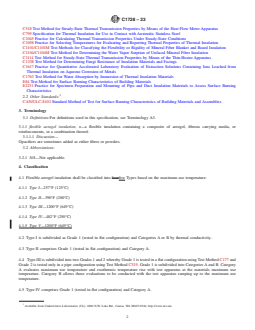
- ASTM C165 – Test Method for Measuring Compressive Properties of Thermal Insulations
- ASTM C167 – Test Methods for Thickness and Density of Blanket or Batt Thermal Insulations
- ASTM C177 – Test Method for Steady-State Heat Flux Measurements and Thermal Transmission Properties
- ASTM C411 – Test Method for Hot-Surface Performance of High-Temperature Thermal Insulation
- ASTM C518 – Test Method for Steady-State Thermal Transmission Properties by Means of the Heat Flow Meter Apparatus
- ASTM C1338 – Test Method for Determining Fungi Resistance of Insulation Materials and Facings
- ASTM C1763 – Test Method for Water Absorption by Immersion of Thermal Insulation Materials
- ASTM C795 – Specification for Thermal Insulation for Use in Contact with Austenitic Stainless Steel
Consult these related standards for complementary guidelines on insulation performance, installation practices, and product evaluation.
Keywords: flexible aerogel insulation, ASTM C1728-23, thermal insulation, aerogel blanket, pipe insulation, thermal conductivity, insulation standards, building materials, industrial insulation, vapor barrier.
Relations
- Effective Date
- 15-Apr-2024
- Effective Date
- 01-Mar-2024
- Effective Date
- 01-Dec-2023
- Effective Date
- 01-Sep-2023
- Effective Date
- 01-Sep-2023
- Effective Date
- 01-May-2020
- Effective Date
- 15-Oct-2019
- Effective Date
- 15-Oct-2019
- Effective Date
- 01-Sep-2019
- Effective Date
- 01-Sep-2019
- Effective Date
- 01-Jul-2019
- Effective Date
- 01-May-2019
- Effective Date
- 15-Apr-2019
- Effective Date
- 01-Apr-2019
- Effective Date
- 01-Mar-2019
Get Certified
Connect with accredited certification bodies for this standard

DIBt (Deutsches Institut für Bautechnik)
German Institute for Building Technology.
DIN CERTCO
DIN Group product certification.

Aboma Certification B.V.
Specialized in construction, metal, and transport sectors.
Sponsored listings
Frequently Asked Questions
ASTM C1728-23 is a technical specification published by ASTM International. Its full title is "Standard Specification for Flexible Aerogel Insulation". This standard covers: ABSTRACT This specification covers the classification and performance of flexible aerogel thermal insulation. It indicates the mechanical, chemical, and property requirements of the flexible aerogel insulation, such as its thickness, density, and flexibility. It also lists the performance requirements for Types I, II, and III flexible aerogel insulation, and the acceptable dimensions and tolerances on flexible aerogel insulation sheets. SCOPE 1.1 This specification covers the classification and performance of flexible aerogel thermal insulation. This will cover the range of continuous exposure operating temperatures from –321°F (–196°C) up to 1200°F (649°C). 1.2 For satisfactory performance, properly installed protective vapor retarders or barriers shall be used on below ambient temperature applications to reduce movement of moisture through or around the insulation to the colder surface. Failure to use a vapor retarder or barrier could lead to insulation and system non-performance. 1.3 The values stated in inch-pound units are to be regarded as standard. The values given in parentheses are mathematical conversions to SI units that are provided for information only and are not considered standard. 1.4 The following safety hazards caveat pertains only to the test methods described in this specification. This standard does not purport to address all of the safety concerns, if any, associated with its use. It is the responsibility of the user of this standard to establish appropriate safety, health, and environmental practices and determine the applicability of regulatory limitations prior to use. 1.5 This international standard was developed in accordance with internationally recognized principles on standardization established in the Decision on Principles for the Development of International Standards, Guides and Recommendations issued by the World Trade Organization Technical Barriers to Trade (TBT) Committee.
ABSTRACT This specification covers the classification and performance of flexible aerogel thermal insulation. It indicates the mechanical, chemical, and property requirements of the flexible aerogel insulation, such as its thickness, density, and flexibility. It also lists the performance requirements for Types I, II, and III flexible aerogel insulation, and the acceptable dimensions and tolerances on flexible aerogel insulation sheets. SCOPE 1.1 This specification covers the classification and performance of flexible aerogel thermal insulation. This will cover the range of continuous exposure operating temperatures from –321°F (–196°C) up to 1200°F (649°C). 1.2 For satisfactory performance, properly installed protective vapor retarders or barriers shall be used on below ambient temperature applications to reduce movement of moisture through or around the insulation to the colder surface. Failure to use a vapor retarder or barrier could lead to insulation and system non-performance. 1.3 The values stated in inch-pound units are to be regarded as standard. The values given in parentheses are mathematical conversions to SI units that are provided for information only and are not considered standard. 1.4 The following safety hazards caveat pertains only to the test methods described in this specification. This standard does not purport to address all of the safety concerns, if any, associated with its use. It is the responsibility of the user of this standard to establish appropriate safety, health, and environmental practices and determine the applicability of regulatory limitations prior to use. 1.5 This international standard was developed in accordance with internationally recognized principles on standardization established in the Decision on Principles for the Development of International Standards, Guides and Recommendations issued by the World Trade Organization Technical Barriers to Trade (TBT) Committee.
ASTM C1728-23 is classified under the following ICS (International Classification for Standards) categories: 91.100.60 - Thermal and sound insulating materials. The ICS classification helps identify the subject area and facilitates finding related standards.
ASTM C1728-23 has the following relationships with other standards: It is inter standard links to ASTM C168-24, ASTM C390-08(2024), ASTM E84-23d, ASTM E84-23c, ASTM C1101/C1101M-23, ASTM C1763-20, ASTM C1763-19, ASTM C1763-19e1, ASTM C390-08(2019), ASTM C1104/C1104M-19, ASTM E84-19b, ASTM C1617-19, ASTM E84-19a, ASTM C1045-19, ASTM E84-19. Understanding these relationships helps ensure you are using the most current and applicable version of the standard.
ASTM C1728-23 is available in PDF format for immediate download after purchase. The document can be added to your cart and obtained through the secure checkout process. Digital delivery ensures instant access to the complete standard document.
Standards Content (Sample)
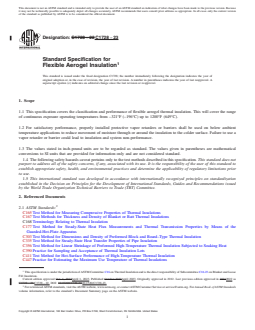
This international standard was developed in accordance with internationally recognized principles on standardization established in the Decision on Principles for the
Development of International Standards, Guides and Recommendations issued by the World Trade Organization Technical Barriers to Trade (TBT) Committee.
Designation: C1728 − 23
Standard Specification for
Flexible Aerogel Insulation
This standard is issued under the fixed designation C1728; the number immediately following the designation indicates the year of
original adoption or, in the case of revision, the year of last revision. A number in parentheses indicates the year of last reapproval. A
superscript epsilon (´) indicates an editorial change since the last revision or reapproval.
1. Scope C167 Test Methods for Thickness and Density of Blanket or
Batt Thermal Insulations
1.1 This specification covers the classification and perfor-
C168 Terminology Relating to Thermal Insulation
mance of flexible aerogel thermal insulation. This will cover
C177 Test Method for Steady-State Heat Flux Measure-
the range of continuous exposure operating temperatures from
ments and Thermal Transmission Properties by Means of
–321°F (–196°C) up to 1200°F (649°C).
the Guarded-Hot-Plate Apparatus
1.2 For satisfactory performance, properly installed protec-
C303 Test Method for Dimensions and Density of Pre-
tive vapor retarders or barriers shall be used on below ambient
formed Block and Board–Type Thermal Insulation
temperature applications to reduce movement of moisture
C335 Test Method for Steady-State Heat Transfer Properties
through or around the insulation to the colder surface. Failure
of Pipe Insulation
to use a vapor retarder or barrier could lead to insulation and
C356 Test Method for Linear Shrinkage of Preformed High-
system non-performance.
Temperature Thermal Insulation Subjected to Soaking
1.3 The values stated in inch-pound units are to be regarded
Heat
as standard. The values given in parentheses are mathematical
C390 Practice for Sampling and Acceptance of Thermal
conversions to SI units that are provided for information only
Insulation Lots
and are not considered standard.
C411 Test Method for Hot-Surface Performance of High-
1.4 The following safety hazards caveat pertains only to the
Temperature Thermal Insulation
test methods described in this specification. This standard does
C447 Practice for Estimating the Maximum Use Tempera-
not purport to address all of the safety concerns, if any,
ture of Thermal Insulations
associated with its use. It is the responsibility of the user of this
C518 Test Method for Steady-State Thermal Transmission
standard to establish appropriate safety, health, and environ-
Properties by Means of the Heat Flow Meter Apparatus
mental practices and determine the applicability of regulatory
C795 Specification for Thermal Insulation for Use in Con-
limitations prior to use.
tact with Austenitic Stainless Steel
1.5 This international standard was developed in accor-
C1045 Practice for Calculating Thermal Transmission Prop-
dance with internationally recognized principles on standard-
erties Under Steady-State Conditions
ization established in the Decision on Principles for the
C1058 Practice for Selecting Temperatures for Evaluating
Development of International Standards, Guides and Recom-
and Reporting Thermal Properties of Thermal Insulation
mendations issued by the World Trade Organization Technical
C1101/C1101M Test Methods for Classifying the Flexibility
Barriers to Trade (TBT) Committee.
or Rigidity of Mineral Fiber Blanket and Board Insulation
C1104/C1104M Test Method for Determining the Water
2. Referenced Documents
Vapor Sorption of Unfaced Mineral Fiber Insulation
2.1 ASTM Standards:
C1114 Test Method for Steady-State Thermal Transmission
C165 Test Method for Measuring Compressive Properties of
Properties by Means of the Thin-Heater Apparatus
Thermal Insulations
C1338 Test Method for Determining Fungi Resistance of
Insulation Materials and Facings
C1617 Practice for Quantitative Accelerated Laboratory
This specification is under the jurisdiction of ASTM Committee C16 on
Thermal Insulation and is the direct responsibility of Subcommittee C16.23 on
Evaluation of Extraction Solutions Containing Ions
Blanket and Loose Fill Insulation.
Leached from Thermal Insulation on Aqueous Corrosion
Current edition approved April 1, 2023. Published April 2023. Originally
of Metals
approved in 2012. Last previous edition approved in 2022 as C1728 – 22. DOI:
10.1520/C1728-23.
C1763 Test Method for Water Absorption by Immersion of
For referenced ASTM standards, visit the ASTM website, www.astm.org, or
Thermal Insulation Materials
contact ASTM Customer Service at service@astm.org. For Annual Book of ASTM
E84 Test Method for Surface Burning Characteristics of
Standards volume information, refer to the standard’s Document Summary page on
the ASTM website. Building Materials
Copyright © ASTM International, 100 Barr Harbor Drive, PO Box C700, West Conshohocken, PA 19428-2959. United States
C1728 − 23
E2231 Practice for Specimen Preparation and Mounting of or reinforcements, or a combination thereof, that allow the
Pipe and Duct Insulation Materials to Assess Surface construct to be flexible.
Burning Characteristics 6.1.1 A fibrous carrying media or reinforcement, or both,
consists of the following: fibers, batts, strips, sheets, or some
2.2 Other Standards:
combination thereof.
CAN/ULC-S102 Standard Method of Test for Surface Burn-
6.1.1.1 This fibrous carrying media or reinforcement
ing Characteristics of Building Materials and Assemblies
material, or both, is either organic, such as polyester, or
3. Terminology inorganic, such as glass fibers. Additionally, some flexible
aerogel insulation contains additives such as a water resistant
3.1 Definitions:For definitions used in this specification, see
treatment or opacifiers, or both.
Terminology A3.
3.1.1 flexible aerogel insulation, n—a flexible insulation
7. Physical, Mechanical and Chemical Property
containing a composite of aerogel, fibrous carrying media, or
Requirements
reinforcements, or a combination thereof.
NOTE 1—Performance requirements for flexible aerogel insulation
3.1.1.1 Discussion—Opacifiers are sometimes added as ei- (Type I Grade 1 Category A, Type I Grade 1 Category B, Type II Grade
1 Category A, Type III Grade 1 Category A, Type III Grade 1 Category B,
ther fibers or powders.
Type III Grade 2 Category A, Type IV Grade 1 Category A, and Type V
3.2 Abbreviations:
Grade 1 Category A) are given in Table 1.
3.2.1 N/A—Not applicable.
7.1 Maximum Use Temperature—Test in accordance with
Test Method C411 and the hot surface performance of Practice
4. Classification
C447 at the maximum use temperature of the insulation in flat
4.1 Flexible aerogel insulation shall be classified into five
configuration. The test thickness shall be 3.2 in. (80 mm) or the
Types based on the maximum use temperature:
manufacturer’s maximum recommended thickness and tested
4.1.1 Type I—257°F (125°C)
without metal jacketing or other protective layers. The flexible
4.1.2 Type II—390°F (200°C)
aerogel insulation shall not flame or glow during hot surface
4.1.3 Type III—1200°F (649°C)
exposure. No evidence of melting or fiber degradation shall be
4.1.4 Type IV—482°F (250°C)
evident upon post test inspection. The test surface shall be at
4.1.5 Type V—1200°F (649°C)
the maximum use temperature specified in Table 1 for all Types
except Type III, Grade 1 Category B, when the insulation is
4.2 Type I is subdivided as Grade 1 (tested in flat configu-
applied. For Type III Grade 1 Category B materials a tempera-
ration) and Categories A or B by thermal conductivity.
ture ramp of the test surface is permissible and shall be a
4.3 Type II comprises Grade 1 (tested in flat configuration)
minimum of 300°F (167°C)/h and detailed in the test report.
and Category A.
7.2 Thickness and Density—The thickness and density shall
4.4 Type III is subdivided into two Grades 1 and 2 whereby
be determined and reported in accordance with Test Methods
Grade 1 is tested in a flat configuration using Test Method
C167 or C303.
C177 and Grade 2 is tested only in a pipe configuration using
7.3 Apparent Thermal Conductivity:
Test Method C335. Grade 1 is subdivided into Categories A
7.3.1 Determine the thermal conductivity as a function of
and B. Category A evaluates maximum use temperature and
temperature for the representative specimens with data ob-
exothermic temperature rise with test apparatus at the materials
tained from a series of thermal tests utilizing Test Methods
maximum use temperature. Category B allows those evalua-
C177, C518, C1114, or C335 as appropriate for the material
tions to be conducted with the test apparatus ramping up to the
under study. Specimen shall be tested unfaced and, for Type III,
maximum use temperature.
Grade 2 (pipe configuration per Test Method C335), test at a
4.5 Type IV comprises Grade 1 (tested in flat configuration)
minimum of 4 layers. Each layer shall have a minimum
and Category A.
thickness of 0.2 in. (5 mm). The test report shall state the
4.6 Type V comprises Grade 1 (tested in flat configuration)
barometric pressure at the time of the tests. See Note 2 below.
and Category A.
7.3.2 As specified in Practice C1045, the range of test
conditions must include at least one test where the hot surface
5. Ordering Information
temperature is greater than, or equal to, the hot limit of the
temperature range of desired data and at least one test where
5.1 The Type, Grade, Category, dimensions, and thickness
the cold temperature is less than, or equal to, the cold limit of
shall be specified by the purchaser. A product certification (if
the temperature range desired. At least two additional tests
required) shall be specified in the purchase order.
shall be performed and distributed evenly over the rest of the
6. Materials and Manufacture temperature range.
7.3.3 Final analysis of the thermal data shall be conducted in
6.1 Composition—Flexible aerogel insulation is a composite
accordance with Practice C1045 to generate a thermal conduc-
of an amorphous silica-based aerogel, a fibrous carrying media,
tivity versus temperature relationship for the specimen.
7.3.4 The final step of Practice C1045 analysis is to calcu-
late the thermal conductivity using the equations generated at
Available from Underwriters Laboratories (UL), 2600 N.W. Lake Rd., Camas,
WA 98607-8542, http://www.ul.com. a set of mean temperatures for comparison to the specification.
C1728 − 23
TABLE 1 Performance Requirements for Types I, II, III, and IV Flexible Aerogel Insulation
Type I I II III III III IV V
Grade 1 1 1 1 1 2 1 1
Category A B A A B A A A
Maximum use temperature, 257 257 390 1200 1200 1200 482 1200
°F (°C) (125) (125) (199) (649) (649) (649) (250) (649)
Minimum use temperature, -321 -321 -321 75 75 75 -321 75
°F (°C) (-196) (-196) (-196) (24) (24) (24) (-196) (24)
Minimum / Maximum Composite Density, 1.9 to 6.3 5.0 to 11.2 4.7 to 9.4 10.0 to
...
This document is not an ASTM standard and is intended only to provide the user of an ASTM standard an indication of what changes have been made to the previous version. Because
it may not be technically possible to adequately depict all changes accurately, ASTM recommends that users consult prior editions as appropriate. In all cases only the current version
of the standard as published by ASTM is to be considered the official document.
Designation: C1728 − 22 C1728 − 23
Standard Specification for
Flexible Aerogel Insulation
This standard is issued under the fixed designation C1728; the number immediately following the designation indicates the year of
original adoption or, in the case of revision, the year of last revision. A number in parentheses indicates the year of last reapproval. A
superscript epsilon (´) indicates an editorial change since the last revision or reapproval.
1. Scope
1.1 This specification covers the classification and performance of flexible aerogel thermal insulation. This will cover the range
of continuous exposure operating temperatures from –321°F (–196°C) up to 1200°F (649°C).
1.2 For satisfactory performance, properly installed protective vapor retarders or barriers shall be used on below ambient
temperature applications to reduce movement of moisture through or around the insulation to the colder surface. Failure to use a
vapor retarder or barrier could lead to insulation and system non-performance.
1.3 The values stated in inch-pound units are to be regarded as standard. The values given in parentheses are mathematical
conversions to SI units that are provided for information only and are not considered standard.
1.4 The following safety hazards caveat pertains only to the test methods described in this specification. This standard does not
purport to address all of the safety concerns, if any, associated with its use. It is the responsibility of the user of this standard to
establish appropriate safety, health, and environmental practices and determine the applicability of regulatory limitations prior
to use.
1.5 This international standard was developed in accordance with internationally recognized principles on standardization
established in the Decision on Principles for the Development of International Standards, Guides and Recommendations issued
by the World Trade Organization Technical Barriers to Trade (TBT) Committee.
2. Referenced Documents
2.1 ASTM Standards:
C165 Test Method for Measuring Compressive Properties of Thermal Insulations
C167 Test Methods for Thickness and Density of Blanket or Batt Thermal Insulations
C168 Terminology Relating to Thermal Insulation
C177 Test Method for Steady-State Heat Flux Measurements and Thermal Transmission Properties by Means of the
Guarded-Hot-Plate Apparatus
C303 Test Method for Dimensions and Density of Preformed Block and Board–Type Thermal Insulation
C335 Test Method for Steady-State Heat Transfer Properties of Pipe Insulation
C356 Test Method for Linear Shrinkage of Preformed High-Temperature Thermal Insulation Subjected to Soaking Heat
C390 Practice for Sampling and Acceptance of Thermal Insulation Lots
C411 Test Method for Hot-Surface Performance of High-Temperature Thermal Insulation
C447 Practice for Estimating the Maximum Use Temperature of Thermal Insulations
This specification is under the jurisdiction of ASTM Committee C16 on Thermal Insulation and is the direct responsibility of Subcommittee C16.23 on Blanket and Loose
Fill Insulation.
Current edition approved Oct. 1, 2022April 1, 2023. Published October 2022April 2023. Originally approved in 2012. Last previous edition approved in 20212022 as
C1728 – 21.C1728 – 22. DOI: 10.1520/C1728-22.10.1520/C1728-23.
For referenced ASTM standards, visit the ASTM website, www.astm.org, or contact ASTM Customer Service at service@astm.org. For Annual Book of ASTM Standards
volume information, refer to the standard’s Document Summary page on the ASTM website.
Copyright © ASTM International, 100 Barr Harbor Drive, PO Box C700, West Conshohocken, PA 19428-2959. United States
C1728 − 23
C518 Test Method for Steady-State Thermal Transmission Properties by Means of the Heat Flow Meter Apparatus
C795 Specification for Thermal Insulation for Use in Contact with Austenitic Stainless Steel
C1045 Practice for Calculating Thermal Transmission Properties Under Steady-State Conditions
C1058 Practice for Selecting Temperatures for Evaluating and Reporting Thermal Properties of Thermal Insulation
C1101/C1101M Test Methods for Classifying the Flexibility or Rigidity of Mineral Fiber Blanket and Board Insulation
C1104/C1104M Test Method for Determining the Water Vapor Sorption of Unfaced Mineral Fiber Insulation
C1114 Test Method for Steady-State Thermal Transmission Properties by Means of the Thin-Heater Apparatus
C1338 Test Method for Determining Fungi Resistance of Insulation Materials and Facings
C1617 Practice for Quantitative Accelerated Laboratory Evaluation of Extraction Solutions Containing Ions Leached from
Thermal Insulation on Aqueous Corrosion of Metals
C1763 Test Method for Water Absorption by Immersion of Thermal Insulation Materials
E84 Test Method for Surface Burning Characteristics of Building Materials
E2231 Practice for Specimen Preparation and Mounting of Pipe and Duct Insulation Materials to Assess Surface Burning
Characteristics
2.2 Other Standards:
CAN/ULC-S102 Standard Method of Test for Surface Burning Characteristics of Building Materials and Assemblies
3. Terminology
3.1 Definitions:For definitions used in this specification, see Terminology A3.
3.1.1 flexible aerogel insulation, n—a flexible insulation containing a composite of aerogel, fibrous carrying media, or
reinforcements, or a combination thereof.
3.1.1.1 Discussion—
Opacifiers are sometimes added as either fibers or powders.
3.2 Abbreviations:
3.2.1 N/A—Not applicable.
4. Classification
4.1 Flexible aerogel insulation shall be classified into fourfive Types based on the maximum use temperature:
4.1.1 Type I—257°F (125°C)
4.1.2 Type II—390°F (200°C)
4.1.3 Type III—1200°F (649°C)
4.1.4 Type IV—482°F (250°C)
4.1.5 Type V—1200°F (649°C)
4.2 Type I is subdivided as Grade 1 (tested in flat configuration) and Categories A or B by thermal conductivity.
4.3 Type II comprises Grade 1 (tested in flat configuration) and Category A.
4.4 Type III is subdivided into two Grades 1 and 2 whereby Grade 1 is tested in a flat configuration using Test Method C177 and
Grade 2 is tested only in a pipe configuration using Test Method C335. Grade 1 is subdivided into Categories A and B. Category
A evaluates maximum use temperature and exothermic temperature rise with test apparatus at the materials maximum use
temperature. Category B allows those evaluations to be conducted with the test apparatus ramping up to the maximum use
temperature.
4.5 Type IV comprises Grade 1 (tested in flat configuration) and Category A.
Available from Underwriters Laboratories (UL), 2600 N.W. Lake Rd., Camas, WA 98607-8542, http://www.ul.com.
C1728 − 23
4.6 Type V comprises Grade 1 (tested in flat configuration) and Category A.
5. Ordering Information
5.1 The Type, Grade, Category, dimensions, and thickness shall be specified by the purchaser. A product certification (if required)
shall be specified in the purchase order.
6. Materials and Manufacture
6.1 Composition—Flexible aerogel insulation is a composite of an amorphous silica-based aerogel, a fibrous carrying media, or
reinforcements, or a combination thereof, that allow the construct to be flexible.
6.1.1 A fibrous carrying media or reinforcement, or both, consists of the following: fibers, batts, strips, sheets, or some
combination thereof.
6.1.1.1 This fibrous carrying media or reinforcement material, or both, is either organic, such as polyester, or inorganic, such as
glass fibers. Additionally, some flexible aerogel insulation contains additives such as a water resistant treatment or opacifiers, or
both.
7. Physical, Mechanical and Chemical Property Requirements
NOTE 1—Performance requirements for flexible aerogel insulation (Type I Grade 1 Category A, Type I Grade 1 Category B, Type II Grade 1 Category
A, Type III Grade 1 Category A, Type III Grade 1 Category B, Type III Grade 2 Category A, and Type IV Grade 1 Category A, and Type V Grade 1
Category A) are given in Table 1.
7.1 Maximum Use Temperature—Test in accordance with Test Method C411 and the hot surface performance of Practice C447
at the maximum use temperature of the insulation in flat configuration. The test thickness shall be 3.2 in. (80 mm) or the
manufacturer’s maximum recommended thickness and tested without metal jacketing or other protective layers. The flexible
aerogel insulation shall not flame or glow during hot surface exposure. No evidence of melting or fiber degradation shall be evident
upon post test inspection. The test surface shall be at the maximum use temperature specified in Table 1 for all Types except Type
III, Grade 1 Category B, when the insulation is applied. For Type III Grade 1 Category B materials a temperature ramp of the test
surface is permissible and shall be a minimum of 300°F (167°C)/h and detailed in the test report.
7.2 Thickness and Density—The thickness and density shall be determined and reported in accordance with Test Methods C167
or C303.
7.3 Apparent Thermal Conductivity:
7.3.1 Determine the thermal conductivity as a function of temperature for the representative specimens with data obtained from
a series of thermal tests utilizing Test Methods C177, C518, C1114, or C335 as appropriate for the material under study. Specimen
shall be tested unfaced and, for Type III, Grade 2 (pipe configuration per Test Method C335), test at a minimum of 4 layers. Each
layer shall have a minimum thickness of 0.2 in. (5 mm). The test report shall state the barometric pressure at the time of the tests.
See Note 2 below.
7.3.2 As specified in Practice C1045, the range of test conditions must include at least one test where the hot surface temperature
is greater than, or equal to, the hot limit of the temperature range of desired data and at least one test where the cold temperature
is less than, or equal to, the cold limit of the temperature range desired. At least two additional tests shall be performed and
distributed evenly over the rest of the temperature range.
7.3.3 Final analysis of the thermal data shall be conducted in accordance with Practice C1045 to generate a thermal conductivity
versus temperature relationship for the specimen.
7.3.4 The final step of Practice C1045 analysis is to calculate the thermal conductivity using the equations generated at a set of
mean temperatures for comparison to the specification.
7.3.5 Practice C1058 shall be used to obtain recommended test temperature combinations for testing purposes.
C1728 − 23
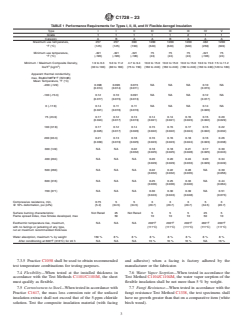
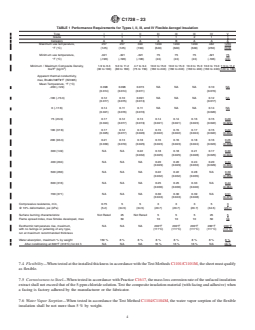
TABLE 1 Performance Requirements for Types I, II, III, and IV Flexible Aerogel Insulation
Type I I II III III III IV V
Grade 1 1 1 1 1 2 1 1
Category A B A A B A A A
Maximum use temperature, 257 257 390 1200 1200 1200 482 1200
°F (°C) (125) (125) (199) (649) (649) (649) (250) (649)
Minimum use temperature, -321 -321 -321 75 75 75 -321 75
°F (°C) (-196) (-196) (-196) (24) (24) (24) (-196) (24)
Minimum / Maximum Composite Density, 1.9 to 6.3 5.0 to 11.2 4.7 to 9.4 10.0 to 15.0 10.0 to 15.0 10.0 to 15.0 10.0 to 15.0 7.5 to 11.2
3 3
lbs/ft (kg/m ) (30 to 100) (80 to 180) (75 to 150) (160 to 240) (160 to 240) (160 to 240) (160 to 240)(120 to 180)
Apparent thermal conductivity,
max, Btucin/hcf
...