

ASTM E3356-22
(Guide)Standard Guide for Stakeholder Engagement on Environmental Risk Management and Climate
General Information
- Abstract
SIGNIFICANCE AND USE
5.1 Stakeholder engagement, in the climate vulnerability context, most often refers to the meaningful involvement of affected parties in planning or decision-making efforts in order to integrate their knowledge and values with a particular project’s more specialized knowledge and purpose. In turn, stakeholders are often broadly defined as those people who are affected by or can affect a decision and range from the “average” citizen to groups of highly interested or invested decision-makers.
5.2 It is important that stakeholders understand the role they are invited to play in a public engagement program. This will help provide clarity to the process and help avoid misunderstandings. Stakeholder roles may naturally evolve over the period that they are engaged in a public process, and as transition occurs, it is wise to redefine these roles. When an advisory committee or partnership between public agencies is established, it is helpful to develop a charter or other memo of understanding that describes the roles and responsibilities of all involved.
5.3 EPA’s Public Involvement Spectrum (2015)(6) can provide useful tools. Fig. 2 illustrates a spectrum of public involvement options that may be appropriate.
FIG. 2 EPA Public Involvement Spectrum.
Source: U.S. EPA’s Public Involvement Spectrum
SCOPE
1.1 This guide provides a series of steps to develop and execute an effective stakeholder engagement process for a broad spectrum of environmental projects including, but not limited to, site remediation and brownfields development, as well as local and regional climate resiliency and climate vulnerability initiatives. This guide does not apply to broad programmatic initiatives.
1.2 Effective stakeholder engagement in site remediation, brownfields redevelopment, habitat restoration, climate resiliency, climate vulnerability, and flood prevention and control projects requires a process that is based on mutual education, effective communication about the project and its impacts, identification of the interests that will be affected, and open discussion about how to address those interests to the extent that is possible. The General Accountability Office suggests that core principles and strategic approaches enhance stakeholder participation (GAO 2006)(1)2. The National Oceanic and Atmospheric Administration (NOAA) reported that stakeholders developed more robust mitigation measures that addressed multiple hazards when they integrated climate variability into vulnerability and risk assessments associated with flooding and other natural disasters in the East Bay area of California’s San Francisco Bay. (NOAA, 2021)(2).
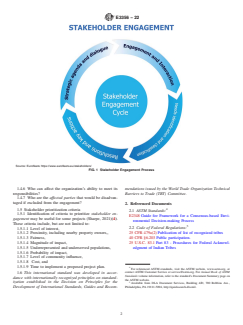
1.3 An effective stakeholder engagement process (see Fig. 1) can create benefits for large projects, including:3
FIG. 1 Stakeholder Engagement Process
Source: Eurofleets https://www.eurofleets.eu/stakeholders/
1.3.1 Improved, sustainable outcomes, because the final project plan builds on local capacity and knowledge and considers local and regional issues that may require resolution in order to move forward.
1.3.2 Shared understanding of perspectives, issues, challenges, alternatives, and how these influence the desired or necessary outcomes
1.3.3 Credibility of and predictability for the project plan that comes from transparency
1.3.4 Stakeholder support for the planning process through shared data, ideas, funding, and political support
1.3.5 Strengthened relationships among affected parties for moving forward on the project.
1.3.6 Satisfying any legally-required public notice and participation requirements.
1.3.6.1 Stakeholder engagement should not be confused with the public participation requirements of the National Environmental Policy Act codified in 40 CFR §6.203. because NEPA potentially does not involve stakeholders until later in the project development process. In addition, NEPA's public participation process is not as flexible as that descr...
- Status
- Published
- Publication Date
- 30-Sep-2022
- Technical Committee
- E50 - Environmental Assessment, Risk Management and Corrective Action
- Drafting Committee
- E50.05 - Environmental Risk Management
Overview
ASTM E3356-22: Standard Guide for Stakeholder Engagement on Environmental Risk Management and Climate provides a structured approach for developing and executing effective stakeholder engagement processes in environmental projects. Developed by ASTM International, this standard focuses on meaningful involvement of affected and interested parties in planning and decision-making for site remediation, brownfields redevelopment, habitat restoration, climate resiliency, climate vulnerability, and flood prevention and control initiatives. By integrating stakeholder knowledge and values, the guide aims to improve project outcomes, build trust, and fulfill legal and regulatory requirements.
Key Topics
Stakeholder Identification and Roles
- Defines stakeholders as anyone affected by or able to affect a decision, from local residents to key decision-makers and agencies.
- Emphasizes the importance of clearly communicating the role of each stakeholder and regularly updating these roles as the project evolves.
Engagement Process and Principles
- Steps for establishing effective stakeholder engagement, including setting clear goals, ensuring mutual education, maintaining open communication, and identifying affected interests.
- Advocates for transparency, timely information sharing, and measurable engagement outcomes.
- Encourages use of advisory committees, public information efforts, and consensus-building tools.
Core Benefits of Stakeholder Engagement
- Enhanced, sustainable outcomes based on local knowledge and capacity.
- Increased transparency, support, and predictability for project plans.
- Stronger relationships and improved credibility among all parties involved.
- Fulfilling legal public notice and participation requirements.
Special Considerations for Vulnerable Communities
- Focuses on including populations at heightened risk from climate change, such as those with fewer resources or greater exposure to environmental impacts.
- Promotes the use of inclusive tools and methods to ensure all voices are heard, especially for underserved and underrepresented groups.
Applications
ASTM E3356-22 is widely applicable in:
- Environmental Remediation and Brownfields Projects
- Ensures that local communities, regulatory agencies, and other stakeholders are engaged early and throughout project development, leading to more accepted and robust solutions.
- Climate Resiliency and Vulnerability Initiatives
- Supports collaboration between organizations, local governments, and communities to address multi-hazard risks and climate adaptation strategies.
- Flood Prevention, Habitat Restoration, and Infrastructure Planning
- Provides guidelines for developing charters or memoranda of understanding for advisory committees, fostering collaborative partnerships that are crucial for complex or controversial projects.
- Equity and Environmental Justice Programs
- Encourages the identification and inclusion of vulnerable demographics, reducing the chance for disproportionate negative impacts.
Practical implementation includes conducting stakeholder analyses, establishing clear communication channels, offering workshops and accessible information, and facilitating consensus- or mediation-based approaches.
Related Standards
The guide references and aligns with several other frameworks and standards:
- ASTM E2348 – Guide for Framework for a Consensus-based Environmental Decision-making Process
- ISO 26000 – Guidance on Social Responsibility (especially regarding stakeholder identification)
- EPA Public Involvement Spectrum – Tools and methods for public and stakeholder involvement
- NOAA Best Practices – Integration of climate risk assessments into stakeholder-driven projects
Additionally, it provides compatibility with legal requirements, such as those specified under the National Environmental Policy Act (NEPA), while distinguishing its broader, more flexible approach to stakeholder engagement.
Keywords: stakeholder engagement, environmental risk management, climate vulnerability, meaningful involvement, public participation, environmental remediation, community engagement, ASTM E3356-22, environmental standards, climate resiliency, project planning.
Relations
- Effective Date
- 01-Feb-2024
- Effective Date
- 01-Jan-2017
- Effective Date
- 01-Sep-2010
Get Certified
Connect with accredited certification bodies for this standard

BSI Group
BSI (British Standards Institution) is the business standards company that helps organizations make excellence a habit.

Bureau Veritas
Bureau Veritas is a world leader in laboratory testing, inspection and certification services.

DNV
DNV is an independent assurance and risk management provider.
Sponsored listings
Frequently Asked Questions
ASTM E3356-22 is a guide published by ASTM International. Its full title is "Standard Guide for Stakeholder Engagement on Environmental Risk Management and Climate". This standard covers: SIGNIFICANCE AND USE 5.1 Stakeholder engagement, in the climate vulnerability context, most often refers to the meaningful involvement of affected parties in planning or decision-making efforts in order to integrate their knowledge and values with a particular project’s more specialized knowledge and purpose. In turn, stakeholders are often broadly defined as those people who are affected by or can affect a decision and range from the “average” citizen to groups of highly interested or invested decision-makers. 5.2 It is important that stakeholders understand the role they are invited to play in a public engagement program. This will help provide clarity to the process and help avoid misunderstandings. Stakeholder roles may naturally evolve over the period that they are engaged in a public process, and as transition occurs, it is wise to redefine these roles. When an advisory committee or partnership between public agencies is established, it is helpful to develop a charter or other memo of understanding that describes the roles and responsibilities of all involved. 5.3 EPA’s Public Involvement Spectrum (2015)(6) can provide useful tools. Fig. 2 illustrates a spectrum of public involvement options that may be appropriate. FIG. 2 EPA Public Involvement Spectrum. Source: U.S. EPA’s Public Involvement Spectrum SCOPE 1.1 This guide provides a series of steps to develop and execute an effective stakeholder engagement process for a broad spectrum of environmental projects including, but not limited to, site remediation and brownfields development, as well as local and regional climate resiliency and climate vulnerability initiatives. This guide does not apply to broad programmatic initiatives. 1.2 Effective stakeholder engagement in site remediation, brownfields redevelopment, habitat restoration, climate resiliency, climate vulnerability, and flood prevention and control projects requires a process that is based on mutual education, effective communication about the project and its impacts, identification of the interests that will be affected, and open discussion about how to address those interests to the extent that is possible. The General Accountability Office suggests that core principles and strategic approaches enhance stakeholder participation (GAO 2006)(1)2. The National Oceanic and Atmospheric Administration (NOAA) reported that stakeholders developed more robust mitigation measures that addressed multiple hazards when they integrated climate variability into vulnerability and risk assessments associated with flooding and other natural disasters in the East Bay area of California’s San Francisco Bay. (NOAA, 2021)(2). 1.3 An effective stakeholder engagement process (see Fig. 1) can create benefits for large projects, including:3 FIG. 1 Stakeholder Engagement Process Source: Eurofleets https://www.eurofleets.eu/stakeholders/ 1.3.1 Improved, sustainable outcomes, because the final project plan builds on local capacity and knowledge and considers local and regional issues that may require resolution in order to move forward. 1.3.2 Shared understanding of perspectives, issues, challenges, alternatives, and how these influence the desired or necessary outcomes 1.3.3 Credibility of and predictability for the project plan that comes from transparency 1.3.4 Stakeholder support for the planning process through shared data, ideas, funding, and political support 1.3.5 Strengthened relationships among affected parties for moving forward on the project. 1.3.6 Satisfying any legally-required public notice and participation requirements. 1.3.6.1 Stakeholder engagement should not be confused with the public participation requirements of the National Environmental Policy Act codified in 40 CFR §6.203. because NEPA potentially does not involve stakeholders until later in the project development process. In addition, NEPA's public participation process is not as flexible as that descr...
SIGNIFICANCE AND USE 5.1 Stakeholder engagement, in the climate vulnerability context, most often refers to the meaningful involvement of affected parties in planning or decision-making efforts in order to integrate their knowledge and values with a particular project’s more specialized knowledge and purpose. In turn, stakeholders are often broadly defined as those people who are affected by or can affect a decision and range from the “average” citizen to groups of highly interested or invested decision-makers. 5.2 It is important that stakeholders understand the role they are invited to play in a public engagement program. This will help provide clarity to the process and help avoid misunderstandings. Stakeholder roles may naturally evolve over the period that they are engaged in a public process, and as transition occurs, it is wise to redefine these roles. When an advisory committee or partnership between public agencies is established, it is helpful to develop a charter or other memo of understanding that describes the roles and responsibilities of all involved. 5.3 EPA’s Public Involvement Spectrum (2015)(6) can provide useful tools. Fig. 2 illustrates a spectrum of public involvement options that may be appropriate. FIG. 2 EPA Public Involvement Spectrum. Source: U.S. EPA’s Public Involvement Spectrum SCOPE 1.1 This guide provides a series of steps to develop and execute an effective stakeholder engagement process for a broad spectrum of environmental projects including, but not limited to, site remediation and brownfields development, as well as local and regional climate resiliency and climate vulnerability initiatives. This guide does not apply to broad programmatic initiatives. 1.2 Effective stakeholder engagement in site remediation, brownfields redevelopment, habitat restoration, climate resiliency, climate vulnerability, and flood prevention and control projects requires a process that is based on mutual education, effective communication about the project and its impacts, identification of the interests that will be affected, and open discussion about how to address those interests to the extent that is possible. The General Accountability Office suggests that core principles and strategic approaches enhance stakeholder participation (GAO 2006)(1)2. The National Oceanic and Atmospheric Administration (NOAA) reported that stakeholders developed more robust mitigation measures that addressed multiple hazards when they integrated climate variability into vulnerability and risk assessments associated with flooding and other natural disasters in the East Bay area of California’s San Francisco Bay. (NOAA, 2021)(2). 1.3 An effective stakeholder engagement process (see Fig. 1) can create benefits for large projects, including:3 FIG. 1 Stakeholder Engagement Process Source: Eurofleets https://www.eurofleets.eu/stakeholders/ 1.3.1 Improved, sustainable outcomes, because the final project plan builds on local capacity and knowledge and considers local and regional issues that may require resolution in order to move forward. 1.3.2 Shared understanding of perspectives, issues, challenges, alternatives, and how these influence the desired or necessary outcomes 1.3.3 Credibility of and predictability for the project plan that comes from transparency 1.3.4 Stakeholder support for the planning process through shared data, ideas, funding, and political support 1.3.5 Strengthened relationships among affected parties for moving forward on the project. 1.3.6 Satisfying any legally-required public notice and participation requirements. 1.3.6.1 Stakeholder engagement should not be confused with the public participation requirements of the National Environmental Policy Act codified in 40 CFR §6.203. because NEPA potentially does not involve stakeholders until later in the project development process. In addition, NEPA's public participation process is not as flexible as that descr...
ASTM E3356-22 is classified under the following ICS (International Classification for Standards) categories: 13.020.70 - Environmental projects. The ICS classification helps identify the subject area and facilitates finding related standards.
ASTM E3356-22 has the following relationships with other standards: It is inter standard links to ASTM E2348-24, ASTM E2348-17, ASTM E2348-06(2010). Understanding these relationships helps ensure you are using the most current and applicable version of the standard.
ASTM E3356-22 is available in PDF format for immediate download after purchase. The document can be added to your cart and obtained through the secure checkout process. Digital delivery ensures instant access to the complete standard document.
Standards Content (Sample)
This international standard was developed in accordance with internationally recognized principles on standardization established in the Decision on Principles for the
Development of International Standards, Guides and Recommendations issued by the World Trade Organization Technical Barriers to Trade (TBT) Committee.
Designation: E3356 − 22
Standard Guide for
Stakeholder Engagement on Environmental Risk
Management and Climate
This standard is issued under the fixed designation E3356; the number immediately following the designation indicates the year of
original adoption or, in the case of revision, the year of last revision. A number in parentheses indicates the year of last reapproval. A
superscript epsilon (´) indicates an editorial change since the last revision or reapproval.
1. Scope 1.3.3 Credibility of and predictability for the project plan
that comes from transparency
1.1 This guide provides a series of steps to develop and
1.3.4 Stakeholder support for the planning process through
execute an effective stakeholder engagement process for a
shared data, ideas, funding, and political support
broad spectrum of environmental projects including, but not
1.3.5 Strengthened relationships among affected parties for
limited to, site remediation and brownfields development, as
moving forward on the project.
well as local and regional climate resiliency and climate
1.3.6 Satisfying any legally-required public notice and
vulnerability initiatives. This guide does not apply to broad
programmatic initiatives. participation requirements.
1.3.6.1 Stakeholder engagement should not be confused
1.2 Effective stakeholder engagement in site remediation,
with the public participation requirements of the National
brownfields redevelopment, habitat restoration, climate
Environmental PolicyAct codified in 40 CFR §6.203. because
resiliency, climate vulnerability, and flood prevention and
NEPA potentially does not involve stakeholders until later in
control projects requires a process that is based on mutual
the project development process. In addition, NEPA’s public
education, effective communication about the project and its
participation process is not as flexible as that described in this
impacts, identification of the interests that will be affected, and
guide.
open discussion about how to address those interests to the
3) reported additional
1.3.7 Welp and Stoll-Kleeman (2006)(
extent that is possible. The General Accountability Office
benefits of engaging stakeholders and affected parties in
suggests that core principles and strategic approaches enhance
2 decisions regarding natural resources management. These ben-
stakeholder participation (GAO 2006)(1) . The National Oce-
efits include:
anic and Atmospheric Administration (NOAA) reported that
1.3.7.1 Enhanced understanding,
stakeholders developed more robust mitigation measures that
1.3.7.2 Developing new options,
addressed multiple hazards when they integrated climate vari-
ability into vulnerability and risk assessments associated with 1.3.7.3 Decreasing hostility among participants through im-
flooding and other natural disasters in the East Bay area of proved dialog and discussion,
California’s San Francisco Bay. (NOAA, 2021)(2).
1.3.7.4 Enlightening legal policy makers,
1.3.7.5 Producing competent, fair, and optimized solutions,
1.3 An effective stakeholder engagement process (see Fig.
1.3.7.6 Accelerating the decision-making process.
1) can create benefits for large projects, including:
1.3.1 Improved, sustainable outcomes, because the final
1.4 Inordertoidentifyprospective stakeholders,ISO26000
project plan builds on local capacity and knowledge and
clause 5.3.2 suggests that an organization should ask the
considers local and regional issues that may require resolution
following questions:
in order to move forward.
1.4.1 To whom does the organization have legal obliga-
1.3.2 Shared understanding of perspectives, issues,
tions?
challenges, alternatives, and how these influence the desired or
1.4.2 Who might be positively or negatively affected by the
necessary outcomes
organization’s decisions, activities, or anticipated outcomes?
1.4.2.1 Mediators and facilitators are expected to be neutral
ThisguideisunderthejurisdictionofASTMCommitteeE50onEnvironmental parties.
Assessment, Risk Management and CorrectiveAction and is the direct responsibil-
1.4.3 Who is likely to express opinions and concerns about
ity of Subcommittee E50.05 on Environmental Risk Management.
the decisions and activities of the organization?
Current edition approved Oct. 1, 2022. Published November 2022. DOI:
10.1520/E3356–22
1.4.4 Who has been involved in the past when similar
The boldface numbers in parentheses refer to a list of references at the end of
concerns needed to be addressed?
this standard.
1.4.5 Who can help the organization address specific im-
Adapted from Udall Foundation. Principles for Effective Stakeholder Engage-
ment in Infrastructure Permitting and Review Processes. 2020 pacts?
Copyright © ASTM International, 100 Barr Harbor Drive, PO Box C700, West Conshohocken, PA 19428-2959. United States
E3356 − 22
Source: Eurofleets https://www.eurofleets.eu/stakeholders/
FIG. 1 Stakeholder Engagement Process
1.4.6 Who can affect the organization’s ability to meet its mendations issued by the World Trade Organization Technical
responsibilities? Barriers to Trade (TBT) Committee.
1.4.7 Who are the affected parties that would be disadvan-
taged if excluded from the engagement?
2. Referenced Documents
1.5 Stakeholder prioritization criteria 4
2.1 ASTM Standards:
1.5.1 Identification of criteria to prioritize stakeholder en-
E2348 Guide for Framework for a Consensus-based Envi-
gagement may be useful for some projects (Sharpe, 2021)(4).
ronmental Decision-making Process
These criteria include, but are not limited to:
2.2 Code of Federal Regulations:
1.5.1.1 Level of interest,
25 CFR 479a(2) Publication of list of recognized tribes
1.5.1.2 Proximity, including nearby property owners,,
40 CFR §6.203 Public participation.
1.5.1.3 Fairness,
1.5.1.4 Magnitude of impact, 25 U.S.C. 83.1 Part 83 - Procedures for Federal Acknowl-
1.5.1.5 Underrepresented and underserved populations, edgment of Indian Tribes
1.5.1.6 Probability of impact,
1.5.1.7 Level of community influence,
1.5.1.8 Cost, and
1.5.1.9 Time to implement a proposed project plan.
For referenced ASTM standards, visit the ASTM website, www.astm.org, or
contact ASTM Customer Service at service@astm.org. For Annual Book of ASTM
1.6 This international standard was developed in accor-
Standards volume information, refer to the standard’s Document Summary page on
dance with internationally recognized principles on standard-
the ASTM website.
ization established in the Decision on Principles for the 5
Available from DLA Document Services, Building 4/D, 700 Robbins Ave.,
Development of International Standards, Guides and Recom- Philadelphia, PA 19111-5094, http://quicksearch.dla.mil.
E3356 − 22
2.3 US EPA References: 3.2.5 consensus building, n—is a process in which people
EPA-100-R-00-04 U.S. EPA. Stakeholder Involvement & agree to work together to resolve common problems in a
Public Participation at the U.S. EPA, , January 2001 relatively informal, cooperative manner.
U.S. EPA. Better Decisions through Consultation and
3.2.5.1 Discussion—Consensus Building is a technique that
Collaboration, 2015 https://www.epa.gov/international-
can be used to bring together representatives from different
cooperation/better-decisions-through-consultation-and-
stakeholder groups early in a decision-making process. A
collaboration
neutral third party (mediator or facilitator) helps the people
design and implement their own strategy for developing group
2.4 Other References:
solutions to the problems (see Guide E2348).
Federal Emergency Management Agency. Guidance for
Stakeholder Engagement, Preliminary Production Pro-
3.2.6 facilitation, v—is a process used to help a group of
cess. November 2019
people or parties have constructive discussions about complex
ISO 26000-2010 Guidance on Social Responsibility
or potentially controversial issues.
3.2.6.1 Discussion—The facilitator provides assistance by
helping the parties set ground rules for these discussions,
3. Terminology
promoting effective communication, eliciting creative options,
3.1 This section provides definitions of terms not unique to
and keeping the group focused and on track. Facilitation can
this practice, descriptions of terms specific to this guide, and a be used even where parties have not yet agreed to attempt to
list of acronyms and abbreviations used herein. The terms are
resolve a conflict
an integral part of this guide and are critical to its understand-
3.2.7 fair treatment, n—as defined on EPA’s Environmental
ing and use.
Justice Website, means that no group of people, including a
3.2 Definitions, Acronyms, Abbreviations
racial, ethnic, or socioeconomic group, should bear a dispro-
3.2.1 affected parties—stakeholders who are or may be
portionate share of the negative environmental consequences
impacted by any agency’s or project proponent’s decisions.
from industrial, municipal, and commercial operations, or the
execution of federal, state, local, and tribal programs and
3.2.2 agreement—a mutually acceptable decision that the
policies.
parties agree to implement.
3.2.2.1 Discussion—Processes that produce agreements can
3.2.8 information exchange, n—a meeting at which partici-
reduce the total time needed to reach a final decision, build
pants share data or ideas, provide information, express
support among stakeholders, lead to early implementation, and
concerns, or provide individual input.
greatly reduce the threat of second-guessing and future litiga-
3.2.8.1 Discussion—Information exchanges can help define
tion. Agreement processes seek consensus between the project
the problem and issues for further discussion, build trust,
proponent and stakeholders.
improve relationships, and allow interest groups to hear first-
3.2.3 alternative dispute resolution (ADR), n—as defined in
hand the concerns of other affected parties. Information ex-
the Administrative Dispute Resolution Act of 1996, is “any
changes offer a chance to see reactions to “what if” proposals,
procedure that is used to resolve issues in controversy, includ-
allowingtheprojectproponenttogaugethelevelofacceptance
ing but not limited to conciliation, facilitation, mediation, fact
or opposition to proposed actions.
finding, minitrials, arbitration, use of ombuds or any combina-
3.2.9 meaningful involvement, n—means potentially af-
tion thereof.” 5 U.S.C. 571(3); these Alternative Dispute
fected community residents have an appropriate opportunity to
Resolution techniques involve a neutral third party, a person
participate in decisions about a proposed activity that will
who assists others in designing and conducting a process for
affect their environment and/or health; the public’s contribu-
reaching agreement, if possible.
tion can influence the regulatory agency’s or proponent’s
3.2.3.1 Discussion—The neutral third party has no stake in
decision; the concerns of all participants involved will be
the substantive outcome of the process. Depending on the
considered in the decisionmaking process; and the decision
circumstances of a particular dispute, neutral third parties may
makers seek out and facilitate the involvement of those
be agency employees or may be from outside the agency or the
potentially affected.
entity proposing the project. Typically, all aspects of ADR are
3.2.10 mediation, n—is a process in which a neutral third
voluntary, including the decision to participate, the type of
party (the mediator) helps disputants reach a mutually satisfy-
process used, and the content of a final agreement, if any.
ing settlement of their differences.
3.2.4 climate vulnerability—describes the degree to which
3.2.10.1 Discussion—Mediation is often voluntary,
natural, built, and human systems are at risk of exposure to
informal,andconfidential.Themediatorhelpsthedisputantsto
climate change impacts.
communicate clearly, to listen carefully, and to consider
creative ways to reach resolution. The mediator makes no
judgments about the people or the conflict and issues no
AvailablefromUnitedStatesEnvironmentalProtectionAgency(EPA),William
decision. Any agreement that is reached must satisfy all the
Jefferson Clinton Bldg., 1200 Pennsylvania Ave., NW, Washington, DC 20460,
http://www.epa.gov. disputants.
Available from International Organization for Standardization (ISO), ISO
3.2.11 mediator, n—is a person who mediates—helps to
Central Secretariat, Chemin de Blandonnet 8, CP 401, 1214 Vernier, Geneva,
Switzerland, https://www.iso.org. settle a dispute or create agreement when there is conflict
E3356 − 22
between two or more people or groups by acting as neutral 3.2.18 vulnerable communities, n—populations at height-
third party. A facilitator can serve the role of a mediator. ened risk and exposure to adverse impacts of climate change
due to location and geography.
3.2.12 outreach, n—The process by which affected parties
are informed of the project proponent’s goals, decisions, and
3.2.18.1 Discussion—Vulnerable communities experience
actions.
heightened risk and increased sensitivity to climate change and
3.2.12.1 Discussion—Outreach gives the public and stake-
have less capacity and fewer resources to cope with, adapt to,
holders access to scientific and technical information to better
orrecoverfromclimateimpacts.Thesedisproportionateeffects
understand the issues. While outreach is a critical element in
are caused by physical (built and environmental), social,
the success of the other forms of consultative and collaborative
political, and/or economic factor(s), which are exacerbated by
processes,thishandbookdoesnotspecificallyaddressoutreach
climate impacts. These latter factors include, but are not
activities.
limited to, race, class, sexual orientation and identification,
national origin, and income inequality.
3.2.13 recommendation, n—the end product of group delib-
3.3 Acronyms, Abbreviations, and Initialisms
erations.
3.3.1 ADR—Alternative Dispute Resolution
3.2.13.1 Discussion—Stakeholder groups often review or
develop data that are quite specific. The group, often together
3.3.2 EPA / US EPA—United States Environmental Protec-
with proponent personnel and a mediator, deliberates and
tion Agency
develops joint recommendations. In this way, decision-makers
3.3.3 ISO—International Organization for Standardization
receive the benefit of different viewpoints distilled into specific
3.3.4 NGO—Non-governmental organization
recommendations from the group. Stakeholders can also high-
light a range of options and illuminate the pros and cons of
4. Summary of Guide
each option (Munns 2019) (5).
4.1 Aprocedure for this guide is provided in Section 6.This
3.2.14 stakeholders, n—are individuals or representatives
guide does not apply to broad programmatic initiatives.
fromorganizationsorinterestgroupsthathaveastronginterest
in the proponent’s proposal, project, work, and policies. 5. Significance and Use
3.2.15 stakeholder action, n—a process to empower mem-
5.1 Stakeholder engagement, in the climate vulnerability
bers of an industrial sector, NGO or affected community to context, most often refers to the meaningful involvement of
develop creative solutions that they themselves will imple-
affected parties in planning or decision-making efforts in order
ment. to integrate their knowledge and values with a particular
3.2.15.1 Discussion—The stakeholder action process,
project’s more specialized knowledge and purpose. In turn,
which often consists of a series of meetings, workshops, stakeholders are often broadly defined as those people who are
dialogues, or other interactive gatherings, emphasizes the affected by or can affect a decision and range from the
generation of solutions that are acceptable to all involved. “average” citizen to groups of highly interested or invested
Individuals usually participate as representatives of organiza- decision-makers.
tions or constituencies, rather than themselves.
5.2 Itisimportantthat stakeholdersunderstandtherolethey
3.2.16 timely information, n—means distributing informa- are invited to play in a public engagement program. This will
tion sufficiently far in advance so that the stakeholders have
help provide clarity to the process and help avoid misunder-
enough time to review relevant material, decide whether to standings. Stakeholder roles may naturally evolve over the
become involved, and make plans for that involvement.
period that they are engaged in a public process, and as
3.2.16.1 Discussion—Timely applies to the availability of transition occurs, it is wise to redefine these roles. When an
background information on particular issues, as well as notice
advisory committee or partnership between public agencies is
of public meetings, public comment periods, or other critical established, it is helpful to develop a charter or other memo of
involvement activities.
understandingthatdescribestherolesandresponsibilitiesofall
involved.
3.2.17 tribe, n—means an Indian or Alaska Native tribe,
band, nation, pueblo, village, or community that the Secretary
5.3 EPA’s Public Involvement Spectrum (2015)(6) can pro-
oftheInterioracknowledgestoexistasanIndiantribepursuant
vide useful tools. Fig. 2 illustrates a spectrum of public
to the Federally Recognized IndianTribe ListAct of 1994, (see
involvement options that may be appropriate.
25 U.S.C. 83.1)
6. Procedure
3.2.17.1 Discussion—The Secretary of the Interior
publishes, on an annual basis, prepares a list of all federally- 6.1 Establish a realistic budget for, and integrate the stake-
recognized Indian Tribes. See 25 CFR 479a(2). holder engagement process into the project timeline.
E3356 − 22
Source: U.S. EPA’s Public Involvement Spectrum
FIG. 2 EPA Public Involvement Spectrum.
6.2 Provide Clear Goals and Avenues for Stakeholder and 6.2.4 Institutionalize stakeholder engagement by funding it,
Public Participation: staffing it, and making public commitments to it.
6.2.1 A well-planned engagement effort supports and 6.2.5 Examples of best practices, tools, techniques:
complements the overall planning process (Udall 2020)(7). 6.2.5.1 Establish a public information and education effort
Well-informed stakeholders and citizens who understand the at the outset or before the start of the approval and permitting
project and permitting process and who can identify and process.
capitalize on opportunities for their involvement can facilitate 6.2.5.2 Ensure that subject matter experts are not talking
broader community acceptance (see Fig. 3). For example, the over the stakeholders.
California Department of Water Resources has developed and 6.2.5.3 Develop and share a process map with the public
deployed a stakeholder engagement plan addressing Ground- and stakeholders so that they can see where their input fits into
water Sustainability and Climate (see CalDWR 2018)(8). the decision-making process
6.2.1.1 From the earliest stage of the project, identify and 6.2.5.4 Develop overarching goals for the stakeholder and
communicate: public engagement effort
(1) The goals and schedule of the project planning and 6.2.5.5 Develop an organized engagement approach at the
developmentprocessandopportunitiesfor meaningful involve- outset, and update and modify it as needed
ment 6.2.5.6 Treat stakeholder engagement the same as any other
(2) Commitment from project sponsors and others to stake- planning component, including creating timetables, budgets,
holder engagement effort staffing, and management.
(3) Key milestones and timelines in the project develop-
6.3 Stakeholder Identification and Accessibility :
ment process
6.3.1 Stakeholder identification should be carried out with
6.2.2 Analyze the needs for meaningful involvement and
the objective of establishing which individuals and organiza-
stakeholder engagement in the particular project and develop
tions may be directly or indirectly affected (positively and
options to meet those needs (see Fig. 3 regarding the con-
tinuum of processes for public participation).
6.2.3 Engage stakeholders in the planning for the stake-
Adapted from Udall Foundation. Principles for Effective Stakeholder Engage-
holder engagement process. ment in Infrastructure Permitting and Review Processes. 2020
E3356 − 22
Source: Principles for Effective Stakeholder Engagement in Infrastructure Permitting and Review Processes, National Center for Environmental Conflict Resolution.
FIG. 3 Spectrum of Stakeholder and Public Involvement Mechanisms in Infrastructure Permitting Processes
negatively)bytheprojectproponent’sactivitiesormayhavean by project impacts than others and who may be limited in their
interest in or influence on the project (see Appendix X2). ability to claim or take advantage of project benefits.
6.3.1.1 As part of the stakeholder identification process, the (1) This may include women, tribes, ethnic minorities,
following factors should be considered: children, young people, elderly/retired, single-headed families,
(1) The project’s potential impacts during construction and households with low income, and disabled people.
operation.
6.3.2.4 National and Tribal governments.
(2) What type of stakeholder engagement is mandated by
6.3.2.5 Regional, state, provincial, county, and municipal
treaty, law, and project standards?
government.
(3) Who is likely to be affected (directly or indirectly) by
6.3.2.6 Public districts including, but not limited to:
potential impacts in the project’s area of influence?
education, health, hospitals, ports, public safety, public utility,
(4) Who are the vulnerable groups requiring special en-
water utilities, and transportation.
gagement efforts?
6.3.2.7 Local businesses and operators, agricultural
(5) Who supports or opposes the changes that proponent’s
institutions/associations.
activities or projects will bring and why?
6.3.2.8 Non-Governmental Organizations (NGOs); local,
6.3.2 Stakeholders identified by this process belong to one
regional, national NGOs and associations.
of the following gr
...