

ASTM D4014-23
(Specification)Standard Specification for Plain and Steel-Laminated Elastomeric Bearings for Bridges
General Information
- Abstract
ABSTRACT
This specification covers bearings, which consist of all elastomer or of alternate laminates of elastomer and steel, when the function of the bearings is to transfer loads or accommodate relative movement between a bridge superstructure and its supporting structure, or both. The bearings are furnished in four types as follows: plain elastomeric bearing pad; plain elastomeric sandwich bearing; steel-laminated elastomeric bearing; and steel-laminated elastomeric bearing with external load plate. The elastomer for the manufacture of the bearing is furnished in two types: Type CR and Type NR. The elastomer for the manufacture of the bearing is furnished in four grades of low-temperature properties: Grade 0; Grade 2; Grade 3; and Grade 5. The elastomeric compound used in the construction of a bearing shall contain only either natural rubber or chloroprene rubber as the raw polymer. Internal steel laminates shall be of rolled mild steel. Plain bearing pads shall be molded individually, or cut from previously molded strips or slabs, or extruded and cut to length. A steel-laminated bearing or a plain sandwich bearing shall be molded as a single unit under pressure and heat. All bonding of elastomer to steel laminates and to external load plates shall be carried out during molding. Bearing compression tests, compression stiffness, visual inspection, quality control properties, shear modulus, ozone resistance, and low-temperature grade tests shall be performed to conform to the specified requirements.
SCOPE
1.1 This specification covers bearings which consist of all elastomer or of alternate laminates of elastomer and steel, when the function of the bearings is to transfer loads or accommodate relative movement between a bridge superstructure and its supporting structure, or both.
1.2 The values stated in SI units are to be regarded as the standard.
Note 1: The words “elastomer” or “elastomeric” will be used interchangeably with the word “rubber” in this specification.
1.3 The following safety hazards caveat pertains only to the test methods portion, Section 8, of this specification: This standard does not purport to address all of the safety concerns, if any, associated with its use. It is the responsibility of the user of this standard to establish appropriate safety, health, and environmental practices and determine the applicability of regulatory limitations prior to use.
1.4 This international standard was developed in accordance with internationally recognized principles on standardization established in the Decision on Principles for the Development of International Standards, Guides and Recommendations issued by the World Trade Organization Technical Barriers to Trade (TBT) Committee.
- Status
- Published
- Publication Date
- 31-Oct-2023
- Technical Committee
- D04 - Road and Paving Materials
- Drafting Committee
- D04.32 - Bridges and Structures
Buy Documents
ASTM D4014-23 - Standard Specification for Plain and Steel-Laminated Elastomeric Bearings for Bridges
REDLINE ASTM D4014-23 - Standard Specification for Plain and Steel-Laminated Elastomeric Bearings for Bridges
Overview
ASTM D4014-23 - Standard Specification for Plain and Steel-Laminated Elastomeric Bearings for Bridges defines requirements for elastomeric bearings utilized in bridge construction. These bearings, constructed from either all-elastomer or a combination of elastomer and steel laminates, are essential for transferring loads and accommodating movements between a bridge’s superstructure and its supporting structure. The standard, published by ASTM International, establishes criteria ensuring that these bearings perform reliably under varied environmental and structural conditions.
Developed in line with internationally recognized standardization principles, ASTM D4014-23 applies globally for the design, manufacturing, and application of elastomeric bearings, enhancing the safety and longevity of bridge infrastructure.
Key Topics
Types of Bearings:
- Plain elastomeric bearing pad
- Plain elastomeric sandwich bearing
- Steel-laminated elastomeric bearing
- Steel-laminated elastomeric bearing with external load plate(s)
Material Specifications:
- Elastomer must be either natural rubber (NR) or chloroprene rubber (CR)
- Four grades for low-temperature performance: Grade 0, Grade 2, Grade 3, and Grade 5
Manufacturing Requirements:
- Steel laminates must be of rolled mild steel
- Proper bonding between elastomer and steel
- Surface finishes and mold requirements
Testing and Quality Control:
- Compression and stiffness testing
- Shear modulus, ozone resistance, and low-temperature performance
- Visual inspection for bonding and cracking
Marking and Traceability:
- Each bearing to be clearly marked with order, lot, and identification numbers, as well as elastomer type and grade
Applications
ASTM D4014-23 is a critical standard for the design, selection, and quality control of elastomeric bearings in new bridge construction as well as bridge rehabilitation projects. Its practical uses include:
- Load Transfer & Movement Accommodation: Bearings manufactured per ASTM D4014-23 safely transfer vertical and horizontal loads and handle expansion, contraction, and rotational movement between bridge elements.
- Adaptability to Climate: By specifying elastomer grades for low-temperature resilience, the standard ensures reliable performance across diverse climatic zones.
- Public Infrastructure: The specification is essential for highway authorities, bridge engineers, and contractors aiming to meet official project and durability requirements.
- Procurement & Compliance: Manufacturers and specifiers reference ASTM D4014-23 to guarantee that products meet international performance and safety benchmarks.
Related Standards
To foster uniformity and compatibility, ASTM D4014-23 references and aligns with numerous related standards, including:
- ASTM A36/A36M: Specification for Carbon Structural Steel
- ASTM A1011/A1011M: Specification for Steel Sheet and Strip, Hot-Rolled, Carbon, and Structural Grades
- ASTM D395: Test Methods for Rubber Property - Compression Set
- ASTM D412: Test Methods for Vulcanized Rubber and Thermoplastic Elastomers - Tension
- ASTM D1149: Test Methods for Rubber Deterioration - Ozone Controlled Environment
- ASTM D2240: Test Method for Rubber Property - Durometer Hardness
- AASHTO M 251: Standard Specification for Plain and Laminated Elastomeric Bridge Bearings
Selecting the correct bearing type, material, and grade specified in ASTM D4014-23 ensures long-term structural integrity and service life for bridges, reinforcing the standard’s importance for bridge engineering and public safety.
Relations
- Effective Date
- 01-Nov-2023
Buy Documents
ASTM D4014-23 - Standard Specification for Plain and Steel-Laminated Elastomeric Bearings for Bridges
REDLINE ASTM D4014-23 - Standard Specification for Plain and Steel-Laminated Elastomeric Bearings for Bridges
Get Certified
Connect with accredited certification bodies for this standard

Zavod za gradbeništvo Slovenije (ZAG) - Inšpekcija
ZAG inspection body for construction products, structures, and materials.
Sponsored listings
Frequently Asked Questions
ASTM D4014-23 is a technical specification published by ASTM International. Its full title is "Standard Specification for Plain and Steel-Laminated Elastomeric Bearings for Bridges". This standard covers: ABSTRACT This specification covers bearings, which consist of all elastomer or of alternate laminates of elastomer and steel, when the function of the bearings is to transfer loads or accommodate relative movement between a bridge superstructure and its supporting structure, or both. The bearings are furnished in four types as follows: plain elastomeric bearing pad; plain elastomeric sandwich bearing; steel-laminated elastomeric bearing; and steel-laminated elastomeric bearing with external load plate. The elastomer for the manufacture of the bearing is furnished in two types: Type CR and Type NR. The elastomer for the manufacture of the bearing is furnished in four grades of low-temperature properties: Grade 0; Grade 2; Grade 3; and Grade 5. The elastomeric compound used in the construction of a bearing shall contain only either natural rubber or chloroprene rubber as the raw polymer. Internal steel laminates shall be of rolled mild steel. Plain bearing pads shall be molded individually, or cut from previously molded strips or slabs, or extruded and cut to length. A steel-laminated bearing or a plain sandwich bearing shall be molded as a single unit under pressure and heat. All bonding of elastomer to steel laminates and to external load plates shall be carried out during molding. Bearing compression tests, compression stiffness, visual inspection, quality control properties, shear modulus, ozone resistance, and low-temperature grade tests shall be performed to conform to the specified requirements. SCOPE 1.1 This specification covers bearings which consist of all elastomer or of alternate laminates of elastomer and steel, when the function of the bearings is to transfer loads or accommodate relative movement between a bridge superstructure and its supporting structure, or both. 1.2 The values stated in SI units are to be regarded as the standard. Note 1: The words “elastomer” or “elastomeric” will be used interchangeably with the word “rubber” in this specification. 1.3 The following safety hazards caveat pertains only to the test methods portion, Section 8, of this specification: This standard does not purport to address all of the safety concerns, if any, associated with its use. It is the responsibility of the user of this standard to establish appropriate safety, health, and environmental practices and determine the applicability of regulatory limitations prior to use. 1.4 This international standard was developed in accordance with internationally recognized principles on standardization established in the Decision on Principles for the Development of International Standards, Guides and Recommendations issued by the World Trade Organization Technical Barriers to Trade (TBT) Committee.
ABSTRACT This specification covers bearings, which consist of all elastomer or of alternate laminates of elastomer and steel, when the function of the bearings is to transfer loads or accommodate relative movement between a bridge superstructure and its supporting structure, or both. The bearings are furnished in four types as follows: plain elastomeric bearing pad; plain elastomeric sandwich bearing; steel-laminated elastomeric bearing; and steel-laminated elastomeric bearing with external load plate. The elastomer for the manufacture of the bearing is furnished in two types: Type CR and Type NR. The elastomer for the manufacture of the bearing is furnished in four grades of low-temperature properties: Grade 0; Grade 2; Grade 3; and Grade 5. The elastomeric compound used in the construction of a bearing shall contain only either natural rubber or chloroprene rubber as the raw polymer. Internal steel laminates shall be of rolled mild steel. Plain bearing pads shall be molded individually, or cut from previously molded strips or slabs, or extruded and cut to length. A steel-laminated bearing or a plain sandwich bearing shall be molded as a single unit under pressure and heat. All bonding of elastomer to steel laminates and to external load plates shall be carried out during molding. Bearing compression tests, compression stiffness, visual inspection, quality control properties, shear modulus, ozone resistance, and low-temperature grade tests shall be performed to conform to the specified requirements. SCOPE 1.1 This specification covers bearings which consist of all elastomer or of alternate laminates of elastomer and steel, when the function of the bearings is to transfer loads or accommodate relative movement between a bridge superstructure and its supporting structure, or both. 1.2 The values stated in SI units are to be regarded as the standard. Note 1: The words “elastomer” or “elastomeric” will be used interchangeably with the word “rubber” in this specification. 1.3 The following safety hazards caveat pertains only to the test methods portion, Section 8, of this specification: This standard does not purport to address all of the safety concerns, if any, associated with its use. It is the responsibility of the user of this standard to establish appropriate safety, health, and environmental practices and determine the applicability of regulatory limitations prior to use. 1.4 This international standard was developed in accordance with internationally recognized principles on standardization established in the Decision on Principles for the Development of International Standards, Guides and Recommendations issued by the World Trade Organization Technical Barriers to Trade (TBT) Committee.
ASTM D4014-23 is classified under the following ICS (International Classification for Standards) categories: 93.040 - Bridge construction. The ICS classification helps identify the subject area and facilitates finding related standards.
ASTM D4014-23 has the following relationships with other standards: It is inter standard links to ASTM D4014-03(2018). Understanding these relationships helps ensure you are using the most current and applicable version of the standard.
ASTM D4014-23 is available in PDF format for immediate download after purchase. The document can be added to your cart and obtained through the secure checkout process. Digital delivery ensures instant access to the complete standard document.
Standards Content (Sample)
This international standard was developed in accordance with internationally recognized principles on standardization established in the Decision on Principles for the
Development of International Standards, Guides and Recommendations issued by the World Trade Organization Technical Barriers to Trade (TBT) Committee.
Designation: D4014 − 23
Standard Specification for
Plain and Steel-Laminated Elastomeric Bearings for
Bridges
This standard is issued under the fixed designation D4014; the number immediately following the designation indicates the year of
original adoption or, in the case of revision, the year of last revision. A number in parentheses indicates the year of last reapproval. A
superscript epsilon (´) indicates an editorial change since the last revision or reapproval.
1. Scope D412 Test Methods for Vulcanized Rubber and Thermoplas-
tic Elastomers—Tension
1.1 This specification covers bearings which consist of all
D518 Test Method for Rubber Deterioration—Surface
elastomer or of alternate laminates of elastomer and steel,
Cracking (Withdrawn 2007)
when the function of the bearings is to transfer loads or
D573 Test Method for Rubber—Deterioration in an Air
accommodate relative movement between a bridge superstruc-
Oven
ture and its supporting structure, or both.
D832 Practice for Rubber Conditioning For Low Tempera-
1.2 The values stated in SI units are to be regarded as the
ture Testing
standard.
D1149 Test Methods for Rubber Deterioration—Cracking in
NOTE 1—The words “elastomer” or “elastomeric” will be used inter-
an Ozone Controlled Environment
changeably with the word “rubber” in this specification.
D1415 Test Method for Rubber Property—International
1.3 The following safety hazards caveat pertains only to the
Hardness
test methods portion, Section 8, of this specification: This
D1418 Practice for Rubber and Rubber Latices—
standard does not purport to address all of the safety concerns,
Nomenclature
if any, associated with its use. It is the responsibility of the user
D2000 Classification System for Rubber Products in Auto-
of this standard to establish appropriate safety, health, and
motive Applications
environmental practices and determine the applicability of
D2137 Test Methods for Rubber Property—Brittleness Point
regulatory limitations prior to use.
of Flexible Polymers and Coated Fabrics
1.4 This international standard was developed in accor-
D2240 Test Method for Rubber Property—Durometer Hard-
dance with internationally recognized principles on standard-
ness
ization established in the Decision on Principles for the
D3183 Practice for Rubber—Preparation of Pieces for Test
Development of International Standards, Guides and Recom-
Purposes from Products
mendations issued by the World Trade Organization Technical
E4 Practices for Force Calibration and Verification of Test-
Barriers to Trade (TBT) Committee.
ing Machines
2. Referenced Documents
2.2 AASHTO Standards:
2.1 ASTM Standards: M 251 Standard Specification for Plain and Laminated
A36/A36M Specification for Carbon Structural Steel Elastomeric Bridge Bearings
A1011/A1011M Specification for Steel, Sheet and Strip,
Hot-Rolled, Carbon, Structural, High-Strength Low- 3. Terminology
Alloy, High-Strength Low-Alloy with Improved
3.1 Definitions:
Formability, and Ultra-High Strength
3.1.1 design load—the mean compressive stress applied to
D395 Test Methods for Rubber Property—Compression Set
the area of the steel laminate.
3.1.2 external load plate—a steel plate bonded to the top or
This specification is under the jurisdiction of ASTM Committee D04 on Road
bottom elastomeric surface of a bearing, or both.
and Paving Materials and is the direct responsibility of Subcommittee D04.32 on
Bridges and Structures.
Current edition approved Nov. 1, 2023. Published November 2023. Originally
approved in 1981. Last previous edition approved in 2018 as D4014 – 03 (2018).
DOI: 10.1520/D4014-23. The last approved version of this historical standard is referenced on
For referenced ASTM standards, visit the ASTM website, www.astm.org, or www.astm.org.
contact ASTM Customer Service at service@astm.org. For Annual Book of ASTM Available from American Association of State Highway and Transportation
Standards volume information, refer to the standard’s Document Summary page on Officials (AASHTO), 444 N. Capitol St., NW, Suite 249, Washington, DC 20001,
the ASTM website. http://www.transportation.org.
Copyright © ASTM International, 100 Barr Harbor Drive, PO Box C700, West Conshohocken, PA 19428-2959. United States
D4014 − 23
3.1.3 lot—unless otherwise specified in the contract or 4.1.2 Plain elastomeric sandwich bearing.
purchase order, a lot shall consist of a single type of bearing, of
4.1.3 Steel-laminated elastomeric bearing.
the same design and material, submitted for inspection at the
4.1.4 Steel-laminated elastomeric bearing with external load
same time.
plate(s).
3.1.4 plain elastomeric bearing pad—a bearing that consists
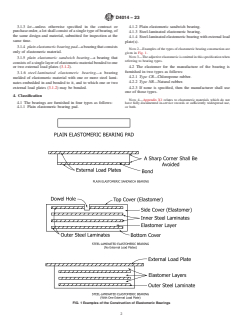
NOTE 2—Examples of the types of elastomeric bearing construction are
only of elastomeric material.
given in Fig. 1.
NOTE 3—The adjective elastomeric is omitted in this specification when
3.1.5 plain elastomeric sandwich bearing—a bearing that
referring to bearing types.
consists of a single layer of elastomeric material bonded to one
or two external load plates (3.1.2). 4.2 The elastomer for the manufacture of the bearing is
furnished in two types as follows:
3.1.6 steel-laminated elastomeric bearing—a bearing
4.2.1 Type CR—Chloroprene rubber.
molded of elastomeric material with one or more steel lami-
4.2.2 Type NR—Natural rubber.
nates embedded in and bonded to it, and to which one or two
external load plates (3.1.2) may be bonded. 4.2.3 If none is specified, then the manufacturer shall use
one of those types.
4. Classification
NOTE 4—Appendix X1 relates to elastomeric materials which do not
4.1 The bearings are furnished in four types as follows:
have fully documented in-service records or sufficiently widespread use,
4.1.1 Plain elastomeric bearing pad. or both.
FIG. 1 Examples of the Construction of Elastomeric Bearings
D4014 − 23
NOTE 5—The abbreviations for the elastomer types are taken from
elastomer at the outer edges of bonds to external load plates
Practice D1418.
shall be shaped to avoid serious stress concentrations (see Fig.
4.3 The elastomer for the manufacture of the bearing is 1).
furnished in four grades of low-temperature properties. The
6.7 Internal steel laminates shall be free of sharp edges.
grades and typical operating temperature conditions for each
6.8 External load plates shall be protected from rusting
grade are as follows:
when supplied by the manufacturer.
4.3.1 Grade 0—Suitable for continuous use down to +5 °C.
(As per AASHTO M 251, NO low-temperature tests for Grade 6.9 All molds shall have a standard shop-practice mold
0 to 2; recommend the same here.)
finish.
4.3.2 Grade 2—Sub-zero temperatures occur at night and
6.10 The use of internal alignment pins to hold the steel
occasionally persist for no more than one or two days.
reinforcement plates shall be allowed.
4.3.3 Grade 3—Same as Grade 2 but occasional periods of
up to two weeks continuously below zero.
7. Dimensions and Permissible Variations
4.3.4 Grade 5—Sub-zero temperatures down to −40 °C per-
7.1 All elastomeric layers, for example, plain-bearing pads,
sisting for several months each year with up to two months
laminates, and covers, shall be of uniform thickness unless
continuously below −15 °C.
otherwise specified in the contract or purchase order.
4.3.5 If a grade is not specified, Grade 0 shall be furnished.
An elastomer of a higher grade number may be substituted for
7.2 All internal steel laminates shall be of uniform thick-
any lower grade.
ness. When specified in the contract or purchase order, the
thickness of the outer steel laminates may differ if not adjacent
NOTE 6—A discussion of low-temperature properties of elastomeric
to an external load plate (see Fig. 1).
materials is given in Practice D832.
NOTE 7—The grade numbers for the low-temperature properties corre-
7.3 The minimum thickness of internal steel laminates shall
spond to those in Table 6 of Classification D2000.
be 2.0 mm or 0.078 in. (14 gage) when the greater of the length
or width of a rectangular bearing or the diameter of a circular
5. Ordering Information
bearing is less than 450 mm or 18 in. In all other cases, the
5.1 Orders for each type of bearing under this specification
minimum thickness shall be 2 mm or 0.075 in. (14 gage).
shall include the following:
7.4 External load plates shall be of uniform thickness unless
5.1.1 Quantity,
otherwise specified in the contract or purchase order.
5.1.2 Bearing design,
7.5 Bearing dimensions and elastomer layer thicknesses
NOTE 8—An example of the design information required is given in
shall satisfy the tolerances in Table 1, in which D is the length,
Appendix X2. Working drawings may be substituted.
width, or diameter as appropriate, and T is the total elastomer
5.1.3 Design load,
thickness.
5.1.4 Shear modulus of the elastomer,
7.6 Variation from a plane parallel to a design surface shall
5.1.5 Rubber type,
not exceed an average slope of 0.005 for the upper surface and
5.1.6 Rubber grade, and
0.006 for a side surface.
5.1.7 Ozone test partial pressure, if higher than 50 mPa
(formerly referred to as a concentration of 50 parts per hundred
8. Test Methods and Acceptance Requirements
million (pphm)).
8.1 Bearing Compression Tests—All bearings sampled from
6. Materials and Manufacture
a lot shall be subjected to the compression tests. The cost of
replacement bearings and of testing them shall be borne by the
6.1 The elastomeric compound used in the construction of a
supplier.
bearing shall contain only either natural rubber or chloroprene
8.1.1 The bearings shall be brought to a temperature of 23 6
rubber as the raw polymer. No reclaimed rubber shall be used.
6 °C and shall be tested at this temperature.
6.2 Internal steel laminates shall be of rolled mild steel
(Specification A1011/A1011M).
6.3 External load plates shall conform to the requirements
of Specification A36/A36M unless otherwise specified in the
TABLE 1 Tolerances for Bearing Dimensions and Elastomer
contract or purchase order. Layer Thicknesses
Tolerance
6.4 Plain bearing pads shall be molded individually, or cut
Dimension
Minimum Maximum
from previously molded strips or slabs, or extruded and cut to
Length, width or diameter of 0 5 (0.2) + 0.005D
length. Cutting shall produce a smooth surface and no heating
bearing, mm (in.)
of the elastomer.
Height of bearing, mm (in.) 0 2 (0.1) + 0.04T
Thickness of elastomer 0 3 (0.1)
6.5 A steel-laminated bearing or a plain sandwich bearing
cover at top, bottom or side,
shall be molded as a single unit under pressure and heat.
mm (in.)
Thickness of internal elas- ±20 % of design
6.6 All bonding of elastomer to steel laminates and to
tomer laminate, % value
external load plates shall be carried out during molding. The
D4014 − 23
TABLE 2 Quality Control Properties of Elastomer
8.1.2 Compression Stiffness—Load the bearing to the design
load (3.1.1) by increments of one fifth of the design load. For Rubber NR CR
each load increment, the loading time shall be within the range Hardness limits (Test Method 45 to 75 45 to 75
D1415 or D2240)
of 1.4 to 2.6 min. When the increment has been applied, the
Physical properties (Test Methods
load or deflection (depending on the type of testing machine)
D412):
Tensile strength, min, MPa (psi) 15.5 (2250) 15.5 (2250)
shall be maintained constant for 30 s then the load and
Ultimate elongation:
deflection measured. From a plot of load against deflection, the
45 to 55 hardness, min, % 400 400
compression stiffness shall be determined as the slope of the
56 to 65 hardness, min, % 400 350
best straight line through the points, ignoring the first point at 66 to 75 hardness, min, % 300 300
High-temperature resistance (Test
zero load. Record the compressive stiffness for each bearing.
Method D573)
8.1.3 Visual Inspection—Increase the load to 1.5 times the
Aging time, h 168 70
Aging
...
This document is not an ASTM standard and is intended only to provide the user of an ASTM standard an indication of what changes have been made to the previous version. Because
it may not be technically possible to adequately depict all changes accurately, ASTM recommends that users consult prior editions as appropriate. In all cases only the current version
of the standard as published by ASTM is to be considered the official document.
Designation: D4014 − 03 (Reapproved 2018) D4014 − 23
Standard Specification for
Plain and Steel-Laminated Elastomeric Bearings for
Bridges
This standard is issued under the fixed designation D4014; the number immediately following the designation indicates the year of
original adoption or, in the case of revision, the year of last revision. A number in parentheses indicates the year of last reapproval. A
superscript epsilon (´) indicates an editorial change since the last revision or reapproval.
1. Scope
1.1 This specification covers bearings,bearings which consist of all elastomer or of alternate laminates of elastomer and steel,
when the function of the bearings is to transfer loads or accommodate relative movement between a bridge superstructure and its
supporting structure, or both.
1.2 The values stated in SI units are to be regarded as the standard.
NOTE 1—The words “elastomer” or “elastomeric” will be used interchangeably with the word “rubber” in this specification.
1.3 The following safety hazards caveat pertains only to the test methods portion, Section 8, of this specification: This standard
does not purport to address all of the safety concerns, if any, associated with its use. It is the responsibility of the user of this
standard to establish appropriate safety, health, and environmental practices and determine the applicability of regulatory
limitations prior to use.
1.4 This international standard was developed in accordance with internationally recognized principles on standardization
established in the Decision on Principles for the Development of International Standards, Guides and Recommendations issued
by the World Trade Organization Technical Barriers to Trade (TBT) Committee.
2. Referenced Documents
2.1 ASTM Standards:
A36/A36M Specification for Carbon Structural Steel
A1011/A1011M Specification for Steel, Sheet and Strip, Hot-Rolled, Carbon, Structural, High-Strength Low-Alloy, High-
Strength Low-Alloy with Improved Formability, and Ultra-High Strength
D395 Test Methods for Rubber Property—Compression Set
D412 Test Methods for Vulcanized Rubber and Thermoplastic Elastomers—Tension
D518 Test Method for Rubber Deterioration—Surface Cracking (Withdrawn 2007)
D573 Test Method for Rubber—Deterioration in an Air Oven
D832 Practice for Rubber Conditioning For Low Temperature Testing
D1149 Test Methods for Rubber Deterioration—Cracking in an Ozone Controlled Environment
D1415 Test Method for Rubber Property—International Hardness
D1418 Practice for Rubber and Rubber Latices—Nomenclature
This specification is under the jurisdiction of ASTM Committee D04 on Road and Paving Materials and is the direct responsibility of Subcommittee D04.32 on Bridges
and Structures.
Current edition approved April 1, 2018Nov. 1, 2023. Published April 2018November 2023. Originally approved in 1981. Last previous edition approved in 20122018 as
D4014 – 03 (2012).(2018). DOI: 10.1520/D4014-03R18.10.1520/D4014-23.
For referenced ASTM standards, visit the ASTM website, www.astm.org, or contact ASTM Customer Service at service@astm.org. For Annual Book of ASTM Standards
volume information, refer to the standard’s Document Summary page on the ASTM website.
The last approved version of this historical standard is referenced on www.astm.org.
Copyright © ASTM International, 100 Barr Harbor Drive, PO Box C700, West Conshohocken, PA 19428-2959. United States
D4014 − 23
D2000 Classification System for Rubber Products in Automotive Applications
D2137 Test Methods for Rubber Property—Brittleness Point of Flexible Polymers and Coated Fabrics
D2240 Test Method for Rubber Property—Durometer Hardness
D3183 Practice for Rubber—Preparation of Pieces for Test Purposes from Products
E4 Practices for Force Calibration and Verification of Testing Machines
2.2 AASHTO Standards:
M 251 Standard Specification for Plain and Laminated Elastomeric Bridge Bearings
3. Terminology
3.1 Definitions:
3.1.1 design load—the mean compressive stress applied to the area of the steel laminate.
3.1.2 external load plate—a steel plate bonded to the top or bottom elastomeric surface of a bearing, or both.
3.1.3 lot—unless otherwise specified in the contract or purchase order, a lot shall consist of a single type of bearing, of the same
design and material, submitted for inspection at the same time.
3.1.4 plain elastomeric bearing pad—a bearing that consists only of elastomeric material.
3.1.5 plain elastomeric sandwich bearing—a bearing that consists of a single layer of elastomeric material bonded to one or two
external load plates (3.1.2).
3.1.6 steel-laminated elastomeric bearing—a bearing molded of elastomeric material with one or more steel laminates embedded
in and bonded to it, and to which one or two external load plates (3.1.2) may be bonded.
4. Classification
4.1 The bearings are furnished in four types as follows:
4.1.1 Plain elastomeric bearing pad.
4.1.2 Plain elastomeric sandwich bearing.
4.1.3 Steel-laminated elastomeric bearing.
4.1.4 Steel-laminated elastomeric bearing with external load plate(s).
NOTE 2—Examples of the types of elastomeric bearing construction are given in Fig. 1.
NOTE 3—The adjective elastomeric is omitted in this specification when referring to bearing types.
4.2 The elastomer for the manufacture of the bearing is furnished in two types as follows:
4.2.1 Type CR—Chloroprene rubber.
4.2.2 Type NR—Natural rubber.
4.2.3 If none is specified, then the manufacturer shall use one of those types.
NOTE 4—Appendix X1 relates to elastomeric materials which do not have fully documented in-service records or sufficiently widespread use, or both.
NOTE 5—The abbreviations for the elastomer types are taken from Practice D1418.
Available from American Association of State Highway and Transportation Officials (AASHTO), 444 N. Capitol St., NW, Suite 249, Washington, DC 20001,
http://www.transportation.org.
D4014 − 23
FIG. 1 Examples of the Construction of Elastomeric Bearings
4.3 The elastomer for the manufacture of the bearing is furnished in four grades of low-temperature properties. The grades and
typical operating temperature conditions for each grade are as follows:
4.3.1 Grade 0—Suitable for continuous use down to +5 °C. (As per AASHTO M 251, NO low-temperature tests for Grade 0 to
2; recommend the same here.)
4.3.2 Grade 2—Sub-zero temperatures occur at night and occasionally persist for no more than one or two days.
4.3.3 Grade 3—Same as Grade 2 but occasional periods of up to two weeks continuously below zero.
4.3.4 Grade 5—Sub-zero temperatures down to −40 °C persisting for several months each year with up to two months
continuously below −15 °C.
4.3.5 If a grade is not specified, Grade 0 shall be furnished. An elastomer of a higher grade number may be substituted for any
lower grade.
D4014 − 23
NOTE 6—A discussion of low-temperature properties of elastomeric materials is given in Practice D832.
NOTE 7—The grade numbers for the low-temperature properties correspond to those in Table 6 of Classification D2000.
5. Ordering Information
5.1 Orders for each type of bearing under this specification shall include the following:
5.1.1 Quantity,
5.1.2 Bearing design,
NOTE 8—An example of the design information required is given in Appendix X2. Working drawings may be substituted.
5.1.3 Design load,
5.1.4 Shear modulus of the elastomer,
5.1.5 Rubber type,
5.1.6 Rubber grade, and
5.1.7 Ozone test partial pressure, if higher than 50 mPa (formerly referred to as a concentration of 50 parts per hundred million
(pphm)).
6. Materials and Manufacture
6.1 The elastomeric compound used in the construction of a bearing shall contain only either natural rubber or chloroprene rubber
as the raw polymer. No reclaimed rubber shall be used.
6.2 Internal steel laminates shall be of rolled mild steel.steel (Specification A1011/A1011M).
6.3 External load plates shall conform to the requirements of Specification A36/A36M unless otherwise specified in the contract
or purchase order.
6.4 Plain bearing pads shall be molded individually, or cut from previously molded strips or slabs, or extruded and cut to length.
Cutting shall produce a smooth surface and no heating of the elastomer.
6.5 A steel-laminated bearing or a plain sandwich bearing shall be molded as a single unit under pressure and heat.
6.6 All bonding of elastomer to steel laminates and to external load plates shall be carried out during molding. The elastomer at
the outer edges of bonds to external load plates shall be shaped to avoid serious stress concentrations (see Fig. 1).
6.7 Internal steel laminates shall be free of sharp edges.
6.8 External load plates shall be protected from rusting when supplied by the manufacturer.
6.9 All molds shall have a standard shop-practice mold finish.
6.10 The use of internal alignment pins to hold the steel reinforcement plates shall be allowed.
7. Dimensions and Permissible Variations
7.1 All elastomeric layers, for example, plain-bearing pads, laminates, and covers, shall be of uniform thickness unless otherwise
specified in the contract or purchase order.
D4014 − 23
7.2 All internal steel laminates shall be of uniform thickness. When specified in the contract or purchase order, the thickness of
the outer steel laminates may differ if not adjacent to an external load plate (see Fig. 1).
7.3 The minimum thickness of internal steel laminates shall be 1.52.0 mm or 0.060 in. (160.078 in. (14 gage) when the greater
of the length or width of a rectangular bearing or the diameter of a circular bearing is less than 450 mm or 18 in. In all other cases,
the minimum thickness shall be 2 mm or 0.075 in. (14 gage).
7.4 External load plates shall be of uniform thickness unless otherwise specified in the contract or purchase order.
7.5 Bearing dimensions and elastomer layer thicknesses shall satisfy the tolerances in Table 1, in which D is the length, width,
or diameter as appropriate, and T is the total elastomer thickness.
7.6 Variation from a plane parallel to a design surface shall not exceed an average slope of 0.005 for the upper surface and 0.006
for a side surface.
8. Test Methods and Acceptance Requirements
8.1 Bearing Compression Tests—All bearings sampled from a lot shall be subjected to the compression tests. The cost of
replacement bearings and of testing them shall be borne by the supplier.
8.1.1 The bearings shall be brought to a temperature of 23 6 6 °C and shall be tested at this temperature.
8.1.2 Compression Stiffness—Load the bearing to the design load (3.1.1) by increments of one-fifth one fifth of the design load.
For each load increment, the loading time shall be within the range of 1.4 to 2.6 min. When the increment has been applied, the
load or deflection (depending on the type of testing machine) shall be maintained constant for 30 s then the load and deflection
measured. From a plot of load against deflection, the compression stiffness shall be determined as the slope of the best straight line
through the points, ignoring the first point at zero load. Record the compressive stiffness for each bearing.
8.1.3 Visual Inspection—Increase the load to 1.5 times the design load, then maintain either load or deflection constant while the
bearing is inspected for visual faults, as follows:
8.1.3.1 If lack of elastomer to steel bond is indicated, the bearing shall be rejected.
8.1.3.2 If laminate placement faults are observed which result in elastomer layer thickness that exceeds the tolerances in 7.5, the
bearing shall be rejected.
8.1.3.3 If there are at least three separate surface cracks which are each at least 2 mm wide and 2 mm deep, the bearing shall be
rejected.
8.1.4 Record the median compressive stiffness (K) of the bearing of median stiffness. The compressive stiffness of each bearing
tested shall not differ from (K) by more than 10 %.
8.1.5 For each bearing that fails to meet the requirements in 8.1, tw
...