

ASTM D8507-23
(Specification)Standard Specification for High Load Multi-Rotational Disc Bearings for Bridges and Structures
General Information
- Abstract
SCOPE
1.1 This specification covers bridge bearings that consist of an unconfined polyether urethane rotational element subjected to compression loads, along with a resisting mechanism to transmit shear and/or tension loads through the bearing. For expansion and/or contraction applications, an additional stainless steel flat surface slides against a carbon steel plate faced with sheet polytetrafluoroethylene (PTFE). The function of the bearing is to transfer loads and to accommodate any relative movement, including rotation between a bridge superstructure and its supporting structure, or both.
1.2 The requirements stated in this specification are the minimums necessary for the manufacture of quality bearing devices. It may be necessary to increase these minimum values due to other design or construction conditions.
1.3 The values stated in inch-pound units are to be regarded as the standard. The values given in parentheses are for information only.
1.4 This standard does not purport to address all of the safety concerns, if any, associated with its use. It is the responsibility of the user of this standard to establish appropriate safety, health, and environmental practices and determine the applicability of regulatory limitations prior to use.
1.5 This international standard was developed in accordance with internationally recognized principles on standardization established in the Decision on Principles for the Development of International Standards, Guides and Recommendations issued by the World Trade Organization Technical Barriers to Trade (TBT) Committee.
- Status
- Published
- Publication Date
- 30-Apr-2023
- Technical Committee
- D04 - Road and Paving Materials
- Drafting Committee
- D04.32 - Bridges and Structures
Overview
ASTM D8507-23 is the international standard specification developed by ASTM for high load multi-rotational disc bearings, which are critical components used in bridges and structures. This specification details the minimum requirements for bearings that utilize an unconfined polyether urethane rotational element under compression loads and feature mechanisms to effectively transmit both shear and tension loads through the bearing. Where movement due to expansion or contraction is required, the standard also addresses the use of sliding surfaces that combine stainless steel and PTFE (polytetrafluoroethylene).
These disc bearings play a vital role in transferring structural loads and accommodating rotations and movements between a bridge superstructure and its supporting foundation. The standard provides material, design, manufacturing, testing, and performance criteria to ensure reliability and longevity in structural applications.
Key Topics
- Bearing Types: The standard classifies disc bearings into several types including fixed, unidirectional and multi-directional expansion, and uplift-disc bearings to address a range of structural and movement needs.
- Materials: Key materials covered in ASTM D8507-23 include polyether urethane for the disc element, structural steels, stainless steel for sliding surfaces, and pure virgin PTFE for low-friction movement surfaces.
- Load and Movement Accommodation: The specification requires these bearings to efficiently handle compression, shear, and tension loads while enabling controlled rotation and translation where necessary.
- Surface Protection: Guidance is provided for corrosion resistance via zinc metallizing, galvanizing, and other approved coatings.
- Testing and Quality Assurance: Detailed test methods ensure performance criteria are met, including compression proof load, friction coefficient, horizontal load, long-term deterioration, and material property verification.
- Product Marking: The standard specifies clear product identification and placement markings for proper installation and traceability.
Applications
- Bridge Construction: High load multi-rotational disc bearings specified by ASTM D8507-23 are integral to highway, railway, and pedestrian bridges. They maintain infrastructure safety by accommodating traffic-induced movement and structural deformations.
- Large Structures: These bearings are also used in other civil engineering structures where substantial static and dynamic loads, as well as multi-directional movements, must be managed safely.
- Retrofit and Maintenance: When upgrading older bridges or maintaining existing infrastructure, these bearings can be specified for improved performance and service life.
Practical implementation of ASTM D8507-23 enhances bridge durability and performance by ensuring that critical load transfer and movement accommodate the unique structural demands of various bridge designs and environmental conditions.
Related Standards
These referenced standards and guides ensure harmonization and interoperability in bridge engineering:
- ASTM A36/A36M, A588/A588M, A572/A572M, A709/A709M – Specifications for structural steel used in bearing plates and guide bars.
- ASTM A240/A240M – Specification for stainless steel sheet for sliding surfaces.
- ASTM D395, D412, D638, D792, D2240 – Test methods for evaluating material properties of elastomers, plastics, and PTFE.
- ASTM D4894, D4895 – Specifications for PTFE for sliding surfaces.
- AASHTO LRFD Bridge Design and Construction Specifications – U.S. standards for bridge engineering.
- AWS D1.5, D1.6, C2.23 – American Welding Society standards for bridge welding and corrosion protection.
- AREMA Manual for Railway Engineering – Railway bridge application guidance.
Keywords: high load disc bearings, bridge bearings, multi-rotational bearings, polyether urethane, PTFE, ASTM D8507-23, expansion bearings, structural steel, bridge construction standards, sliding bearings.
By adhering to ASTM D8507-23, civil engineers and bridge designers ensure optimal reliability, performance, and regulatory compliance for critical bridge and structural bearing applications.
Relations
- Effective Date
- 01-Nov-2023
- Effective Date
- 01-May-2019
- Effective Date
- 01-Nov-2017
- Effective Date
- 01-Sep-2017
- Effective Date
- 01-Sep-2017
- Effective Date
- 01-Dec-2016
- Effective Date
- 01-May-2016
- Effective Date
- 01-May-2016
- Effective Date
- 01-May-2016
- Effective Date
- 15-Feb-2016
- Effective Date
- 01-Nov-2015
- Effective Date
- 01-May-2015
- Effective Date
- 01-May-2015
- Effective Date
- 01-Mar-2015
- Effective Date
- 01-Jan-2015
Get Certified
Connect with accredited certification bodies for this standard

Zavod za gradbeništvo Slovenije (ZAG) - Inšpekcija
ZAG inspection body for construction products, structures, and materials.
Sponsored listings
Frequently Asked Questions
ASTM D8507-23 is a technical specification published by ASTM International. Its full title is "Standard Specification for High Load Multi-Rotational Disc Bearings for Bridges and Structures". This standard covers: SCOPE 1.1 This specification covers bridge bearings that consist of an unconfined polyether urethane rotational element subjected to compression loads, along with a resisting mechanism to transmit shear and/or tension loads through the bearing. For expansion and/or contraction applications, an additional stainless steel flat surface slides against a carbon steel plate faced with sheet polytetrafluoroethylene (PTFE). The function of the bearing is to transfer loads and to accommodate any relative movement, including rotation between a bridge superstructure and its supporting structure, or both. 1.2 The requirements stated in this specification are the minimums necessary for the manufacture of quality bearing devices. It may be necessary to increase these minimum values due to other design or construction conditions. 1.3 The values stated in inch-pound units are to be regarded as the standard. The values given in parentheses are for information only. 1.4 This standard does not purport to address all of the safety concerns, if any, associated with its use. It is the responsibility of the user of this standard to establish appropriate safety, health, and environmental practices and determine the applicability of regulatory limitations prior to use. 1.5 This international standard was developed in accordance with internationally recognized principles on standardization established in the Decision on Principles for the Development of International Standards, Guides and Recommendations issued by the World Trade Organization Technical Barriers to Trade (TBT) Committee.
SCOPE 1.1 This specification covers bridge bearings that consist of an unconfined polyether urethane rotational element subjected to compression loads, along with a resisting mechanism to transmit shear and/or tension loads through the bearing. For expansion and/or contraction applications, an additional stainless steel flat surface slides against a carbon steel plate faced with sheet polytetrafluoroethylene (PTFE). The function of the bearing is to transfer loads and to accommodate any relative movement, including rotation between a bridge superstructure and its supporting structure, or both. 1.2 The requirements stated in this specification are the minimums necessary for the manufacture of quality bearing devices. It may be necessary to increase these minimum values due to other design or construction conditions. 1.3 The values stated in inch-pound units are to be regarded as the standard. The values given in parentheses are for information only. 1.4 This standard does not purport to address all of the safety concerns, if any, associated with its use. It is the responsibility of the user of this standard to establish appropriate safety, health, and environmental practices and determine the applicability of regulatory limitations prior to use. 1.5 This international standard was developed in accordance with internationally recognized principles on standardization established in the Decision on Principles for the Development of International Standards, Guides and Recommendations issued by the World Trade Organization Technical Barriers to Trade (TBT) Committee.
ASTM D8507-23 is classified under the following ICS (International Classification for Standards) categories: 93.040 - Bridge construction. The ICS classification helps identify the subject area and facilitates finding related standards.
ASTM D8507-23 has the following relationships with other standards: It is inter standard links to ASTM A240/A240M-23a, ASTM D4894-19, ASTM A240/A240M-17, ASTM A709/A709M-17e1, ASTM A709/A709M-17, ASTM A240/A240M-16a, ASTM A240/A240M-16, ASTM A709/A709M-16a, ASTM D4895-16, ASTM A709/A709M-16, ASTM A240/A240M-15b, ASTM D4895-15, ASTM D4894-15, ASTM A240/A240M-15a, ASTM A240/A240M-15. Understanding these relationships helps ensure you are using the most current and applicable version of the standard.
ASTM D8507-23 is available in PDF format for immediate download after purchase. The document can be added to your cart and obtained through the secure checkout process. Digital delivery ensures instant access to the complete standard document.
Standards Content (Sample)
This international standard was developed in accordance with internationally recognized principles on standardization established in the Decision on Principles for the
Development of International Standards, Guides and Recommendations issued by the World Trade Organization Technical Barriers to Trade (TBT) Committee.
Designation: D8507 − 23
Standard Specification for
High Load Multi-Rotational Disc Bearings for Bridges and
Structures
This standard is issued under the fixed designation D8507; the number immediately following the designation indicates the year of
original adoption or, in the case of revision, the year of last revision. A number in parentheses indicates the year of last reapproval. A
superscript epsilon (´) indicates an editorial change since the last revision or reapproval.
1. Scope A240/A240M Specification for Chromium and Chromium-
Nickel Stainless Steel Plate, Sheet, and Strip for Pressure
1.1 This specification covers bridge bearings that consist of
Vessels and for General Applications
an unconfined polyether urethane rotational element subjected
A572/A572M Specification for High-Strength Low-Alloy
to compression loads, along with a resisting mechanism to
Columbium-Vanadium Structural Steel
transmit shear and/or tension loads through the bearing. For
A588/A588M Specification for High-Strength Low-Alloy
expansion and/or contraction applications, an additional stain-
Structural Steel, up to 50 ksi [345 MPa] Minimum Yield
less steel flat surface slides against a carbon steel plate faced
Point, with Atmospheric Corrosion Resistance
with sheet polytetrafluoroethylene (PTFE). The function of the
A709/A709M Specification for Structural Steel for Bridges
bearing is to transfer loads and to accommodate any relative
D395 Test Methods for Rubber Property—Compression Set
movement, including rotation between a bridge superstructure
D412 Test Methods for Vulcanized Rubber and Thermoplas-
and its supporting structure, or both.
tic Elastomers—Tension
1.2 The requirements stated in this specification are the
D638 Test Method for Tensile Properties of Plastics
minimums necessary for the manufacture of quality bearing
D792 Test Methods for Density and Specific Gravity (Rela-
devices. It may be necessary to increase these minimum values
tive Density) of Plastics by Displacement
due to other design or construction conditions.
D2240 Test Method for Rubber Property—Durometer Hard-
1.3 The values stated in inch-pound units are to be regarded ness
D4894 Specification for Polytetrafluoroethylene (PTFE)
as the standard. The values given in parentheses are for
information only. Granular Molding and Ram Extrusion Materials
D4895 Specification for Polytetrafluoroethylene (PTFE)
1.4 This standard does not purport to address all of the
Resin Produced From Dispersion
safety concerns, if any, associated with its use. It is the
2.2 AASHTO Standards:
responsibility of the user of this standard to establish appro-
AASHTO Standard Specifications for Highway Bridges
priate safety, health, and environmental practices and deter-
AASHTO LRFD Bridge Design Specifications
mine the applicability of regulatory limitations prior to use.
AASHTO LRFD Bridge Construction Specifications
1.5 This international standard was developed in accor-
dance with internationally recognized principles on standard-
2.3 AWS Standards:
ization established in the Decision on Principles for the
C2.23 Specification for the Application of Thermal Spray
Development of International Standards, Guides and Recom-
Coatings (Metallizing) of Aluminum, Zinc, and Their
mendations issued by the World Trade Organization Technical Alloys and Composites for the Corrosion Protection of
Barriers to Trade (TBT) Committee.
Steel
D1.5 AASHTO/AWS Bridge Welding Code
2. Referenced Documents
D1.6 AWS Structural Welding Code—Stainless Steel
2.1 ASTM Standards:
2.4 AREMA Standards:
A36/A36M Specification for Carbon Structural Steel
AREMA Manual for Railway Engineering
This specification is under the jurisdiction of ASTM Committee D04 on Road
and Paving Materials and is the direct responsibility of Subcommittee D04.32 on Available from American Association of State Highway and Transportation
Bridges and Structures. Officials (AASHTO), 444 N. Capitol St., NW, Suite 249, Washington, DC 20001,
Current edition approved May 1, 2023. Published May 2023. DOI: 10.1520/ http://www.transportation.org.
D8507-23. Available from American Welding Society (AWS), 8669 NW 36 St., #130,
For referenced ASTM standards, visit the ASTM website, www.astm.org, or Miami, FL 33166-6672, http://www.aws.org.
contact ASTM Customer Service at service@astm.org. For Annual Book of ASTM Available from American Railway Engineering and Maintenance-of-Way
Standards volume information, refer to the standard’s Document Summary page on Association (AREMA), 4501 Forbes Blvd., Suite 130, Lanham, MD 20706,
the ASTM website. https://www.arema.org.
Copyright © ASTM International, 100 Barr Harbor Drive, PO Box C700, West Conshohocken, PA 19428-2959. United States
D8507 − 23
3. Classification 4.5 Sheet Polytetrafluoroethylene (PTFE)—The sheet PTFE
shall be virgin material (not reprocessed) meeting the require-
3.1 The bearings are furnished in six types, as follows:
ments of Specification D4894 or D4895. The PTFE shall be
3.1.1 Fixed Disc Bearing—Rotation only.
resistant to acids, alkalis, petroleum products, and non-
3.1.2 Unidirectional Expansion Disc Bearing—Rotation
absorption of water. It shall be stable for temperatures up to
plus movement in one direction.
500 °F (260 °C) and shall be nonflammable. Filler material, if
3.1.3 Multi-Directional Expansion Disc Bearing—Rotation
used, shall be composed of milled glass or carbon fibers with
plus movement in all directions.
a maximum of 25 % filler content.
3.1.4 Fixed Uplift Disc Bearing—Rotation plus uplift re-
4.5.1 The thickness of the sheet PTFE shall be a minimum
straint.
of ⁄4 in. (6.35 mm) and shall be recessed at least one half of its
3.1.5 Unidirectional Expansion Uplift Disc Bearing—
thickness into a steel substrate.
Rotation plus uplift restraint and movement in one direction.
4.5.2 The sheet PTFE for the principal sliding surface and
3.1.6 Multi-Directional Expansion Uplift Disc Bearing—
for guide bars, if used, shall conform to the physical property
Rotation plus uplift restraint and movement in all directions.
requirements listed in Table 2.
4. Material Specifications
4.1 Steel—The steel used for all major plates and guide bars,
TABLE 2 Physical Property Requirements for Sheet PTFE
if used, shall be structural steel conforming to Specification
Physical Properties Test Method Requirement
A36/A36M, A588/A588M, A572/A572M, or A709/A709M,
Ultimate tensile strength, min, psi (MPa) D638 2800 (19.3)
as required. All exposed surfaces shall be zinc metalized and
Ultimate elongation, min, % D638 200
Specific gravity D792 2.13–2.19
sealed according to AWS C2.23 or treated with other project-
approved coating systems such as zinc paint or hot-dip
galvanizing. Hot-dip galvanizing should be used with caution
since it can cause warping of the steel plates. The dry film
4.5.3 Low-friction sliding materials other than PTFE can be
thickness (DFT) of the approved coating system must be
considered for guide bars. If used, the low-friction sliding
specified by the owner, as well as the paint manufacturer’s
material shall be an engineered polymer that has good wear and
recommendations if using a paint system.
abrasion resistance and minimal deflection under compression
4.2 Shear and/or Tension Resisting Mechanism—The shear
load. Along with a wide temperature operating range, it shall
and/or tension resisting mechanism shall be alloy steel capable
also have excellent weathering properties with good chemical
of resisting the shear and/or tension loads transmitted through
resistance and a low water absorption rate.
the bearing. The mechanism may be placed either inside or
outside of the polyether urethane disc and shall not restrict the
5. Design Requirements
required rotation of the bearing.
NOTE 1—To Designer: The bearing details shall be designed in
accordance with the requirements of the current edition with interims of
4.3 Polyether Urethane Disc—The polyether urethane disc
the AASHTO LRFD Bridge Design Specifications, AREMA Manual for
material shall conform to the physical property requirements
Railway Engineering, or other governing design procedures.
listed in Table 1. The polyether urethane element shall be
5.1 Rotational Element:
molded as a single piece; separate layers are not allowed.
5.1.1 The polyether urethane disc geometry shall be deter-
Alternate disc material durometers can be considered by the
mined such that the bearing is capable of withstanding the
owner with supporting testing provided on the polyether
design vertical load without liftoff between bearing compo-
urethane materials as well as full-size disc bearing elements.
nents at the corresponding design rotation. Calculations show-
4.4 Stainless Steel Flat Sliding Surface—The sheet stainless
ing determination of the disc geometry shall be submitted to
steel used as the mating sliding surface to the sheet PTFE in the
the owner for approval.
expansion disc bearings shall conform to Specification A240/
5.1.2 The thickness of the polyether urethane disc shall not
A240M, type 304, 16 μin. (0.5 μm) rms finish.
be less than:
R * D ⁄ 2 * ε (1)
~ ! ~ !
ot d max
TABLE 1 Physical Property Requirements for Polyether Urethane
where:
Physical Properties Test Method Requirement
Hardness, Shore D Durometer D2240 60–65
D = outside dimension of the rotational element, in. (mm),
d
R = design rotation of the bearing at service limit state (in
ot
Tensile stress, min at 100 % elongation, D412 2100 (14.5)
radians), and
psi (MPa)
ɛ = compressive strain of the rotational element at design
max
Tensile stress, min at 200 % elongation, D412 3700 (25.5)
service vertical load with zero rotation, not including
psi (MPa)
long-term creep, in/in. Not to exceed 10 % of the
Ultimate tensile strength, min, psi (MPa) D412 5500 (37.9)
thickness of the unstressed rotational element.
Ultimate elongation, min, % D412 253 5.1.3 The area of the polyether urethane disc shall be
designed for a maximum average service limit stress of
Compression set, 22 h at 158 °F, Method D395 40
5000 psi (34.5 MPa) unless otherwise substantiated by test
B, max, %
data.
D8507 − 23
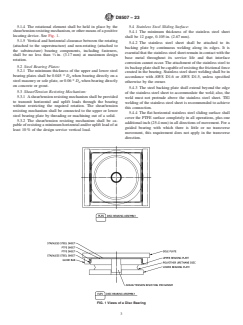
5.1.4 The rotational element shall be held in place by the 5.4 Stainless Steel Sliding Surface:
shear/tension resisting mechanism, or other means of a positive
5.4.1 The minimum thickness of the stainless steel sheet
locating device. See Fig. 1.
shall be 12 gage, 0.105 in. (2.67 mm).
5.1.5 Vertical and horizontal clearance between the rotating
5.4.2 The stainless steel sheet shall be attached to its
(attached to the superstructure) and non-rotating (attached to
backing plate by continuous welding along its edges. It is
the substructure) bearing components, including fasteners,
essential that the stainless steel sheet remain in contact with the
shall be no less than ⁄8 in. (3.17 mm) at maximum design
base metal throughout its service life and that interface
rotation.
corrosion cannot occur. The attachment of the stainless steel to
5.2 Steel Bearing Plates:
its backup plate shall be capable of resisting the frictional force
5.2.1 The minimum thickness of the upper and lower steel
created in the bearing. Stainless steel sheet welding shall be in
bearing plates shall be 0.045 * D when bearing directly on a
d
accordance with AWS D1.6 or AWS D1.5, unless specified
steel masonry or sole plate, or 0.06 * D when bearing directly
d
otherwise by the owne
...