

ASTM D6297-20
(Specification)Standard Specification for Asphaltic Plug Joints for Bridges
General Information
- Abstract
ABSTRACT
This specification covers the standards the material, testing and application requirements for a field molded asphaltic plug joint (APJ) used in expansion joint sealing on asphalt concrete overlay and portland cement concrete decks. This specification is limited only to field molded APJ which can consist of multilayer, or single layer, or both, application systems. The asphaltic binder to be used shall be a thermoplastic polymeric-modified asphalt. The aggregates shall be crushed, washed, and dried. Physical properties of the asphalt such as softening point, tensile adhesion, ductility, resilience, and flexibility shall also be tested and shall conform to other ASTM documents prescribed herein.
SCOPE
1.1 This specification covers the material, testing, and application requirements for a field-molded asphaltic plug joint (APJ) used in expansion joint sealing on asphalt concrete overlay and portland cement concrete decks. The scope of this specification is limited to field-molded APJ. This molded element can consist of multilayer or single layer, or both, application systems depending upon individual manufacturing requirements. The details of this specification are limited to the materials used in the application of APJ. It is recommended that a practical means of testing the watertightness aspects of the individual systems, either in the field or at the testing laboratory, be developed. When used on highway bridges, limits on maximum joint movements shall be specifically identified for each type of APJ. APJs should not be used for movement applications exceeding ±25 mm from the installation width.
1.2 The values stated in SI units are to be regarded as standard. No other units of measurement are included in this standard.
1.3 The text of this standard references notes and footnotes which provide explanatory material. These notes and footnotes (excluding those in tables and figures) shall not be considered as requirements of the standard.
1.4 This standard does not purport to address all of the safety concerns, if any, associated with its use. It is the responsibility of the user of this standard to establish appropriate safety, health, and environmental practices and determine the applicability of regulatory limitations prior to use.
1.5 This international standard was developed in accordance with internationally recognized principles on standardization established in the Decision on Principles for the Development of International Standards, Guides and Recommendations issued by the World Trade Organization Technical Barriers to Trade (TBT) Committee.
- Status
- Published
- Publication Date
- 30-Jun-2020
- Technical Committee
- D04 - Road and Paving Materials
- Drafting Committee
- D04.32 - Bridges and Structures
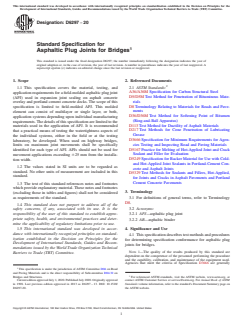
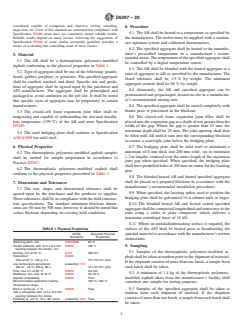


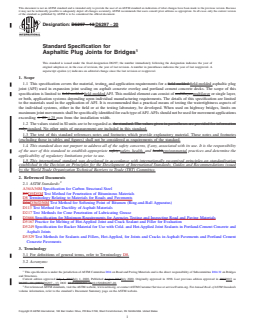
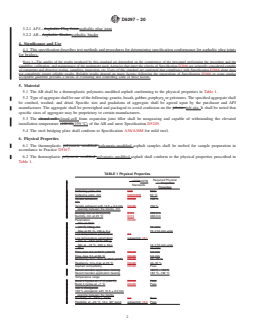

Overview
ASTM D6297-20: Standard Specification for Asphaltic Plug Joints for Bridges establishes material, testing, and application requirements for field-molded asphaltic plug joints (APJs) used to seal expansion joints in asphalt concrete and portland cement concrete bridge decks. This specification is designed to ensure that APJs deliver long-term watertight performance, flexibility, and durability under the demanding conditions found on highway bridges. The standard outlines the types of materials used-such as thermoplastic polymeric-modified asphaltic binders and specific aggregates-and details the necessary physical properties, installation procedures, and essential quality controls.
ASTM D6297-20 helps bridge owners, designers, and contractors select and install APJ systems capable of accommodating typical bridge movements while maintaining structural integrity and overall service life.
Key Topics
Material Requirements
- Thermoplastic polymeric-modified asphaltic binder
- Aggregates such as granite, basalt, and gritstones, which must be crushed, washed, and dried
- Closed-cell foam for expansion joint fillers-capable of withstanding high installation temperatures
- Use of steel bridging plates as required
Physical Properties
- Softening point, tensile adhesion, ductility, penetration, flow, resilience, bond strength, and flexibility
- Watertightness and flexibility at specified temperature ranges
Application and Installation
- Mixing procedures for binder and aggregates
- Temperature control during installation
- Placement and compaction requirements
- Use of antiskid/antitracking surfaces where needed
Testing and Quality Control
- Random sampling procedures for materials
- Laboratory and field tests for conformance-such as low-temperature penetration and flexibility
- Guidelines for inspection and documentation
Applications
ASTM D6297-20 is primarily applied in the construction and maintenance of highway bridges, ensuring reliable expansion joint sealing in both asphalt and portland cement concrete overlays. Its benefits and practical applications include:
- Accommodating Bridge Movements: APJ systems specified under this standard are suitable for movements not exceeding ±25 mm. This ensures performance in typical expansion/contraction cycles without loss of watertightness.
- Watertight Sealing: The systems provide a continuous, impermeable barrier, protecting the bridge deck and substructure from water ingress and deicing chemicals.
- Load Distribution: Steel bridging plates distribute loads across the expansion joint, ensuring even surface transitions and enhanced durability.
- Flexibility for Manufacturers and Contractors: The specification allows for both single-layer and multilayer APJ applications, supporting a range of bridge design and field conditions.
- Improved Safety and Service Life: The antiskid surface, combined with durable materials, supports a safe driving surface and reduces long-term maintenance needs.
Related Standards
Several ASTM standards are referenced within ASTM D6297-20 to guarantee comprehensive compliance and consistent quality:
- ASTM D5/D5M: Penetration of Bituminous Materials
- ASTM D36/D36M: Softening Point of Bitumen (Ring-and-Ball Apparatus)
- ASTM D113: Ductility of Asphalt Materials
- ASTM D217: Cone Penetration of Lubricating Grease (for testing)
- ASTM D3666: Minimum Requirements for Agencies Testing Road and Paving Materials
- ASTM D5167: Practice for Melting Hot-Applied Joint and Crack Sealant for Evaluation
- ASTM D5249: Backer Material for Use with Joint Sealants in Concrete and Asphalt Joints
- ASTM D5329: Test Methods for Hot-Applied Sealants and Fillers in Asphalt and Concrete Pavements
- ASTM A36/A36M: Carbon Structural Steel (for bridging plates)
The use of these referenced standards ensures that materials and practices associated with asphaltic plug joints for bridges meet recognized industry benchmarks, supporting quality, safety, and international compatibility in bridge construction projects.
Keywords: ASTM D6297-20, asphaltic plug joint, APJ, bridge expansion joint sealing, thermoplastic polymeric-modified asphalt, highway bridge joints, asphalt concrete, portland cement concrete, watertight joint, bridge deck protection
Relations
- Effective Date
- 01-May-2020
- Effective Date
- 01-May-2020
- Effective Date
- 15-Dec-2019
- Effective Date
- 01-Aug-2019
- Effective Date
- 01-Jul-2019
- Effective Date
- 01-May-2019
- Effective Date
- 15-Dec-2018
- Effective Date
- 01-Oct-2018
- Effective Date
- 15-Aug-2018
- Effective Date
- 01-Jul-2018
- Effective Date
- 01-Feb-2018
- Effective Date
- 15-Jul-2017
- Effective Date
- 15-Jun-2017
- Effective Date
- 01-May-2017
- Effective Date
- 01-Mar-2017
Get Certified
Connect with accredited certification bodies for this standard

DIBt (Deutsches Institut für Bautechnik)
German Institute for Building Technology.
DIN CERTCO
DIN Group product certification.
Zavod za gradbeništvo Slovenije (ZAG) - Inšpekcija
ZAG inspection body for construction products, structures, and materials.
Sponsored listings
Frequently Asked Questions
ASTM D6297-20 is a technical specification published by ASTM International. Its full title is "Standard Specification for Asphaltic Plug Joints for Bridges". This standard covers: ABSTRACT This specification covers the standards the material, testing and application requirements for a field molded asphaltic plug joint (APJ) used in expansion joint sealing on asphalt concrete overlay and portland cement concrete decks. This specification is limited only to field molded APJ which can consist of multilayer, or single layer, or both, application systems. The asphaltic binder to be used shall be a thermoplastic polymeric-modified asphalt. The aggregates shall be crushed, washed, and dried. Physical properties of the asphalt such as softening point, tensile adhesion, ductility, resilience, and flexibility shall also be tested and shall conform to other ASTM documents prescribed herein. SCOPE 1.1 This specification covers the material, testing, and application requirements for a field-molded asphaltic plug joint (APJ) used in expansion joint sealing on asphalt concrete overlay and portland cement concrete decks. The scope of this specification is limited to field-molded APJ. This molded element can consist of multilayer or single layer, or both, application systems depending upon individual manufacturing requirements. The details of this specification are limited to the materials used in the application of APJ. It is recommended that a practical means of testing the watertightness aspects of the individual systems, either in the field or at the testing laboratory, be developed. When used on highway bridges, limits on maximum joint movements shall be specifically identified for each type of APJ. APJs should not be used for movement applications exceeding ±25 mm from the installation width. 1.2 The values stated in SI units are to be regarded as standard. No other units of measurement are included in this standard. 1.3 The text of this standard references notes and footnotes which provide explanatory material. These notes and footnotes (excluding those in tables and figures) shall not be considered as requirements of the standard. 1.4 This standard does not purport to address all of the safety concerns, if any, associated with its use. It is the responsibility of the user of this standard to establish appropriate safety, health, and environmental practices and determine the applicability of regulatory limitations prior to use. 1.5 This international standard was developed in accordance with internationally recognized principles on standardization established in the Decision on Principles for the Development of International Standards, Guides and Recommendations issued by the World Trade Organization Technical Barriers to Trade (TBT) Committee.
ABSTRACT This specification covers the standards the material, testing and application requirements for a field molded asphaltic plug joint (APJ) used in expansion joint sealing on asphalt concrete overlay and portland cement concrete decks. This specification is limited only to field molded APJ which can consist of multilayer, or single layer, or both, application systems. The asphaltic binder to be used shall be a thermoplastic polymeric-modified asphalt. The aggregates shall be crushed, washed, and dried. Physical properties of the asphalt such as softening point, tensile adhesion, ductility, resilience, and flexibility shall also be tested and shall conform to other ASTM documents prescribed herein. SCOPE 1.1 This specification covers the material, testing, and application requirements for a field-molded asphaltic plug joint (APJ) used in expansion joint sealing on asphalt concrete overlay and portland cement concrete decks. The scope of this specification is limited to field-molded APJ. This molded element can consist of multilayer or single layer, or both, application systems depending upon individual manufacturing requirements. The details of this specification are limited to the materials used in the application of APJ. It is recommended that a practical means of testing the watertightness aspects of the individual systems, either in the field or at the testing laboratory, be developed. When used on highway bridges, limits on maximum joint movements shall be specifically identified for each type of APJ. APJs should not be used for movement applications exceeding ±25 mm from the installation width. 1.2 The values stated in SI units are to be regarded as standard. No other units of measurement are included in this standard. 1.3 The text of this standard references notes and footnotes which provide explanatory material. These notes and footnotes (excluding those in tables and figures) shall not be considered as requirements of the standard. 1.4 This standard does not purport to address all of the safety concerns, if any, associated with its use. It is the responsibility of the user of this standard to establish appropriate safety, health, and environmental practices and determine the applicability of regulatory limitations prior to use. 1.5 This international standard was developed in accordance with internationally recognized principles on standardization established in the Decision on Principles for the Development of International Standards, Guides and Recommendations issued by the World Trade Organization Technical Barriers to Trade (TBT) Committee.
ASTM D6297-20 is classified under the following ICS (International Classification for Standards) categories: 91.100.30 - Concrete and concrete products; 93.040 - Bridge construction; 93.080.20 - Road construction materials. The ICS classification helps identify the subject area and facilitates finding related standards.
ASTM D6297-20 has the following relationships with other standards: It is inter standard links to ASTM D36/D36M-14(2020), ASTM D5329-20, ASTM D5/D5M-19a, ASTM D8-19, ASTM D217-19a, ASTM D217-19, ASTM D8-18c, ASTM D5167-13(2018), ASTM D8-18b, ASTM D8-18a, ASTM D8-18, ASTM D8-17c, ASTM D8-17b, ASTM D8-17a, ASTM D8-17. Understanding these relationships helps ensure you are using the most current and applicable version of the standard.
ASTM D6297-20 is available in PDF format for immediate download after purchase. The document can be added to your cart and obtained through the secure checkout process. Digital delivery ensures instant access to the complete standard document.
Standards Content (Sample)
This international standard was developed in accordance with internationally recognized principles on standardization established in the Decision on Principles for the
Development of International Standards, Guides and Recommendations issued by the World Trade Organization Technical Barriers to Trade (TBT) Committee.
Designation: D6297 −20
Standard Specification for
Asphaltic Plug Joints for Bridges
This standard is issued under the fixed designation D6297; the number immediately following the designation indicates the year of
original adoption or, in the case of revision, the year of last revision. A number in parentheses indicates the year of last reapproval. A
superscript epsilon (´) indicates an editorial change since the last revision or reapproval.
1. Scope 2. Referenced Documents
2.1 ASTM Standards:
1.1 This specification covers the material, testing, and
A36/A36M Specification for Carbon Structural Steel
application requirements for a field-molded asphaltic plug joint
D5/D5M Test Method for Penetration of Bituminous Mate-
(APJ) used in expansion joint sealing on asphalt concrete
rials
overlay and portland cement concrete decks. The scope of this
D8 Terminology Relating to Materials for Roads and Pave-
specification is limited to field-molded APJ. This molded
ments
element can consist of multilayer or single layer, or both,
D36/D36M Test Method for Softening Point of Bitumen
application systems depending upon individual manufacturing
(Ring-and-Ball Apparatus)
requirements.The details of this specification are limited to the
D113 Test Method for Ductility of Asphalt Materials
materials used in the application of APJ. It is recommended
D217 Test Methods for Cone Penetration of Lubricating
that a practical means of testing the watertightness aspects of
Grease
the individual systems, either in the field or at the testing
D3666 Specification for Minimum Requirements for Agen-
laboratory, be developed. When used on highway bridges,
cies Testing and Inspecting Road and Paving Materials
limits on maximum joint movements shall be specifically
D5167 Practice for Melting of Hot-Applied Joint and Crack
identified for each type of APJ. APJs should not be used for
Sealant and Filler for Evaluation
movement applications exceeding 625 mm from the installa-
D5249 Specification for Backer Material for Use with Cold-
tion width.
and Hot-Applied Joint Sealants in Portland-Cement Con-
1.2 The values stated in SI units are to be regarded as
crete and Asphalt Joints
standard. No other units of measurement are included in this
D5329 Test Methods for Sealants and Fillers, Hot-Applied,
standard.
for Joints and Cracks in Asphalt Pavements and Portland
Cement Concrete Pavements
1.3 The text of this standard references notes and footnotes
which provide explanatory material. These notes and footnotes
3. Terminology
(excluding those in tables and figures) shall not be considered
as requirements of the standard. 3.1 For definitions of general terms, refer to Terminology
D8.
1.4 This standard does not purport to address all of the
safety concerns, if any, associated with its use. It is the 3.2 Acronyms:
responsibility of the user of this standard to establish appro- 3.2.1 APJ—asphaltic plug joint
priate safety, health, and environmental practices and deter-
3.2.2 AB—asphaltic binder
mine the applicability of regulatory limitations prior to use.
4. Significance and Use
1.5 This international standard was developed in accor-
dance with internationally recognized principles on standard-
4.1 Thisspecificationdescribestestmethodsandprocedures
ization established in the Decision on Principles for the
for determining specification conformance for asphaltic plug
Development of International Standards, Guides and Recom-
joints for bridges.
mendations issued by the World Trade Organization Technical
NOTE 1—The quality of the results produced by this standard are
Barriers to Trade (TBT) Committee.
dependent on the competence of the personnel performing the procedure
and the capability, calibration, and maintenance of the equipment used.
Agencies that meet the criteria of Specification D3666 are generally
This specification is under the jurisdiction of ASTM Committee D04 on Road
and Paving Materials and is the direct responsibility of Subcommittee D04.32 on
Bridges and Structures. For referenced ASTM standards, visit the ASTM website, www.astm.org, or
Current edition approved July 1, 2020. Published July 2020. Originally approved contact ASTM Customer Service at service@astm.org. For Annual Book of ASTM
in 1998. Last previous edition approved in 2013 as D6297 – 13. DOI: 10.1520/ Standards volume information, refer to the standard’s Document Summary page on
D6297-20. the ASTM website.
Copyright © ASTM International, 100 Barr Harbor Drive, PO Box C700, West Conshohocken, PA 19428-2959. United States
D6297 − 20
considered capable of competent and objective testing, sampling,
8. Procedure
inspection, etc. Users of this standard are cautioned that compliance with
8.1 TheAB shall be heated to a temperature as specified by
Specification D3666 alone does not completely ensure reliable results.
the manufacturer. The melter must be supplied with a continu-
Reliable results depend on many factors; following the suggestions of
Specification D3666 or some similar acceptable guideline provides a
ous agitation system and calibrated thermometers.
means of evaluating and controlling some of those factors.
8.2 The specified aggregate shall be heated to the manufac-
turer’s prescribed temperature in a manufacturer’s recom-
5. Material
mendedmixer.Thetemperatureofthespecifiedaggregateshall
5.1 The AB shall be a thermoplastic polymeric-modified
be controlled by a digital temperature sensor.
asphalt conforming to the physical properties in Table 1.
8.3 The AB shall be blended with the heated aggregate at a
5.2 Type of aggregate shall be one of the following: granite,
ratio of aggregate toAB as specified by the manufacturer. The
basalt, gabbro, porphyry, or gritstones. The specified aggregate
blend tolerance shall be 65 % by weight. The minimum
shall be crushed, washed, and dried. Specific size and grada-
aggregate content shall be 68 % by weight.
tions of aggregate shall be agreed upon by the purchaser and
8.4 Alternately, the AB and specified aggregate can be
APJ manufacturer. The aggregate shall be preweighed and
premeasured and prepackaged, heated on-site in a manufactur-
packaged to avoid confusion on the job site. It shall be noted
er’s recommended mixing unit.
that specific sizes of aggregate may be proprietary to certain
manufacturers. 8.5 The specified aggregate shall be coated completely with
binder prior to placement in the blockout.
5.3 The closed-cell foam expansion joint filler shall be
nongassing and capable of withstanding the elevated installa- 8.6 The closed-cell foam expansion joint filler shall be
placed into the expansion gap at a depth of not greater than the
tion temperature (199 °C) of the AB and meet Specification
D5249. width of the gap. Where the gap is greater than 25 mm, the
minimum depth shall be 25 mm. The joint opening shall then
5.4 The steel bridging plate shall conform to Specification
be filled with AB until it runs into the corresponding blockout
A36/A36M for mild steel.
to ensure a watertight joint below the bridging plate.
6. Physical Properties 8.7 The bridging plate shall be mild steel or aluminum a
minimum of 6 mm thick and 200 mm wide, cut in minimum
6.1 The thermoplastic polymeric-modified asphalt samples
1.2 m lengths, centere
...
This document is not an ASTM standard and is intended only to provide the user of an ASTM standard an indication of what changes have been made to the previous version. Because
it may not be technically possible to adequately depict all changes accurately, ASTM recommends that users consult prior editions as appropriate. In all cases only the current version
of the standard as published by ASTM is to be considered the official document.
Designation: D6297 − 13 D6297 − 20
Standard Specification for
Asphaltic Plug Joints for Bridges
This standard is issued under the fixed designation D6297; the number immediately following the designation indicates the year of
original adoption or, in the case of revision, the year of last revision. A number in parentheses indicates the year of last reapproval. A
superscript epsilon (´) indicates an editorial change since the last revision or reapproval.
1. Scope
1.1 This specification covers the material, testing, and application requirements for a field molded field-molded asphaltic plug
joint (APJ) used in expansion joint sealing on asphalt concrete overlay and portland cement concrete decks. The scope of this
specification is limited to field molded field-molded APJ. This molded element can consist of multilayer,multilayer or single layer,
or both, application systems depending upon individual manufacturing requirements. The details of this specification are limited
to the materials used in the application of APJ. It is recommended that a practical means of testing the watertightness aspects of
the individual systems, either in the field or at the testing laboratory, be developed. When used on highway bridges, limits on
maximum joint movements shall be specifically identified for each type of APJ. APJs should not be used for movement applications
exceeding 6 25 625 mm from the installation width.
1.2 The values stated in SI units are to be regarded as the standard. The values given in parentheses are provided for information
only.standard. No other units of measurement are included in this standard.
1.3 The text of this standard references notes and footnotes which provide explanatory material. These notes and footnotes
(excluding those in tables and figures) shall not be considered as requirements of the standard.
1.4 This standard does not purport to address all of the safety concerns, if any, associated with its use. It is the responsibility
of the user of this standard to establish appropriate safety safety, health, and healthenvironmental practices and determine the
applicability of regulatory limitations prior to use.
1.5 This international standard was developed in accordance with internationally recognized principles on standardization
established in the Decision on Principles for the Development of International Standards, Guides and Recommendations issued
by the World Trade Organization Technical Barriers to Trade (TBT) Committee.
2. Referenced Documents
2.1 ASTM Standards:
A36/A36M Specification for Carbon Structural Steel
D5D5/D5M Test Method for Penetration of Bituminous Materials
D8 Terminology Relating to Materials for Roads and Pavements
D36D36/D36M Test Method for Softening Point of Bitumen (Ring-and-Ball Apparatus)
D113 Test Method for Ductility of Asphalt Materials
D217 Test Methods for Cone Penetration of Lubricating Grease
D3666 Specification for Minimum Requirements for Agencies Testing and Inspecting Road and Paving Materials
D5167 Practice for Melting of Hot-Applied Joint and Crack Sealant and Filler for Evaluation
D5249 Specification for Backer Material for Use with Cold- and Hot-Applied Joint Sealants in Portland-Cement Concrete and
Asphalt Joints
D5329 Test Methods for Sealants and Fillers, Hot-Applied, for Joints and Cracks in Asphalt Pavements and Portland Cement
Concrete Pavements
3. Terminology
3.1 For definitions of general terms, refer to Terminology D8.
3.2 Acronyms:
This specification is under the jurisdiction of ASTM Committee D04 on Road and Paving Materials and is the direct responsibility of Subcommittee D04.32 on Bridges
and Structures.
Current edition approved July 1, 2013July 1, 2020. Published August 2013July 2020. Originally approved in 1998. Last previous edition approved in 20072013 as
D6297 – 01 (2007).D6297 – 13. DOI: 10.1520/D6297-13.10.1520/D6297-20.
For referenced ASTM standards, visit the ASTM website, www.astm.org, or contact ASTM Customer Service at service@astm.org. For Annual Book of ASTM Standards
volume information, refer to the standard’s Document Summary page on the ASTM website.
Copyright © ASTM International, 100 Barr Harbor Drive, PO Box C700, West Conshohocken, PA 19428-2959. United States
D6297 − 20
3.2.1 APJ—Asphaltic Plug Joint.asphaltic plug joint
3.2.2 AB—Asphaltic Binder.asphaltic binder
4. Significance and Use
4.1 This specification describes test methods and procedures for determining specification conformance for asphaltic plug joints
for bridges.
NOTE 1—The quality of the results produced by this standard are dependent on the competence of the personnel performing the procedure and the
capability, calibration, and maintenance of the equipment used. Agencies that meet the criteria of Specification D3666 are generally considered capable
of competent and objective testing, sampling, inspection, etc. Users of this standard are cautioned that compliance with Specification D3666 alone does
not completely ensure reliable results. Reliable results depend on many factors; following the suggestions of Specification D3666 or some similar
acceptable guideline provides a means of evaluating and controlling some of those factors.
5. Material
5.1 The AB shall be a thermoplastic polymeric-modified asphalt conforming to the physical properties in Table 1.
5.2 Type of aggregate shall be one of the following: granite, basalt, gabbro, porphyry, or gritstones. The specified aggregate shall
be crushed, washed, and dried. Specific size and gradations of aggregate shall be agreed upon by the purchaser and APJ
manufacturer. The aggregate shall be preweighed and packaged to avoid confusion on the jobsite. job site. It shall be noted that
specific sizes of aggregate may be proprietary to certain manufacturers.
5.3 The closed cell closed-cell foam expansion joint filler shall be nongassing and capable of withstanding the elevated
installation temperature (199°C)(199 °C) of the AB and meet Specification D5249.
5.4 The steel bridging plate shall conform to Specification A36/A36M for mild steel.
6. Physical Properties
6.1 The thermoplastic polymeric modified polymeric-modified asphalt samples shall be melted for sample preparation in
accordance to Practice D5167.
6.2 The thermoplastic polymeric modified polymeric-modified asphalt shall conform to the physical properties prescribed in
Table 1.
TABLE 1 Physical Properties
Required Physical
ASTMASTM
Properties
Standards
Properties
Softening point, min D36 83°C
Softening point, min D36/D36M 83 °C
Tensile adhesion, D5329 700 %
min
Tensile adhesion with 12.5 ± 0.2 mm D5329 700 %
opening between the blocks, min
Ductility, min at 25°C(77°F) D113 400 mm
Ductility, min at 25 °C D113 400 mm
Penetration D5329
Max at 25°C
(77°F) 150 g, 5 s 75 units
Max at 25 °C, 150 g, 5 s 75 1/10 mm units
Low temperature penetration 9.1
Low temperature penetration subsection 10.1
Min at −18°C (0°F) 200 g,
Min at −18 °C, 200 g, 60 s 10 1/10 mm units
60 s 10 units
Flow, max 5 h at 60°C (140°F) D5329 3.0 mm
Flow, max 5 h at 60 °C D5329 3.0 mm
Resiliency, min - max at 25°C (77°F) D5329 40 - 70 %
Resiliency, min–max at 25 °C D5329 40–70 %
Asphalt compatibility D5329 Pass
Recommended application heating 182°C - 199°C
Recommended application heating 182 °C–199 °C
Temperature range
Bond 3 Cycles at −7°C (+20°F), D5329 Pass
Bond 3 cycles at −7 °C D5329 Pass
100 % Elongation
100 % elongation with 12.5 ± 0.2 mm
opening between the blocks
Flexibility, at −23°C (−10°F) 9.2 Pass
Flexibility at −23 °C, 10 s, 90° bend subsection 10.2 Pass
D6297 − 20
7. Dimensions and Tolerances
7.1 The size, shape, and dimensional tolerance shall be agreed upon by the purchaser and the producer or supplier. These
tolerances shall be in compliance with the field construction specifications. The standard minimum blockout dimensions are 50
...