

ASTM D7070-16
(Test Method)Standard Test Methods for Creep of Rock Core Under Constant Stress and Temperature
General Information
- Abstract
SIGNIFICANCE AND USE
5.1 There are many underground structures that are constructed for permanent or long-term use. Often, these structures are subjected to a relatively constant load. Creep tests provide quantitative parameters for stability analysis of these structures.
5.2 The deformation and strength properties of rock cores measured in the laboratory usually do not accurately reflect large-scale in situ properties, because the latter are strongly influenced by joints, faults, inhomogeneities, weakness planes, and other factors. Therefore, laboratory test results of intact specimens shall be utilized with proper judgment in engineering applications.
Note 1: The statements on precision and bias contained in this test method; the precision of this test method is dependent on the competence of the personnel performing it, and the suitability of the equipment and facilities used. Agencies that meet the criteria of Practice D3740 are generally considered capable of competent and objective testing. Users of this test method are cautioned that compliance with Practice D3740 does not in itself assure reliable testing. Reliable testing depends on many factors; Practice D3740 provides a means of evaluating some of these factors.
SCOPE
1.1 These test methods cover the creep behavior of intact weak and hard rock core in fixed states of stress at ambient (room) or elevated temperatures. For creep behavior at lower temperatures refer to Test Method D5520. The methods specify the apparatus, instrumentation, and procedures necessary to determine the strain as a function of time under sustained load at constant temperature and when applicable, constant humidity.
1.1.1 Hard rocks are considered those with a maximum axial strain at failure of less than 2 %. Weak rocks include such materials as salt, potash, shale, and weathered rock, which often exhibit very large strain at failure.
1.2 This standard consists of three methods that cover the creep capacity of core specimens.
1.2.1 Method A—Creep of Hard Rock Core Specimens in Uniaxial Compression at Ambient or Elevated Temperature.
1.2.2 Method B—Creep of Weak Rock Core Specimens in Uniaxial Compression at Ambient or Elevated Temperature.
1.2.3 Method C—Creep of Rock Core Specimens in Triaxial Compression at Ambient or Elevated Temperature.
1.3 All observed and calculated values shall conform to the guidelines for significant digits and rounding established in Practice D6026.
1.4 The procedures used to specify how data are collected/recorded and calculated in this standard are regarded as the industry standard. In addition, they are representative of the significant digits that generally should be retained. The procedures used do not consider material variation, purpose for obtaining data, special purpose studies, or any considerations for the user’s objectives; and it is common practice to increase or reduce significant digits of reported data to commensurate with these considerations. It is beyond the scope of these test methods to consider significant digits used in analysis methods for engineering design.
1.5 Units—The values stated in SI units are to be regarded as the standard. The values given in parentheses are mathematical conversions to inch-pound units that are provided for information only and are not considered standard.
1.6 This standard does not purport to address all of the safety concerns, if any, associated with its use. It is the responsibility of the user of this standard to establish appropriate safety and health practices and to determine the applicability of regulatory limitations prior to use. For specific precautionary statements, see Section 7.
- Status
- Published
- Publication Date
- 31-Oct-2016
- Technical Committee
- D18 - Soil and Rock
- Drafting Committee
- D18.12 - Rock Mechanics
Buy Documents
ASTM D7070-16 - Standard Test Methods for Creep of Rock Core Under Constant Stress and Temperature
REDLINE ASTM D7070-16 - Standard Test Methods for Creep of Rock Core Under Constant Stress and Temperature
Overview
ASTM D7070-16: Standard Test Methods for Creep of Rock Core Under Constant Stress and Temperature provides comprehensive guidelines for measuring the time-dependent deformation (creep) of intact rock core specimens. These test methods assess both weak and hard rock types in the laboratory under controlled stress and temperature conditions, supporting the long-term stability evaluation of underground structures such as tunnels, caverns, and storage facilities. The procedures outlined in ASTM D7070-16 are valuable for geotechnical engineers, researchers, and construction professionals involved in design and safety analysis of subterranean environments.
Key Topics
ASTM D7070-16 includes the following significant areas:
- Creep Behavior Assessment: Guidelines for evaluating the strain of rock core as a function of time under a constant load and temperature.
- Rock Type Classification:
- Hard rocks: Exhibit less than 2% strain at failure (e.g., granite, limestone).
- Weak rocks: Exhibit larger strains at failure (e.g., salt, potash, shale, weathered rock).
- Three Main Test Methods:
- Method A: Uniaxial creep test for hard rock cores at ambient or elevated temperature.
- Method B: Uniaxial creep test for weak rock cores at ambient or elevated temperature.
- Method C: Triaxial creep test for rock cores at ambient or elevated temperature.
- Test Apparatus and Procedures: Detailed requirements for loading devices, triaxial cells, temperature and humidity control, strain measurement systems, and specimen preparation.
- Data Handling and Reporting: Emphasizes significant digits, proper rounding, and complete reporting of test conditions, results, and specimen characteristics.
- Judgment in Application: Notes that laboratory results may not fully represent in situ rock mass properties due to geological features like joints, faults, and inhomogeneities.
Applications
The ASTM D7070-16 standard is highly practical in a range of geotechnical and civil engineering contexts:
- Stability Analysis of Underground Structures: Creep test results support the design and long-term safety evaluation of tunnels, mines, and underground storage systems exposed to sustained loads.
- Rock Mechanics Research: Used in research projects investigating the time-dependent behavior of geological materials under controlled laboratory conditions.
- Engineering Design: Provides essential data for determining deformation rates and for predicting the service life of structures excavated or constructed in rock environments.
- Quality Assurance: Ensures that laboratory testing for project design meets standardized procedures, allowing for reliable comparison and data interpretation.
- Education and Training: Serves as a foundational document for training technicians and engineers in rock core testing methodologies.
Related Standards
ASTM D7070-16 references and aligns with several related standards for a thorough approach to rock core testing and data management:
- ASTM D653: Terminology Relating to Soil, Rock, and Contained Fluids
- ASTM D2113: Practice for Rock Core Drilling and Sampling for Site Exploration
- ASTM D2216: Test Methods for Laboratory Determination of Water (Moisture) Content of Soil and Rock
- ASTM D3740: Practice for Agencies Engaged in Testing/Inspection of Soil and Rock
- ASTM D4543: Practice for Preparing Rock Core as Cylindrical Test Specimens
- ASTM D5520: Test Method for Laboratory Determination of Creep Properties of Frozen Soil Samples
- ASTM D6026: Practice for Using Significant Digits in Geotechnical Data
- ASTM E4: Practices for Force Verification of Testing Machines
Summary
ASTM D7070-16 is a critical standard for evaluating the creep properties of rock cores under sustained loads and controlled temperature, contributing significantly to the fields of geotechnical engineering, underground construction, and scientific research. By following the methods and procedures prescribed by ASTM D7070-16, engineers and laboratories can produce consistent, reliable, and actionable data for stability analysis and long-term design of subterranean structures. For full compliance and technical requirements, users should consult the latest official version of the standard as published by ASTM International.
Relations
- Replaces
ASTM D7070-08 - Standard Test Methods for Creep of Rock Core Under Constant Stress and Temperature - Effective Date
- 01-Nov-2016
- Effective Date
- 01-Nov-2023
- Effective Date
- 01-Oct-2019
- Effective Date
- 01-Mar-2019
- Effective Date
- 15-Nov-2018
- Effective Date
- 01-Aug-2014
- Effective Date
- 01-Jun-2014
- Effective Date
- 01-May-2012
- Effective Date
- 01-Mar-2012
- Effective Date
- 01-Nov-2011
- Effective Date
- 01-Sep-2011
- Effective Date
- 01-Sep-2011
- Effective Date
- 01-Aug-2011
- Effective Date
- 01-Jul-2010
- Effective Date
- 01-Jun-2010
Buy Documents
ASTM D7070-16 - Standard Test Methods for Creep of Rock Core Under Constant Stress and Temperature
REDLINE ASTM D7070-16 - Standard Test Methods for Creep of Rock Core Under Constant Stress and Temperature
Get Certified
Connect with accredited certification bodies for this standard

Zavod za gradbeništvo Slovenije (ZAG) - Inšpekcija
ZAG inspection body for construction products, structures, and materials.
Sponsored listings
Frequently Asked Questions
ASTM D7070-16 is a standard published by ASTM International. Its full title is "Standard Test Methods for Creep of Rock Core Under Constant Stress and Temperature". This standard covers: SIGNIFICANCE AND USE 5.1 There are many underground structures that are constructed for permanent or long-term use. Often, these structures are subjected to a relatively constant load. Creep tests provide quantitative parameters for stability analysis of these structures. 5.2 The deformation and strength properties of rock cores measured in the laboratory usually do not accurately reflect large-scale in situ properties, because the latter are strongly influenced by joints, faults, inhomogeneities, weakness planes, and other factors. Therefore, laboratory test results of intact specimens shall be utilized with proper judgment in engineering applications. Note 1: The statements on precision and bias contained in this test method; the precision of this test method is dependent on the competence of the personnel performing it, and the suitability of the equipment and facilities used. Agencies that meet the criteria of Practice D3740 are generally considered capable of competent and objective testing. Users of this test method are cautioned that compliance with Practice D3740 does not in itself assure reliable testing. Reliable testing depends on many factors; Practice D3740 provides a means of evaluating some of these factors. SCOPE 1.1 These test methods cover the creep behavior of intact weak and hard rock core in fixed states of stress at ambient (room) or elevated temperatures. For creep behavior at lower temperatures refer to Test Method D5520. The methods specify the apparatus, instrumentation, and procedures necessary to determine the strain as a function of time under sustained load at constant temperature and when applicable, constant humidity. 1.1.1 Hard rocks are considered those with a maximum axial strain at failure of less than 2 %. Weak rocks include such materials as salt, potash, shale, and weathered rock, which often exhibit very large strain at failure. 1.2 This standard consists of three methods that cover the creep capacity of core specimens. 1.2.1 Method A—Creep of Hard Rock Core Specimens in Uniaxial Compression at Ambient or Elevated Temperature. 1.2.2 Method B—Creep of Weak Rock Core Specimens in Uniaxial Compression at Ambient or Elevated Temperature. 1.2.3 Method C—Creep of Rock Core Specimens in Triaxial Compression at Ambient or Elevated Temperature. 1.3 All observed and calculated values shall conform to the guidelines for significant digits and rounding established in Practice D6026. 1.4 The procedures used to specify how data are collected/recorded and calculated in this standard are regarded as the industry standard. In addition, they are representative of the significant digits that generally should be retained. The procedures used do not consider material variation, purpose for obtaining data, special purpose studies, or any considerations for the user’s objectives; and it is common practice to increase or reduce significant digits of reported data to commensurate with these considerations. It is beyond the scope of these test methods to consider significant digits used in analysis methods for engineering design. 1.5 Units—The values stated in SI units are to be regarded as the standard. The values given in parentheses are mathematical conversions to inch-pound units that are provided for information only and are not considered standard. 1.6 This standard does not purport to address all of the safety concerns, if any, associated with its use. It is the responsibility of the user of this standard to establish appropriate safety and health practices and to determine the applicability of regulatory limitations prior to use. For specific precautionary statements, see Section 7.
SIGNIFICANCE AND USE 5.1 There are many underground structures that are constructed for permanent or long-term use. Often, these structures are subjected to a relatively constant load. Creep tests provide quantitative parameters for stability analysis of these structures. 5.2 The deformation and strength properties of rock cores measured in the laboratory usually do not accurately reflect large-scale in situ properties, because the latter are strongly influenced by joints, faults, inhomogeneities, weakness planes, and other factors. Therefore, laboratory test results of intact specimens shall be utilized with proper judgment in engineering applications. Note 1: The statements on precision and bias contained in this test method; the precision of this test method is dependent on the competence of the personnel performing it, and the suitability of the equipment and facilities used. Agencies that meet the criteria of Practice D3740 are generally considered capable of competent and objective testing. Users of this test method are cautioned that compliance with Practice D3740 does not in itself assure reliable testing. Reliable testing depends on many factors; Practice D3740 provides a means of evaluating some of these factors. SCOPE 1.1 These test methods cover the creep behavior of intact weak and hard rock core in fixed states of stress at ambient (room) or elevated temperatures. For creep behavior at lower temperatures refer to Test Method D5520. The methods specify the apparatus, instrumentation, and procedures necessary to determine the strain as a function of time under sustained load at constant temperature and when applicable, constant humidity. 1.1.1 Hard rocks are considered those with a maximum axial strain at failure of less than 2 %. Weak rocks include such materials as salt, potash, shale, and weathered rock, which often exhibit very large strain at failure. 1.2 This standard consists of three methods that cover the creep capacity of core specimens. 1.2.1 Method A—Creep of Hard Rock Core Specimens in Uniaxial Compression at Ambient or Elevated Temperature. 1.2.2 Method B—Creep of Weak Rock Core Specimens in Uniaxial Compression at Ambient or Elevated Temperature. 1.2.3 Method C—Creep of Rock Core Specimens in Triaxial Compression at Ambient or Elevated Temperature. 1.3 All observed and calculated values shall conform to the guidelines for significant digits and rounding established in Practice D6026. 1.4 The procedures used to specify how data are collected/recorded and calculated in this standard are regarded as the industry standard. In addition, they are representative of the significant digits that generally should be retained. The procedures used do not consider material variation, purpose for obtaining data, special purpose studies, or any considerations for the user’s objectives; and it is common practice to increase or reduce significant digits of reported data to commensurate with these considerations. It is beyond the scope of these test methods to consider significant digits used in analysis methods for engineering design. 1.5 Units—The values stated in SI units are to be regarded as the standard. The values given in parentheses are mathematical conversions to inch-pound units that are provided for information only and are not considered standard. 1.6 This standard does not purport to address all of the safety concerns, if any, associated with its use. It is the responsibility of the user of this standard to establish appropriate safety and health practices and to determine the applicability of regulatory limitations prior to use. For specific precautionary statements, see Section 7.
ASTM D7070-16 is classified under the following ICS (International Classification for Standards) categories: 93.020 - Earthworks. Excavations. Foundation construction. Underground works. The ICS classification helps identify the subject area and facilitates finding related standards.
ASTM D7070-16 has the following relationships with other standards: It is inter standard links to ASTM D7070-08, ASTM D3740-23, ASTM D3740-19, ASTM D2216-19, ASTM D5520-18, ASTM D653-14, ASTM E4-14, ASTM D3740-12a, ASTM D3740-12, ASTM D5520-11, ASTM D653-11, ASTM D3740-11, ASTM E122-09e1, ASTM D2216-10, ASTM E4-10. Understanding these relationships helps ensure you are using the most current and applicable version of the standard.
ASTM D7070-16 is available in PDF format for immediate download after purchase. The document can be added to your cart and obtained through the secure checkout process. Digital delivery ensures instant access to the complete standard document.
Standards Content (Sample)
This international standard was developed in accordance with internationally recognized principles on standardization established in the Decision on Principles for the
Development of International Standards, Guides and Recommendations issued by the World Trade Organization Technical Barriers to Trade (TBT) Committee.
Designation: D7070 − 16
Standard Test Methods for
Creep of Rock Core Under Constant Stress and
Temperature
This standard is issued under the fixed designation D7070; the number immediately following the designation indicates the year of
original adoption or, in the case of revision, the year of last revision.Anumber in parentheses indicates the year of last reapproval.A
superscript epsilon (´) indicates an editorial change since the last revision or reapproval.
1. Scope* 1.5 Units—The values stated in SI units are to be regarded
asthestandard.Thevaluesgiveninparenthesesaremathemati-
1.1 These test methods cover the creep behavior of intact
cal conversions to inch-pound units that are provided for
weak and hard rock core in fixed states of stress at ambient
information only and are not considered standard.
(room) or elevated temperatures. For creep behavior at lower
1.6 This standard does not purport to address all of the
temperaturesrefertoTestMethodD5520.Themethodsspecify
safety concerns, if any, associated with its use. It is the
the apparatus, instrumentation, and procedures necessary to
responsibility of the user of this standard to establish appro-
determine the strain as a function of time under sustained load
priate safety and health practices and to determine the
at constant temperature and when applicable, constant humid-
applicability of regulatory limitations prior to use. For specific
ity.
precautionary statements, see Section 7.
1.1.1 Hard rocks are considered those with a maximum
axialstrainatfailureoflessthan2%.Weakrocksincludesuch
2. Referenced Documents
materials as salt, potash, shale, and weathered rock, which
2.1 ASTM Standards:
often exhibit very large strain at failure.
D653Terminology Relating to Soil, Rock, and Contained
1.2 This standard consists of three methods that cover the
Fluids
creep capacity of core specimens.
D2113Practice for Rock Core Drilling and Sampling of
1.2.1 Method A—Creep of Hard Rock Core Specimens in
Rock for Site Exploration
Uniaxial Compression at Ambient or Elevated Temperature.
D2216Test Methods for Laboratory Determination ofWater
1.2.2 Method B—Creep of Weak Rock Core Specimens in
(Moisture) Content of Soil and Rock by Mass
Uniaxial Compression at Ambient or Elevated Temperature.
D2845Test Method for Laboratory Determination of Pulse
1.2.3 Method C—CreepofRockCoreSpecimensinTriaxial
Velocities and Ultrasonic Elastic Constants of Rock
Compression at Ambient or Elevated Temperature.
D3740Practice for Minimum Requirements for Agencies
1.3 All observed and calculated values shall conform to the
Engaged in Testing and/or Inspection of Soil and Rock as
guidelines for significant digits and rounding established in
Used in Engineering Design and Construction
Practice D6026.
D4543PracticesforPreparingRockCoreasCylindricalTest
Specimens and Verifying Conformance to Dimensional
1.4 The procedures used to specify how data are collected/
and Shape Tolerances
recorded and calculated in this standard are regarded as the
D5079Practices for Preserving andTransporting Rock Core
industry standard. In addition, they are representative of the
Samples
significant digits that generally should be retained. The proce-
D5520Test Method for Laboratory Determination of Creep
dures used do not consider material variation, purpose for
Properties of Frozen Soil Samples by Uniaxial Compres-
obtaining data, special purpose studies, or any considerations
sion
for the user’s objectives; and it is common practice to increase
D6026Practice for Using Significant Digits in Geotechnical
or reduce significant digits of reported data to commensurate
Data
with these considerations. It is beyond the scope of these test
E4Practices for Force Verification of Testing Machines
methodstoconsidersignificantdigitsusedinanalysismethods
E122PracticeforCalculatingSampleSizetoEstimate,With
for engineering design.
Specified Precision, the Average for a Characteristic of a
Lot or Process
This test method is under the jurisdiction ofASTM Committee D18 and is the
direct responsibility of Subcommittee D18.12 on Rock Mechanics. For referenced ASTM standards, visit the ASTM website, www.astm.org, or
Current edition approved Nov. 1, 2016. Published November 2016. Originally contact ASTM Customer Service at service@astm.org. For Annual Book of ASTM
approved in 2004. Last previous edition approved in 2008 as D7070-08. DOI: Standards volume information, refer to the standard’s Document Summary page on
10.1520/D7070-16. the ASTM website.
*A Summary of Changes section appears at the end of this standard
Copyright © ASTM International, 100 Barr Harbor Drive, PO Box C700, West Conshohocken, PA 19428-2959. United States
D7070 − 16
factors; Practice D3740 provides a means of evaluating some of these
3. Terminology
factors.
3.1 Definitions:
3.1.1 Fordefinitionsofcommontechnicaltermsusedinthis
6. Apparatus
standard, refer to Terminology D653.
6.1 Loading Device—The loading device shall be of suffi-
3.2 Definitions of Terms Specific to This Standard:
cient capacity to meet the requirements of the testing program
3.2.1 hard rock—rockcoreexhibitinglessthan2%strainat
andcapableofapplyingthetestloadatarateconformingtothe
failure when tested in uniaxial compression.
requirements specified in 9.5. The device shall be capable of
3.2.2 weak rock—rock core exhibiting 2% or greater strain maintaining the specified test load to within 62%. The force
at failure when tested in uniaxial compression. measurement device or load cell shall be calibrated in accor-
dance with the procedures outlined in Practice E4 and follow-
3.2.3 true stress—a constant stress applied to a specimen as
ing the schedule provided in Practice D3740.
a result of a varying vertical load based upon changes in the
specimen diameter.
NOTE 2—By definition, creep is the time-dependent deformation under
constant stress. The loading device is specified to maintain constant axial
load and therefore, constant engineering stress. The true stress, however,
4. Summary of Test Method
decreases as the specimen deforms and the cross-sectional area increases.
4.1 Asection of rock core is cut to length, and the ends are Because of the associated experimental ease, constant load testing is
recommended. However, the procedure permits constant true-stress
machined flat or are capped in a manner to produce a
testing, provided that the applied load is increased with specimen
cylindrical test specimen.
deformation so that true stress is constant within 62%.
4.2 For MethodsAand B, (Uniaxial Compression Method)
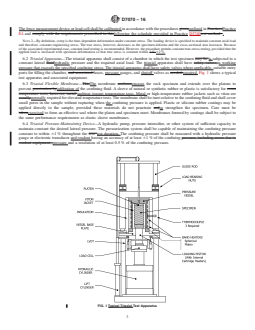
6.2 Triaxial Apparatus—The triaxial apparatus shall consist
the specimen is positioned onto a loading frame. A specified
of a chamber in which the test specimen is subjected to a
axial load is applied rapidly to the specimen and sustained
constant lateral hydraulic pressure and the required axial load.
throughoutthetestduration.Thespecimenmaybesubjectedto
The triaxial apparatus shall have a working pressure that
an elevated temperature and/or constant humidity environment
exceeds the specified confining stress. The triaxial apparatus
if so desired. The axial deformation is monitored as a function
shall have safety valves where applicable, suitable entry ports
ofelapsedtime.Thelateraldeformationmayalsobemonitored
for filling the chamber, hoses, pressure gauges, and shutoff
as a function of elapsed time if so desired.
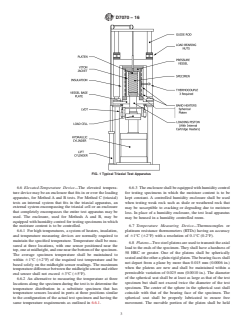
valves as required. Fig. 1 shows a typical test apparatus and
4.3 For Method C (Triaxial Compression Method), the
associated equipment.
specimen is placed into a triaxial chamber and then positioned
6.3 Triaxial Flexible Membrane—The membrane encases
onto a loading frame. The specimen is subjected to a constant
the rock specimen and extends over the platens to prevent
confining pressure.Aspecified axial load is rapidly applied to
infiltration of the confining fluid. A sleeve of natural or
the specimen and maintained throughout the test duration. If
synthetic rubber or plastic is satisfactory for ambient (room)
desired, the specimen, while positioned in the triaxial cell, can
temperature tests. Metal or high-temperature rubber jackets
be subjected to elevated temperature. The axial deformation is
such as viton are normally required for elevated temperature
monitored as a function of elapsed time. The lateral deforma-
tests. The membrane shall be inert relative to the confining
tion may also be monitored as a function of elapsed time if so
fluid and shall cover small pores in the sample without
desired.
rupturing when the confining pressure is applied. Plastic or
silicone rubber coatings may be applied directly to the sample,
5. Significance and Use
provided these materials do not penetrate or strengthen the
5.1 There are many underground structures that are con- specimen. Care must be exercised to form an effective seal
structedforpermanentorlong-termuse.Often,thesestructures where the platen and specimen meet. Membranes formed by
are subjected to a relatively constant load. Creep tests provide coatingsshallbesubjecttothesameperformancerequirements
quantitative parameters for stability analysis of these struc- as elastic sleeve membranes.
tures.
6.4 Triaxial Pressure-Maintaining Device—A hydraulic
5.2 The deformation and strength properties of rock cores
pump, pressure intensifier, or other system of sufficient capac-
measured in the laboratory usually do not accurately reflect ity to maintain constant the desired lateral pressure. The
large-scale in situ properties, because the latter are strongly
pressurization system shall be capable of maintaining the
influenced by joints, faults, inhomogeneities, weakness planes, confiningpressureconstanttowithin 61%throughoutthetest
and other factors. Therefore, laboratory test results of intact
duration. The confining pressure shall be measured with a
specimens shall be utilized with proper judgment in engineer- hydraulic pressure gauge or electronic transducer and readout
ing applications.
having an accuracy of at least 61% of the confining pressure
and a resolution of at least 0.5% of the confining pressure.
NOTE 1—The statements on precision and bias contained in this test
method; the precision of this test method is dependent on the competence
6.5 Confining-Pressure Fluids—For ambient (room) tem-
of the personnel performing it, and the suitability of the equipment and
perature tests, hydraulic fluids compatible with the pressure-
facilities used. Agencies that meet the criteria of Practice D3740 are
maintaining device shall be used. For elevated temperature
generally considered capable of competent and objective testing. Users of
tests the fluid shall remain stable at the temperature and
this test method are cautioned that compliance with Practice D3740 does
not in itself assure reliable testing. Reliable testing depends on many pressure levels designated for the test.
D7070 − 16
FIG. 1 Typical Triaxial Test Apparatus
6.6 Elevated-Temperature Device—The elevated tempera- 6.6.3 Theenclosureshallbeequippedwithhumiditycontrol
ture device may be an enclosure that fits in or over the loading
for testing specimens in which the moisture content is to be
apparatus, for Method A and B tests. For Method C (triaxial)
kept constant. A controlled humidity enclosure shall be used
tests an internal system that fits in the triaxial apparatus, an
when testing weak rock such as shale or weathered rock that
external system encompassing the triaxial cell or an enclosure
may be susceptible to cracking or degrading due to moisture
that completely encompasses the entire test apparatus may be
loss. In place of a humidity enclosure, the test load apparatus
used. The enclosure, used for Methods A and B, may be
may be housed in a humidity controlled room.
equipped with humidity control for testing specimens in which
6.7 Temperature Measuring Device—Thermocouples or
the moisture content is to be controlled.
platinum resistance thermometers (RTDs) having an accuracy
6.6.1 For high temperatures, a system of heaters, insulation,
and temperature measuring devices are normally required to of 61°C (62°F) with a resolution of 0.1°C (0.2°F).
maintain the specified temperature. Temperature shall be mea-
6.8 Platens—Twosteelplatensareusedtotransmittheaxial
sured at three locations, with one sensor positioned near the
loadtotheendsofthespecimen.Theyshallhaveahardnessof
top,oneatmidheight,andonenearthebottomofthespecimen.
58 HRC or greater. One of the platens shall be spherically
The average specimen temperature shall be maintained to
seatedandtheotheraplainrigidplaten.Thebearingfacesshall
within 61°C (62°F) of the required test temperature and be
not depart from a plane by more than 0.015 mm (0.0006 in.)
based solely on the midheight sensor readings. The maximum
when the platens are new and shall be maintained within a
temperaturedifferencebetweenthemidheightsensorandeither
permissible variation of 0.025 mm (0.0010 in.). The diameter
end sensor shall not exceed 63°C (65°F).
of the spherical seat shall be at least as large as that of the test
6.6.2 An alternative to measuring the temperature at three
specimen but shall not exceed twice the diameter of the test
locationsalongthespecimenduringthetestistodeterminethe
specimen. The center of the sphere in the spherical seat shall
temperature distribution in a substitute specimen that has
coincide with that of the bearing face of the specimen. The
temperature sensors located in ports at three positions similar
spherical seat shall be properly lubricated to ensure free
to the configuration of the actual test specimen and having the
same temperature requirements as outlined in 6.6.1. movement. The movable portion of the platen shall be held
D7070 − 16
closely in the spherical seat, but the design shall be such that 7. Hazards
the bearing face can be rotated and tilted through small angles
7.1 Danger exists near loading and triaxial testing equip-
in any direction.
mentbecauseofthehighpressuresandloadsdevelopedwithin
6.8.1 Hard Rock Specimens—The platen diameter shall be
the system. Elevated temperatures increase the risks of electri-
at least as great as the specimen but shall not exceed the
cal shorts and fire. Test systems shall be designed and
specimen diameter by more than 1.50 mm (0.060 in.). This
constructed with adequate safety factors, assembled with
platen diameter shall be retained for a length of at least
properly rated fittings, and provided with protective shields to
one-half the specimen diameter.
protect people from system failure.
6.8.2 Weak Rock Specimens—The platen diameter shall be
at least as great as the specimen but shall not exceed the 7.2 The use of a gas as the confining pressure component
specimen diameter by more than 10% of the specimen introducespotentialforextremeviolenceandshallnotbeused.
diameter. Because weak rocks can deform significantly in
7.3 A fluid shall be used as the component to confine the
creep tests, it is important to reduce friction in the platen-
specimen under pressure.The flash point of the confining fluid
specimen interfaces to facilitate relative slip between the
shallbehigherthanthetargetoperatingtemperatureduringthe
specimen ends and the platens. Effective friction-reducing
test.
precautions include polishing the platen surfaces to a mirror
finish and attaching a thin, 0.15 mm (0.0060 in.) thick Teflon
8. Samples and Specimens
sheet to the platen surfaces.
8.1 Samples may be either drilled cores obtained directly
6.9 Strain/Deformation Measuring Devices—The strain/
from the in situ rock or obtained from block samples cored in
deformation measuring system shall measure the strain with a
–6
the field or in the laboratory.
resolutionofatleast25×10 strainandanaccuracy 62%of
–6
8.1.1 Thecoreorientationtoverticalshallbedeterminedfor
thev
...
This document is not an ASTM standard and is intended only to provide the user of an ASTM standard an indication of what changes have been made to the previous version. Because
it may not be technically possible to adequately depict all changes accurately, ASTM recommends that users consult prior editions as appropriate. In all cases only the current version
of the standard as published by ASTM is to be considered the official document.
Designation: D7070 − 08 D7070 − 16
Standard Test Methods for
Creep of Rock Core Under Constant Stress and
Temperature
This standard is issued under the fixed designation D7070; the number immediately following the designation indicates the year of
original adoption or, in the case of revision, the year of last revision. A number in parentheses indicates the year of last reapproval. A
superscript epsilon (´) indicates an editorial change since the last revision or reapproval.
1. Scope*
1.1 These test methods cover the creep behavior of intact softweak and hard rock core in fixed states of stress and temperature.
They at ambient (room) or elevated temperatures. For creep behavior at lower temperatures refer to Test Method D5520. The
methods specify the apparatus, instrumentation, and procedures for determining necessary to determine the strain as a function of
time under sustained load. Hard rocks are those with a maximum axial strain at failure of less than 2 %. Soft rocks include such
materials as salt and potash, which often exhibit very large strain at failure.load at constant temperature and when applicable,
constant humidity.
1.1.1 Hard rocks are considered those with a maximum axial strain at failure of less than 2 %. Weak rocks include such materials
as salt, potash, shale, and weathered rock, which often exhibit very large strain at failure.
1.2 This standard replaces and combines the following Standard Test Methods now to be referred to as Methods: consists of
three methods that cover the creep capacity of core specimens.
Method ‘A’ (D5341 Creep of Hard Rock Core Specimens in Uniaxial Compression at Ambient/Elevated Temperatures);
Method ‘B’ (D4405 Creep of Soft Rock Core Specimens in Uniaxial Compression at Ambient or Elevated Temperature); and
Method ‘C’ (D4406 Creep of Rock Core Specimens in Triaxial Compression at Ambient or Elevated Temperature).
1.2.1 Method A—Creep of Hard Rock Core Specimens in Uniaxial Compression at Ambient or Elevated Temperature.
1.2.2 Method B—Creep of Weak Rock Core Specimens in Uniaxial Compression at Ambient or Elevated Temperature.
1.2.3 Method C—Creep of Rock Core Specimens in Triaxial Compression at Ambient or Elevated Temperature.
1.3 All observed and calculated values shall conform to the guidelines for significant digits and rounding established in Practice
D6026.
1.3.1 The method used to specify how data are collected, calculated, or recorded in this standard is not directly related to the
accuracy to which the data can be applied in design or other uses, or both. How one applies the results obtained using this standard
is beyond its scope.
1.4 The procedures used to specify how data are collected/recorded and calculated in this standard are regarded as the industry
standard. In addition, they are representative of the significant digits that generally should be retained. The procedures used do not
consider material variation, purpose for obtaining data, special purpose studies, or any considerations for the user’s objectives; and
it is common practice to increase or reduce significant digits of reported data to commensurate with these considerations. It is
beyond the scope of these test methods to consider significant digits used in analysis methods for engineering design.
1.5 Units—The values stated in SI units are to be regarded as the standard. The values given in parentheses are mathematical
conversions to inch-pound units that are provided for information only and are not considered standard.
1.6 This standard does not purport to address all of the safety concerns, if any, associated with its use. It is the responsibility
of the user of this standard to establish appropriate safety and health practices and to determine the applicability of regulatory
limitations prior to use. For specific precautionary statements, see Section 7.
2. Referenced Documents
2.1 ASTM Standards:
D653 Terminology Relating to Soil, Rock, and Contained Fluids
This test method is under the jurisdiction of ASTM Committee D18 and is the direct responsibility of Subcommittee D18.12 on Rock Mechanics.
Current edition approved July 1, 2008Nov. 1, 2016. Published August 2008November 2016. Originally approved in 2004. Last previous edition approved in 20042008
as D7070 – 04.D7070 - 08. DOI: 10.1520/D7070-08.10.1520/D7070-16.
For referenced ASTM standards, visit the ASTM website, www.astm.org, or contact ASTM Customer Service at service@astm.org. For Annual Book of ASTM Standards
volume information, refer to the standard’s Document Summary page on the ASTM website.
*A Summary of Changes section appears at the end of this standard
Copyright © ASTM International, 100 Barr Harbor Drive, PO Box C700, West Conshohocken, PA 19428-2959. United States
D7070 − 16
D2113 Practice for Rock Core Drilling and Sampling of Rock for Site Exploration
D2216 Test Methods for Laboratory Determination of Water (Moisture) Content of Soil and Rock by Mass
D2845 Test Method for Laboratory Determination of Pulse Velocities and Ultrasonic Elastic Constants of Rock
D3740 Practice for Minimum Requirements for Agencies Engaged in Testing and/or Inspection of Soil and Rock as Used in
Engineering Design and Construction
D4543 Practices for Preparing Rock Core as Cylindrical Test Specimens and Verifying Conformance to Dimensional and Shape
Tolerances
D5079 Practices for Preserving and Transporting Rock Core Samples
D5520 Test Method for Laboratory Determination of Creep Properties of Frozen Soil Samples by Uniaxial Compression
D6026 Practice for Using Significant Digits in Geotechnical Data
E4 Practices for Force Verification of Testing Machines
E122 Practice for Calculating Sample Size to Estimate, With Specified Precision, the Average for a Characteristic of a Lot or
Process
3. Terminology
3.1 Refer to Terminology D653 for specific definitions.Definitions:
3.1.1 For definitions of common technical terms used in this standard, refer to Terminology D653.
3.2 Definitions of Terms Specific to This Standard:
3.2.1 hard rock—rock core exhibiting less than 2 % strain at failure when tested in uniaxial compression.
3.2.2 weak rock—rock core exhibiting 2 % or greater strain at failure when tested in uniaxial compression.
3.2.3 true stress—a constant stress applied to a specimen as a result of a varying vertical load based upon changes in the
specimen diameter.
4. Summary of Test Method
4.1 A section of rock core is cut to length, and the ends are machined flat or are capped in a manner to produce a cylindrical
test specimen.
4.2 For Methods A and B, (Uniaxial Compression Method) the specimen is positioned onto a loading frame. A specified axial
load is applied rapidly to the specimen and sustained throughout the test duration. The specimen may be subjected to an elevated
temperature and/or constant humidity environment if so desired. The axial deformation is monitored as a function of elapsed time.
The lateral deformation may also be monitored as a function of elapsed time if so desired.
4.3 A section of rock core specimen is cut to length, and the ends are machined flat to produce a cylindrical test specimen. For
the Uniaxial Compression Method,For Method C (Triaxial Compression Method), the specimen is placed in a loading frame. For
Triaxial Compression Method, the specimen is placed in a triaxial loading chamber and subjected to confining pressure. If required,
the specimen is heated to the desired test temperature. Axial load is applied rapidly into a triaxial chamber and then positioned onto
a loading frame. The specimen is subjected to a constant confining pressure. A specified axial load is rapidly applied to the
specimen and sustained. Deformation maintained throughout the test duration. If desired, the specimen, while positioned in the
triaxial cell, can be subjected to elevated temperature. The axial deformation is monitored as a function of elapsed time. The lateral
deformation may also be monitored as a function of elapsed time if so desired.
5. Significance and Use
5.1 There are many underground structures that are createdconstructed for permanent or long-term use. Often, these structures
are subjected to an approximatelya relatively constant load. Creep tests provide quantitative parameters for stability analysis of
these structures.
5.2 The deformation and strength properties of rock cores measured in the laboratory usually do not accurately reflect
large-scale in situ properties, because the latter are strongly influenced by joints, faults, inhomogeneities, weakness planes, and
other factors. Therefore, laboratory values for test results of intact specimens mustshall be employedutilized with proper judgment
in engineering applications.
NOTE 1—Notwithstanding the The statements on precision and bias contained in this test method; the precision of this test method is dependent on
the competence of the personnel performing it, and the suitability of the equipment and facilities used. Agencies that meet the criteria of Practice D3740
are generally considered capable of competent and objective testing. Users of this test method are cautioned that compliance with Practice D3740 does
not in itself assure reliable testing. Reliable testing depends on many factors; Practice D3740 provides a means of evaluating some of these factors.
6. Apparatus
6.1 Loading Device—The loading device shall be of sufficient capacity to apply meet the requirements of the testing program
and capable of applying the test load at a rate conforming to the requirements specified in 10.69.5 and . The device shall be able
to maintaincapable of maintaining the specified test load within 2 %. It shall be verified at suitable time intervals to within 62 %.
D7070 − 16
The force measurement device or load cell shall be calibrated in accordance with the procedures givenoutlined in PracticesPractice
E4 and comply with the requirements prescribed in thisfollowing the schedule provided in Practice D3740test method. .
NOTE 2—By definition, creep is the time-dependent deformation under constant stress. The loading device is specified to maintain constant axial load
and therefore, constant engineering stress. The true stress, however, decreases as the specimen deforms and the cross-sectional area increases. Because
of the associated experimental ease, constant load testing is recommended. However, the procedure permits constant true-stress testing, provided that the
applied load is increased with specimen deformation so that true stress is constant within 2 %.62 %.
6.2 Triaxial Apparatus—The triaxial apparatus shall consist of a chamber in which the test specimen may be is subjected to a
constant lateral fluidhydraulic pressure and the required axial load. The triaxial apparatus shall have safety valves, a working
pressure that exceeds the specified confining stress. The triaxial apparatus shall have safety valves where applicable, suitable entry
ports for filling the chamber, and associated hoses, pressure gauges, and shutoff valves as needed.required. Fig. 1 shows a typical
test apparatus and associated equipment.
6.3 Triaxial Flexible Membrane—ThisThe membrane enclosesencases the rock specimen and extends over the platens to
prevent penetration byinfiltration of the confining fluid. A sleeve of natural or synthetic rubber or plastic is satisfactory for room
temperature tests; however, metal ambient (room) temperature tests. Metal or high-temperature rubber jackets such as viton are
usuallynormally required for elevated temperature tests. The membrane shall be inert relative to the confining fluid and shall cover
small pores in the sample without rupturing when the confining pressure is applied. Plastic or silicone rubber coatings may be
applied directly to the sample, provided these materials do not penetrate andor strengthen the specimen. Care must be
takenexercised to form an effective seal where the platen and specimen meet. Membranes formed by coatings shall be subject to
the same performance requirements as elastic sleeve membranes.
6.4 Triaxial Pressure-Maintaining Device—A hydraulic pump, pressure intensifier, or other system of sufficient capacity to
maintain constant the desired lateral pressure. The pressurization system shall be capable of maintaining the confining pressure
constant to within 61 % throughout the test. test duration. The confining pressure shall be measured with a hydraulic pressure
gauge or electronic transducer and readout having an accuracy of at least 61 % of the confining pressure, including errors due to
readout equipment, pressure and a resolution of at least 0.5 % of the confining pressure.
FIG. 1 Typical Triaxial Test Apparatus
D7070 − 16
6.5 Confining-Pressure Fluids—For room ambient (room) temperature tests, hydraulic fluids compatible with the pressure-
maintaining device shouldshall be used. For elevated temperature tests the fluid mustshall remain stable at the temperature and
pressure levels designated for the test.
6.6 Elevated-Temperature Enclosure—Device—The elevated temperature enclosuredevice may be either an enclosure that fits
in or over the loading apparatus, for Method A and B tests. For Method C (triaxial) tests an internal system that fits in the triaxial
apparatus, or an external system encompassing the complete test apparatus. The enclosure triaxial cell or an enclosure that
completely encompasses the entire test apparatus may be used. The enclosure, used for Methods A and B, may be equipped with
humidity control for testing specimens in which the moisture content is to be controlled. For high temperatures, a system of heaters,
insulation, and temperature measuring devices are normally required to maintain the specified temperature. Temperature shall be
measured at three locations, with one sensor near the top, one at midheight, and one near the bottom of the specimen. The average
specimen temperature based on the midheight sensor shall be maintained to within 61°C of the required test temperature. The
maximum temperature difference between the midheight sensor and either end sensor shall not exceed 3°C when measured under
steady state temperature conditions as defined in Section 6.6.
NOTE 3—An alternative to measuring the temperature at three locations along the specimen during the test is to determine the temperature distribution
in a substitute specimen that has temperature sensors located in drill holes at a minimum of six positions: along both the centerline and specimen periphery
at midheight and at each end of the specimen. The temperature controller set point shall be adjusted to obtain steady-state temperatures (see Section 10.5)
in the substitute specimen that meet the temperature requirements at each test temperature (the centerline temperature at midheight shall be within 61°C
of the required test temperature, and all other specimen temperatures shall not deviate from this temperature by more than 3°C). The relationship between
controller set point and substitute specimen temperature can be used to determine the specimen temperature during testing, provided that the output of
the temperature feedback sensor (or other fixed-location temperature sensor in the triaxial apparatus) is maintained constant within 61°C of the required
test temperature. The relationship between temperature controller set point and steady-state specimen temperature shall be verified periodically. The
substitute specimen is used solely to determine the temperature distribution in a specimen in the triaxial apparatus; it is not to be used to determine creep
behavior.
6.6.1 For high temperatures, a system of heaters, insulation, and temperature measuring devices are normally required to
maintain the specified temperature. Temperature shall be measured at three locations, with one sensor positioned near the top, one
at midheight, and one near the bottom of the specimen. The average specimen temperature shall be maintained to within 61°C
(62°F) of the required test temperature and be based solely on the midheight sensor readings. The maximum temperature
difference between the midheight sensor and either end sensor shall not exceed 63°C (65°F).
6.6.2 An alternative to measuring the temperature at three locations along the specimen during the test is to determine the
temperature distribution in a substitute specimen that has temperature sensors located in ports at three positions similar to the
configuration of the actual test specimen and having the same temperature requirements as outlined in 6.6.1.
6.6.3 The enclosure shall be equipped with humidity control for testing specimens in which the moisture content is to be kept
constant. A controlled humidity enclosure shall be used when testing weak rock such as shale or weathered rock that may be
susceptible to cracking or degrading due to moisture loss. In place of a humidity enclosure, the test load apparatus may be housed
in a humidity controlled room.
6.7 Temperature Measuring Device—Special limits-of-error thermocouples Thermocouples or platinum resistance thermom-
eters (RTDs) having accuracies of at least 61°C an accuracy of 61°C (62°F) with a resolution of 0.1°C. 0.1°C (0.2°F).
6.8 Platens—Two steel platens are used to transmit the axial load to the ends of the specimen. They shall have a hardness of
not less than 58 HRC. 58 HRC or greater. One of the platens shouldshall be spherically seated and the other a plain rigid platen.
The bearing faces shall not depart from a plane by more than 0.015 mm (0.0006 in.) when the platens are new and shall be
maintained within a permissible variation of 0.025 mm. mm (0.0010 in.). The diameter of the spherical seat shall be at least as
large as that of the test specimen but shall not exceed twice the diameter of the test specimen. The center of the sphere in the
spherical seat shall coincide with that of the bearing face of the specimen. The spherical seat shall be properly lubricated to ensure
free movement. The movable portion of the platen shall be held closely in the spherical seat, but the design shall be such that the
bearing face can be rotated and tilted through small angles in any direction. If a spherical seat is not used, the bearing faces of the
platens shall be parallel to 0.0005 mm/mm of platen diameter.
6.8.1 Hard Rock Specimens—The platen diameter shall be at least as great as the specimen but shall not exceed the specimen
diameter by more than 1.50 mm. mm (0.060 in.). This platen diameter shall be retained for a length of at least one-half the
specimen diameter.
6.8.2 SoftWeak Rock Specimens—The platen diameter shall be at least as great as the specimen but shall not exceed the specimen
diameter by more than 10 % of the specimen diameter. Because softweak rocks can deform significantly in creep tests, it is
important to reduce friction in the platen-specimen interfaces to facilitate relative slip between the specimen ends and the platens.
Effective friction-reducing precautions include polishing the platen surfaces to a mirror finish and attaching a thin, 0.15 mm
(0.0060 in.) thick teflonTeflon sheet to the platen surfaces.
D7070 − 16
6.9 Strain/Deformation Measuring Devices—The strain/deformation measuring system shall measure the strain with a
-6–6 -6–6
resolution of at least 25 × 10 strain and an accuracy within 2 % 62 % of the value of readings above 250 × 10 strain and
-6–6 -6–6
accuracy and resolution within 5 × 10 for readings lower than 250 × 10 strain, including errors introduced by excitation
and readout equipment. The system shall be free from noncharacterizable long-term instability (drift) that results in an apparent
-8–8
strain rate of 10 /s.
NOTE 3—The user is cautioned about the influence of pressure and temperature on the Pressure and temperature used during the test may influence
the output of strain and deformation sensors located within the triaxial environment. Caution shall be exercised to verify the readings represent accur
...