

ASTM D5438-23
(Practice)Standard Practice for Collection of Floor Dust for Chemical Analysis
General Information
- Abstract
SIGNIFICANCE AND USE
5.1 This practice may be used to collect dust from carpeted or bare floor surfaces for gravimetric or chemical analysis. The collected sample is substantially unmodified by the sampling procedure.
5.2 This practice provides for a reproducible dust removal rate from level loop and plush carpets, as well as bare floors. It has the ability to achieve relatively constant removal efficiency at different loadings of floor dust.
5.3 This practice also provides for the efficient capture of semivolatile organic chemicals associated with the dust. The test system can be fitted with special canisters downstream of the cyclone for the capture of specific semivolatile organic chemicals that may volatilize from the dust particles during collection.
5.4 This practice does not describe procedures for evaluation of the safety of floor surfaces or the potential human exposure to floor dust. It is the user's responsibility to evaluate the data collected by this practice and make such determinations in the light of other available information.
5.5 This practice provides per-event dust chemical concentration and chemical loading. Advantages and trade-offs of different sampling approaches have been discussed (7).
5.6 This practice uses a removable, cleanable dropout jar that facilitates per-event sampling. Other per-event vacuum attachments are commercially available. These are not directly comparable with composite sampling done using whole vacuum cleaner bags.
SCOPE
1.1 This practice covers a procedure for the collection of a sample of dust from carpets and bare floors that can be analyzed for inorganic metals such as lead and organic compounds such as pesticides and other semi-volatile organic compounds (SVOCs).
1.2 This practice is applicable to a variety of carpeted and bare floor surfaces. It has been tested for level loop and plush pile carpets and bare wood floors, specifically. This practice is not applicable to elevated, non-floor surfaces.
1.3 This practice is not intended for the collection and evaluation of dust for the presence of asbestos fibers.
1.4 The values stated in SI units are to be regarded as standard. No other units of measurement are included in this standard.
1.5 This practice describes use of a sampling device, the High-Volume Small Surface Sampler (HVS3). Other event-based sampling devices that use commercially available vacuum attachments are not in scope. Composite sampling using whole vacuum cleaner bags is not in scope. Other approaches for floor or non-floor surface sampling (Practices D6966, D6661, D7144) are not within the scope.
1.6 This practice only applies to the HVS3. Other dust sampling methods may or may not be directly comparable. Method evaluation for other dust sampling approaches is encouraged. This could be done by comparison with methods outlined in this standard practice for HVS3 or through independent evaluation using field spikes and certified reference materials.
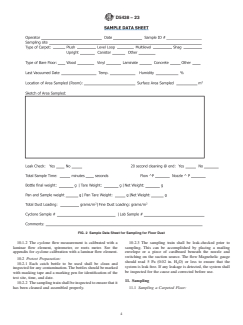
1.7 This practice provides information on dust loading, chemical dust concentration, and chemical dust loading. Information on the type of floor, the floor surface area sampled, and amount of dust collected is required (see Fig. 2). Cleaning the vacuum attachments in between sampling events is also required (see Section 13).
1.8 This standard does not purport to address all of the safety concerns, if any, associated with its use. It is the responsibility of the user of this standard to establish appropriate safety, health, and environmental practices and determine the applicability of regulatory limitations prior to use.
1.9 This international standard was developed in accordance with internationally recognized principles on standardization established in the Decision on Principles for the Development of International Standards, Guides and Recommendations issued by the World Trade Organization Technical Barriers to Trade (TBT) Committee.
- Status
- Published
- Publication Date
- 31-Aug-2023
- Technical Committee
- D22 - Air Quality
- Drafting Committee
- D22.05 - Indoor Air
Overview
ASTM D5438-23, Standard Practice for Collection of Floor Dust for Chemical Analysis, establishes a consistent procedure for collecting representative dust samples from carpets and bare floor surfaces. Developed by ASTM International, this standard is specifically designed for use with the High-Volume Small Surface Sampler (HVS3). The method supports the accurate analysis of floor dust for various inorganic metals, such as lead, as well as organic compounds including pesticides and semi-volatile organic compounds (SVOCs).
This practice ensures the collection process does not modify the dust sample, enabling both gravimetric and chemical analysis to be performed on the collected material. It also specifies the collection of per-event dust samples, crucial for detailed exposure and contamination studies in indoor environments.
Key Topics
Sampling Devices and Applicability
- Describes the exclusive use of the HVS3 for event-based dust sampling.
- Excludes composite sampling methods, such as using whole vacuum cleaner bags or other devices.
Surface Types Covered
- Applicable to level loop and plush pile carpets, tested on bare wood floors.
- Not intended for elevated or non-floor surfaces.
Captured Analytes
- Suitable for analyzing dust for metals (e.g., lead), organic pesticides, and other SVOCs.
- Not intended for asbestos testing.
Sampling Process
- Ensures reproducible dust removal rate, regardless of dust loading level.
- Designed to efficiently capture both particulate dust and semivolatile organics using additional canisters when needed.
- Utilizes a removable, cleanable catch jar, enabling easy per-event sampling.
Data Collection
- Provides guidance on recording floor type, area sampled, dust weight, and chemical concentrations.
- Yields results in terms of dust loading (g/m²), chemical concentrations, and chemical loading per surface area.
Sample Handling and Transport
- Details protocols for transferring and storing samples for subsequent chemical analysis-addressing specific needs for inorganic and organic analytes.
Applications
ASTM D5438-23 is widely used in a variety of environmental health, industrial hygiene, and indoor air quality assessment contexts:
Residential and Commercial Indoor Environments
- Supports studies on indoor dust contamination and human exposure, particularly for children in homes or occupants in workplaces.
Lead and Pesticide Exposure Assessment
- Critical for regulatory compliance, risk assessments, and remediation verification projects where precise chemical analysis of settled floor dust is required.
Research and Public Health
- Used in academic, governmental, and private sector research projects investigating the presence and distribution of metals, pesticides, and SVOCs in indoor environments.
Environmental and Industrial Hygiene Surveys
- Assists in the quantification and source attribution of particulate matter and chemical residues on floors, aiding in targeted cleaning and mitigation strategies.
Related Standards
For a comprehensive approach to dust and surface contamination analysis, the following ASTM standards are relevant:
- ASTM D6661 - Practice for Field Collection of Organic Compounds from Surfaces Using Wipe Sampling.
- ASTM D6966 - Practice for Collection of Settled Dust Samples Using Wipe Sampling Methods for Subsequent Determination of Metals.
- ASTM D7144 - Practice for Collection of Surface Dust by Micro-vacuum Sampling for Subsequent Determination of Metals and Metalloids.
- ASTM F608 - Test Method for Evaluation of Carpet Embedded Dirt Removal Effectiveness of Household/Commercial Vacuum Cleaners.
ASTM D5438-23 specifically focuses on event-based dust collection from floor surfaces using HVS3, and comparison with other sampling methodologies is encouraged for validation and broader application.
By following ASTM D5438-23, organizations and researchers gain a reliable, standardized method for collecting floor dust samples for chemical analysis, supporting accurate assessment and effective management of indoor environmental quality.
Relations
- Effective Date
- 01-Sep-2023
- Effective Date
- 01-Jan-2024
- Effective Date
- 01-Nov-2022
- Effective Date
- 01-Sep-2023
- Effective Date
- 01-Sep-2023
- Effective Date
- 01-Sep-2023
- Effective Date
- 01-Sep-2023
- Effective Date
- 01-Sep-2023
- Effective Date
- 01-Sep-2023
Get Certified
Connect with accredited certification bodies for this standard

CIS Institut d.o.o.
Personal Protective Equipment (PPE) certification body. Notified Body NB-2890 for EU Regulation 2016/425 PPE.

Kiwa BDA Testing
Building and construction product certification.
Kmetijski inštitut Slovenije
Agricultural Institute of Slovenia. Soil testing, plant health, agricultural product analysis.
Sponsored listings
Frequently Asked Questions
ASTM D5438-23 is a standard published by ASTM International. Its full title is "Standard Practice for Collection of Floor Dust for Chemical Analysis". This standard covers: SIGNIFICANCE AND USE 5.1 This practice may be used to collect dust from carpeted or bare floor surfaces for gravimetric or chemical analysis. The collected sample is substantially unmodified by the sampling procedure. 5.2 This practice provides for a reproducible dust removal rate from level loop and plush carpets, as well as bare floors. It has the ability to achieve relatively constant removal efficiency at different loadings of floor dust. 5.3 This practice also provides for the efficient capture of semivolatile organic chemicals associated with the dust. The test system can be fitted with special canisters downstream of the cyclone for the capture of specific semivolatile organic chemicals that may volatilize from the dust particles during collection. 5.4 This practice does not describe procedures for evaluation of the safety of floor surfaces or the potential human exposure to floor dust. It is the user's responsibility to evaluate the data collected by this practice and make such determinations in the light of other available information. 5.5 This practice provides per-event dust chemical concentration and chemical loading. Advantages and trade-offs of different sampling approaches have been discussed (7). 5.6 This practice uses a removable, cleanable dropout jar that facilitates per-event sampling. Other per-event vacuum attachments are commercially available. These are not directly comparable with composite sampling done using whole vacuum cleaner bags. SCOPE 1.1 This practice covers a procedure for the collection of a sample of dust from carpets and bare floors that can be analyzed for inorganic metals such as lead and organic compounds such as pesticides and other semi-volatile organic compounds (SVOCs). 1.2 This practice is applicable to a variety of carpeted and bare floor surfaces. It has been tested for level loop and plush pile carpets and bare wood floors, specifically. This practice is not applicable to elevated, non-floor surfaces. 1.3 This practice is not intended for the collection and evaluation of dust for the presence of asbestos fibers. 1.4 The values stated in SI units are to be regarded as standard. No other units of measurement are included in this standard. 1.5 This practice describes use of a sampling device, the High-Volume Small Surface Sampler (HVS3). Other event-based sampling devices that use commercially available vacuum attachments are not in scope. Composite sampling using whole vacuum cleaner bags is not in scope. Other approaches for floor or non-floor surface sampling (Practices D6966, D6661, D7144) are not within the scope. 1.6 This practice only applies to the HVS3. Other dust sampling methods may or may not be directly comparable. Method evaluation for other dust sampling approaches is encouraged. This could be done by comparison with methods outlined in this standard practice for HVS3 or through independent evaluation using field spikes and certified reference materials. 1.7 This practice provides information on dust loading, chemical dust concentration, and chemical dust loading. Information on the type of floor, the floor surface area sampled, and amount of dust collected is required (see Fig. 2). Cleaning the vacuum attachments in between sampling events is also required (see Section 13). 1.8 This standard does not purport to address all of the safety concerns, if any, associated with its use. It is the responsibility of the user of this standard to establish appropriate safety, health, and environmental practices and determine the applicability of regulatory limitations prior to use. 1.9 This international standard was developed in accordance with internationally recognized principles on standardization established in the Decision on Principles for the Development of International Standards, Guides and Recommendations issued by the World Trade Organization Technical Barriers to Trade (TBT) Committee.
SIGNIFICANCE AND USE 5.1 This practice may be used to collect dust from carpeted or bare floor surfaces for gravimetric or chemical analysis. The collected sample is substantially unmodified by the sampling procedure. 5.2 This practice provides for a reproducible dust removal rate from level loop and plush carpets, as well as bare floors. It has the ability to achieve relatively constant removal efficiency at different loadings of floor dust. 5.3 This practice also provides for the efficient capture of semivolatile organic chemicals associated with the dust. The test system can be fitted with special canisters downstream of the cyclone for the capture of specific semivolatile organic chemicals that may volatilize from the dust particles during collection. 5.4 This practice does not describe procedures for evaluation of the safety of floor surfaces or the potential human exposure to floor dust. It is the user's responsibility to evaluate the data collected by this practice and make such determinations in the light of other available information. 5.5 This practice provides per-event dust chemical concentration and chemical loading. Advantages and trade-offs of different sampling approaches have been discussed (7). 5.6 This practice uses a removable, cleanable dropout jar that facilitates per-event sampling. Other per-event vacuum attachments are commercially available. These are not directly comparable with composite sampling done using whole vacuum cleaner bags. SCOPE 1.1 This practice covers a procedure for the collection of a sample of dust from carpets and bare floors that can be analyzed for inorganic metals such as lead and organic compounds such as pesticides and other semi-volatile organic compounds (SVOCs). 1.2 This practice is applicable to a variety of carpeted and bare floor surfaces. It has been tested for level loop and plush pile carpets and bare wood floors, specifically. This practice is not applicable to elevated, non-floor surfaces. 1.3 This practice is not intended for the collection and evaluation of dust for the presence of asbestos fibers. 1.4 The values stated in SI units are to be regarded as standard. No other units of measurement are included in this standard. 1.5 This practice describes use of a sampling device, the High-Volume Small Surface Sampler (HVS3). Other event-based sampling devices that use commercially available vacuum attachments are not in scope. Composite sampling using whole vacuum cleaner bags is not in scope. Other approaches for floor or non-floor surface sampling (Practices D6966, D6661, D7144) are not within the scope. 1.6 This practice only applies to the HVS3. Other dust sampling methods may or may not be directly comparable. Method evaluation for other dust sampling approaches is encouraged. This could be done by comparison with methods outlined in this standard practice for HVS3 or through independent evaluation using field spikes and certified reference materials. 1.7 This practice provides information on dust loading, chemical dust concentration, and chemical dust loading. Information on the type of floor, the floor surface area sampled, and amount of dust collected is required (see Fig. 2). Cleaning the vacuum attachments in between sampling events is also required (see Section 13). 1.8 This standard does not purport to address all of the safety concerns, if any, associated with its use. It is the responsibility of the user of this standard to establish appropriate safety, health, and environmental practices and determine the applicability of regulatory limitations prior to use. 1.9 This international standard was developed in accordance with internationally recognized principles on standardization established in the Decision on Principles for the Development of International Standards, Guides and Recommendations issued by the World Trade Organization Technical Barriers to Trade (TBT) Committee.
ASTM D5438-23 is classified under the following ICS (International Classification for Standards) categories: 13.040.40 - Stationary source emissions. The ICS classification helps identify the subject area and facilitates finding related standards.
ASTM D5438-23 has the following relationships with other standards: It is inter standard links to ASTM D5438-17, ASTM F608-24, ASTM F608-22, ASTM D7144-21, ASTM D7297-21, ASTM E1775-20, ASTM E1979-21, ASTM D1356-20a, ASTM D7659-21. Understanding these relationships helps ensure you are using the most current and applicable version of the standard.
ASTM D5438-23 is available in PDF format for immediate download after purchase. The document can be added to your cart and obtained through the secure checkout process. Digital delivery ensures instant access to the complete standard document.
Standards Content (Sample)
This international standard was developed in accordance with internationally recognized principles on standardization established in the Decision on Principles for the
Development of International Standards, Guides and Recommendations issued by the World Trade Organization Technical Barriers to Trade (TBT) Committee.
Designation: D5438 − 23
Standard Practice for
Collection of Floor Dust for Chemical Analysis
This standard is issued under the fixed designation D5438; the number immediately following the designation indicates the year of
original adoption or, in the case of revision, the year of last revision. A number in parentheses indicates the year of last reapproval. A
superscript epsilon (´) indicates an editorial change since the last revision or reapproval.
1. Scope 1.8 This standard does not purport to address all of the
safety concerns, if any, associated with its use. It is the
1.1 This practice covers a procedure for the collection of a
responsibility of the user of this standard to establish appro-
sample of dust from carpets and bare floors that can be
priate safety, health, and environmental practices and deter-
analyzed for inorganic metals such as lead and organic com-
mine the applicability of regulatory limitations prior to use.
pounds such as pesticides and other semi-volatile organic
1.9 This international standard was developed in accor-
compounds (SVOCs).
dance with internationally recognized principles on standard-
1.2 This practice is applicable to a variety of carpeted and
ization established in the Decision on Principles for the
bare floor surfaces. It has been tested for level loop and plush
Development of International Standards, Guides and Recom-
pile carpets and bare wood floors, specifically. This practice is
mendations issued by the World Trade Organization Technical
not applicable to elevated, non-floor surfaces.
Barriers to Trade (TBT) Committee.
1.3 This practice is not intended for the collection and
2. Referenced Documents
evaluation of dust for the presence of asbestos fibers.
2.1 ASTM Standards:
1.4 The values stated in SI units are to be regarded as
D422 Test Method for Particle-Size Analysis of Soils (With-
standard. No other units of measurement are included in this
drawn 2016)
standard.
D1356 Terminology Relating to Sampling and Analysis of
1.5 This practice describes use of a sampling device, the
Atmospheres
High-Volume Small Surface Sampler (HVS3). Other event-
D6661 Practice for Field Collection of Organic Compounds
based sampling devices that use commercially available
from Surfaces Using Wipe Sampling
vacuum attachments are not in scope. Composite sampling
D6966 Practice for Collection of Settled Dust Samples
using whole vacuum cleaner bags is not in scope. Other
Using Wipe Sampling Methods for Subsequent Determi-
approaches for floor or non-floor surface sampling (Practices
nation of Metals
D6966, D6661, D7144) are not within the scope.
D7144 Practice for Collection of Surface Dust by Micro-
vacuum Sampling for Subsequent Determination of Met-
1.6 This practice only applies to the HVS3. Other dust
als and Metalloids
sampling methods may or may not be directly comparable.
E1 Specification for ASTM Liquid-in-Glass Thermometers
Method evaluation for other dust sampling approaches is
E337 Test Method for Measuring Humidity with a Psy-
encouraged. This could be done by comparison with methods
chrometer (the Measurement of Wet- and Dry-Bulb Tem-
outlined in this standard practice for HVS3 or through inde-
peratures)
pendent evaluation using field spikes and certified reference
E1137/E1137M Specification for Industrial Platinum Resis-
materials.
tance Thermometers
1.7 This practice provides information on dust loading,
E1195 Test Method for Determining a Sorption Constant
chemical dust concentration, and chemical dust loading. Infor-
(K ) for an Organic Chemical in Soil and Sediments
oc
mation on the type of floor, the floor surface area sampled, and
(Withdrawn 2013)
amount of dust collected is required (see Fig. 2). Cleaning the
E2251 Specification for Liquid-in-Glass ASTM Thermom-
vacuum attachments in between sampling events is also
eters with Low-Hazard Precision Liquids
required (see Section 13).
For referenced ASTM standards, visit the ASTM website, www.astm.org, or
This practice is under the jurisdiction of ASTM Committee D22 on Air Quality contact ASTM Customer Service at service@astm.org. For Annual Book of ASTM
and is the direct responsibility of Subcommittee D22.05 on Indoor Air. Standards volume information, refer to the standard’s Document Summary page on
Current edition approved Sept. 1, 2023. Published September 2023. Originally the ASTM website.
approved in 1993. Last previous edition approved in 2017 as D5438 – 17. DOI: The last approved version of this historical standard is referenced on
10.1520/D5438-23. www.astm.org.
Copyright © ASTM International, 100 Barr Harbor Drive, PO Box C700, West Conshohocken, PA 19428-2959. United States
D5438 − 23
F608 Test Method for Evaluation of Carpet Embedded Dirt This catch bottle shall be capped for storage of the sample and
Removal Effectiveness of Household/Commercial transported to the laboratory for analysis.
Vacuum Cleaners
5. Significance and Use
3. Terminology
5.1 This practice may be used to collect dust from carpeted
3.1 Definitions—For definitions of terms used in this or bare floor surfaces for gravimetric or chemical analysis. The
practice, refer to Terminology D1356. collected sample is substantially unmodified by the sampling
3.1.1 carpet-embedded dust, n—soil and other particulate procedure.
matter, approximately 5 μm equivalent aerodynamic diameter
5.2 This practice provides for a reproducible dust removal
and larger, embedded in carpet pile and normally removable by
rate from level loop and plush carpets, as well as bare floors. It
household vacuum cleaners.
has the ability to achieve relatively constant removal efficiency
3.1.2 debris, n—items (that is, bug parts, plastics, foam,
at different loadings of floor dust.
matted hair, gravel, etc.,) that would not pass through a 2 mm
5.3 This practice also provides for the efficient capture of
sieve and would not be considered surface dust or carpet-
semivolatile organic chemicals associated with the dust. The
embedded dust.
test system can be fitted with special canisters downstream of
3.1.3 particle size fraction bins, n—the mass of surface dust
the cyclone for the capture of specific semivolatile organic
or carpet-embedded dust present between two particle-size
chemicals that may volatilize from the dust particles during
values.
collection.
3.1.3.1 Discussion—While this standard practice refers to
5.4 This practice does not describe procedures for evalua-
150 μm, other potential particle-size values such as 20 μm,
tion of the safety of floor surfaces or the potential human
63 μm, 75 μm, 250 μm, 1 mm, 2 mm, and others could be used
exposure to floor dust. It is the user’s responsibility to evaluate
to define particle size fraction bins. See Specification E1195 for
the data collected by this practice and make such determina-
standard number sieves matched to different particle-sizes.
tions in the light of other available information.
3.1.4 surface dust, n—soil and other particulate matter,
5.5 This practice provides per-event dust chemical concen-
approximately 5 μm equivalent aerodynamic diameter and
tration and chemical loading. Advantages and trade-offs of
larger, adhering to floor surfaces and normally removable by
different sampling approaches have been discussed (7).
household vacuum cleaners.
5.6 This practice uses a removable, cleanable dropout jar
that facilitates per-event sampling. Other per-event vacuum
4. Summary of Practice
attachments are commercially available. These are not directly
4.1 The sampling method described in this practice is taken
comparable with composite sampling done using whole
from work published in Roberts et al. (1-3), and Stamper et al.
vacuum cleaner bags.
(4). Appendix F of this published report also contains infor-
mation on the construction of the HVS3 sampler (5).
6. Interferences
4.2 Particulate matter is withdrawn from the carpet or bare
6.1 There are no known interferences to the determination
floor by means of vacuum-induced suction which draws
of dust loadings covered by this practice.
through a sampling nozzle at a specific velocity and flow rate,
and the particles are separated mechanically by a cyclone. The
7. Apparatus
cyclone is designed to efficiently separate and collect particles
approximately 5 μm mean aerodynamic diameter and larger. 7.1 Sampling Apparatus, which may be constructed from
However, much smaller particles are also collected at unknown commercially available vacuum cleaners and attachments (as
efficiencies. The sampling system allows for height, air flow, shown in Fig. 1):
and suction adjustments to reproduce systematically a specific 7.1.1 The dimensions of the sampling apparatus (nozzle
size, cyclone diameter, cyclone inlet diameter, etc.) are inter-
air velocity for the removal of particulate matter from carpeted
and bare floor surfaces, so that these sampling conditions can dependent. The flow rate must produce a sufficient velocity
both at the sampled surface and in the cyclone. The cyclone
be repeated.
must have a cut diameter of 5 μm at the same velocity that will
NOTE 1—Side-by-side comparison of the HVS3 and a conventional
provide a horizontal velocity of 40 cm/s at 10 mm from the
upright vacuum cleaner revealed that both collected particles down to at
nozzle in the carpet material, or 5 mm from the nozzle on bare
least 0.2 μm and that the HVS3 was more efficient at collecting particles
smaller than 20 μm than conventional vacuum cleaners (6). If desired, a floors. The fundamental principles of this device have been
fine-particle filter may be added downstream of the cyclone to collect
discussed in detail in Roberts et al. (1-3).
99.9 % of particles above 0.2 μm aerodynamic mean diameter.
7.1.2 Nozzle—The edges and corners of the sampling nozzle
4.3 The particulate matter in the air stream is collected in a
shall be rounded to prevent catching the carpet material. The
catch bottle attached to the bottom of the collection cyclone.
nozzle must be constructed to allow for sufficient suction to
separate loose particles from the carpet or bare floor and carry
them to the cyclone. It must have an adjustment mechanism to
establish the nozzle lip parallel to the surface and to achieve the
The boldface numbers in parentheses refer to the list of references at the end of
this standard. proper suction velocity and pressure drop across the nozzle. A
D5438 − 23
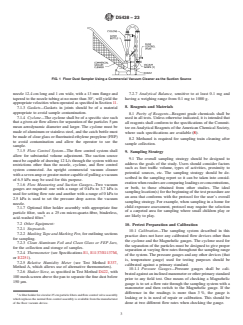
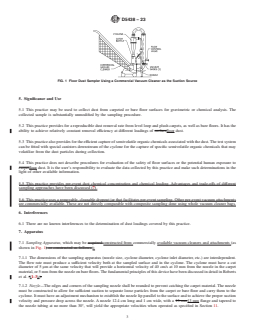
FIG. 1 Floor Dust Sampler Using a Commercial Vacuum Cleaner as the Suction Source
nozzle 12.4 cm long and 1 cm wide, with a 13 mm flange and 7.2.7 Analytical Balance, sensitive to at least 0.1 mg and
tapered to the nozzle tubing at no more than 30°, will yield the having a weighing range from 0.1 mg to 1000 g.
appropriate velocities when operated as specified in Section 11.
8. Reagents and Materials
7.1.3 Gaskets—Gaskets in joints should be of a material
appropriate to avoid sample contamination.
8.1 Purity of Reagents—Reagent grade chemicals shall be
7.1.4 Cyclone—The cyclone shall be of a specific size such
used in all tests. Unless otherwise indicated, it is intended that
that a given air flow allows for separation of the particles 5 μm
all reagents shall conform to the specifications of the Commit-
mean aerodynamic diameter and larger. The cyclone must be
tee on Analytical Reagents of the American Chemical Society,
made of aluminum or stainless steel, and the catch bottle must
where such specifications are available (8).
be made of clear glass or fluorinated ethylene propylene (FEP)
8.2 Methanol is required for sampling train cleaning after
to avoid contamination and allow the operator to see the
sample collection.
sample.
7.1.5 Flow Control System—The flow control system shall
9. Sampling Strategy
allow for substantial volume adjustment. The suction source
9.1 The overall sampling strategy should be designed to
must be capable of drawing 12 L/s through the system with no
address the goals of the study. Users should consider factors
restrictions other than the nozzle, cyclone, and flow control
such as foot traffic volume, types of activities, proximity to
system connected. An upright commercial vacuum cleaner
potential sources, etc. The sampling strategy should be de-
with a seven amp or greater motor capable of pulling a vacuum
scribed in the sampling report so it can be taken into consid-
of 6.5 kPa may be used for this purpose.
eration when readers are comparing loadings or concentrations,
7.1.6 Flow Measuring and Suction Gauges—Two vacuum
or both, to those obtained from other studies. The ideal
gauges are required: one with a range of 0 kPa to 3.7 kPa is
sampling location(s) for the beginning of the test procedure are
used for setting flow rate and another with a range of 0 kPa to
an area that conforms with the protocol for the user’s overall
2.5 kPa is used to set the pressure drop across the vacuum
sampling strategy. For example, when sampling in a home for
nozzle.
child exposure assessment, protocol may require the selection
7.1.7 Optional filter holder assembly with appropriate fine
of a carpeted area for sampling where small children play or
particle filter, such as a 25 cm micro-quartz-fibre, binderless,
5 are likely to play.
acid-washed filter.
7.2 Other Equipment:
10. Pretest Preparation and Calibration
7.2.1 Stopwatch.
10.1 Calibration—The sampling system described in this
7.2.2 Masking Tape and Marking Pen, for outlining sections
practice does not have any calibrated flow devices other than
for sampling.
the cyclone and the Magnehelic gauges. The cyclone used for
7.2.3 Clean Aluminum Foil and Clean Glass or FEP Jars,
the separation of the particles must be designed to give proper
for the collection and storage of samples.
separation at varying flow rates throughout the sampling range
7.2.4 Thermometer (see Specifications E1, E1137/E1137M,
of the system. The pressure gauges and any other devices (that
or E2251).
is, temperature gauge) used for testing purposes should be
7.2.5 Relative Humidity Meter (see Test Method E337,
calibrated against a primary standard.
Method A, which allows use of alternative thermometers).
10.1.1 Pressure Gauges—Pressure gauges shall be cali-
7.2.6 Shaker Sieve, as specified in Test Method D422, with
brated against an inclined manometer or other primary standard
100 mesh-screen above the pan to separate the fine dust below
prior to any field test. One means of checking a Magnehelic
150 μm.
gauge is to set a flow rate through the sampling system with a
manometer and then switch to the Magnehelic gauge. If the
difference in the readings is more than 3 %, the gauge is
A filter holder for circular 25 cm particle filters and flow control valve assembly
leaking or is in need of repair or calibration. This should be
which replaces the normal flow control assembly is available from the manufacturer
of the floor vacuum device. done at two different flow rates when checking the gauge.
D5438 − 23
FIG. 2 Sample Data Sheet for Sampling for Floor Dust
10.1.2 The cyclone flow measurement is calibrated with a 10.2.3 The sampling train shall be leak-checked prior to
laminar flow element, spirometer, or roots meter. See the sampling. This can be accomplished by placing a mailing
appendix for cyclone calibration with a laminar flow element. envelope or a piece of cardboard beneath the nozzle and
switching on the suction source. The flow Magnehelic gauge
10.2 Pretest Preparation:
should read 5 Pa (0.02 in. H O) or less to ensure that the
10.2.1 Each catch bottle to be used shall be clean and
system is leak free. If any leakage is detected, the system shall
inspected for any contamination. The bottles should be marked
be inspected for the cause and corrected before use.
with masking tape and a marking pen for identification of the
test site, time, and date.
11. Sampling
10.2.2 The sampling train shall be inspected to ensure that it
has been cleaned and assembled properly. 11.1 Sampling a Carpeted Floor:
D5438 − 23
FIG. 3 Example of a Typical Sampling Procedure
11.1.1 Pre-Test Survey—Immediately prior to testing, com- 11.1.7 If the rug area to be sampled is very dirty, or has not
plete a data form recording all requested information and been cleaned frequently, care must be taken to avoid filling up
sketch the area to be sampled. (See Fig. 2 for a sample data the cyclone catch bottle on the first sample area. If it is
form.) suspected that this will be the case, start with a 0.25 m
11.1.2 Select a sampling area in accordance with the estab- sampling area. Then take a second and a third area as before,
lished protocol for your sampling campaign. This should be until the catch bottle is 75 % full.
determined prior to testing.
11.1.8 Adjust the flow rate and nozzle pressure drop to
11.1.3 A typical sampling procedure may use measuring values that approximate those given in Table 1. Use the same
tapes
...
This document is not an ASTM standard and is intended only to provide the user of an ASTM standard an indication of what changes have been made to the previous version. Because
it may not be technically possible to adequately depict all changes accurately, ASTM recommends that users consult prior editions as appropriate. In all cases only the current version
of the standard as published by ASTM is to be considered the official document.
Designation: D5438 − 17 D5438 − 23
Standard Practice for
Collection of Floor Dust for Chemical Analysis
This standard is issued under the fixed designation D5438; the number immediately following the designation indicates the year of
original adoption or, in the case of revision, the year of last revision. A number in parentheses indicates the year of last reapproval. A
superscript epsilon (´) indicates an editorial change since the last revision or reapproval.
1. Scope
1.1 This practice covers a procedure for the collection of a sample of dust from carpets and bare floors that can be analyzed for
lead, pesticides, or other chemical compounds and elements.inorganic metals such as lead and organic compounds such as
pesticides and other semi-volatile organic compounds (SVOCs).
1.2 This practice is applicable to a variety of carpeted and bare floor surfaces. It has been tested for level loop and plush pile
carpets and bare wood floors, specifically. This practice is not applicable to elevated, non-floor surfaces.
1.3 This practice is not intended for the collection and evaluation of dust for the presence of asbestos fibers.
1.4 The values stated in SI units are to be regarded as standard. No other units of measurement are included in this standard.
1.5 This practice describes use of a sampling device, the High-Volume Small Surface Sampler (HVS3). Other event-based
sampling devices that use commercially available vacuum attachments are not in scope. Composite sampling using whole vacuum
cleaner bags is not in scope. Other approaches for floor or non-floor surface sampling (Practices D6966, D6661, D7144) are not
within the scope.
1.6 This practice only applies to the HVS3. Other dust sampling methods may or may not be directly comparable. Method
evaluation for other dust sampling approaches is encouraged. This could be done by comparison with methods outlined in this
standard practice for HVS3 or through independent evaluation using field spikes and certified reference materials.
1.7 This practice provides information on dust loading, chemical dust concentration, and chemical dust loading. Information on
the type of floor, the floor surface area sampled, and amount of dust collected is required (see Fig. 2). Cleaning the vacuum
attachments in between sampling events is also required (see Section 13).
1.8 This standard does not purport to address all of the safety concerns, if any, associated with its use. It is the responsibility
of the user of this standard to establish appropriate safety and healthsafety, health, and environmental practices and determine
the applicability of regulatory limitations prior to use.
1.9 This international standard was developed in accordance with internationally recognized principles on standardization
established in the Decision on Principles for the Development of International Standards, Guides and Recommendations issued
by the World Trade Organization Technical Barriers to Trade (TBT) Committee.
This practice is under the jurisdiction of ASTM Committee D22 on Air Quality and is the direct responsibility of Subcommittee D22.05 on Indoor Air.
Current edition approved March 1, 2017Sept. 1, 2023. Published March 2017September 2023. Originally approved in 1993. Last previous edition approved in 20112017
as D5438 – 11.D5438 – 17. DOI: 10.1520/D5438-17.10.1520/D5438-23.
Copyright © ASTM International, 100 Barr Harbor Drive, PO Box C700, West Conshohocken, PA 19428-2959. United States
D5438 − 23
2. Referenced Documents
2.1 ASTM Standards:
D422 Test Method for Particle-Size Analysis of Soils (Withdrawn 2016)
D1356 Terminology Relating to Sampling and Analysis of Atmospheres
D6661 Practice for Field Collection of Organic Compounds from Surfaces Using Wipe Sampling
D6966 Practice for Collection of Settled Dust Samples Using Wipe Sampling Methods for Subsequent Determination of Metals
D7144 Practice for Collection of Surface Dust by Micro-vacuum Sampling for Subsequent Determination of Metals and
Metalloids
E1 Specification for ASTM Liquid-in-Glass Thermometers
E337 Test Method for Measuring Humidity with a Psychrometer (the Measurement of Wet- and Dry-Bulb Temperatures)
E1137/E1137M Specification for Industrial Platinum Resistance Thermometers
E1195 Test Method for Determining a Sorption Constant (K ) for an Organic Chemical in Soil and Sediments (Withdrawn
oc
2013)
E2251 Specification for Liquid-in-Glass ASTM Thermometers with Low-Hazard Precision Liquids
F608 Test Method for Evaluation of Carpet Embedded Dirt Removal Effectiveness of Household/Commercial Vacuum Cleaners
3. Terminology
3.1 Definitions—For definitions of terms used in this practice, refer to Terminology D1356.
3.1.1 carpet-embedded dust—dust, n—soil and other particulate matter, approximately 5-μm5 μm equivalent aerodynamic
diameter and larger, embedded in carpet pile and normally removable by household vacuum cleaners.
3.1.2 debris, n—items (that is, bug parts, plastics, foam, matted hair, gravel, etc.,) that would not pass through a 2 mm sieve and
would not be considered surface dust or carpet-embedded dust.
3.1.3 particle size fraction bins, n—the mass of surface dust or carpet-embedded dust present between two particle-size values.
3.1.3.1 Discussion—
While this standard practice refers to 150 μm, other potential particle-size values such as 20 μm, 63 μm, 75 μm, 250 μm, 1 mm,
2 mm, and others could be used to define particle size fraction bins. See Specification E1195 for standard number sieves matched
to different particle-sizes.
3.1.4 surface dust—dust, n—soil and other particulate matter, approximately 5-μm5 μm equivalent aerodynamic diameter and
larger, adhering to floor surfaces and normally removable by household vacuum cleaners.
4. Summary of Practice
4.1 The sampling method described in this practice is taken from work published in Roberts et al. ((1-3),), and Stamper et al. ((4).
Appendix F of this published report also contains information on the construction of the HVS3 sampler (5).
4.2 Particulate matter is withdrawn from the carpet or bare floor by means of vacuum-induced suction which draws through a
sampling nozzle at a specific velocity and flow rate, and the particles are separated mechanically by a cyclone. The cyclone is
designed to efficiently separate and collect particles approximately 5-μm5 μm mean aerodynamic diameter and larger. However,
much smaller particles are also collected at unknown efficiencies. The sampling system allows for height, air flow, and suction
adjustments to reproduce systematically a specific air velocity for the removal of particulate matter from carpeted and bare floor
surfaces, so that these sampling conditions can be repeated.
NOTE 1—Side-by-side comparison of the HVS3 and a conventional upright vacuum cleaner revealed that both collected particles down to at least 0.2 μm
and that the HVS3 was more efficient at collecting particles smaller than 20 μm than conventional vacuum cleaners (56). If desired, a fine-particle filter
may be added downstream of the cyclone to collect 99.9 % of particles above 0.2 μm aerodynamic mean diameter.
4.3 The particulate matter in the air stream is collected in a catch bottle attached to the bottom of the collection cyclone. This catch
bottle shall be capped for storage of the sample and transported to the laboratory for analysis.
For referenced ASTM standards, visit the ASTM website, www.astm.org, or contact ASTM Customer Service at service@astm.org. For Annual Book of ASTM Standards
volume information, refer to the standard’s Document Summary page on the ASTM website.
The last approved version of this historical standard is referenced on www.astm.org.
The boldface numbers in parentheses refer to the list of references at the end of this standard.
D5438 − 23
FIG. 1 Floor Dust Sampler Using a Commercial Vacuum Cleaner as the Suction Source
5. Significance and Use
5.1 This practice may be used to collect dust from carpeted or bare floor surfaces for gravimetric or chemical analysis. The
collected sample is substantially unmodified by the sampling procedure.
5.2 This practice provides for a reproducible dust removal rate from level loop and plush carpets, as well as bare floors. It has the
ability to achieve relatively constant removal efficiency at different loadings of surfacefloor dust.
5.3 This practice also provides for the efficient capture of semivolatile organic chemicals associated with the dust. The test system
can be fitted with special canisters downstream of the cyclone for the capture of specific semivolatile organic chemicals that may
volatilize from the dust particles during collection.
5.4 This practice does not describe procedures for evaluation of the safety of floor surfaces or the potential human exposure to
carpetfloor dust. It is the user’s responsibility to evaluate the data collected by this practice and make such determinations in the
light of other available information.
5.5 This practice provides per-event dust chemical concentration and chemical loading. Advantages and trade-offs of different
sampling approaches have been discussed (7).
5.6 This practice uses a removable, cleanable dropout jar that facilitates per-event sampling. Other per-event vacuum attachments
are commercially available. These are not directly comparable with composite sampling done using whole vacuum cleaner bags.
6. Interferences
6.1 There are no known interferences to the determination of dust loadings covered by this practice.
7. Apparatus
7.1 Sampling Apparatus, which may be acquired constructed from commercially available vacuum cleaners and attachments (as
shown in Fig. 1) or constructed as follows:):
7.1.1 The dimensions of the sampling apparatus (nozzle size, cyclone diameter, cyclone inlet diameter, etc.) are interdependent.
The flow rate must produce a sufficient velocity both at the sampled surface and in the cyclone. The cyclone must have a cut
diameter of 5 μm at the same velocity that will provide a horizontal velocity of 40 cm/s at 10 mm from the nozzle in the carpet
material, or 5 mm from the nozzle on bare floors. The fundamental principles of this device have been discussed in detail in Roberts
et al. ((1-3).).
7.1.2 Nozzle—The edges and corners of the sampling nozzle shall be rounded to prevent catching the carpet material. The nozzle
must be constructed to allow for sufficient suction to separate loose particles from the carpet or bare floor and carry them to the
cyclone. It must have an adjustment mechanism to establish the nozzle lip parallel to the surface and to achieve the proper suction
velocity and pressure drop across the nozzle. A nozzle 12.4 cm long and 1 cm wide, with a 13-mm13 mm flange and tapered to
the nozzle tubing at no more than 30°, will yield the appropriate velocities when operated as specified in Section 11.
D5438 − 23
7.1.3 Gaskets—Gaskets in joints should be of a material appropriate to avoid sample contamination.
7.1.4 Cyclone—The cyclone shall be of a specific size such that a given air flow allows for separation of the particles 5-μm5 μm
mean aerodynamic diameter and larger. The cyclone must be made of aluminum or stainless steel, and the catch bottle must be
made of clear glass or fluorinated ethylene propylene (FEP) to avoid contamination and allow the operator to see the sample.
7.1.5 Flow Control System—The flow control system shall allow for substantial volume adjustment. The suction source must be
capable of drawing 12 L/s through the system with no restrictions other than the nozzle, cyclone, and flow control system
connected. An upright commercial vacuum cleaner with a seven amp or greater motor capable of pulling a vacuum of 6.5 kPa may
be used for this purpose.
7.1.6 Flow Measuring and Suction Gauges—Two vacuum gauges are required—required: one with a range of 00 kPa to 3.7 kPa
is used for setting flow rate and another with a range of 00 kPa to 2.5 kPa is used to set the pressure drop across the vacuum nozzle.
7.1.7 Optional filter holder assembly with appropriate fine particle filter, such as a 25-cm25 cm micro-quartz-fibre, binderless,
acid-washed filter.
7.2 Other Equipment:
7.2.1 Stopwatch.
7.2.2 Masking Tape and Marking Pen, for outlining sections for sampling.
7.2.3 Clean Aluminum Foil and Clean Glass or FEP Jars, for the collection and storage of samples.
7.2.4 Thermometer (see SpecificationSpecifications E1, E1137/E1137M, or E2251).
7.2.5 Relative Humidity Meter (see Test Method E337, Method A, which allows use of alternative thermometers).
7.2.6 Shaker Sieve, as specified in Test Method D422, with 100 mesh-screen above the pan to separate the fine dust below 150
μm.
7.2.7 Analytical Balance, sensitive to at least 0.1 mg and having a weighing range from 0.1 mg to 1000 g.
8. Reagents and Materials
8.1 Purity of Reagents—Reagent grade chemicals shall be used in all tests. Unless otherwise indicated, it is intended that all
reagents shall conform to the specifications of the Committee on Analytical Reagents of the American Chemical Society, where
such specifications are available ((68).).
8.2 Methanol is required for sampling train cleaning after sample collection.
9. Sampling Strategy
9.1 The overall sampling strategy should be designed to address the goals of the study. Users should consider factors such as foot
traffic volume, types of activities, proximity to potential sources, etc. The sampling strategy should be described in the sampling
report so it can be taken into consideration when readers are comparing loadings or concentrations, or both, to those obtained from
other studies. The ideal sampling location(s) for the beginning of the test procedure are an area that conforms with the protocol
for the user’s overall sampling strategy. For example, when sampling in a home for child exposure assessment, protocol may
require the selection of a carpeted area for sampling where small children play or are likely to play.
10. Pretest Preparation and Calibration
10.1 Calibration—The sampling system described in this practice does not have any calibrated flow devices other than the cyclone
A filter holder for circular 25–cm25 cm particle filters and flow control valve assembly which replaces the normal flow control assembly is available from the
manufacturer of the floor vacuum device.
D5438 − 23
and the Magnehelic gauges. The cyclone used for the separation of the particles must be designed to give proper separation at
varying flow rates throughout the sampling range of the system. The pressure gauges and any other devices (that is, temperature
gauge) used for testing purposes should be calibrated against a primary standard.
10.1.1 Pressure Gauges—Pressure gauges shall be calibrated against an inclined manometer or other primary standard prior to any
field test. One means of checking a Magnehelic gauge is to set a flow rate through the sampling system with a manometer and then
switch to the Magnehelic gauge. If the difference in the readings is more than 3 %, the gauge is leaking or is in need of repair or
calibration. This should be done at two different flow rates when checking the gauge.
10.1.2 The cyclone flow measurement is calibrated with a laminar flow element, spirometer, or roots meter. See the appendix for
cyclone calibration with a laminar flow element.
D5438 − 23
10.2 Pretest Preparation:
10.2.1 Each catch bottle to be used shall be clean and inspected for any contamination. The bottles should be marked with masking
tape and a marking pen for identification of the test site, time, and date.
10.2.2 The sampling train shall be inspected to ensure that it has been cleaned and assembled properly.
10.2.3 The sampling train shall be leak-checked prior to sampling. This can be accomplished by placing a mailing envelope or
a piece of cardboard beneath the nozzle and switching on the suction source. The flow Magnehelic gauge should read 5 Pa (0.02
in. H O) or less to ensure that the system is leak free. If any leakage is detected, the system shall be inspected for the cause and
corrected before use.
11. Sampling
11.1 Sampling a Carpeted Floor:
11.1.1 Pre-Test Survey—Immediately prior to testing, complete a data form recording all requested information and sketch the area
to be sampled. (See Fig. 2 for a sample data form.)
11.1.2 Select a sampling area in accordance with the established protocol for your sampling campaign. This should be determined
prior to testing.
11.1.3 A typical sampling procedure may use measuring tapes placed on the carpet so that they are parallel to each other and on
either side of the portion of carpet to be sampled (Fig. 3). The measuring tapes should be between 0.5 and 1.5-m0.5 m and 1.5 m
apart and extended as far as practical. They should be taped to the carpet with masking tape every 30 cm.
11.1.4 Place the sampler in one corner of the sampling area and adjust the flow rate and pressure drop according to the type of
carpet (see 11.1.8). The two factors that affect the efficiency of the sampling system are the flow rate and pressure drop at the
nozzle. The pressure drop at the nozzle is a function of the flow rate and distance between the surface and the nozzle flange.
11.1.5 Clean the wheels and nozzle lip with a clean laboratory tissue immediately before sampling. Begin sampling by moving
the nozzle between the ends of the two measuring tapes. The sampler is then moved back and forth four times on the first strip,
moving the samp
...