

ASTM D7144-21
(Practice)Standard Practice for Collection of Surface Dust by Micro-vacuum Sampling for Subsequent Determination of Metals and Metalloids
General Information
- Abstract
SIGNIFICANCE AND USE
5.1 Human exposure to toxic metals and metalloids present in surface dust can result from dermal contact with or ingestion of contaminated dust. Also, inhalation exposure can result from disturbing dust particles from contaminated surfaces. Thus, standardized methods for the collection and analysis of metals and metalloids in surface dust samples are needed in order to evaluate the potential for human exposure to toxic elements.
5.2 This practice involves the use of sampling equipment to collect surface dust samples that may contain toxic metals and metalloids, and is intended for use by qualified technical professionals.
5.3 This practice allows for the subsequent determination of collected elemental concentrations on an area (loading) or mass concentration basis, or both.
5.4 Because particle losses can occur due to collection of dust onto the inner surfaces of the nozzle, the length of the collection nozzle is specified in order that such losses are comparable from one sample to another.
5.5 This practice is suitable for the collection of surface dust samples from, for example: (a) soft, porous surfaces such as carpet or upholstery; (b) hard, rough surfaces such as concrete or roughened wood; (c) confined areas that cannot be easily sampled by other means (such as wipe sampling as described in Practice D6966). A companion sampling technique that may be used for collection of surface dust from hard, smooth surfaces is wipe sampling (Practice D6966). A companion vacuum sampling technique that may be used for sampling carpets is described in Practice D5438.
5.6 Procedures presented in this practice are intended to provide a standardized method for dust collection from surfaces that cannot be reliably sampled using wipe collection methods (for example, Practice D6966). Additionally, the procedure described uses equipment that is readily available and in common use for other environmental and occupational hygiene sampling applications.
5.7 The entire...
SCOPE
1.1 This practice covers the micro-vacuum collection of surface dust for subsequent determination of metals and metalloids. The primary intended application is for sampling from soft, rough, or porous surfaces.
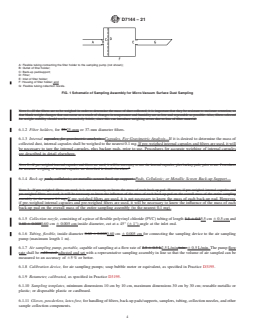
1.2 Micro-vacuum sampling is carried out using a collection nozzle attached to a filter holder (sampling cassette) that is connected to an air sampling pump.
1.3 This practice allows for the subsequent determination of metals and metalloids on a loading basis (mass of element(s) per unit area sampled), or on a concentration basis (mass of element(s) per unit mass of sample collected), or both.
1.4 The values stated in SI units are to be regarded as standard. No other units of measurement are included in this standard.
1.5 Limitations—Due to a number of physical factors inherent in the micro-vacuum sampling method, analytical results for vacuum dust samples are not likely to reflect the total dust contained within the sampling area prior to sample collection. Indeed, dust collection will generally be biased towards smaller, less dense dust particles. Nevertheless, the use of this standard practice will generate data that are consistent and comparable between operators performing micro-vacuum collection at a variety of sampling locations and sites.2
1.6 This standard does not purport to address all of the safety concerns, if any, associated with its use. It is the responsibility of the user of this standard to establish appropriate safety, health, and environmental practices and determine the applicability of regulatory limitations prior to use.
1.7 This international standard was developed in accordance with internationally recognized principles on standardization established in the Decision on Principles for the Development of International Standards, Guides and Recommendations issued by the World Trade Organization Technical Barriers to Trade (TBT) Committee.
- Status
- Published
- Publication Date
- 30-Apr-2021
- Technical Committee
- D22 - Air Quality
- Drafting Committee
- D22.04 - Workplace Air Quality
Buy Documents
ASTM D7144-21 - Standard Practice for Collection of Surface Dust by Micro-vacuum Sampling for Subsequent Determination of Metals and Metalloids
REDLINE ASTM D7144-21 - Standard Practice for Collection of Surface Dust by Micro-vacuum Sampling for Subsequent Determination of Metals and Metalloids
Overview
ASTM D7144-21: Standard Practice for Collection of Surface Dust by Micro-vacuum Sampling for Subsequent Determination of Metals and Metalloids provides a uniform procedure for collecting surface dust samples using micro-vacuum techniques. This practice is designed to support the accurate analysis of toxic metals and metalloids present in dust, which are critical indicators for evaluating human exposure risks in residential, commercial, and occupational settings.
This standard is intended for use by qualified professionals to assess contamination levels on soft, rough, or porous surfaces, where traditional wipe sampling methods are ineffective. Following ASTM D7144-21 ensures data consistency and comparability across different locations and sampling operators, contributing to effective environmental health and safety management.
Key Topics
- Micro-vacuum Sampling Technique: Utilizes a collection nozzle attached to a filter holder and a pump to draw air and collect dust from surfaces.
- Target Surfaces: Applicable to soft, rough, or porous materials such as carpets, upholstery, concrete, and rough wood that are challenging to sample through wipe methods.
- Analyte Flexibility: Suitable for subsequent determination of both metals and metalloids in dust samples, reported on an area (mass per unit area) or concentration basis (mass per unit dust).
- Standardization and Reproducibility: Specifies equipment configurations, nozzle dimensions, and operation parameters, promoting consistency in dust sampling.
- Contamination Control: Emphasizes the use of clean and dedicated components for each sample to prevent cross-contamination and ensure data integrity.
- Comprehensive Documentation: Recommends meticulous record keeping (sample location, date, surface type, calibration data, etc.) to enable detailed traceability and reporting.
- Safety and Regulatory Compliance: Advises that users implement appropriate safety, health, and environmental practices and consider regulatory requirements.
Applications
Micro-vacuum sampling with ASTM D7144-21 is widely used in:
- Environmental and Occupational Hygiene Monitoring: Identifying levels of toxic metals (such as lead, mercury, arsenic) and metalloids in workplaces, residences, and public buildings.
- Indoor Air Quality Assessments: Evaluating dust-bound contaminants to assess potential inhalation, ingestion, or dermal contact risks.
- Remediation and Abatement Verification: Collecting post-remediation dust samples to confirm the effectiveness of decontamination in buildings affected by industrial activities or environmental hazards.
- Regulatory Compliance and Research: Supporting compliance with governmental standards for hazardous materials and enabling data-driven risk assessments.
- Confined or Inaccessible Locations: Sampling within small, irregular, or otherwise challenging areas not suitable for wipe sampling.
Related Standards
ASTM D7144-21 is closely aligned with several other key standards to ensure comprehensive assessment of dust and air quality:
- ASTM D1356 - Terminology Relating to Sampling and Analysis of Atmospheres
- ASTM D3195 - Practice for Rotameter Calibration
- ASTM D4840 - Guide for Sample Chain-of-Custody Procedures
- ASTM D5438 - Practice for Collection of Floor Dust for Chemical Analysis
- ASTM D5337 - Practice for Flow Rate Adjustment of Personal Sampling Pumps
- ASTM D6966 - Practice for Collection of Settled Dust Samples Using Wipe Sampling Methods
- ASTM D7035 - Test Method for Determination of Metals and Metalloids in Airborne Particulate Matter
- ISO 15202-1 - Workplace Air - Determination of Metals and Metalloids in Airborne Particulate Matter by ICP-AES
Keywords: surface dust collection, micro-vacuum sampling, toxic metals, metalloids, environmental monitoring, occupational hygiene, ASTM D7144-21, dust sampling standard.
Relations
- Effective Date
- 01-Sep-2023
- Effective Date
- 01-Sep-2020
- Effective Date
- 15-Mar-2020
- Effective Date
- 01-Nov-2018
- Effective Date
- 15-Aug-2018
- Effective Date
- 01-Mar-2017
- Effective Date
- 15-Oct-2015
- Effective Date
- 01-Jul-2015
- Effective Date
- 01-Dec-2014
- Effective Date
- 01-May-2014
- Effective Date
- 15-Jan-2014
- Effective Date
- 01-Apr-2013
- Effective Date
- 15-Nov-2011
- Effective Date
- 15-Aug-2011
- Effective Date
- 01-Apr-2010
Buy Documents
ASTM D7144-21 - Standard Practice for Collection of Surface Dust by Micro-vacuum Sampling for Subsequent Determination of Metals and Metalloids
REDLINE ASTM D7144-21 - Standard Practice for Collection of Surface Dust by Micro-vacuum Sampling for Subsequent Determination of Metals and Metalloids
Get Certified
Connect with accredited certification bodies for this standard

ECOCERT
Organic and sustainability certification.

Eurofins Food Testing Global
Global leader in food, environment, and pharmaceutical product testing.

Intertek Bangladesh
Intertek certification and testing services in Bangladesh.
Sponsored listings
Frequently Asked Questions
ASTM D7144-21 is a standard published by ASTM International. Its full title is "Standard Practice for Collection of Surface Dust by Micro-vacuum Sampling for Subsequent Determination of Metals and Metalloids". This standard covers: SIGNIFICANCE AND USE 5.1 Human exposure to toxic metals and metalloids present in surface dust can result from dermal contact with or ingestion of contaminated dust. Also, inhalation exposure can result from disturbing dust particles from contaminated surfaces. Thus, standardized methods for the collection and analysis of metals and metalloids in surface dust samples are needed in order to evaluate the potential for human exposure to toxic elements. 5.2 This practice involves the use of sampling equipment to collect surface dust samples that may contain toxic metals and metalloids, and is intended for use by qualified technical professionals. 5.3 This practice allows for the subsequent determination of collected elemental concentrations on an area (loading) or mass concentration basis, or both. 5.4 Because particle losses can occur due to collection of dust onto the inner surfaces of the nozzle, the length of the collection nozzle is specified in order that such losses are comparable from one sample to another. 5.5 This practice is suitable for the collection of surface dust samples from, for example: (a) soft, porous surfaces such as carpet or upholstery; (b) hard, rough surfaces such as concrete or roughened wood; (c) confined areas that cannot be easily sampled by other means (such as wipe sampling as described in Practice D6966). A companion sampling technique that may be used for collection of surface dust from hard, smooth surfaces is wipe sampling (Practice D6966). A companion vacuum sampling technique that may be used for sampling carpets is described in Practice D5438. 5.6 Procedures presented in this practice are intended to provide a standardized method for dust collection from surfaces that cannot be reliably sampled using wipe collection methods (for example, Practice D6966). Additionally, the procedure described uses equipment that is readily available and in common use for other environmental and occupational hygiene sampling applications. 5.7 The entire... SCOPE 1.1 This practice covers the micro-vacuum collection of surface dust for subsequent determination of metals and metalloids. The primary intended application is for sampling from soft, rough, or porous surfaces. 1.2 Micro-vacuum sampling is carried out using a collection nozzle attached to a filter holder (sampling cassette) that is connected to an air sampling pump. 1.3 This practice allows for the subsequent determination of metals and metalloids on a loading basis (mass of element(s) per unit area sampled), or on a concentration basis (mass of element(s) per unit mass of sample collected), or both. 1.4 The values stated in SI units are to be regarded as standard. No other units of measurement are included in this standard. 1.5 Limitations—Due to a number of physical factors inherent in the micro-vacuum sampling method, analytical results for vacuum dust samples are not likely to reflect the total dust contained within the sampling area prior to sample collection. Indeed, dust collection will generally be biased towards smaller, less dense dust particles. Nevertheless, the use of this standard practice will generate data that are consistent and comparable between operators performing micro-vacuum collection at a variety of sampling locations and sites.2 1.6 This standard does not purport to address all of the safety concerns, if any, associated with its use. It is the responsibility of the user of this standard to establish appropriate safety, health, and environmental practices and determine the applicability of regulatory limitations prior to use. 1.7 This international standard was developed in accordance with internationally recognized principles on standardization established in the Decision on Principles for the Development of International Standards, Guides and Recommendations issued by the World Trade Organization Technical Barriers to Trade (TBT) Committee.
SIGNIFICANCE AND USE 5.1 Human exposure to toxic metals and metalloids present in surface dust can result from dermal contact with or ingestion of contaminated dust. Also, inhalation exposure can result from disturbing dust particles from contaminated surfaces. Thus, standardized methods for the collection and analysis of metals and metalloids in surface dust samples are needed in order to evaluate the potential for human exposure to toxic elements. 5.2 This practice involves the use of sampling equipment to collect surface dust samples that may contain toxic metals and metalloids, and is intended for use by qualified technical professionals. 5.3 This practice allows for the subsequent determination of collected elemental concentrations on an area (loading) or mass concentration basis, or both. 5.4 Because particle losses can occur due to collection of dust onto the inner surfaces of the nozzle, the length of the collection nozzle is specified in order that such losses are comparable from one sample to another. 5.5 This practice is suitable for the collection of surface dust samples from, for example: (a) soft, porous surfaces such as carpet or upholstery; (b) hard, rough surfaces such as concrete or roughened wood; (c) confined areas that cannot be easily sampled by other means (such as wipe sampling as described in Practice D6966). A companion sampling technique that may be used for collection of surface dust from hard, smooth surfaces is wipe sampling (Practice D6966). A companion vacuum sampling technique that may be used for sampling carpets is described in Practice D5438. 5.6 Procedures presented in this practice are intended to provide a standardized method for dust collection from surfaces that cannot be reliably sampled using wipe collection methods (for example, Practice D6966). Additionally, the procedure described uses equipment that is readily available and in common use for other environmental and occupational hygiene sampling applications. 5.7 The entire... SCOPE 1.1 This practice covers the micro-vacuum collection of surface dust for subsequent determination of metals and metalloids. The primary intended application is for sampling from soft, rough, or porous surfaces. 1.2 Micro-vacuum sampling is carried out using a collection nozzle attached to a filter holder (sampling cassette) that is connected to an air sampling pump. 1.3 This practice allows for the subsequent determination of metals and metalloids on a loading basis (mass of element(s) per unit area sampled), or on a concentration basis (mass of element(s) per unit mass of sample collected), or both. 1.4 The values stated in SI units are to be regarded as standard. No other units of measurement are included in this standard. 1.5 Limitations—Due to a number of physical factors inherent in the micro-vacuum sampling method, analytical results for vacuum dust samples are not likely to reflect the total dust contained within the sampling area prior to sample collection. Indeed, dust collection will generally be biased towards smaller, less dense dust particles. Nevertheless, the use of this standard practice will generate data that are consistent and comparable between operators performing micro-vacuum collection at a variety of sampling locations and sites.2 1.6 This standard does not purport to address all of the safety concerns, if any, associated with its use. It is the responsibility of the user of this standard to establish appropriate safety, health, and environmental practices and determine the applicability of regulatory limitations prior to use. 1.7 This international standard was developed in accordance with internationally recognized principles on standardization established in the Decision on Principles for the Development of International Standards, Guides and Recommendations issued by the World Trade Organization Technical Barriers to Trade (TBT) Committee.
ASTM D7144-21 is classified under the following ICS (International Classification for Standards) categories: 71.040.99 - Other standards related to analytical chemistry. The ICS classification helps identify the subject area and facilitates finding related standards.
ASTM D7144-21 has the following relationships with other standards: It is inter standard links to ASTM D5438-23, ASTM D1356-20a, ASTM D1356-20, ASTM D6966-18, ASTM D4840-99(2018)e1, ASTM D5438-17, ASTM D1356-15a, ASTM D1356-15, ASTM D1356-14b, ASTM D1356-14a, ASTM D1356-14, ASTM D6966-13, ASTM D5337-11, ASTM D5438-11, ASTM D7035-10. Understanding these relationships helps ensure you are using the most current and applicable version of the standard.
ASTM D7144-21 is available in PDF format for immediate download after purchase. The document can be added to your cart and obtained through the secure checkout process. Digital delivery ensures instant access to the complete standard document.
Standards Content (Sample)
This international standard was developed in accordance with internationally recognized principles on standardization established in the Decision on Principles for the
Development of International Standards, Guides and Recommendations issued by the World Trade Organization Technical Barriers to Trade (TBT) Committee.
Designation: D7144 − 21
Standard Practice for
Collection of Surface Dust by Micro-vacuum Sampling for
Subsequent Determination of Metals and Metalloids
This standard is issued under the fixed designation D7144; the number immediately following the designation indicates the year of
original adoption or, in the case of revision, the year of last revision. A number in parentheses indicates the year of last reapproval. A
superscript epsilon (´) indicates an editorial change since the last revision or reapproval.
1. Scope mendations issued by the World Trade Organization Technical
Barriers to Trade (TBT) Committee.
1.1 This practice covers the micro-vacuum collection of
surface dust for subsequent determination of metals and
2. Referenced Documents
metalloids. The primary intended application is for sampling
2.1 ASTM Standards:
from soft, rough, or porous surfaces.
D1356 Terminology Relating to Sampling and Analysis of
1.2 Micro-vacuumsamplingiscarriedoutusingacollection
Atmospheres
nozzle attached to a filter holder (sampling cassette) that is
D3195 Practice for Rotameter Calibration
connected to an air sampling pump.
D4840 Guide for Sample Chain-of-Custody Procedures
1.3 This practice allows for the subsequent determination of
D5438 Practice for Collection of Floor Dust for Chemical
metals and metalloids on a loading basis (mass of element(s)
Analysis
per unit area sampled), or on a concentration basis (mass of
D5337 Practice for Flow RateAdjustment of Personal Sam-
element(s) per unit mass of sample collected), or both.
pling Pumps
D6966 Practice for Collection of Settled Dust Samples
1.4 The values stated in SI units are to be regarded as
Using Wipe Sampling Methods for Subsequent Determi-
standard. No other units of measurement are included in this
nation of Metals
standard.
D7035 Test Method for Determination of Metals and Met-
1.5 Limitations—Due to a number of physical factors inher-
alloids in Airborne Particulate Matter by Inductively
ent in the micro-vacuum sampling method, analytical results
Coupled Plasma Atomic Emission Spectrometry (ICP-
for vacuum dust samples are not likely to reflect the total dust
AES)
contained within the sampling area prior to sample collection.
Indeed, dust collection will generally be biased towards
3. Terminology
smaller, less dense dust particles. Nevertheless, the use of this
3.1 Definitions—For definitions of terms relating to sam-
standard practice will generate data that are consistent and
pling and analysis of dust not given here, refer to Terminology
comparable between operators performing micro-vacuum col-
D1356.
lection at a variety of sampling locations and sites.
1.6 This standard does not purport to address all of the 3.2 Definitions of Terms Specific to This Standard:
3.2.1 air sampling pump, n—a portable pump that is used to
safety concerns, if any, associated with its use. It is the
responsibility of the user of this standard to establish appro- draw air through a filter holder/collection nozzle assembly for
micro-vacuum collection of surface dust. An example would
priate safety, health, and environmental practices and deter-
mine the applicability of regulatory limitations prior to use. include a personal sampling pump.
1.7 This international standard was developed in accor-
3.2.2 batch, n—a group of field or quality control samples,
dance with internationally recognized principles on standard-
orboth,thatarecollectedtogetherinasimilarenvironmentand
ization established in the Decision on Principles for the
are processed together using the same reagents and equipment.
Development of International Standards, Guides and Recom-
3.2.3 collection nozzle, n—a piece of flexible plastic tubing
cut at a 45º angle at the inlet end, and connected at the outlet
This practice is under the jurisdiction ofASTM Committee D22 on Air Quality end to the inlet orifice of a filter holder (sampling cassette).
and is the direct responsibility of Subcommittee D22.04 on WorkplaceAir Quality.
Current edition approved May 1, 2021. Published May 2021. Originally
approved in 2005. Last previous edition approved in 2016 as D7144 – 05a (2016).
DOI: 10.1520/D7144-21. For referenced ASTM standards, visit the ASTM website, www.astm.org, or
Reynolds, S. J., et al.,“Laboratory Comparison of Vacuum, OSHA, and HUD contact ASTM Customer Service at service@astm.org. For Annual Book of ASTM
Sampling Methods for Lead in Household Dust,” American Industrial Hygiene Standards volume information, refer to the standard’s Document Summary page on
Association Journal, Vol 58, 1997, pp. 439–446. the ASTM website.
Copyright © ASTM International, 100 Barr Harbor Drive, PO Box C700, West Conshohocken, PA 19428-2959. United States
D7144 − 21
3.2.4 field blank, n—a sample that is handled in exactly the
same way that field samples are collected, except that no air is
drawn through it.
3.2.5 filter holder, n—an apparatus that supports and con-
tains the filter medium upon which dust is collected. It is also
often referred to as a sampling cassette.
3.2.6 internal capsule, n—a device inserted into a filter
holder (sampling cassette) that allows complete capture of A: Flexible tubing connecting the filter holder to the sampling pump (not shown);
B: Outlet of filter holder;
contaminant within its envelope and prevents deposition of
C: Back-up pad/support;
collected material on the internal walls of the sampling
D: Filter;
E: Inlet of filter holder;
cassette.Useofaninternalcapsuleisnecessaryforgravimetric
F: Housing of filter holder; and
analysis purposes.
G: Flexible tubing collection nozzle.
3.2.6.1 Discussion—Such capsules are commercially avail-
able. FIG. 1 Schematic of Sampling Assembly for Micro-Vacuum Sur-
face Dust Sampling
3.2.7 sampling device (assembly), n—for micro-vacuum
sampling, an apparatus consisting of the collection nozzle,
filter holder (containing internal capsule, if necessary), and air
5.3 This practice allows for the subsequent determination of
sampling pump, used to collect surface dust. The collection
collectedelementalconcentrationsonanarea(loading)ormass
nozzle is attached to the inlet end of the filter holder. The filter
concentration basis, or both.
holderhousesthefilter,throughwhichairisdrawnbyusingthe
5.4 Because particle losses can occur due to collection of
air sampling pump.The filter holder is attached to the pump by
dust onto the inner surfaces of the nozzle, the length of the
flexible tubing.
collection nozzle is specified in order that such losses are
3.2.8 surface dust, n—particulate matter on a given surface
comparable from one sample to another.
which has been transported to its present location by various
means, such as settling through the air or tracking from other 5.5 Thispracticeissuitableforthecollectionofsurfacedust
sources. samples from, for example: (a) soft, porous surfaces such as
carpet or upholstery; (b) hard, rough surfaces such as concrete
4. Summary of Practice
or roughened wood; (c) confined areas that cannot be easily
4.1 Samples of surface dust are collected from selected
sampled by other means (such as wipe sampling as described
sampling locations into individual filter holders by using a
in Practice D6966).Acompanion sampling technique that may
micro-vacuum collection technique that employs a personal
be used for collection of surface dust from hard, smooth
sampling pump. The sample is then processed for transport
surfaces is wipe sampling (Practice D6966). A companion
and subsequent laboratory analysis for determination of metals
vacuum sampling technique that may be used for sampling
and metalloids content.
carpets is described in Practice D5438.
4.2 The collected sample may include particles which ad-
5.6 Procedures presented in this practice are intended to
here to the internal walls of the filter holder. This material
provide a standardized method for dust collection from sur-
should be rinsed or wiped off and added to the sample meant
faces that cannot be reliably sampled using wipe collection
for subsequent chemical analysis. However, this material
methods (for example, Practice D6966). Additionally, the
cannot be included in gravimetric determination unless an
procedure described uses equipment that is readily available
internal capsule that can be accurately weighed is used during
and in common use for other environmental and occupational
sample collection.
hygiene sampling applications.
5. Significance and Use 5.7 The entire contents of the filter holder, that is, the filter
plus collected dust, is targeted for subsequent analysis for
5.1 Human exposure to toxic metals and metalloids present
metals and metalloids content. An internal capsule is used if
insurfacedustcanresultfromdermalcontactwithoringestion
gravimetric analysis is necessary.
ofcontaminateddust.Also,inhalationexposurecanresultfrom
disturbing dust particles from contaminated surfaces. Thus,
6. Apparatus
standardized methods for the collection and analysis of metals
6.1 Dust Sampling Equipment—The sampling assembly
and metalloids in surface dust samples are needed in order to
(see Fig. 1) for the micro-vacuum collection of surface dust
evaluate the potential for human exposure to toxic elements.
samples has the following components:
5.2 This practice involves the use of sampling equipment to
6.1.1 Filters, of a diameter suitable for use with the filter
collect surface dust samples that may contain toxic metals and
holders,andwithacollectionefficiencyofnotlessthan99.5 %
metalloids, and is intended for use by qualified technical
for particles with a diffusion diameter of 0.3 µm, and with a
professionals.
verylowmetalcontent(typicallylessthan0.1µgofeachmetal
of interest per filter) (see Test Method D7035).
Ashley, K., et al., “Evaluation of a Standardized Micro-vacuum Sampling
6.1.1.1 Weight-stable filters shall be used if it is desired to
Method for Collection of Surface Dust,” Journal of Occupational and Environmen-
tal Hygiene, Vol 4, 2007, pp. 215–223. determine the mass of collected dust. If the filters are to be
D7144 − 21
weighed in order to determine the mass of dust collected, it is 7.1.1 Assemble the filter in the filter holder, with the filter
important that they be resistant to moisture retention, so that supported on a back-up pad or metallic screen. To prevent
blank weight changes that can occur as a result of changes in contamination, the filter should be handled only with tweezers.
temperature and humidity are as low and repeatable as pos-
7.1.2 If pre-weighed filters and internal capsules are used,
sible. Also, filters selected for weight stability should not be
record their masses to the nearest 0.1 mg using established
excessivelybrittle,sincethiscanintroduceweighingerrorsdue
acceptance criteria.
to loss of fil
...
This document is not an ASTM standard and is intended only to provide the user of an ASTM standard an indication of what changes have been made to the previous version. Because
it may not be technically possible to adequately depict all changes accurately, ASTM recommends that users consult prior editions as appropriate. In all cases only the current version
of the standard as published by ASTM is to be considered the official document.
Designation: D7144 − 05a (Reapproved 2016) D7144 − 21
Standard Practice for
Collection of Surface Dust by Micro-vacuum Sampling for
Subsequent Metals DeterminationDetermination of Metals
and Metalloids
This standard is issued under the fixed designation D7144; the number immediately following the designation indicates the year of
original adoption or, in the case of revision, the year of last revision. A number in parentheses indicates the year of last reapproval. A
superscript epsilon (´) indicates an editorial change since the last revision or reapproval.
1. Scope
1.1 This practice covers the micro-vacuum collection of surface dust for subsequent determination of metals. metals and
metalloids. The primary intended application is for sampling from soft, rough, or porous surfaces.
1.2 Micro-vacuum sampling is carried out using a collection nozzle attached to a filter holder (sampling cassette) that is connected
to an air sampling pump.
1.3 This practice allows for the subsequent determination of metals and metalloids on a loading basis (mass of metal(s)element(s)
per unit area sampled), or on a concentration basis (mass of metal(s)element(s) per unit mass of sample collected), or both.
1.4 The values stated in SI units are to be regarded as standard. No other units of measurement are included in this standard.
1.5 Limitations—Due to a number of physical factors inherent in the micro-vacuum sampling method, analytical results for
vacuum dust samples are not likely to reflect the total dust contained within the sampling area prior to sample collection. Indeed,
dust collection will generally be biased towards smaller, less dense dust particles. Nevertheless, the use of this standard practice
will generate data that are consistent and comparable between operators performing micro-vacuum collection at a variety of
sampling locations and sites.
1.6 This standard does not purport to address all of the safety concerns, if any, associated with its use. It is the responsibility
of the user of this standard to establish appropriate safety safety, health, and healthenvironmental practices and determine the
applicability of regulatory limitations prior to use.
1.7 This international standard was developed in accordance with internationally recognized principles on standardization
established in the Decision on Principles for the Development of International Standards, Guides and Recommendations issued
by the World Trade Organization Technical Barriers to Trade (TBT) Committee.
This practice is under the jurisdiction of ASTM Committee D22 on Air Quality and is the direct responsibility of Subcommittee D22.04 on Workplace Air Quality.
Current edition approved Oct. 1, 2016May 1, 2021. Published October 2016May 2021. Originally approved in 2005. Last previous edition approved in 20112016 as
D7144 – 05a (2011).(2016). DOI: 10.1520/D7144-05AR16.10.1520/D7144-21.
Reynolds, S. J., et al.,“Laboratory Comparison of Vacuum, OSHA, and HUD Sampling Methods for Lead in Household Dust,” American Industrial Hygiene Association
Journal, Vol.Vol 58, 1997, pp. 439–446.
Copyright © ASTM International, 100 Barr Harbor Drive, PO Box C700, West Conshohocken, PA 19428-2959. United States
D7144 − 21
2. Referenced Documents
2.1 ASTM Standards:
D1356 Terminology Relating to Sampling and Analysis of Atmospheres
D3195 Practice for Rotameter Calibration
D4840 Guide for Sample Chain-of-Custody Procedures
D5438 Practice for Collection of Floor Dust for Chemical Analysis
D5337 Practice for Flow Rate Adjustment of Personal Sampling Pumps
D6966 Practice for Collection of Settled Dust Samples Using Wipe Sampling Methods for Subsequent Determination of Metals
D7035 Test Method for Determination of Metals and Metalloids in Airborne Particulate Matter by Inductively Coupled Plasma
Atomic Emission Spectrometry (ICP-AES)
2.2 ISO Standard:
ISO 15202-1 Workplace air—Determination of metals and metalloids in airborne particulate matter by inductively coupled
plasma atomic emission spectrometry—Part 1: Sampling
3. Terminology
3.1 Definitions—For definitions of terms relating to sampling and analysis of dust not given here, refer to Terminology D1356.
3.2 Definitions of Terms Specific to This Standard:
3.2.1 air sampling pump—pump, n—a portable pump that is used to draw air through a filter holder/collection nozzle assembly
for micro-vacuum collection of surface dust. An example would include a personal sampling pump. D1356
3.2.2 batch—batch, n—a group of field or quality control samples, or both, that are collected together in a similar environment
and are processed together using the same reagents and equipment.
3.2.3 collection nozzle—nozzle, n—a piece of flexible plastic tubing cut at a 45º angle at the inlet end, and connected at the outlet
end to the inlet orifice of a filter holder (sampling cassette).
3.2.4 field blank—blank, n—a sample that is handled in exactly the same way that field samples are collected, except that no air
is drawn through it.
3.2.5 filter holder—holder, n—an apparatus that supports and contains the filter medium upon which dust is collected. It is also
often referred to as a sampling cassette.
3.2.6 internal capsule—capsule, n—a device inserted into a filter holder (sampling cassette) that allows complete capture of
contaminant within its envelope and prevents deposition of collected material on the internal walls of the sampling cassette. Use
of an internal capsule is necessary for gravimetric analysis purposes.
3.2.6.1 Discussion—
Such capsules are commercially available.
3.2.7 sampling device (assembly)—(assembly), n—for micro-vacuum sampling, an apparatus consisting of the collection nozzle,
filter holder (containing internal capsule, if necessary), and air sampling pump, used to collect surface dust. The collection nozzle
is attached to the inlet end of the filter holder. The filter holder houses the filter, through which air is drawn by using the air
sampling pump. The filter holder is attached to the pump by flexible tubing.
3.2.8 surface dust—dust, n—particulate matter on a given surface which has been transported to its present location by various
means, such as settling through the air or tracking from other sources.
4. Summary of Practice
4.1 Samples of surface dust are collected from selected sampling locations into individual filter holders by using a micro-vacuum
For referenced ASTM standards, visit the ASTM website, www.astm.org, or contact ASTM Customer Service at service@astm.org. For Annual Book of ASTM Standards
volume information, refer to the standard’sstandard’s Document Summary page on the ASTM website.
D7144 − 21
collection technique that employs a personal sampling pump. The sample is then processed for transport and subsequent
laboratory analysis for determination of metals and metalloids content.
4.2 The collected sample may include particles which adhere to the internal walls of the filter holder. This material should be
rinsed or wiped off and added to the sample meant for subsequent chemical analysis. However, this material cannot be included
in gravimetric determination unless an internal capsule that can be accurately weighed is used during sample collection.
5. Significance and Use
5.1 Human exposure to toxic metals and metalloids present in surface dust can result from dermal contact with or ingestion of
contaminated dust. Also, inhalation exposure can result from disturbing dust particles from contaminated surfaces. Thus,
standardized methods for the collection and analysis of metals and metalloids in surface dust samples are needed in order to
evaluate the potential for human exposure to toxic elements.
5.2 This practice involves the use of sampling equipment to collect surface dust samples that may contain toxic metals,metals and
metalloids, and is intended for use by qualified technical professionals.
5.3 This practice allows for the subsequent determination of collected metalselemental concentrations on an area (loading) or mass
concentration basis, or both.
5.4 Because particle losses can occur due to collection of dust onto the inner surfaces of the nozzle, the length of the collection
nozzle is specified in order that such losses are comparable from one sample to another.
5.5 This practice is suitable for the collection of surface dust samples from, for example: (a) soft, porous surfaces such as carpet
or upholstery; (b) hard, rough surfaces such as concrete or roughened wood; (c) confined areas that cannot be easily sampled by
other means (such as wipe sampling as described in Practice D6966). A companion sampling technique that may be used for
collection of surface dust from hard, smooth surfaces is wipe sampling (Practice D6966). A companion vacuum sampling technique
that may be used for sampling carpets is described in Practice D5438.
5.6 Procedures presented in this practice are intended to provide a standardized method for dust collection from surfaces that
cannot be reliably sampled using wipe collection methods (for example, Practice D6966). Additionally, the procedure described
uses equipment that is readily available and in common use for other environmental and occupational hygiene sampling
applications.
5.7 The entire contents of the filter holder, that is, the filter plus collected dust, is targeted for subsequent analysis for metals and
metalloids content. An internal capsule is used if gravimetric analysis is necessary.
6. Apparatus
6.1 Dust Sampling Equipment—The sampling assembly (see Fig. 1) for the micro-vacuum collection of surface dust samples has
the following components:
6.1.1 Filters, of a diameter suitable for use with the filter holders, and with a collection efficiency of not less than 99.5 % for
particles with a diffusion diameter of 0.3 μm, and with a very low metal content (typically less than 0.1 μg of each metal of interest
per filter) (see ISO 15202-1).Test Method D7035).
6.1.1.1 Weight-stable filters or matched-weight filters shall be used if it is desired to determine the mass of collected dust. If the
filters are to be weighed in order to determine the mass of dust collected, it is important that they be resistant to moisture retention,
so that blank weight changes that can occur as a result of changes in temperature and humidity are as low and repeatable as
possible. Also, filters selected for weight stability should not be excessively brittle, since this can introduce weighing errors due
to loss of filter material.
Que HeeAshley, S. S., K., et al., “Evolution of Efficient Methods to Sample Lead Sources, Such as House Dust and Hand Dust, in the Homes of Children.” “Evaluation
of a Standardized Micro-vacuum Sampling Method for Collection of Surface Dust,” Environmental ResearchJournal of Occupational and Environmental Hygiene, Vol.Vol
384, 19852007, pp. 77215–95.–223.
D7144 − 21
A: Flexible tubing connecting the filter holder to the sampling pump (not shown);
B: Outlet of filter holder;
C: Back-up pad/support;
D: Filter;
E: Inlet of filter holder;
F: Housing of filter holder; and
G: Flexible tubing collection nozzle.
FIG. 1 Schematic of Sampling Assembly for Micro-Vacuum Surface Dust Sampling
NOTE 1—If the filters are to be weighed in order to determine the mass of dust collected, it is important that they be resistant to moisture retention, so
that blank weight changes that can occur as a result of changes in temperature and humidity are as low and repeatable as possible. Also, filters selected
for weight stability should not be excessively brittle, since this can introduce weighing errors due to loss of filter material.
6.1.2 Filter holders, for 25-25-mm or 37-mm diameter filters.
6.1.3 Internal capsules, for gravimetric analysis—Capsules, For Gravimetric Analysis—If it is desired to determine the mass of
collected dust, internal capsules shall be weighed to the nearest 0.1 mg. If pre-weighed internal capsules and filters are used, it will
be necessary to tare the internal capsules, plus backup pads, prior to use. Procedures for accurate weighing of internal capsul
...