

EN 81-40:2020
(Main)Safety rules for the construction and installation of lifts - Special lifts for the transport of persons and goods - Part 40: Stairlifts and inclined lifting platforms intended for persons with impaired mobility
- Abstract
1.1 This document deals with safety requirements for construction, manufacturing, installation, maintenance and dismantling of electrically operated stairlifts (chair, standing platform and wheelchair platform) affixed to a building structure, moving in an inclined plane and intended for use by persons with impaired mobility:
- travelling over a stair or an accessible inclined surface;
- intended for use by one person;
- whose carriage is directly retained and guided by a guide rail or rails;
- supported or sustained by rope (5.4.4), rack and pinion (5.4.5), chain (5.4.6), friction traction drive (5.4.7), and guided rope and ball (5.4.8).
1.2 This document identifies hazards as listed in Clause 4 which arise during the various phases in the life of such equipment and describes methods for the elimination or reduction of these hazards when used as intended by the manufacturer.
1.3 This document does not specify the additional requirements for:
- operation in severe conditions (e.g. extreme climates, strong magnetic fields);
- operation subject to special rules (e.g. potentially explosive atmospheres);
- handling of materials, the nature of which could lead to dangerous situations;
- use of energy systems other than electricity;
- hazards occurring during manufacture;
- earthquakes, flooding, fire;
- evacuation during a fire;
- stairlifts for goods only;
- concrete, hardcore, timber or other foundation or building arrangement;
- design of anchorage bolts to the supporting structure.
NOTE For the actual type of machinery, noise is not considered a significant nor relevant hazard.
1.4 This document is not applicable to power operated stairlifts which are manufactured before the date of publication of this document by CEN.
- Status
- Published
- Publication Date
- 15-Sep-2020
- Withdrawal Date
- 29-Sep-2022
- Technical Committee
- CEN/TC 10 - Passenger, goods and service lifts
- Drafting Committee
- CEN/TC 10 - Passenger, goods and service lifts
- Current Stage
- 9092 - Decision on results of review/2YR ENQ - revise - Review Enquiry
- Start Date
- 05-Mar-2026
- Completion Date
- 14-Oct-2026
- Directive
- 2006/42/EC - Directive 2006/42/EC of the European Parliament and of the Council of 17 May 2006 on machinery, and amending Directive 95/16/EC (recast)OJ Ref: L, L 366 OJ Date: 15-Oct-2021



Overview
EN 81-40:2020 (CEN) specifies safety rules for the construction and installation of stairlifts and inclined lifting platforms intended for persons with impaired mobility. It covers electrically operated chair, standing platform and wheelchair platform stairlifts affixed to a building, travelling on an inclined plane for one person and retained/guided by guide rail(s). The standard identifies significant hazards (see Clause 4) across the machine lifecycle and defines measures to eliminate or reduce risks during design, manufacture, installation, maintenance and dismantling.
Key topics and technical requirements
- Scope and exclusions: applies to electrically powered stairlifts for persons with impaired mobility; excludes severe environments, explosive atmospheres, non-electric energy systems, manufacturing hazards, seismic/flood/fire events, evacuation during fire, goods-only lifts, foundation design and anchorage bolt design (see Clause 1.3).
- Safety requirements and protective measures (Clause 5): requirements for guide rails, mechanical stops, safety gear, overspeed detection, drive systems and electrical installations.
- Permitted drive systems: rope, rack-and-pinion, chain, friction/traction drive, and guided rope-and-ball drives (specified in 5.4.x).
- Carriage design: ergonomics, restraints, levelling, edges and surfaces to reduce entrapment and fall risk (Clause 5.6; Annex A test procedures).
- Verification and testing (Clause 6 & Annex A/B/G): design verification, type and routine tests, static overload, chair levelling, self-sustaining system checks, and friction/traction drive conformity tests.
- Information for use and marking (Clause 7): instruction handbook, warning signals, maintenance and servicing guidance.
- Interface with building (Annex C): minimum clearances, access, means of escape considerations and electrical supply/lighting requirements.
- Updates in 2020 edition: removal of screw-and-nut drive, added verification tests, building interface requirements, lightning protection and dated normative references; supersedes EN 81-40:2008.
Applications and users
EN 81-40:2020 is used by:
- Stairlift manufacturers and designers for compliant product development and CE marking.
- Installers and contractors for safe installation and handover.
- Maintenance and service providers to define inspection regimes and testing.
- Regulators, accessibility planners and building owners to assess conformity, procurement specifications and building interfaces.
- Occupational health & safety professionals to evaluate hazards and mitigation measures.
Typical applications: residential and public building stairlift installations, accessibility retrofit projects, product certification and pre-use verification.
Related standards
- EN 81 series (lift safety family) - EN 81-40 is a type C standard in the EN ISO 12100 framework.
- Annex ZA relates EN 81-40 to the essential requirements of Directive 2006/42/EC (machinery directive).
Keywords: EN 81-40:2020, stairlifts, inclined lifting platforms, safety rules, CEN, persons with impaired mobility, installation, maintenance, guide rails, verification tests.
Relations
- Effective Date
- 23-Sep-2020
- Effective Date
- 11-Mar-2026
- Effective Date
- 11-Mar-2026
- Effective Date
- 09-Feb-2026
- Effective Date
- 09-Feb-2026
- Effective Date
- 09-Feb-2026
- Effective Date
- 09-Feb-2026
- Effective Date
- 09-Feb-2026
- Effective Date
- 09-Feb-2026
- Effective Date
- 09-Feb-2026
- Effective Date
- 09-Feb-2026
- Effective Date
- 09-Feb-2026
- Refers
EN IEC 60747-5-5:2020 - Semiconductor devices - Part 5-5: Optoelectronic devices - Photocouplers - Effective Date
- 09-Feb-2026
- Effective Date
- 09-Feb-2026
- Effective Date
- 09-Feb-2026
Get Certified
Connect with accredited certification bodies for this standard

BSI Group
BSI (British Standards Institution) is the business standards company that helps organizations make excellence a habit.

TÜV Rheinland
TÜV Rheinland is a leading international provider of technical services.

TÜV SÜD
TÜV SÜD is a trusted partner of choice for safety, security and sustainability solutions.
Sponsored listings
Frequently Asked Questions
EN 81-40:2020 is a standard published by the European Committee for Standardization (CEN). Its full title is "Safety rules for the construction and installation of lifts - Special lifts for the transport of persons and goods - Part 40: Stairlifts and inclined lifting platforms intended for persons with impaired mobility". This standard covers: 1.1 This document deals with safety requirements for construction, manufacturing, installation, maintenance and dismantling of electrically operated stairlifts (chair, standing platform and wheelchair platform) affixed to a building structure, moving in an inclined plane and intended for use by persons with impaired mobility: - travelling over a stair or an accessible inclined surface; - intended for use by one person; - whose carriage is directly retained and guided by a guide rail or rails; - supported or sustained by rope (5.4.4), rack and pinion (5.4.5), chain (5.4.6), friction traction drive (5.4.7), and guided rope and ball (5.4.8). 1.2 This document identifies hazards as listed in Clause 4 which arise during the various phases in the life of such equipment and describes methods for the elimination or reduction of these hazards when used as intended by the manufacturer. 1.3 This document does not specify the additional requirements for: - operation in severe conditions (e.g. extreme climates, strong magnetic fields); - operation subject to special rules (e.g. potentially explosive atmospheres); - handling of materials, the nature of which could lead to dangerous situations; - use of energy systems other than electricity; - hazards occurring during manufacture; - earthquakes, flooding, fire; - evacuation during a fire; - stairlifts for goods only; - concrete, hardcore, timber or other foundation or building arrangement; - design of anchorage bolts to the supporting structure. NOTE For the actual type of machinery, noise is not considered a significant nor relevant hazard. 1.4 This document is not applicable to power operated stairlifts which are manufactured before the date of publication of this document by CEN.
1.1 This document deals with safety requirements for construction, manufacturing, installation, maintenance and dismantling of electrically operated stairlifts (chair, standing platform and wheelchair platform) affixed to a building structure, moving in an inclined plane and intended for use by persons with impaired mobility: - travelling over a stair or an accessible inclined surface; - intended for use by one person; - whose carriage is directly retained and guided by a guide rail or rails; - supported or sustained by rope (5.4.4), rack and pinion (5.4.5), chain (5.4.6), friction traction drive (5.4.7), and guided rope and ball (5.4.8). 1.2 This document identifies hazards as listed in Clause 4 which arise during the various phases in the life of such equipment and describes methods for the elimination or reduction of these hazards when used as intended by the manufacturer. 1.3 This document does not specify the additional requirements for: - operation in severe conditions (e.g. extreme climates, strong magnetic fields); - operation subject to special rules (e.g. potentially explosive atmospheres); - handling of materials, the nature of which could lead to dangerous situations; - use of energy systems other than electricity; - hazards occurring during manufacture; - earthquakes, flooding, fire; - evacuation during a fire; - stairlifts for goods only; - concrete, hardcore, timber or other foundation or building arrangement; - design of anchorage bolts to the supporting structure. NOTE For the actual type of machinery, noise is not considered a significant nor relevant hazard. 1.4 This document is not applicable to power operated stairlifts which are manufactured before the date of publication of this document by CEN.
EN 81-40:2020 is classified under the following ICS (International Classification for Standards) categories: 11.180.10 - Aids and adaptation for moving; 91.140.90 - Lifts. Escalators. The ICS classification helps identify the subject area and facilitates finding related standards.
EN 81-40:2020 has the following relationships with other standards: It is inter standard links to EN 81-40:2008, ISO 606:2015, ISO 7000:2019, EN IEC 62305-3:2024, EN 61249-2-1:2005, EN 60747-5-1:2001/A2:2002, EN 60747-5-1:2001, EN 60747-5-1:2001/A1:2002, EN 60747-5-2:2001, EN 60529:1991/A2:2013, EN 60529:1991, EN 60204-1:2018, EN IEC 60747-5-5:2020, EN IEC 62305-4:2024, EN IEC 62305-1:2024. Understanding these relationships helps ensure you are using the most current and applicable version of the standard.
EN 81-40:2020 is associated with the following European legislation: EU Directives/Regulations: 2006/42/EC; Standardization Mandates: M/396, M/BC/CEN/92/3. When a standard is cited in the Official Journal of the European Union, products manufactured in conformity with it benefit from a presumption of conformity with the essential requirements of the corresponding EU directive or regulation.
EN 81-40:2020 is available in PDF format for immediate download after purchase. The document can be added to your cart and obtained through the secure checkout process. Digital delivery ensures instant access to the complete standard document.
Standards Content (Sample)
SLOVENSKI STANDARD
01-december-2020
Varnostna pravila za konstruiranje in vgradnjo dvigal (liftov) - Posebna dvigala za
prevoz oseb in blaga - 40. del: Priprave za vzpenjanje po stopnicah in dvižne
ploščadi z diagonalnim pomikanjem za osebe z omejenimi gibalnimi sposobnostmi
Safety rules for the construction and installation of lifts - Special lifts for the transport of
persons and goods - Part 40: Stairlifts and inclined lifting platforms intended for persons
with impaired mobility
Sicherheitsregeln für die Konstruktion und den Einbau von Aufzügen - Spezielle Aufzüge
für den Personen- und Gütertransport - Teil 40: Treppenschrägaufzüge und
Plattformaufzüge mit geneigter Fahrbahn für Personen mit Behinderungen
Règles de sécurité pour la construction et l'installation des élévateurs - Élévateurs
spéciaux pour le transport des personnes et des charges - Partie 40 : Ascensièges et
plates-formes élévatrices inclinées à l'usage des personnes à mobilité réduite
Ta slovenski standard je istoveten z: EN 81-40:2020
ICS:
11.180.10 Pripomočki in prilagoditve za Aids and adaptation for
gibanje moving
91.140.90 Dvigala. Tekoče stopnice Lifts. Escalators
2003-01.Slovenski inštitut za standardizacijo. Razmnoževanje celote ali delov tega standarda ni dovoljeno.
EN 81-40
EUROPEAN STANDARD
NORME EUROPÉENNE
September 2020
EUROPÄISCHE NORM
ICS 91.140.90; 11.180.10 Supersedes EN 81-40:2008
English Version
Safety rules for the construction and installation of lifts -
Special lifts for the transport of persons and goods - Part
40: Stairlifts and inclined lifting platforms intended for
persons with impaired mobility
Règles de sécurité pour la construction et l'installation Sicherheitsregeln für die Konstruktion und den Einbau
des élévateurs - Élévateurs spéciaux pour le transport von Aufzügen - Spezielle Aufzüge für den Personen-
des personnes et des charges - Partie 40 : Ascensièges und Gütertransport - Teil 40: Treppenschrägaufzüge
et plates-formes élévatrices inclinées à l'usage des und Plattformaufzüge mit geneigter Fahrbahn für
personnes à mobilité réduite Personen mit Behinderungen
This European Standard was approved by CEN on 29 June 2020.
CEN members are bound to comply with the CEN/CENELEC Internal Regulations which stipulate the conditions for giving this
European Standard the status of a national standard without any alteration. Up-to-date lists and bibliographical references
concerning such national standards may be obtained on application to the CEN-CENELEC Management Centre or to any CEN
member.
This European Standard exists in three official versions (English, French, German). A version in any other language made by
translation under the responsibility of a CEN member into its own language and notified to the CEN-CENELEC Management
Centre has the same status as the official versions.
CEN members are the national standards bodies of Austria, Belgium, Bulgaria, Croatia, Cyprus, Czech Republic, Denmark, Estonia,
Finland, France, Germany, Greece, Hungary, Iceland, Ireland, Italy, Latvia, Lithuania, Luxembourg, Malta, Netherlands, Norway,
Poland, Portugal, Republic of North Macedonia, Romania, Serbia, Slovakia, Slovenia, Spain, Sweden, Switzerland, Turkey and
United Kingdom.
EUROPEAN COMMITTEE FOR STANDARDIZATION
COMITÉ EUROPÉEN DE NORMALISATION
EUROPÄISCHES KOMITEE FÜR NORMUNG
CEN-CENELEC Management Centre: Rue de la Science 23, B-1040 Brussels
© 2020 CEN All rights of exploitation in any form and by any means reserved Ref. No. EN 81-40:2020 E
worldwide for CEN national Members.
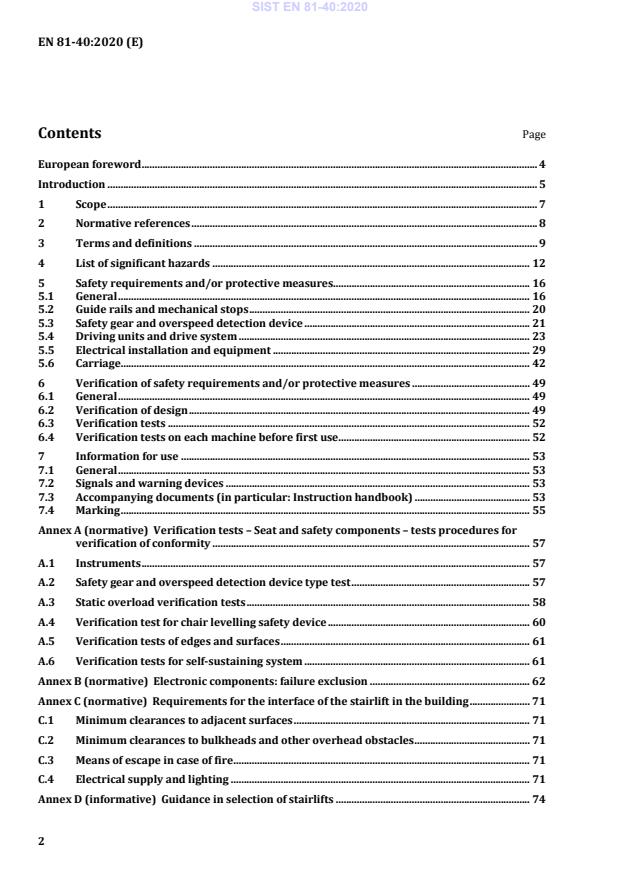
Contents Page
European foreword . 4
Introduction . 5
1 Scope . 7
2 Normative references . 8
3 Terms and definitions . 9
4 List of significant hazards . 12
5 Safety requirements and/or protective measures. 16
5.1 General . 16
5.2 Guide rails and mechanical stops . 20
5.3 Safety gear and overspeed detection device . 21
5.4 Driving units and drive system . 23
5.5 Electrical installation and equipment . 29
5.6 Carriage. 42
6 Verification of safety requirements and/or protective measures . 49
6.1 General . 49
6.2 Verification of design . 49
6.3 Verification tests . 52
6.4 Verification tests on each machine before first use . 52
7 Information for use . 53
7.1 General . 53
7.2 Signals and warning devices . 53
7.3 Accompanying documents (in particular: Instruction handbook) . 53
7.4 Marking . 55
Annex A (normative) Verification tests – Seat and safety components – tests procedures for
verification of conformity . 57
A.1 Instruments . 57
A.2 Safety gear and overspeed detection device type test . 57
A.3 Static overload verification tests . 58
A.4 Verification test for chair levelling safety device . 60
A.5 Verification tests of edges and surfaces . 61
A.6 Verification tests for self-sustaining system . 61
Annex B (normative) Electronic components: failure exclusion . 62
Annex C (normative) Requirements for the interface of the stairlift in the building . 71
C.1 Minimum clearances to adjacent surfaces . 71
C.2 Minimum clearances to bulkheads and other overhead obstacles . 71
C.3 Means of escape in case of fire . 71
C.4 Electrical supply and lighting . 71
Annex D (informative) Guidance in selection of stairlifts . 74
D.1 General . 74
D.2 Selection of stairlift . 74
D.3 Maintenance . 74
Annex E (informative) Recommendations for the provisions and use of specially adapted
control devices, switches and sensors . 75
E.1 Control devices . 75
E.2 Specially adapted switches . 75
Annex F (informative) In-use periodic examination, tests and servicing . 76
F.1 Periodic examinations and tests . 76
F.2 Servicing . 76
Annex G (normative) Friction/traction drive – Calculation and test for verification of
traction conformity . 77
Annex ZA (informative) Relationship between this European Standard and the essential
requirements of Directive 2006/42/EC aimed to be covered . 78
Bibliography . 81
European foreword
This document (EN 81-40:2020) has been prepared by Technical Committee CEN/TC 10 “Lifts, escalators
and moving walks”, the secretariat of which is held by AFNOR.
This European Standard shall be given the status of a national standard, either by publication of an
identical text or by endorsement, at the latest by March 2021, and conflicting national standards shall be
withdrawn at the latest by September 2022.
Attention is drawn to the possibility that some of the elements of this document may be the subject of
patent rights. CEN shall not be held responsible for identifying any or all such patent rights.
This document supersedes EN 81-40:2008.
are:
— support for screw and nut drive has been removed;
— verification tests have been added for static overload, chair levelling, edges and surfaces and self-
sustaining system;
— requirements for the interface of the stairlift in the building have been added;
— a requirement for lightning protection has been added;
— all normative references to other standards have been dated;
— a new Annex ZA, including a detailed Table ZA.1, has been developed.
This document has been prepared under a mandate given to CEN by the European Commission and the
European Free Trade Association, and supports essential requirements of EU Directive(s).
For relationship with EU Directive(s), see informative Annex ZA, which is an integral part of this
document.
According to the CEN-CENELEC Internal Regulations, the national standards organisations of the
following countries are bound to implement this European Standard: Austria, Belgium, Bulgaria, Croatia,
Cyprus, Czech Republic, Denmark, Estonia, Finland, France, Germany, Greece, Hungary, Iceland, Ireland,
Italy, Latvia, Lithuania, Luxembourg, Malta, Netherlands, Norway, Poland, Portugal, Republic of North
Macedonia, Romania, Serbia, Slovakia, Slovenia, Spain, Sweden, Switzerland, Turkey and the United
Kingdom.
Introduction
The population of Europe is ageing and the prevalence of disability, including disability associated with
the ageing process, is increasing. Older people and people with disabilities at present are estimated to
number some 80 million people – a large and growing proportion of the European Union population. The
changing demography presents both opportunities and challenges for the Union. The economic, social
and cultural potential of older people and people with disabilities is underexploited at present. However,
there is a growing recognition that society needs to exploit this potential for the economic and social
benefit of society generally.
This is one of the reasons that led to this document on vertical lifting platforms for people with impaired
mobility being one means to provide accessibility to buildings.
This document is a type C standard as stated in EN ISO 12100:2010.
This document is of relevance, in particular, for the following stakeholder groups representing the market
players with regard to machinery safety:
— machine manufacturers (small, medium and large enterprises);
— health and safety bodies (regulators, accident prevention organizations, market surveillance etc.).
Others can be affected by the level of machinery safety achieved with the means of the document by the
above-mentioned stakeholder groups:
— machine users/employers (small, medium and large enterprises);
— machine users/employees (e.g. trade unions, organizations for people with special needs);
— service providers, e.g. for maintenance (small, medium and large enterprises);
— consumers (in case of machinery intended for use by consumers).
The above-mentioned stakeholder groups have been given the possibility to participate at the drafting
process of this document.
The machinery concerned and the extent to which hazards, hazardous situations or hazardous events are
covered are indicated in the Scope of this document.
When requirements of this type-C standard are different from those which are stated in type-A or type-B
standards, the requirements of this type-C standard take precedence over the requirements of the other
standards for machines that have been designed and built according to the requirements of this type-C
standard.
Assumptions
With the aim of clarifying the intentions of the standard and avoiding doubts when reading it, the
following assumptions were made when producing it:
a) components without specific requirements are:
1) designed in accordance with the usual engineering practice and calculation codes, including all
failure modes;
2) of sound mechanical and electrical construction;
b) general electrical hazards are dealt with according to B level electrical safety standards;
c) components are kept in good repair and working order, in accordance with the maintenance manual,
so that the required characteristics remain despite wear;
d) by design of the load bearing elements, a safe operation of the machine is ensured throughout the
entire maximum working load range;
e) a mechanical device built according to good practice and the requirements of the standard, will not
deteriorate to a point of creating a hazard without the possibility of detection;
f) the ambient temperature is between 0 °C and +40 °C, at the place of use of the machinery;
g) Negotiation occurs between the manufacturer (the person applying the CE mark) and the user
concerning the specificity of the use and places of use of the stairlift:
1) suitability for user (see Annex D);
2) the place of installation allows a safe use for the machine (see Annex C);
3) any additional fire protection requirements.
1 Scope
1.1 This document deals with safety requirements for construction, manufacturing, installation,
maintenance and dismantling of electrically operated stairlifts (chair, standing platform and wheelchair
platform) affixed to a building structure, moving in an inclined plane and intended for use by persons
with impaired mobility:
— travelling over a stair or an accessible inclined surface;
— intended for use by one person;
— whose carriage is directly retained and guided by a guide rail or rails;
— supported or sustained by rope (5.4.4), rack and pinion (5.4.5), chain (5.4.6), friction/traction drive
(5.4.7), and guided rope and ball (5.4.8).
1.2 This document identifies hazards as listed in Clause 4 which arise during the various phases in the
life of such equipment and describes methods for the elimination or reduction of these hazards when
used as intended by the manufacturer.
1.3 This document does not specify the additional requirements for:
— operation in severe conditions (e.g. extreme climates, strong magnetic fields);
— operation subject to special rules (e.g. potentially explosive atmospheres);
— handling of materials, the nature of which could lead to dangerous situations;
— use of energy systems other than electricity;
— hazards occurring during manufacture;
— earthquakes, flooding, fire;
— evacuation during a fire;
— stairlifts for goods only;
— concrete, hardcore, timber or other foundation or building arrangement;
— design of anchorage bolts to the supporting structure.
NOTE For the actual type of machinery, noise is not considered a significant nor relevant hazard.
1.4 This document is not applicable to power operated stairlifts which are manufactured before the
date of publication of this document by CEN.
2 Normative references
The following documents are referred to in the text in such a way that some or all of their content
constitutes requirements of this document. For dated references, only the edition cited applies. For
undated references, the latest edition of the referenced document (including any amendments) applies.
EN 81-20:2020, Safety rules for the construction and installation of lifts — Lifts for the transport of persons
and goods — Part 20: Passenger and goods passenger lifts
EN 81-50:2020, Safety rules for the construction and installation of lifts — Examinations and tests — Part
50: Design rules, calculations, examinations and tests of lift components
EN 1021-2:2014, Furniture — Assessment of the ignitability of upholstered furniture — Part 2: Ignition
source match flame equivalent
EN 12385-4:2002+A1:2008, Steel wire ropes — Safety — Part 4: Stranded ropes for general lifting
applications
EN 16005:2012/AC:2015, Power operated pedestrian doorsets — Safety in use — Requirements and test
methods
EN 60204-1:2018, Safety of machinery — Electrical equipment of machines — Part 1: General requirements
(IEC 60204-1:2016, modified)
EN 60529:1991 , Degrees of protection provided by enclosures (IP Code)
EN 60664-1:2007, Insulation coordination for equipment within low-voltage systems — Part 1: Principles,
requirements and tests (IEC 60664-1:2007)
EN 60695-11-10:2013, Fire hazard testing — Part 11-10: Test flames — 50 W horizontal and vertical flame
test methods (IEC 60695-11-10:2013)
EN 60747-5 (all parts), Discrete semiconductor devices and integrated circuits — Part 5: Optoelectronic
devices (IEC 60747-5 all parts)
EN 60947-1:2007 , Low-voltage switchgear and controlgear — Part 1: General rules (IEC 60947-1:2007)
EN 60947-4-1:2010/A1:2012, Low-voltage switchgear and controlgear — Part 4-1: Contactors and motor-
starters — Electromechanical contactors and motor-starters (IEC 60947-4-1:2009/A1:2012)
EN 60947-5-1:2017, Low-voltage switchgear and controlgear — Part 5-1: Control circuit devices and
switching elements — Electromechanical control circuit devices (IEC 60947-5-1:2016)
EN 61249-2-1:2005, Materials for printed boards and other interconnecting structures — Part 2-1:
Reinforced base materials, clad and unclad — Phenolic cellulose paper reinforced laminated sheets,
economic grade, copper-clad (IEC 61249-2-1:2005)
This document is impacted by the amendments EN 60529:1991/A1:2000 and EN 60529:1991/A2:2013 and the
corrigendum EN 60529:1991/AC:2016-12.
This document is impacted by the amendments EN 60947-1:2007/A1:2011 and EN 60947-1:2007/A2:2014.
EN 61508-2:2010, Functional safety of electrical/electronic/programmable electronic safety-related
systems — Part 2: Requirements for electrical/electronic/programmable electronic safety-related systems
(IEC 61508-2:2010)
EN 61508-3:2010, Functional safety of electrical/electronic/programmable electronic safety-related
systems — Part 3: Software requirements (IEC 61508-3:2010)
EN IEC 61558-1:2019, Safety of transformers, reactors, power supply units and combinations thereof —
Part 1: General requirements and tests (IEC 61558-1:2017)
EN 62305 (all parts), Protection against lightning (IEC 62305)
EN 62326-1:2002, Printed boards — Part 1: Generic specification (IEC 62326-1:2002)
EN ISO 9773:1998 , Plastics — Determination of burning behaviour of thin flexible vertical specimens in
contact with a small-flame ignition source (ISO 9773:1998)
EN ISO 12100:2010, Safety of machinery — General principles for design — Risk assessment and risk
reduction (ISO 12100:2010)
EN ISO 13854:2019, Safety of machinery — Minimum gaps to avoid crushing of parts of the human body
(ISO 13854:2017)
EN ISO 13857:2019, Safety of machinery — Safety distances to prevent hazard zones being reached by
upper and lower limbs (ISO 13857:2019)
EN ISO 14120:2015, Safety of machinery — Guards — General requirements for the design and construction
of fixed and movable guards (ISO 14120:2015)
ISO 606:2015, Short-pitch transmission precision roller and bush chains, attachments and associated chain
sprockets
ISO 7000:2019, Graphical symbols for use on equipment — Registered symbols
ISO 9772:2012, Cellular plastics — Determination of horizontal burning characteristics of small specimens
subjected to a small flame
IEC 60417:2002 DB, Graphical symbols for use on equipment
IEC 60617 (all parts), Graphical symbols for diagrams
3 Terms and definitions
For the purposes of this document, the definitions given in EN ISO 12100:2010, EN 81-20:2020 and the
following apply.
ISO and IEC maintain terminological databases for use in standardization at the following addresses:
• IEC Electropedia: available at http://www.electropedia.org/
• ISO Online browsing platform: available at https://www.iso.org/obp
This document is impacted by the amendment EN ISO 9773:1998/A1:2003.
3.1
barrier arm
bar or similar device so arranged as to provide protection against persons falling from a stairlift
3.2
brake
mechanism employed to bring the stairlift to a stop and hold it in position
3.3
carriage
mobile trolley which is retained, supported and guided by one or more rails, upon which a chair, platform
or other purpose-made adaptation to carry the user is supported and securely attached
3.4
competent person
person, suitably trained and qualified by knowledge and practical experience, and provided with the
necessary instructions to enable the required work to be carried out safely
3.5
drive unit
mechanical unit, including the motor, that drives and stops the carriage
3.6
electrical safety chain
total of the electric safety devices, which can either be switches or safety circuits, connected in series with
each other
3.7
electrical safety circuit
electrical or electronic circuit with an equivalent degree of safety to a switch containing electrical safety
contacts
3.8
electrical safety contact
contact in which the separation of the circuit breaking elements is made by positive means
3.9
electrical safety device
either an electrical switch incorporating one or more electrical safety contacts, or a safety circuit
3.10
final limit device
last electric safety device situated beyond terminal floors
3.11
guide rail
rigid components which provide guiding for the carriage
3.12
guided rope
rope that is either fixed or moving, and is completely guided over its entire length such that it may
transmit a load either in thrust or tension
3.13
impaired mobility
difficulty in using stairs because of impairment
Note 1 to entry: Some examples, but not restricted to, are: wheelchair user, person with walking difficulties,
persons with impaired mobility and/or children with impaired mobility and elderly persons.
Note 2 to entry: This definition is specific to the sense of this document and not a full definition of the term.
3.14
journey
movement of the carriage between any two levels which incorporates one start and one stop
[SOURCE: ISO 9386-2:2000, 3.24]
3.15
maximum working load
rated load + overload
3.16
overload
25 % of rated load
3.17
overspeed detection device
device which interrupts the electric safety chain and if necessary causes the safety gear to be applied
when the stairlift attains a pre-determined speed
3.18
public access
location where the user is unknown
3.19
rated load
load for which the equipment has been designed
3.20
rated speed
design speed of the carrier
3.21
safety factor
ratio, either of the yield load, or the ultimate tensile load to the load that can be imposed upon a member
by the rated load for a material under static or dynamic conditions
3.22
safety gear
mechanical device for stopping and maintaining the carriage stationary on the guide rail/s in case of
overspeeding in the downward direction or the breaking of the suspension
3.23
self-sustaining drive system
system that, under free running conditions, ensures that the speed of the stairlift decreases
3.24
sensitive edge
device attached to any edge to provide protection against a trapping, shearing or crushing hazard
3.25
sensitive surface
device similar in effect to a sensitive edge but so arranged to protect a whole surface
3.26
slack rope/chain device
device, or combination of devices, arranged to stop the stairlift if any suspension rope or chain slackens
by a pre-determined amount
3.27
stairlift
appliance for transporting a person (either seated or standing) or person in a wheelchair between two or
more boarding points by means of a guided carriage moving in an inclined plane
3.28
terminal device
device or combination of devices arranged to stop the stairlift at or near a boarding point
3.29
unlocking zone
zone extending above and below a boarding point in which the carriage has to be positioned to enable
the corresponding ramp(s) and barrier arm(s) to be unlocked
4 List of significant hazards
This clause contains all the significant hazards, hazardous situations and events, as far as they are dealt
with in this document, identified by risk assessment as significant for this type of machinery and which
require action to eliminate or reduce the risk.
The significant hazards are based upon EN ISO 12100:2010. Also shown are the subclause references to
the safety requirements and/or protective measures in this document.
Table 1 shows the hazards which have been identified and where the corresponding requirements have
been formulated in this document, in order to limit the risk or reduce these hazards in each situation.
NOTE Hazards resulting from allergic reactions to persons are not addressed in this document.
Table 1 — Significant hazards relating to the general design and construction of stair lifts
Group Significant hazard in accordance Relevant clauses in this document
with EN ISO 12100:2010, Table B.1
General, for many machines relevant
1 Mechanical hazards
1.1 Due to machine parts or workpieces, e.g. 5.1.7, 5.1.9, 5.4.5.1, 5.4.5.2
— by mechanical strength (break-
up)
Due to machine parts or workpieces, e.g. 5.1.9
— by kinetic energy (acceleration,
deceleration, moving/rotating
elements)
1.2 by stored energy, e.g. 5.6.2.4.3
— elastic elements (springs)
1.3 Crushing 5.1
1.4 Shearing 5.1
1.5 Cutting or severing 5.6.2.2
1.6 Entanglement 5.1
1.7 Drawing-in or trapping 5.1.3
1.8 Impact 5.6.4.3
1.10 Friction or abrasion 5.6.2.5
1.12 Slipping, tripping and falling 5.6.2.1, 5.6.2.3, 5.6.3.1, 5.6.3.2, 5.6.3.3,
5.6.4.1, 5.6.4.4, 5.6.4.5, 5.6.4.6, 5.6.4.7
1.13 Instability 5.1.7
2 Electrical hazards
2.1 Touching live parts 5.5.1, 5.5.4.1, 5.5.9, 5.5.12.1, 5.5.12.4
2.2 Parts which have become live under fault
5.5.5.1, 5.5.12.6
conditions
2.7 Short-circuit 5.5.5.1, 5.5.9.2, 5.5.12.5, 5.5.12.10
2.8 Overload 5.5.1.2, 5.5.8, 5.5.12.3, 5.5.12.8, 5.5.12.11
4 Noise hazards
4.1 Permanent hearing loss, tinnitus Not covered
5 Vibration hazards
5.1 Vibrations transmitted to the operator
when sitting during operation 5.1.1
6 Radiation hazards
6.2 Radio frequency electromagnetic 5.5.13
radiation
Group Significant hazard in accordance Relevant clauses in this document
with EN ISO 12100:2010, Table B.1
7 Material/ substance hazards
7.1 Hazards from contact with inhalation of 5.5.12.2
harmful fluids, gases, mists, fumes and
dusts
7.2 Fire 5.1.4, C.3
8 Ergonomic hazards
8.1 Unhealthy postures or excessive effort 5.6.2.4.2, 5.6.4.3, 5.6.4.11
8.4 Inadequate local lighting C.4
8.5 Design or location of indicators and
7.2, 7.4
visual displays units
8.6 Design, location or identification of control
devices 5.5.13, 5.5.14
8.9 Human error during operation 5.5.12.7, 5.5.12.9, 5.6.2.4, Clause 7
9 Hazards associated with the environment in which the machine is used
9.4 Snow, water, wind, temperature 5.1.8
10.1 Failure/disorder of the control system and 5.4.8.4, 5.5.1, 5.5.2, 5.5.3, 5.5.4.2, 5.5.5,
control circuits 5.5.6, 5.5.10, 5.5.11, 5.5.13, 5.5.14, 5.5.15
10.3 Software error Not covered
10.4 Failure of the power supply 5.5.5.1
12 Hazards due to:
— assembly and installation
— setting
— cleaning
— fault-finding
— maintenance
12.1 Maintenance 5.1.3, 5.3.4
12.2 Insufficient means of access during use,
5.1.3, 5.4.3, 5.5.16, 5.6.4.8
setting and maintenance
12.4 Being trapped in a machine 5.1.3, 5.4.3, 5.5.12.12, 5.5.16, 5.6.4.8,
5.6.4.10
Supplementary, due to the mobility of machinery
16 Hazards related to travelling function
16.5 Insufficient ability of machinery to be 5.5.2, 5.5.3, 5.5.4, 5.5.5, 5.5.6, 6.4
slowed down, stopped and immobilized
Group Significant hazard in accordance Relevant clauses in this document
with EN ISO 12100:2010, Table B.1
17 Hazards linked to work position (including driving station) on the machine
17.1 Fall of persons during access to or 5.6.2.6, 5.6.3.3, 5.6.4.6, 5.6.4.7, 5.6.4.8,
at/from the work position 5.6.2.1, 5.6.2.3, 5.6.3.1.1, 5.6.3.2
17.3 Mechanical hazards at the work position, 5.2, 5.3, 5.3.1.7, 5.6.2, 5.6.3.2, 5.6.4.5,
such as: 5.6.4.6
— contact with the wheels
rollover and overturning
slipping during access
— fall of objects, penetration by objects
— contact of persons with machine
parts or tools (pedestrian controlled
machines
Supplementary, due to lifting operations
22 Mechanical hazards caused by load falls, collisions, machine tipping
22.1 Lack of stability 5.2.1, 5.4.7.1, 5.4.7.3
22.2 Uncontrolled loading, overloading, 5.1.6, 5.6.4.3, 7.3.1.1
overturning moments exceeded
22.8 Derailment 5.2.3
22.9 Insufficient mechanical strength of parts 5.1.7
22.10 Inadequate design of pulleys and drums 5.4.1.7, 5.4.4.2, 5.4.4.3, 5.4.8.2
22.11 Inadequate selection of chains, ropes,
5.4.4.1, 5.4.4.4, 5.4.6.1, 5.4.6.2, 5.4.6.3,
lifting and accessories and their
5.4.6.4, 5.4.8.1, 5.4.8.3
inadequate integration into the machine
23 Hazards linked to driver/operator position
23.1 Insufficient visibility from driver position 5.6.4.13, 6.4
Supplementary, for machinery presenting particular hazards due to the lifting of persons
27 Mechanical hazards
27.1 Due to: 5.1.6, 5.1.7, 5.4.1.3, 5.6.4.2
— inadequate mechanical strength
— inadequate working coefficients
— failing of loading control
27.2 Failing of controls in person carrier
5.5.13, 5.5.14
(function, priority)
27.3 Overspeed of person carrier 5.3
27.4 Falling of persons from person carrier 5.6.1, 5.6.2.1, 5.6.2.3, 5.6.2.6 5.6.3.1,
5.6.3.2, 5.6.4.1, 5.6.4.4, 5.6.4.5, 5.6.4.6,
5.6.4.7
5 Safety requirements and/or protective measures
5.1 General
5.1.1 Introduction
Machinery shall comply with the safety requirements and/or protective measures of this clause. In
addition, the machine shall be designed according to the principles of EN ISO 12100:2010 for relevant
but not significant hazards, which are not dealt with by this document.
It shall be ensured that the dimensions specified in this document are maintained despite wear.
Consideration shall also be given to the need for protection against the effects of corrosion. All materials
shall be asbestos free.
The positioning of the stairlift at the terminal or intermediate stops shall be such that the main entry or
exit doors to the building can be fully opened when not in use.
All components shall be designed and manufactured to facilitate ease of handling during, transportation,
installation and dismantling.
The stairlift shall not emit vibrations which could be harmful to the user.
5.1.2 Pattern of use
The design of the stairlift shall take account of the intended use and frequency to which it will be
subjected, as determined by the manufacturer with a minimum of 10 stairlift starts with rated load at
maximum inclination per hour (see also informative guidance on the selection of stairlifts, Annex D).
5.1.3 Access for maintenance, repair and inspection
Stairlifts shall be designed, constructed and installed so that periodic inspection, testing, maintenance or
repair of all components can be safely and readily carried out. Information concerning these activities is
provided in 6.4, Clause 7 and Annex F.
Guarding shall be designed and constructed in accordance with EN ISO 14120:2015, EN ISO 13857:2019,
EN ISO 13854:2019. Guard fixing systems shall remain attached to the guards or to the machinery when
the guards are removed.
5.1.4 Fire resistance
Materials used in the construction of the stairlift shall be flame retardant and self-extinguishing.
NOTE National regulations can apply.
Plastic components and electrical wiring insulation shall be flame retardant and self-extinguishing.
Materials shall have flame retardant properties to the following classifications as appropriate (see
Table 2).
Table 2 — Fire resistance classification
Material type Applicable standard Class
designation
Cellular plastic materials having ISO 9772:2012 HF-1
densities less than 250 kg/m
Thin, flexible plastic materials VTM-0
EN ISO 9773:1998
Solid and cellular plastic and other EN 60695-11-10:2013 Horizontal
non-metallic materials having a burning – HB40
density of not less than 250 kg/m
Vertical burning
– V-0
Upholstery material EN 1021-2:2014 Test report as in
EN 1021-2:2014,
Annex B to give
all results as ‘No '
5.1.5 Speed
Carriage speed in normal operation shall not exceed 0,15 m/s when measured at the reference point A
defined in Figures 1 and 2.
Key
A reference point for speed calculation
Figure 1 — Reference point for wheelchair and standing user
Dimension in millimetres
Key
A reference point for speed calculation
NOTE For stairlifts with combined seated and standing function, see Figure 1.
Figure 2 — Reference point for seated user
5.1.6 Rated load
5.1.6.1 General
For seated or standing users, stairlifts shall be designed for a capacity of one person, for which the rated
load shall be not less than 115 kg.
For wheelchair users, platform stairlifts shall be designed so that the minimum rated load is not less
than 250 kg/m . For public access the minimum rated load shall be 250 kg.
5.1.6.2 Load control
Wheelchair platform stairlifts shall be fitted with a device to prevent normal starting in the event of
overload on the platform. The overload is considered to occur when the rated load is exceeded by 25 %
when the load is uniformly distributed about point A as shown in Figure 1.
In the event of overload users shall be informed by an audible and visible signal on the platform.
5.1.7 Resistance to operating forces
5.1.7.1 The complete stairlift installation shall resist, without permanent deformation, the forces
imposed on it during normal operation, during the application of the safety devices and at impact on
mechanical stops when travelling at the rated speed. However, local deformation that does not affect the
operation of the stairlift arising from the safety gear gripping device or mechanical end stop is permissible
If after impact, the mechanical end stop components has to be replaced it has to be clearly written into
the service manual.
Unless otherwise stated in this document, the safety factor, according to the yield strength, for all parts
of the equipment shall be not less than 2,5.
5.1.7.2 Guiding components, their attachments and joints shall withstand deflections due to uneven
loading without affecting normal operation.
5.1.7.3 All load bearing components and joints, which are critical to fatigue shall be designed to take
into account the degree of stress fluctuation and the number of stress cycles, which can be a multiple of
the number of load cycles.
The design shall be based upon:
a) a minimum number of load cycles of 45 000;
b) each load cycle at rated load + 10 % as defined by the manufacturer and shall at least consist of:
1) a user mounting the lift;
2) one start (acceleration from rest to rated speed);
3) not less than 5 m of travel;
4) one stop (deceleration from rated speed);
5) a user dismounting the lift;
6) a rail section at the maximum rail angle, or at worst case angle as defined by the manufacturer;
and additionally, in the case of curved rail stairlifts:
i) a worst-case rail as defined by the manufacturer, incorporating rail sections at the minimum
and maximum rail angles and worst case two- and three-dimensional bends, and
ii) a rail, serving landing heights of not less than 3 m vertically.
c) steps b) 1) and 5) can be performed in a separate test
d) fixings to the building specified to ensure that their integrity is maintained during normal operating
conditions.
Components may be replaced during the empirical fatigue analysis in line with manufacturers normal
service recommendations.
5.1.7.4 After the test according to 5.1.7.3, the test shall continue for another 5 000 cycles at no load.
5.1.8 Protection of equipment against harmful external influences
5.1.8.1 General
Mechanical and electrical components shall be protected from the harmful and hazardous effects of
external influences that will be encountered at the proposed installation site, e.g.:
a) ingress of water and solid bodies;
b) the effects of humidity, temperature, corrosion, atmospheric pollution, solar radiation;
c) actions of flora, fauna.
The protection shall be designed and constructed and the stairlift shall be installed in such a manner that
the influences mentioned above do not prevent the stairlift from operating safely and reliably.
5.1.8.2 Degree of protection for outdoor use
For outdoor use, stairlifts shall have a degree of protection only for electrical equipment which is not less
than IP44 as defined in EN 60529:19911.
The degree of protection shall be increased as necessary appropriate to the location and operating
conditions.
5.1.9 Guarding of equipment from mechanical damage
Guarding shall be designed and constructed in accordance with EN ISO 14120:2015, EN ISO 13857:2019,
EN ISO 13854:2019. Guard fixing systems shall remain attached to the guards or to the machinery when
the guards are removed.
5.2 Guide rails and mechanical stops
5.2.1 Guide rails
5.2.1.1 A guide rail or guide rails shall be provided to retain and guide the carriage throughout its
travel. Only one carriage shall be fitted on any one stairlift guide rail. Any adjacent stairlift guide rail shall
be so positioned that there is no crushing or shearing hazard between the carriages when they are in the
positions of closest proximity.
5.2.1.2 The stairlift support system shall ensure that the platform cannot tilt more than 5° from the
horizontal when carrying rated load. All load bearing components shall be able to withstand the loads as
prescribed in A.3.
5.2.1.3 Guide rails shall be made of metallic ductile material.
5.2.2 Folding guide rails
5.2.2.1 Folding guide rails shall not obstruct the stairway or boarding point when in the folded
position.
5.2.2.2 Manual folding sections shall be balanced and operate with a maximum force of 30 N to
position the folding section.
5.2.2.3 An electrical safety device shall be fitted to prevent the stairlift from reaching the folding
guide rail section, except when the folding section is correctly positioned for the operation of the stairlift.
5.2.2.4 The control system for motorised folding guide rail drives shall operate from constant
pressure (hold-to-run) controls. However, self-maintaining controls may be used if the kinetic energy
within the folding rail system is less than 1,69 J according to EN 16005:2012/AC:2015.
5.2.2.5 Motorised drives shall also be capable of emergency manual operation by an attendant with
the maximum force of 50 N.
5.2.2.6 The drive to the folding mechanism sh
...