

EN 58:2026
(Main)Bitumens and bituminous binders - Sampling of bituminous binders
- Abstract
This document specifies methods of sampling bituminous binders, to determine the average quality of the material under examination or to determine deviations from average quality.
- Status
- Not Published
- Publication Date
- 08-Dec-2026
- Technical Committee
- CEN/TC 336 - Bituminous binders
- Drafting Committee
- CEN/TC 336/WG 1 - Bituminous binders for paving
- Current Stage
- 5060 - Closure of Vote - Formal Approval
- Start Date
- 08-Oct-2026
- Due Date
- 28-Jun-2027
- Completion Date
- 08-Oct-2026

EN 58:2026 is a CEN European Standard for sampling bituminous binders. It specifies methods for taking samples so that users can assess the average quality of the material under examination or check for deviations from that average. It is intended for people who sample, test, or buy bituminous binders in production, storage, transport, and laboratory work.
What does EN 58:2026 specify?
EN 58:2026 covers how to take representative samples of bituminous binders from pipelines, storage containers, cans, drums, lumps, and spraying equipment. Clause 1 gives the purpose, and the rest of the document is organized into safety precautions, sampling principles, sample size, method selection, sample counts, detailed sampling arrangements and methods, and final sample handling. Annex A provides an example reporting form for unique sample identification.
| Annex | What it covers |
|---|---|
| Annex A | Example of a sampling report form, including data on the material, delivery, and sampling |
The standard is focused on sampling practice, not on product specification. Its aim is to make the sample representative enough for later laboratory testing or for checking whether the material differs across the delivery or storage volume.
What are the key requirements of EN 58:2026?
Safety and planning
Clause 4 sets out safety precautions that are treated as good practice and are to be followed together with local rules and petroleum-industry safety codes. It requires checks on hazardous-area entry, equipment condition, and access facilities before sampling starts. In practice, this means the sampler must assess the site and equipment before opening a tank, pipe, or container.
Clause 4 also requires non-ferrous metallic sampling devices in flammable atmospheres, suitable cords, and precautions against breathing bitumen vapours. Clause 4 item h adds a pre-sampling hazard and risk assessment with reference to the product Safety Data Sheet [SDS]. For the reader, this means the sampling job is not only a technical task but also a controlled safety activity.
Clause 7 adds a specific warning for sampling near open surfaces of liquid binder. The document recommends avoiding manual sampling in that area when other means can be used. This matters because the choice of method affects exposure risk as well as sample quality.
Sampling method, sample size, and number of samples
Clause 7 says the sampling method depends on the material’s nature, quantity, and temperature, the type and size of the container, and whether the material is stationary or flowing. Table 1 links the method to the situation, such as pipelines, tanks, drums, or cans. In practice, the operator must match the method to the actual material condition instead of using one routine method for everything.
Clause 6 states that each divided sample should contain at least 0,5 kg. Clause 8 then sets how many samples to take according to the size and form of the delivery. For cans and lumps, the document uses a sampling count scheme in Table 2, and if the first tests show a deviation from specification, the remaining samples are tested as well. This means sample planning depends on delivery size, and extra testing may be triggered by the first result.
Clause 8 also requires at least three layer samples when checking homogeneity or segregation in stationary liquid material, and these layer samples are not to be mixed into a composite sample. That is important because the point is to detect differences between layers, not to average them away.
Sampling arrangements and representative sampling
Clause 9 describes the main sampling arrangements. For flowing material, the document includes sampling probes, sampling valves in container walls, sampling valves in delivery pipes, and three-way valves. For stationary or container material, it includes weighted sampling cans, surface sampling cans, bottom-closing sampling tubes, open sampling tubes, and a vertical straight-through sampling can. For the reader, this means the document gives a practical tool for each common handling situation.
Clause 9 also states that when a representative sample is needed from flowing material, sampling can be continuous or taken as spot samples at equal intervals over the flow period. For well-mixed material, a spot sample from the middle third may be enough, but for material that is not well mixed, a composite sample from at least three spot samples is needed. This matters because the document distinguishes between a sample for a single point in time and a sample meant to represent the whole delivery.
Clause 9.1 requires an initial draw-off where needed to remove dead volume or stale material from a sampling point, and it recommends valves or systems with zero or minimal dead volume. That is a practical safeguard against collecting residue instead of current product.
Further treatment, labeling, and despatch
Clause 10 says spot samples may be combined and subdivided only immediately after sampling, without interruption, to keep hot-flowing material pourable and to avoid loss of volatile fractions. Clause 10 also requires clean, dry sample containers, combination containers, and despatch containers suited to the material type. For emulsions, only glass or plastic containers are to be used, and the despatch container must be completely filled.
Clause 10 further requires each divided sample to be clearly and durably labeled with a unique identification that matches the sampling report. The report itself must accompany each divided sample and must not be placed inside the sample container. In practice, traceability is built into the sampling chain, which helps later testing, disputes, and audits.
What terms does EN 58:2026 define?
- Composite sample - a sample made by mixing several spot samples; it is used when the material may not be uniform and one point sample would not be representative.
- Divided sample - a sample obtained by splitting a spot, composite, or representative sample into similar parts; this supports parallel testing or distribution to different laboratories.
- Laboratory sample - the sample intended for laboratory testing; it is the form that is sent on for analysis after sampling and any necessary subdivision.
- Spot sample - a sample taken in one operation at one place and time; it represents a specific point in the material or flow.
- Stationary material - material in a storage container when all valves are closed and there is no flow; this term matters because some methods are only suitable for static material.
- Material under examination - the entire quantity of bituminous binder whose properties are being assessed; the body of the document shortens this to “material”.
- Side-stream sample - a sample taken from the outlet stream by a sampling probe; it is used for flowing material in pipelines.
Who uses EN 58:2026?
EN 58:2026 is used by producers and suppliers of bitumens and bituminous binders, by transport and storage operators, and by laboratories that prepare and test samples. It is also relevant to quality managers, inspectors, and buyers who need traceable sampling results. Their main tasks are taking samples from tanks, pipelines, drums, cans, lumps, and spraying equipment; recording the sampling details; and preparing samples for later testing.
The document is especially useful where sample quality depends on temperature, flow condition, container geometry, or the risk of segregation. That is why it gives separate methods for liquid, viscous, semi-solid, and granular material.
What changed in EN 58:2026 from the previous edition?
EN 58:2026 supersedes EN 58:2012. The foreword states three changes:
- Clause 3.9 has a rephrased note to improve clarity.
- Clause 4 now adds a recommendation to assess hazards and risks before sampling and to refer to the product SDS.
- Clause 7 introduces a safety warning against sampling near open surfaces of liquid binder.
Which standards are used with EN 58:2026?
- EN 12597 - the normative reference for terminology. EN 58:2026 uses it together with its own definitions.
- EN 12594 - cited in a note for preparation of test samples. It provides the next step after sampling, when a laboratory sample is turned into test samples.
- EN ISO 3170 - listed in the bibliography as a related standard on manual sampling of hydrocarbon liquids. It gives a broader reference point for manual liquid sampling practice.
What does the EN 58:2026 document contain?
EN 58:2026 contains a safety clause, a sampling-principles clause, sample-size guidance, method-selection guidance, and detailed methods for different product states and delivery forms. It also includes two tables: Table 1 maps sampling methods to material form and container type, and Table 2 gives the number of cans or lumps to sample. The 16 figures show typical sampling devices and set-ups, including probes, valves, weighted cans, surface and vertical sampling cans, tubes, and the coning-and-quartering sequence for granular material.
Annex A gives a practical form for sampling records, with fields for the material, delivery, sampler, method, deviations, and observations. That form supports traceability and makes it easier to link the sample to later test results.
Relations
- Effective Date
- 13-Dec-2023
Get Certified
Connect with accredited certification bodies for this standard

DIBt (Deutsches Institut für Bautechnik)
German Institute for Building Technology.
DIN CERTCO
DIN Group product certification.

Aboma Certification B.V.
Specialized in construction, metal, and transport sectors.
Sponsored listings
Frequently Asked Questions
EN 58:2026 is a draft published by the European Committee for Standardization (CEN). Its full title is "Bitumens and bituminous binders - Sampling of bituminous binders". This standard covers: This document specifies methods of sampling bituminous binders, to determine the average quality of the material under examination or to determine deviations from average quality.
This document specifies methods of sampling bituminous binders, to determine the average quality of the material under examination or to determine deviations from average quality.
EN 58:2026 is classified under the following ICS (International Classification for Standards) categories: 91.100.50 - Binders. Sealing materials. The ICS classification helps identify the subject area and facilitates finding related standards.
EN 58:2026 has the following relationships with other standards: It is inter standard links to EN 58:2012. Understanding these relationships helps ensure you are using the most current and applicable version of the standard.
EN 58:2026 is available in PDF format for immediate download after purchase. The document can be added to your cart and obtained through the secure checkout process. Digital delivery ensures instant access to the complete standard document.
Standards Content (Sample)
SLOVENSKI STANDARD
oSIST prEN 58:2026
01-maj-2026
Bitumni in bitumenska veziva - Vzorčenje bitumenskih veziv
Bitumens and bituminous binders - Sampling of bituminous binders
Bitumen und bitumenhaltige Bindemittel - Probenahme von bitumenhaltiger Bindemittel
Bitumes et liants bitumineux - Échantillonnage des liants bitumineux
Ta slovenski standard je istoveten z: prEN 58
ICS:
75.140 Voski, bitumni in drugi naftni Waxes, bituminous materials
proizvodi and other petroleum products
91.100.50 Veziva. Tesnilni materiali Binders. Sealing materials
oSIST prEN 58:2026 en,fr,de
2003-01.Slovenski inštitut za standardizacijo. Razmnoževanje celote ali delov tega standarda ni dovoljeno.
oSIST prEN 58:2026
oSIST prEN 58:2026
DRAFT
EUROPEAN STANDARD
prEN 58
NORME EUROPÉENNE
EUROPÄISCHE NORM
March 2026
ICS 91.100.50 Will supersede EN 58:2012
English Version
Bitumens and bituminous binders - Sampling of
bituminous binders
Bitumes et liants bitumineux - Échantillonnage des Bitumen und bitumenhaltige Bindemittel -
liants bitumineux Probenahme von bitumenhaltiger Bindemittel
This draft European Standard is submitted to CEN members for enquiry. It has been drawn up by the Technical Committee
CEN/TC 336.
If this draft becomes a European Standard, CEN members are bound to comply with the CEN/CENELEC Internal Regulations
which stipulate the conditions for giving this European Standard the status of a national standard without any alteration.
This draft European Standard was established by CEN in three official versions (English, French, German). A version in any other
language made by translation under the responsibility of a CEN member into its own language and notified to the CEN-CENELEC
Management Centre has the same status as the official versions.
CEN members are the national standards bodies of Austria, Belgium, Bulgaria, Croatia, Cyprus, Czech Republic, Denmark, Estonia,
Finland, France, Germany, Greece, Hungary, Iceland, Ireland, Italy, Latvia, Lithuania, Luxembourg, Malta, Netherlands, Norway,
Poland, Portugal, Republic of North Macedonia, Romania, Serbia, Slovakia, Slovenia, Spain, Sweden, Switzerland, Türkiye and
United Kingdom.
Recipients of this draft are invited to submit, with their comments, notification of any relevant patent rights of which they are
aware and to provide supporting documentation.
Warning : This document is not a European Standard. It is distributed for review and comments. It is subject to change without
notice and shall not be referred to as a European Standard.
EUROPEAN COMMITTEE FOR STANDARDIZATION
COMITÉ EUROPÉEN DE NORMALISATION
EUROPÄISCHES KOMITEE FÜR NORMUNG
CEN-CENELEC Management Centre: Rue de la Science 23, B-1040 Brussels
© 2026 CEN All rights of exploitation in any form and by any means reserved Ref. No. prEN 58:2026 E
worldwide for CEN national Members.
oSIST prEN 58:2026
prEN 58:2026 (E)
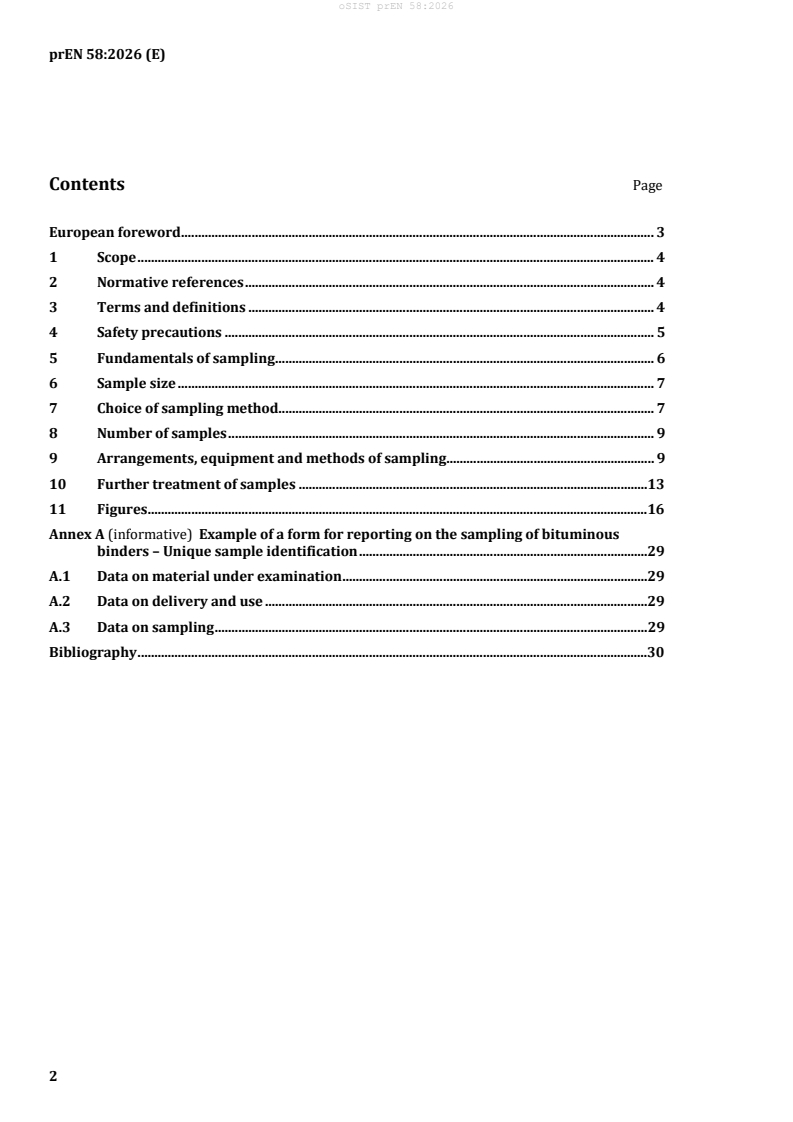
Contents Page
European foreword . 3
1 Scope . 4
2 Normative references . 4
3 Terms and definitions . 4
4 Safety precautions . 5
5 Fundamentals of sampling . 6
6 Sample size . 7
7 Choice of sampling method. 7
8 Number of samples . 9
9 Arrangements, equipment and methods of sampling . 9
10 Further treatment of samples .13
11 Figures .16
Annex A (informative) Example of a form for reporting on the sampling of bituminous
binders – Unique sample identification .29
A.1 Data on material under examination .29
A.2 Data on delivery and use .29
A.3 Data on sampling .29
Bibliography .30
oSIST prEN 58:2026
prEN 58:2026 (E)
European foreword
This document (prEN 58:2026) has been prepared by Technical Committee CEN/TC 336 “Bitumens and
bituminous binders”, the secretariat of which is held by AFNOR.
This document is currently submitted to the CEN Enquiry.
This document will supersede EN 58:2012.
prEN 58:2026 includes the following significant changes with respect to EN 58:2012:
a) in 3.9, the Note 1 to entry has been rephrased for better clarity;
b) in Clause 4 “Safety precautions”, item h) was added recommending to carry out a safety assessment
prior sampling operation and referring to product's SDS;
c) in Clause 7 “Choice of sampling method”, a safety warning has been introduced recommending to
avoid sampling in vicinity of open surfaces of liquid binder.
oSIST prEN 58:2026
prEN 58:2026 (E)
1 Scope
This document specifies methods of sampling bituminous binders, to determine the average quality of
the material under examination or to determine deviations from average quality.
2 Normative references
The following documents are referred to in the text in such a way that some or all of their content
constitutes requirements of this document. For dated references, only the edition cited applies. For
undated references, the latest edition of the referenced document (including any amendments) applies.
EN 12597, Bitumens and bituminous binders — Terminology
3 Terms and definitions
For the purposes of this document, the terms and definitions given in EN 12597 and the following apply.
ISO and IEC maintain terminology databases for use in standardization at the following addresses:
— ISO Online browsing platform: available at https://www.iso.org/obp
— IEC Electropedia: available at https://www.electropedia.org/
3.1
composite sample
sample made up by the mixing of several spot samples (3.9)
Note 1 to entry: A composite sample is regarded as a representative sample if the spot samples (3.9) are taken
according to a sampling plan that makes it probable that the composition of the composite sample approaches that
of the material as closely as possible.
3.2
divided sample
sample formed by dividing a spot (3.9), composite (3.1) or representative sample into several similar
parts by appropriate means
3.3
flowing material
material which flows in a transport pipeline or out of the drainline of a storage container
3.4
laboratory sample
sample intended for laboratory tests
Note 1 to entry: Preparation of test samples is specified in EN 12594 [1]
3.5
layer sample
upper, middle or lower layer spot sample (3.9) taken at a specific depth in a stationary material (3.10),
usually in order to detect segregation in large storage containers
oSIST prEN 58:2026
prEN 58:2026 (E)
3.6
main stream sample
sample taken from the outlet stream of a container, such that the entire cross-section of the outlet stream
is included
3.7
material under examination
entire quantity of the bituminous binder of which the properties are to be assessed
Note 1 to entry: “Material under examination” is termed simply “material” in the body of this document.
3.8
side-stream sample
sample taken from the outlet stream by means of a sampling probe
3.9
spot sample
sample, taken in a single operation at a single place and time
Note 1 to entry: If it can be assumed that the material is homogeneous, a spot sample is regarded as a
representative sample. If the material is not homogeneous, a composite sample shall be taken to ensure the sample
is representative.
3.10
stationary material
material in a storage container when all valves are closed and there is no flowing in the container
3.11
surface sample
spot sample (3.9) taken at less than 5 cm below the upper surface
3.12
test sample
sample produced by treatment or subdivision of a laboratory sample (3.4) during preparation in the
laboratory of the sample for individual tests
3.13
vertical straight-through sample
sample taken by drawing a sampling device through the total depth of the material under examination
(3.7) and thereby including all layers of the material
4 Safety precautions
The safety precautions given in this clause represent good practice and shall be applied in all cases where
they are not in conflict with local or other regulations that shall be followed.
The list of safety precautions given in this clause is not necessarily exhaustive and they should be
considered in conjunction with relevant national safety regulations or recognized safety code(s) for the
petroleum industry.
a) All regulations concerning entry into hazardous areas shall be observed rigorously.
b) Equipment shall be maintained adequately. Regular inspections of equipment should be carried out
by a competent person.
oSIST prEN 58:2026
prEN 58:2026 (E)
c) All equipment and access facilities shall be checked to ensure that they are adequate for safe working
before commencement of sampling.
d) Metallic sampling devices used in flammable atmospheres shall be constructed only from non-
ferrous metal(s).
e) Cords used as components of sampling devices shall be constructed only from vegetable fibre(s), e.g.
manilla or sisal; for emulsions, the cord used shall not absorb water from the emulsion.
NOTE Attention is drawn to the situation that, for cords made from man-made fibres, it is possible for an
operator to build up a dangerous level of electrostatic charge on his person, if he is not earthed and wearing
insulating gloves, and that certain man-made fibres can melt or dissolve in hot bitumen.
f) Precautions shall be taken to prevent the breathing of bitumen vapours during sampling operations.
g) For samples taken from the main stream, the sampling device shall be selected such that sampling
can be performed without pressure.
h) Prior to any bitumen or bituminous binder sampling operation, the hazards and risks associated with
handling the product should be assessed. This should include reference to the Safety Data Sheet (SDS)
of the product.
5 Fundamentals of sampling
5.1 Correct sampling techniques are a prerequisite to obtain meaningful test results.
5.2 The person taking the sample shall be experienced in the methods to be employed.
5.3 If the sample is to be subdivided, a suitably large representative sample shall be taken and divided
into the required number of divided samples.
5.4 A sampling report shall be prepared and signed by the person taking the sample.
The sampling report shall include:
a) the name and address of the manufacturer;
b) the name and address of the supplier (if different from manufacturer);
c) object of sampling (batch number, storage container, pipe identification);
d) the nature and type of material sampled;
e) the date and time of sampling;
f) the name of the sampler;
g) a unique identification of the sample(s);
h) the number and amount of samples;
i) the sampling method used;
j) reference to this document including its year of publication (i.e. prEN 58:2026);
oSIST prEN 58:2026
prEN 58:2026 (E)
k) any deviation, by agreement or otherwise, from the procedure specified in this document;
l) any special observations or any unusual features observed.
A prepared form shall be used for the sampling report (see example given in Annex A); a copy of the
sampling report shall be placed with each divided sample. Sampling reports shall not be put into sample
containers.
Because of the variety of materials for which the same container vehicle or storage tank can be used,
account should always be taken of possible contamination by residues, deposits or solvents. For this
reason, it is recommended to enter data in the report on the previous history of the container vehicle or
storage tank.
6 Sample size
Each divided sample should consist of at least 0,5 kg material.
NOTE The required size of a laboratory sample is dependent upon the nature and extent of the tests to be
carried out.
7 Choice of sampling method
The sampling method to be used depends upon:
a) nature, quantity and temperature of the material under examination;
b) number, type and size of the containers or cans from which the sample is to be taken;
c) whether the sample is to be taken from a stationary or a flowing material.
Arrangements, equipment and methods of sampling are described in Clause 9.
If samples shall be taken frequently from a large volume liquid material container, sampling appliances
such as sampling valves, sampling probes or three-way cocks can conveniently be installed permanently.
Otherwise, liquid test materials can be sampled by immersion techniques, for example, by weighted
sampling cans or bottom closing sampling tubes; materials fluid at low temperature can be sampled from
drums or containers of up to 2 m capacity by means of open sampling tubes. Table 1 gives an informative
guideline for sampling devices.
Very good care should be taken when taking samples of liquid bitumen or bituminous binders from open
surfaces by manual means, e.g. those described in section 9.2. An accurate hazard and risk assessment
should be carried out before any operations where exposure to emissions, e.g. H S from hot bitumen
might happen, and the appropriate working and protection measures be respected. It is recommended to
apply other means of sampling but those where manual operations are to be carried out in vicinity of
open surfaces of liquid binder.
Viscous, plastic and semi-solid material shall be sampled using tools of the kind described in 9.4, semi-
solid to brittle material by means of hand-operated tools described in 9.5 and granular material or lumps
according to 9.5 and 9.6.
Sampling from the main stream by disconnecting the pipe linking a container vehicle to a storage tank
shall not be carried out.
oSIST prEN 58:2026
prEN 58:2026 (E)
Table 1 — Sampling methods for material liquid
at either high or low temperatures in pipelines, containers or cans
Sampling from Sampling from containers of
Sampling method
pipelines capacity
3 3 3
In > 50 m > 2 m ≤ 2 m
Main Side
accordance > 800 m to to and
stream stream
3 3
with 800 m 50 m cans
sampling
9.1.2 - + - - - -
probe
Sampling
using from 9.1.3 - - + + + -
permanently sampling
9.1.4 - + - - - -
installed valve
equipment
3-way
9.1.5 + - - - - -
valve
weighted
sampling 9.2.1 - - + + + (+)
can
surface
sampling 9.2.2 - - - - + -
can
bottom
Sampling
closing
using 9.2.3 - - - (+) + +
sampling
immersion
tube
methods
open
sampling 9.2.4 - - - - - 0
tube
vertical
straight-
9.2.5 - - - - + +
through
can
Sampling
from
directly
spraying 9.3 + - - - - -
from
equipment
installations
Key
+ usable
(+) limited use
0 only usable for materials fluid at low temperature
- not applicable
oSIST prEN 58:2026
prEN 58:2026 (E)
8 Number of samples
The number of samples taken shall be dependent upon the size and form of the container and for
deliveries in cans and lumps upon the number of those in a delivery; the number of samples to be taken
from a container shall be as given for each sampling method in Clause 9.
For deliveries in cans and lumps, the number of cans or lumps from which samples are to be taken shall
conform to Table 2. Initially, one sample from each can or lump shall be tested. If this test shows deviation
from the specification, the remaining samples shall be tested.
If sampling is intended to check homogeneity (segregation) in stationary liquid material, at least three
layer samples (upper layer, middle layer and lower layer) shall be taken. They shall not be mixed to form
a composite sample.
If, in exceptional circumstances, it is desired to assess the average quality from layer samples, the
geometry of the container shall be taken into account.
Table 2 — Number of cans or lumps from which samples are to be taken
Total number of cans or lumps (n) Number of cans or lumps sampled
2 to 8 2
9 to 27 3
28 to 64 4
65 to 125 5
126 to 216 6
217 to 343 7
344 to 512 8
513 to 729 9
730 to 1 000 10
n , rounded to the nearest integer above,
over 1 000
where n is the total number of cans or lumps
9 Arrangements, equipment and methods of sampling
9.1 Sampling using permanently installed systems
9.1.1 Necessary drawing off before sampling.
Depending on the type of system (e.g. valve) used to take the sample and/or on the design of the unit (e.g.
sampling pipe) from which the material is sampled, a draw-off shall be performed to ensure that the
sample is a relevant and representative part of the material.
Each sampling point shall be assessed in order to define the minimum volume to be discarded and thus
to fulfil the requirement listed above; assessment shall be reported in an appropriate document. More
precisely, when a material draw-off is required (e.g. from a valve with dead volume, a long sampling
pipe…), the quantity/volume of material to be taken prior sampling shall be accurately evaluated.
Any drawn off material or any sample after use, may be recycled on site or elsewhere.
oSIST prEN 58:2026
prEN 58:2026 (E)
It is recommended to use valves or sampling systems with zero or minimal dead volume. With valves
having no dead volume, it is not necessary to draw off any material before sampling.
The sampling step on a running line shall be performed in accordance with all the appropriate safety and
health practices.
9.1.2 Sampling probe
If samples shall be taken from a flowing material, it is convenient to take side-stream samples using a
sampling probe installed in the delivery pipe. The sampling probe shall be installed in an upward-sloping
section of the pipe or on the pressure side of the pump, or in the case of a gravity-fed system in a
completely full section of pipe. The internal diameter of the sampling probe shall be less than 1/8 of the
internal diameter of the delivery pipe, and its opening shall be approximately central in the pipe facing
upstream. The sampling probe shall be equipped with a stop-valve. For very viscous material, it may be
advantageous to arrange for the movable parts to be totally immersed in the material. Figure 1 (for pipes
without pressure) and Figure 2 show examples of suitable arrangements; the arrangements shown in
Figures 1 and 2 shall be equipped with a protecting box in the sampling device.
Necessity to draw off material should be assessed (see 9.1.1).
If a representative sample is required, either sampling can be continuous, or spot samples can be taken
by opening the stop valve at equal time intervals throughout the period of flow.
This method is usable for flowing material. For a well mixed material, a spot sample, usually taken from
the middle third of the material, may be regarded as a representative sample. For material that is not well
mixed, a sample during the whole period of flow, or a composite sample formed from at least three spot
samples, shall be taken.
9.1.3 Sampling valve in container walls
Sampling valves in the walls of heated containers can advantageously be installed so that the movable
parts and the pipework are as far as possible within the heated material. Figure 3 shows a suitable
arrangement. For this arrangement, a simple cover shall be provided for the sampling device.
Necessity to draw off material should be assessed (see 9.1.1).
The sample shall be drawn off into a suitable clean container or bottle.
This method is suitable for all liq
...