

EN 1253-2:2015
(Main)Gullies for buildings - Part 2: Roof drains and floor gullies without trap
- Abstract
This European Standard classifies roof drains and floor gullies without trap for use inside buildings, gives guidance for places of installation and specifies requirements for the construction, design, performance and marking as well as test methods of factory made roof drains and floor gullies without trap (further: floor gullies) for buildings, irrespective of the material for use in drainage systems.
Although normally used to convey rainwater and wastewater, these roof drains and floor gullies without trap may convey other wastewater provided there is no risk of damage to components or of injury to health.
This European Standard does not apply to trapped floor gullies with a depth of water seal of at least 50 mm as specified in EN 1253 1.
- Status
- Published
- Publication Date
- 20-Jan-2015
- Technical Committee
- CEN/TC 165 - Waste water engineering
- Drafting Committee
- CEN/TC 165/WG 11 - Waste fittings
- Current Stage
- 9060 - Closure of 2 Year Review Enquiry - Review Enquiry
- Start Date
- 04-Jun-2026
- Completion Date
- 04-Jun-2026

Overview
EN 1253-2:2015 (CEN) - "Gullies for buildings - Part 2: Roof drains and floor gullies without trap" defines classification, requirements and test methods for factory-made roof drains and floor gullies without trap used inside buildings. The standard applies regardless of material and covers installation guidance, construction, design, performance, marking and conformity assessment for devices that normally convey rainwater and wastewater (and other non‑harmful wastewaters). It is part of the EN 1253 series and supersedes earlier EN 1253-1/2 editions.
Key Topics
- Product classification and terminology: definitions for roof drains, parapet drains, emergency drains, bodies, gratings, frames, extensions and outlets.
- Design & construction requirements: integration with building structure, prevention of movement that would impair function, safe surfaces and removable gratings that resist accidental dislodgement yet allow maintenance.
- Places of installation: guidance for gravity and siphonic drainage systems, roof types (untrafficked, pedestrian access, green roofs, roof gardens, parking decks).
- Watertightness & joints: compatibility with pipework standards and requirements for watertight connections and sealing.
- Materials & durability: material-neutral approach with requirements for resistance to bitumen/asphalt, climatic influences and temperature cycling.
- Mechanical strength & loading: loading and impact tests (including revised test loads and block shapes), plus rules for grating strength and test loads.
- Hydraulic performance: flow-rate testing under specified conditions for different product types.
- Grating apertures: classification of grating aperture sizes (classes H, K, L, R, M, N, P) with maximum aperture limits and a specific 8 mm maximum requirement in barefoot areas.
- Marking, documentation & conformity: marking requirements, installation instructions and links to conformity evaluation (EN 1253-3).
Applications
- Specification and selection of roof outlets, parapet drains, emergency drains and floor gullies in building projects.
- Design and detailing for roofing contractors, waterproofing installers (incl. liquid applied roof waterproofing kits and flexible waterproofing sheets), mechanical & plumbing engineers, architects and product manufacturers.
- Test laboratories and certification bodies performing watertightness, load, flow-rate and climatic tests.
- Building owners and facility managers evaluating product suitability for untrafficked roofs, pedestrian roofs, green roofs or parking decks.
Related Standards
- EN 1253-1 (trapped floor gullies)
- EN 1253-3 (evaluation of conformity)
- EN 124 (gully/manhole tops)
- EN 476 (general requirements for drain/sewer components)
Keywords: EN 1253-2:2015, gullies for buildings, roof drains, floor gullies without trap, drainage systems, flow rates, mechanical strength, waterproofing, CEN.
Relations
- Effective Date
- 08-Jun-2022
- Effective Date
- 08-Jun-2022
- Effective Date
- 28-Jan-2026
- Effective Date
- 28-Jan-2026
- Effective Date
- 28-Jan-2026
- Effective Date
- 28-Jan-2026
- Effective Date
- 28-Jan-2026
- Effective Date
- 28-Jan-2026
- Effective Date
- 28-Jan-2026
- Effective Date
- 28-Jan-2026
- Effective Date
- 28-Jan-2026
- Effective Date
- 28-Jan-2026
- Effective Date
- 28-Jan-2026
- Effective Date
- 28-Jan-2026
- Effective Date
- 28-Jan-2026
Get Certified
Connect with accredited certification bodies for this standard

DIBt (Deutsches Institut für Bautechnik)
German Institute for Building Technology.
DIN CERTCO
DIN Group product certification.

Aboma Certification B.V.
Specialized in construction, metal, and transport sectors.
Sponsored listings
Frequently Asked Questions
EN 1253-2:2015 is a standard published by the European Committee for Standardization (CEN). Its full title is "Gullies for buildings - Part 2: Roof drains and floor gullies without trap". This standard covers: This European Standard classifies roof drains and floor gullies without trap for use inside buildings, gives guidance for places of installation and specifies requirements for the construction, design, performance and marking as well as test methods of factory made roof drains and floor gullies without trap (further: floor gullies) for buildings, irrespective of the material for use in drainage systems. Although normally used to convey rainwater and wastewater, these roof drains and floor gullies without trap may convey other wastewater provided there is no risk of damage to components or of injury to health. This European Standard does not apply to trapped floor gullies with a depth of water seal of at least 50 mm as specified in EN 1253 1.
This European Standard classifies roof drains and floor gullies without trap for use inside buildings, gives guidance for places of installation and specifies requirements for the construction, design, performance and marking as well as test methods of factory made roof drains and floor gullies without trap (further: floor gullies) for buildings, irrespective of the material for use in drainage systems. Although normally used to convey rainwater and wastewater, these roof drains and floor gullies without trap may convey other wastewater provided there is no risk of damage to components or of injury to health. This European Standard does not apply to trapped floor gullies with a depth of water seal of at least 50 mm as specified in EN 1253 1.
EN 1253-2:2015 is classified under the following ICS (International Classification for Standards) categories: 91.140.80 - Drainage systems. The ICS classification helps identify the subject area and facilitates finding related standards.
EN 1253-2:2015 has the following relationships with other standards: It is inter standard links to EN 1253-1:2003, EN 1253-2:2003, EN 1253-3:2016, EN 124-1:2015, EN 124-6:2015, EN 124-3:2015, EN 124-2:2015, EN 476:2022, EN 124-5:2015, EN 124-4:2015, EN 13564-2:2002, EN 1253-4:2016, EN 13598-1:2020, EN 13564-1:2002, EN 1253-5:2003. Understanding these relationships helps ensure you are using the most current and applicable version of the standard.
EN 1253-2:2015 is available in PDF format for immediate download after purchase. The document can be added to your cart and obtained through the secure checkout process. Digital delivery ensures instant access to the complete standard document.
Standards Content (Sample)
SLOVENSKI STANDARD
01-marec-2015
Nadomešča:
SIST EN 1253-1:2003
SIST EN 1253-2:2004
Odtoki v stavbah - 2. del: Strešni vtočniki in talni odtoki brez smradne zapore
Gullies for buildings - Part 2: Roof drains and floor gullies without trap
Abläufe für Gebäude - Teil 2: Dachabläufe und Bodenabläufe ohne Geruchverschluss
Avaloirs et siphons pour bâtiments - Partie 2 : Avaloirs de toiture et avaloirs/siphons de
sol sans garde d’eau
Ta slovenski standard je istoveten z: EN 1253-2:2015
ICS:
91.140.80 Drenažni sistemi Drainage systems
2003-01.Slovenski inštitut za standardizacijo. Razmnoževanje celote ali delov tega standarda ni dovoljeno.
EUROPEAN STANDARD
EN 1253-2
NORME EUROPÉENNE
EUROPÄISCHE NORM
January 2015
ICS 91.140.80 Supersedes EN 1253-1:2003, EN 1253-2:2003
English Version
Gullies for buildings - Part 2: Roof drains and floor gullies without
trap
Avaloirs et siphons pour bâtiments - Partie 2 : Avaloirs de Abläufe für Gebäude - Teil 2: Dachabläufe und
toiture et avaloirs/siphons de sol sans garde d'eau Bodenabläufe ohne Geruchverschluss
This European Standard was approved by CEN on 22 November 2014.
CEN members are bound to comply with the CEN/CENELEC Internal Regulations which stipulate the conditions for giving this European
Standard the status of a national standard without any alteration. Up-to-date lists and bibliographical references concerning such national
standards may be obtained on application to the CEN-CENELEC Management Centre or to any CEN member.
This European Standard exists in three official versions (English, French, German). A version in any other language made by translation
under the responsibility of a CEN member into its own language and notified to the CEN-CENELEC Management Centre has the same
status as the official versions.
CEN members are the national standards bodies of Austria, Belgium, Bulgaria, Croatia, Cyprus, Czech Republic, Denmark, Estonia,
Finland, Former Yugoslav Republic of Macedonia, France, Germany, Greece, Hungary, Iceland, Ireland, Italy, Latvia, Lithuania,
Luxembourg, Malta, Netherlands, Norway, Poland, Portugal, Romania, Slovakia, Slovenia, Spain, Sweden, Switzerland, Turkey and United
Kingdom.
EUROPEAN COMMITTEE FOR STANDARDIZATION
COMITÉ EUROPÉEN DE NORMALISATION
EUROPÄISCHES KOMITEE FÜR NORMUNG
CEN-CENELEC Management Centre: Avenue Marnix 17, B-1000 Brussels
© 2015 CEN All rights of exploitation in any form and by any means reserved Ref. No. EN 1253-2:2015 E
worldwide for CEN national Members.
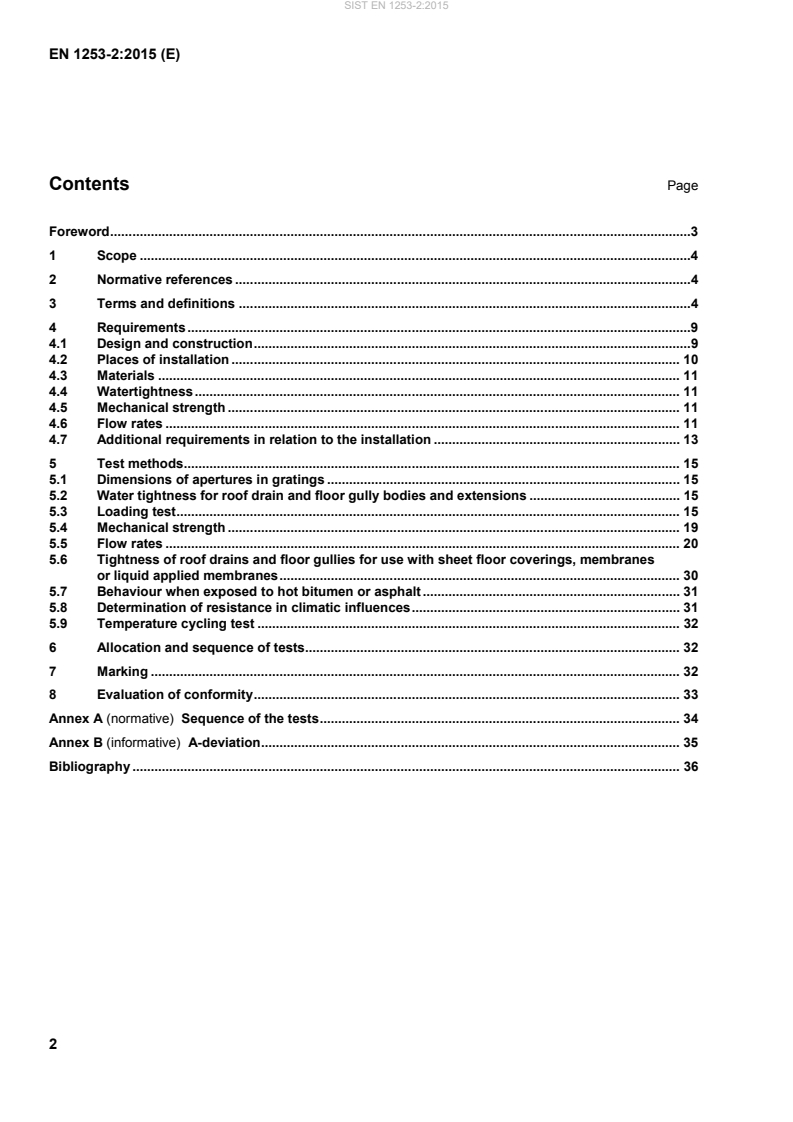
Contents Page
Foreword .3
1 Scope .4
2 Normative references .4
3 Terms and definitions .4
4 Requirements .9
4.1 Design and construction .9
4.2 Places of installation . 10
4.3 Materials . 11
4.4 Watertightness . 11
4.5 Mechanical strength . 11
4.6 Flow rates . 11
4.7 Additional requirements in relation to the installation . 13
5 Test methods . 15
5.1 Dimensions of apertures in gratings . 15
5.2 Water tightness for roof drain and floor gully bodies and extensions . 15
5.3 Loading test . 15
5.4 Mechanical strength . 19
5.5 Flow rates . 20
5.6 Tightness of roof drains and floor gullies for use with sheet floor coverings, membranes
or liquid applied membranes . 30
5.7 Behaviour when exposed to hot bitumen or asphalt . 31
5.8 Determination of resistance in climatic influences . 31
5.9 Temperature cycling test . 32
6 Allocation and sequence of tests . 32
7 Marking . 32
8 Evaluation of conformity . 33
Annex A (normative) Sequence of the tests . 34
Annex B (informative) A-deviation . 35
Bibliography . 36
Foreword
This document (EN 1253-2:2015) has been prepared by Technical Committee CEN/TC 165 “Waste water
engineering”, the secretariat of which is held by DIN.
This European Standard shall be given the status of a national standard, either by publication of an identical
text or by endorsement, at the latest by July 2015 and conflicting national standards shall be withdrawn at the
latest by July 2015.
Attention is drawn to the possibility that some of the elements of this document may be the subject of patent
rights. CEN [and/or CENELEC] shall not be held responsible for identifying any or all such patent rights.
This document, together with EN 1253-1:2015, supersedes EN 1253-1:2003 and EN 1253-2:2003.
This is the second part in EN 1253, a series of standards relating to floor gullies, roof drains and access
covers for drainage systems inside buildings. The EN 1253 series under the main title Gullies for buildings will
actually consist of the following parts:
— Part 1: Trapped floor gullies with a depth of water seal of at least 50 mm;
— Part 2: Roof drains and floor gullies without trap;
— Part 3: Evaluation of conformity;
— Part 4: Access covers;
— Part 5: Gullies with light liquids closure.
Since the latest versions of EN 1253-1 and EN 1253-2 the most significant technical changes are the
following:
a) reduction of scope on roof outlets and floor gullies without trap including parapet and emergency drains
for use in gravity and siphonic drainage systems;
b) more definitive description of products;
c) modification of terms and definitions;
d) precision in definition of places of installation;
e) consideration of liquid applied membranes as connecting components;
f) precision of test conditions for flow rate testing for different types of products;
g) revision of loading test concerning test loads, loading speed as well as shape, size and point of impact of
test blocks in dependence on different configuration of gratings;
h) introduction of classification of products concerning their temperature cycling behavior according to
number of hot/cold water cycles.
According to the CEN-CENELEC Internal Regulations, the national standards organizations of the following
countries are bound to implement this European Standard: Austria, Belgium, Bulgaria, Croatia, Cyprus, Czech
Republic, Denmark, Estonia, Finland, Former Yugoslav Republic of Macedonia, France, Germany, Greece,
Hungary, Iceland, Ireland, Italy, Latvia, Lithuania, Luxembourg, Malta, Netherlands, Norway, Poland, Portugal,
Romania, Slovakia, Slovenia, Spain, Sweden, Switzerland, Turkey and the United Kingdom.
1 Scope
This European Standard classifies roof drains and floor gullies without trap for use inside buildings, gives
guidance for places of installation and specifies requirements for the construction, design, performance and
marking as well as test methods of factory made roof drains and floor gullies without trap (further: floor gullies)
for buildings, irrespective of the material for use in drainage systems.
Although normally used to convey rainwater and wastewater, these roof drains and floor gullies without trap
may convey other wastewater provided there is no risk of damage to components or of injury to health.
This European Standard does not apply to trapped floor gullies with a depth of water seal of at least 50 mm as
specified in EN 1253-1.
2 Normative references
The following documents, in whole or in part, are normatively referenced in this document and are
indispensable for its application. For dated references, only the edition cited applies. For undated references,
the latest edition of the referenced document (including any amendments) applies.
EN 124, Gully tops and manhole tops for vehicular and pedestrian areas — Design requirements, type testing,
marking, quality control
EN 476, General requirements for components used in drains and sewers
EN 1253-3, Gullies for buildings — Part 3: Evaluation of conformity
3 Terms and definitions
For the purposes of this document, the following terms and definitions apply.
3.1
roof drain
non-trapped discharge fitting for the drainage of surface water from roof, balcony and terrace surfaces via a
rainwater connecting pipe
Note 1 to entry: See Figure 1.
Note 2 to entry: A roof drain can include an anti-vortex device.
3.2
parapet drain
roof drain for the drainage of flat roofs and roof terraces with a fascia which penetrates the fascia
Note 1 to entry: See Figure 2.
3.3
emergency drain
roof drain for emergency drainage in the form of a roof, parapet or gutter outlet with or without a rainwater
connection pipe
Key
1 grating/frame, leaf/gravel trap
2 liquid applied roof waterproofing kit or flexible sheet for waterproofing
3 extension
4 seal
5 connecting flange
6 body
7 outlet
Figure 1 — Roof drain (example)
Key
1 grating
2 body
3 connecting flange
4 liquid applied roof waterproofing kit or flexible sheet for waterproofing
5 outlet (round or rectangular)
Figure 2 — Parapet drain (example)
3.4
gravity drainage system
system where flow is caused by gravity and where the pipe normally operates partially full
3.5
siphonic drainage system
system for drainage of rainwater in which the outlets and pipework enable the system to flow completely full
under design conditions and make use of the total height available between the outlets and the point of
change to partially filled flow
3.6
head of water
depth h of a water line over the spill edge of the roof drain or floor gully as shown in Figure 3
Key
h head of water
Figure 3 — Head of water
3.7
grating
removable component with apertures which permit the discharge of water
3.8
frame
support for a grating or cover which is connected to a body either directly or by means of a flexible sheet for
waterproofing clamping ring or an extension
3.9
cover
removable part of an access cover which covers the opening
3.10
body
part of a roof drain or floor gully below or in the floor, ground or roof on which the grating/frame/extension is
mounted, and to which the pipework is connected
3.11
extension
component used to adjust the height of a grating or cover above a body
3.12
joint
connection between the adjacent ends of two components including the means of sealing
3.13
flexible sheet for waterproofing clamping ring
component used to clamp a flexible sheet for waterproofing to a body or extension
3.14
connecting flange
separate or an integral part of a body or of an extension which receives a flexible sheet for waterproofing or
the liquid applied roof waterproofing kit
3.15
external diameter
OD
mean external diameter of the pipe barrel at any cross section
3.16
internal diameter
ID
mean internal diameter of the pipe barrel at any cross section
3.17
liquid applied roof waterproofing kit
LARWK
particular combination of a defined set of components to be installed in liquid form for roof waterproofing by
application and/or incorporation and/or joining of the components in accordance with particular design
methods
Note 1 to entry: The liquid applied watertight covering is usually a paste-like composite material or a combination of
separate materials that can be poured, spread or sprayed on the subsurface by brush, roller or similar suitable applicator.
3.18
flexible sheet for waterproofing
factory made sheet for prevention of passage of water from the plane to another which can be rolled up or
folded for easy transport to the site
3.19
untrafficked roof
roof consisting of the structural deck and all the layers on it, including waterproofing, insulation and a surface
protective layer not designed for foot traffic above that required for maintenance
3.20
pedestrian access roof
roof consisting of the structural deck and all the layers on it, including waterproofing, insulation and a surface
protective layer designed for foot traffic and gathering of people greater than that required for maintenance
3.21
green roof
roof consisting of the structural deck and all the layers on it, including waterproofing, insulation and a thin layer
of growing medium planted with vegetation
3.22
roof garden
roof consisting of the structural deck and all the layers on it, including waterproofing, insulation and a
substantial layer of growing medium planted with intensive vegetation and possibly paving
3.23
parking deck
roof consisting of the structural deck and all the layers on it, including waterproofing, insulation and a surface
protective layer designed to withstand and distribute loads produced by the traffic associated with the parking
of vehicles
3.24
nominal size
DN
numerical indication of size which is a convenient integer approximately equal to the internal diameter (DN/ID)
or the external diameter (DN/OD) in millimetres
3.25
floor gully without trap
discharge fitting the top of which is a grating or cover capable of installation at ground or floor level intended to
receive wastewater through apertures in the grating
Note 1 to entry: See Figure 4.
Key
1 grating
2 outlet
3 body
Figure 4 — Floor gully without trap (typical example)
3.26
wastewater
water composed of any combination of water discharged from domestic, industrial or commercial premises,
surface run-off and accidentally any sewer infiltration water
[SOURCE: EN 16323:2014, 2.3.10.65]
3.27
surface water
water from precipitation, which has not seeped into the ground and is discharged to the drain or sewer system
directly from the ground or from exterior building surfaces
[SOURCE: EN 16323:2014, 2.1.1.3]
3.28
clear opening
CO
diameter of the largest circle that can be inscribed within the unsupported area of the grating
3.29
test load
specified load which a component is required to withstand
3.30
outlet
male or female connection to the drainage pipe
4 Requirements
4.1 Design and construction
4.1.1 General
Roof drains and floor gullies shall be capable of being connected to the pipework system covered by relevant
European Standards, and, when installed in accordance with the manufacturer's instructions, shall form an
integral part of the building. There shall be no movement possible between the roof drain or floor gully and the
floor or roof construction, which would impair the functioning of the installed roof drain or floor gully.
The upper surfaces of frame and grating shall be flush, except in untrafficked roof. When in position, it shall
not be possible for gratings and covers to be dislodged from the frame, but they shall be easy to remove for
maintenance and cleaning.
Roof drains and floor gullies shall be delivered with installation instructions.
All pipe joints to and from the roof drain or floor gully shall be designed to be watertight in accordance with
EN 476.
4.1.2 Appearance
Internal and external surfaces shall be free from sharp edges and imperfections which could impair functioning
of the gully or give risk of injury.
4.1.3 Apertures in gratings
Apertures can be holes or slots of any shape.
When measured in accordance with 5.1, the permissible aperture dimensions for gratings are given in
Table 1.
Table 1 — Apertures in gratings
Class Dimensions of apertures in gratings
Minimum width Maximum width
mm mm
b
H 1,5 4 15 (max. 8 mm in barefoot areas)
b
K 3 4 10 (max. 8 mm in barefoot areas)
a
L 15 4 15 (max. 8 mm in barefoot areas)
a
R 4 25 (max. 8 mm in barefoot areas)
a
4 25
M 125
4 25
N 250
4 25
P 400
a
In commercially used premises, gratings may also be used with a maximum width of apertures up to 31 mm.
b
Apertures of less than 4 mm width are permitted and shall not form part of the hydraulic tests.
Gratings for installation in untrafficked roof shall project not less than 30 mm above the roof covering. If the
height of any subsequent surfacing cannot be specified, the grating shall project not less than 70 mm above
the connecting surfaces.
NOTE If necessary, appropriate means can be provided to prevent the ingress of fine particles such as gravel into a
roof drain.
4.2 Places of installation
4.2.1 General
A guide for selecting the class of roof drains and floor gullies appropriate to the place of installation is given
below. The selection of the appropriate class is the responsibility of the specifier.
a) Class H 1,5: Untrafficked roof such as felt-and-gravel roofs, gravel fill roofs and similar.
b) Class K 3: Areas without vehicular traffic, such as dwellings, commercial and some public buildings.
c) Class L 15: Areas with light vehicular traffic such as in commercially used premises and public areas.
d) Class R 50: Areas with vehicular traffic, such as in commercially used premises and factories.
e) Class M 125: Areas with vehicular traffic, such as parking decks, factories and workshops.
f) Class N 250: Heavy duty industrial areas subject to fork lift traffic.
g) Class P 400: Extra-heavy duty applications where gullies are subjected to industrial fork lift trucks and/or
where heavy vehicles are manoeuvring.
Classes E 600 and F 900 gully tops conforming to EN 124 may be used for all areas subject to special
stresses such as exhibition halls, market halls, factory sheds and aircraft hangars.
4.2.2 Exceptions
Non-load bearing gratings for places of installation which are not accessible to vehicles and pedestrians
(protected by suitable masonry surroundings) and which are not covered by the places of installation listed
above nor by EN 124 shall at least conform to the test requirements given in 5.3, Class H 1,5.
4.3 Materials
Materials for roof drains shall be resistant to rainwater, UV radiation, local climatic conditions and, if required,
to hot bitumen.
Materials for floor gullies shall withstand a maximum intermittent wastewater temperature of 95 °C.
Materials shall withstand the stresses likely to occur during installation and operation.
Roof drains and floor gullies made of materials which are not inherently corrosion-resistant shall be protected
by corrosion prevention treatment.
For industrial wastewater applications, the chemical compatibility and exposure to continuous elevated
temperatures of materials with the transported fluids should be determined separately between the specifier
and the manufacturer.
4.4 Watertightness
4.4.1 Watertightness for bodies
No leaks shall occur when tested in accordance with 5.2.
4.4.2 Watertightness of joints for extensions
Where the situation dictates watertightness between extension and body (typical exception, e.g. green roofs,
inverted roofs), the joint between the extension and the body shall be watertight when tested in accordance
with 5.2.
4.5 Mechanical strength
4.5.1 Loading strength
Roof drains and floor gullies and/or gratings are classified by loading strength, when tested in accordance with
5.3, into the following classes: H 1,5, K 3, L 15, R 50, M 125, N 250, P 400.
Roof drains and floor gullies not accessible to either vehicular or foot traffic or not required to withstand
external loads are not classified.
4.5.2 Clamping ring
When tested in accordance with 5.4, the clamping ring shall not change its position and shall not show any
damage after testing that impairs function.
4.6 Flow rates
4.6.1 Floor gullies
When tested in accordance with 5.5.1, floor gullies shall be capable of discharging at flow rates given in
Table 2.
Table 2 — Minimum flow rates for floor gullies
a
Nominal size of outlet Floor gullies
(q )
grate
DN/OD DN/ID Minimum flow rate Head of water h
l/s mm
32 0,4
30 0,4
40 0,6
40 0,6
50 0,8
50 0,8
63 0,8
75 0,8
70 0,8
75 0,8
90 0,8
100 1,4
100 1,4
110 1,4
125 2,8
125 2,8
150 4,0
160 4,0
a
All dimensions not mentioned in this table shall be tested with the next higher dimension.
4.6.2 Roof drains or parapet drains
The manufacturer shall state the flow rates of the roof drains or parapet drains as a function of the head of
water in a table or a diagram. The tests shall be performed in accordance with 5.5.2 and 5.5.3 and in
accordance with the manufacturer's installation instructions. The tests are considered to be passed, if the
values given in Table 3 are met.
Parapet drains can be non-piped (spouts) or piped in the form of a drainage system.
Table 3 — Minimum flow rates for roof drains
Nominal size of roof spigot Gravity drainage Siphonic drainage
Minimum flow Minimum flow
DN/OD DN/ID Head of water h Head of water h
rate rate
l/s mm l/s mm
40 2,5
— —
40 3,0
50 4,0
0,9
50 6,0
63 1,0 7,0
1,7 12,0 55
2,6 14,0
90 3,0 18,0
4,5 22,0
7,0
45 — —
8,1
4.6.3 Roof drains and parapet drains for siphonic drainage
Roof drains and parapet drains shall be suitable for roof drainage systems intended to be operated in a fully
filled state. The flow rates and the single resistor coefficient shall be determined in accordance with 5.5.4.2
and be stated by the manufacturer.
When tested in accordance with 5.5.4, roof drains and parapet drains shall be capable of achieving the
minimum flow rates given in Table 3.
4.6.4 Coefficient of hydraulic loss
For designing a siphonic drainage system, the coefficient of hydraulic loss of the complete ready-for-use roof
drain with and without extensions shall be determined in accordance with 5.5.4.3.
4.7 Additional requirements in relation to the installation
4.7.1 Roof drains and floor gullies for use with a membrane
Roof drains and floor gullies for use with a membrane shall be fitted with a connecting flange in accordance
with Table 4.
Table 4 — Connecting flanges
Minimum effective flange width
mm
Type of seal in flange area
Connecting flange with counter-
Flange for Flange for
flange
bonding welding
a
Fixed Loose
Bitumen covering
— bonded — — 100 —
— clamped 70 60 — —
—
Membranes manufactured
from plastics or elastomers
— attached with adhesive — — 30 —
— clamped 50 40 — —
— welded on membrane — — — 50
— LARWK — — 30 —
a
This value is also applicable to gullies fitted with a skirt membrane at the manufacturer's works.
Roof drains for use with a membrane shall be fitted with a sealing flange in accordance with Table 4 and/or
with a membrane clamping ring and shall be tight when tested in accordance with 5.6.
For floor gullies where a clamping ring without weep holes is used, the connection of a flange shall be tight
when tested in accordance with 5.6.
When tested in accordance with 5.4.2, there shall be no peeling at ≤ 100 N.
4.7.2 Behaviour when exposed to hot bitumen or asphalt
Roof drains and floor gullies in direct contact with hot bitumen or poured asphalt shall be resistant up to a
temperature of (220 ± 5) °C when tested in accordance with 5.7. This requirement is considered to be met for
roof drains with factory fixed bitumen membranes and for gullies made exclusively of metal.
4.7.3 Resistance to climatic influences
Roof drains and their components shall be resistant to climatic influences. They shall be frost resistant to
−20 °C and heat resistant up to 80 °C when tested in accordance with 5.8.
4.7.4 Resistance to thermal cycling
When tested in accordance with 5.9, floor gullies and their components shall show no deformation or change
in the components' surface structure which could affect their fitness for use.
5 Test methods
5.1 Dimensions of apertures in gratings
By means of suitable measuring instruments or balls of suitable sizes in accordance with Table 1, check that
the dimensions of the apertures comply with the mi
...