

EN 12604:2017/FprA1
(Amendment)Industrial, commercial and garage doors and gates - Mechanical aspects - Requirements and test methods
- Abstract
This European Standard specifies mechanical requirements and test methods for manually operated doors, gates and barriers, intended for installation in areas in the reach of persons, and for which the main intended use is giving safe access for goods and vehicles accompanied or driven by persons in industrial, commercial or residential premises.
This European Standard also covers manually operated vertically moving commercial doors such as rolling shutters and rolling grilles, used in retail premises which are mainly provided for goods protection.
This document applies only to doors which are not part of the load carrying structure of the building.
It does not apply to
- lock gates and dock gates;
- doors on vehicles;
- doors mainly for the retention of animals unless they are at the site perimeter;
- doors intended for pedestrian use;
- railway barriers.
Whenever the term "door" is used in this document, it is deemed to cover the full scope of types and variances of doors, gates and barriers defined by the scope of this Standard.
- Status
- Not Published
- Publication Date
- 11-Apr-2021
- Withdrawal Date
- 11-Jul-2021
- Technical Committee
- CEN/TC 33 - Doors, windows, shutters and building hardware
- Drafting Committee
- CEN/TC 33/WG 5 - Industrial, commercial and garage doors and gates
- Current Stage
- 5060 - Closure of Vote - Formal Approval
- Start Date
- 08-Oct-2020
- Due Date
- 18-Nov-2020
- Completion Date
- 08-Oct-2020

Overview
EN 12604:2017 / FprA1 - Industrial, commercial and garage doors and gates: mechanical aspects - requirements and test methods (CEN) defines mechanical requirements and test methods for manually operated doors, gates and barriers installed where they are within reach of people. The standard covers a wide range of non-load-bearing products used to give safe access for goods and vehicles in industrial, commercial and residential premises, and includes vertically moving commercial doors such as rolling shutters and rolling grilles used for retail goods protection. It explicitly excludes lock/dock gates, vehicle doors, most animal-retention doors, pedestrian-only doors and railway barriers.
Key topics and technical requirements
- Scope and definitions for manually operated industrial doors, commercial doors and garage doors in reach of persons.
- Mechanical test methods and safety performance requirements relevant to door components and whole assemblies.
- Operability: amendment clarifies that where testing replaces calculation, the minimum safety factor before yield must be 1.1.
- Suspension and drive alignment: sprockets, pulleys and shaft fixings must allow and maintain correct alignment to avoid premature wear or failure; installation/maintenance information is required.
- Information for use (Clause 6):
- Health & safety instructions must be provided in paper form; other instructions may be paper or electronic.
- Safety-related instructions must appear at front of manual; minimum character height 3 mm (capital letters).
- Required content: manufacturer identification, model/type, installation and commissioning guidance (including safe gaps/distances), intended use, maintenance/cleaning, spare parts affecting safety, competent-person tasks, wearing parts, discard criteria and recommended inspection intervals (yearly inspection recommended).
- Warnings such as “Prevent children playing with the door” and guidance after anti-drop safeguarding activation.
- Package mass > 20 kg must be identified with handling recommendations.
- Marking (Clause 7): visible, legible, indelible marking with manufacturer name/address, door designation, model/type reference, serial number (if any), year of construction and temperature range if outside +5 °C to +40 °C.
- Annex C - Logbook: suggested content for a maintenance logbook including unique ID, installation details, maintenance/repairs record and responsible persons’ signatures.
Applications and users
Who uses EN 12604:2017/FprA1:
- Manufacturers and product designers for compliance-driven mechanical design and testing of doors, gates and rolling shutters.
- Test laboratories and conformity assessors applying the specified test methods.
- Installers and commissioning teams requiring installation, alignment and safety guidance.
- Facility managers, building owners and maintenance personnel using the logbook, maintenance schedules and safety information.
- Specifiers and procurement teams writing contracts and performance requirements for industrial and commercial doors.
Practical uses:
- Product development and type testing
- Installation checklists and commissioning procedures
- Maintenance programs and annual safety inspections
- Labelling, user manuals and legal compliance documentation
Related standards (CEN context)
EN 12604:2017/FprA1 is part of the CEN/TC 33 suite of standards for doors, windows and shutters. For complete compliance and system-level safety, consult other CEN standards covering electrical safety, pedestrian doors, and performance classifications.
Relations
- Effective Date
- 19-Jan-2023
- Effective Date
- 28-Jan-2026
- Effective Date
- 28-Jan-2026
- Effective Date
- 28-Jan-2026
- Effective Date
- 28-Jan-2026
- Effective Date
- 28-Jan-2026
- Effective Date
- 28-Jan-2026
- Effective Date
- 28-Jan-2026
- Effective Date
- 05-Sep-2018
Get Certified
Connect with accredited certification bodies for this standard

DIBt (Deutsches Institut für Bautechnik)
German Institute for Building Technology.
DIN CERTCO
DIN Group product certification.

Aboma Certification B.V.
Specialized in construction, metal, and transport sectors.
Sponsored listings
Frequently Asked Questions
EN 12604:2017/FprA1 is a draft published by the European Committee for Standardization (CEN). Its full title is "Industrial, commercial and garage doors and gates - Mechanical aspects - Requirements and test methods". This standard covers: This European Standard specifies mechanical requirements and test methods for manually operated doors, gates and barriers, intended for installation in areas in the reach of persons, and for which the main intended use is giving safe access for goods and vehicles accompanied or driven by persons in industrial, commercial or residential premises. This European Standard also covers manually operated vertically moving commercial doors such as rolling shutters and rolling grilles, used in retail premises which are mainly provided for goods protection. This document applies only to doors which are not part of the load carrying structure of the building. It does not apply to - lock gates and dock gates; - doors on vehicles; - doors mainly for the retention of animals unless they are at the site perimeter; - doors intended for pedestrian use; - railway barriers. Whenever the term "door" is used in this document, it is deemed to cover the full scope of types and variances of doors, gates and barriers defined by the scope of this Standard.
This European Standard specifies mechanical requirements and test methods for manually operated doors, gates and barriers, intended for installation in areas in the reach of persons, and for which the main intended use is giving safe access for goods and vehicles accompanied or driven by persons in industrial, commercial or residential premises. This European Standard also covers manually operated vertically moving commercial doors such as rolling shutters and rolling grilles, used in retail premises which are mainly provided for goods protection. This document applies only to doors which are not part of the load carrying structure of the building. It does not apply to - lock gates and dock gates; - doors on vehicles; - doors mainly for the retention of animals unless they are at the site perimeter; - doors intended for pedestrian use; - railway barriers. Whenever the term "door" is used in this document, it is deemed to cover the full scope of types and variances of doors, gates and barriers defined by the scope of this Standard.
EN 12604:2017/FprA1 is classified under the following ICS (International Classification for Standards) categories: 91.060.50 - Doors and windows. The ICS classification helps identify the subject area and facilitates finding related standards.
EN 12604:2017/FprA1 has the following relationships with other standards: It is inter standard links to EN 12604:2017+A1:2020, EN ISO 8028:2018, EN ISO 18752:2022, EN ISO 3949:2018, EN ISO 6802:2018, EN ISO 18752:2025, EN ISO 3949:2020, EN ISO 8028:2024, EN 12604:2017. Understanding these relationships helps ensure you are using the most current and applicable version of the standard.
EN 12604:2017/FprA1 is available in PDF format for immediate download after purchase. The document can be added to your cart and obtained through the secure checkout process. Digital delivery ensures instant access to the complete standard document.
Standards Content (Sample)
SLOVENSKI STANDARD
01-september-2019
Vrata v industrijske in javne prostore ter garažna vrata - Mehanske lastnosti -
Zahteve in preskusne metode
Industrial, commercial and garage doors and gates - Mechanical aspects - Requirements
and test methods
Tore - Mechanische Aspekte - Anforderungen und Prüfverfahren
Portes et portails industriels, commerciaux et résidentiels - Aspects mécaniques -
Exigences et méthodes d'essai
Ta slovenski standard je istoveten z: EN 12604:2017/prA1
ICS:
91.060.50 Vrata in okna Doors and windows
91.090 Konstrukcije zunaj stavb External structures
2003-01.Slovenski inštitut za standardizacijo. Razmnoževanje celote ali delov tega standarda ni dovoljeno.
DRAFT
EUROPEAN STANDARD
EN 12604:2017
NORME EUROPÉENNE
EUROPÄISCHE NORM
prA1
June 2019
ICS 91.060.50
English Version
Industrial, commercial and garage doors and gates -
Mechanical aspects - Requirements and test methods
Portes et portails industriels, commerciaux et Tore - Mechanische Aspekte - Anforderungen und
résidentiels - Aspects mécaniques - Exigences et Prüfverfahren
méthodes d'essai
This draft amendment is submitted to CEN members for enquiry. It has been drawn up by the Technical Committee CEN/TC 33.
This draft amendment A1, if approved, will modify the European Standard EN 12604:2017. If this draft becomes an amendment,
CEN members are bound to comply with the CEN/CENELEC Internal Regulations which stipulate the conditions for inclusion of
this amendment into the relevant national standard without any alteration.
This draft amendment was established by CEN in three official versions (English, French, German). A version in any other
language made by translation under the responsibility of a CEN member into its own language and notified to the CEN-CENELEC
Management Centre has the same status as the official versions.
CEN members are the national standards bodies of Austria, Belgium, Bulgaria, Croatia, Cyprus, Czech Republic, Denmark, Estonia,
Finland, Former Yugoslav Republic of Macedonia, France, Germany, Greece, Hungary, Iceland, Ireland, Italy, Latvia, Lithuania,
Luxembourg, Malta, Netherlands, Norway, Poland, Portugal, Romania, Serbia, Slovakia, Slovenia, Spain, Sweden, Switzerland,
Turkey and United Kingdom.
Recipients of this draft are invited to submit, with their comments, notification of any relevant patent rights of which they are
aware and to provide supporting documentation.
Warning : This document is not a European Standard. It is distributed for review and comments. It is subject to change without
notice and shall not be referred to as a European Standard.
EUROPEAN COMMITTEE FOR STANDARDIZATION
COMITÉ EUROPÉEN DE NORMALISATION
EUROPÄISCHES KOMITEE FÜR NORMUNG
CEN-CENELEC Management Centre: Rue de la Science 23, B-1040 Brussels
© 2019 CEN All rights of exploitation in any form and by any means reserved Ref. No. EN 12604:2017/prA1:2019 E
worldwide for CEN national Members.
EN 12604:2017/prA1:2019 (E)
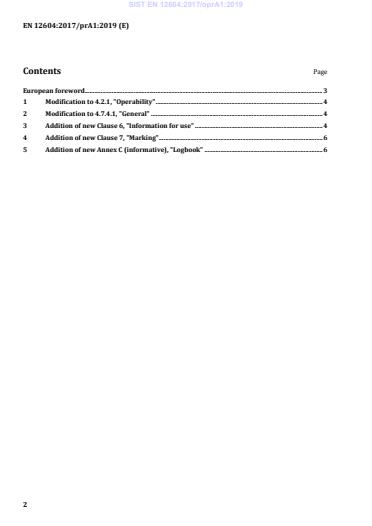
Contents Page
European foreword . 3
1 Modification to 4.2.1, "Operability" . 4
2 Modification to 4.7.4.1, "General" . 4
3 Addition of new Clause 6, "Information for use" . 4
4 Addition of new Clause 7, "Marking" . 6
5 Addition of new Annex C (informative), "Logbook" . 6
EN 12604:2017/prA1:2019 (E)
European foreword
This document (EN 12604:2017/prA1:2019) has been prepared by Technical Committee CEN/TC 33
“Doors, windows, shutters, building hardware and curtain walling”, the secretariat of which is held by
AFNOR.
This document is currently submitted to the CEN Enquiry.
EN 12604:2017/prA1:2019 (E)
1 Modification to 4.2.1, "Operability"
In the third paragraph, replace:
"For components where testing is carried out instead of calculation the safety factor shall be 1,1."
with
"For components where testing is carried out instead of calculation the minimum safety factor before
yield shall be 1,1.".
2 Modification to 4.7.4.1, "General"
Add the following text at the beginning of 4.7.4.1:
"Where necessary for safety (e.g. to avoid excess wear and premature failure of means of suspension)
means shall provide for, and the maintenance of, the correct alignment of sprockets and pulleys with
their associated chains, rope or straps. This shall include the security of fixings to shafts on which
sprockets and pulleys are mounted, and means necessary to prevent lateral displacement of t
...