


EN 1988-2:1998
(Main)Foodstuffs - Determination of sulfite - Part 2: Enzymatic method
Foodstuffs - Determination of sulfite - Part 2: Enzymatic method
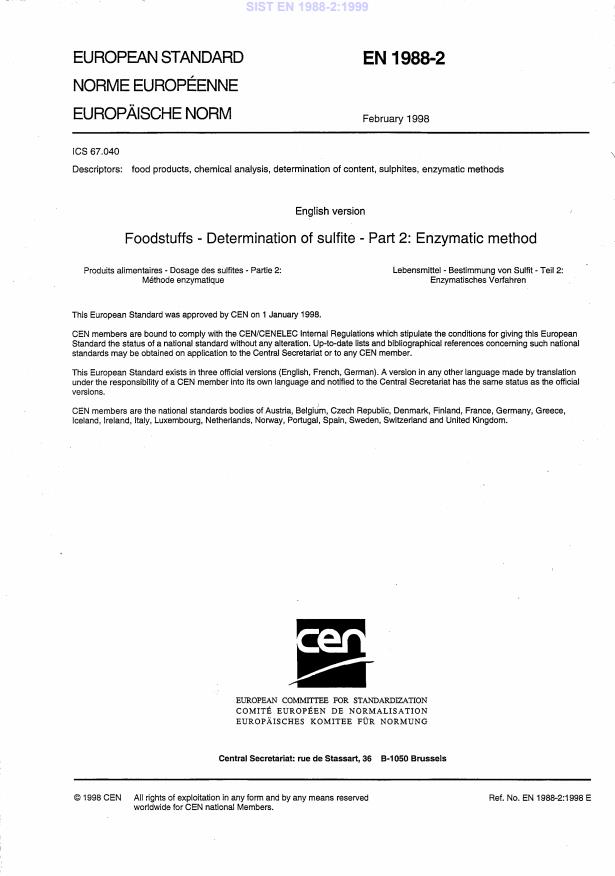
This European Standard specifies an enzymatic method for the determination of the sulfite content, expressed as sulfur dioxide, in foodstuffs. Other sulfur-containing substances such as sulfate, sulfide or thiosulfate do not interfere with the determination. Carbonyl-sulfite complexes react as free sulfites. Isothiocyanates occuring in, e.g. mustard interfere with the determination. The method is not applicable to cabbages, dried garlic, dried onions, ginger, leeks and soy protein.
Lebensmittel - Bestimmung von Sulfit - Teil 2: Enzymatisches Verfahren
Diese Europäische Norm legt ein enzymatisches Verfahren zur Bestimmung von Sulfit (ausgedrückt in Schwefeldioxid) in Lebensmittel fest. Andere schwefelhaltige Substanzen wie Sulfate, Sulfide oder Thiosulfate stören die Bestimmung nicht. Carbonylsulfitkomplexe reagieren wie freies Sulfit. Isothiocyanate, die z.B. in Senf vorkommen, stören die Bestimmung von Sulfit. Das Verfahren ist nicht anwendbar auf Kohl, getrockneten Knoblauch, getrocknete Zwiebeln, Ingwer, Lauch und Sojaproteine.
Produits alimentaires - Dosage des sulfites - Partie 2: Méthode enzymatique
La présente partie de norme spécifie une méthode enzymatique permettant de déterminer la concentration en sulfites, exprimée en dioxyde de soufre, des produits alimentaires. D'autres substances contenant du soufre, tels que des sulfates, des sulfures ou des hyposulfites, n'interfèrent pas dans l'analyse. Les complexes carbonyl-sulfites réagissent comme des sulfites libres. Les isothiocyanates, qui se forment par exemple dans la moutarde, perturbent l'analyse pour le dosage des sulfites. La méthode n'est pas applicable à l'ail séché, aux oignons séchés, au gingembre, aux protéines de soja, aux poireaux.
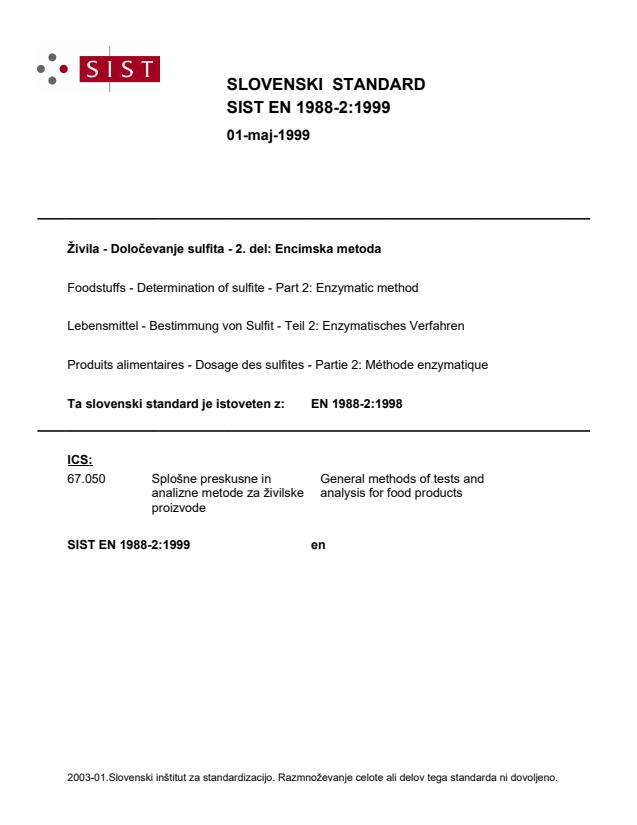
Živila - Določevanje sulfita - 2. del: Encimska metoda
General Information
- Status
- Published
- Publication Date
- 17-Feb-1998
- Withdrawal Date
- 30-Aug-1998
- Technical Committee
- CEN/TC 275 - Food analysis - Horizontal methods
- Drafting Committee
- CEN/TC 275 - Food analysis - Horizontal methods
- Current Stage
- 9093 - Decision to confirm - Review Enquiry
- Start Date
- 09-Nov-2023
- Completion Date
- 14-Apr-2025
Overview
EN 1988-2:1998 - Foodstuffs: Determination of sulfite - Part 2: Enzymatic method is a European Standard published by CEN that specifies an enzymatic analytical procedure for measuring sulfite levels in food. Results are reported expressed as sulfur dioxide (SO2). The standard defines the intended scope, key interferences, and cases where the enzymatic method is not applicable.
Key topics and requirements
- Measurement principle: An enzymatic method for the quantitative determination of sulfite in foodstuffs (results as SO2).
- Reporting unit: Sulfite content expressed as sulfur dioxide.
- Selectivity / interferences:
- Non-interfering substances: Other sulfur-containing compounds such as sulfate, sulfide and thiosulfate do not interfere with the enzymatic determination.
- Reactive forms: Carbonyl–sulfite complexes are measured as free sulfites by this method (they react back to form detectable sulfite).
- Known interferent: Isothiocyanates (for example, compounds occurring in mustard) interfere with the enzymatic assay and may bias results.
- Limitations / exclusions: The method is not applicable to certain matrices including cabbages, dried garlic, dried onions, ginger, leeks and soy protein-these foods require alternative validated methods.
- Scope definition: Applies to general foodstuffs where enzymatic sulfite determination is appropriate and validated.
Applications
- Routine food safety testing and quality control to monitor sulfite preservative levels in processed foods and beverages.
- Regulatory compliance testing where sulfite content must be declared or controlled according to regional food laws.
- Supplier/industry QC for manufacturers using sulfiting agents or controlling residual sulfite in products.
- Laboratory method selection: used to decide if enzymatic analysis is suitable for a particular food matrix, given the specified interferences and exclusions.
Who should use EN 1988-2:1998
- Accredited food testing laboratories and analytical chemists.
- Food manufacturers and ingredient suppliers performing in-house quality control.
- Regulatory agencies and inspection bodies that assess sulfite/sulfur dioxide levels.
- Researchers validating or comparing analytical methods for sulfur-containing compounds in foods.
Related standards
- Other parts of the EN 1988 series and CEN/ISO standards covering sulfite/sulfur dioxide determination and general analytical methods for food products.
- National or regional testing protocols that reference CEN enzymatic procedures.
Keywords: EN 1988-2:1998, sulfite determination, enzymatic method, foodstuffs, sulfur dioxide, sulfite testing, food analysis, sulfite interference.

Frequently Asked Questions
EN 1988-2:1998 is a standard published by the European Committee for Standardization (CEN). Its full title is "Foodstuffs - Determination of sulfite - Part 2: Enzymatic method". This standard covers: This European Standard specifies an enzymatic method for the determination of the sulfite content, expressed as sulfur dioxide, in foodstuffs. Other sulfur-containing substances such as sulfate, sulfide or thiosulfate do not interfere with the determination. Carbonyl-sulfite complexes react as free sulfites. Isothiocyanates occuring in, e.g. mustard interfere with the determination. The method is not applicable to cabbages, dried garlic, dried onions, ginger, leeks and soy protein.
This European Standard specifies an enzymatic method for the determination of the sulfite content, expressed as sulfur dioxide, in foodstuffs. Other sulfur-containing substances such as sulfate, sulfide or thiosulfate do not interfere with the determination. Carbonyl-sulfite complexes react as free sulfites. Isothiocyanates occuring in, e.g. mustard interfere with the determination. The method is not applicable to cabbages, dried garlic, dried onions, ginger, leeks and soy protein.
EN 1988-2:1998 is classified under the following ICS (International Classification for Standards) categories: 67.040 - Food products in general. The ICS classification helps identify the subject area and facilitates finding related standards.
You can purchase EN 1988-2:1998 directly from iTeh Standards. The document is available in PDF format and is delivered instantly after payment. Add the standard to your cart and complete the secure checkout process. iTeh Standards is an authorized distributor of CEN standards.
Standards Content (Sample)
2003-01.Slovenski inštitut za standardizacijo. Razmnoževanje celote ali delov tega standarda ni dovoljeno.Lebensmittel - Bestimmung von Sulfit - Teil 2: Enzymatisches VerfahrenProduits alimentaires - Dosage des sulfites - Partie 2: Méthode enzymatiqueFoodstuffs - Determination of sulfite - Part 2: Enzymatic method67.050Splošne preskusne in analizne metode za živilske proizvodeGeneral methods of tests
...
The EN 1988-2:1998 standard provides a thorough framework for the enzymatic determination of sulfite content in foodstuffs, expressed as sulfur dioxide. Its scope is well-defined, ensuring that users understand the specific applications and limitations of the method. The standard explicitly mentions that it is designed to accurately measure sulfite levels without interference from other sulfur-containing substances like sulfates, sulfides, or thiosulfates, which is a considerable strength in its methodological approach. This specificity helps in ensuring reliable results in various food analytical practices. Moreover, the standard identifies potential interferences that should be taken into account during testing, such as isothiocyanates found in mustard, which adds to the robustness of the enzymatic method by preemptively addressing variables that could affect accuracy. The clear exclusions of certain food items-cabbages, dried garlic, dried onions, ginger, leeks, and soy protein-from the applicability of this method also enhance its integrity, guiding users toward alternative methods for those particular products. The relevance of EN 1988-2:1998 extends to its alignment with food safety regulations and quality assurance protocols. By providing a reliable, enzymatic method for sulfite determination, it supports food manufacturers and regulatory bodies in monitoring sulfite levels, thereby ensuring consumer safety. This standard plays a crucial role in the food industry, especially considering that sulfites are commonly used as preservatives, which necessitates accurate measurements to prevent potential health risks to sensitive individuals. Overall, the EN 1988-2:1998 standard stands out due to its precise and practical scope, its clear guidelines regarding potential interferences, and its important role in ensuring food safety through reliable sulfite determination in foodstuffs.
EN 1988-2:1998は、食品中の亜硫酸塩の含有量を硫黄二酸化物として定量するための酵素法を規定したヨーロッパ標準です。この標準は、亜硫酸塩の正確な評価を可能にする明確で詳細な手順を提供しており、食品業界や品質管理において非常に重要な役割を果たします。 この標準の範囲は、食品における亜硫酸塩の分析に特化しており、硫酸塩、硫化物、チオ硫酸塩などの他の硫黄含有物質が妨害しないことを明言しています。これにより、亜硫酸塩の定量に対する信頼性が高まります。特に、カーボニル-亜硫酸塩複合体が自由な亜硫酸塩と反応することが示されている点も、実用性の面で優れています。 一方で、マスタードに存在するイソチオシアネートが定量に干渉する可能性があり、注意が必要です。また、キャベツ、乾燥ニンニク、乾燥玉ねぎ、生姜、リーキ、大豆プロテインにはこの方法が適用できないため、特定の食品群においては他の分析手法を検討する必要があります。 全体として、EN 1988-2:1998は、食品中の亜硫酸塩の酵素法による定量を行うための信頼性の高い導き手となり、業界全体における品質と安全性の向上に寄与する標準として非常に関連性が高いと言えます。
SIST EN 1988-2:1999 표준은 식품에서 아황산염을 측정하는 효소적 방법을 명확히 규정하고 있습니다. 이 표준의 범위는 식품에서 아황산의 함량을 정량적으로 측정하는 데 중점을 두며, 그 결과는 아황산이산화물(SO₂)로 표현됩니다. 이 표준의 중요한 강점 중 하나는 아황산염 측정 시 다른 황 함유 물질인 황산염, 황화물 및 티오황산염이 방해되지 않는다는 점입니다. 또한, 탄소일-아황산염 복합체는 자유 아황산염으로 반응하여 정확한 측정을 가능하게 합니다. 그러나 겨자에 포함된 이소티오시아네이트와 같은 특정 물질은 측정에 간섭할 수 있으므로, 이 표준 사용 시 주의가 필요합니다. 또한, 이 효소적 방법은 특정 식품에 적용되지 않음을 명시하고 있습니다. 예를 들어, 양배추, 건조 마늘, 건조 양파, 생강, 리크 및 대두 단백질과 같은 식품에서는 이 방법을 사용하는 것이 적합하지 않습니다. 이러한 정보는 사용자가 표준을 올바르게 이해하고 적용하는 데 큰 도움이 됩니다. 결론적으로, SIST EN 1988-2:1999 표준은 식품에서 아황산염을 정확하고 신뢰성 있게 측정할 수 있는 효소적 방법을 제공하여, 식품 안전성을 높이는 데 중요한 역할을 하고 있습니다.
Questions, Comments and Discussion
Ask us and Technical Secretary will try to provide an answer. You can facilitate discussion about the standard in here.
Loading comments...