


EN 13565-2:2018+AC:2019/prA1
(Amendment)Fixed firefighting systems - Foam systems - Part 2: Design, construction and maintenance
Fixed firefighting systems - Foam systems - Part 2: Design, construction and maintenance
This document specifies the requirements and describes the methods for design, installation, testing and maintenance of low, medium, and high expansion foam fire extinguishing systems.
Foam systems may be used to suppress the release of toxic vapours but this application is outside the scope of this document.
This document provides guidance for the design of various foam systems available to persons with knowledge and experience in determining the selection of foam fire extinguishing systems which will be effective in protecting specific hazard configurations. For the application of this standard, a risk assessment by a qualified and experienced person should be performed for both new and existing systems, however the risk assessment is outside the scope of this document.
This document does not cover a risk analysis carried out by a competent person.
Nothing in this document is intended to restrict new technologies or alternative arrangements, provided that the level of foam system performance prescribed in this standard is not lowered, and supported by documented evidence/test reports.
All foam systems are generally unsuitable for the following:
- chemicals, such as cellulose nitrate, that release sufficient oxygen or other oxidizing agents which can sustain combustion;
- energized unenclosed electrical equipment;
- metals such as sodium, potassium and sodium-potassium alloys which are reactive to water;
- hazardous, water-reactive materials such as triethyl-aluminium and phosphorous pentoxide;
- combustible metals such as aluminium and magnesium.
Ortsfeste Brandbekämpfungsanlagen - Schaumlöschanlagen - Teil 2: Planung, Einbau und Wartung
Installations fixes de lutte contre l’incendie - Systèmes à émulseurs - Partie 2 : Calcul, installation et maintenance - Amendement 1
Vgrajeni gasilni sistemi - Sistemi za gašenje s peno - 2. del: Načrtovanje, izvedba in vzdrževanje - Dopolnilo A1
General Information
- Status
- Not Published
- Publication Date
- 24-Jun-2026
- Technical Committee
- CEN/TC 191 - Fixed firefighting systems
- Drafting Committee
- CEN/TC 191/WG 2 - Foam extinguishing systems
- Current Stage
- 4599 - Dispatch of FV draft to CMC - Finalization for Vote
- Start Date
- 11-Dec-2025
- Due Date
- 13-Jan-2025
- Completion Date
- 11-Dec-2025
Relations
- Effective Date
- 12-Apr-2023
Overview
EN 13565-2:2018+AC:2019/prA1 (CEN) covers the design, construction and maintenance of fixed foam firefighting systems. It applies to low-, medium- and high‑expansion foam systems used to control and extinguish flammable liquid fires. The amendment (prA1) updates application rates, correction factors and test/design guidance - including specific provisions for non‑fluorinated (F3) foam concentrates - and clarifies test standards and system performance requirements. The document excludes risk assessments, toxic‑vapour suppression applications, and certain incompatible fuels and materials (e.g. reactive metals, energized unenclosed electrical equipment, cellulose nitrate).
Key topics and technical requirements
- Scope and exclusions: Specifies where foam systems are appropriate and lists materials/hazards for which foam is generally unsuitable.
- Design rates and formulae: Introduces a formula for non‑fluorinated foams (q = qdr × fo × fh) and provides guidance on deriving design rates from test data.
- Non‑fluorinated foam (F3) guidance: Requires system design to reference fire test data (VdS 3896, UL 162, FM 5130). For UL 162–based designs a 60% higher design rate is required compared with test rates; VdS and FM-based designs use the test rate.
- Updated tables and correction factors: Amendments replace tables for correction factors (other hazards, aircraft hangars) and include test/design rate tables for F3 agents, expansion ratios and minimum design rates.
- System components and testing: Covers closed‑head sprinklers, open sprayers, monitors, pourers, deluge systems and foam generators; mandates that discharge devices be tested in combination with the specific foam solution.
- Performance and alternative solutions: New technologies and alternative arrangements are permitted provided they achieve at least the same level of performance and are supported by documented evidence or test reports.
- Maintenance and testing: Specifies installation, commissioning, operational testing and periodic maintenance requirements to ensure system readiness (detailed procedures remain in the standard).
Applications and users
- Typical applications: tank farms, bunded/diked areas, process and fuel‑handling areas, aircraft hangars, flammable liquid stores, tyre/packaging storage, recycling facilities.
- Primary users: fire protection engineers, system designers, installers, maintenance contractors, facility safety managers, manufacturers, testing laboratories and authorities having jurisdiction.
- Practical value: Ensures repeatable, tested performance of foam systems; informs selection of foam concentrates and discharge devices; supports regulatory compliance and safety planning.
Related standards & test references
- EN 1568 series (foam concentrate classification)
- UL 162, FM 5130, VdS 3896 (fire test procedures and listings)
- EN 13565-2 amendment prA1 (2025) - updates correction factors, design tables and non‑fluorinated foam guidance
Keywords: EN 13565-2, foam systems, fixed firefighting systems, design rates, F3 non‑fluorinated foam, UL 162, FM 5130, VdS 3896, aircraft hangars, foam system maintenance.

Frequently Asked Questions
EN 13565-2:2018+AC:2019/prA1 is a draft published by the European Committee for Standardization (CEN). Its full title is "Fixed firefighting systems - Foam systems - Part 2: Design, construction and maintenance". This standard covers: This document specifies the requirements and describes the methods for design, installation, testing and maintenance of low, medium, and high expansion foam fire extinguishing systems. Foam systems may be used to suppress the release of toxic vapours but this application is outside the scope of this document. This document provides guidance for the design of various foam systems available to persons with knowledge and experience in determining the selection of foam fire extinguishing systems which will be effective in protecting specific hazard configurations. For the application of this standard, a risk assessment by a qualified and experienced person should be performed for both new and existing systems, however the risk assessment is outside the scope of this document. This document does not cover a risk analysis carried out by a competent person. Nothing in this document is intended to restrict new technologies or alternative arrangements, provided that the level of foam system performance prescribed in this standard is not lowered, and supported by documented evidence/test reports. All foam systems are generally unsuitable for the following: - chemicals, such as cellulose nitrate, that release sufficient oxygen or other oxidizing agents which can sustain combustion; - energized unenclosed electrical equipment; - metals such as sodium, potassium and sodium-potassium alloys which are reactive to water; - hazardous, water-reactive materials such as triethyl-aluminium and phosphorous pentoxide; - combustible metals such as aluminium and magnesium.
This document specifies the requirements and describes the methods for design, installation, testing and maintenance of low, medium, and high expansion foam fire extinguishing systems. Foam systems may be used to suppress the release of toxic vapours but this application is outside the scope of this document. This document provides guidance for the design of various foam systems available to persons with knowledge and experience in determining the selection of foam fire extinguishing systems which will be effective in protecting specific hazard configurations. For the application of this standard, a risk assessment by a qualified and experienced person should be performed for both new and existing systems, however the risk assessment is outside the scope of this document. This document does not cover a risk analysis carried out by a competent person. Nothing in this document is intended to restrict new technologies or alternative arrangements, provided that the level of foam system performance prescribed in this standard is not lowered, and supported by documented evidence/test reports. All foam systems are generally unsuitable for the following: - chemicals, such as cellulose nitrate, that release sufficient oxygen or other oxidizing agents which can sustain combustion; - energized unenclosed electrical equipment; - metals such as sodium, potassium and sodium-potassium alloys which are reactive to water; - hazardous, water-reactive materials such as triethyl-aluminium and phosphorous pentoxide; - combustible metals such as aluminium and magnesium.
EN 13565-2:2018+AC:2019/prA1 is classified under the following ICS (International Classification for Standards) categories: 13.220.20 - Fire protection. The ICS classification helps identify the subject area and facilitates finding related standards.
EN 13565-2:2018+AC:2019/prA1 has the following relationships with other standards: It is inter standard links to EN 13565-2:2018+AC:2019. Understanding these relationships helps ensure you are using the most current and applicable version of the standard.
EN 13565-2:2018+AC:2019/prA1 is available in PDF format for immediate download after purchase. The document can be added to your cart and obtained through the secure checkout process. Digital delivery ensures instant access to the complete standard document.
Standards Content (Sample)
SLOVENSKI STANDARD
01-marec-2025
Vgrajeni gasilni sistemi - Sistemi za gašenje s peno - 2. del: Načrtovanje, izvedba
in vzdrževanje - Dopolnilo A1
Fixed firefighting systems - Foam systems - Part 2: Design, construction and
maintenance
Ortsfeste Brandbekämpfungsanlagen - Schaumlöschanlagen - Teil 2: Planung, Einbau
und Wartung
Installations fixes de lutte contre l’incendie - Systèmes à émulseurs - Partie 2 : Calcul,
installation et maintenance - Amendement 1
Ta slovenski standard je istoveten z: EN 13565-2:2018+AC:2019/prA1
ICS:
13.220.10 Gašenje požara Fire-fighting
SIST EN 13565- en,fr,de
2:2018+AC:2019/oprA1:2025
2003-01.Slovenski inštitut za standardizacijo. Razmnoževanje celote ali delov tega standarda ni dovoljeno.
DRAFT
EUROPEAN STANDARD
EN 13565-2:2018+AC:2019
NORME EUROPÉENNE
EUROPÄISCHE NORM
prA1
January 2025
ICS 13.220.20
English Version
Fixed firefighting systems - Foam systems - Part 2: Design,
construction and maintenance
Installations fixes de lutte contre l'incendie - Systèmes Ortsfeste Brandbekämpfungsanlagen -
à émulseurs - Partie 2 : Calcul, installation et Schaumlöschanlagen - Teil 2: Planung, Einbau und
maintenance Wartung
This draft amendment is submitted to CEN members for enquiry. It has been drawn up by the Technical Committee CEN/TC 191.
This draft amendment A1, if approved, will modify the European Standard EN 13565-2:2018+AC:2019. If this draft becomes an
amendment, CEN members are bound to comply with the CEN/CENELEC Internal Regulations which stipulate the conditions for
inclusion of this amendment into the relevant national standard without any alteration.
This draft amendment was established by CEN in three official versions (English, French, German). A version in any other
language made by translation under the responsibility of a CEN member into its own language and notified to the CEN-CENELEC
Management Centre has the same status as the official versions.
CEN members are the national standards bodies of Austria, Belgium, Bulgaria, Croatia, Cyprus, Czech Republic, Denmark, Estonia,
Finland, France, Germany, Greece, Hungary, Iceland, Ireland, Italy, Latvia, Lithuania, Luxembourg, Malta, Netherlands, Norway,
Poland, Portugal, Republic of North Macedonia, Romania, Serbia, Slovakia, Slovenia, Spain, Sweden, Switzerland, Türkiye and
United Kingdom.
Recipients of this draft are invited to submit, with their comments, notification of any relevant patent rights of which they are
aware and to provide supporting documentation.
Warning : This document is not a European Standard. It is distributed for review and comments. It is subject to change without
notice and shall not be referred to as a European Standard.
EUROPEAN COMMITTEE FOR STANDARDIZATION
COMITÉ EUROPÉEN DE NORMALISATIO N
EUROPÄISCHES KOMITEE FÜR NORMUN G
CEN-CENELEC Management Centre: Rue de la Science 23, B-1040 Brussels
© 2025 CEN All rights of exploitation in any form and by any means reserved Ref. No. EN 13565-2:2018+AC:2019/prA1:2025
worldwide for CEN national Members. E
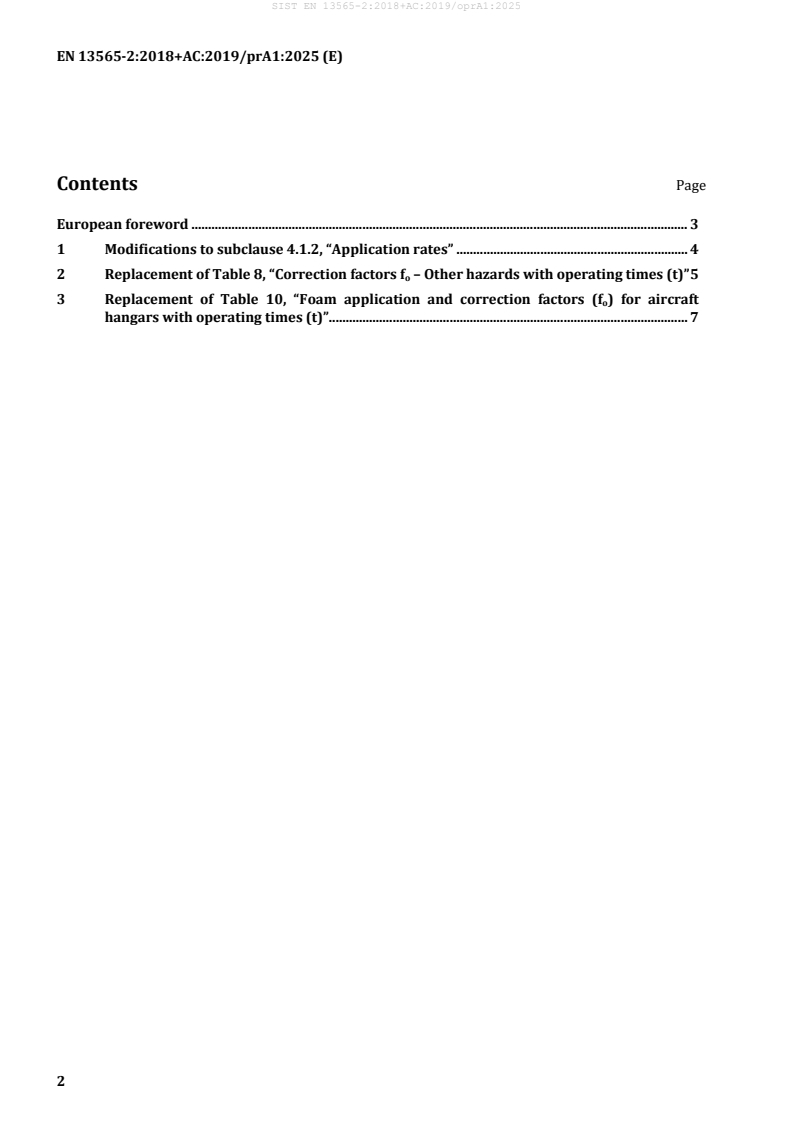
Contents Page
European foreword . 3
1 Modifications to subclause 4.1.2, “Application rates” . 4
2 Replacement of Table 8, “Correction factors f – Other hazards with operating times (t)” 5
o
3 Replacement of Table 10, “Foam application and correction factors (f ) for aircraft
o
hangars with operating times (t)”. 7
European foreword
This document (EN 13565-2:2018+AC:2019/prA1:2025) has been prepared by Technical Committee
CEN/TC 191 “Fixed firefighting systems”, the secretariat of which is held by BSI.
This document is currently submitted to the CEN Enquiry.
1 Modifications to subclause 4.1.2, “Application rates”
Add the following below Formula (1) and renumber the subsequent formulae:
“Where non-fluorinated foam concentrate (“F3” according to EN 1568-3 and EN 1568-4) is to be used the
application rates for low and medium expansion foam shall be calculated as follows:
q = qdr x fo x fh (2)
where
q design rate (see design rates non-fluorinated foams, Tables 3 and 5)”
dr
Add the following below Table 2:
“Design rates non-fluorinated foams
Where non-fluorinated foam concentrate is to be used for flammable liquid protection in:
1) closed head sprinklers and open sprayers (air-aspirating or non-air-aspirating type) these shall be
tested in combination with the specific foam solution to protect the risk. VdS 3896 (2022)
paragraphs 5.3.1, UL 162 (2022) paragraph 11 or FM 5130 (May 2021) paragraph 4.22 test
procedures shall be used to prove the system's performance. For systems designed using test data
from UL 162 the design rate shall be 60% higher than used in the test, while for VdS 3896 and FM
5130 the design rate shall equal that used in the test. Design rates can be taken from VdS certificate
or UL/FM listing.
NOTE 1 For a given foam generating device F3 foam agents can respond to changing pressure with a
reduction of foam quality in both directions of pressure change.
2) all other discharge devices than 1) shall be tested in combination with the specific foam solution to
protect the risk. The expansion ratio of the foam discharge device shall be same or higher than used
in the fire test. An appropriate test procedure can be found in UL 162 (2022) paragraph 12 or FM
5130 where Table 3 shall be applied to define the design rate q . The design rates q can be taken
dr dr
...
Questions, Comments and Discussion
Ask us and Technical Secretary will try to provide an answer. You can facilitate discussion about the standard in here.
Loading comments...