

EN 302-2:2023
(Main)Adhesives for load-bearing timber structures - Test methods - Part 2: Determination of resistance to delamination
General Information
- Abstract
This document specifies a method for determining the resistance to delamination in glue lines.
It is applicable to the following applications:
a) for assessing the compliance of adhesives with EN 301, EN 15425, EN 16254, EN 17334 and EN 17418;
b) for assessing the suitability and quality of adhesives for load-bearing timber structures;
c) for comparing the effects on the bond strength resulting from the choice of bonding conditions, from different climatic conditioning and from the treatment of the test pieces before and after bonding.
This test does not apply to modified and stabilized wood with strongly reduced swelling and shrinkage properties, such as acetylated wood, heat-treated wood and polymer impregnated wood.
This test is intended primarily to obtain performance data for the classification of adhesives for load-bearing timber structures according to their suitability for use in defined climatic environments.
This method is not intended to provide data for structural design and does not necessarily represent the performance of the bonded member in service.
- Status
- Published
- Publication Date
- 14-Feb-2023
- Technical Committee
- CEN/TC 193 - Adhesives
- Drafting Committee
- CEN/TC 193/SC 1 - Adhesives for wood and derived timber products
- Current Stage
- 6060 - Definitive text made available (DAV) - Publishing
- Start Date
- 15-Feb-2023
- Due Date
- 09-Dec-2022
- Completion Date
- 15-Feb-2023



Overview
EN 302-2:2023 - "Adhesives for load-bearing timber structures - Test methods - Part 2: Determination of resistance to delamination" (CEN) specifies a laboratory method to determine the resistance to delamination of glue lines in laminated timber members. The standard defines how to produce test specimens, the impregnation–drying cycle (vacuum/pressure water uptake followed by rapid drying), and how to measure and report delamination as a proportion of total glue-line length. This test is intended primarily to provide performance data for classification of adhesives for load-bearing timber structures and to support compliance assessment with related adhesive standards.
Key topics and technical requirements
- Scope and purpose
- Evaluates resistance to delamination in glue lines for adhesives used in load-bearing timber structures.
- Intended for classification and comparative testing, not for structural design of bonded members.
- Excludes use on modified or stabilized wood with strongly reduced swelling/shrinkage (e.g., acetylated, heat‑treated, polymer‑impregnated wood).
- Specimen preparation
- Distinguishes close contact glue lines (≤ 0.1 mm) and thick glue lines (> 0.1 mm nominal at bonding).
- Timber selection: flat‑sawn Norway spruce (Picea abies) as reference (also covers Silver fir and Scots pine); provisions for other species and preservative‑treated wood when relevant.
- Conditioning to standard climate (20 °C / 65 % RH) to ~12 % moisture content before bonding.
- Test principle
- Impregnation with water using alternating vacuum and pressure cycles, followed by rapid drying in controlled air‑circulating ovens.
- Measurement of total delamination length (both end‑grain surfaces) and normalization against nominal glue‑line length.
- Apparatus and climate control
- Pressure vessel/autoclave (capable of ≥ 625 kPa absolute), vacuum pump (< 20 kPa absolute), pressure pump, air‑circulating ovens with specified temperature/humidity for Type I (high temperature) and Type II (low temperature) procedures.
- Balance (±1 g), chisels for opening glue lines, specified air speed for drying chamber.
- Reporting
- Results expressed as percentage/length of delamination; full test conditions, specimen details and adhesive formulation to be recorded.
Applications and users
Who uses EN 302-2:2023:
- Adhesive manufacturers performing product development and performance verification.
- Independent testing laboratories and certification bodies assessing adhesive compliance.
- Timber product manufacturers and quality-control teams for bonded structural elements.
- Specifiers, material engineers and standards committees evaluating adhesive suitability for defined climatic environments.
Practical uses:
- Classification of adhesives for load-bearing timber per EN 301, EN 15425, EN 16254, EN 17334 and EN 17418.
- Comparing effects of bonding conditions, climatic conditioning and pre/post‑treatment on bond durability.
- Establishing quality control test protocols for laminated timber production.
Related standards
- EN 301 (phenolic and aminoplastic adhesives)
- EN 15425 (one‑component PUR adhesives)
- EN 16254 (EPI adhesives)
- EN 17334 (glued‑in rods)
- EN 17418 (on‑site repair adhesives)
- Other EN 302 series test methods (Parts 1, 3–8) and EN 923 (terms and definitions)
Keywords: EN 302-2:2023, delamination test, adhesives for load-bearing timber structures, glue line, resistance to delamination, timber adhesive testing, CEN standard.
Relations
- Effective Date
- 18-Jan-2023
- Effective Date
- 28-Jan-2026
- Effective Date
- 28-Jan-2026
- Effective Date
- 24-Jun-2026
- Effective Date
- 24-Jun-2026
- Effective Date
- 28-Jan-2026
- Effective Date
- 28-Jan-2026
- Effective Date
- 28-Jan-2026
- Effective Date
- 28-Jan-2026
- Effective Date
- 28-Jan-2026
- Effective Date
- 28-Jan-2026
- Effective Date
- 28-Jan-2026
- Effective Date
- 28-Jan-2026
- Effective Date
- 28-Jan-2026
- Effective Date
- 28-Jan-2026
Get Certified
Connect with accredited certification bodies for this standard

DIN CERTCO
DIN Group product certification.

Smithers Quality Assessments
US management systems and product certification.
Sponsored listings
Frequently Asked Questions
EN 302-2:2023 is a standard published by the European Committee for Standardization (CEN). Its full title is "Adhesives for load-bearing timber structures - Test methods - Part 2: Determination of resistance to delamination". This standard covers: This document specifies a method for determining the resistance to delamination in glue lines. It is applicable to the following applications: a) for assessing the compliance of adhesives with EN 301, EN 15425, EN 16254, EN 17334 and EN 17418; b) for assessing the suitability and quality of adhesives for load-bearing timber structures; c) for comparing the effects on the bond strength resulting from the choice of bonding conditions, from different climatic conditioning and from the treatment of the test pieces before and after bonding. This test does not apply to modified and stabilized wood with strongly reduced swelling and shrinkage properties, such as acetylated wood, heat-treated wood and polymer impregnated wood. This test is intended primarily to obtain performance data for the classification of adhesives for load-bearing timber structures according to their suitability for use in defined climatic environments. This method is not intended to provide data for structural design and does not necessarily represent the performance of the bonded member in service.
This document specifies a method for determining the resistance to delamination in glue lines. It is applicable to the following applications: a) for assessing the compliance of adhesives with EN 301, EN 15425, EN 16254, EN 17334 and EN 17418; b) for assessing the suitability and quality of adhesives for load-bearing timber structures; c) for comparing the effects on the bond strength resulting from the choice of bonding conditions, from different climatic conditioning and from the treatment of the test pieces before and after bonding. This test does not apply to modified and stabilized wood with strongly reduced swelling and shrinkage properties, such as acetylated wood, heat-treated wood and polymer impregnated wood. This test is intended primarily to obtain performance data for the classification of adhesives for load-bearing timber structures according to their suitability for use in defined climatic environments. This method is not intended to provide data for structural design and does not necessarily represent the performance of the bonded member in service.
EN 302-2:2023 is classified under the following ICS (International Classification for Standards) categories: 83.180 - Adhesives. The ICS classification helps identify the subject area and facilitates finding related standards.
EN 302-2:2023 has the following relationships with other standards: It is inter standard links to EN 302-2:2017, EN 384:2016+A2:2022, EN 923:2015, EN 301:2023+A1:2026, EN 15425:2023+A1:2026, EN 301:2017, EN 17334:2021, EN 302-5:2023, EN 16254:2013+A1:2016, EN 17418:2021, EN 301:2013, EN 301:2006, EN 16254:2023, EN 15425:2023, EN 301:2023. Understanding these relationships helps ensure you are using the most current and applicable version of the standard.
EN 302-2:2023 is available in PDF format for immediate download after purchase. The document can be added to your cart and obtained through the secure checkout process. Digital delivery ensures instant access to the complete standard document.
Standards Content (Sample)
SLOVENSKI STANDARD
01-april-2023
Lepila za nosilne lesene konstrukcije - Preskusne metode - 2. del: Ugotavljanje
odpornosti lepljenega stika proti razslojevanju (delaminaciji)
Adhesives for load-bearing timber structures - Test methods - Part 2: Determination of
resistance to delamination
Klebstoffe für tragende Holzbauteile - Prüfverfahren - Teil 2: Bestimmung der
Delaminierungsbeständigkeit
Adhésifs pour structures portantes en bois - Méthodes d’essai - Partie 2 : Détermination
de la résistance à la délamination
Ta slovenski standard je istoveten z: EN 302-2:2023
ICS:
83.180 Lepila Adhesives
91.080.20 Lesene konstrukcije Timber structures
2003-01.Slovenski inštitut za standardizacijo. Razmnoževanje celote ali delov tega standarda ni dovoljeno.
EN 302-2
EUROPEAN STANDARD
NORME EUROPÉENNE
February 2023
EUROPÄISCHE NORM
ICS 83.180 Supersedes EN 302-2:2017
English Version
Adhesives for load-bearing timber structures - Test
methods - Part 2: Determination of resistance to
delamination
Adhésifs pour structures portantes en bois - Méthodes Klebstoffe für tragende Holzbauteile - Prüfverfahren -
d'essai - Partie 2 : Détermination de la résistance à la Teil 2: Bestimmung der Delaminierungsbeständigkeit
délamination
This European Standard was approved by CEN on 18 December 2022.
CEN members are bound to comply with the CEN/CENELEC Internal Regulations which stipulate the conditions for giving this
European Standard the status of a national standard without any alteration. Up-to-date lists and bibliographical references
concerning such national standards may be obtained on application to the CEN-CENELEC Management Centre or to any CEN
member.
This European Standard exists in three official versions (English, French, German). A version in any other language made by
translation under the responsibility of a CEN member into its own language and notified to the CEN-CENELEC Management
Centre has the same status as the official versions.
CEN members are the national standards bodies of Austria, Belgium, Bulgaria, Croatia, Cyprus, Czech Republic, Denmark, Estonia,
Finland, France, Germany, Greece, Hungary, Iceland, Ireland, Italy, Latvia, Lithuania, Luxembourg, Malta, Netherlands, Norway,
Poland, Portugal, Republic of North Macedonia, Romania, Serbia, Slovakia, Slovenia, Spain, Sweden, Switzerland, Türkiye and
United Kingdom.
EUROPEAN COMMITTEE FOR STANDARDIZATION
COMITÉ EUROPÉEN DE NORMALISATION
EUROPÄISCHES KOMITEE FÜR NORMUNG
CEN-CENELEC Management Centre: Rue de la Science 23, B-1040 Brussels
© 2023 CEN All rights of exploitation in any form and by any means reserved Ref. No. EN 302-2:2023 E
worldwide for CEN national Members.
Contents Page
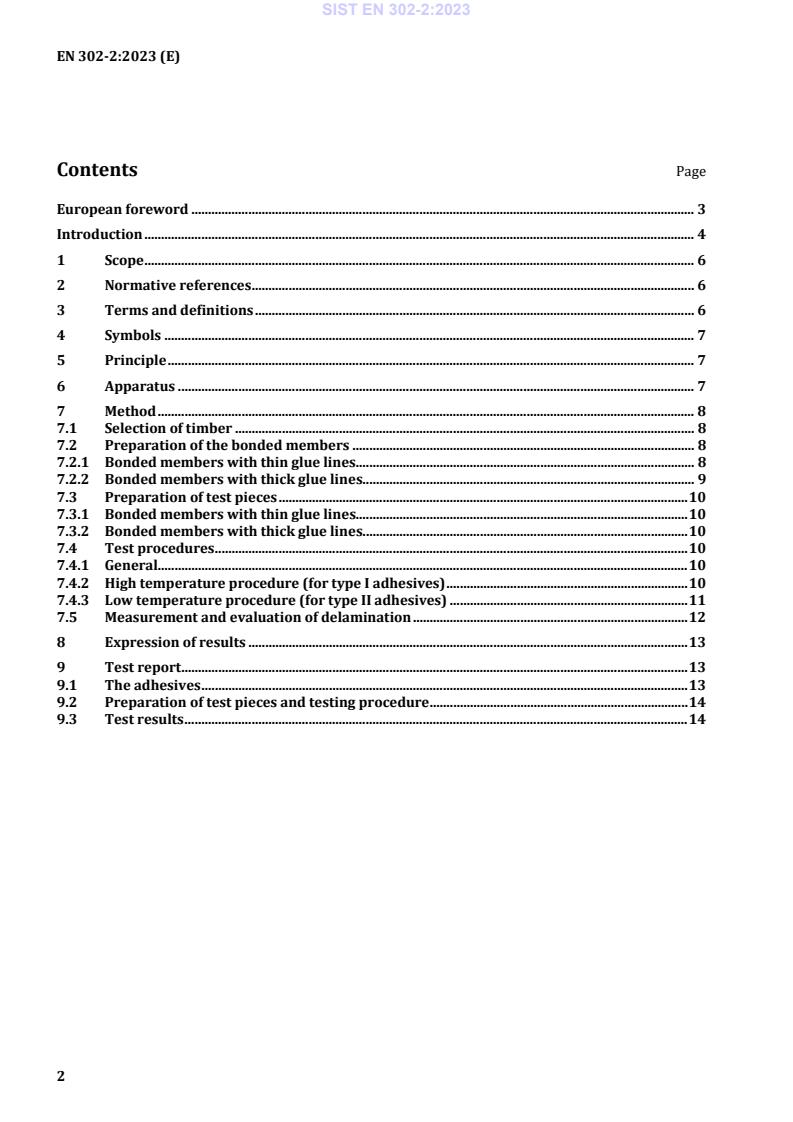
European foreword . 3
Introduction . 4
1 Scope . 6
2 Normative references . 6
3 Terms and definitions . 6
4 Symbols . 7
5 Principle . 7
6 Apparatus . 7
7 Method . 8
7.1 Selection of timber . 8
7.2 Preparation of the bonded members . 8
7.2.1 Bonded members with thin glue lines. 8
7.2.2 Bonded members with thick glue lines. 9
7.3 Preparation of test pieces . 10
7.3.1 Bonded members with thin glue lines. 10
7.3.2 Bonded members with thick glue lines. 10
7.4 Test procedures . 10
7.4.1 General. 10
7.4.2 High temperature procedure (for type I adhesives) . 10
7.4.3 Low temperature procedure (for type II adhesives) . 11
7.5 Measurement and evaluation of delamination . 12
8 Expression of results . 13
9 Test report . 13
9.1 The adhesives . 13
9.2 Preparation of test pieces and testing procedure . 14
9.3 Test results . 14
European foreword
This document (EN 302-2:2023) has been prepared by Technical Committee CEN/TC 193 “Adhesives”,
the secretariat of which is held by UNE.
This European Standard shall be given the status of a national standard, either by publication of an
identical text or by endorsement, at the latest by August 2023, and conflicting national standards shall
be withdrawn at the latest by August 2023.
Attention is drawn to the possibility that some of the elements of this document may be the subject of
patent rights. CEN shall not be held responsible for identifying any or all such patent rights.
This document supersedes EN 302-2:2017.
Compared to EN 302-2:2017, the following modifications have been made:
a) the list of standards in the Introduction has been updated;
b) two new standards, EN 17334 and EN 17418, have been included in the Scope;
c) two new clauses (Terms and definitions and Symbols) have been introduced;
d) for preservative treated wood the test with pine also covers fir and spruce;
e) 2 mm glue line thickness has been replaced by thick glue lines;
f) nominal glue line thickness of test pieces has been included under 9.2;
g) the Bibliography has been deleted.
Any feedback and questions on this document should be directed to the users’ national standards body.
A complete listing of these bodies can be found on the CEN website.
According to the CEN-CENELEC Internal Regulations, the national standards organisations of the
following countries are bound to implement this European Standard: Austria, Belgium, Bulgaria,
Croatia, Cyprus, Czech Republic, Denmark, Estonia, Finland, France, Germany, Greece, Hungary, Iceland,
Ireland, Italy, Latvia, Lithuania, Luxembourg, Malta, Netherlands, Norway, Poland, Portugal, Republic of
North Macedonia, Romania, Serbia, Slovakia, Slovenia, Spain, Sweden, Switzerland, Türkiye and the
United Kingdom.
Introduction
This document is one of a series dealing with adhesives for use with timber structures, and is published
in support of the EN 1995 series, Eurocode 5: Design of timber structures. The series consists of five
classification and performance requirements for adhesives for load-bearing timber structures, phenolic
and aminoplastic adhesives (EN 301), one component polyurethane adhesives (EN 15425), emulsion
polymer isocyanate adhesives (EN 16254), two component epoxy and polyurethane adhesives for glued
in rods (EN 17334) and for on-site repair of cracked timber structures (EN 17418) and all together
twelve test methods (EN 302-1, EN 302-2, EN 302-3, EN 302-4, EN 302-5, EN 302-6, EN 302-7 and
EN 302-8 and EN 15416-1, EN 15416-3, EN 15416-4 and EN 15416-5).
These European Standards have the following titles:
EN 301, Adhesives, phenolic and aminoplastic, for load-bearing timber structures — Classification and
performance requirements
EN 302, Adhesives for load-bearing timber structures — Test methods:
— Part 1: Determination of longitudinal tensile shear strength
— Part 2: Determination of resistance to delamination
— Part 3: Determination of the effect of acid damage to wood fibres by temperature and humidity
cycling on the transverse tensile strength
— Part 4: Determination of the effects of wood shrinkage on the shear strength
— Part 5: Determination of maximum assembly time under referenced conditions
— Part 6: Determination of the minimum pressing time under referenced conditions
— Part 7: Determination of the working life under referenced conditions
— Part 8: Static load test of multiple bond line specimens in compression shear
EN 15416, Adhesives for load bearing timber structures other than phenolic and aminoplastic — Test
methods:
— Part 1: Long-term tension load test perpendicular to the bond line at varying climate conditions with
specimens perpendicular to the glue line (Glass house test)
— Part 3: Creep deformation test at cyclic climate conditions with specimens loaded in bending shear
— Part 4: Determination of open assembly time under referenced conditions
— Part 5: Determination of minimum pressing time under referenced conditions
EN 15425, Adhesives — One component polyurethane (PUR) for load-bearing timber structures —
Classification and performance requirements
EN 16254, Adhesives — Emulsion polymer isocyanate (EPI) for load-bearing timber structures —
Classification and performance requirements
EN 17334, Glued-in rods in glued structural timber products — Testing, requirements and bond shear
strength classification
EN 17418, Two-component epoxy and polyurethane adhesives for on-site repair of cracked timber
structures — Testing, requirements and repair strength verification
Safety statement
Persons using this document should be familiar with the normal laboratory practice, if applicable. This
document cannot address all of the safety problems, if any, associated with its use. It is the
responsibility of the user to establish appropriate safety and health practices and to ensure compliance
with any regulatory conditions.
Environmental statement
It is understood that some of the material permitted in this standard can have a negative environmental
impact. As technological advantages lead to better alternatives for these materials, they will be
eliminated from this standard to the greatest extent possible.
At the end of the test, it is recommended that the users of the standard take care to carry out an
appropriate disposal of the wastes, according to local regulations.
1 Scope
This document specifies a method for determining the resistance to delamination in glue lines.
It is applicable to the following applications:
a) for assessing the compliance of adhesives with EN 301, EN 15425, EN 16254, EN 17334 and
EN 17418;
b) for assessing the suitability and quality of adhesives for load-bearing timber structures;
c) for comparing the effects on the bond strength resulting from the choice of bonding conditions,
from different climatic conditioning and from the treatment of the test pieces before and after
bonding.
This test does not apply to modified and stabilized wood with strongly reduced swelling and shrinkage
properties, such as acetylated wood, heat-treated wood and polymer impregnated wood.
This test is intended primarily to obtain performance data for the classification of adhesives for load-
bearing timber structures according to their suitability for use in defined climatic environments.
This method is not intended to provide data for structural design and does not necessarily represent
the performance of the bonded member in service.
2 Normative references
The following documents are referred to in the text in such a way that some or all of their content
constitutes requirements of this document. For dated references, only the edition cited applies. For
undated references, the latest edition of the referenced document (including any amendments) applies.
EN 384:2016+A2:2022, Structural timber - Determination of characteristic values of mechanical
properties and density
EN 923, Adhesives - Terms and definitions
3 Terms and definitions
For the purposes of this document, the terms and definitions given in EN 923 and the following apply.
ISO and IEC maintain terminology databases for use in standardization at the following addresses:
— ISO Online browsing platform: available at https://www.iso.org/obp
— IEC Electropedia: available at https://www.electropedia.org/
3.1
glue line
adhesive layer between the wood members
3.2
thick glue line
glue line of nominal thickness of more than 0,1 mm, at the time of bonding
Note 1 to entry: Thick glue lines are achieved by using spacers, grooves or similar devices when two plain
members are glued together.
3.3
close contact glue line
glue line of thickness maximum 0,1 mm
Note 1 to entry: Close contact glue line can be achieved by pressing together two plane wood members with a
clamping pressure of (0,8 ± 0,1) N/mm without additional grooves, spacers or similar devices.
Note 2 to entry: A clamping pressure of (0,6 ± 0,1) N/mm is considered a sufficient pressure to form close
contact glue line in this test.
4 Symbols
D delamination
l total delamination length on both end-grain surfaces
l total nominal length of the glue lines on both end-grain surfaces
m original mass of the test piece
o
t nominal thickness of the thick glueline
5 Principle
Bonded, laminated specimens are subjected to an impregnation-drying procedure. The specimens are
impregnated with water by immersing them and applying alternating high and low (vacuum) pressure.
They are then dried rapidly in a specified air stream at low humidity (see 6.4). The extent of open glue
lines, delamination, as a result of these treatments is measured and compared with the total length of
glue lines on both end-grain faces of the specimen.
6 Apparatus
6.1 Autoclave or similar pressure vessel designed to safely withstand a pressure of at least
625 kPa absolute (525 kPa above nominal atmospheric pressure).
6.2 Vacuum pump or similar device, capable of reducing the pressure in the vessel (6.1) to below
20 kPa absolute (80 kPa below nominal atmospheric pressure).
6.3 Pump or similar device, for obtaining a pressure of at least 600 kPa absolute (500 kPa above
nominal atmospheric pressure).
6.4 Air-circulating oven(s) or chamber(s), capable of drying the test pieces (see 7.4) in the
following climate condition:
a) for low temperature procedure (type II adhesive) a temperature of (27,5 ± 2,5) °C, circulating the
air within the chamber, maintaining a constant relative humidity of (30 ± 5) %; and
b) for high temperature procedure (type I adhesive) a temperature of (65 ± 3) °C, circulating the air
within the chamber, maintaining a relative humidity of (12,5 ± 2,5) %.
NOTE Air speed velocity of 2 m/s to 3 m/s in empty chamber has shown to be suitable to achieve drying
times according to 7.4.2 and 7.4.3.
6.5 Balance, allowing measurements with an uncer
...