

EN ISO 18134-1:2022
(Main)Solid biofuels - Determination of moisture content - Part 1: Reference method (ISO 18134-1:2022)
- Abstract
This document describes the method of determining the moisture content of a test sample of solid biofuels by drying in an oven and can be used when high precision of the determination of moisture content is necessary. The method described in this document is applicable to all solid biofuels. The moisture content of solid biofuels (as received) is always reported based on the total mass of the test sample (wet basis).
NOTE Biomass materials can contain small amounts of volatile organic compounds (VOC) which can evaporate when determining moisture content by oven drying (see References [1] and [2]). The release of such compounds is quite small relative to the overall moisture content as determined by this method and is disregarded in this document.
- Status
- Published
- Publication Date
- 27-Sep-2022
- Technical Committee
- CEN/TC 335 - Solid biofuels
- Drafting Committee
- CEN/TC 335 - Solid biofuels
- Current Stage
- 6060 - Definitive text made available (DAV) - Publishing
- Start Date
- 28-Sep-2022
- Completion Date
- 28-Sep-2022


Overview
EN ISO 18134-1:2022 - "Solid biofuels - Determination of moisture content - Part 1: Reference method" - is the CEN-adopted reference for measuring moisture in solid biofuels by oven drying. Intended where high-precision moisture determination is required, the method applies to all solid biofuels and requires results to be reported on a wet basis (moisture as received, relative to total sample mass). The procedure is internationally harmonized (ISO 18134-1:2022) and supersedes the 2015 edition.
Key Topics and Requirements
- Principle: Dry a test portion in an air atmosphere oven at (105 ± 2) °C until constant mass is reached; calculate moisture from mass loss.
- Apparatus: temperature-controlled drying oven (air changes 3–5/h), non-corrodible trays, and a balance readable to 0.1 g.
- Sample preparation:
- Follow ISO 18135 / ISO 21945 for sampling and ISO 14780 for size reduction.
- Particles: ensure at least one dimension < 31.5 mm.
- Minimum test portion mass: 300 g (or 100 g for fine particulate fuels).
- Warning: avoid moisture gain/loss during handling and grinding; pre-dry high moisture samples if necessary.
- Procedure highlights:
- Weigh an empty drying tray; transfer sample in a thin, even layer (recommendation for fine particles: layer not exceeding 1 g per 1 cm of surface area).
- Use an identical reference tray to correct for buoyancy effects when hot.
- Define constant mass as a change ≤ 0.2% absolute of initial test portion mass during 60 minutes of heating.
- Weigh trays while still hot to apply buoyancy correction.
- Calculation: moisture content reported on a wet basis; includes formulae for pre-dried samples.
Note: Small emissions of volatile organic compounds (VOCs) can occur during oven drying but are considered negligible by this standard.
Applications and Users
EN ISO 18134-1:2022 is used by:
- Accredited testing laboratories performing moisture analysis of pellets, wood chips, agricultural residues, and other solid biofuels.
- Quality control teams at biomass fuel producers and suppliers.
- Certification bodies and regulators verifying fuel specifications and compliance.
- Researchers and product developers needing rigorous moisture data for calorific value, storage, combustion performance, and emissions assessments.
This standard ensures reproducible, traceable moisture results crucial for fuel quality, logistics (storage/drying), and energy content calculations.
Related Standards
- ISO 14780 - Solid biofuels: Sample preparation
- ISO 16559 - Solid biofuels: Vocabulary
- ISO 18135 - Solid biofuels: Sampling
- ISO 21945 - Simplified sampling for small-scale applications
Keywords: EN ISO 18134-1:2022, solid biofuels, moisture content, oven drying, reference method, wet basis, sample preparation, moisture determination.
Relations
- Effective Date
- 05-Oct-2022
- Effective Date
- 25-Aug-2026
- Effective Date
- 25-Aug-2026
- Effective Date
- 25-Aug-2026
- Effective Date
- 09-Feb-2026
- Effective Date
- 28-Jan-2026
- Effective Date
- 28-Jan-2026
- Effective Date
- 28-Jan-2026
- Effective Date
- 28-Jan-2026
- Effective Date
- 28-Jan-2026
- Effective Date
- 28-Jan-2026
- Effective Date
- 28-Jan-2026
- Effective Date
- 28-Jan-2026
- Effective Date
- 28-Jan-2026
- Effective Date
- 28-Jan-2026
Get Certified
Connect with accredited certification bodies for this standard

DNV
DNV is an independent assurance and risk management provider.

Lloyd's Register
Lloyd's Register is a global professional services organisation specialising in engineering and technology.
DNV Energy Systems
Energy and renewable energy certification.
Sponsored listings
Frequently Asked Questions
EN ISO 18134-1:2022 is a standard published by the European Committee for Standardization (CEN). Its full title is "Solid biofuels - Determination of moisture content - Part 1: Reference method (ISO 18134-1:2022)". This standard covers: This document describes the method of determining the moisture content of a test sample of solid biofuels by drying in an oven and can be used when high precision of the determination of moisture content is necessary. The method described in this document is applicable to all solid biofuels. The moisture content of solid biofuels (as received) is always reported based on the total mass of the test sample (wet basis). NOTE Biomass materials can contain small amounts of volatile organic compounds (VOC) which can evaporate when determining moisture content by oven drying (see References [1] and [2]). The release of such compounds is quite small relative to the overall moisture content as determined by this method and is disregarded in this document.
This document describes the method of determining the moisture content of a test sample of solid biofuels by drying in an oven and can be used when high precision of the determination of moisture content is necessary. The method described in this document is applicable to all solid biofuels. The moisture content of solid biofuels (as received) is always reported based on the total mass of the test sample (wet basis). NOTE Biomass materials can contain small amounts of volatile organic compounds (VOC) which can evaporate when determining moisture content by oven drying (see References [1] and [2]). The release of such compounds is quite small relative to the overall moisture content as determined by this method and is disregarded in this document.
EN ISO 18134-1:2022 is classified under the following ICS (International Classification for Standards) categories: 27.190 - Biological sources and alternative sources of energy; 75.160.40 - Biofuels. The ICS classification helps identify the subject area and facilitates finding related standards.
EN ISO 18134-1:2022 has the following relationships with other standards: It is inter standard links to EN ISO 18134-1:2015, ISO 21945:2020, ISO 18135:2017, ISO 16559:2022, ISO 14780:2017, EN ISO 4037-4:2021, EN 13852-1:2025, EN 14961-6:2012, CEN/TS 15149-3:2006, EN 14961-3:2011, EN 15103:2009, EN 14780:2011, EN 14961-2:2011, EN 14961-4:2011, CEN/TR 15149-3:2014. Understanding these relationships helps ensure you are using the most current and applicable version of the standard.
EN ISO 18134-1:2022 is available in PDF format for immediate download after purchase. The document can be added to your cart and obtained through the secure checkout process. Digital delivery ensures instant access to the complete standard document.
Standards Content (Sample)
SLOVENSKI STANDARD
01-december-2022
Nadomešča:
SIST EN ISO 18134-1:2015
Trdna biogoriva - Določevanje vlage - 1. del: Referenčna metoda (ISO 18134-
1:2022)
Solid biofuels - Determination of moisture content - Part 1: Reference method (ISO
18134-1:2022)
Biogene Festbrennstoffe - Bestimmung des Wassergehaltes - Teil 1: Referenzverfahren
(ISO 18134-1:2022)
Biocombustibles solides - Dosage de la teneur en humidité - Méthode de séchage à
l'étuve - Partie 1: Méthode de référence (ISO 18134-1:2022)
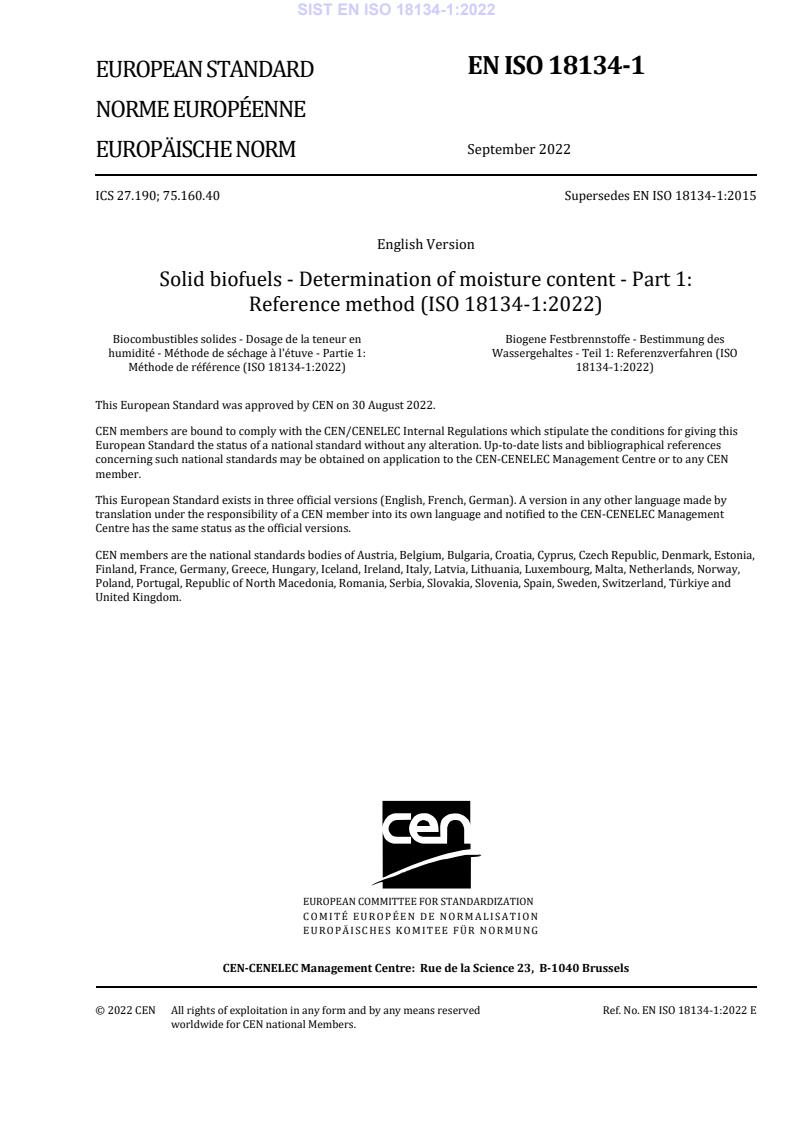
Ta slovenski standard je istoveten z: EN ISO 18134-1:2022
ICS:
75.160.40 Biogoriva Biofuels
2003-01.Slovenski inštitut za standardizacijo. Razmnoževanje celote ali delov tega standarda ni dovoljeno.
EN ISO 18134-1
EUROPEAN STANDARD
NORME EUROPÉENNE
September 2022
EUROPÄISCHE NORM
ICS 27.190; 75.160.40 Supersedes EN ISO 18134-1:2015
English Version
Solid biofuels - Determination of moisture content - Part 1:
Reference method (ISO 18134-1:2022)
Biocombustibles solides - Dosage de la teneur en Biogene Festbrennstoffe - Bestimmung des
humidité - Méthode de séchage à l'étuve - Partie 1: Wassergehaltes - Teil 1: Referenzverfahren (ISO
Méthode de référence (ISO 18134-1:2022) 18134-1:2022)
This European Standard was approved by CEN on 30 August 2022.
CEN members are bound to comply with the CEN/CENELEC Internal Regulations which stipulate the conditions for giving this
European Standard the status of a national standard without any alteration. Up-to-date lists and bibliographical references
concerning such national standards may be obtained on application to the CEN-CENELEC Management Centre or to any CEN
member.
This European Standard exists in three official versions (English, French, German). A version in any other language made by
translation under the responsibility of a CEN member into its own language and notified to the CEN-CENELEC Management
Centre has the same status as the official versions.
CEN members are the national standards bodies of Austria, Belgium, Bulgaria, Croatia, Cyprus, Czech Republic, Denmark, Estonia,
Finland, France, Germany, Greece, Hungary, Iceland, Ireland, Italy, Latvia, Lithuania, Luxembourg, Malta, Netherlands, Norway,
Poland, Portugal, Republic of North Macedonia, Romania, Serbia, Slovakia, Slovenia, Spain, Sweden, Switzerland, Türkiye and
United Kingdom.
EUROPEAN COMMITTEE FOR STANDARDIZATION
COMITÉ EUROPÉEN DE NORMALISATION
EUROPÄISCHES KOMITEE FÜR NORMUNG
CEN-CENELEC Management Centre: Rue de la Science 23, B-1040 Brussels
© 2022 CEN All rights of exploitation in any form and by any means reserved Ref. No. EN ISO 18134-1:2022 E
worldwide for CEN national Members.
Contents Page
European foreword . 3
European foreword
This document (EN ISO 18134-1:2022) has been prepared by Technical Committee ISO/TC 238 "Solid
biofuels" in collaboration with Technical Committee CEN/TC 335 “Solid biofuels” the secretariat of
which is held by SIS.
This European Standard shall be given the status of a national standard, either by publication of an
identical text or by endorsement, at the latest by March 2023, and conflicting national standards shall
be withdrawn at the latest by March 2023.
Attention is drawn to the possibility that some of the elements of this document may be the subject of
patent rights. CEN shall not be held responsible for identifying any or all such patent rights.
This document supersedes EN ISO 18134-1:2015.
Any feedback and questions on this document should be directed to the users’ national standards
body/national committee. A complete listing of these bodies can be found on the CEN website.
According to the CEN-CENELEC Internal Regulations, the national standards organizations of the
following countries are bound to implement this European Standard: Austria, Belgium, Bulgaria,
Croatia, Cyprus, Czech Republic, Denmark, Estonia, Finland, France, Germany, Greece, Hungary, Iceland,
Ireland, Italy, Latvia, Lithuania, Luxembourg, Malta, Netherlands, Norway, Poland, Portugal, Republic of
North Macedonia, Romania, Serbia, Slovakia, Slovenia, Spain, Sweden, Switzerland, Türkiye and the
United Kingdom.
Endorsement notice
The text of ISO 18134-1:2022 has been approved by CEN as EN ISO 18134-1:2022 without any
modification.
INTERNATIONAL ISO
STANDARD 18134-1
Second edition
2022-08
Solid biofuels — Determination of
moisture content —
Part 1:
Reference method
Biocombustibles solides — Dosage de la teneur en humidité —
Partie 1: Méthode de référence
Reference number
ISO 18134-1:2022(E)
ISO 18134-1:2022(E)
© ISO 2022
All rights reserved. Unless otherwise specified, or required in the context of its implementation, no part of this publication may
be reproduced or utilized otherwise in any form or by any means, electronic or mechanical, including photocopying, or posting on
the internet or an intranet, without prior written permission. Permission can be requested from either ISO at the address below
or ISO’s member body in the country of the requester.
ISO copyright office
CP 401 • Ch. de Blandonnet 8
CH-1214 Vernier, Geneva
Phone: +41 22 749 01 11
Email: copyright@iso.org
Website: www.iso.org
Published in Switzerland
ii
ISO 18134-1:2022(E)
Contents Page
Foreword .iv
1 S c op e . 1
2 Nor m at i ve r ef er enc e s . 1
3 Terms and definitions . 1
4 P r i nc iple . 1
5 A pp a r at u s . 2
6 S a mple pr ep a r at ion .2
6 .1 S a mple r e duc t ion . . 2
6.2 P re-dried test sample . 2
6.3 M ass of test portion . . 2
7 P r o c e du re .2
7.1 Ha ndling of test portion . 2
7.2 W eighing of test portion and correction of buoyancy of trays . 3
8 C a lc u l at ion . 3
8.1 General . 3
8.2 M oisture content on a wet basis . 3
8.3 M oisture content for pre-dried material . 4
9 Per f or m a nc e c h a r ac t er i s t ic s . 4
10 Te s t r ep or t . 4
Bibliography . 5
iii
ISO 18134-1:2022(E)
Foreword
ISO (the International Organization for Standardization) is a worldwide federation of national standards
bodies (ISO member bodies). The work of preparing International Standards is normally carried out
through ISO technical committees. Each member body interested in a subject for which a technical
committee has been established has the right to be represented on that committee. International
organizations, governmental and non-governmental, in liaison with ISO, also take part in the work.
ISO collaborates closely with the International Electrotechnical Commission (IEC) on all matters of
electrotechnical standardization.
The procedures used to develop this document and those intended for its further maintenance are
described in the ISO/IEC Directives, Part 1. In particular, the different approval criteria needed for the
different types of ISO documents should be noted. This document was drafted in accordance with the
editorial rules of the ISO/IEC Directives, Part 2 (see www.iso.org/directives).
Attention is drawn to the possibility that some of the elements of this document may be the subject of
patent righ
...