

EN 17860-7:2024
(Main)Carrier cycles - Part 7: Cargo trailers
- Abstract
This document specifies safety requirements and test methods for single and multi-axle cargo trailers and their connecting devices.
This document applies to cargo trailers with a maximum gross vehicle weight of 600 kg.
This document is not applicable to trailer for transportation of passengers, usually children and for type of trailers which use fifth wheel for connecting to the front cycles as listed in the Table 1 in this document.
Table 1 - Types of cycle trailers
Type of trailer Applicability of this document
Multi track single axle Applicable
Multi track multi axle Applicable
Single track with single axle or multi axle Not applicable
Fifth wheel trailer with single axle or multi axle Not applicable
Usage
Cargo Applicable
People/children/pet Not applicable
NOTE Requirements and test methods for electrical assistance for electrically assisted cargo trailers are covered by prEN 17860-5:2023.
- Status
- Published
- Publication Date
- 17-Dec-2024
- Technical Committee
- CEN/TC 333 - Cycles
- Drafting Committee
- CEN/TC 333/WG 9 - Cargo bikes
- Current Stage
- 6060 - Definitive text made available (DAV) - Publishing
- Start Date
- 18-Dec-2024
- Due Date
- 20-Nov-2024
- Completion Date
- 18-Dec-2024
- Directive
- 2001/95/EC - General product safety

Overview
EN 17860-7:2024 - “Carrier cycles - Part 7: Cargo trailers” is a CEN European Standard that specifies safety requirements and test methods for single‑ and multi‑axle cargo trailers and their connecting devices. The standard applies to cargo trailers with a maximum gross vehicle weight of 600 kg and excludes trailers intended for transporting people (e.g., children) and trailers using a fifth‑wheel (semi‑trailer) connection. Electrical assistance requirements are covered separately (see prEN 17860-5:2023).
Key topics and requirements
This part of the EN 17860 series focuses on mechanical and functional safety. Major technical topics include:
- General vehicle requirements (design tolerances, fasteners, mudguards)
- Braking systems (hand‑operated brakes, brake performance and track test methods)
- Parking and stability (parking devices, loading stability)
- Tipping stability - static and dynamic assessments, including a double lane change test
- Drawbar and connecting device requirements (position, clearance, static and strength tests)
- Secondary safety devices (requirements and strength tests)
- Frame integrity - dynamic tests with horizontal, vertical and lateral forces; brake mount tests
- Front wheel fork, wheel/wheel‑tyre assemblies and rim/tyre strength tests
- Drive chain/belt protection and guards for rotating parts
- Visibility, lighting, rear view and warning devices
- Vibrations, ergonomics, structural integrity, user instructions and markings
The standard also provides definitions, normative references and test methods for component and full‑vehicle evaluation.
Practical applications
EN 17860-7:2024 is intended to be used to:
- Validate design safety and durability during product development
- Define test protocols for prototype and production verification
- Support conformity assessments for cargo trailers not covered by EU type approval (Regulation (EU) No. 168/2013)
- Create buyer specifications and procurement requirements for cargo trailers and accessories
- Reduce liability and improve market acceptance through documented compliance with a recognized European standard
Who should use this standard
- Trailer and carrier cycle manufacturers and OEMs
- Product designers and R&D teams working on cargo trailers
- Test laboratories and certification bodies performing mechanical and functional tests
- Fleet operators, bike‑logistics providers and procurement officers specifying safe cargo trailers
- Safety engineers, compliance officers and regulatory authorities
Related standards
- EN 17860 series: Parts 1–6 (terms, lightweight single/multi‑track, heavy weight, electrical aspects, passenger transport)
- prEN 17860‑5:2023 (electrically assisted cargo trailer electrical requirements)
Keywords: EN 17860-7:2024, cargo trailers standard, carrier cycles, trailer safety, test methods, CEN, 600 kg, trailer design, braking test, drawbar strength.
Relations
- Effective Date
- 25-Aug-2026
- Effective Date
- 09-Feb-2026
- Effective Date
- 28-Jan-2026
- Effective Date
- 28-Jan-2026
- Effective Date
- 28-Jan-2026
- Effective Date
- 28-Jan-2026
- Effective Date
- 28-Jan-2026
- Effective Date
- 28-Jan-2026
- Effective Date
- 28-Jan-2026
- Effective Date
- 28-Jan-2026
- Effective Date
- 28-Jan-2026
- Effective Date
- 28-Jan-2026
- Effective Date
- 28-Jan-2026
Get Certified
Connect with accredited certification bodies for this standard

TÜV Rheinland
TÜV Rheinland is a leading international provider of technical services.

TÜV SÜD
TÜV SÜD is a trusted partner of choice for safety, security and sustainability solutions.

DEKRA Certification Inc.
DEKRA US certification services.
Sponsored listings
Frequently Asked Questions
EN 17860-7:2024 is a standard published by the European Committee for Standardization (CEN). Its full title is "Carrier cycles - Part 7: Cargo trailers". This standard covers: This document specifies safety requirements and test methods for single and multi-axle cargo trailers and their connecting devices. This document applies to cargo trailers with a maximum gross vehicle weight of 600 kg. This document is not applicable to trailer for transportation of passengers, usually children and for type of trailers which use fifth wheel for connecting to the front cycles as listed in the Table 1 in this document. Table 1 - Types of cycle trailers Type of trailer Applicability of this document Multi track single axle Applicable Multi track multi axle Applicable Single track with single axle or multi axle Not applicable Fifth wheel trailer with single axle or multi axle Not applicable Usage Cargo Applicable People/children/pet Not applicable NOTE Requirements and test methods for electrical assistance for electrically assisted cargo trailers are covered by prEN 17860-5:2023.
This document specifies safety requirements and test methods for single and multi-axle cargo trailers and their connecting devices. This document applies to cargo trailers with a maximum gross vehicle weight of 600 kg. This document is not applicable to trailer for transportation of passengers, usually children and for type of trailers which use fifth wheel for connecting to the front cycles as listed in the Table 1 in this document. Table 1 - Types of cycle trailers Type of trailer Applicability of this document Multi track single axle Applicable Multi track multi axle Applicable Single track with single axle or multi axle Not applicable Fifth wheel trailer with single axle or multi axle Not applicable Usage Cargo Applicable People/children/pet Not applicable NOTE Requirements and test methods for electrical assistance for electrically assisted cargo trailers are covered by prEN 17860-5:2023.
EN 17860-7:2024 is classified under the following ICS (International Classification for Standards) categories: 43.150 - Cycles. The ICS classification helps identify the subject area and facilitates finding related standards.
EN 17860-7:2024 has the following relationships with other standards: It is inter standard links to ISO 6742-3:2023, ISO 14878:2015, EN ISO 4210-3:2023, EN ISO 4210-4:2023, EN 17860-1:2024, EN 17860-2:2024, EN 17860-5:2024, EN ISO 4210-6:2023, EN 15918:2011+A2:2017, EN ISO 4210-8:2023, EN ISO 4210-2:2023, EN 17860-3:2024, EN 17860-4:2025. Understanding these relationships helps ensure you are using the most current and applicable version of the standard.
EN 17860-7:2024 is associated with the following European legislation: EU Directives/Regulations: 2001/95/EC. When a standard is cited in the Official Journal of the European Union, products manufactured in conformity with it benefit from a presumption of conformity with the essential requirements of the corresponding EU directive or regulation.
EN 17860-7:2024 is available in PDF format for immediate download after purchase. The document can be added to your cart and obtained through the secure checkout process. Digital delivery ensures instant access to the complete standard document.
Standards Content (Sample)
SLOVENSKI STANDARD
01-marec-2025
Tovorna kolesa - 7. del: Kolesarska prikolica
Carrier cycles - Part 7: Cargo trailers
Lastenfahrräder - Teil 7: Anhänger
Cycles utilitaires - Partie 7 : Remorques cargo
Ta slovenski standard je istoveten z: EN 17860-7:2024
ICS:
43.150 Kolesa Cycles
2003-01.Slovenski inštitut za standardizacijo. Razmnoževanje celote ali delov tega standarda ni dovoljeno.
EN 17860-7
EUROPEAN STANDARD
NORME EUROPÉENNE
December 2024
EUROPÄISCHE NORM
ICS 43.150
English Version
Carrier cycles - Part 7: Cargo trailers
Cycles utilitaires - Partie 7 : Remorques cargo Lastenfahrräder - Teil 7: Anhänger
This European Standard was approved by CEN on 4 November 2024.
CEN members are bound to comply with the CEN/CENELEC Internal Regulations which stipulate the conditions for giving this
European Standard the status of a national standard without any alteration. Up-to-date lists and bibliographical references
concerning such national standards may be obtained on application to the CEN-CENELEC Management Centre or to any CEN
member.
This European Standard exists in three official versions (English, French, German). A version in any other language made by
translation under the responsibility of a CEN member into its own language and notified to the CEN-CENELEC Management
Centre has the same status as the official versions.
CEN members are the national standards bodies of Austria, Belgium, Bulgaria, Croatia, Cyprus, Czech Republic, Denmark, Estonia,
Finland, France, Germany, Greece, Hungary, Iceland, Ireland, Italy, Latvia, Lithuania, Luxembourg, Malta, Netherlands, Norway,
Poland, Portugal, Republic of North Macedonia, Romania, Serbia, Slovakia, Slovenia, Spain, Sweden, Switzerland, Türkiye and
United Kingdom.
EUROPEAN COMMITTEE FOR STANDARDIZATION
COMITÉ EUROPÉEN DE NORMALISATION
EUROPÄISCHES KOMITEE FÜR NORMUNG
CEN-CENELEC Management Centre: Rue de la Science 23, B-1040 Brussels
© 2024 CEN All rights of exploitation in any form and by any means reserved Ref. No. EN 17860-7:2024 E
worldwide for CEN national Members.
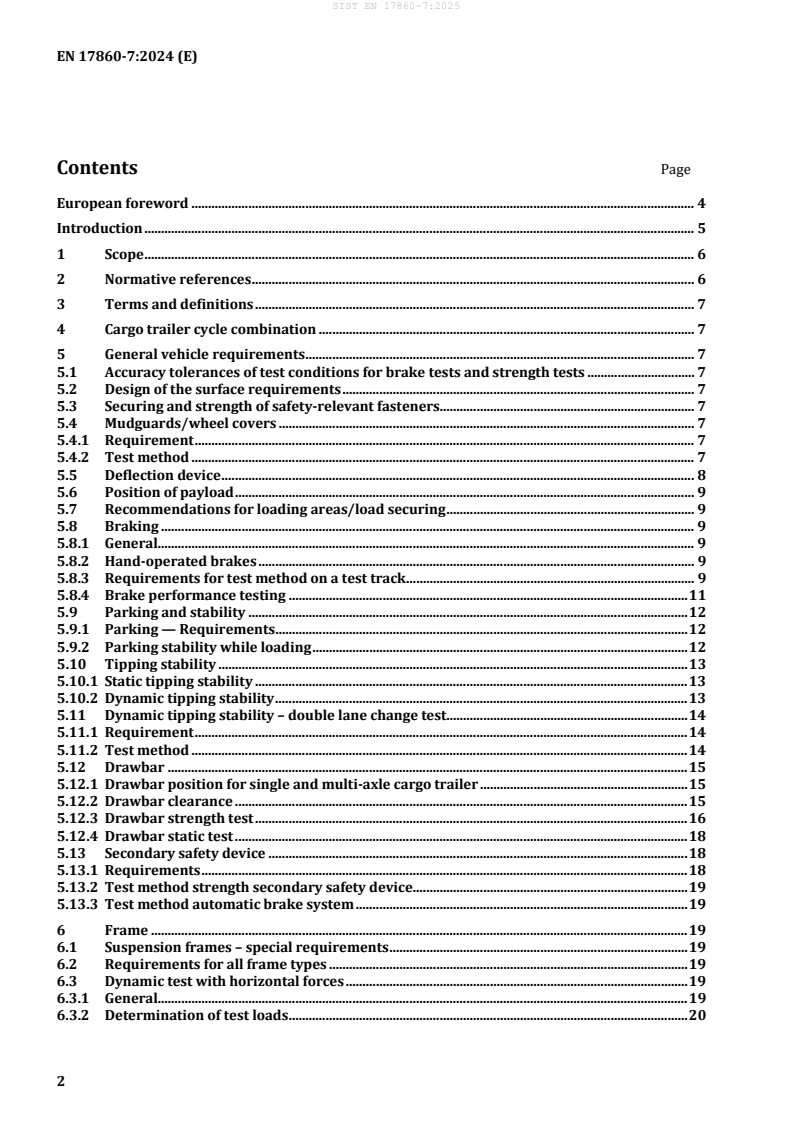
Contents Page
European foreword . 4
Introduction . 5
1 Scope . 6
2 Normative references . 6
3 Terms and definitions . 7
4 Cargo trailer cycle combination . 7
5 General vehicle requirements . 7
5.1 Accuracy tolerances of test conditions for brake tests and strength tests . 7
5.2 Design of the surface requirements . 7
5.3 Securing and strength of safety-relevant fasteners. 7
5.4 Mudguards/wheel covers . 7
5.4.1 Requirement . 7
5.4.2 Test method . 7
5.5 Deflection device . 8
5.6 Position of payload . 9
5.7 Recommendations for loading areas/load securing . 9
5.8 Braking . 9
5.8.1 General. 9
5.8.2 Hand-operated brakes . 9
5.8.3 Requirements for test method on a test track . 9
5.8.4 Brake performance testing . 11
5.9 Parking and stability . 12
5.9.1 Parking — Requirements . 12
5.9.2 Parking stability while loading . 12
5.10 Tipping stability . 13
5.10.1 Static tipping stability . 13
5.10.2 Dynamic tipping stability . 13
5.11 Dynamic tipping stability – double lane change test. 14
5.11.1 Requirement . 14
5.11.2 Test method . 14
5.12 Drawbar . 15
5.12.1 Drawbar position for single and multi-axle cargo trailer . 15
5.12.2 Drawbar clearance . 15
5.12.3 Drawbar strength test . 16
5.12.4 Drawbar static test . 18
5.13 Secondary safety device . 18
5.13.1 Requirements . 18
5.13.2 Test method strength secondary safety device . 19
5.13.3 Test method automatic brake system . 19
6 Frame . 19
6.1 Suspension frames – special requirements . 19
6.2 Requirements for all frame types . 19
6.3 Dynamic test with horizontal forces . 19
6.3.1 General. 19
6.3.2 Determination of test loads . 20
6.3.3 Test method . 20
6.4 Dynamic test with vertical forces onto the loading point . 21
6.4.1 General . 21
6.4.2 Test method . 21
6.5 Dynamic test with lateral forces . 22
6.5.1 General . 22
6.5.2 Requirement . 24
6.5.3 Test method . 24
6.6 Frame – Brake mount test . 26
6.6.1 Requirements . 26
6.6.2 Brake mount fatigue test. 26
6.6.3 Brake mount static torque test . 27
7 Front wheel fork . 27
7.1 General . 27
7.2 Installation of the axle and wheel fastening . 27
7.3 Front wheel fork – Static bending test . 27
7.4 Front wheel forks – Dynamic bending test . 27
7.5 Front wheel forks – Rearward impact test . 28
7.6 Front forks for use with hub or disc brakes . 28
7.6.1 Requirements . 28
7.6.2 Front fork for hub/disc brake — Dynamic test of the brake mounting . 28
7.6.3 Front fork for hub/disc brake – Static braking torque test . 28
8 Wheel and wheel/tyre unit – Dynamic test for cargo trailers . 28
9 Wheels and wheel/tyre assembly. 28
9.1 Wheels/tyre assembly – Concentricity tolerance and lateral tolerance . 28
9.2 Wheel/tyre assembly – Clearance . 28
9.3 Wheel/tyre assembly – static strength test . 28
9.4 Wheels – Wheel retention . 28
10 Rims, tyres and tubes . 29
11 Drive chain and drive belt . 29
11.1 Requirement . 29
11.2 Test method . 29
12 Guard for chain-wheel set and belt drive. 29
12.1 Requirement . 29
12.2 Test method . 29
13 Lighting systems and reflectors . 29
14 Cargo trailer visibility . 29
15 Rear view . 29
16 Warning device . 29
17 Vibrations, ergonomics and design of work equipment . 30
18 Structural integrity test . 30
19 User instructions . 30
20 Markings . 32
20.1 Cargo trailer marking . 32
20.2 Components marking . 33
Bibliography . 34
European foreword
This document (EN 17860-7:2024) has been prepared by Technical Committee CEN/TC 333 “Cycles”,
the secretariat of which is held by UNI.
This European Standard shall be given the status of a national standard, either by publication of an
identical text or by endorsement, at the latest by June 2025, and conflicting national standards shall be
withdrawn at the latest by June 2025.
Attention is drawn to the possibility that some of the elements of this document may be the subject of
patent rights. CEN shall not be held responsible for identifying any or all such patent rights.
This document is part of standard series consisting of the following parts:
— EN 17860-1:2024, Carrier cycles — Part 1: Terms and definitions
— EN 17860-2:2024, Carrier cycles — Part 2: Lightweight single track carrier cycles — Mechanical
aspects
— EN 17860-3:2024, Carrier Cycles — Part 3: Lightweight multi track carrier cycles — Mechanical
aspects
— prEN 17860-4:2024, Carrier Cycles — Part 4: Heavy weight carrier cycles — Mechanical and
functional aspects
— EN 17860-5:2024, Carrier cycles — Part 5: Electrical aspects
— prEN 17860-6:2024 Carrier Cycles — Part 6: Passenger transport
— EN 17860-7:2024, Carrier cycles — Cargo trailers
Any feedback and questions on this document should be directed to the users’ national standards body.
A complete listing of these bodies can be found on the CEN website.
According to the CEN-CENELEC Internal Regulations, the national standards organisations of the
following countries are bound to implement this European Standard: Austria, Belgium, Bulgaria,
Croatia, Cyprus, Czech Republic, Denmark, Estonia, Finland, France, Germany, Greece, Hungary, Iceland,
Ireland, Italy, Latvia, Lithuania, Luxembourg, Malta, Netherlands, Norway, Poland, Portugal, Republic of
North Macedonia, Romania, Serbia, Slovakia, Slovenia, Spain, Sweden, Switzerland, Türkiye and the
United Kingdom
Introduction
This document gives requirements and test methods for mechanical and functional aspects for cargo
trailers.
This document has been developed in response to demand throughout Europe. Its aim is to provide a
standard for the assessment of mechanical aspects for cargo trailers of a type which are excluded from
type approval by Regulation (EU) No. 168/2013.
Because of the diversity of geometries and solutions of trailers not all requirements and test methods in
this document may apply to every trailer.
1 Scope
This document specifies safety requirements and test methods for single and multi-axle cargo trailers
and their connecting devices.
This document applies to cargo trailers with a maximum gross vehicle weight of 600 kg.
This document is not applicable to trailers for the transportation of passengers, usually children, and
for types of trailers that use a fifth wheel for connecting to the front cycles (semi-trailer) as listed in
Table 1 in this document.
Table 1 — Types of cycle trailers
Type of trailer Applicability of this document
Multi track single axle Applicable
Multi track multi axle Applicable
Single track with single axle or multi axle Not applicable
Fifth wheel trailer (semi-trailer) with single
Not applicable
axle or multi axle
Usage
Cargo Applicable
People/children/pet Not applicable
NOTE 1 Requirements and test methods for electrical assistance for electrically assisted cargo trailers are
covered by EN 17860-5:2024.
NOTE 2 For cargo trailers having a maximum gross weight of up to 60 kg, see EN 15918:2011 + A2 Cycles –
Cycle trailers.
2 Normative references
The following documents are referred to in the text in such a way that some or all of their content
constitutes requirements of this document. For dated references, only the edition cited applies. For
undated references, the latest edition of the referenced document (including any amendments) applies.
EN 15918:2011+A2:2017, Cycles — Cycle trailers — Safety requirements and test methods
EN 17860-1:2024, Carrier cycles — Part 1: Terms and definitions
EN 17860-2:2024, Carrier cycles — Part 2: Lightweight single track carrier cycles — Mechanical aspects
EN 17860-3:2024, Carrier cycles — Part 3: Lightweight multi track carrier cycles — Mechanical aspects
FprEN 17860-5:2024, Cycles — Carrier cycles — Part 5: Electrical aspects
EN ISO 4210-2:2023, Cycles — Safety requirements for bicycles — Part 2: Requirements for city and
trekking, young adult, mountain and racing bicycles (ISO 4210-2:2023)
EN ISO 4210-3:2023, Cycles — Safety requirements for bicycles — Part 3: Common test methods (ISO
4210-3:2023)
EN ISO 4210-4:2023, Cycles — Safety requirements for bicycles — Part 4: Braking test methods (ISO
4210-4:2023)
EN ISO 4210-6:2023, Cycles — Safety requirements for bicycles — Part 6: Frame and fork test methods
(ISO 4210-6:2023)
EN ISO 4210-8:2023, Cycles — Safety requirements for bicycles — Part 8: Pedal and drive system test
methods (ISO 4210-8:2023)
ISO 6742-3:2023, Cycles — Lighting and retro reflective devices — Part 3: Installation and use of
lighting and retro reflective devices
ISO 14878:2015, Cycles — Audible warning devices — Technical specification and test methods
3 Terms and definitions
For the purposes of this document, the terms and definitions given in EN 17860-1:2024 apply.
ISO and IEC maintain terminology databases for use in standardization at the following addresses:
— ISO Online browsing platform: available at https://www.iso.org/obp/
— IEC Electropedia: available at https://www.electropedia.org/
4 Cargo trailer cycle combination
The recommended maximum gross vehicle weight of the cargo trailer is:
— 600 kg when the trailer is pulled by a multi track carrier cycle;
— 350 kg when the trailer is pulled by a bicycle, EPAC or single track carrier cycle.
5 General vehicle requirements
5.1 Accuracy tolerances of test conditions for brake tests and strength tests
EN 17860-2:2024, 5.2 applies.
5.2 Design of the surface requirements
EN 17860-2:2024, 5.1 applies.
5.3 Securing and strength of safety-relevant fasteners
EN 17860-:2024, 5.2 applies.
5.4 Mudguards/wheel covers
5.4.1 Requirement
The requirements in accordance with EN ISO 4210-2:2023, 4.11 apply.
5.4.2 Test method
The test shall be conducted in accordance with EN ISO 4210-3:2023, 4.2.
5.5 Deflection device
Cargo trailers shall be designed in accordance with EN 15918:2011+A2:2017 such that a vertical
obstacle cannot be caught between a wheel and the body of the cargo trailer when the cargo trailer is
drawn forwards past any such obstacle. An example is shown in Figure 1.
Key
1 deflection devices
2 vertical obstacle
3 moving direction
Figure 1 — Example of the deflection devices for single and multi axle cargo trailers
The width of cargo trailer in front of the wheels shall not be less than the distance between the tyre
centrelines and be shaped so that the cycle trailer is deflected sideways when drawn past a vertical
obstacle with a minimum height of 750 mm and diameter of 90 mm (see Figure 1).
The deflection device shall be strong enough not to collapse if a trailer with maximum payload is hitting
the obstacle.
5.6 Position of payload
The position of the transported load shall be so that the cargo trailer can be safely operated and braked
in any loading and operating situation, the cyclist in the front is not hindered and vision is not limited. A
rear-view mirror on the towing cycle is recommended if the visibility to the rear is limited due to the
normal positioning of the payload or the vehicle’s construction.
The manufacturer shall specify in the user manual the recommended load distribution on the cargo
trailer so that the load distribution does not result in the centre of gravity of the cargo trailer being too
far back.
The manufacturer shall try to achieve an even distribution of the wheel load and the lowest possible
overall centre of gravity.
5.7 Recommendations for loading areas/load securing
Design recommendations can be found in EN 17860-3:2024, 5.7.
5.8 Braking
5.8.1 General
A cargo trailer shall be equipped with at least two brake systems which are operated simultaneously.
The brake systems shall function without jamming.
Cargo trailers with a total mass of up to 100 kg (including payload) are exempted from overrun brakes
only if the connection point to the cycle is not higher than 400 mm above the ground. The manufacturer
shall confirm the braking performance according to the test in 5.8.3 with the lightest possible cycle
available. Manufacturers shall recommend the cycle type (including brake type, frame type, tire profile
and empty weight of the cycle) according to the results of the braking distance test to their customers
for operations.
The requirements in accordance with Table 2 shall be met.
NOTE See EN ISO 4210-4:2023, 4.6.5.7, Point h), Test method — Simple check on the test track.
5.8.2 Hand-operated brakes
Hand-operated brakes used in the intended operational mode shall comply with clause 6.2 of
EN 17860-2:2024.
5.8.3 Requirements for test method on a test track
The general requirements in accordance with 5.8.1 apply.
The requirements in accordance with a), b) and c) shall be met.
a) When testing on a test track, the cargo trailer shall meet the requirements listed in Table 2 in both
fully laden condition as specified by the manufacturer and in unladen condition. A city cycle having
a functional brake on the front and the rear wheel shall be used as a reference cycle to perform this
test. Independently of the trailer, the cycle shall achieve the braking performance as described in
EN ISO 4210-4:2023.
If the cargo trailer has several loading areas, the payload shall be distributed according to the
manufacturer’s recommendations.
Table 2 — Minimum values for the braking deceleration on cargo trailers
Minimum braking
deceleration
Cargo trailer type Conditions Velocity
a
min
dry 25 km/h
3,4 m/s
Single and multi
axle
wet 16 km/h
2,2 m/s
NOTE The velocity given in the table under dry conditions is the design speed.
If, in dry conditions, the maximum design speed is less than 25 km/h, the cargo trailer shall achieve a
minimum braking deceleration of 3,4 m/s . In wet conditions, the minimum braking deceleration shall
be tested at 65 % of the maximum design speed.
b) The cargo trailer shall exhibit uniform, safe braking behaviour. In the track test, uniform, safe
braking behaviour means that the following shall not occur when stopping within the required,
specified braking distance:
— excessive juddering;
— blocking of the front wheel(s) of the cycle;
— cycle tilting (uncontrollable lifting of the rear wheel(s));
— loss of control by the rider;
— excessive side skidding causing the rider to step on the ground to maintain control;
— connecting device on the cycle disconnects;
— the trailer is no longer in line with the cycle.
Some types of brake systems may not allow for complete avoidance of some wheel skidding during
braking; this is acceptable provided it does not cause problems such as loss of control by the rider.
When bedding in the brakes in accordance with 5.8.4.1.2, make sure that the left and the right side shall
generate equal, balanced braking force. If this is not the case, the brake shall be adjusted according to
the manufacturer's instructions and according to EN 17860-2:2024, clause 6.2.2.2. (Brake adjustment)
after which braking shall be repeated. If the braking imbalance persists, the brakes fail the test.
c) When braking in both wet and dry conditions, the wet: dry braking effect ratio shall be greater than
4:10.
The methods for calculating this ratio are provided in EN ISO 4210-4:2023, 4.6.3.11, Point c) for the test
track.
5.8.4 Brake performance testing
5.8.4.1 Test method on a test track
5.8.4.1.1 General
The requirements in accordance with 5.8.3 (Requirements for the test method on a test track) apply.
The braking decelerations in accordance with Table 2 shall be fulfilled in both fully laden and unladen
conditions.
5.8.4.1.2 Bedding-in the brakes
Prior to the start of each braking effect test, braking to a stop shall be performed to bed all brakes in.
Key
1 start of the test run
2 start of the braking
3 stationary zone after braking
V velocity
Figure 2 — Schematic representation of bedding-in the brake surfaces
The bedding-in process shall be carried out at a speed between 12,5 km/h and 25 km/h. The braking-in
process will start after crossing the starting line. (see Figure 2).
Locking up is not permissible during the bedding-in process.
This braking to a stop shall be repeated a maximum of 25 times or until reliable bedding-in of the
friction surfaces is guaranteed. After the bedding-in process, the braking distance shall be as constant as
possible. The bedding-in process is completed when the mean value of the braking distances of the last
5 braking performances varies by no more than ± 10 %.
5.8.4.1.3 Test runs
The test shall be conducted with a starting speed between 12,5 km/h and 25 km/h; the starting speeds
shall be documented.
The minimum braking deceleration shall be recorded up to ± 1 % precision.
During the brake test, a cargo trailer and cycle combination shall not deviate from the track by more
than ± 5 % of the braking distance. Active counter-steering is not allowed in this case.
The load shall be applied centrally at the loading areas identified by the manufacturer in accordance
with 5.6 (Position of payload) and 5.7 (Recommendations for loading areas/load securing) until the
mass stated by the manufacturer is achieved. The maximum mass is defined in accordance with
Clause 1 (Scope) and Clause 4 (cargo trailer cycle combination).
The test procedure (wet and dry) described in EN ISO 4210-4:2023, clause 4.6.1, shall be applied.
5.9 Parking and stability
5.9.1 Parking — Requirements
The cargo trailer shall be equipped with a mechanical parking brake function. This parking function can
be fulfilled, for instance, by a stand and/or a mechanical parking brake.
The parking function shall prevent the loaded and unladen cargo trailer from rolling away on a slope of
16 % (9,13°) in the direction of the slope.
Additional measures to prevent rolling away, such as wheel chocks are allowed for steeper slopes.
The parking brake is activated by the voluntary action of the rider.
NOTE The stand control is a voluntary action (for single axle cargo trailer).
5.9.2 Parking stability while loading
5.9.2.1 Requirements
The front wheel shall not lift for the multi axle cargo trailer.
5.9.2.2 Test method
The unladen cargo trailer shall be positioned on a flat surface. The parking system shall be engaged. A
person weighing at least 90 kg shall step on the most critical (outer) edge of the loading area standing
straight up, without holding on to something (Figure 3). The test person shall gradually shift their full
weight to the edge, without jumping on. Alternatively, a mass of 90 kg shall be used. The mass shall be
placed within 20 cm of the outer edge of the cargo trailer.
If this requirement cannot be met by design, the manufacturer shall issue a warning.
Figure 3 — Parking stability while loading
5.10 Tipping stability
5.10.1 Static tipping stability
5.10.1.1 Requirements
No wheel shall visibly detach from the ground in the test in accordance with 5.10.1.2.
5.10.1.2 Test method
The test shall be conducted on a surface with a gradient, α, (see Figure 4) by at least 18 % (10,2°).
The test loads in the cargo areas shall be applied in accordance with the manufacturer's load
specifications.
The static, lateral tipping stability shall be verified for all loading conditions up to the respective
maximum payload per cargo area.
If a loading condition is clearly identifiable as the most critical in terms of tipping stability, verification
for this loading condition is sufficient.
For both single and multi-axle cargo trailers, the connecting device along with the drawbar shall be
suspended at normal usage height above the ground to perform the test or to be stored on its stand if
there is one.
If it can be locked, the steering system shall be locked. If the steering system can be locked by being
turned either to the left or to the right, the tests shall be conducted for both directions.
If the steering system cannot be locked, the test shall be conducted with the following steering angles:
— Straight ahead position
Figure 4 — Static tipping stability
5.10.2 Dynamic tipping stability
5.10.2.1 Requirements
At a constant centripetal acceleration of 1,50 m/s , no wheel shall visibly detach from the ground in the
test in accordance with 5.10.2.2.
5.10.2.2 Test method
Cycling shall be performed on a flat surface.
The test diameter, not exceeding 15,5 m and the speed shall be selected from reference values in
Table 3 while intermediate diameter-velocity combinations may be used such that the resulting
centripetal acceleration remains the same (1,50 m/s ).
The chosen test track diameter shall be ridden along with the cargo trailer. The diameter line shall be
kept centrally between the wheels.
The test shall be conducted at a speed applicable to the diameter as given in Table 3, measured centrally
on the circular track or at an outer wheel.
Testing shall be conducted with maximum inflation pressure of the tyres.
During the test drive, the test person shall maintain the sitting position the cycle is designed for.
The test shall be commenced with a flying start.
The dynamic, lateral tipping stability shall be verified for all loading conditions up to the respective
maximum payload per cargo area.
If a loading condition is clearly identifiable as the most critical in terms of tipping stability, verification
for this loading condition is sufficient.
The test is successfully completed if a complete lap has been cycled while no wheel has visibly detached
from the ground.
Table 3 — Reference values for centripetal acceleration
Diameter Speed Velocity v2/r
[m] [km/h] [m/s] 2
[m/s ]
6,4 8,0 2,22 1,54
7,2 8,5 2,36 1,54
8,1 9,0 2,50 1,54
9,0 9,5 2,64 1,54
10,0 10,0 2,78 1,54
11,0 10,5 2,92 1,54
12,1 11,0 3,06 1,54
13,2 11,5 3,19 1,54
14,4 12,0 3,33 1,54
5.11 Dynamic tipping stability – double lane change test
5.11.1 Requirement
A double-lane-change maneuver shall be used to evaluate the dynamic stability.
5.11.2 Test method
The specifications of a double-lane-change maneuver test track are given in Figure 5.
Key
A = 1,1 × vehicle width + 0,25 m
B = vehicle width + 1 m
Figure 5 — Dynamic tipping stability test track layout
The cycle connected with the cargo trailer enters the course (as shown in Figure 5, from left to right) at
a speed of at least 10 km/h and shall maintain the speed throughout the test, upon which the rider
negotiates the course without deviating from the track.
It is recommended the testing speed should be gradually increased and the test should be performed by
an experienced and skilled rider.
The test shall be carried out with an unladen cargo trailer and at maximum gross weight. The test loads
in the cargo areas shall be applied in accordance with the manufacturer's load distribution resulting in
the highest allowable centre of gravity.
5.12 Drawbar
5.12.1 Drawbar position for single and multi-axle cargo trailer
For single axle cargo trailers with a rigid drawbar, the height of the pitch pivot between the connecting
device and the trailer shall not be more than 400 mm above the road surface. The range of standard
drawbar tongue loads shall be defined by the manufacturer. The drawbar tongue load shall not be
negative. The tongue load should be between 5 % and 15 % of the total weight of the trailer when the
trailer is loaded according to the manufacturer's recommendation.
For multi axle cargo trailers an articulated drawbar is required and the drawbar shall be aligned as
horizontally as possible when connected to the tow cycle or according to the manufacturer's
recommendation.
5.12.2 Drawbar clearance
The cargo trailer shall be assembled and the tyres inflated to the pressure specified by the
manufacturer, but not below the minimum pressure indicated on the tyres. If the cargo trailer
manufacturer does not give a tyre pressure, the tyres shall be inflated to the maximum pressure
indicated on the tyres.
For single and multi-axle cargo trailers, the drawbar, and its associated cables (electronics or brake
cable) shall not come into contact with the attached cycle rack or tyres during usage.
In addition, for single axle cargo trailers the following requirements shall be met:
— the coupling head of the cargo trailer shall allow the cycle to turn at least 40 ° in either direction in
relation to the longitudinal axis of the trailer (see Figure 6);
— the centre lines of the cycle and cargo trailer shall, when parallel, not be more than 100 mm apart
(see Figure 7);
— the longitudinal axes of the cycle and the cargo trailer shall be aligned;
— the coupling head of single axle cargo trailers shall be able to swing at least 90 ° in either direction
around the longitudinal axes of the cargo trailer without either trailer wheel lifting off the ground
when the cargo trailer is unloaded.
Figure 6 — Drawbar turning clearance for single axle cargo trailer
Dimensions in mm
Figure 7 — Longitudinal axis alignment for single axle cargo trailer and multi axle trailer
5.12.3 Drawbar strength test
5.12.3.1 Requirements
During the test no breaks, visible cracks or permanent deformations shall be found in the connecting
device, drawbar or the connection of the drawbar to the cargo trailer.
5.12.3.2 Test method
For single axle cargo trailers:
— the cargo trailer without wheels shall be fixed in its usual riding position, with any wheel
suspension devices locked, on a plane horizontal surface (see Figure 8);
— the connecting device of the drawbar shall be attached to an actuator in such a way that horizontal
force is applied to the cargo trailer. Figure 8 depicts a possible arrangement of test equipment for
this test;
— vertical oscillations shall not exceed 10 % of the horizontal displacement of the actuator (1).
Key
1 actuator
F test load
Figure 8 — Drawbar strength testing for single axle cargo trailer
Similarly, for multi axle cargo trailer:
— the cargo trailer rear axle shall be fixed in its usual riding position, with any wheel suspension
devices locked, on a plane horizontal surface (see Figure 9);
— the connecting device of the drawbar shall be attached to an actuator in such a way that horizontal
force is applied to the trailer;
— front wheel(s) of the multi axle cargo trailer shall maintain its position on the ground or test bench
surface;
— the multi axle cargo trailer will be fixed with the steering system locked and so that the horizontal
force does not cause any rotation in the steering system;
— vertical oscillations shall not exceed 10 % of the horizontal displacement of the actuator (1).
Key
1 actuator
F test load
Figure 9 — Drawbar strength testing for multi axle cargo trailer
5.12.3.3 Dynamic test
The cargo trailer along with the coupling assembly shall be coupled to the actuator and
200 000 test cycles shall be performed.
For single axle cargo trailers, the applied force (in N) shall be ± 2,5 × total weight (in kg) as given by the
manufacturer or a minimum of ± 270 N and a maximum frequency of 10 Hz.
For multi axle cargo trailers, the applied force (in N) shall be ± 1,5 × total weight (in kg) as given by the
manufacturer or a minimum of ± 270 N and a maximum frequency of 10 Hz.
5.12.4 Drawbar static test
5.12.4.1 Requirements
During the test no breakage or permanent deformation of more than 20 mm shall be found in the
connecting device, drawbar or the connection of the drawbar to the cargo trailer.
5.12.4.2 Test method
— The cargo trailer shall be fixed from one end and pulled forward with a horizontal force (in N) of
5,0 × total weight (in kg) of the cargo trailer as given by the manufacturer.
— The application of force shall be within an accuracy of ± 5 % and for a minimum time interval of
20 seconds.
5.13 Secondary safety device
5.13.1 Requirements
The cargo trailer shall be equipped with either a secondary safety device between the drawbar and the
cycle which avoids the complete disconnection of the cycle and the cargo trailer in the event of the
failure of the connecting device or shall be equipped with automatic braking functionality.
In case of a disconnection of the cycle and the cargo trailer or if the rider falls, an automatic braking
sequence shall be initiated.
5.13.2 Test method strength secondary safety device
The cargo trailer is uncoupled from the cycle so the only connection between the drawbar and the cycle
is the secondary safety device. Pull the trailer backward with an applied force (in N) × 15,0 total weight
of the trailer (in kg) as given by the manufacturer for 15 s.
During the test, no breaks on the secondary device itself and visible cracks in the mounting of the
secondary device shall be found in the drawbar.
5.13.3 Test method automatic brake system
With the cargo trailer stationary, on a 16 % slope with the trailer loaded to its maximum weight, an
unhooking or coupling disconnection shall be simulated. The trailer shall come to a stop within a
maximum of 1,0 m. This test shall be repeated for both positive and negative slopes.
6 Frame
6.1 Suspension frames – special requirements
Suspension frames shall be designed so that the failure of a spring or a damping element does not cause
the tire to hit any part of the frame or cause the part of the frame holding the wheel to become detached
from the rest of the frame.
NOTE See EN ISO 4210-6:2023, Annex C.
6.2 Requirements for all frame types
In the test in accordance with 6.3 to 6.7, no visible cracks or fractures shall occur on any part of the
frame, and no suspension system components shall become detached.
In systems made of composite materials, the values of the maximum deflection shall not increase by
more than 20 % in comparison with the initial values over the test time (range between two peak
values) at the force application points (see EN ISO 4210-3:2023, 4.6).
6.3 Dynamic test with horizontal forces
6.3.1 General
This test shall only be conducted on multi axle cargo trailers.
The use
...