

EN 15194:2017+A1:2023
(Main + Amendment)Cycles - Electrically power assisted cycles - EPAC Bicycles
General Information
- Abstract
This European Standard applies to EPAC bicycles for private and commercial use with exception of EPAC intended for hire from unattended station.
This European Standard is intended to cover all common significant hazards, hazardous situations and events (see Clause 4) of electrically power assisted bicycles, when used as intended and under condition of misuse that are reasonably foreseeable by the manufacturer.
This European Standard is intended to cover electrically power assisted bicycles of a type which have a maximum continuous rated power of 0,25 kW, of which the output is progressively reduced and finally cut off as the EPAC reaches a speed of 25 km/h, or sooner, if the cyclist stops pedalling.
This European Standard specifies requirements and test methods for engine power management systems, electrical circuits including the charging system for the design and assembly of electrically power assisted bicycles and sub-assemblies for systems having a rated voltage up to and including 48 V d.c. or integrated battery charger with a nominal 230 V a.c. input.
This European Standard specifies safety and safety related performance requirements for the design, assembly, and testing of EPAC bicycles and subassemblies intended for use on public roads, and lays down guidelines for instructions on the use and care of such bicycles.
This European Standard applies to EPAC bicycles that have a maximum saddle height of 635 mm or more and that are intended for use on public roads.
This European Standard is not applicable to EPACs which are manufactured before the date of its publication as EN.
- Status
- Published
- Publication Date
- 22-Aug-2023
- Technical Committee
- CEN/TC 333 - Cycles
- Drafting Committee
- CEN/TC 333/WG 5 - Electric power assisted cycles
- Current Stage
- 9092 - Decision on results of review/2YR ENQ - revise - Review Enquiry
- Start Date
- 05-Mar-2025
- Completion Date
- 30-Sep-2026
- Directive
- 2006/42/EC - Directive 2006/42/EC of the European Parliament and of the Council of 17 May 2006 on machinery, and amending Directive 95/16/EC (recast)OJ Ref: 2024/1329, OJ L, OJ L, 2024/1329 OJ Date: 15-May-2024

Overview
EN 15194:2017+A1:2023 - published by CEN - is the European standard for EPAC bicycles (Electrically Power Assisted Cycles). It applies to EPACs for private and commercial use (except EPACs intended for hire from unattended stations) and sets safety, performance and testing requirements for e-bikes intended for public roads. The standard covers EPACs with a maximum continuous rated motor power of 0.25 kW where assistance is progressively reduced and cut off by 25 km/h (or earlier if pedalling stops). It applies to systems up to 48 V DC or with integrated battery chargers having a 230 V AC input and to bicycles with a saddle height of 635 mm or more.
Key Topics and Requirements
- Scope & safety philosophy: Addresses significant hazards, foreseeable misuse, and safety-related protective measures for EPACs.
- Electrical systems: Requirements and test methods for engine power management, electrical circuits, batteries, chargers, wiring, moisture resistance, and anti‑tampering measures.
- Power limits & control: Defines maximum continuous power (0.25 kW), speed cut-off behaviour at 25 km/h, start‑up assistance mode and power management testing (including measurement at the motor shaft).
- Electromagnetic compatibility (EMC): Annex B sets emission and immunity tests for EPACs and separate electrical/electronic sub-assemblies (ESA), with measurement methods and test conditions.
- Mechanical safety: Detailed requirements for brakes, steering, frames, forks, wheels/tyres, saddles/seat posts, luggage carriers, lighting/reflectors, and thermal hazards.
- Performance and testing: Road-test procedures for fully assembled EPACs, mechanical strength tests, and specific test methods for components and assemblies.
- Marking, labelling & instructions: Mandatory durability tests for marking and required user instructions for safe use and maintenance.
- Exclusions & applicability: Not applicable to EPACs manufactured before the standard’s publication; excludes certain hire‑station EPACs.
Applications and Who Uses It
- EPAC and e-bike manufacturers and component suppliers (motors, batteries, chargers, controllers)
- Design engineers and product safety teams implementing compliant electrical and mechanical designs
- Test laboratories and certification bodies performing conformity and EMC testing
- Retailers, fleet operators and commercial e-bike providers seeking regulatory compliance and safe operation
- Regulators and standards committees using the standard to align national rules and market access in the EU
Related Standards
- National adoptions of EN 15194 by CEN members; consult your national standards body for implementing documents.
- For EMC details, see the normative Annex B within EN 15194 and applicable EMC standards referenced therein.
EN 15194:2017+A1:2023 is essential for ensuring safe, road‑legal EPAC design, consistent testing and market access across Europe.
Relations
- Effective Date
- 07-Dec-2022
- Effective Date
- 07-Dec-2022
- Effective Date
- 25-Aug-2026
- Effective Date
- 25-Aug-2026
- Effective Date
- 25-Aug-2026
- Effective Date
- 25-Aug-2026
- Effective Date
- 25-Aug-2026
- Effective Date
- 25-Aug-2026
- Effective Date
- 10-Feb-2026
- Effective Date
- 09-Feb-2026
- Effective Date
- 09-Feb-2026
- Refers
ISO 6742-2:2015 - Cycles — Lighting and retro-reflective devices — Part 2: Retro-reflective devices - Effective Date
- 09-Feb-2026
- Effective Date
- 09-Feb-2026
- Effective Date
- 09-Feb-2026
- Effective Date
- 09-Feb-2026
Get Certified
Connect with accredited certification bodies for this standard

TÜV Rheinland
TÜV Rheinland is a leading international provider of technical services.

TÜV SÜD
TÜV SÜD is a trusted partner of choice for safety, security and sustainability solutions.

DEKRA Certification Inc.
DEKRA US certification services.
Sponsored listings
Frequently Asked Questions
EN 15194:2017+A1:2023 is a standard published by the European Committee for Standardization (CEN). Its full title is "Cycles - Electrically power assisted cycles - EPAC Bicycles". This standard covers: This European Standard applies to EPAC bicycles for private and commercial use with exception of EPAC intended for hire from unattended station. This European Standard is intended to cover all common significant hazards, hazardous situations and events (see Clause 4) of electrically power assisted bicycles, when used as intended and under condition of misuse that are reasonably foreseeable by the manufacturer. This European Standard is intended to cover electrically power assisted bicycles of a type which have a maximum continuous rated power of 0,25 kW, of which the output is progressively reduced and finally cut off as the EPAC reaches a speed of 25 km/h, or sooner, if the cyclist stops pedalling. This European Standard specifies requirements and test methods for engine power management systems, electrical circuits including the charging system for the design and assembly of electrically power assisted bicycles and sub-assemblies for systems having a rated voltage up to and including 48 V d.c. or integrated battery charger with a nominal 230 V a.c. input. This European Standard specifies safety and safety related performance requirements for the design, assembly, and testing of EPAC bicycles and subassemblies intended for use on public roads, and lays down guidelines for instructions on the use and care of such bicycles. This European Standard applies to EPAC bicycles that have a maximum saddle height of 635 mm or more and that are intended for use on public roads. This European Standard is not applicable to EPACs which are manufactured before the date of its publication as EN.
This European Standard applies to EPAC bicycles for private and commercial use with exception of EPAC intended for hire from unattended station. This European Standard is intended to cover all common significant hazards, hazardous situations and events (see Clause 4) of electrically power assisted bicycles, when used as intended and under condition of misuse that are reasonably foreseeable by the manufacturer. This European Standard is intended to cover electrically power assisted bicycles of a type which have a maximum continuous rated power of 0,25 kW, of which the output is progressively reduced and finally cut off as the EPAC reaches a speed of 25 km/h, or sooner, if the cyclist stops pedalling. This European Standard specifies requirements and test methods for engine power management systems, electrical circuits including the charging system for the design and assembly of electrically power assisted bicycles and sub-assemblies for systems having a rated voltage up to and including 48 V d.c. or integrated battery charger with a nominal 230 V a.c. input. This European Standard specifies safety and safety related performance requirements for the design, assembly, and testing of EPAC bicycles and subassemblies intended for use on public roads, and lays down guidelines for instructions on the use and care of such bicycles. This European Standard applies to EPAC bicycles that have a maximum saddle height of 635 mm or more and that are intended for use on public roads. This European Standard is not applicable to EPACs which are manufactured before the date of its publication as EN.
EN 15194:2017+A1:2023 is classified under the following ICS (International Classification for Standards) categories: 43.120 - Electric road vehicles; 43.150 - Cycles. The ICS classification helps identify the subject area and facilitates finding related standards.
EN 15194:2017+A1:2023 has the following relationships with other standards: It is inter standard links to EN 15194:2017, EN 15194:2017/FprA1:2022, ISO 11452-4:2020, ISO 5775-2:2021, ISO 11451-1:2015, ISO 11452-1:2015, ISO 11452-5:2002, ISO 11452-2:2019, EN 55025:2017, EN 55012:2007, EN 61000-4-2:2009, ISO 6742-2:2015, EN 60529:1991, EN 60335-1:2012, ISO 5775-1:2014. Understanding these relationships helps ensure you are using the most current and applicable version of the standard.
EN 15194:2017+A1:2023 is associated with the following European legislation: EU Directives/Regulations: 2006/42/EC; Standardization Mandates: M/396. When a standard is cited in the Official Journal of the European Union, products manufactured in conformity with it benefit from a presumption of conformity with the essential requirements of the corresponding EU directive or regulation.
EN 15194:2017+A1:2023 is available in PDF format for immediate download after purchase. The document can be added to your cart and obtained through the secure checkout process. Digital delivery ensures instant access to the complete standard document.
Standards Content (Sample)
SLOVENSKI STANDARD
01-november-2023
Nadomešča:
SIST EN 15194:2017
Kolesa - Kolesa z električnim pomožnim pogonom - Kolesa EPAC (vključno z
dopolnilom A1)
Cycles - Electrically power assisted cycles - EPAC Bicycles
Fahrräder - Elektromotorisch unterstützte Räder - EPAC
Cycles - Cycles à assistance électrique - Bicyclettes EPAC
Ta slovenski standard je istoveten z: EN 15194:2017+A1:2023
ICS:
43.120 Električna cestna vozila Electric road vehicles
43.150 Kolesa Cycles
2003-01.Slovenski inštitut za standardizacijo. Razmnoževanje celote ali delov tega standarda ni dovoljeno.
EN 15194:2017+A1
EUROPEAN STANDARD
NORME EUROPÉENNE
August 2023
EUROPÄISCHE NORM
ICS 43.120; 43.150 Supersedes EN 15194:2017
English Version
Cycles - Electrically power assisted cycles - EPAC Bicycles
Cycles - Cycles à assistance électrique - Bicyclettes Fahrräder - Elektromotorisch unterstützte Räder -
EPAC EPAC
This European Standard was approved by CEN on 28 May 2017 and includes Amendment approved by CEN on 22 August 2022.
CEN members are bound to comply with the CEN/CENELEC Internal Regulations which stipulate the conditions for giving this
European Standard the status of a national standard without any alteration. Up-to-date lists and bibliographical references
concerning such national standards may be obtained on application to the CEN-CENELEC Management Centre or to any CEN
member.
This European Standard exists in three official versions (English, French, German). A version in any other language made by
translation under the responsibility of a CEN member into its own language and notified to the CEN-CENELEC Management
Centre has the same status as the official versions.
CEN members are the national standards bodies of Austria, Belgium, Bulgaria, Croatia, Cyprus, Czech Republic, Denmark, Estonia,
Finland, France, Germany, Greece, Hungary, Iceland, Ireland, Italy, Latvia, Lithuania, Luxembourg, Malta, Netherlands, Norway,
Poland, Portugal, Republic of North Macedonia, Romania, Serbia, Slovakia, Slovenia, Spain, Sweden, Switzerland, Türkiye and
United Kingdom.
EUROPEAN COMMITTEE FOR STANDARDIZATION
COMITÉ EUROPÉEN DE NORMALISATION
EUROPÄISCHES KOMITEE FÜR NORMUNG
CEN-CENELEC Management Centre: Rue de la Science 23, B-1040 Brussels
© 2023 CEN All rights of exploitation in any form and by any means reserved Ref. No. EN 15194:2017+A1:2023 E
worldwide for CEN national Members.
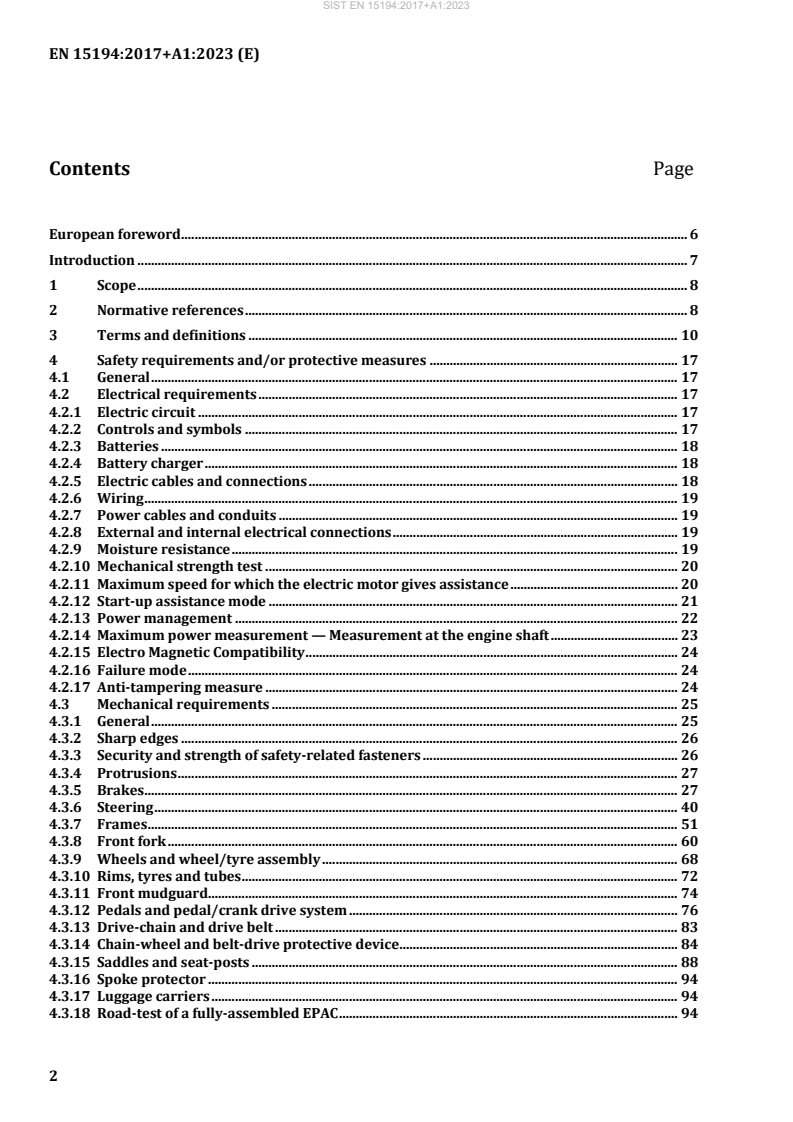
Contents Page
European foreword . 6
Introduction . 7
1 Scope . 8
2 Normative references . 8
3 Terms and definitions . 10
4 Safety requirements and/or protective measures . 17
4.1 General . 17
4.2 Electrical requirements . 17
4.2.1 Electric circuit . 17
4.2.2 Controls and symbols . 17
4.2.3 Batteries . 18
4.2.4 Battery charger . 18
4.2.5 Electric cables and connections . 18
4.2.6 Wiring . 19
4.2.7 Power cables and conduits . 19
4.2.8 External and internal electrical connections . 19
4.2.9 Moisture resistance . 19
4.2.10 Mechanical strength test . 20
4.2.11 Maximum speed for which the electric motor gives assistance . 20
4.2.12 Start-up assistance mode . 21
4.2.13 Power management . 22
4.2.14 Maximum power measurement — Measurement at the engine shaft . 23
4.2.15 Electro Magnetic Compatibility . 24
4.2.16 Failure mode . 24
4.2.17 Anti-tampering measure . 24
4.3 Mechanical requirements . 25
4.3.1 General . 25
4.3.2 Sharp edges . 26
4.3.3 Security and strength of safety-related fasteners . 26
4.3.4 Protrusions . 27
4.3.5 Brakes. 27
4.3.6 Steering . 40
4.3.7 Frames . 51
4.3.8 Front fork . 60
4.3.9 Wheels and wheel/tyre assembly . 68
4.3.10 Rims, tyres and tubes . 72
4.3.11 Front mudguard . 74
4.3.12 Pedals and pedal/crank drive system . 76
4.3.13 Drive-chain and drive belt . 83
4.3.14 Chain-wheel and belt-drive protective device . 84
4.3.15 Saddles and seat-posts . 88
4.3.16 Spoke protector . 94
4.3.17 Luggage carriers . 94
4.3.18 Road-test of a fully-assembled EPAC . 94
4.3.19 Lighting systems and reflectors . 95
4.3.20 Warning device . 96
4.3.21 Thermal hazards . 96
4.3.22 Performance levels (PLrs) for control system of EPACs . 96
4.4 List of significant hazards . 96
5 Marking, labelling . 97
5.1 Requirement . 97
5.2 Durability test . 98
5.2.1 Requirement . 98
5.2.2 Test method . 98
6 Instruction for use . 98
Annex A (informative) Example of relation between speed, torque and current . 101
Annex B (normative) Electromagnetic compatibility of EPAC and ESA . 104
B.1 Conditions applying to EPAC and to electrical/electronic sub-assemblies (ESA) . 104
B.1.1 Marking . 104
B.1.2 Requirements . 104
B.1.2.1 General requirements . 104
B.1.2.2 Broad-band radiation from EPAC . 106
B.1.2.3 Requirements relating to narrow-band radiation emissions from EPAC . 107
B.1.2.4 Requirements regarding EPAC immunity to electromagnetic radiation . 107
B.1.2.5 Requirements concerning broad-band ESA radiation . 107
B.1.2.6 Requirements concerning narrow-band ESA radiation emission . 108
B.1.2.7 Requirements concerning ESA immunity to electromagnetic radiation . 108
B.2 Method of measuring broad-band electromagnetic radiation from EPA . 108
B.2.1 Measuring equipment . 108
B.2.2 Test method . 109
B.2.2.1 General . 109
B.2.2.2 Test conditions . 109
B.2.2.3 State of the EPAC during the test . 109
B.2.2.4 Antenna type, position and orientation . 109
B.2.3 Measurement . 109
B.3 Method of measuring narrow band electromagnetic radiation from EPAC . 109
B.3.1 General . 109
B.3.1.1 Measuring equipment . 109
B.3.1.2 Test method . 109
B.3.1.3 Test conditions . 109
B.3.1.4 State of the EPAC during the tests . 109
B.3.2 Antenna type, position and orientation . 109
B.4 Methods of testing EPAC immunity to electromagnetic radiation . 110
B.4.1 General . 110
B.4.2 Expression of results . 110
B.4.3 Test conditions . 110
B.4.4 State of the EPAC during the tests . 110
B.4.5 Type, position and orientation of the field generator . 111
B.4.5.1 Type of field generator . 111
B.4.5.2 Measurement height and distance . 111
B.4.5.3 Position of the antenna in relation to the EPAC . 111
B.4.5.4 Position of the EPAC . 112
B.4.6 Requisite test and condition . 112
B.4.6.1 Range of frequencies, duration of the tests, polarization . 112
B.4.6.2 Tests to check deterioration in direct control . 112
B.4.7 Generation of the requisite field strength . 112
B.4.7.1 Test method . 112
B.4.7.2 Field strength contour . 113
B.4.7.3 Characteristics of the test signal to be generated . 113
B.4.8 Inspection and monitoring equipment . 114
B.5 Method of measuring broad-band electromagnetic radiation from separate technical
units (ESA) . 114
B.5.1 General . 114
B.5.1.1 Measuring equipment . 114
B.5.1.2 Test method - Test conditions . 114
B.5.2 State of the ESA during the test . 114
B.5.3 Antenna type, position and orientation . 114
B.6 Method of measuring narrow-band electromagnetic radiation from separate
technical units (ESAs) . 114
B.6.1 General . 114
B.6.1.1 Measuring equipment . 114
B.6.1.2 Test method . 114
B.6.2 Test conditions . 114
B.6.3 State of the ESA during the tests . 114
B.6.4 Antenna type, position and orientation . 114
B.7 Methods of testing the ESA immunity to electromagnetic radiation . 115
B.7.1 General . 115
B.7.2 Expression of results . 115
B.7.3 Test conditions . 115
B.7.4 State of the ESA during the tests . 115
B.7.5 Requisite test and condition . 115
B.7.5.1 Test methods . 115
B.7.5.2 Range of frequencies, duration of the tests, polarization . 115
B.7.5.3 Tests to check deterioration in direct control . 115
B.7.6 Generation of the requisite field strength . 116
B.7.6.1 Test method . 116
B.7.6.2 Characteristics of the test signal to be generated . 116
B.7.7 Inspection and monitoring equipment . 116
B.8 ESD test . 117
Annex C (informative) Steering geometry . 118
Annex D (normative) Dummy fork characteristics . 119
Annex E (informative) Explanation of the method of least squares for obtaining line of best
fit and ± 20 % limit lines for braking performance linearity . 121
Annex F (normative) Fork mounting fixture . 124
Annex G (informative) Wheel/tyre assembly - Fatigue test . 125
G.1 Requirements . 125
G.2 Test method . 125
Annex H (normative) Light, warning device, on/off symbols . 127
Annex I (informative) Walk assist mode symbols . 128
Annex ZA (informative) Relationship between this European Standard and the essential
requirements of EU Directive 2006/42/EC aimed to be covered . 129
Bibliography . 133
European foreword
This document (EN 15194:2017+A1:2023) has been prepared by Technical Committee CEN/TC 333
“Cycles”, the secretariat of which is held by UNI.
This European Standard shall be given the status of a national standard, either by publication of an
identical text or by endorsement, at the latest by February 2024, and conflicting national standards
shall be withdrawn at the latest by August 2025.
Attention is drawn to the possibility that some of the elements of this document may be the subject of
patent rights. CEN shall not be held responsible for identifying any or all such patent rights.
This document supersedes !EN 15194:2017".
!EN 15194:2017+A1:2023 includes the following significant technical changes with respect to
EN 15194:2017:
— 4.2.3 “Batteries”: reference to EN standard applicable to batteries of EPAC has been updated with
the new latest edition, in line with specific request of National Authority to reinforce Machinery
directive requirements,
— Annex A “Example of recommendation for battery charging” has been removed."
This document includes Amendment 1 approved by CEN on 22 August 2022.
The start and finish of text introduced or altered by amendment is indicated in the text by tags !".
!This document has been prepared under a standardization request addressed to CEN by the
European Commission. The Standing Committee of the EFTA States subsequently approves these
requests for its Member States.
For the relationship with EU Legislation, see informative Annex ZA, which is an integral part of this
document."
This standard also includes all mechanic requirements applicable to the EPACs and is therefore a stand-
alone document.
Any feedback and questions on this document should be directed to the users’ national standards body.
A complete listing of these bodies can be found on the CEN website.
According to the CEN-CENELEC Internal Regulations, the national standards organisations of the
following countries are bound to implement this European Standard: Austria, Belgium, Bulgaria,
Croatia, Cyprus, Czech Republic, Denmark, Estonia, Finland, France, Germany, Greece, Hungary, Iceland,
Ireland, Italy, Latvia, Lithuania, Luxembourg, Malta, Netherlands, Norway, Poland, Portugal, Republic of
North Macedonia, Romania, Serbia, Slovakia, Slovenia, Spain, Sweden, Switzerland, Türkiye and the
United Kingdom.
Introduction
This European Standard gives requirements for electrically power assisted cycles (EPAC).
This European Standard has been developed in response to demand throughout Europe. Its aim is to
provide a standard for the assessment of electrically powered cycles of a type which are excluded from
type approval by Regulation (EU) No 168/2013.
Due to the limitation of the voltage to 48 V d.c., there are no special requirements applicable to the
EPAC in regard to protection against electrical hazards.
Following the completion of a risk analysis, the focus in this standard is on EPAC as bicycles for city and
trekking. Folding bicycles are included.
This document is a type C standard as stated in EN ISO 12100. The machinery concerned and the extent
to which hazards, hazardous situations and hazardous events covered are indicated in the scope of this
document.
When provisions of this type C standard are different from those which are stated in type A or B
standards, the provisions of this type C standard take precedence over the provisions of the other
standards, for machines that have been designed and built according to the provisions of this type C
standard.
In real life situation an EPAC can fall over to the side causing the battery holder to break without
damage to the battery case itself. While the standard contains a strength test for the battery an
additional test is required for the situation described. This will be considered at the next revision. The
battery holder needs to withstand this realistic and typical situation. Risk assessment carried out by the
manufacturer should identify suitable measures to deal with this situation until it can be dealt with in
the standard.
1 Scope
This European Standard applies to EPAC bicycles for private and commercial use with exception of
EPAC intended for hire from unattended station.
This European Standard is intended to cover all common significant hazards, hazardous situations and
events (see Clause 4) of electrically power assisted bicycles, when used as intended and under condition
of misuse that are reasonably foreseeable by the manufacturer.
This European Standard is intended to cover electrically power assisted bicycles of a type which have a
maximum continuous rated power of 0,25 kW, of which the output is progressively reduced and finally
cut off as the EPAC reaches a speed of 25 km/h, or sooner, if the cyclist stops pedalling.
This European Standard specifies requirements and test methods for engine power management
systems, electrical circuits including the charging system for the design and assembly of electrically
power assisted bicycles and sub-assemblies for systems having a rated voltage up to and including
48 V d.c. or integrated battery charger with a nominal 230 V a.c. input.
This European Standard specifies safety and safety related performance requirements for the design,
assembly, and testing of EPAC bicycles and subassemblies intended for use on public roads, and lays
down guidelines for instructions on the use and care of such bicycles.
This European Standard applies to EPAC bicycles that have a maximum saddle height of 635 mm or
more and that are intended for use on public roads.
This European Standard is not applicable to EPACs which are manufactured before the date of its
publication as EN.
2 Normative references
The following documents, in whole or in part, are normatively referenced in this document and are
indispensable for its application. For dated references, only the edition cited applies. For undated
references, the latest edition of the referenced document (including any amendments) applies.
EN 22248:1992, Packaging — Complete, filled transport packages — Vertical impact test by dropping
(ISO 2248:1985)
!EN 50604-1:2016, Secondary lithium batteries for light EV (electric vehicle) applications – Part 1:
General safety requirements and test methods
EN 50604-1:2016/A1:2021, Secondary lithium batteries for light EV (electric vehicle) applications –
Part 1: General safety requirements and test methods"
EN 55012:2007, Vehicles, boats and internal combustion engines — Radio disturbance characteristics —
Limits and methods of measurement for the protection of on-board receivers (CISPR 12:2007)
!EN IEC 55016-1-1:2019, Specification for radio disturbance and immunity measuring apparatus and
methods — Part 1-1: Radio disturbance and immunity measuring apparatus — Measuring apparatus
(CISPR 16-1-1:2019)"
!EN 55025:2017, Vehicles, boats and internal combustion engines — Radio disturbance
characteristics —Limits and methods of measurement for the protection of on-board receivers
(CISPR 25:2016)"
EN 60034-1:2010, Rotating electrical machines — Part 1: Rating and performance (IEC 60034-1:2010,
modified)
EN 60068-2-75:2014, Environmental testing — Part 2-75: Tests — Test Eh: Hammer tests (IEC 60068-2-
75:2014)
EN 60335-1:2012, Household and similar electrical appliances — Safety — Part 1: General requirements
(IEC 60335-1:2010, modified)
HD 60364-5-52:2011, Low-voltage electrical installations — Part 5-52: Selection and erection of
electrical equipment — Wiring systems (IEC 60364-5-52:2009, modified)
EN 60529:1991, Degrees of protection provided by enclosures (IP Code) (IEC 60529:1989)
EN 61000-4-2:2009, Electromagnetic compatibility (EMC) — Part 4-2: Testing and measurement
techniques — Electrostatic discharge immunity test (IEC 61000-4-2:2008)
!EN ISO 7010:2020, Graphical symbols — Safety colours and safety signs — Registered safety signs
(ISO 7010:2019)"
EN ISO 11243:2016, Cycles — Luggage carriers for bicycles — Requirements and test methods
(ISO 11243:2016)
EN ISO 12100:2010, Safety of machinery — General principles for design — Risk assessment and risk
reduction (ISO 12100:2010)
EN ISO 13849-1:2015, Safety of machinery — Safety-related parts of control systems — Part 1: General
principles for design (ISO 13849-1:2015)
!EN ISO 13849-2:2012, Safety of machinery – Safety-related parts of control systems – Part 2:
Validation (ISO 13849-2:2012)"
ISO 5775-1:2014, Bicycle tyres and rims — Part 1: Tyre designations and dimensions
!ISO 5775-2:2021, Bicycle tyres and rims — Part 2: Rims"
ISO 6742-1:2015, Cycles -- Lighting and retro-reflective devices — Part 1: Lighting and light signalling
devices
ISO 6742-2:2015, Cycles — Lighting and retro-reflective devices — Part 2: Retro-reflective devices
ISO 9633:2001, Cycle chains — Characteristics and test methods
ISO 11451-1:2015, Road vehicles — Vehicle test methods for electrical disturbances from narrowband
radiated electromagnetic energy — Part 1: General principles and terminology
ISO 11452-1:2015, Road vehicles — Component test methods for electrical disturbances from narrowband
radiated electromagnetic energy — Part 1: General principles and terminology
!ISO 11452-2:2019, Road vehicles — Component test methods for electrical disturbances from
narrowband radiated electromagnetic energy — Part 2: Absorber-lined shielded enclosure"
ISO 11452-3:2016, Road vehicles — Component test methods for electrical disturbances from narrowband
radiated electromagnetic energy — Part 3: Transverse electromagnetic (TEM) cell
!ISO 11452-4:2020, Road vehicles — Component test methods for electrical disturbances from
narrowband radiated electromagnetic energy — Part 4: Harness excitation methods"
ISO 11452-5:2002, Road vehicles — Component test methods for electrical disturbances from narrowband
radiated electromagnetic energy — Part 5: Stripline
3 Terms and definitions
For the purposes of this document, the following terms and definitions apply.
3.1
cycle
vehicle that has at least two wheels and is propelled solely or mainly by the muscular energy of the
person on that vehicle, in particular by means of pedals
3.2
bicycle
two-wheeled vehicle that is propelled solely or mainly by the muscular energy of the person on that
vehicle, in particular by means of pedals
3.3
electrically power assisted cycle
EPAC
cycle, equipped with pedals and an auxiliary electric motor, which cannot be propelled exclusively by
means of this auxiliary electric motor, except in the start-up assistance mode
3.4
city and trekking bicycle
bicycle designed for use on public roads primarily for means of transportation or leisure
3.5
mountain-bicycle
bicycle designed for use off-road on rough terrain, on public roads and on public pathways equipped
with a suitably strengthened frame and other components, and, typically, with wide-section tyres with
coarse tread patterns and a wide range of transmission gears
3.6
racing-bicycle
bicycle intended for high-speed amateur use on public roads having a steering assembly with multiple
grip positions allowing for an aerodynamic posture, a multi-speed transmission system, tyre width not
greater than 28 mm, and a maximum mass of 12 kg for the fully assembled bicycle
3.7
recumbent bicycle
bicycle that places the rider in a laid-back reclining position
3.8
young adult bicycle
bicycle designed for use on public roads by a young adult whose weight is less than 40 kg with
maximum saddle height of 635 mm or more and less than 750 mm
3.9
fully assembled bicycle
bicycle fitted with all the components necessary for its intended use
3.10
folding bicycle
bicycle designed to fold into a compact form, facilitating transport and storage
3.11
bar-end
extension secured to the end of a handlebar to provide an additional hand-grip and usually with its axis
perpendicular to the axis of the end of the handlebar
3.12
brake-lever
lever that operates a braking device
3.13
disc-brake
brake in which pads are used to grip the lateral faces of a thin disc attached to or incorporated in the
wheel-hub
3.14
braking distance
distance travelled by a bicycle between the commencement of braking (3.16) and the point at which the
bicycle comes to rest
3.15
braking force
F
Br
tangential rearward force between the tyre and the ground or the tyre and the drum or belt of the test
machine
3.16
commencement of braking
point on the test track or test machine at which the brake actuating device operated directly by the
riders hand or foot or by a test mechanism starts to move from its rest position
Note 1 to entry: On the test track, this point is determined by the first brake-actuating device (front or rear) to
operate.
3.17
brake-lever cut-off switch
device that cuts off the motor assistance while using the brake lever
3.18
composite materials
component that is entirely or partially made of a non-metallic matrix materials which is reinforced by
metallic or non-metallic materials such as short or long fibres, fabric or particles
3.19
composite wheels
wheel assembly containing any composite material
3.20
continuous rated power
output power specified by manufacturer, at which the motor reaches its thermal equilibrium at given
ambient conditions
3.21
thermal equilibrium
temperatures of motor parts which do not vary more than 2K per h
3.22
crank assembly
assembly for fatigue testing consisting of the drive side and the non-drive side crank arm, the pedal
spindle-adaptors, the bottom-bracket spindle, and the first component of the drive system
EXAMPLE The chain-wheel set.
3.23
cut off speed
speed reached, by the EPAC, at the moment the current has dropped to zero or to the no load current
value
3.24
drive belt
seamless ring belt which is used as a means of transmitting motive force
3.25
dummy fork
test fork manufactured to specific characteristics that can be substituted within a test for either the fork
supplied by the manufacturer or where a fork has not been supplied
3.26
electromagnetic compatibility
ability of an EPAC or one of its electrical/electronic systems to function satisfactorily in its
electromagnetic environment without introducing intolerable electromagnetic disturbance to anything
in that environment
3.27
electromagnetic disturbance
electromagnetic phenomenon such as electromagnetic noise, an unwanted signal or a change in the
propagation medium itself which may degrade the performance of an EPAC or one of its
electronic/electrical systems
3.28
electromagnetic environment
all electromagnetic phenomena present in a given situation
3.29
electromagnetic immunity
ability of an EPAC or one of its electronic/electrical systems to perform without degradation of its
performance in the presence of specific electromagnetic disturbance
3.30
electronic/electrical subassembly
ESA
electronic and/or electrical component, or an assembly of components provided for installation into an
EPAC, together with all electrical connections and associated wiring for the execution of several specific
functions
3.31
ESA test
test carried out on one or more specific ESAs
3.32
ESA type in relation to electromagnetic compatibility
separate technical ESA unit that does not differ from other units in its essential design and construction
aspects
Note 1 to entry: For example:
— the function performed by the ESA;
— the general layout of the electronic and/or electrical components;
— direct vehicle control performed by the rider acting on the steering, the brakes and the accelerator
control.
3.33
exposed protrusion
protrusion which through its location and rigidity could present a hazard to the rider either through
heavy contact with it in normal use or should the rider fall onto it in an accident
3.34
fork steerer
fork stem
part of a fork that rotates about the steering axis of a bicycle frame head tube
Note1 to entry: It is normally connected to the fork crown or directly to the fork legs, and is normally the point
of connection between the fork and the handlebar stem.
3.35
fracture
unintentional separation into two or more parts
3.36
full discharge of the battery
point at which the battery does not deliver any power/energy to the motor, according to the battery
manufacturer’s specifications
Note1 to entry: It is recommended that the battery cells be never fully discharged and residual current of
battery be used by other devices.
3.37
highest gear
gear ratio which gives the greatest distance travelled for one rotation of the cranks
3.38
hub-brake
brake which acts directly on the wheel-hub
3.39
hub-generator
electric generating device built in the wheel-hub
3.40
integrated charger
charger which is a part of the bicycle and needs tools to be disassembled from it
3.41
electrical control system
electronic and/or electrical component, or an assembly of components provided for installation into a
vehicle, together with all electrical connections and associated wiring for the engine electrical power
assistance
3.42
lowest gear
gear ratio which gives the shortest distance travelled for one rotation of the cranks
3.43
maximum inflation pressure
maximum tyre pressure recommended by the tyre or rim manufacturer for a safe and efficient
performance
Note 1 to entry: If the rim and tyre both indicate a maximum inflation pressure, the maximum inflation
pressure is the lowest of the two pressures indicated.
3.44
maximum saddle height
vertical distance from the ground to the point where the top of the seat surface is intersected by the
seat-post axis, measured with the seat in a horizontal position and with the seat-post set to the
minimum insertion-depth mark
3.45
maximum assisted speed by design
maximum designed speed up to which assistance is provided
3.46
minimum insertion-depth mark
mark indicating the minimum insertion-depth of handlebar stem into fork steerer (fork stem) or seat-
post into frame
3.47
narrow-band emission
emission which has a bandwidth less than that of a specific receiver or measuring instrument
3.48
no load current point
current for which there is no torque on the driving wheel
3.49
off-road rough-terrain
coarse pebble tracks, forest trails, and other general off-road tracks where tree-roots and rocks are
likely to be encountered
3.50
pedal tread-surface
surface of a pedal that is presented to the underside of the foot
3.51
primary retention system
system that keeps the front/rear wheel securely attached to the frame/fork dropouts whilst riding
3.52
public road
any designated and adopted road, pavement, path or track on which a bicycle is legally permitted to
travel and on most though not all such public roads, bicycles will share use with other forms of
transport including motorized traffic
3.53
pulley
rotating wheel mounted on an axle, that contains around its circumference teeth or groove over which a
belt can pass to transmit power
3.54
quick-release device
l
...