


EN 1993-1-3:2024
(Main)Eurocode 3 - Design of steel structures - Part 1-3: Cold-formed members and sheeting
Eurocode 3 - Design of steel structures - Part 1-3: Cold-formed members and sheeting
1.1 Scope of prEN 1993-1-3
(1) This document provides rules for structural design of cold-formed steel members and sheeting.
(2) This document applies to cold-formed steel products made from coated or uncoated hot- or cold-rolled sheet or strip, which have been cold-formed by processes such as roll-forming or press braking. It also covers sheeting and members which are curved during fabrication by continuous bending or roll-forming. Sheeting which has the curvature created by crushing the inner flanges is not included. This document is also applicable to the design of profiled steel sheeting for composite steel and concrete slabs at the construction stage, see EN 1994. The execution of steel structures made of cold-formed steel members and sheeting is covered in EN 1090 4. Provisions for bolted connections are provided in EN 1090 2.
NOTE The rules in prEN 1993 1 3 complement the rules in other parts of EN 1993 1.
(3) Methods are also given for stressed-skin design, using steel sheeting as a structural diaphragm.
(4) This document does not apply to cold-formed circular and rectangular structural hollow sections supplied to EN 10219, for which reference is made to EN 1993 1 1 and EN 1993 1 8.
(5) This document provides methods for design by calculation and for design assisted by testing. The methods for design by calculation apply only within the stated ranges of material properties and geometric proportions, for which sufficient experience and test evidence is available. These limitations do not apply to design assisted by testing.
1.2 Assumptions
(1) Unless specifically stated, EN 1990, EN 1991 (all parts) and EN 1993 1 1 apply.
(2) The design methods given in prEN 1993 1 3 are applicable if:
- the execution quality is as specified in EN 1090 4, the execution quality of bolted connections is as specified in EN 1090 2, and
- the construction materials and products are as specified in the relevant parts of EN 1993 (all parts), or in the relevant material and product specifications.
(2) EN 1993 is intended to be used in conjunction with:
- the parts of EN 1992 to EN 1999 where steel structures or steel components are referred to within those documents;
- EN, EAD and ETA standards for construction products relevant to steel structures.
Eurocode 3 - Bemessung und Konstruktion von Stahlbauten - Teil 1-3: Kaltgeformte Bauteile und Profiltafeln
1.1 Anwendungsbereich zu FprEN 1993 1 3
(1) Dieses Dokument enthält Regeln für die Tragwerksplanung von kaltgeformten Stahlbauteilen und Profiltafeln.
(2) Dieses Dokument gilt für kaltgeformte Stahlerzeugnisse aus beschichtetem oder nicht beschichtetem, warm- oder kaltgewalzten Blech oder Band, das durch Rollprofilier- oder Kantverfahren kaltgeformt wurde. Sie behandelt ebenfalls Profiltafeln und Bauteile, die während der Fertigung durch stetiges Biegen oder Rollprofilieren gekrümmt werden. Profiltafeln, deren Krümmung durch Stauchung der Innengurte erzeugt wird, sind nicht enthalten. Dieses Dokument gilt auch für die Bemessung von Profiltafeln für Stahl-Beton-Verbunddecken im Bauzustand, siehe EN 1994 (alle Teile). Die Ausführung von Stahltragwerken aus kaltgeformten Stahlbauteilen ist in EN 1090 4 geregelt. EN 1090 2 enthält Festlegungen zu Schraubverbindungen.
ANMERKUNG Die Regelungen in FprEN 1993 1 3 ergänzen die Regelungen in anderen Teilen von EN 1993 1.
(3) Es werden auch Bemessungsverfahren für Schubfeldkonstruktionen mit Stahl-Profiltafeln angegeben.
(4) Dieses Dokument gilt nicht für kaltgeformte Rund- und Rechteckhohlprofile, die nach EN 10219 (alle Teile) geliefert werden; hierzu wird auf EN 1993 1 1 und EN 1993 1 8 verwiesen.
(5) Dieses Dokument enthält Verfahren für die rechnerische Bemessung und die versuchsgestützte Bemessung. Die rechnerischen Bemessungsverfahren gelten nur in den angegebenen Grenzen für die Werkstoffkennwerte und geometrischen Verhältnisse, für die ausreichende Erfahrung und Versuchsergebnisse vorhanden sind. Diese Einschränkungen gelten nicht für die versuchsgestützte Bemessung.
1.2 Annahmen
(1) Sofern nicht ausdrücklich angegeben, gelten EN 1990, EN 1991 (alle Teile) und EN 1993 1 1.
(2) Die Bemessungsverfahren nach FprEN 1993 1 3 gelten, wenn:
- die Ausführungsqualität den Festlegungen nach EN 1090 4 entspricht, die Ausführungsqualität der Schraubenverbindungen den Festlegungen nach EN 1090 2 entspricht; und
- die Werkstoffe und Bauprodukte den Festlegungen in den maßgebenden Teilen von EN 1993 (alle Teile) oder in den maßgebenden Werkstoff- und Produktspezifikationen entsprechen.
(3) EN 1993 muss angewendet werden in Verbindung mit:
- den Teilen von EN 1992 bis EN 1999, wenn in diesen Dokumenten auf Stahltragwerke und Stahlbauteile Bezug genommen wird;
- EN-, EAD- und ETA-Normen für Bauprodukte, die für Stahltragwerke maßgebend sind.
Eurocode 3 - Calcul des structures en acier - Partie 1-3: Règles générales - Profilés et plaques formés à froid
Domaine d'application du FprEN 1993-1-3
(1) Le présent document fournit des règles pour le calcul des structures des profilés et plaques nervurées en acier formés à froid.
(2) Le présent document s'applique aux produits en acier formés à froid par des procédés tels que le profilage aux galets ou le pliage à la presse plieuse, à partir de tôles ou bandes d'acier laminées à chaud ou à froid, revêtues ou non revêtues. Il couvre également les plaques nervurées et les profilés qui sont cintrés pendant la fabrication par un procédé de cintrage continu ou de profilage aux galets. Il ne couvre pas les plaques nervurées dont la courbure est obtenue par écrasement des semelles intérieures. Le présent document s'applique également au calcul des plaques nervurées en acier destinées aux dalles mixtes acier-béton en phase de coulage, voir EN 1994 (toutes les parties). L'exécution des structures en acier constituées de profilés et de plaques nervurées en acier formés à froid est couverte par l'EN 1090-4. Des dispositions pour les assemblages boulonnés sont fournies dans l'EN 1090-2.
NOTE Les règles données dans le FprEN 1993-1-3 complètent celles des autres parties de l'EN 1993-1.
(3) Le présent document donne également des méthodes de calcul pour le dimensionnement des structures, tenant compte de la collaboration de paroi, en utilisant des plaques nervurées en acier comme diaphragme.
(4) Le présent document ne s'applique pas aux profils creux de construction circulaires et rectangulaires formés à froid fournis suivant l'EN 10219, pour lesquels il convient de se reporter à l'EN 1993-1-1 et à l'EN 1993-1-8.
(5) Le présent document fournit des méthodes de dimensionnement par calcul et de dimensionnement assisté par des essais. Les méthodes de dimensionnement par calcul ne s'appliquent que dans des gammes bien définies de caractéristiques de matériaux et de proportions géométriques pour lesquelles on dispose d'une expérience suffisante et d'une validation par essais. Ces limitations ne s'appliquent pas au dimensionnement assisté par des essais.
1.2 Hypothèses
(1) Sauf indication contraire, l'EN 1990, l'EN 1991(toutes les parties) et l'EN 1993 1 1 s'appliquent.
(2) Les méthodes de calcul données dans le FprEN 1993 1 3 sont applicables si :
- la qualité de l'exécution est telle que spécifiée dans l'EN 1090 4, la qualité de l'exécution des assemblages boulonnés est telle que spécifiée dans l'EN 1090 2 ; et
- les matériaux et produits de construction sont tels que spécifiés dans les parties pertinentes de l'EN 1993 (toutes les parties) ou dans les spécifications de matériaux et de produits appropriées.
(3) L'EN 1993 est destiné à être utilisé conjointement avec :
- les parties de l'EN 1992 à l'EN 1999 lorsque des structures en acier ou des composants en acier sont référencés dans ces documents ;
- les normes EN pour les produits de construction pertinents pour les structures en acier.
Evrokod 3 - Projektiranje jeklenih konstrukcij - 1-3. del: Hladno oblikovani profili in pločevina
(1) Ta dokument podaja pravila za konstrukcijsko projektiranje hladno oblikovanih jeklenih profilov in pločevine.
(2) Uporablja se za hladno oblikovane jeklene proizvode, izdelane iz prevlečene ali neprevlečene hladno ali vroče valjane pločevine ali trakov, ki so bili hladno oblikovani s postopki, kot sta oblikovanje zvitkov ali krivljenje pločevine. Zajema tudi pločevino in profile, ki so med izdelavo ukrivljeni s stalnim upogibanjem ali valjanjem. Pločevina z ukrivljenostjo, ki nastane zaradi zmečkanja notranjih prirobnic, ni vključena. Ta dokument se uporablja tudi za projektiranje profilirane jeklene pločevine za kompozitne jeklene in betonske plošče v fazi gradnje; glej standard EN 1994. Izvedba jeklenih konstrukcij, izdelanih iz hladno oblikovanih jeklenih profilov in pločevine, je zajeta v standardu EN 1090-4. Določbe za vijačne spoje so podane v standardu EN 1090-2.
OPOMBA: Pravila v standardu prEN 1993-1-3 dopolnjujejo pravila iz drugih delov standarda EN 1993-1.
(3) Podane so tudi metode za projektiranje konstrukcij z obremenjeno lupino, pri katerih se jeklena pločevina uporablja kot zaščitna plast.
(4) Ta dokument se ne uporablja za hladno oblikovane okrogle in pravokotne votle konstrukcijske profile iz standarda EN 10219, na katerega se sklicujeta standarda EN 1993-1-1 in EN 1993-1-8.
(5) Ta dokument podaja metode za projektiranje z izračuni in za projektiranje s pomočjo preskušanja. Metode za projektiranje z izračuni se uporabljajo samo za navedene razpone lastnosti materiala in geometričnih lastnosti, za katere je na voljo dovolj izkušenj in preskusnih rezultatov. Te omejitve ne veljajo za projektiranje s pomočjo preskušanja.
1.2 Predpostavke
(1) Če ni izrecno navedeno drugače, se uporabljajo standardi EN 1990, EN 1991 (vsi deli) in EN 1993-1-1.
(2) Metode za projektiranje, podane v standardu prEN 1993-1-3, se uporabljajo, če:
– je kakovost izvedbe takšna, kot je določeno v standardu EN 1090-4, in je kakovost izvedbe vijačnih spojev takšna, kot je določeno v standardu EN 1090-2; ter
– so uporabljeni gradbeni materiali in proizvodi iz ustreznih delov standarda EN 1993 (vsi deli) ali ustreznih specifikacij za materiale in proizvode.
(2) Standard EN 1993 je namenjen za uporabo v povezavi z naslednjimi standardi:
– deli standardov EN 1992 do EN 1999, kjer se ti dokumenti sklicujejo na jeklene konstrukcije ali jeklene komponente;
– standardi EN, EAD in ETA za gradbene proizvode, ki veljajo za jeklene konstrukcije.
General Information
- Status
- Published
- Publication Date
- 26-Mar-2024
- Technical Committee
- CEN/TC 250 - Structural Eurocodes
- Drafting Committee
- CEN/TC 250/SC 3/WG 3 - Evolution of EN 1993-1-3 - Cold-formed members
- Current Stage
- 6060 - Definitive text made available (DAV) - Publishing
- Start Date
- 27-Mar-2024
- Due Date
- 28-Nov-2021
- Completion Date
- 27-Mar-2024
Relations
- Effective Date
- 08-Apr-2024
- Effective Date
- 28-Jan-2026
- Effective Date
- 28-Jan-2026
- Effective Date
- 28-Jan-2026
- Effective Date
- 28-Jan-2026
- Effective Date
- 28-Jan-2026
- Effective Date
- 28-Jan-2026
- Refers
EN 1993-1-5:2024 - Eurocode 3 - Design of steel structures - Part 1-5: Plated structural elements - Effective Date
- 28-Jan-2026
- Effective Date
- 28-Jan-2026
- Effective Date
- 28-Jan-2026
- Effective Date
- 28-Jan-2026
- Refers
EN 1993-6:2007 - Eurocode 3 - Design of steel structures - Part 6: Crane supporting structures - Effective Date
- 28-Jan-2026
- Effective Date
- 28-Jan-2026
- Effective Date
- 28-Jan-2026
- Effective Date
- 28-Jan-2026
Overview
EN 1993-1-3:2024 - Eurocode 3: Design of steel structures - Part 1-3: Cold‑formed members and sheeting provides harmonised European rules for the structural design of cold‑formed steel products and profiled sheeting. Published by CEN in 2024, it replaces the 2006 edition and forms part of the second‑generation Eurocodes. The standard covers design by calculation and design assisted by testing, and includes provisions for stressed‑skin (diaphragm) action of sheeting and for profiled sheeting used in composite slabs at the construction stage.
Key topics and requirements
- Scope of materials and forms: Applies to coated or uncoated hot‑ or cold‑rolled sheet or strip that has been cold‑formed (e.g., roll‑forming, press‑braking). Curved members produced by continuous bending or roll‑forming are included; sheeting curved by crushing inner flanges is excluded.
- Design methods: Rules for design by calculation within validated geometric and material ranges, and procedures for design assisted by testing where calculation limits do not apply.
- Buckling and stability: Detailed treatment of local, distortional and global buckling modes specific to thin‑walled cold‑formed sections and profiled sheeting.
- Cross‑sectional analysis: Effective width/ thickness methods, provisions for outstand elements, and criteria for sections with multiple unstiffened webs.
- Connections and execution: References execution quality and bolted connection requirements to EN 1090 (execution) and EN 1090‑2 (bolted connections). Welding and fastening provisions are included.
- Special systems: Stressed‑skin design using sheeting as structural diaphragms, and rules for liner trays, sandwich panels and sheeting‑restraint effects.
- Testing and annexes: Normative annex with testing procedures and informative annexes addressing fastener durability and mixed effective width/thickness methods.
- Limitations: Excludes cold‑formed circular and rectangular hollow sections supplied to EN 10219 (covered by EN 1993‑1‑1 and EN 1993‑1‑8).
Practical applications
- Design and verification of roofing and wall profiled sheeting, cold‑formed purlins, girts, liner trays and light steel framing.
- Use in the design of profiled sheeting for composite steel–concrete slabs during construction (see EN 1994).
- Guidance for fabricators, structural engineers, manufacturers of cold‑formed sections, construction contractors and test laboratories when designing thin‑walled steel elements and connections.
Who uses this standard
- Structural and façade engineers, detailing engineers and fabricators working with cold‑formed steel
- Manufacturers of profiled sheeting, fasteners and light gauge sections
- Certification bodies, testing laboratories and software developers producing compliant calculation tools
- Authorities and clients referencing Eurocode design rules
Related standards
- EN 1990 (Basis of structural design), EN 1991 (Actions)
- EN 1993 family (especially EN 1993‑1‑1)
- EN 1994 (composite steel and concrete)
- EN 1090‑1/2/4 (execution and connections)
- EN 10219 (cold‑formed hollow sections - excluded from this part)
Keywords: EN 1993‑1‑3:2024, Eurocode 3, cold‑formed members, profiled sheeting, design of steel structures, stressed‑skin design, thin‑walled steel.

Get Certified
Connect with accredited certification bodies for this standard

ICC Evaluation Service
Building products evaluation and certification.

QAI Laboratories
Building and construction product testing and certification.

Aboma Certification B.V.
Specialized in construction, metal, and transport sectors.
Sponsored listings
Frequently Asked Questions
EN 1993-1-3:2024 is a standard published by the European Committee for Standardization (CEN). Its full title is "Eurocode 3 - Design of steel structures - Part 1-3: Cold-formed members and sheeting". This standard covers: 1.1 Scope of prEN 1993-1-3 (1) This document provides rules for structural design of cold-formed steel members and sheeting. (2) This document applies to cold-formed steel products made from coated or uncoated hot- or cold-rolled sheet or strip, which have been cold-formed by processes such as roll-forming or press braking. It also covers sheeting and members which are curved during fabrication by continuous bending or roll-forming. Sheeting which has the curvature created by crushing the inner flanges is not included. This document is also applicable to the design of profiled steel sheeting for composite steel and concrete slabs at the construction stage, see EN 1994. The execution of steel structures made of cold-formed steel members and sheeting is covered in EN 1090 4. Provisions for bolted connections are provided in EN 1090 2. NOTE The rules in prEN 1993 1 3 complement the rules in other parts of EN 1993 1. (3) Methods are also given for stressed-skin design, using steel sheeting as a structural diaphragm. (4) This document does not apply to cold-formed circular and rectangular structural hollow sections supplied to EN 10219, for which reference is made to EN 1993 1 1 and EN 1993 1 8. (5) This document provides methods for design by calculation and for design assisted by testing. The methods for design by calculation apply only within the stated ranges of material properties and geometric proportions, for which sufficient experience and test evidence is available. These limitations do not apply to design assisted by testing. 1.2 Assumptions (1) Unless specifically stated, EN 1990, EN 1991 (all parts) and EN 1993 1 1 apply. (2) The design methods given in prEN 1993 1 3 are applicable if: - the execution quality is as specified in EN 1090 4, the execution quality of bolted connections is as specified in EN 1090 2, and - the construction materials and products are as specified in the relevant parts of EN 1993 (all parts), or in the relevant material and product specifications. (2) EN 1993 is intended to be used in conjunction with: - the parts of EN 1992 to EN 1999 where steel structures or steel components are referred to within those documents; - EN, EAD and ETA standards for construction products relevant to steel structures.
1.1 Scope of prEN 1993-1-3 (1) This document provides rules for structural design of cold-formed steel members and sheeting. (2) This document applies to cold-formed steel products made from coated or uncoated hot- or cold-rolled sheet or strip, which have been cold-formed by processes such as roll-forming or press braking. It also covers sheeting and members which are curved during fabrication by continuous bending or roll-forming. Sheeting which has the curvature created by crushing the inner flanges is not included. This document is also applicable to the design of profiled steel sheeting for composite steel and concrete slabs at the construction stage, see EN 1994. The execution of steel structures made of cold-formed steel members and sheeting is covered in EN 1090 4. Provisions for bolted connections are provided in EN 1090 2. NOTE The rules in prEN 1993 1 3 complement the rules in other parts of EN 1993 1. (3) Methods are also given for stressed-skin design, using steel sheeting as a structural diaphragm. (4) This document does not apply to cold-formed circular and rectangular structural hollow sections supplied to EN 10219, for which reference is made to EN 1993 1 1 and EN 1993 1 8. (5) This document provides methods for design by calculation and for design assisted by testing. The methods for design by calculation apply only within the stated ranges of material properties and geometric proportions, for which sufficient experience and test evidence is available. These limitations do not apply to design assisted by testing. 1.2 Assumptions (1) Unless specifically stated, EN 1990, EN 1991 (all parts) and EN 1993 1 1 apply. (2) The design methods given in prEN 1993 1 3 are applicable if: - the execution quality is as specified in EN 1090 4, the execution quality of bolted connections is as specified in EN 1090 2, and - the construction materials and products are as specified in the relevant parts of EN 1993 (all parts), or in the relevant material and product specifications. (2) EN 1993 is intended to be used in conjunction with: - the parts of EN 1992 to EN 1999 where steel structures or steel components are referred to within those documents; - EN, EAD and ETA standards for construction products relevant to steel structures.
EN 1993-1-3:2024 is classified under the following ICS (International Classification for Standards) categories: 91.010.30 - Technical aspects; 91.080.13 - Steel structures. The ICS classification helps identify the subject area and facilitates finding related standards.
EN 1993-1-3:2024 has the following relationships with other standards: It is inter standard links to EN 1993-1-3:2006/AC:2009, EN 1991-1-5:2025, EN 1090-4:2018, EN 1993-4-2:2007/A1:2017, EN 1993-1-14:2025, EN 14509:2013, EN 1090-2:2018+A1:2024, EN 1993-1-5:2024, EN 1991-3:2006, EN 1993-5:2025, EN 1991-1-7:2025, EN 1993-6:2007, EN 1993-1-11:2006, EN 1993-1-9:2025, EN ISO 7438:2020. Understanding these relationships helps ensure you are using the most current and applicable version of the standard.
EN 1993-1-3:2024 is associated with the following European legislation: EU Directives/Regulations: 305/2011; Standardization Mandates: M/515. When a standard is cited in the Official Journal of the European Union, products manufactured in conformity with it benefit from a presumption of conformity with the essential requirements of the corresponding EU directive or regulation.
EN 1993-1-3:2024 is available in PDF format for immediate download after purchase. The document can be added to your cart and obtained through the secure checkout process. Digital delivery ensures instant access to the complete standard document.
Standards Content (Sample)
SLOVENSKI STANDARD
SIST EN 1993-1-3:2024
01-julij-2024
Nadomešča:
SIST EN 1993-1-3:2007
SIST EN 1993-1-3:2007/AC:2010
Evrokod 3 - Projektiranje jeklenih konstrukcij - 1-3. del: Hladno oblikovani profili in
pločevina
Eurocode 3 - Design of steel structures - Part 1-3: Cold-formed members and sheeting
Eurocode 3 - Bemessung und Konstruktion von Stahlbauten - Teil 1-3: Kaltgeformte
Bauteile und Profiltafeln
Eurocode 3 - Calcul des structures en acier - Partie 1-3: Règles générales - Profilés et
plaques formés à froid
Ta slovenski standard je istoveten z: EN 1993-1-3:2024
ICS:
91.010.30 Tehnični vidiki Technical aspects
91.080.13 Jeklene konstrukcije Steel structures
SIST EN 1993-1-3:2024 en,fr,de
2003-01.Slovenski inštitut za standardizacijo. Razmnoževanje celote ali delov tega standarda ni dovoljeno.
SIST EN 1993-1-3:2024
SIST EN 1993-1-3:2024
EN 1993-1-3
EUROPEAN STANDARD
NORME EUROPÉENNE
March 2024
EUROPÄISCHE NORM
ICS 91.010.30; 91.080.13 Supersedes EN 1993-1-3:2006
English Version
Eurocode 3 - Design of steel structures - Part 1-3: Cold-
formed members and sheeting
Eurocode 3 - Calcul des structures en acier - Partie 1-3: Eurocode 3 - Bemessung und Konstruktion von
Règles générales - Profilés et plaques formés à froid Stahlbauten - Teil 1-3: Kaltgeformte Bauteile und
Profiltafeln
This European Standard was approved by CEN on 1 January 2024.
CEN members are bound to comply with the CEN/CENELEC Internal Regulations which stipulate the conditions for giving this
European Standard the status of a national standard without any alteration. Up-to-date lists and bibliographical references
concerning such national standards may be obtained on application to the CEN-CENELEC Management Centre or to any CEN
member.
This European Standard exists in three official versions (English, French, German). A version in any other language made by
translation under the responsibility of a CEN member into its own language and notified to the CEN-CENELEC Management
Centre has the same status as the official versions.
CEN members are the national standards bodies of Austria, Belgium, Bulgaria, Croatia, Cyprus, Czech Republic, Denmark, Estonia,
Finland, France, Germany, Greece, Hungary, Iceland, Ireland, Italy, Latvia, Lithuania, Luxembourg, Malta, Netherlands, Norway,
Poland, Portugal, Republic of North Macedonia, Romania, Serbia, Slovakia, Slovenia, Spain, Sweden, Switzerland, Türkiye and
United Kingdom.
EUROPEAN COMMITTEE FOR STANDARDIZATION
COMITÉ EUROPÉEN DE NORMALISATION
EUROPÄISCHES KOMITEE FÜR NORMUNG
CEN-CENELEC Management Centre: Rue de la Science 23, B-1040 Brussels
© 2024 CEN All rights of exploitation in any form and by any means reserved Ref. No. EN 1993-1-3:2024 E
worldwide for CEN national Members.
SIST EN 1993-1-3:2024
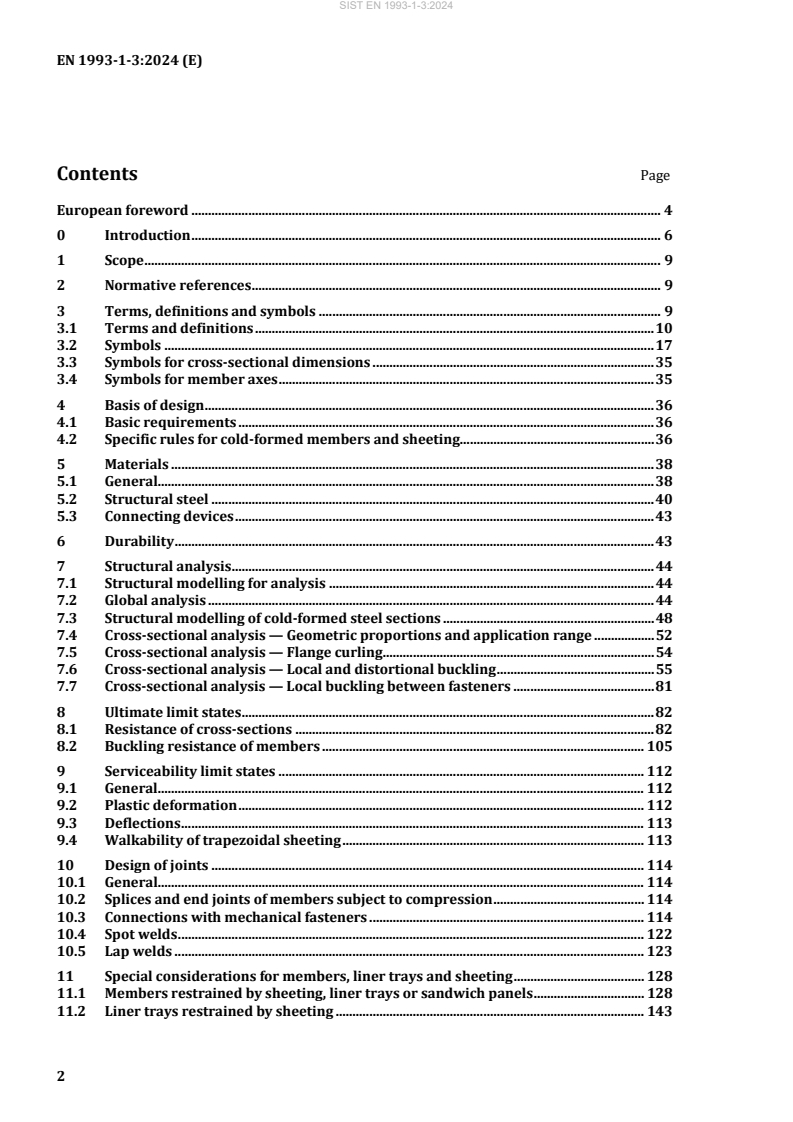
Contents Page
European foreword . 4
0 Introduction . 6
1 Scope . 9
2 Normative references . 9
3 Terms, definitions and symbols . 9
3.1 Terms and definitions . 10
3.2 Symbols . 17
3.3 Symbols for cross-sectional dimensions . 35
3.4 Symbols for member axes . 35
4 Basis of design . 36
4.1 Basic requirements . 36
4.2 Specific rules for cold-formed members and sheeting. 36
5 Materials . 38
5.1 General. 38
5.2 Structural steel . 40
5.3 Connecting devices . 43
6 Durability . 43
7 Structural analysis . 44
7.1 Structural modelling for analysis . 44
7.2 Global analysis . 44
7.3 Structural modelling of cold-formed steel sections . 48
7.4 Cross-sectional analysis — Geometric proportions and application range . 52
7.5 Cross-sectional analysis — Flange curling . 54
7.6 Cross-sectional analysis — Local and distortional buckling . 55
7.7 Cross-sectional analysis — Local buckling between fasteners . 81
8 Ultimate limit states . 82
8.1 Resistance of cross-sections . 82
8.2 Buckling resistance of members . 105
9 Serviceability limit states . 112
9.1 General. 112
9.2 Plastic deformation . 112
9.3 Deflections . 113
9.4 Walkability of trapezoidal sheeting . 113
10 Design of joints . 114
10.1 General. 114
10.2 Splices and end joints of members subject to compression . 114
10.3 Connections with mechanical fasteners . 114
10.4 Spot welds . 122
10.5 Lap welds . 123
11 Special considerations for members, liner trays and sheeting . 128
11.1 Members restrained by sheeting, liner trays or sandwich panels . 128
11.2 Liner trays restrained by sheeting . 143
SIST EN 1993-1-3:2024
11.3 Special considerations for sheeting . 150
11.4 Lateral and torsional restraints of members provided by sheeting, liner trays or
sandwich panels . 163
11.5 Stressed skin design . 173
12 Design assisted by testing . 178
Annex A (normative) Testing procedures . 180
A.1 General . 180
A.2 Tests on materials . 181
A.3 Tests on single beams and columns . 181
A.4 Tests on structures and sub-assemblies . 184
A.5 Tests on profiled sheeting and liner trays . 186
A.6 Tests on torsionally restrained members . 195
A.7 Tests on fastenings . 197
A.8 Tests on components of storage equipment . 198
A.9 Evaluation of test results . 198
Annex B (informative) Durability of fasteners . 203
B.1 Use of this annex . 203
B.2 Scope and field of application . 203
Annex C (normative) Mixed effective width/effective thickness method for outstand
elements . 206
C.1 Use of this annex . 206
C.2 Scope and field of application . 206
C.3 Cross-sectional resistance . 206
Bibliography . 208
SIST EN 1993-1-3:2024
European foreword
This document (EN 1993-1-3:2024) has been prepared by Technical Committee CEN/TC 250 “Structural
Codes”, the secretariat of which is held by BSI. CEN/TC 250 is responsible for all Structural Eurocodes
and has been assigned responsibility for structural and geotechnical design matters by CEN.
This European Standard shall be given the status of a national standard, either by publication of an
identical text or by endorsement, at the latest by September 2027 and conflicting national standards shall
be withdrawn at the latest by March 2028.
Attention is drawn to the possibility that some of the elements of this document may be the subject of
patent rights. CEN shall not be held responsible for identifying any or all such patent rights.
This document supersedes EN 1993-1-3:2006 and its corrigenda.
The first generation of EN Eurocodes was published between 2002 and 2007. This document forms part
of the second generation of the Eurocodes, which have been prepared under Mandate M/515 issued to
CEN by the European Commission and the European Free Trade Association.
The Eurocodes have been drafted to be used in conjunction with relevant execution, material, product
and test standards, and to identify requirements for execution, materials, products and testing that are
relied upon by the Eurocodes.
The Eurocodes recognize the responsibility of each Member State and have safeguarded their right to
determine values related to regulatory safety matters at national level through the use of National
Annexes.
The main changes compared to the previous edition are listed below:
— Harmonization of wording according to the latest editions of EN 1993-1-1, EN 1993-1-5 and
EN 1993-1-8;
— Nominal values of ultimate tensile strength (Table 5.1) adjusted to EN 1993-1-1 or the relevant
product standards for harmonization (Clause 5);
— Minor specification added for the design of sinusoidal sheeting for clarification (7.6.5);
— Minor specification added for the design of trapezoidal sheeting in axial compression (8.1.3);
— Design of cross-sectional resistance to transverse forces of cross-sections with two or more
unstiffened webs specified depending on the type of support (8.1.6.3);
— Design Formula for cross-sectional resistance of sections in combined axial force, bending moment,
shear force and torsion reviewed for clarification (8.1.10);
— Minor specifications and explanations added for the buckling design of sections in combined
compression and bending (8.2.5);
— Specifications of the design provisions in serviceability limit states (text converted into formulae)
for clarification (Clause 9);
— Specifications for the design of trapezoidal sheeting with overlaps for clarification (11.3.4);
SIST EN 1993-1-3:2024
— Specifications for the bending moment resistance of liner trays for clarification (11.2.2);
— Specifications of the test set-up of single span tests for a clear uniform experimental test procedure
(A.5.2);
— Specifications of the test set-up and assessment criteria of tests on sheeting (for walkability) for a
clear uniform experimental test procedure (A.5.6);
— Special provisions for fasteners made of stainless steel in relation to corrosion environment
deleted; general reference to EN 1993-1-4 included (Annex B).
Any feedback and questions on this document should be directed to the users’ national standards body.
A complete listing of these bodies can be found on the CEN website.
According to the CEN-CENELEC Internal Regulations, the national standards organizations of the
following countries are bound to implement this European Standard: Austria, Belgium, Bulgaria, Croatia,
Cyprus, Czech Republic, Denmark, Estonia, Finland, France, Germany, Greece, Hungary, Iceland, Ireland,
Italy, Latvia, Lithuania, Luxembourg, Malta, Netherlands, Norway, Poland, Portugal, Republic of North
Macedonia, Romania, Serbia, Slovakia, Slovenia, Spain, Sweden, Switzerland, Türkiye and the United
Kingdom.
SIST EN 1993-1-3:2024
0 Introduction
0.1 Introduction to the Eurocodes
The Structural Eurocodes comprise the following standards generally consisting of a number of Parts:
— EN 1990, Eurocode: Basis of structural and geotechnical design
— EN 1991, Eurocode 1: Actions on structures
— EN 1992, Eurocode 2: Design of concrete structures
— EN 1993, Eurocode 3: Design of steel structures
— EN 1994, Eurocode 4: Design of composite steel and concrete structures
— EN 1995, Eurocode 5: Design of timber structures
— EN 1996, Eurocode 6: Design of masonry structures
— EN 1997, Eurocode 7: Geotechnical design
— EN 1998, Eurocode 8: Design of structures for earthquake resistance
— EN 1999, Eurocode 9: Design of aluminium structures
— New parts are under development, e.g. Eurocode for design of structural glass
The Eurocodes are intended for use by designers, clients, manufacturers, constructors, relevant
authorities (in exercising their duties in accordance with national or international regulations),
educators, soft-ware developers, and committees drafting standards for related product, testing and
execution standards.
NOTE Some aspects of design are most appropriately specified by relevant authorities or, where not specified,
can be agreed on a project-specific basis between relevant parties such as designers and clients. The Eurocodes
identify such aspects making explicit reference to relevant authorities and relevant parties.
0.2 Introduction to EN 1993 (all parts)
EN 1993 (all parts) applies to the design of buildings and civil engineering works in steel. It complies with
the principles and requirements for the safety and serviceability of structures, the basis of their design
and verification that are given in EN 1990 — Basis of structural and geotechnical design.
EN 1993 (all parts) is concerned only with requirements for resistance, serviceability, durability and fire
resistance of steel structures. Other requirements, e.g. concerning thermal or sound insulation, are not
covered.
EN 1993 is subdivided in various parts:
EN 1993-1, Design of Steel Structures — Part 1: General rules and rules for buildings;
EN 1993-2, Design of Steel Structures — Part 2: Bridges;
EN 1993-3, Design of Steel Structures — Part 3: Towers, masts and chimneys;
EN 1993-4, Design of Steel Structures — Part 4: Silos and tanks;
SIST EN 1993-1-3:2024
EN 1993-5, Design of Steel Structures — Part 5: Piling;
EN 1993-6, Design of Steel Structures — Part 6: Crane supporting structures;
EN 1993-7, Design of steel structures — Part 7: Sandwich panels.
EN 1993-1 in itself does not exist as a physical document, but comprises the following 14 separate parts,
the basic part being EN 1993-1-1:
EN 1993-1-1, Design of Steel Structures — Part 1-1: General rules and rules for buildings;
EN 1993-1-2, Design of Steel Structures — Part 1-2: Structural fire design;
EN 1993-1-3, Design of Steel Structures — Part 1-3: Cold-formed members and sheeting;
NOTE Cold formed hollow sections supplied according to EN 10219 (all parts) are covered in EN 1993-1-1.
EN 1993-1-4, Design of Steel Structures — Part 1-4: Stainless steel structures;
EN 1993-1-5, Design of Steel Structures — Part 1-5: Plated structural elements;
EN 1993-1-6, Design of Steel Structures — Part 1-6: Strength and stability of shell structures;
EN 1993-1-7, Design of Steel Structures — Part 1-7: Plate assemblies with elements under transverse loads;
EN 1993-1-8, Design of Steel Structures — Part 1-8: Joints;
EN 1993-1-9, Design of Steel Structures — Part 1-9: Fatigue;
EN 1993-1-10, Design of Steel Structures — Part 1-10: Material toughness and through-thickness
properties;
EN 1993-1-11, Design of Steel Structures — Part 1-11: Tension components;
EN 1993-1-12, Design of Steel Structures — Part 1-12: Additional rules for steel grades up to S960;
EN 1993-1-13, Design of Steel Structures — Part 1-13: Beams with large web openings;
EN 1993-1-14, Design of Steel Structures — Part 1-14: Design assisted by finite element analysis.
All subsequent parts EN 1993-1-2 to EN 1993-1-14 treat general topics that are independent from the
structural type like structural fire design, cold-formed members and sheeting, stainless steels, plated
structural elements, etc.
All subsequent parts numbered EN 1993-2 to EN 1993-7 treat topics relevant for a specific structural
type like steel bridges, towers, masts and chimneys, silos and tanks, piling, crane supporting structures,
etc. EN 1993-2 to EN 1993-7 refer to the generic rules in EN 1993-1 and supplement, modify or supersede
them.
0.3 Introduction to EN 1993-1-3
EN 1993-1-3 gives supplementary design rules for cold-formed steel members and sheeting. The focus in
EN 1993-1-3 is on design methods and design rules for individual cold-formed members (beams,
columns and beam-columns), sheeting and liner trays regarding resistance, stability and serviceability.
SIST EN 1993-1-3:2024
0.4 Verbal forms used in the Eurocodes
The verb “shall” expresses a requirement strictly to be followed and from which no deviation is permitted
in order to comply with the Eurocodes.
The verb “should” expresses a highly recommended choice or course of action. Subject to national
regulation and/or any relevant contractual provisions, alternative approaches could be used/adopted
where technically justified.
The verb “may” expresses a course of action permissible within the limits of the Eurocodes.
The verb “can” expresses possibility and capability; it is used for statements of fact and clarification of
concepts.
0.5 National Annex for EN 1993-1-3
National choice is allowed in this standard where explicitly stated within notes. National choice includes
the selection of values for Nationally Determined Parameters (NDPs).
The national standard implementing EN 1993-1-3 can have a National Annex containing all national
choices to be used for the design of buildings and civil engineering works to be constructed in the relevant
country.
When no national choice is given, the default choice given in this standard is to be used.
When no national choice is made and no default is given in this standard, the choice can be specified by a
relevant authority or, where not specified, agreed for a specific project by appropriate parties.
National choice is allowed in EN 1993-1-3 through notes to the following clauses:
4.2(3) 4.2(4) 4.2(5) 5.2.1(3)
7.1(2) 7.2.1(6) 8.2.5(2) 10.3(3)
10.3(3) 10.3(3) 10.3(3) 12(1)
A.1(1) A.9.4(3)
National choice is allowed in EN 1993-1-3 on the application of the following informative annexes:
Annex B
The National Annex can contain, directly or by reference, non-contradictory complementary information
for ease of implementation, provided it does not alter any provisions of the Eurocodes.
SIST EN 1993-1-3:2024
1 Scope
1.1 Scope of EN 1993-1-3
(1) This document provides rules for structural design of cold-formed steel members and sheeting.
(2) This document applies to cold-formed steel products made from coated or uncoated hot- or cold-
rolled sheet or strip, which have been cold-formed by processes such as roll-forming or press-braking. It
also covers sheeting and members which are curved during fabrication by continuous bending or roll-
forming. Sheeting which has the curvature created by crushing the inner flanges is not included. This
document is also applicable to the design of profiled steel sheeting for composite steel and concrete slabs
at the construction stage, see EN 1994 (all parts). The execution of steel structures made of cold-formed
steel members and sheeting is covered in EN 1090-4. Provisions for bolted connections are provided in
EN 1090-2.
NOTE The rules in EN 1993-1-3 complement the rules in the other parts of EN 1993-1.
(3) Methods are also given for stressed-skin design, using steel sheeting as a structural diaphragm.
(4) This document does not apply to cold-formed circular and rectangular structural hollow sections
supplied to EN 10219 (all parts), for which reference is made to EN 1993-1-1 and EN 1993-1-8.
(5) This document provides methods for design by calculation and for design assisted by testing. The
methods for design by calculation apply only within the stated ranges of material properties and
geometric proportions, for which sufficient experience and test evidence is available. These limitations
do not apply to design assisted by testing.
1.2 Assumptions
(1) Unless specifically stated, EN 1990, EN 1991 (all parts) and EN 1993-1-1 apply.
(2) The design methods given in EN 1993-1-3 are applicable if:
— the execution quality is as specified in EN 1090-4, the execution quality of bolted connections is as
specified in EN 1090-2, and
— the construction materials and products are as specified in the relevant parts of EN 1993 (all parts),
or in the relevant material and product specifications.
(3) EN 1993 is intended to be used in conjunction with:
— the parts of EN 1992 to EN 1999 where steel structures or steel components are referred to within
those documents;
— EN standards for construction products relevant to steel structures.
2 Normative references
The following documents are referred to in the text in such a way that some or all of their content
constitutes requirements of this document. For dated references, only the edition cited applies. For
undated references, the latest edition of the referenced document (including any amendments) applies.
NOTE See the Bibliography for a list of other documents cited that are not normative references, including
those referenced as recommendations (i.e. through ‘should’ clauses) and permissions (i.e. through ‘may’ clauses).
EN 1090-2, Execution of steel structures and aluminium structures — Part 2: Technical requirements for
steel structures
SIST EN 1993-1-3:2024
EN 1090-4, Execution of steel structures and aluminium structures — Part 4: Technical requirements for
cold-formed structural steel elements and cold-formed structures for roof, ceiling, floor and wall
applications
EN 1990, Eurocode — Basis of structural and geotechnical design
EN 1991 (all parts), Eurocode 1 — Actions on structures
EN 1993 (all parts), Eurocode 3 — Design of steel structures
EN 1993-1-1:2022, Eurocode 3 — Design of steel structures — Part 1-1: General rules and rules for
buildings
EN 14509, Self-supporting double skin metal faced insulating panels — Factory made products —
Specifications
EN ISO 7438, Metallic materials — Bend test (ISO 7438)
3 Terms, definitions and symbols
3.1 Terms and definitions
For the purposes of this document, the terms and definitions given in EN 1990 and the following apply.
3.1.1 Material
3.1.1.1
basic material
flat steel sheet material used for cold-forming sections and profiled sheeting
3.1.1.2
basic yield strength
tensile yield strength of the basic material
3.1.1.3
nominal thickness
target average thickness after cold-forming specified by the steel supplier, inclusive of zinc and other
metallic coating layers, but not including organic coatings
3.1.1.4
steel core thickness
nominal thickness minus zinc and other metallic coating layers
3.1.1.5
coil
storage system where a continuous plate is wound onto a drum
3.1.1.6
cold-forming
procedure of metal-forming executed near room temperature without the addition of heat
SIST EN 1993-1-3:2024
3.1.1.7
press-braking
method of cold-forming using a brake press, where a metal sheet is bent between a punch and die
3.1.1.8
roll-forming
metal-forming process involving the continuous bending of a steel sheet into a cross-section by forcing it
through successive sets of rolls
3.1.1.9
galvanizing
zinc coating for corrosion protection
3.1.1.10
harmonized product standard
European Standard developed by a recognized European Standards Organization: CEN, CENELEC or ETSI,
in response to a request from the European Commission to one of these organizations
3.1.2 Cold-formed steel members, sheeting and sandwich panels
3.1.2.1
member
structural element with cross-sectional dimensions much smaller than its length
Note 1 to entry: Examples of typical cross-sectional shapes of cold-formed steel members are shown in Figure 3.1.
Cross-sections of cold-formed steel members can either be unstiffened or incorporate longitudinal stiffeners in the
webs, the flanges or both.
Figure 3.1 — Typical cross-sectional shapes of cold-formed members
3.1.2.2
sheeting
structural element with a depth much smaller than its width and length, typically used as cladding or
roofing or decking
Note 1 to entry: Examples of typical cross-sectional shapes of sheeting are shown in Figure 3.2. Cross-sections of
sheeting can either be unstiffened or incorporate longitudinal stiffeners in the webs, the flanges or both.
SIST EN 1993-1-3:2024
Figure 3.2 — Examples of cold-formed profiled sheeting and liner trays
3.1.2.3
liner tray
profiled sheet with large lipped edge stiffeners, suitable for interlocking with adjacent liner trays to form
a plane of ribbed sheeting that is capable of supporting a parallel plane of profiled sheeting spanning
perpendicular to the span of the liner trays
Note 1 to entry: Examples of typical cross-sectional shapes of liner trays are shown in Figure 3.2.
3.1.2.4
sandwich panel
cladding or roofing system consisting of a typically low-density core bonded to two outer skin layers
3.1.2.5
bend
rounded transition zone between flat plate elements
3.1.2.6
unstiffened elements
internal or outstand compression elements without stiffeners
3.1.2.7
stiffened elements
compression elements with intermediate or edge stiffeners
3.1.2.8
stiffener
within the context of EN 1993-1-3 the term ‘stiffener’ without further specification refers to a
longitudinal stiffener, i.e. a single fold or succession of folds in the cross-section aimed at increasing the
resistance against local buckling/distortional buckling
Note 1 to entry: Longitudinal stiffeners can either be edge stiffeners or intermediate stiffeners.
SIST EN 1993-1-3:2024
3.1.2.9
edge stiffener
longitudinal stiffener obtained by folding over the edge of a plate element with the aim of increasing the
resistance against cross-sectional instability
Note 1 to entry: Typical edge stiffeners are shown in Figure 3.3.
a) Single-fold edge stiffeners b) Double-fold edge stiffeners
Figure 3.3 — Typical edge stiffeners
3.1.2.10
intermediate stiffener
longitudinal stiffener consisting of multiple bends within a plate element with the aim of increasing the
resistance against cross-sectional instability
Note 1 to entry: Typical intermediate stiffeners are shown in Figure 3.4.
a) grooves b) folds
Figure 3.4 — Typical intermediate stiffeners
3.1.3 Stability modes
3.1.3.1
cross-sectional instability
instability where the cross-section as a whole does not undergo any translation or rotation; cross-
sectional instabilities are usually categorized into local buckling and distortional buckling modes
3.1.3.2
local (plate) buckling
cross-sectional instability in which the constituent plates only undergo out-of-plane plate bending
deformations and the corners of the cross-section remain in their original positions, defined as plate
buckling according to EN 1993-1-5
3.1.3.3
distortional buckling
cross-sectional instability where some constituent plates undergo in-plane displacements in addition to
out-of-plane displacements resulting from plate bending; in the particular case of lipped C- or Z-sections,
distortional buckling may be interpreted as torsional-flexural buckling of the flange-lip assembly about
the web-flange junction
SIST EN 1993-1-3:2024
3.1.3.4
global buckling
instability characterized by a translation and/or rotation of the cross-section with minimal change in its
shape (i.e. excluding cross-sectional instability); global buckling modes include flexural, torsional,
torsional-flexural and lateral-torsional modes
3.1.4 Cross-sectional analysis
3.1.4.1
design thickness
steel thickness used in design by calculation, according to 3.3.3(6) and 5.2.4
3.1.4.2
developed length
length measured along the midline of plate element(s) or a cross-section, including the lengths of any
bends or stiffeners
3.1.4.3
gross cross-section
full cross-section without any deductions to account for local/distortional buckling or the presence of
holes
3.1.4.4
effective cross-section
idealized cross-section accounting for the modified stress distribution in the local/distortional post-
buckling range; the effective cross-section consists of portions of the plate elements adjacent to
longitudinally supported edges which are assumed to carry stress, while the remainder of the cross-
section is assumed to carry no stress
3.1.4.5
effective thickness
reduced thickness of a plate-stiffener assembly to account for the effects of distortional buckling
3.1.4.6
effective width
width or combined widths of a plate element, assumed to carry stress in the post-local buckling range,
whilst the remainder of the plate element is assumed to carry no stress (see also: effective cross-section)
3.1.4.7
relative slenderness
normalized non-dimensional slenderness ratio
3.1.5 Cold-formed steel structures
3.1.5.1
support
location at which a member is able to transfer forces or moments to a foundation, or to another member
or structural component
SIST EN 1993-1-3:2024
3.1.5.2
restraint
full restriction of the lateral, rotational or warping deformation of a member or element, which increases
its buckling resistance
3.1.5.3
partial restraint
restriction of the lateral, rotational or warping deformation of a member or element, which increases its
buckling resistance in a similar way to a spring support
3.1.5.4
residual bending moment resistance
bending moment resistance remaining in the cross-section after reaching the maximum cross-sectional
design bending moment resistance (i.e. on the descending branch of the moment-rotation curve)
3.1.5.5
diaphragm action
structural behaviour primarily involving in-plane shear in sheeting
3.1.5.6
stressed-skin design
design method that allows for the contribution made by diaphragm action to the stiffness and strength of
a structure
3.1.5.7
anti-sag bar
member providing lateral restraint to the free flange of a member
3.1.6 Joints
3.1.6.1
joint
zone where two or more members are interconnected
3.1.6.2
connection
set of basic components used to transfer forces and moments between two or more members or sheets
at the location where they meet
3.1.6.3
basic component of a joint
part of a joint that makes a contribution to one or more of its structural properties
3.1.6.4
connected element
any member or sheeting that is joined to another member or sheeting
SIST EN 1993-1-3:2024
3.1.6.5
fastener
connection element: rivets, cartridge-fired pins, self-tapping/self-drilling screws, bolts or welds
3.1.6.6
fastening
local interaction of a fastener (rivets, cartridge-fired pins or self-tapping/self-drilling screws) with the
surrounding material of the connected elements
3.1.6.7
blind rivet
rivet
mechanical fastener which establishes a connection by pulling a mandrel against its tubular body and
plastically deforming it; it requires access to only one side of the connected elements for installation
3.1.6.8
cartridge-fired pins
fasteners similar to nails driven into the connected elements at high speed using a specially designed gun
3.1.6.9
self-drilling self-tapping screw
screw with a drill tip, which drills a hole and forms the female thread in a single operation as the screw
is driven into the material
3.1.6.10
self-tapping screw
screw which produces its female thread in a predrilled hole as the screw is driven into the material
Note 1 to entry: Self-tapping screws are also referred to as screw in this document for simplification.
3.1.6.11
component I
connected element of fastening adjacent to the head of the fastener (or the swage head in the case of blind
rivets)
3.1.6.12
component II
second connected element of a fastening, usually the supporting structure
SIST EN 1993-1-3:2024
3.2 Symbols
For the purposes of this document, the following symbols apply.
3.2.1 Latin upper-case symbols
A area of the gross cross-section
A area of the effective cross-section, accounting for local and distortional buckling
eff
A area of the gross cross-section of element i
i
A net cross-sectional area of a connected part
net
A tensile stress area of a fastener
s
A area of the gross cross-section with sharp corners
sh
A area of the effective cross-section of the stiffener
st
A reduced area of the effective cross-section of the stiffener due to distortional buckling
st,red
A area of the effective cross-section of a single web stiffener in compression or of the web
st,a
stiffener closer to the compression flange in webs with two stiffeners in trapezoidal
sheeting
A reduced area of the effective cross-section of a single web stiffener in compression or of the
st,a,red
web stiffener closer to the compression flange in webs with two stiffeners in trapezoidal
sheeting
A area of the effective cross-section of the second web stiffener in compression in trapezoidal
st,b
sheeting
A reduced area of the effective cross-section of the second web stiffener in compression in
st,b,red
trapezoidal sheeting
A area of the effective cross-section of the edge stiffener in flange 1
st1
A area of the effective cross-section of the edge stiffener in flange 2
st2
C rotational spring stiffness
C rotational spring stiffness which represents the partial torsional restraint provided to
D
members by sheeting, liner trays or sandwich panels
C rotational spring stiffness of the connection between the sheeting, sandwich panels or liner
D,A
trays and the member
C rotational spring stiffness resulting from the distortion of the cross-section of the member
D,B
C rotational spring stiffness representing the flexural stiffness of the sheeting, liner trays or
D,C
sandwich panels
C , C rotational spring stiffness of plane elements with edge or intermediate stiffeners
θ θi
C rotation coefficient representing the value of C if the width of the member flange is equal
100 D,A
to 100 mm
D thickness of a sandwich panel
E modulus of elasticity
SIST EN 1993-1-3:2024
E modulus of elasticity of the core of a sandwich panel
C
E compressive modulus of elasticity of the core of a sandwich panel
C,c
E tensile modulus of elasticity of the core of a sandwich panel
C,t
E modulus of elasticity of the core of a sandwich panel depending on the duration of loading
C,t,θ
F design value of the bearing resistance of a connection or fastening
b,Rd
F elastic force of a member in compression, determined with an initial bow according to the
bow,max
product specification
F elastic force of a member in compression, determined with an initial bow from test samples
bow,test
F design value of the transverse force
Ed
F design value of the transverse forces resulting from an assumed load distribution of a point
Ed,i
load or line load over the ribs of trapezoidal sheeting
F design value of the end resistance of a spot weld
e,Rd
F design value of the shear force in a screw for fastening trapezoidal sheeting at overlaps
k,ol,Ed
F test load in tests on torsionally restrained members
lat
F design value of the net-section resistance, determined for the relevant type of mechanical
n,Rd
fastener or weld
F design value of the pull-out resistance of a fastener
o,Rd
Fp,Rd design value of the pull-through resistance of a fastener
Frib,Ed proportion of the design value of the load carried by a rib of trapezoidal sheeting for the
purpose of verifying the resistance to transverse forces of the web
F total test load in a strength test
str
F reaction force at the support of sheeting
supp
F design value of the tensile force in a fastener
t,Ed
F design value of the tensile resistance of a fastener
t,Rd
F characteristic value of the tensile resistance of a fastener
t,Rk
F design value of the tearing and bearing resistance of a spot weld
tb,Rd
F unit load, acting at the centroid of the assembly consisting of the effective parts of the
unit
stiffener and the adjacent effective areas of the stiffened plate
F design value of the shear force in a fastener
v,Ed
F design value of the shear resistance of a fastener, determined for the relevant type of
v,Rd
mechanical fastener or weld
F characteristic value of the shear resistance of a fastener, determined for the relevant type
v,Rk
of mechanical fastener or weld
F design value of the resistance of a fillet or arc spot welded connection
w,Rd
F F transverse reaction forces in the plane of the flanges
R1, R2
SIST EN 1993-1-3:2024
G shear modulus
I moment of inertia of the gross cross-section
I´ moment of inertia of the gross cross-section related to the centroidal axes y´-y´or z´-z´
I moment of inertia of the effective cross-section
eff
I moment of inertia of a fictitious effective cross-section for serviceability limit state design
fic
I moment of inertia of the gross cross-section of the free flange plus the contributing part of
fz
the web for bending about the z-z axis
I moment of inertia of the wide flange of a liner tray about its own centroidal axis parallel to
lt,a
the wide flange
I moment of inertia of the gross cross-section with sharp corners
sh
I moment of inertia of the cross-section of a stiffener
st
I moment of inertia of the effective cross-section of a single web stiffener in compression or
st,a
of the web stiffener closer to the compression flange in webs with two stiffeners in
trapezoidal sheeting about its own centroidal axis parallel to the stiffened element
I torsional constant of the gross cross-section
T
I warping constant of the gross cross-section
w
I warping constant of the effective cross-section
w,eff
I warping constant of the gross cross-section with sharp corners
w,sh
I(σ) moment of inertia of the effective cross-section calculated for a maximum stress σ ≥ σ ,
eff gr
used in serviceability limit state design
K equivalent linear spring stiffness which represents the partial rotational restraint provided
by sheeting, liner trays or sandwich panels in member design
K stiffness parameter which accounts for the presence of a steel saddle washer when
a
determining the rotational stiffness of trapezoidal sheeting
K stiffness against lateral displacement of a member resulting from the rotational stiffness of
A
the joint between the sheeting and the member;
K stiffness against lateral displacement of a member resulting from the distortion of the cross-
B
section of the member
K stiffness against lateral displacement of a member resulting from the flexural stiffness of
C
the sheeting
K spring stiffness of the compressed flanges of liner trays
fz
K spring stiffness which represents the fasteners in the overlapping flanges of trapezoidal
ol,f
sheeting
K spring
...
Questions, Comments and Discussion
Ask us and Technical Secretary will try to provide an answer. You can facilitate discussion about the standard in here.
Loading comments...