


EN 1993-1-9:2025
(Main)Eurocode 3: Design of steel structures - Part 1-9: Fatigue
General Information
- Abstract
1.1 Scope of EN 1993-1-9
(1) EN 1993-1-9 gives design methods for the verification of the fatigue design situation of steel structures.
NOTE Steel structures consist of members and their joints. Each member and joint can be represented as a constructional detail or as several of the latter.
(2) Design methods other than the stress-based methods, such as the notch strain method or fracture mechanics methods, are not covered by EN 1993-1-9.
(3) EN 1993-1-9 only applies to structures made of all grades of structural steels and products within the scope of EN 1993-1 (all parts), in accordance with the provisions noted in the detail category tables or annexes.
(4) EN 1993-1-9 only applies to structures where execution conforms to EN 1090-2.
NOTE Supplementary execution requirements are indicated in the detail category tables.
(5) EN 1993-1-9 applies to structures operating under normal atmospheric conditions and with sufficient corrosion protection and regular maintenance. The effect of seawater corrosion is not covered.
(6) EN 1993-1-9 applies to structures with hot dip galvanizing in accordance with the provisions noted in the detail category tables or annexes.
(7) Microstructural damage from high temperature (> 150°C) that occurs during the design service life is not covered.
(8) EN 1993-1-9 gives guidance of how to consider post-fabrication treatments that are intended to improve the fatigue resistance of constructional details.
1.2 Assumptions
(1) Unless specifically stated, EN 1990, EN 1991 (all parts) and EN 1993 1 (all parts) apply.
(2) The design methods given in EN 1993-1-9 are applicable if:
- the execution quality is as specified in EN 1090-2, and
- the construction materials and products used are as specified in the relevant parts on EN 1993 (all parts), or in the relevant material and product specifications.
(3) The design methods of EN 1993-1-9 are generally derived from fatigue tests on constructional details with large scale specimens that include effects of geometrical and structural imperfections from material production and execution (e.g. the effects of tolerances and residual stresses from welding).
- Status
- Published
- Publication Date
- 04-Mar-2025
- Technical Committee
- CEN/TC 250 - Structural Eurocodes
- Drafting Committee
- CEN/TC 250/SC 3/WG 9 - Evolution of EN 1993-1-9 - Fatigue
- Current Stage
- 6060 - Definitive text made available (DAV) - Publishing
- Start Date
- 05-Mar-2025
- Due Date
- 28-Nov-2021
- Completion Date
- 05-Mar-2025


Overview
EN 1993-1-9:2025 - Eurocode 3: Design of steel structures - Part 1‑9: Fatigue gives the stress‑based design framework for verifying the fatigue performance of steel structures. It covers design methods, classification of constructional details, fatigue resistance curves and verification procedures applicable to structural steels and products within the scope of EN 1993 (all parts). The standard applies where execution conforms to EN 1090‑2, structures operate under normal atmospheric conditions with corrosion protection and maintenance, and post‑fabrication treatments are considered to improve fatigue resistance. Methods such as notch‑strain or fracture‑mechanics are explicitly excluded.
Key topics and requirements
- Fatigue design methods: Stress‑based approaches only - nominal stress method, hot‑spot stress method, and effective notch stress method (annexes provide detailed procedures).
- Fatigue action effect: Calculation of nominal stresses and stress ranges, relevant nominal stress definitions, and effective design stress ranges.
- Fatigue resistance: Endurance (S–N) curves, classification of constructional details into detail categories, and modifications for size, surface treatment or other effects.
- Verification rules: Procedures for fatigue verification (elastic behaviour, reference values, fatigue limit, multiaxial fatigue) and cumulative damage (linear damage models in Annex A).
- Specific provisions and annexes:
- Annex A–C: Verification models, hot‑spot and effective notch stress methods.
- Annex F: Fatigue design for welds treated with High Frequency Mechanical Impact (HFMI).
- Annexes D, E, G: Recommendations for magnification/stress concentration factors, preloaded bolts/rods, and hot‑spot reference methods.
- Applicability limits: Applies to all grades of structural steels per EN 1993 and to hot‑dip galvanized structures where noted. Seawater corrosion and high‑temperature (>150°C) microstructural damage during service life are not covered.
Practical applications
- Design and assessment of bridges, buildings, cranes, offshore‑adjacent structures (subject to applicability limits), and fatigue‑sensitive steel components.
- Preparation of fatigue checks in structural design reports, detailing detail categories and S–N curve selection.
- Specification of fabrication and post‑fabrication treatments (e.g., HFMI) and execution quality requirements per EN 1090‑2.
- Used by structural engineers, detailers, fabricators, QA/QC engineers, project inspectors and regulatory authorities assessing fatigue life.
Related standards
- EN 1990 (basis of structural design)
- EN 1991 (actions on structures)
- EN 1993 (other parts covering materials/products)
- EN 1090‑2 (execution of steel structures)
Keywords: EN 1993-1-9:2025, Eurocode 3, fatigue design, steel structures, EN 1090-2, nominal stress method, hot‑spot stress, effective notch stress, fatigue resistance, HFMI.
Relations
- Effective Date
- 12-Mar-2025
- Effective Date
- 19-Jun-2024
- Effective Date
- 17-Sep-2026
- Effective Date
- 25-Mar-2026
- Effective Date
- 25-Mar-2026
- Effective Date
- 25-Mar-2026
- Effective Date
- 25-Mar-2026
- Refers
EN 1991-3:2026 - Eurocode 1 - Actions on structures - Part 3: Actions induced by cranes and machines - Effective Date
- 25-Mar-2026
- Effective Date
- 25-Mar-2026
- Effective Date
- 25-Mar-2026
- Effective Date
- 25-Mar-2026
- Effective Date
- 25-Mar-2026
- Effective Date
- 28-Jan-2026
- Refers
EN 1991-1-4:2005 - Eurocode 1: Actions on structures - Part 1-4: General actions - Wind actions - Effective Date
- 28-Jan-2026
- Effective Date
- 28-Jan-2026
Get Certified
Connect with accredited certification bodies for this standard

DIBt (Deutsches Institut für Bautechnik)
German Institute for Building Technology.
DIN CERTCO
DIN Group product certification.

Aboma Certification B.V.
Specialized in construction, metal, and transport sectors.
Sponsored listings
Frequently Asked Questions
EN 1993-1-9:2025 is a draft published by the European Committee for Standardization (CEN). Its full title is "Eurocode 3: Design of steel structures - Part 1-9: Fatigue". This standard covers: 1.1 Scope of EN 1993-1-9 (1) EN 1993-1-9 gives design methods for the verification of the fatigue design situation of steel structures. NOTE Steel structures consist of members and their joints. Each member and joint can be represented as a constructional detail or as several of the latter. (2) Design methods other than the stress-based methods, such as the notch strain method or fracture mechanics methods, are not covered by EN 1993-1-9. (3) EN 1993-1-9 only applies to structures made of all grades of structural steels and products within the scope of EN 1993-1 (all parts), in accordance with the provisions noted in the detail category tables or annexes. (4) EN 1993-1-9 only applies to structures where execution conforms to EN 1090-2. NOTE Supplementary execution requirements are indicated in the detail category tables. (5) EN 1993-1-9 applies to structures operating under normal atmospheric conditions and with sufficient corrosion protection and regular maintenance. The effect of seawater corrosion is not covered. (6) EN 1993-1-9 applies to structures with hot dip galvanizing in accordance with the provisions noted in the detail category tables or annexes. (7) Microstructural damage from high temperature (> 150°C) that occurs during the design service life is not covered. (8) EN 1993-1-9 gives guidance of how to consider post-fabrication treatments that are intended to improve the fatigue resistance of constructional details. 1.2 Assumptions (1) Unless specifically stated, EN 1990, EN 1991 (all parts) and EN 1993 1 (all parts) apply. (2) The design methods given in EN 1993-1-9 are applicable if: - the execution quality is as specified in EN 1090-2, and - the construction materials and products used are as specified in the relevant parts on EN 1993 (all parts), or in the relevant material and product specifications. (3) The design methods of EN 1993-1-9 are generally derived from fatigue tests on constructional details with large scale specimens that include effects of geometrical and structural imperfections from material production and execution (e.g. the effects of tolerances and residual stresses from welding).
1.1 Scope of EN 1993-1-9 (1) EN 1993-1-9 gives design methods for the verification of the fatigue design situation of steel structures. NOTE Steel structures consist of members and their joints. Each member and joint can be represented as a constructional detail or as several of the latter. (2) Design methods other than the stress-based methods, such as the notch strain method or fracture mechanics methods, are not covered by EN 1993-1-9. (3) EN 1993-1-9 only applies to structures made of all grades of structural steels and products within the scope of EN 1993-1 (all parts), in accordance with the provisions noted in the detail category tables or annexes. (4) EN 1993-1-9 only applies to structures where execution conforms to EN 1090-2. NOTE Supplementary execution requirements are indicated in the detail category tables. (5) EN 1993-1-9 applies to structures operating under normal atmospheric conditions and with sufficient corrosion protection and regular maintenance. The effect of seawater corrosion is not covered. (6) EN 1993-1-9 applies to structures with hot dip galvanizing in accordance with the provisions noted in the detail category tables or annexes. (7) Microstructural damage from high temperature (> 150°C) that occurs during the design service life is not covered. (8) EN 1993-1-9 gives guidance of how to consider post-fabrication treatments that are intended to improve the fatigue resistance of constructional details. 1.2 Assumptions (1) Unless specifically stated, EN 1990, EN 1991 (all parts) and EN 1993 1 (all parts) apply. (2) The design methods given in EN 1993-1-9 are applicable if: - the execution quality is as specified in EN 1090-2, and - the construction materials and products used are as specified in the relevant parts on EN 1993 (all parts), or in the relevant material and product specifications. (3) The design methods of EN 1993-1-9 are generally derived from fatigue tests on constructional details with large scale specimens that include effects of geometrical and structural imperfections from material production and execution (e.g. the effects of tolerances and residual stresses from welding).
EN 1993-1-9:2025 is classified under the following ICS (International Classification for Standards) categories: 91.010.30 - Technical aspects; 91.080.13 - Steel structures. The ICS classification helps identify the subject area and facilitates finding related standards.
EN 1993-1-9:2025 has the following relationships with other standards: It is inter standard links to EN 1993-1-9:2005/AC:2005, EN 1993-1-9:2005/AC:2009, EN 1993-7:2026, EN 1991-1-6:2026, EN 1991-1-4:2026, EN 1993-2:2026, EN 1993-3:2026, EN 1991-3:2026, EN 1993-1-11:2026, EN 1993-4-2:2026, EN 1991-1-8:2026, EN 1991-4:2026, EN 1991-1-3:2025, EN 1991-1-4:2005, EN 1993-4-2:2007. Understanding these relationships helps ensure you are using the most current and applicable version of the standard.
EN 1993-1-9:2025 is associated with the following European legislation: EU Directives/Regulations: 305/2011; Standardization Mandates: M/515. When a standard is cited in the Official Journal of the European Union, products manufactured in conformity with it benefit from a presumption of conformity with the essential requirements of the corresponding EU directive or regulation.
EN 1993-1-9:2025 is available in PDF format for immediate download after purchase. The document can be added to your cart and obtained through the secure checkout process. Digital delivery ensures instant access to the complete standard document.
Standards Content (Sample)
SLOVENSKI STANDARD
oSIST prEN 1993-1-9:2023
01-maj-2023
Evrokod 3: Projektiranje jeklenih konstrukcij – 1-9. del: Utrujanje
Eurocode 3: Design of steel structures - Part 1-9: Fatigue
Eurocode 3: Bemessung und Konstruktion von Stahlbauten - Teil 1-9: Ermüdung
Eurocode 3: Calcul des structures en acier - Partie 1-9: Fatigue
Ta slovenski standard je istoveten z: prEN 1993-1-9
ICS:
91.010.30 Tehnični vidiki Technical aspects
91.080.13 Jeklene konstrukcije Steel structures
oSIST prEN 1993-1-9:2023 en,fr,de
2003-01.Slovenski inštitut za standardizacijo. Razmnoževanje celote ali delov tega standarda ni dovoljeno.
oSIST prEN 1993-1-9:2023
oSIST prEN 1993-1-9:2023
DRAFT
EUROPEAN STANDARD
prEN 1993-1-9
NORME EUROPÉENNE
EUROPÄISCHE NORM
March 2023
ICS Will supersede EN 1993-1-9:2005
English Version
Eurocode 3: Design of steel structures - Part 1-9: Fatigue
Eurocode 3: Calcul des structures en acier - Partie 1-9: Eurocode 3: Bemessung und Konstruktion von
Fatigue Stahlbauten - Teil 1-9: Ermüdung
This draft European Standard is submitted to CEN members for enquiry. It has been drawn up by the Technical Committee
CEN/TC 250.
If this draft becomes a European Standard, CEN members are bound to comply with the CEN/CENELEC Internal Regulations
which stipulate the conditions for giving this European Standard the status of a national standard without any alteration.
This draft European Standard was established by CEN in three official versions (English, French, German). A version in any other
language made by translation under the responsibility of a CEN member into its own language and notified to the CEN-CENELEC
Management Centre has the same status as the official versions.
CEN members are the national standards bodies of Austria, Belgium, Bulgaria, Croatia, Cyprus, Czech Republic, Denmark, Estonia,
Finland, France, Germany, Greece, Hungary, Iceland, Ireland, Italy, Latvia, Lithuania, Luxembourg, Malta, Netherlands, Norway,
Poland, Portugal, Republic of North Macedonia, Romania, Serbia, Slovakia, Slovenia, Spain, Sweden, Switzerland, Türkiye and
United Kingdom.
Recipients of this draft are invited to submit, with their comments, notification of any relevant patent rights of which they are
aware and to provide supporting documentation.
Warning : This document is not a European Standard. It is distributed for review and comments. It is subject to change without
notice and shall not be referred to as a European Standard.
EUROPEAN COMMITTEE FOR STANDARDIZATION
COMITÉ EUROPÉEN DE NORMALISATION
EUROPÄISCHES KOMITEE FÜR NORMUNG
CEN-CENELEC Management Centre: Rue de la Science 23, B-1040 Brussels
© 2023 CEN All rights of exploitation in any form and by any means reserved Ref. No. prEN 1993-1-9:2023 E
worldwide for CEN national Members.
oSIST prEN 1993-1-9:2023
prEN 1993-1-9:2023 (E)
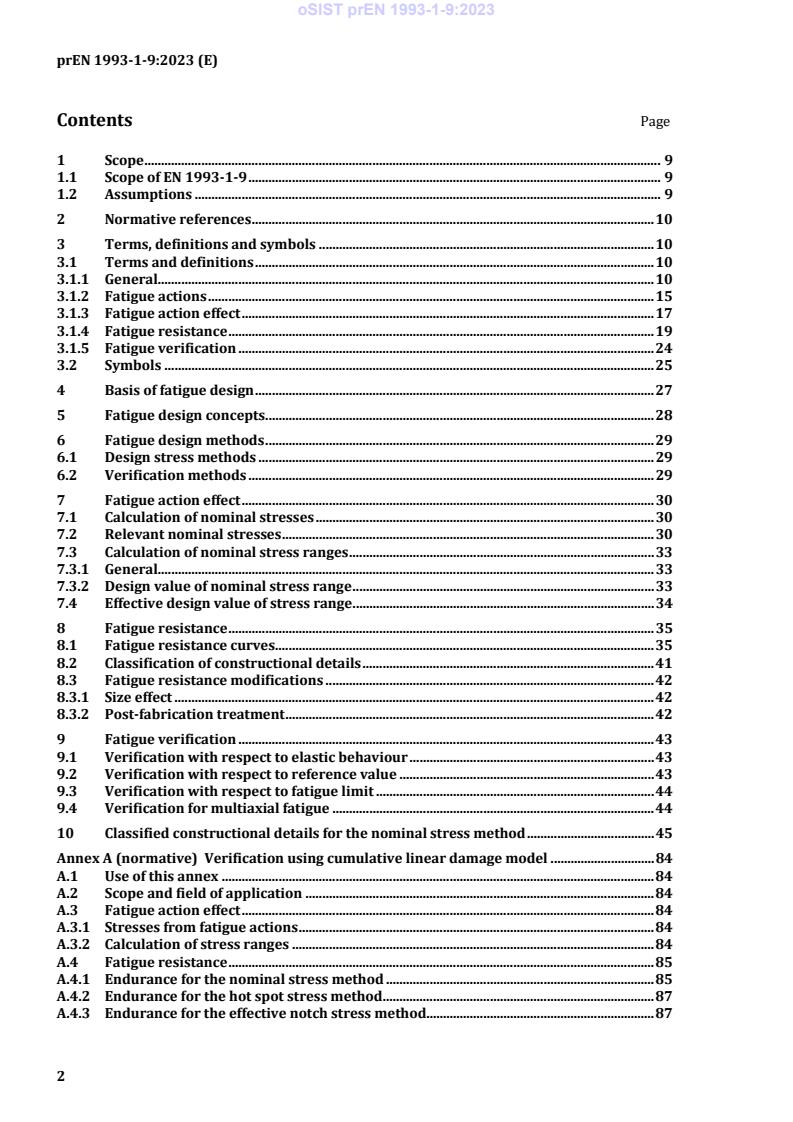
Contents Page
1 Scope . 9
1.1 Scope of EN 1993-1-9 . 9
1.2 Assumptions . 9
2 Normative references . 10
3 Terms, definitions and symbols . 10
3.1 Terms and definitions . 10
3.1.1 General. 10
3.1.2 Fatigue actions . 15
3.1.3 Fatigue action effect . 17
3.1.4 Fatigue resistance . 19
3.1.5 Fatigue verification . 24
3.2 Symbols . 25
4 Basis of fatigue design . 27
5 Fatigue design concepts . 28
6 Fatigue design methods . 29
6.1 Design stress methods . 29
6.2 Verification methods . 29
7 Fatigue action effect . 30
7.1 Calculation of nominal stresses . 30
7.2 Relevant nominal stresses . 30
7.3 Calculation of nominal stress ranges . 33
7.3.1 General. 33
7.3.2 Design value of nominal stress range . 33
7.4 Effective design value of stress range . 34
8 Fatigue resistance . 35
8.1 Fatigue resistance curves . 35
8.2 Classification of constructional details . 41
8.3 Fatigue resistance modifications . 42
8.3.1 Size effect . 42
8.3.2 Post-fabrication treatment . 42
9 Fatigue verification . 43
9.1 Verification with respect to elastic behaviour . 43
9.2 Verification with respect to reference value . 43
9.3 Verification with respect to fatigue limit . 44
9.4 Verification for multiaxial fatigue . 44
10 Classified constructional details for the nominal stress method . 45
Annex A (normative) Verification using cumulative linear damage model . 84
A.1 Use of this annex . 84
A.2 Scope and field of application . 84
A.3 Fatigue action effect . 84
A.3.1 Stresses from fatigue actions . 84
A.3.2 Calculation of stress ranges . 84
A.4 Fatigue resistance . 85
A.4.1 Endurance for the nominal stress method . 85
A.4.2 Endurance for the hot spot stress method . 87
A.4.3 Endurance for the effective notch stress method. 87
oSIST prEN 1993-1-9:2023
prEN 1993-1-9:2023 (E)
A.4.4 Endurance for welded joints subjected to High Frequency Mechanical Impact
Treatment . 87
A.5 Fatigue verification . 88
Annex B (normative) Hot spot stress method . 91
B.1 Use of this annex . 91
B.2 Scope and field of application . 91
B.3 Fatigue action effect . 91
B.3.1 Stresses from fatigue actions. 91
B.3.2 Calculation of stress ranges . 93
B.4 Fatigue resistance . 94
B.4.1 Fatigue resistance curves . 94
B.4.2 Classification of constructional details . 96
B.4.3 Fatigue resistance modification . 99
B.5 Fatigue verification . 100
Annex C (normative) Effective notch stress method . 101
C.1 Use of this annex . 101
C.2 Scope and field of application . 101
C.3 Fatigue action effect . 101
C.3.1 Stresses from fatigue action. 101
C.3.2 Calculation of stress ranges . 102
C.4 Fatigue resistance . 103
C.4.1 Fatigue resistance curves . 103
C.4.2 Classification of constructional details . 103
C.5 Fatigue verification . 104
Annex D (informative) Recommendations for magnification factors k and stress
concentration factors k . 105
f
D.1 Use of this annex . 105
D.2 Scope and field of application . 105
D.3 Secondary moments in lattice girders . 105
D.4 Flanges of ⌶-section girders with transitions in thickness or width . 106
D.5 Thickness transitions in plates . 108
D.6 Shell structures . 108
Annex E (informative) Recommendations for preloaded bolts and rods subject to tension
................................................................................................................................................................ 109
E.1 Use of this annex . 109
E.2 Scope and field of application . 109
E.3 Simplified calculation method . 110
Annex F (informative) Fatigue design of welded joints subjected to High Frequency
Mechanical Impact Treatment . 112
F.1 Use of this annex . 112
F.2 Scope and field of application . 112
F.3 Fatigue action effect . 113
F.3.1 Stresses from fatigue actions. 113
F.3.2 Calculation of the stress ranges . 113
F.4 Fatigue resistance . 114
F.4.1 Fatigue resistance curves . 114
F.4.2 Classification of constructional details . 115
F.4.3 Alternative formulae for determination of detail category . 119
F.4.4 Fatigue resistance modification . 119
F.5 Fatigue verification . 120
oSIST prEN 1993-1-9:2023
prEN 1993-1-9:2023 (E)
F.6 Requirements for application . 120
F.6.1 Requirements for welds before HFMI treatment . 120
F.6.2 Requirements for welds after HFMI treatment . 121
F.6.3 Quality control . 121
F.7 Treatment of variable amplitude loading . 121
Annex G (informative) Hot spot stress reference detail method . 123
G.1 Use of this annex . 123
G.2 Scope and field of application . 123
G.3 Fatigue action effect . 123
G.4 Fatigue resistance . 123
G.5 Fatigue verification . 124
Bibliography . 125
oSIST prEN 1993-1-9:2023
prEN 1993-1-9:2023 (E)
European foreword
This document (prEN 1993-1-9:2023) has been prepared by Technical Committee CEN/TC 250
“Structural Codes”, the secretariat of which is held by BSI. CEN/TC 250 is responsible for all Structural
Eurocodes and has been assigned responsibility for structural and geotechnical design matters by CEN.
This document is currently submitted to the CEN Enquiry.
This document will supersede EN 1993-1-9:2005 and EN 1993-1-9:2005/AC:2009.
The first generation of EN Eurocodes was published between 2002 and 2007. This document forms part
of the second generation of the Eurocodes, which have been prepared under Mandate M/515 issued to
CEN by the European Commission and the European Free Trade Association.
The Eurocodes have been drafted to be used in conjunction with relevant execution, material, product
and test standards, and to identify requirements for execution, materials, products and testing that are
relied upon by the Eurocodes.
The Eurocodes recognise the responsibility of each Member State and have safeguarded their right to
determine values related to regulatory safety matters at national level through the use of national
annexes.
oSIST prEN 1993-1-9:2023
prEN 1993-1-9:2023 (E)
Introduction
0.1 Introduction to the Eurocodes
The Structural Eurocodes comprise the following standards generally consisting of a number of parts:
• EN 1990 Eurocode: Basis of structural and geotechnical design;
• EN 1991 Eurocode 1: Actions on structures;
• EN 1992 Eurocode 2: Design of concrete structures;
• EN 1993 Eurocode 3: Design of steel structures;
• EN 1994 Eurocode 4: Design of composite steel and concrete structures;
• EN 1995 Eurocode 5: Design of timber structures;
• EN 1996 Eurocode 6: Design of masonry structures;
• EN 1997 Eurocode 7: Geotechnical design;
• EN 1998 Eurocode 8: Design of structures for earthquake resistance;
• EN 1999 Eurocode 9: Design of aluminium structures;
• New parts are under development, e.g. Eurocode for design of structural glass.
The Eurocodes are intended for use by designers, clients, manufacturers, constructors, relevant
authorities (in exercising their duties in accordance with national or international regulations),
educators, soft-ware developers, and committees drafting standards for related product, testing and
execution standards.
NOTE Some aspects of design are most appropriately specified by relevant authorities or, where not specified,
can be agreed on a project-specific basis between relevant parties such as designers and clients. The Eurocodes
identify such aspects making explicit reference to relevant authorities and relevant parties.
0.2 Introduction to EN 1993 (all parts)
EN 1993 (all parts) applies to the design of buildings and civil engineering works in steel. It complies with
the principles and requirements for the safety and serviceability of structures, the basis of their design
and verification that are given in EN 1990 – Basis of structural design.
EN 1993 (all parts) is concerned only with requirements for resistance, serviceability, durability and fire
resistance of steel structures. Other requirements, e.g. concerning thermal or sound insulation, are not
covered.
EN 1993 is subdivided in various parts:
• EN 1993-1, Design of Steel Structures — Part 1: General rules and rules for buildings;
• EN 1993-2, Design of Steel Structures — Part 2: Steel bridges;
• EN 1993-3, Design of Steel Structures — Part 3: Towers, masts and chimneys;
• EN 1993-4, Design of Steel Structures — Part 4: Silos and tanks;
oSIST prEN 1993-1-9:2023
prEN 1993-1-9:2023 (E)
• EN 1993-5, Design of Steel Structures — Part 5: Piling;
• EN 1993-6, Design of Steel Structures — Part 6: Crane supporting structures;
• EN 1993-7, Design of steel structures — Part 7: Design of sandwich panels.
EN 1993-1 in itself does not exist as a physical document, but as a document series that comprises the
following 14 separate parts, the basic part being EN 1993-1-1:
• EN 1993-1-1, Design of Steel Structures — Part 1-1: General rules and rules for buildings;
• EN 1993-1-2, Design of Steel Structures — Part 1-2: Structural fire design;
• EN 1993-1-3, Design of Steel Structures — Part 1-3: Cold-formed members and sheeting;
NOTE Cold formed hollow sections supplied according to EN 10219 are covered in EN 1993-1-1.
• EN 1993-1-4, Design of Steel Structures — Part 1-4: Stainless steels;
• EN 1993-1-5, Design of Steel Structures — Part 1-5: Plated structural elements;
• EN 1993-1-6, Design of Steel Structures — Part 1-6: Strength and stability of shell structures;
• EN 1993-1-7, Design of Steel Structures — Part 1-7: Strength and stability of planar plated structures
transversely loaded;
• EN 1993-1-8, Design of Steel Structures — Part 1-8: Design of joints;
• EN 1993-1-9, Design of Steel Structures — Part 1-9: Fatigue strength of steel structures;
• EN 1993-1-10, Design of Steel Structures — Part 1-10: Material toughness and through-thickness
properties;
• EN 1993-1-11, Design of Steel Structures — Part 1-11: Design of structures with tension components
made of steel;
• EN 1993-1-12, Design of Steel Structures — Part 1-12: Additional rules for steel grades up to S960;
• EN 1993-1-13, Design of Steel Structures — Part 1-13: Beams with large web openings;
• EN 1993-1-14, Design of Steel Structures — Part 1-14: Design assisted by finite element analysis.
All subsequent parts numbered EN 1993-1-2 to EN 1993-1-14 treat general topics that are independent
from the structural type like structural fire design, cold-formed members and sheeting, stainless steels,
plated structural elements, etc.
All subsequent parts numbered EN 1993-2 to EN 1993-7 treat topics relevant for a specific structural
type like steel bridges, towers, masts and chimneys, silos and tanks, piling, crane supporting structures,
etc. EN 1993-2 to EN 1993-7 refer to the generic rules in EN 1993-1 and supplement, modify or supersede
them.
oSIST prEN 1993-1-9:2023
prEN 1993-1-9:2023 (E)
0.3 Introduction to EN 1993-1-9
EN 1993-1-9 gives specific design rules for verification of fatigue resistance of steel structures. It is
intended to be used with EN 1990, EN 1991 and EN 1993-1. Matters that are already covered in those
documents are not repeated. The focus in EN 1993-1-9 is on design rules that supplement, modify or
supersede the equivalent provisions given in EN 1993-1.
0.4 Verbal forms used in the Eurocodes
The verb “shall" expresses a requirement strictly to be followed and from which no deviation is permitted
in order to comply with the Eurocodes.
The verb “should” expresses a highly recommended choice or course of action. Subject to national
regulation and/or any relevant contractual provisions, alternative approaches could be used/adopted
where technically justified.
The verb “may" expresses a course of action permissible within the limits of the Eurocodes.
The verb “can" expresses possibility and capability; it is used for statements of fact and clarification of
concepts.
0.5 National annex for EN 1993-1-9
National choice is allowed in this standard where explicitly stated within notes. National choice includes
the selection of values for Nationally Determined Parameters (NDPs).
The national standard implementing EN 1993-1-9 can have a National Annex containing all national
choices to be used for the design of steel structures to be constructed in the relevant country.
When no national choice is given, the default choice given in this standard is to be used.
When no national choice is made and no default is given in this standard, the choice can be specified by a
relevant authority or, where not specified, agreed for a specific project by appropriate parties.
National choice is allowed in EN 1993-1-9 through notes to the following:
1.1(8) 4(6) 5(4) 5(6)
6.1(3) – 3 choices 7.1(4) 8.2(1) – 2 choices 9.1(1)
9.4(3) B.2(1) B.2(1) C.2(4)
C.2(5) F.2(2) F.2(5) F.2(6)
F.3.2(1) F.4.2.1(3)
National choice is allowed in EN 1993-1-9 on the application of the following informative annexes:
Annex D Annex E Annex F Annex G
The National annex may contain, directly or by reference, non-contradictory complementary information
for ease of implementation, provided it does not alter any provisions of the Eurocodes.
oSIST prEN 1993-1-9:2023
prEN 1993-1-9:2023 (E)
1 Scope
1.1 Scope of EN 1993-1-9
(1) EN 1993-1-9 gives design methods for the verification of the fatigue design situation of steel
structures.
NOTE Steel structures consist of members and their joints. Each member and joint can be represented as a
constructional detail or as several of the latter.
(2) Design methods other than the stress-based methods, such as the notch strain method or fracture
mechanics methods, are not covered by EN 1993-1-9.
(3) EN 1993-1-9 only applies to structures made of all grades of structural steels which conform to
EN 1993-1 (all parts), in accordance with the provisions noted in the detail category tables or annexes.
(4) EN 1993-1-9 only applies to structures where execution conforms to EN 1090-2.
NOTE Supplementary execution requirements are indicated in the detail category tables.
(5) EN 1993-1-9 applies to structures operating under normal atmospheric conditions and with
sufficient corrosion protection and regular maintenance. The effect of seawater corrosion is not covered.
(6) EN 1993-1-9 applies to structures with hot dip galvanizing in accordance with the provisions
noted in the detail category tables or annexes.
(7) Microstructural damage from high temperature (> 150°C) that occurs during the design service
life is not covered.
(8) EN 1993-1-9 gives guidance of how to consider post-fabrication treatments that are intended to
improve the fatigue resistance of constructional details.
1.2 Assumptions
(1) Unless specifically stated, EN 1990, EN 1991 (all parts) and the other relevant parts of EN 1993-1
(all parts) apply.
(2) The design methods given in EN 1993-1-9 are applicable if:
• the execution quality is as specified in EN 1090-2, and
• the construction materials and products used are as specified in the relevant parts on EN 1993 (all
parts), or in the relevant material and product specifications.
(3) The design methods of EN 1993-1-9 are generally derived from fatigue tests on constructional
details with large scale specimens that include effects of geometrical and structural imperfections from
material production and execution (e.g. the effects of tolerances and residual stresses from welding).
oSIST prEN 1993-1-9:2023
prEN 1993-1-9:2023 (E)
2 Normative references
The following documents are referred to in the text in such a way that some or all of their content
constitutes requirements of this document. For dated references, only the edition cited applies. For
undated references, the latest edition of the referenced document (including any amendments) applies.
NOTE See the Bibliography for a list of other documents cited that are not normative references, including
those referenced as recommendations (i.e. through ‘should’ clauses) and permissions (i.e. through ‘may’ clauses).
EN 1090-2, Execution of steel structures and aluminium structures — Part 2: Technical requirements for
steel structures
EN 1990, Eurocode - Basis of structural design
EN 1991 (all parts), Eurocode 1 - Actions on structures
EN 1993-1 (all parts), Eurocode 3 - Design of steel structures
3 Terms, definitions and symbols
3.1 Terms and definitions
For the purpose of this document terms and definitions given in EN 1990, EN 1991 (all parts),
EN 1993-1-1, EN 1993-1-5, EN 1993-1-8 and the following apply.
3.1.1 General
3.1.1.1
fatigue
gradually progressive, localised damaging process of a constructional detail within a structure subject to
fatigue action (see 3.1.2.1) that may culminate in failure caused by crack initiation and propagation
Note 1 to entry: The type of failure depends on the definition of fatigue resistance, see 3.1.4.1.
3.1.1.2
design service life
reference period of time that depends on the type of structure for which its constructional details are
required to perform safely with an appropriate level of reliability that failure by fatigue cracking will not
occur
Note 1 to entry: EN 1990 gives provisions on design service life.
3.1.1.3
safe life concept
design concept in which an appropriate level of reliability for the fatigue design situation is obtained
without the need for regular in-service inspection or monitoring for fatigue during the design service life
3.1.1.4
damage tolerant concept
design concept in which an appropriate level of reliability for the fatigue design situation is obtained by
implementing prescribed inspection and maintenance for detecting and mitigating fatigue during the
design service life
oSIST prEN 1993-1-9:2023
prEN 1993-1-9:2023 (E)
3.1.1.5
constructional detail
part of a member or joint containing a stress raising effect
3.1.1.6
hollow section joint
joint consisting of structural circular hollow sections (CHS) or structural rectangular hollow sections
(RHS), or their combinations as used in uniplanar or multi-planar trusses or girders, such as T-, Y-, X-, K-
, XX-, and KK-joints
3.1.1.7
rod
circular solid threaded member made of structural steel including stainless steel
3.1.1.8
stress raising effect
local increase in stress caused by discontinuity in loading and/or geometry and/or material
3.1.1.9
stress concentration
computable part of stress raising effect, expressed by the stress concentration factor k , see Figure 3.1
f
Note 1 to entry: Stress concentration factors are usually only available for concentrated load effects and geometric
effects.
a) reference: b) concentrated c) macro-geometric d) macro-geometric effects
without stress load effect effects accounting accounting for eccentricity
concentration for large opening (maximum tensile stress shown)
(k = 1)
f
Key
σ nominal stress
kf stress concentration factor
A cross-sectional area
F concentrated load
Figure 3.1 — Examples of stress concentration factor k
f
oSIST prEN 1993-1-9:2023
prEN 1993-1-9:2023 (E)
3.1.1.10
concentrated load effect
stress raising effect arising from discontinuity in loading caused by single loads, usually not taken into
account in the detail category tables, e.g. Figure 3.1 b)
3.1.1.11
macro-geometric effect
stress raising effect arising from discontinuity in gross shape of a member, see e.g. Figure 3.1 c) and d),
usually not taken into account in the detail category tables
Note 1 to entry: Examples are apertures, re-entrant corners, large openings, shear lag, curved members, secondary
bending caused by eccentricities and misalignments beyond the limits accounted for by the detail category tables.
3.1.1.12
misalignment
unintended offset or out-of-straightness (angular mismatch) due to the arrangement or position of
jointed elements arising during the manufacturing process
3.1.1.13
eccentricity
intended offset of jointed elements
3.1.1.14
joint-geometric effect
stress raising effect arising from discontinuity in local shape of a member caused by attachments or
connected members, see Figure 3.2 c)
Note 1 to entry: Examples are shell bending stresses in addition to membrane stresses in plates caused by one-sided
attachment.
3.1.1.15
notch-geometric effect
stress raising effect arising from discontinuity in local geometry of a member at a microscopic scale
caused by notch geometry (notch radius), see Figure 3.2 d)
Note 1 to entry: Examples for non-welded member are scratches, corrosion pits and rolling defects. Examples for
welded members are weld profile shape, weld toes, weld roots, lack of fusion, slag inclusion, lack of penetration,
cold laps and porosity.
3.1.1.16
material effect
stress raising effect arising from discontinuity in material properties, such as regions with different yield
strengths in the heat affected zone of welds, that are accounted for within the detail category tables
oSIST prEN 1993-1-9:2023
prEN 1993-1-9:2023 (E)
a) transverse weld toe b) nominal stress c) hot spot stress d) effective notch
distribution distribution stress distribution
Key
1 potential crack
2 stress distribution on surface accounting for weld with sharply edged weld toes
3 linear stress extrapolation
4 stress distribution on surface accounting for weld with rounded off weld toes
5 round off radius for weld toe
nominal stress at potential crack location (here: weld toe)
σ
σ hot spot stress at potential crack location (see 3.1.1.20)
HS
effective notch stress at potential crack location (see 3.1.1.22)
σENS
Figure 3.2 — Examples of different types of normal stress distribution in the vicinity of
transverse weld toe
3.1.1.17
nominal stress
σ or τ
elastic stress in a constructional detail adjacent to a potential crack location, disregarding any stress
raising effect, Figure 3.2 b)
Note 1 to entry: The nominal stress as specified in EN 1993-1-9 can be a normal stress, a shear stress, a principal
stress or an equivalent stress.
Note 2 to entry: The joint-geometric (see 3.1.1.14), the notch-geometric (see 3.1.1.15) and the material effects (see
3.1.1.16) are accounted for by the nominal stress-based detail categories. See 3.1.1.18 if macro-geometric and/or
concentrated load effects exist.
Note 3 to entry: For beam-like components with uniform loading, the nominal stress can be calculated by beam
theory.
3.1.1.18
modified nominal stress
nominal stress multiplied by an appropriate stress concentration factor k to allow for geometric and/or
f
concentrated load effects, see Figures 3.1 b) to d)
Note 1 to the entry: Instead of stress concentration factors, fatigue notch factors kt can be used. Examples are given
in EN 1999-1-3.
oSIST prEN 1993-1-9:2023
prEN 1993-1-9:2023 (E)
3.1.1.19
geometric stress
structural stress
elastic stress within a welded constructional detail accounting for joint-geometric effects (and macro-
geometric and concentrated load effects if applicable) and neglecting the notch-geometric and material
effects, see Figure 3.2 c)
Note 1 to entry: The notch-geometric (see 3.1.1.13) and the material effects (see 3.1.1.14) are accounted for in Table
B.1.
3.1.1.20
hot spot stress
σHS
stress at the weld toe of the considered constructional detail derived from the geometric stress (see
3.1.1.18) through stress extrapolation
Note 1 to entry: See EN 1993-1-14 for determination of hot spot stress.
3.1.1.21
notch stress
elastic stress in a constructional detail taking into account all stress concentrations, Figure 3.2 d)
3.1.1.22
effective notch stress
σ
ENS
peak value of notch stress at potential crack location modelled with a specified effective notch radius,
Figure 3.2 d)
Note 1 to entry: See EN 1993-1-14 for determination of effective notch stress.
3.1.1.23
residual stresses
permanent stresses in a member or structure in the absence of any external action
Note 1 to entry: Residual stresses can arise from rolling, cutting and forming processes, thermal treatment, weld
shrinkage or lack of fit between members. As external action is absent, the residual stresses locked in a member are
self-balancing.
3.1.1.24
inspection
examination for conformity by measuring, observing, or testing relevant characteristics
oSIST prEN 1993-1-9:2023
prEN 1993-1-9:2023 (E)
3.1.2 Fatigue actions
3.1.2.1
fatigue action
action on a structure that is composed of loading events for which the number of reoccurrences cannot
be neglected for structural design as the action effect on the constructional details may cause fatigue
Note 1 to entry: Examples of fatigue actions are:
− axle loads of lorries on road bridges,
− transverse forces due to alternate vortex-shedding on masts, towers and chimneys,
− wheel loads of cranes on crane runway beams.
Note 2 to entry: EN 1990 gives representative values of the actions on structures for the fatigue design situation.
3.1.2.2
loading event (load cycle)
period of time with a defined variation in magnitude and/or point of application of the fatigue action that
can be considered to reoccur a number of times
Note 1 to entry: Examples of loading events are:
− sequence summarizing approach, passage and departure of a lorry or a railway train in case of bridges,
− shedding of a single vortex in case of masts, towers, chimneys,
− sequence of crane operations commencing when a payload is hoisted and ending when the crane is ready to
hoist the next payload in case of crane runway beams.
3.1.2.3
loading history
presentation of the expected fatigue action on a structure (considering prediction inaccuracy) during its
design service life by arranging the loading events in chronological sequence
oSIST prEN 1993-1-9:2023
prEN 1993-1-9:2023 (E)
3.1.2.4
action spectrum
evaluation of the loading history of a structure presenting the different levels of fatigue action with the
associated relative frequency (number of stress cycles) in descending order by neglecting sequence
effects
Note 1 to entry: The fatigue action can be described by ordinary spectra (relationship of different action levels Q
i
and associated numbers of load cycles Ni) or by cumulative spectra (also called sum-spectra; relationship of
different action levels Q and associated number of load cycles ΣN for which this action level is reached or exceeded).
i i
Figure 3.3 shows selected types of action spectra that are commonly used:
− discrete action spectrum of different action levels Q , Figure 3.3 a)
i
− continuous loading spectrum characterized by Qmax, Nmax and a standardized spectrum shape, Figure 3.3 b)
− equivalent constant loading spectrum characterized by Qe and Nmax, Figure 3.3 c)
− equivalent constant loading spectrum characterized by Q and 2×10 load cycles representing a simplified
e,2
fatigue load model in EN 1991, Figure 3.3 d).
Note 2 to entry: EN 1990 contains general provisions for structures for which EN 1991 does not provide loading
spectra.
Note 3 to entry: The equivalent constant loading spectra characterized by Qe,2 and 2×10 load cycles replace real
discrete or continuous load spectra.
a) ordinary and corresponding cumulative discrete b) ordinary and corresponding cumulative
multiple action level spectra continuous multiple action level spectra
c) equivalent constant ‘single action level spectrum d) equivalent constant ‘single action level
spectrum with 2×10 load cycles
Key
N number of cycles at action level Q
i i
ΣN number of cycles for which action level Qi is reached or exceeded
i
N total number of cycles
max
Qi action level
Qe load level of damage equivalent constant action spectrum
Q load level of damage equivalent constant action spectrum with 2×10 load cycles
e,2
Q representative value of fatigue action spectrum
max
Figure 3.3 — Commonly used representations of action spectra
oSIST prEN 1993-1-9:2023
prEN 1993-1-9:2023 (E)
3.1.3 Fatigue action effect
3.1.3.1
fatigue action effect
resulting stress effect from the application of the fatigue action on a constructional detail that is
composed of stress cycles
3.1.3.2
stress cycle
period of time (denoted ‘1’ in Figure 3.4) with a defined stress variation between a maximum and
minimum stress starting and ending at the same stress level
Key
σ minimum stress
min
maximum stress
σmax
stress range
∆σ
t time
1 stress cycle
2 stress amplitude
3 mean stress
Figure 3.4 — Stress cycle parameters (also applicable for shear stress cycles)
3.1.3.3
stress history
presentation of the expected fatigue action effect by arranging the stress cycles in chronological sequence
3.1.3.4
stress range
difference between maximum and minimum stress of a stress cycle, see Figure 3.4
oSIST prEN 1993-1-9:2023
prEN 1993-1-9:2023 (E)
3.1.3.5
stress ratio
ratio of minimum and maximum stress of a particular stress cycle, with stresses calculated including the
static load effects from the relevant combination of actions
Note 1 to entry: The influence of stress ratio only exists for non-welded constructional details and for welded
constructional details with thermal stress relief or post-weld treatment as specified in Annex F.
3.1.3.6
thermal stress relief
reduction in residual stress as a result of thermal treatment (e.g. post weld heat treatment)
3.1.3.7
stress amplitude
half of stress range of a particular stress cycle, denoted ‘2’ in Figure 3.4
3.1.3.8
constant amplitude fatigue action effect
fatigue action effect where all stress cycles have the same stress range
3.1.3.9
variable amplitude fatigue action effect
fatigue action effect where the stress ranges vary between stress cycles
3.1.3.10
stress-range spectrum
evaluation of expected stress history presenting the different stress ranges and the associated relative
frequency (number of stress cycles) commonly presented in descending order neglecting sequence
effects through cycle counting methods, such as the rainflow and reservoir methods
a) discrete cumulative b) continuous cumulative c) equivalent constant d) equivalent constant
variable amplitude variable amplitude amplitude spectrum amplitude spectrum
spectrum spectrum with 2×10 s
...