

EN 10276-2:2003
(Main)Chemical analysis of ferrous materials - Determination of oxygen content in steel and iron - Part 2: Infrared method after fusion under inert gas
General Information
- Abstract
This European Standard specifies an infrared method after fusion under inert gas for the determination of oxygen in steel and iron.
The method is applicable to oxygen contents between 0,0005 % (m/m) and 0,01 % (m/m).
- Status
- Published
- Publication Date
- 01-Jul-2003
- Technical Committee
- ECISS/TC 102 - Methods of chemical analysis for iron and steel
- Drafting Committee
- ECISS/TC 102 - Methods of chemical analysis for iron and steel
- Current Stage
- 9093 - Decision to confirm - Review Enquiry
- Start Date
- 09-Oct-2025
- Completion Date
- 30-Sep-2026

Overview - EN 10276-2:2003 (Infrared method for oxygen in steel and iron)
EN 10276-2:2003, published by CEN, specifies an infrared (IR) method after fusion under inert gas for the determination of oxygen in steel and iron. The method covers oxygen contents from 0,0005 % (m/m) to 0,01 % (m/m) and is part of the family of standards for chemical analysis of ferrous materials. The procedure uses fusion in a single‑use graphite crucible under high‑purity helium and measurement of CO / CO2 by infrared absorption against potassium nitrate calibration standards.
Key topics and technical requirements
- Principle: Fuse ~1 g test portions in a graphite crucible under helium at a minimum temperature of 2000 °C, convert sample oxygen to CO (and then CO2), and measure IR absorption.
- Two analysis modes:
- Method 1 - total oxygen (single fusion).
- Method 2 - separation of surface contamination and bulk oxygen via controlled heating rates or two‑stage fusion (recording the bulk oxygen signal).
- Calibration and standards: Use potassium nitrate (KNO3) stock and serial standards (stock = 4 mg O/ml) dried in tin/nickel capsules to build a calibration curve.
- Reagents and materials: High‑purity helium (total impurity ≤ 0,0005 % m/m), magnesium perchlorate or anhydrous CaSO4 (drying agent), ascarite (NaOH on support), CuO or Pt oxidation catalyst, tin/nickel capsules with low oxygen content, high‑purity graphite powder.
- Apparatus: Single‑use graphite crucibles, fusion/IR analyser (follow manufacturer instructions), micropipette (≤ ±1 ml error for 100 ml), glass‑wool filters.
- Quality checks: Blank tests (duplicate) and preparation/control tests required; specified acceptance limits for blank values and repeatability between duplicate determinations are provided in the standard.
Practical applications and users
- Who uses it: Metallurgical laboratories, steel producers, quality control/QA labs, certification bodies, research labs and failure‑analysis teams performing oxygen determination in steel and iron.
- Why use it: To monitor deoxidation efficiency, control steel refining processes, certify material chemical composition, support product grading and traceability, and investigate inclusions or defects related to oxygen content.
- Benefits: High sensitivity for low oxygen levels, separation of surface contamination versus bulk oxygen (Method 2), and traceable calibration using KNO3 standards.
Related standards
- EN 10276-1 - Sampling and preparation of steel samples for oxygen determination (referenced for sample prep).
- EN ISO 14284 - Sampling and preparation of samples for chemical composition analysis.
Keywords: EN 10276-2, oxygen in steel, infrared method, fusion under inert gas, chemical analysis of ferrous materials, oxygen determination, metallurgical analysis, steel quality.
Relations
- Effective Date
- 28-Jan-2026
- Effective Date
- 28-Jan-2026
- Effective Date
- 09-Feb-2026
- Effective Date
- 09-Feb-2026
- Effective Date
- 28-Jan-2026
- Effective Date
- 22-Dec-2008
Get Certified
Connect with accredited certification bodies for this standard

Element Materials Technology
Materials testing and product certification.

Inštitut za kovinske materiale in tehnologije
Institute of Metals and Technology. Materials testing, metallurgical analysis, NDT.
Sponsored listings
Frequently Asked Questions
EN 10276-2:2003 is a standard published by the European Committee for Standardization (CEN). Its full title is "Chemical analysis of ferrous materials - Determination of oxygen content in steel and iron - Part 2: Infrared method after fusion under inert gas". This standard covers: This European Standard specifies an infrared method after fusion under inert gas for the determination of oxygen in steel and iron. The method is applicable to oxygen contents between 0,0005 % (m/m) and 0,01 % (m/m).
This European Standard specifies an infrared method after fusion under inert gas for the determination of oxygen in steel and iron. The method is applicable to oxygen contents between 0,0005 % (m/m) and 0,01 % (m/m).
EN 10276-2:2003 is classified under the following ICS (International Classification for Standards) categories: 77.040.30 - Chemical analysis of metals. The ICS classification helps identify the subject area and facilitates finding related standards.
EN 10276-2:2003 has the following relationships with other standards: It is inter standard links to EN 10276-1:2000, EN ISO 14284:2022, EN IEC 60598-1:2021, EN 62035:2014, CEN/TR 10261:2008; is excused to EN 10276-1:2000. Understanding these relationships helps ensure you are using the most current and applicable version of the standard.
EN 10276-2:2003 is associated with the following European legislation: Standardization Mandates: M/005. When a standard is cited in the Official Journal of the European Union, products manufactured in conformity with it benefit from a presumption of conformity with the essential requirements of the corresponding EU directive or regulation.
EN 10276-2:2003 is available in PDF format for immediate download after purchase. The document can be added to your cart and obtained through the secure checkout process. Digital delivery ensures instant access to the complete standard document.
Standards Content (Sample)
2003-01.Slovenski inštitut za standardizacijo. Razmnoževanje celote ali delov tega standarda ni dovoljeno.Chemical analysis of ferrous materials - Determination of oxygen content in steel and iron - Part 2: Infrared method after fusion under inert gasChemische Analyse von Eisenwerkstoffen - Bestimmung des Sauerstoffgehalts von Stahl und Eisen - Teil 2: Messung der Infrarotabsorption nach Aufschmelzen unter InertgasAnalyse chimique des matériaux ferreux - Détermination de la teneur en oxygene de l'acier et de la fonte - Partie 2: Méthode par absorption dans l'infrarouge apres fusion sous gaz inerteChemical analysis of ferrous materials - Determination of oxygen content in steel and iron - Part 2: Infrared method after fusion under inert gas77.040.30Kemijska analiza kovinChemical analysis of metalsICS:Ta slovenski standard je istoveten z:EN 10276-2:2003SIST EN 10276-2:2004en01-junij-2004SIST EN 10276-2:2004SLOVENSKI
STANDARD
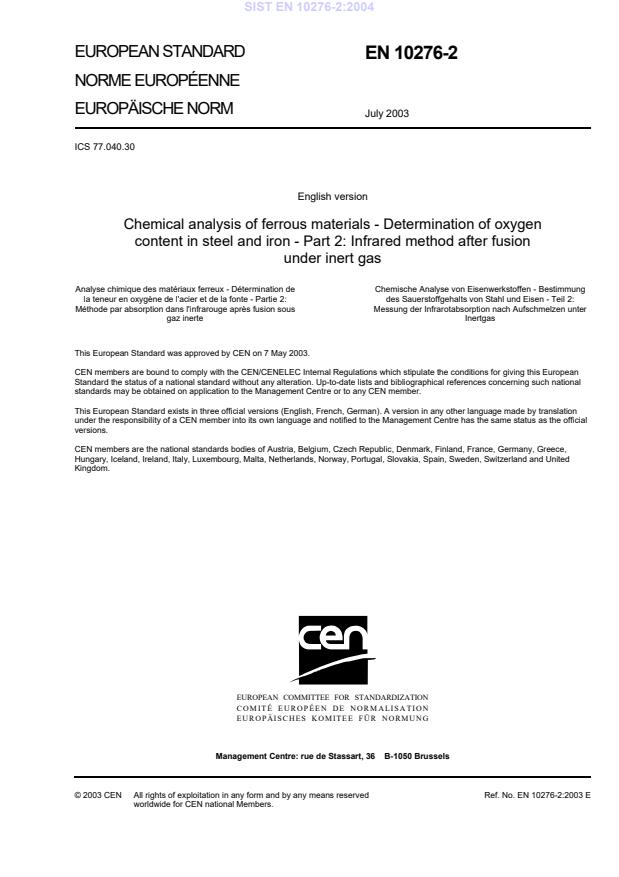
EUROPEAN STANDARDNORME EUROPÉENNEEUROPÄISCHE NORMEN 10276-2July 2003ICS 77.040.30English versionChemical analysis of ferrous materials - Determination of oxygencontent in steel and iron - Part 2: Infrared method after fusionunder inert gasAnalyse chimique des matériaux ferreux - Détermination dela teneur en oxygène de l'acier et de la fonte - Partie 2:Méthode par absorption dans l'infrarouge après fusion sousgaz inerteChemische Analyse von Eisenwerkstoffen - Bestimmungdes Sauerstoffgehalts von Stahl und Eisen - Teil 2:Messung der Infrarotabsorption nach Aufschmelzen unterInertgasThis European Standard was approved by CEN on 7 May 2003.CEN members are bound to comply with the CEN/CENELEC Internal Regulations which stipulate the conditions for giving this EuropeanStandard the status of a national standard without any alteration. Up-to-date lists and bibliographical references concerning such nationalstandards may be obtained on application to the Management Centre or to any CEN member.This European Standard exists in three official versions (English, French, German). A version in any other language made by translationunder the responsibility of a CEN member into its own language and notified to the Management Centre has the same status as the officialversions.CEN members are the national standards bodies of Austria, Belgium, Czech Republic, Denmark, Finland, France, Germany, Greece,Hungary, Iceland, Ireland, Italy, Luxembourg, Malta, Netherlands, Norway, Portugal, Slovakia, Spain, Sweden, Switzerland and UnitedKingdom.EUROPEAN COMMITTEE FOR STANDARDIZATIONCOMITÉ EUROPÉEN DE NORMALISATIONEUROPÄISCHES KOMITEE FÜR NORMUNGManagement Centre: rue de Stassart, 36
B-1050 Brussels© 2003 CENAll rights of exploitation in any form and by any means reservedworldwide for CEN national Members.Ref. No. EN 10276-2:2003 ESIST EN 10276-2:2004
...