

EN 12299:2024/prA1
(Amendment)Railway applications - Ride comfort for passengers - Measurement and evaluation
General Information
- Abstract
The purpose of this document is to provide methods for quantifying the ride comfort of a passenger in a rail vehicle in response to the track sections it is operated over.
The methods aim to quantify the effects of vehicle body motions on ride comfort and to make the assessment of passenger comfort predictable, repeatable, objective and meaningful.
The methods and comfort scales are validated for people of good health.
This document applies to passengers in rail vehicles operating on heavy rail networks.
This document applies to measurements of motions. It also applies to simulated motions. Guidance is provided on:
- which method described within the document should be used for different scenarios;
- typical values for different comfort levels;
- the application of simulation.
This document excludes health and safety issues, non-passenger carrying vehicles, vehicle homologation and safety, limit values, motion sickness, discomfort caused by accelerating and braking, design guidelines and measurement technology.
- Status
- Not Published
- Publication Date
- 26-Aug-2027
- Technical Committee
- CEN/TC 256 - Railway applications
- Drafting Committee
- CEN/TC 256/WG 7 - Ride comfort
- Current Stage
- 4097 - End of interruption of work - split/merged
- Start Date
- 22-Jul-2026
- Completion Date
- 30-Sep-2026

Overview
EN 12299:2024/prA1 is a European draft amendment standard developed by the European Committee for Standardization (CEN) for evaluating ride comfort for passengers in railway vehicles. This standard focuses on providing objective, repeatable, and validated methods for measuring and assessing the comfort experienced by passengers in heavy rail vehicles, based on the body motions caused by track conditions. The standard is specifically intended for individuals in good health and applies to both measured and simulated motions.
By outlining clear methodologies for the quantification and evaluation of ride comfort, EN 12299:2024/prA1 aims to support more accurate, meaningful, and comparable assessments of passenger comfort across different rail systems and networks.
Key Topics
Objective Assessment Methods
- Standardized procedures for quantifying ride comfort using vehicle body motion data.
- Application of validated comfort scales appropriate for healthy passengers.
- Clear guidance on selecting the relevant methodology based on different scenarios.
Measurement and Simulation
- Procedures for using both direct measurements and simulated motion data for comfort evaluation.
- Specification of time series, statistical analysis, and spectral analysis requirements for comfort-related data.
Comfort Index and Statistical Analysis
- Use of comfort indices to express the percentage of dissatisfied passengers during specific events.
- Requirements for the calculation and reporting of averages, peak values, and statistical distributions (mean, standard deviation, percentiles).
Guidance on Data Reporting
- Instructions for reporting results such as RMS acceleration values, statistical functions, and power spectral densities.
- Recommendations for documenting test conditions including speed, track geometry, and acceleration alignment.
Applications
EN 12299:2024/prA1 is valuable for a variety of stakeholders in the railway sector:
Rolling Stock Manufacturers and Designers
- Use the standard to validate and optimize vehicle designs for improved passenger ride comfort.
- Compare comfort across different vehicle models and configurations.
Railway Operators and Network Managers
- Monitor and assess passenger comfort during routine operations or after infrastructure changes.
- Benchmark ride comfort performance and optimize maintenance or upgrades based on objective data.
Railway Testing and Certification Bodies
- Apply consistent and recognized procedures when assessing passenger ride quality in compliance evaluations.
Consultants and Researchers
- Utilize the standard as a reference framework for conducting studies or reporting on passenger comfort in rail systems.
The standard can be applied during design verification, operational testing, passenger experience analysis, and in simulation environments for predictive assessment.
Related Standards
- EN 12299:2024 - The base standard for ride comfort measurement to which this amendment applies.
- EN 14363 - Railway applications related to the testing for the acceptance of running characteristics.
- ISO 2631 - Mechanical vibration and shock - evaluation of human exposure to whole-body vibration.
- EN 61373 - Railway applications - Rolling stock equipment - Shock and vibration tests.
By aligning with EN 12299 and referenced international standards, organizations can ensure a consistent approach to measuring and improving railway passenger comfort.
By following EN 12299:2024/prA1, stakeholders in the railway industry gain a comprehensive, harmonized method for measuring and evaluating passenger ride comfort, enhancing the ability to deliver safer and more pleasant journeys across heavy rail networks.
Relations
- Amends
EN 12299:2024 - Railway applications - Ride comfort for passengers - Measurement and evaluation - Effective Date
- 21-May-2025
Get Certified
Connect with accredited certification bodies for this standard

IRIS Certification (UNIFE)
International Railway Industry Standard certification.

TÜV SÜD Rail GmbH
TÜV SÜD railway certification services.

Bureau Veritas Railway Certification
Railway and transportation certification.
Sponsored listings
Frequently Asked Questions
EN 12299:2024/prA1 is a draft published by the European Committee for Standardization (CEN). Its full title is "Railway applications - Ride comfort for passengers - Measurement and evaluation". This standard covers: The purpose of this document is to provide methods for quantifying the ride comfort of a passenger in a rail vehicle in response to the track sections it is operated over. The methods aim to quantify the effects of vehicle body motions on ride comfort and to make the assessment of passenger comfort predictable, repeatable, objective and meaningful. The methods and comfort scales are validated for people of good health. This document applies to passengers in rail vehicles operating on heavy rail networks. This document applies to measurements of motions. It also applies to simulated motions. Guidance is provided on: - which method described within the document should be used for different scenarios; - typical values for different comfort levels; - the application of simulation. This document excludes health and safety issues, non-passenger carrying vehicles, vehicle homologation and safety, limit values, motion sickness, discomfort caused by accelerating and braking, design guidelines and measurement technology.
The purpose of this document is to provide methods for quantifying the ride comfort of a passenger in a rail vehicle in response to the track sections it is operated over. The methods aim to quantify the effects of vehicle body motions on ride comfort and to make the assessment of passenger comfort predictable, repeatable, objective and meaningful. The methods and comfort scales are validated for people of good health. This document applies to passengers in rail vehicles operating on heavy rail networks. This document applies to measurements of motions. It also applies to simulated motions. Guidance is provided on: - which method described within the document should be used for different scenarios; - typical values for different comfort levels; - the application of simulation. This document excludes health and safety issues, non-passenger carrying vehicles, vehicle homologation and safety, limit values, motion sickness, discomfort caused by accelerating and braking, design guidelines and measurement technology.
EN 12299:2024/prA1 is classified under the following ICS (International Classification for Standards) categories: 45.060.20 - Trailing stock. The ICS classification helps identify the subject area and facilitates finding related standards.
EN 12299:2024/prA1 has the following relationships with other standards: It is inter standard links to EN 12299:2024. Understanding these relationships helps ensure you are using the most current and applicable version of the standard.
EN 12299:2024/prA1 is available in PDF format for immediate download after purchase. The document can be added to your cart and obtained through the secure checkout process. Digital delivery ensures instant access to the complete standard document.
Standards Content (Sample)
SLOVENSKI STANDARD
01-maj-2026
Železniške naprave - Udobnost vožnje potnikov - Meritve in vrednotenje -
Dopolnilo A1
Railway applications - Ride comfort for passengers - Measurement and evaluation
Bahnanwendungen - Fahrkomfort für Fahrgäste - Messung und Auswertung
Applications ferroviaires - Confort de marche des voyageurs - Mesurage et évaluation
Ta slovenski standard je istoveten z: EN 12299:2024/prA1
ICS:
13.160 Vpliv vibracij in udarcev na Vibration and shock with
ljudi respect to human beings
45.060.20 Železniški vagoni Trailing stock
2003-01.Slovenski inštitut za standardizacijo. Razmnoževanje celote ali delov tega standarda ni dovoljeno.
DRAFT
EUROPEAN STANDARD
EN 12299:2024
NORME EUROPÉENNE
EUROPÄISCHE NORM
prA1
March 2026
ICS 45.060.20
English Version
Railway applications - Ride comfort for passengers -
Measurement and evaluation
Applications ferroviaires - Confort de marche des Bahnanwendungen - Fahrkomfort für Fahrgäste -
voyageurs - Mesurage et évaluation Messung und Auswertung
This draft amendment is submitted to CEN members for enquiry. It has been drawn up by the Technical Committee CEN/TC 256.
This draft amendment A1, if approved, will modify the European Standard EN 12299:2024. If this draft becomes an amendment,
CEN members are bound to comply with the CEN/CENELEC Internal Regulations which stipulate the conditions for inclusion of
this amendment into the relevant national standard without any alteration.
This draft amendment was established by CEN in three official versions (English, French, German). A version in any other
language made by translation under the responsibility of a CEN member into its own language and notified to the CEN-CENELEC
Management Centre has the same status as the official versions.
CEN members are the national standards bodies of Austria, Belgium, Bulgaria, Croatia, Cyprus, Czech Republic, Denmark, Estonia,
Finland, France, Germany, Greece, Hungary, Iceland, Ireland, Italy, Latvia, Lithuania, Luxembourg, Malta, Netherlands, Norway,
Poland, Portugal, Republic of North Macedonia, Romania, Serbia, Slovakia, Slovenia, Spain, Sweden, Switzerland, Türkiye and
United Kingdom.
Recipients of this draft are invited to submit, with their comments, notification of any relevant patent rights of which they are
aware and to provide supporting documentation.
Warning : This document is not a European Standard. It is distributed for review and comments. It is subject to change without
notice and shall not be referred to as a European Standard.
EUROPEAN COMMITTEE FOR STANDARDIZATION
COMITÉ EUROPÉEN DE NORMALISATION
EUROPÄISCHES KOMITEE FÜR NORMUNG
CEN-CENELEC Management Centre: Rue de la Science 23, B-1040 Brussels
© 2026 CEN All rights of exploitation in any form and by any means reserved Ref. No. EN 12299:2024/prA1:2026 E
worldwide for CEN national Members.
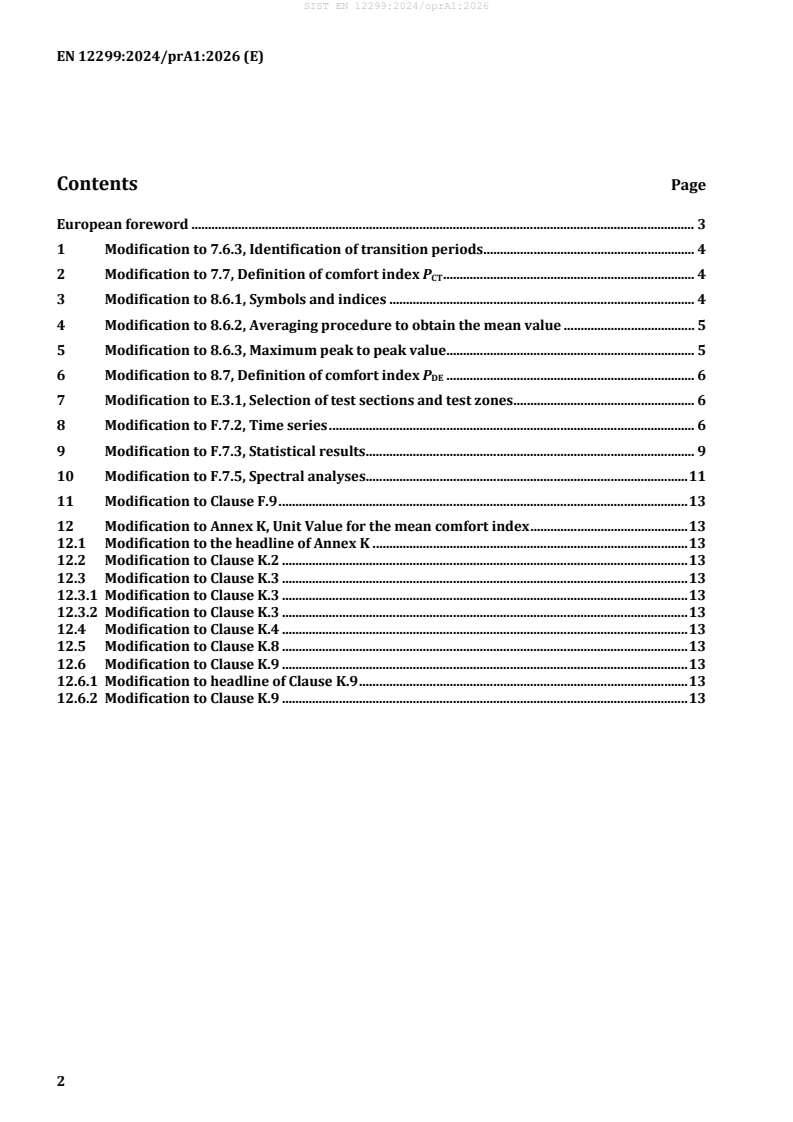
Contents Page
European foreword . 3
1 Modification to 7.6.3, Identification of transition periods . 4
2 Modification to 7.7, Definition of comfort index P . 4
CT
3 Modification to 8.6.1, Symbols and indices . 4
4 Modification to 8.6.2, Averaging procedure to obtain the mean value . 5
5 Modification to 8.6.3, Maximum peak to peak value. 5
6 Modification to 8.7, Definition of comfort index P . 6
DE
7 Modification to E.3.1, Selection of test sections and test zones . 6
8 Modification to F.7.2, Time series . 6
9 Modification to F.7.3, Statistical results . 9
10 Modification to F.7.5, Spectral analyses . 11
11 Modification to Clause F.9 . 13
12 Modification to Annex K, Unit Value for the mean comfort index . 13
12.1 Modification to the headline of Annex K . 13
12.2 Modification to Clause K.2 . 13
12.3 Modification to Clause K.3 . 13
12.3.1 Modification to Clause K.3 . 13
12.3.2 Modification to Clause K.3 . 13
12.4 Modification to Clause K.4 . 13
12.5 Modification to Clause K.8 . 13
12.6 Modification to Clause K.9 . 13
12.6.1 Modification to headline of Clause K.9 . 13
12.6.2 Modification to Clause K.9 . 13
European foreword
This document (EN 12299:2024/prA1:2026) has been prepared by Technical Committee CEN/TC 256
“Railway applications”, the secretariat of which is held by DIN.
This document is currently submitted to the CEN Enquiry.
1 Modification to 7.6.3, Identification of transition periods
Replace in the second paragraph following Figure 2, second line “BBR TR DOS 017” with
“BRR TR DOS 017”.
2 Modification to 7.7, Definition of comfort index P
CT
Replace the numbering of the following formulae: “
P 100⋅ max A⋅ ÿ +⋅B y − C ;0 (16a)
)
(
CT_lat { 1s 1s }
max max
E
PD= 100⋅⋅( ϕ ) (16b)
{ }
CT_rol 1s
max
(16c)
PP + P
CT CT_lat CT_rol
“ with “
P 100⋅ max A⋅ ÿ +⋅B y − C ;0
(17)
( )
CT_lat { 1s 1s }
max max
E
PD= 100⋅⋅( ϕ ) (18)
{ }
CT_rol 1s
max
PP + P (19)
CT CT_lat CT_rol
“.
3 Modification to 8.6.1, Symbols and indices
Replace the following paragraph (hyphen): “
— P index for comfort on discrete events, calculated following Formula (20), indicating the
DE
percentage of dissatisfied passengers;
“ with “
— P index for comfort on discrete events, calculated following Formula (22), indicating the
DE
percentage of dissatisfied passengers;
“.
=
=
=
=
4 Modification to 8.6.2, Averaging procedure to obtain the mean value
Replace the following (2nd) paragraph: “
The averaging of the signals during the period
...