

EN 311:2002
(Main)Wood-based panels - Surface soundness - Test method
- Abstract
This European Standard specifies a method of assessing the surface soundness of coated wood-based panels and uncoated particle boards, wet and dry process fibreboards and cement bonded particle boards.
NOTE The grid patterned face of wet processed hardboards cannot be tested according to this standard.
- Status
- Published
- Publication Date
- 14-May-2002
- Withdrawal Date
- 29-Nov-2002
- Technical Committee
- CEN/TC 112 - Woodbased panels
- Drafting Committee
- CEN/TC 112 - Woodbased panels
- Current Stage
- 9093 - Decision to confirm - Review Enquiry
- Start Date
- 06-May-2025
- Completion Date
- 14-Oct-2026
Buy Documents
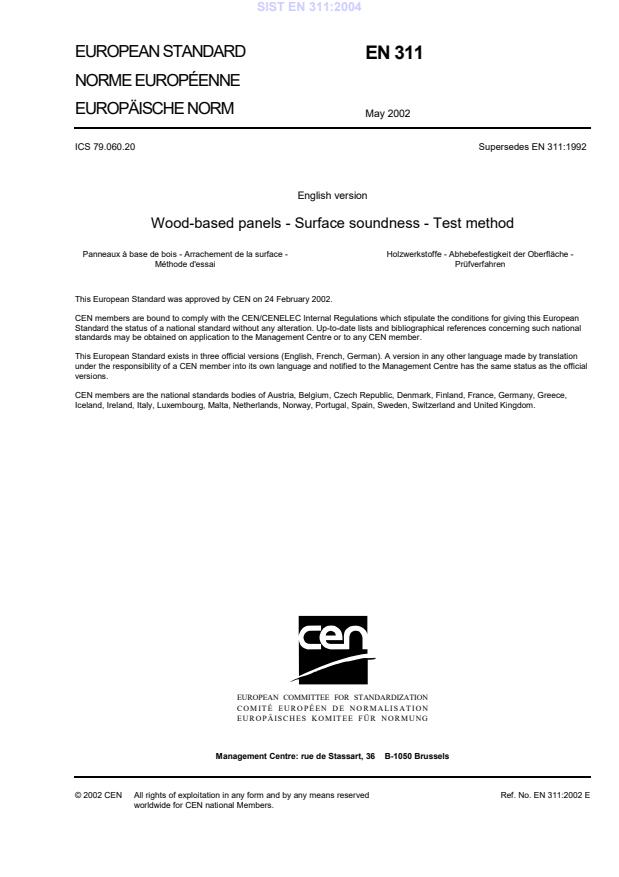


Overview
EN 311:2002 - Wood-based panels - Surface soundness - Test method (CEN) specifies a standardized tensile test for assessing the surface soundness (bond quality at the surface) of coated and uncoated wood-based panels. It applies to overlaid panels, unfaced particle boards, wet and dry process fibreboards (e.g., MDF), and cement-bonded particle boards. Note: the grid-patterned face of wet-processed hardboards is excluded.
Key topics and technical requirements
- Scope: Overlaid and unfaced wood-based panels; wet/dry fibreboards; cement-bonded boards.
- Sampling and specimen size: Follow EN 326-1. Use 8 test pieces, each 50 × 50 mm per board (or 8 per surface for different coatings).
- Groove preparation:
- Circular groove inside diameter 35.7 ± 0.2 mm (enclosed area = 1 000 mm²).
- Depth: 0.3 ± 0.1 mm (for overlaid panels the groove must just break through the coating and not penetrate >0.3 mm into the board).
- Steel pad: Mushroom-shaped steel pad 35.6 ± 0.1 mm diameter to bond to the prepared surface.
- Conditioning: All specimens to constant mass at (20 ± 2) °C and (65 ± 5) % RH; constant mass = two weighings 24 h apart differing by ≤ 0.1 %.
- Adhesive & bonding:
- Preferred: hot-melt adhesive (melting point < 150 °C) applied to heated pad.
- If heating weakens surface (e.g., some MDF or overlays), use cold-setting epoxy.
- For panels thinner than 15 mm, strengthen underside with a 50 × 50 mm steel plate ≥ 10 mm thick.
- Test method & measurement:
- Specimen mounted in gimbal and pulled at constant speed so failure occurs in (60 ± 30) s.
- Record maximum force at fracture and failure mode (within coating, within underlying board, at interface, etc.).
- Result expression: Surface soundness SS = F / A (N/mm²), where A = 1 000 mm². Report to 0.01 N/mm². Reject tests where failure is within the pad glueline unless specified.
Practical applications and users
- Manufacturers of particle board, MDF, HDF, overlaid laminates and cement-bonded panels use EN 311:2002 for quality control and product specification.
- Test laboratories and certification bodies apply the method to verify surface bonding, durability of coatings/overlays, and compliance with customer or regulatory requirements.
- Designers, specifiers, and buyers in furniture, interior finish, flooring and construction rely on surface soundness data to assess suitability for finishing, machining, and end-use performance.
Related standards
- EN 326-1 (Sampling, cutting and inspection - Part 1) is normative for sampling and reporting referenced in EN 311:2002.
Keywords: EN 311:2002, surface soundness, wood-based panels, test method, particle board, fibreboard, overlaid panels, tensile test, CEN.
Relations
- Effective Date
- 22-Dec-2008
- Effective Date
- 28-Jan-2026
- Effective Date
- 28-Jan-2026
- Effective Date
- 28-Jan-2026
- Effective Date
- 28-Jan-2026
- Effective Date
- 28-Jan-2026
- Effective Date
- 28-Jan-2026
- Effective Date
- 28-Jan-2026
- Effective Date
- 28-Jan-2026
- Effective Date
- 28-Jan-2026
- Referred By
EN 622-5:2009 - Fibreboards - Specifications - Part 5: Requirements for dry process boards (MDF) - Effective Date
- 28-Jan-2026
- Effective Date
- 28-Jan-2026
- Effective Date
- 28-Jan-2026
- Effective Date
- 28-Jan-2026
- Effective Date
- 28-Jan-2026
Buy Documents
Get Certified
Connect with accredited certification bodies for this standard

Gozdarski inštitut Slovenije
Slovenian Forestry Institute. Forest management certification support, timber testing.
Sponsored listings
Frequently Asked Questions
EN 311:2002 is a standard published by the European Committee for Standardization (CEN). Its full title is "Wood-based panels - Surface soundness - Test method". This standard covers: This European Standard specifies a method of assessing the surface soundness of coated wood-based panels and uncoated particle boards, wet and dry process fibreboards and cement bonded particle boards. NOTE The grid patterned face of wet processed hardboards cannot be tested according to this standard.
This European Standard specifies a method of assessing the surface soundness of coated wood-based panels and uncoated particle boards, wet and dry process fibreboards and cement bonded particle boards. NOTE The grid patterned face of wet processed hardboards cannot be tested according to this standard.
EN 311:2002 is classified under the following ICS (International Classification for Standards) categories: 79.060.20 - Fibre and particle boards. The ICS classification helps identify the subject area and facilitates finding related standards.
EN 311:2002 has the following relationships with other standards: It is inter standard links to EN 311:1992, EN 326-1:1994, EN 312:2010, CEN/TS 16368:2014, EN 13329:2006+A1:2008, EN 14322:2004, EN 13329:2016, EN 13329:2016+A1:2017, EN 17142:2018, EN 14322:2021, EN 622-5:2009, CEN/TS 16526:2013, EN 14322:2017, EN 15197:2007, EN 13329:2016+A2:2021. Understanding these relationships helps ensure you are using the most current and applicable version of the standard.
EN 311:2002 is associated with the following European legislation: EU Directives/Regulations: 305/2011, 89/106/EEC. When a standard is cited in the Official Journal of the European Union, products manufactured in conformity with it benefit from a presumption of conformity with the essential requirements of the corresponding EU directive or regulation.
EN 311:2002 is available in PDF format for immediate download after purchase. The document can be added to your cart and obtained through the secure checkout process. Digital delivery ensures instant access to the complete standard document.
Standards Content (Sample)
2003-01.Slovenski inštitut za standardizacijo. Razmnoževanje celote ali delov tega standarda ni dovoljeno.Holzwerkstoffe - Abhebefestigkeit der Oberfläche - PrüfverfahrenPanneaux a base de bois - Arrachement de la surface - Méthode d'essaiWood-based panels - Surface soundness - Test method79.060.01Wood-based panels in generalICS:Ta slovenski standard je istoveten z:EN 311:2002SIST EN 311:2004en01-januar-2004SIST EN 311:2004SLOVENSKI
STANDARDSIST EN 311:19961DGRPHãþD
EUROPEAN STANDARDNORME EUROPÉENNEEUROPÄISCHE NORMEN 311May 2002ICS 79.060.20Supersedes EN 311:1992English versionWood-based panels - Surface soundness - Test methodPanneaux à base de bois - Arrachement de la surface -Méthode d'essaiHolzwerkstoffe - Abhebefestigkeit der Oberfläche -PrüfverfahrenThis European Standard was approved by CEN on 24 February 2002.CEN members are bound to comply with the CEN/CENELEC Internal Regulations which stipulate the conditions for giving this EuropeanStandard the status of a national standard without any alteration. Up-to-date lists and bibliographical references concerning such nationalstandards may be obtained on application to the Management Centre or to any CEN member.This European Standard exists in three official versions (English, French, German). A version in any other language made by translationunder the responsibility of a CEN member into its own language and notified to the Management Centre has the same status as the officialversions.CEN members are the national standards bodies of Austria, Belgium, Czech Republic, Denmark, Finland, France, Germany, Greece,Iceland, Ireland, Italy, Luxembourg, Malta, Netherlands, Norway, Portugal, Spain, Sweden, Switzerland and United Kingdom.EUROPEAN COMMITTEE FOR STANDARDIZATIONCOMITÉ EUROPÉEN DE NORMALISATIONEUROPÄISCHES KOMITEE FÜR NORMUNGManagement Centre: rue de Stassart, 36
B-1050 Brussels© 2002 CENAll rights of exploitation in any form and by any means reservedworldwide for CEN national Members.Ref. No. EN 311:2002 ESIST EN 311:2004
...
SLOVENSKI STANDARD
01-januar-2004
Nadomešča:
SIST EN 311:1996
Lesne plošče – Čvrstost površine – Preskusna metoda
Wood-based panels - Surface soundness - Test method
Holzwerkstoffe - Abhebefestigkeit der Oberfläche - Prüfverfahren
Panneaux a base de bois - Arrachement de la surface - Méthode d'essai
Ta slovenski standard je istoveten z: EN 311:2002
ICS:
79.060.01 Lesne plošče na splošno Wood-based panels in
general
2003-01.Slovenski inštitut za standardizacijo. Razmnoževanje celote ali delov tega standarda ni dovoljeno.
EUROPÄISCHE NORM
EN 311
EUROPEAN STANDARD
NORME EUROPÉENNE
Mai 2002
ICS 79.060.20 Ersatz für EN 311:1992
Deutsche Fassung
Holzwerkstoffe - Abhebefestigkeit der Oberfläche -
Prüfverfahren
Wood-based panels - Surface soundness - Test method Panneaux à base de bois - Arrachement de la surface -
Méthode d'essai
Diese Europäische Norm wurde vom CEN am 24.Februar 2002 angenommen.
Die CEN-Mitglieder sind gehalten, die CEN/CENELEC-Geschäftsordnung zu erfüllen, in der die Bedingungen festgelegt sind, unter denen
dieser Europäischen Norm ohne jede Änderung der Status einer nationalen Norm zu geben ist. Auf dem letzen Stand befindliche Listen
dieser nationalen Normen mit ihren bibliographischen Angaben sind beim Management-Zentrum oder bei jedem CEN-Mitglied auf Anfrage
erhältlich.
Diese Europäische Norm besteht in drei offiziellen Fassungen (Deutsch, Englisch, Französisch). Eine Fassung in einer anderen Sprache,
die von einem CEN-Mitglied in eigener Verantwortung durch Übersetzung in seine Landessprache gemacht und dem Management-
Zentrum mitgeteilt worden ist, hat den gleichen Status wie die offiziellen Fassungen.
CEN-Mitglieder sind die nationalen Normungsinstitute von Belgien, Dänemark, Deutschland, Finnland, Frankreich, Griechenland, Irland,
Island, Italien, Luxemburg, Malta, Niederlande, Norwegen, Österreich, Portugal, Schweden, Schweiz, Spanien, der Tschechischen
Republik und dem Vereinigten Königreich.
EUROPÄISCHES KOMITEE FÜR NORMUNG
EUROPEAN COMMITTEE FOR STANDARDIZATION
COMITÉ EUROPÉEN DE NORMALISATION
Management-Zentrum: rue de Stassart, 36 B-1050 Brüssel
© 2002 CEN Alle Rechte der Verwertung, gleich in welcher Form und in welchem Ref. Nr. EN 311:2002 D
Verfahren, sind weltweit den nationalen Mitgliedern von CEN
vorbehalten.
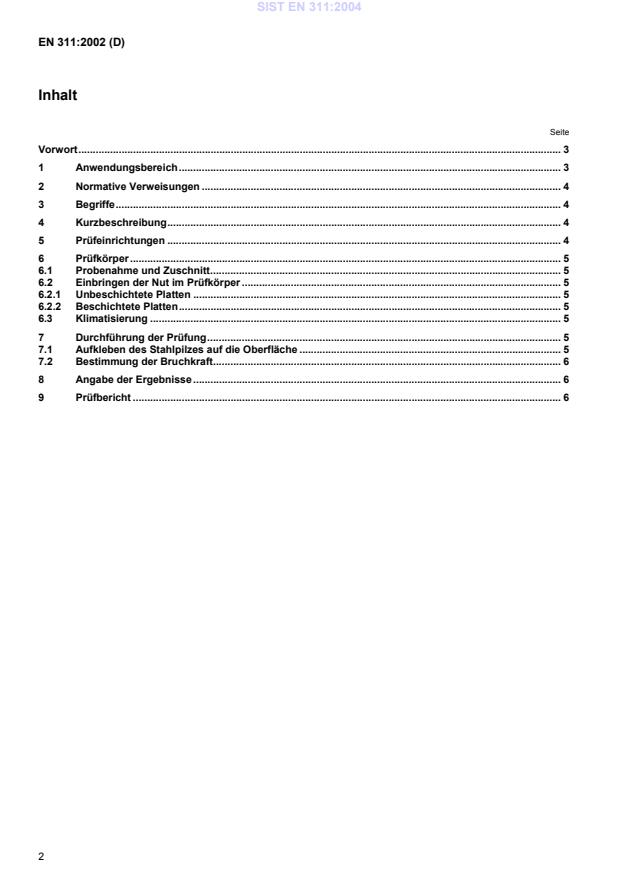
Inhalt
....................................................................................................................................................................................................................... Seite
Vorwort. 3
1 Anwendungsbereich. 3
2 Normative Verweisungen . 4
3 Begriffe. 4
4 Kurzbeschreibung. 4
5 Prüfeinrichtungen . 4
6 Prüfkörper. 5
6.1 Probenahme und Zuschnitt. 5
6.2 Einbringen der Nut im Prüfkörper . 5
6.2.1 Unbeschichtete Platten . 5
6.2.2 Beschichtete Platten. 5
6.3 Klimatisierung . 5
7 Durchführung der Prüfung. 5
7.1 Aufkleben des Stahlpilzes auf die Oberfläche . 5
7.2 Bestimmung der Bruchkraft. 6
8 Angabe der Ergebnisse . 6
9 Prüfbericht . 6
Vorwort
Dieses Dokument EN 311:2002 wurde vom CEN/TC 112 „Holzwerkstoffe“ erarbeitet, dessen Sekretariat vom DIN
gehalten wird.
Diese Europäische Norm muss den Status einer nationalen Norm erhalten, entweder durch Veröffentlichung eines
identischen Textes oder durch Anerkennung bis November 2002, und etwaige entgegenstehende nationale Nor-
men müssen bis November 2002 zurückgezogen werden.
Dieses Dokument ersetzt EN 311:1992.
Im Vergleich zu EN 311:1992 sind folgende Änderungen vorgenommen worden:
a) Der Anwendungsbereich wurde erweitert. Die Norm gilt jetzt auch für beschichtete Platten, für Faserplatten nach
dem Nass- und nach dem Trockenverfahren sowie für zementgebundene Spanplatten.
b) Die Anzahl der Prüfkörper wurde von 10 auf 8 verringert.
c) Die Prüfung von Platten mit einer Dicke von weniger als 15 mm wurde geändert.
Entsprechend der CEN/CENELEC-Geschäftsordnung sind die nationalen Normungsinstitute der folgenden Länder
gehalten, diese Europäische Norm zu übernehmen: Belgien, Dänemark, Deutschland, Finnland, Frankreich,
Griechenland, Irland, Island, Italien, Luxemburg, Niederlande, Norwegen, Österreich, Portugal, Schweden,
Schweiz, Spanien, die Tschechische Republik und das Vereinigte Königreich.
1 Anwendungsbereich
Diese Europäische Norm legt für beschichtete Holzwerkstoffe sowie für unbeschichtete Spanplatten, für unbe-
schichtete Faserplatten nach dem Nass- und nach dem Trockenverfahren und für unbeschichtete zementgebundene
Spanplatten ein Verfahren zur Beurteilung der Abhebefestigkeit der Oberfläche fest.
ANMERKUNG Die Siebseite von harten Faserplatten nach dem Nassverfahren kann nach dieser Norm nicht geprüft werden.
2 Normative Verweisungen
Diese Europäische Norm enthält
...