

EN 622-4:2024
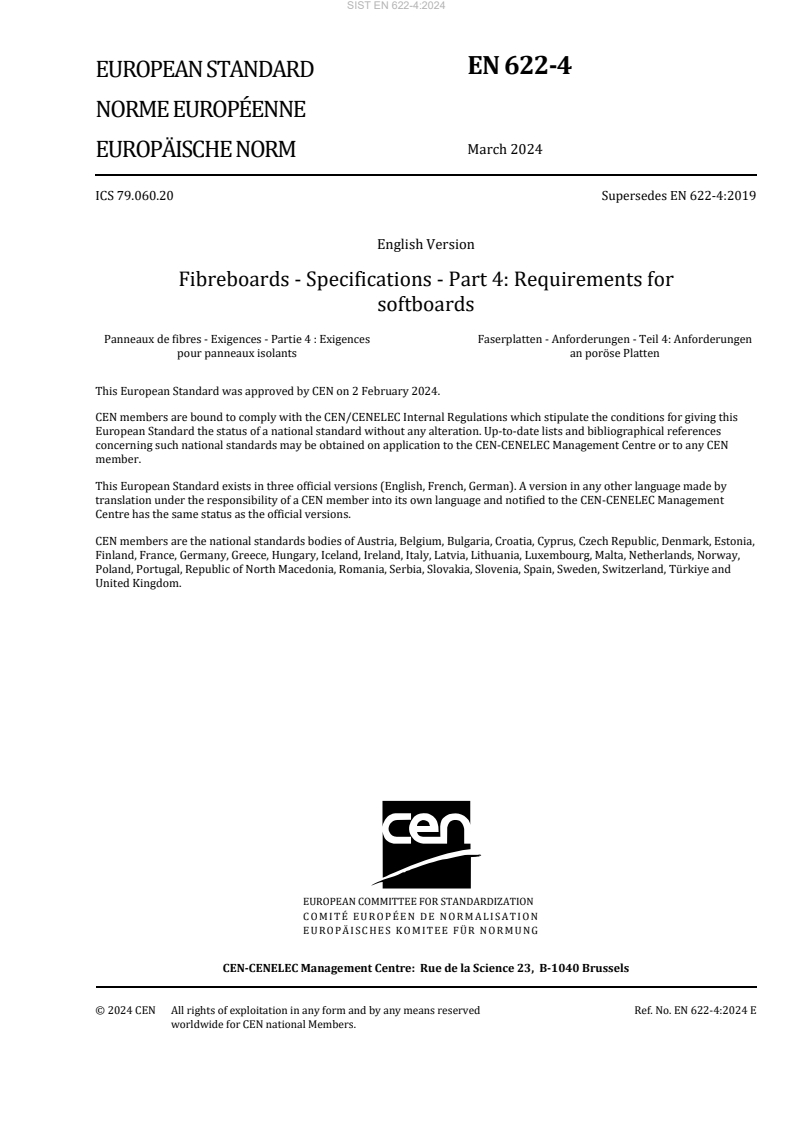
(Main)Fibreboards - Specifications - Part 4: Requirements for softboards
- Abstract
This document specifies the requirements for softboards as defined in EN 316, with a density from 230 kg/ m3 to 400 kg/ m3.
The values listed in this document relate to product properties but they are not characteristic values to be used in design calculations.
NOTE Panels which are intended for use exclusively as thermal insulating products are covered by EN 13171.
- Status
- Published
- Publication Date
- 19-Mar-2024
- Technical Committee
- CEN/TC 112 - Woodbased panels
- Drafting Committee
- CEN/TC 112/WG 11 - Particleboards and fibreboards
- Current Stage
- 6060 - Definitive text made available (DAV) - Publishing
- Start Date
- 20-Mar-2024
- Due Date
- 21-Aug-2025
- Completion Date
- 20-Mar-2024
Overview
EN 622-4:2024 is a European standard published by CEN that specifies the requirements for softboards-a type of fibreboard with densities ranging from 230 kg/m³ to 400 kg/m³. These softboards are defined in EN 316 and are primarily used in various building and construction applications. The standard focuses on product properties such as swelling, bending strength, and modulus of elasticity, but clarifies these values are not intended for design calculations.
This updated 2024 edition supersedes EN 622-4:2019 and introduces revisions to load duration classifications and board type denominations. It applies across the European Economic Area (EEA) and sets out compliance and marking requirements ensuring quality and traceability.
Key Topics
Scope and Definitions:
EN 622-4 covers softboards with nominal densities between 230–400 kg/m³. It excludes fibreboards solely designed for thermal insulation, which fall under EN 13171. Key terms such as dry, humid, and external conditions define the environmental suitability categories based on moisture exposure and service class.Requirements:
The standard classifies softboards into general purpose and load-bearing types, with specific property requirements for dry, humid, and external conditions. Essential measured properties include:- Swelling in thickness after 2 hours immersion (per EN 317)
- Bending strength (per EN 310)
- Modulus of elasticity in bending (for load-bearing boards, per EN 310)
These properties vary depending on nominal thickness and intended use, ensuring the softboards can withstand expected environmental and mechanical stresses.
Verification and Control:
Compliance is verified through factory production control and external inspections using established sampling and testing methods (EN 326 series). Testing intervals and sampling procedures ensure ongoing product quality during manufacturing.Marking & Traceability:
For construction market boards under the EU Construction Products Regulation, marking must meet EN 13986 requirements. Other softboards require manufacturer identification, batch numbers, nominal thickness, and board type markings. A standardized colour coding system facilitates quick identification of board type and intended usage.
Applications
EN 622-4 certified softboards are widely utilized in building and furniture manufacturing where fibreboards must meet specific performance criteria for moisture resistance and load-bearing capacity. Typical applications include:
- Interior wall and ceiling linings
- Flooring underlays and substrates
- Non-load-bearing fitments
- Load-bearing structural elements in dry or humid conditions
- Certain external applications where moisture exposure is limited
This standard ensures the softboards perform reliably in these contexts, maintaining dimensional stability and mechanical strength to support usage over the product life cycle.
Related Standards
- EN 316: Defines the types and classifications of fibreboards, including softboards referenced in EN 622-4.
- EN 622-1: General requirements for fibreboards, providing foundational properties applicable to softboards.
- EN 13171: Thermal insulating fibreboards, distinct from those covered under EN 622-4 due to their insulation focus.
- EN 310: Test methods for bending strength and modulus of elasticity relevant for verifying mechanical performance.
- EN 317: Test method for swelling in thickness after water immersion-crucial for moisture resistance assessment.
- EN 13986: Requirements for wood-based panels used in construction related to characteristics, conformity, and marking, important for legal and quality compliance.
By adhering to EN 622-4:2024 requirements, manufacturers and specifiers can ensure high-quality softboards that meet harmonized European standards for building safety, durability, and environmental suitability. This standard supports sustainable construction practices by defining reliable fibreboard specifications critical to modern wood-based panel products.
Relations
- Effective Date
- 17-May-2023
- Effective Date
- 28-Jan-2026
- Effective Date
- 28-Jan-2026
- Effective Date
- 28-Jan-2026
- Effective Date
- 28-Jan-2026
- Effective Date
- 28-Jan-2026
- Effective Date
- 28-Jan-2026
- Effective Date
- 28-Jan-2026
- Effective Date
- 28-Jan-2026
- Effective Date
- 28-Jan-2026
- Effective Date
- 28-Jan-2026
- Effective Date
- 28-Jan-2026
- Effective Date
- 28-Jan-2026
- Referred By
EN 1995-1-2:2025 - Eurocode 5 - Design of timber structures - Part 1-2: Structural fire design - Effective Date
- 28-Jan-2026
- Referred By
EN 14964:2006 - Rigid underlays for discontinuous roofing - Definitions and characteristics - Effective Date
- 28-Jan-2026
Get Certified
Connect with accredited certification bodies for this standard

Gozdarski inštitut Slovenije
Slovenian Forestry Institute. Forest management certification support, timber testing.
Sponsored listings
Frequently Asked Questions
EN 622-4:2024 is a standard published by the European Committee for Standardization (CEN). Its full title is "Fibreboards - Specifications - Part 4: Requirements for softboards". This standard covers: This document specifies the requirements for softboards as defined in EN 316, with a density from 230 kg/ m3 to 400 kg/ m3. The values listed in this document relate to product properties but they are not characteristic values to be used in design calculations. NOTE Panels which are intended for use exclusively as thermal insulating products are covered by EN 13171.
This document specifies the requirements for softboards as defined in EN 316, with a density from 230 kg/ m3 to 400 kg/ m3. The values listed in this document relate to product properties but they are not characteristic values to be used in design calculations. NOTE Panels which are intended for use exclusively as thermal insulating products are covered by EN 13171.
EN 622-4:2024 is classified under the following ICS (International Classification for Standards) categories: 79.060.20 - Fibre and particle boards. The ICS classification helps identify the subject area and facilitates finding related standards.
EN 622-4:2024 has the following relationships with other standards: It is inter standard links to EN 622-4:2019, EN 310:1993, EN 326-2:2010+A1:2014, EN 326-1:1994, EN 326-3:2003, EN 317:1993, EN 13986:2004, EN 622-1:2003, EN 1995-1-1:2004, EN ISO 1514:2016, CEN/TR 15276-1:2009, EN 13986:2004+A1:2015, EN ISO 1514:2024, EN 1995-1-2:2025, EN 14964:2006. Understanding these relationships helps ensure you are using the most current and applicable version of the standard.
EN 622-4:2024 is available in PDF format for immediate download after purchase. The document can be added to your cart and obtained through the secure checkout process. Digital delivery ensures instant access to the complete standard document.
Standards Content (Sample)
SLOVENSKI STANDARD
01-junij-2024
Vlaknene plošče - Specifikacije - 4. del: Zahteve za mehke plošče
Fibreboards - Specifications - Part 4: Requirements for softboards
Faserplatten - Anforderungen - Teil 4: Anforderungen an poröse Platten
Panneaux de fibres - Exigences - Partie 4 : Exigences pour panneaux isolants
Ta slovenski standard je istoveten z: EN 622-4:2024
ICS:
79.060.20 Vlaknene in iverne plošče Fibre and particle boards
2003-01.Slovenski inštitut za standardizacijo. Razmnoževanje celote ali delov tega standarda ni dovoljeno.
EN 622-4
EUROPEAN STANDARD
NORME EUROPÉENNE
March 2024
EUROPÄISCHE NORM
ICS 79.060.20 Supersedes EN 622-4:2019
English Version
Fibreboards - Specifications - Part 4: Requirements for
softboards
Panneaux de fibres - Exigences - Partie 4 : Exigences Faserplatten - Anforderungen - Teil 4: Anforderungen
pour panneaux isolants an poröse Platten
This European Standard was approved by CEN on 2 February 2024.
CEN members are bound to comply with the CEN/CENELEC Internal Regulations which stipulate the conditions for giving this
European Standard the status of a national standard without any alteration. Up-to-date lists and bibliographical references
concerning such national standards may be obtained on application to the CEN-CENELEC Management Centre or to any CEN
member.
This European Standard exists in three official versions (English, French, German). A version in any other language made by
translation under the responsibility of a CEN member into its own language and notified to the CEN-CENELEC Management
Centre has the same status as the official versions.
CEN members are the national standards bodies of Austria, Belgium, Bulgaria, Croatia, Cyprus, Czech Republic, Denmark, Estonia,
Finland, France, Germany, Greece, Hungary, Iceland, Ireland, Italy, Latvia, Lithuania, Luxembourg, Malta, Netherlands, Norway,
Poland, Portugal, Republic of North Macedonia, Romania, Serbia, Slovakia, Slovenia, Spain, Sweden, Switzerland, Türkiye and
United Kingdom.
EUROPEAN COMMITTEE FOR STANDARDIZATION
COMITÉ EUROPÉEN DE NORMALISATION
EUROPÄISCHES KOMITEE FÜR NORMUNG
CEN-CENELEC Management Centre: Rue de la Science 23, B-1040 Brussels
© 2024 CEN All rights of exploitation in any form and by any means reserved Ref. No. EN 622-4:2024 E
worldwide for CEN national Members.
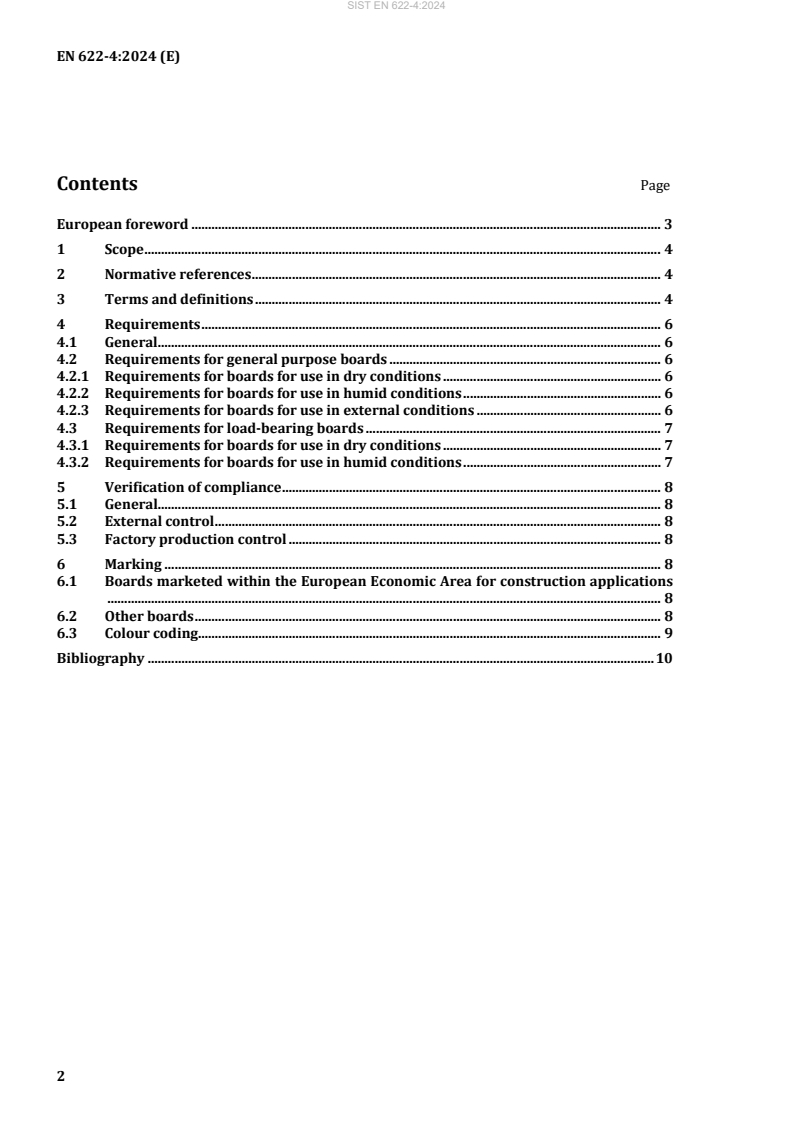
Contents Page
European foreword . 3
1 Scope . 4
2 Normative references . 4
3 Terms and definitions . 4
4 Requirements . 6
4.1 General. 6
4.2 Requirements for general purpose boards . 6
4.2.1 Requirements for boards for use in dry conditions . 6
4.2.2 Requirements for boards for use in humid conditions . 6
4.2.3 Requirements for boards for use in external conditions . 6
4.3 Requirements for load-bearing boards . 7
4.3.1 Requirements for boards for use in dry conditions . 7
4.3.2 Requirements for boards for use in humid conditions . 7
5 Verification of compliance . 8
5.1 General. 8
5.2 External control . 8
5.3 Factory production control . 8
6 Marking . 8
6.1 Boards marketed within the European Economic Area for construction applications
..................................................................................................................................................................... 8
6.2 Other boards . 8
6.3 Colour coding. 9
Bibliography . 10
European foreword
This document (EN 622-4:2024) has been prepared by Technical Committee CEN/TC 112 “Wood-based
panels”, the secretariat of which is held by DIN.
This European Standard shall be given the status of a national standard, either by publication of an
identical text or by endorsement, at the latest by September 2024, and conflicting national standards shall
be withdrawn at the latest by September 2024.
Attention is drawn to the possibility that some of the elements of this document may be the subject of
patent rights. CEN shall not be held responsible for identifying any or all such patent rights.
This document supersedes EN 622-4:2019.
The main changes compared to the previous edition are listed below:
a) limitation of fibre boards of type SB.LS and SB.HLS to short-term and instantaneous load duration
has been deleted;
b) denomination of those boards therefore has been changed from SB.LS to SB.L and SB.HLS to SB.HL,
respectively.
This document is one of a series of standards specifying requirements for fibreboards. The other parts of
this series are listed in Clause 2 and in the Bibliography.
Any feedback and questions on this document should be directed to the users’ national standards body.
A complete listing of these bodies can be found on the CEN website.
According to the CEN-CENELEC Internal Regulations, the national standards organisations of the
following countries are bound to implement this European Standard: Austria, Belgium, Bulgaria, Croatia,
Cyprus, Czech Republic, Denmark, Estonia, Finland, France, Germany, Greece, Hungary, Iceland, Ireland,
Italy, Latvia, Lithuania, Luxembourg, Malta, Netherlands, Norway, Poland, Portugal, Republic of North
Macedonia, Romania, Serbia, Slovakia, Slovenia, Spain, Sweden, Switzerland, Türkiye and the United
Kingdom.
1 Scope
This document specifies the requirements for softboards as defined in EN 316, with a density from
3 3
230 kg/ m to 400 kg/ m .
The values listed in this document relate to product properties but they are not characteristic values to
be used in design calculations.
NOTE Panels which are intended for use exclusively as thermal insulating products are covered by EN 13171.
2 Normative references
The following documents are referred to in the text in such a way that some or all of their content
constitutes requirements of this document. For dated references, only the edition cited applies. For
undated references, the latest edition of the referenced document (including any amendments) applies.
EN 310, Wood-based panels — Determination of modulus of elasticity in bending and of bending strength
EN 317, Particleboards and fibreboards — Determination of swelling in thickness after immersion in water
EN 326-1, Wood-based panels — Sampling, cutting and inspection — Part 1: Sampling and cutting of test
pieces and expression of test results
EN 326-2, Wood-based panels — Sampling, cutting and inspection — Part 2: Initial type testing and factory
production control
EN 326-3, Wood-based panels — Sampling, cutting and inspection — Part 3: Inspection of an isolated lot of
panels
EN 622-1, Fibreboards — Specifications — Part 1: General requirements
EN 13986, Wood-based panels for use in construction — Characteristics, evaluation of conformity and
marking
3 Terms and definitions
For the purposes of this document, the terms and definitions given in EN 13986 and the following apply.
ISO and IEC maintain terminology databases for use in standardization at the following addresses:
— ISO Online browsing platform: available at https://www.iso.org/obp
— IEC Electropedia: available at https://www.electropedia.org/
3.1
dry conditions
conditions corresponding to service class 1 of EN 1995-1-1 which is characterized by a moisture content
in the material corresponding to a temperature of 20 °C and a relative humidity of the surrounding air
only exceeding 65 % for a few weeks per year
Note 1 to entry: Boards of this type are suitable for use only in use class 1 of EN 335.
[SOURCE: EN 13986:2004+A1:2015, 3.8.2, modified – Note 1 to entry has been added.]
3.2
humid conditions
conditions corresponding to service class 2 of EN 1995-1-1 which is characterized by a moisture content
in the material corresponding to a temperature of 20 °C and a relative humidity of the surrounding air
only exceeding 85 % for a few we
...