

EN 17037:2018
(Main)Daylight in buildings
- Abstract
This document specifies elements for achieving, by means of natural light, an adequate subjective impression of lightness indoors, and for providing an adequate view out. In addition, recommendations for the duration of sunshine exposure within occupied rooms are given.
This document gives information on how to use daylighting to provide lighting within interiors, and how to limit glare. This document defines metrics used for the evaluation of daylighting conditions and gives principles of calculation and verification. These principles allow to address the issue of variability of daylight over the days and the year.
This document applies to all spaces that may be regularly occupied by people for extended periods except where daylighting is contrary to the nature and role of the actual work done.
The specification of lighting requirements for humans in indoor work places including visual tasks are given in EN 12464-1 and are not part of this document.
- Status
- Withdrawn
- Publication Date
- 11-Dec-2018
- Withdrawal Date
- 20-Oct-2026
- Technical Committee
- CEN/TC 169 - Lighting applications
- Drafting Committee
- CEN/TC 169/WG 11 - Daylight
- Current Stage
- 9960 - Withdrawal effective - Withdrawal
- Start Date
- 22-Dec-2021
- Completion Date
- 21-Oct-2026
- Ref Project
SIST EN 17037:2019 - Daylight of buildings
Buy Documents



Relations
- Effective Date
- 19-Jan-2023
- Effective Date
- 25-Aug-2026
- Refers
EN 12665:2018 - Light and lighting - Basic terms and criteria for specifying lighting requirements - Effective Date
- 28-Jan-2026
- Refers
EN 12216:2018 - Shutters, external blinds, internal blinds - Terminology, glossary and definitions - Effective Date
- 28-Jan-2026
- Effective Date
- 28-Jan-2026
- Effective Date
- 28-Jan-2026
- Effective Date
- 28-Jan-2026
- Corrected By
EN 17037:2018/AC:2021 - Daylight in buildings - Effective Date
- 16-Jun-2021
Buy Documents
Get Certified
Connect with accredited certification bodies for this standard

DIBt (Deutsches Institut für Bautechnik)
German Institute for Building Technology.
DIN CERTCO
DIN Group product certification.

Aboma Certification B.V.
Specialized in construction, metal, and transport sectors.
Sponsored listings
Frequently Asked Questions
EN 17037:2018 is a standard published by the European Committee for Standardization (CEN). Its full title is "Daylight in buildings". This standard covers: This document specifies elements for achieving, by means of natural light, an adequate subjective impression of lightness indoors, and for providing an adequate view out. In addition, recommendations for the duration of sunshine exposure within occupied rooms are given. This document gives information on how to use daylighting to provide lighting within interiors, and how to limit glare. This document defines metrics used for the evaluation of daylighting conditions and gives principles of calculation and verification. These principles allow to address the issue of variability of daylight over the days and the year. This document applies to all spaces that may be regularly occupied by people for extended periods except where daylighting is contrary to the nature and role of the actual work done. The specification of lighting requirements for humans in indoor work places including visual tasks are given in EN 12464-1 and are not part of this document.
This document specifies elements for achieving, by means of natural light, an adequate subjective impression of lightness indoors, and for providing an adequate view out. In addition, recommendations for the duration of sunshine exposure within occupied rooms are given. This document gives information on how to use daylighting to provide lighting within interiors, and how to limit glare. This document defines metrics used for the evaluation of daylighting conditions and gives principles of calculation and verification. These principles allow to address the issue of variability of daylight over the days and the year. This document applies to all spaces that may be regularly occupied by people for extended periods except where daylighting is contrary to the nature and role of the actual work done. The specification of lighting requirements for humans in indoor work places including visual tasks are given in EN 12464-1 and are not part of this document.
EN 17037:2018 is classified under the following ICS (International Classification for Standards) categories: 91.160.01 - Lighting in general. The ICS classification helps identify the subject area and facilitates finding related standards.
EN 17037:2018 has the following relationships with other standards: It is inter standard links to EN 17037:2018+A1:2021, ISO 15649:2001, EN 12665:2018, EN 12216:2018, EN 12464-1:2021, EN 14893:2006/AC:2007, EN 14501:2005, EN 17037:2018/AC:2021. Understanding these relationships helps ensure you are using the most current and applicable version of the standard.
EN 17037:2018 is available in PDF format for immediate download after purchase. The document can be added to your cart and obtained through the secure checkout process. Digital delivery ensures instant access to the complete standard document.
Standards Content (Sample)
SLOVENSKI STANDARD
01-marec-2019
Dnevna svetloba v stavbah
Daylight of buildings
Tageslicht in Gebäuden
L'éclairage naturel des bâtiments
Ta slovenski standard je istoveten z: EN 17037:2018
ICS:
91.160.01 Razsvetljava na splošno Lighting in general
2003-01.Slovenski inštitut za standardizacijo. Razmnoževanje celote ali delov tega standarda ni dovoljeno.
EN 17037
EUROPEAN STANDARD
NORME EUROPÉENNE
December 2018
EUROPÄISCHE NORM
ICS 91.160.01
English Version
Daylight in buildings
L'éclairage naturel des bâtiments Tageslicht in Gebäuden
This European Standard was approved by CEN on 29 July 2018.
CEN members are bound to comply with the CEN/CENELEC Internal Regulations which stipulate the conditions for giving this
European Standard the status of a national standard without any alteration. Up-to-date lists and bibliographical references
concerning such national standards may be obtained on application to the CEN-CENELEC Management Centre or to any CEN
member.
This European Standard exists in three official versions (English, French, German). A version in any other language made by
translation under the responsibility of a CEN member into its own language and notified to the CEN-CENELEC Management
Centre has the same status as the official versions.
CEN members are the national standards bodies of Austria, Belgium, Bulgaria, Croatia, Cyprus, Czech Republic, Denmark, Estonia,
Finland, Former Yugoslav Republic of Macedonia, France, Germany, Greece, Hungary, Iceland, Ireland, Italy, Latvia, Lithuania,
Luxembourg, Malta, Netherlands, Norway, Poland, Portugal, Romania, Serbia, Slovakia, Slovenia, Spain, Sweden, Switzerland,
Turkey and United Kingdom.
EUROPEAN COMMITTEE FOR STANDARDIZATION
COMITÉ EUROPÉEN DE NORMALISATION
EUROPÄISCHES KOMITEE FÜR NORMUNG
CEN-CENELEC Management Centre: Rue de la Science 23, B-1040 Brussels
© 2018 CEN All rights of exploitation in any form and by any means reserved Ref. No. EN 17037:2018 E
worldwide for CEN national Members.
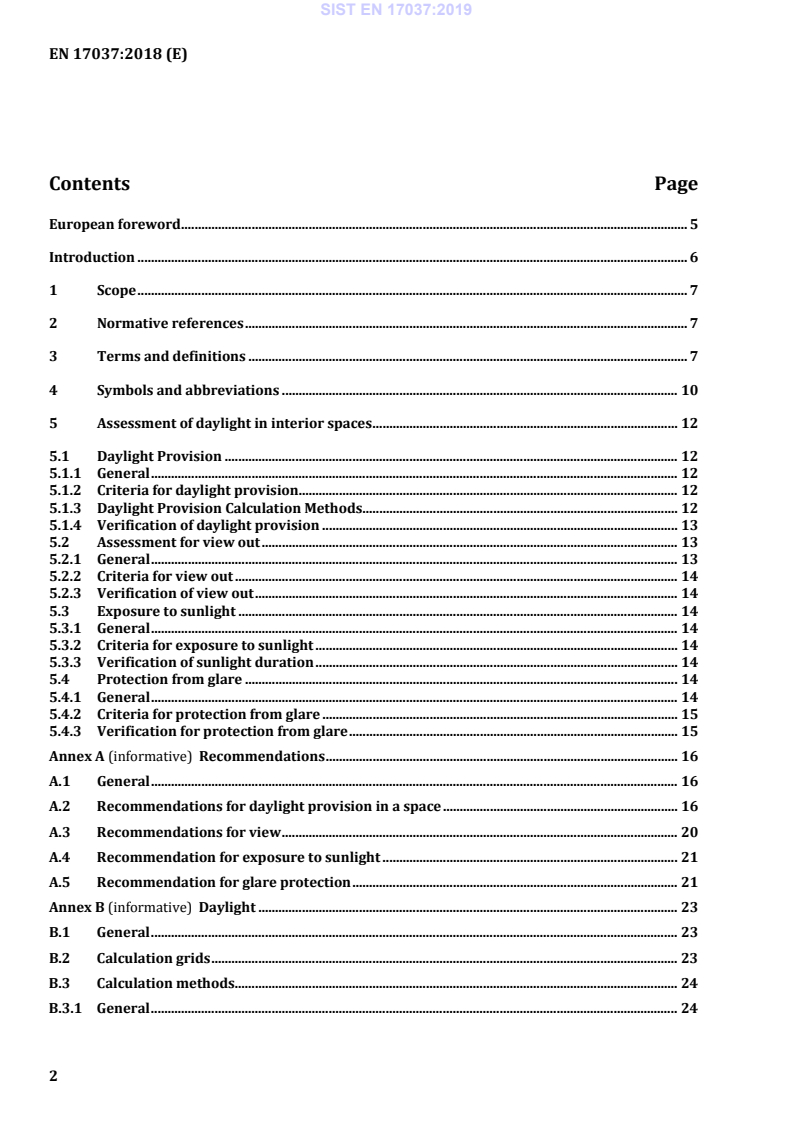
Contents Page
European foreword . 5
Introduction . 6
1 Scope . 7
2 Normative references . 7
3 Terms and definitions . 7
4 Symbols and abbreviations . 10
5 Assessment of daylight in interior spaces . 12
5.1 Daylight Provision . 12
5.1.1 General . 12
5.1.2 Criteria for daylight provision. 12
5.1.3 Daylight Provision Calculation Methods . 12
5.1.4 Verification of daylight provision . 13
5.2 Assessment for view out . 13
5.2.1 General . 13
5.2.2 Criteria for view out . 14
5.2.3 Verification of view out . 14
5.3 Exposure to sunlight . 14
5.3.1 General . 14
5.3.2 Criteria for exposure to sunlight . 14
5.3.3 Verification of sunlight duration . 14
5.4 Protection from glare . 14
5.4.1 General . 14
5.4.2 Criteria for protection from glare . 15
5.4.3 Verification for protection from glare . 15
Annex A (informative) Recommendations . 16
A.1 General . 16
A.2 Recommendations for daylight provision in a space . 16
A.3 Recommendations for view . 20
A.4 Recommendation for exposure to sunlight . 21
A.5 Recommendation for glare protection . 21
Annex B (informative) Daylight . 23
B.1 General . 23
B.2 Calculation grids . 23
B.3 Calculation methods . 24
B.3.1 General . 24
B.3.2 Calculation method using daylight factor (method 1) . 24
B.3.3 Calculation method using illuminance level (method 2) . 25
B.4 Daylight availability . 25
B.5 Validation of actual daylighting performance . 26
Annex C (informative) View out . 27
C.1 General . 27
C.2 Quality of view out . 27
C.3 Width of view out . 27
C.4 Verification of view . 32
C.4.1 Simplified verification method . 32
C.4.2 Advanced verification method . 33
Annex D (informative) Exposure to sunlight . 36
D.1 General . 36
D.2 Principle of assessment of hours of sunlight . 36
D.3 Method using software . 38
D.4 Method using manual geometric constructions . 40
D.5 Determination of the position of the sun in the sky . 40
D.6 Evaluation rules for sunlight duration . 45
D.7 Sunlight duration in the reference point P . 46
D.7.1 Example . 46
D.7.2 Calculation. 46
D.7.3 Result . 47
D.8 On-site verification of duration of exposure to sunlight . 48
Annex E (informative) Glare . 50
E.1 General . 50
E.2 Daylight Glare Probability . 50
E.3 Annual evaluation . 51
E.3.1 General . 51
E.3.2 Simplified annual glare evaluation . 52
E.3.2.1 General . 52
E.3.2.2 Solar protection device being opaque in the extended and close position . 53
E.3.2.3 Solar protection device where the curtain is made of textile, film or perforated
opaque material . 53
E.3.2.4 Non-diffusing glazing device with a low variable light transmittance (e.g.
electrochromic glazing). 56
E.3.2.5 Sunshine zones . 58
E.4 Reflections or veiling glare . 59
E.5 Verification of the glare protection capability of shadings . 59
Annex F (informative) A–deviations . 62
Bibliography . 63
European foreword
This document (EN 17037:2018) has been prepared by Technical Committee CEN/TC 169 “Light and
Lighting”, the secretariat of which is held by DIN.
This European Standard shall be given the status of a national standard, either by publication of an
identical text or by endorsement, at the latest by June 2019, and conflicting national standards shall be
withdrawn at the latest by June 2019.
Attention is drawn to the possibility that some of the elements of this document may be the subject of
patent rights. CEN shall not be held responsible for identifying any or all such patent rights.
According to the CEN-CENELEC Internal Regulations, the national standards organisations of the
following countries are bound to implement this European Standard: Austria, Belgium, Bulgaria,
Croatia, Cyprus, Czech Republic, Denmark, Estonia, Finland, Former Yugoslav Republic of Macedonia,
France, Germany, Greece, Hungary, Iceland, Ireland, Italy, Latvia, Lithuania, Luxembourg, Malta,
Netherlands, Norway, Poland, Portugal, Romania, Serbia, Slovakia, Slovenia, Spain, Sweden, Switzerland,
Turkey and the United Kingdom.
Introduction
Daylight should be a significant source of illumination for all spaces with daylight opening(s). Daylight
is strongly favoured by building occupants as a way to adequately illuminate the indoor surfaces, and to
save energy for electrical lighting.
Daylight can provide significant quantities of light indoors, with high colour rendering and variability,
changing through the day and the seasons. Daylight openings provide views and connection to the
outside and contribute to the psychological well-being of occupants. A daylight opening can also
provide exposure to sunlight indoors, which is important, for example, in dwellings, hospital wards and
nurseries. In a space, where activities comparable to reading, writing or using display devices are
carried out, a shading device should be provided to reduce visual discomfort. The standard addresses
daylighting performance over the year. Daylight should illuminate spaces during a significant fraction of
the annual daylight hours over the year. Daylight provision depends firstly on the availability of daylight
outside (i.e. the prevailing climate at the site) and, thereafter, the environment surrounding the
building, the components immediate around the daylight opening and the configuration of the interior
spaces.
This standard encourages building designers to assess and ensure successfully daylit spaces. It also
allows building designers and developers to target ambitions with respect to daylighting, as well as
addressing other issues related to daylight design, such as view out, protection against glare, and
exposure to sunlight.
1 Scope
This document specifies elements for achieving, by means of natural light, an adequate subjective
impression of lightness indoors, and for providing an adequate view out. In addition, recommendations
for the duration of sunshine exposure within occupied rooms are given.
This document gives information on how to use daylighting to provide lighting within interiors, and
how to limit glare. This document defines metrics used for the evaluation of daylighting conditions and
gives principles of calculation and verification. These principles allow to address the issue of variability
of daylight over the days and the year.
This document applies to all spaces that may be regularly occupied by people for extended periods
except where daylighting is contrary to the nature and role of the actual work done.
The specification of lighting requirements for humans in indoor work places including visual tasks are
given in EN 12464-1 and are not part of this document.
2 Normative references
The following documents are referred to in the text in such a way that some or all of their content
constitutes requirements of this document. For dated references, only the edition cited applies. For
undated references, the latest edition of the referenced document (including any amendments) applies.
EN 12216, Shutters, external blinds, internal blinds — Terminology, glossary and definitions
EN 12464-1, Light and lighting — Lighting of work places — Part 1: Indoor work places
EN 12665:2018, Light and lighting — Basic terms and criteria for specifying lighting requirements
EN 14501:2005, Blinds and shutters — Thermal and visual comfort — Performance characteristics and
classification
ISO 15469:2004, Spatial distribution of daylight — CIE standard general sky
3 Terms and definitions
For the purposes of this document, the terms and definitions given in EN 12665:2018 and the following
apply.
3.1
daylight
visible part of global solar radiation
Note 1 to entry: Also defined as part of global solar radiation capable of causing a visual sensation [CIE
ILV 278].
[SOURCE: EN 12665:2018, 3.4.7, modified – note to entry added]
3.2
daylight factor
ratio of the illuminance at a point on a given plane due to the light received directly or indirectly from a
sky of assumed or known luminance distribution, to the illuminance on a horizontal plane due to an
unobstructed hemisphere of this sky, excluding the contribution of direct sunlight to both illuminances
Note 1 to entry: Glazing, dirt effects, etc. are included.
Note 2 to entry: When calculating the lighting of interiors, the contribution of direct sunlight needs to
be considered separately.
Note 3 to entry: The term daylight factor is normally used when considering an overcast sky as sky
type 1 or 16 in ISO 15469.
[SOURCE: EN 12665:2018, 3.4.8, CIE ILV 17-279, modified – note 3 to entry added]
3.3
daylight opening
any area in the building envelope that is capable of admitting daylight to an interior
3.4
daylight provision
level of illuminance achieved across a fraction of a reference plane for a fraction of daylight hours
within a space
3.5
diffuse horizontal illuminance (from the sky)
illuminance produced by skylight on a horizontal surface on the Earth
[SOURCE: CIE ILV 17-302]
3.6
discomfort glare
glare that causes discomfort without necessarily impairing the vision of objects
[SOURCE: EN 12665:2018, 3.2.23, CIE ILV 17-333]
3.7
glare
condition of vision in which there is discomfort or a reduction in the ability to see details or objects,
caused by an unsuitable distribution or range of luminance, or by extreme contrasts
[SOURCE: EN 12665:2018, 3.1.8, CIE ILV 17-492]
3.8
global horizontal illuminance
illuminance produced by daylight on a horizontal surface on the Earth
[SOURCE: CIE ILV 17-495]
3.9
no-ground line for view
divider between the part of the space from which the ground can be seen directly by a sitting person
and the part from which it cannot
3.10
no-sky line for view
divider between the part of the space from which the sky can be seen directly by a sitting person and
the part from which it cannot
3.11
obstruction
anything outside a building which prevents the direct view of part of the sky
[SOURCE: CIE ILV 17-834]
3.12
outside distance of view
distance from the inner surface of view opening to opposite major obstructions located in front of the
opening
3.13
reference plane
plane in a space on which illuminances and/or daylight factors are calculated, specified or measured
3.14
reference point for view
position from which the view is assessed
3.15
skylight
part of sky radiation capable of causing a visual sensation
[SOURCE: CIE ILV 17-1194]
3.16
solar altitude
vertical angle between the line passing through the centre of the solar disc and the horizontal plane
measured from the reference/observation point
3.17
solar azimuth
horizontal angle between vertical plane passing through the geographical north and vertical plane
passing through the centre of the solar disc
Note 1 to entry: Solar azimuth is measured clockwise from due North from 0° to 360°
3.18
sunlight
part of direct solar radiation capable of causing a visual sensation
[SOURCE: CIE ILV 17-1281]
3.19
sunlight exposure
sum of the time (hours) (e.g. on a given day) within a given period during which the sun is above the
actual horizon with a cloudless sky, which may be limited by permanent obstructions like mountains,
buildings, etc.
3.20
utilized area
fraction of the space intended to be occupied
3.21
veiling reflections
specular reflections that appear on the object viewed and that partially or wholly obscure the details by
reducing contrast
[SOURCE: EN 12665:2018, 3.2.24, CIE ILV 17-1396]
3.22
view
visual contact with the surrounding through an opening in the surface of a building, providing
information about the surrounding landscape/cityscape, possibility to experience the weather changes
and to follow the time over the day
3.23
view opening
any area in the building envelope admitting a view, including glazed walls, glazed doors, etc
4 Symbols and abbreviations
For the purposes of this document, the specific symbols listed in Table 1 apply.
Table 1 — Symbols and units
Symbol Name of quantity Unit
A Area of the façade 2
façade m
A Area of the glazing 2
glazing m
D Daylight factor %
DGP Daylight glare probability -
DGP DGP-value, that is not exceeded in more than 5 % of the occupation time -
e < 5 %
DGP Simplified DGP value -
s
DGP Threshold DGP value for a critical glare situation -
t
D Target daylight factor %
T
D Minimum target daylight factor %
TM
D Distance from daylight opening m
w
ET Equation of time h
E Vertical illuminance at eye level -2
v lx (lm·m )
Symbol Name of quantity Unit
E Diffuse horizontal illuminance (from the sky) -2
v,d lx (lm·m )
E Median diffuse horizontal skylight illuminance -2
v,d,med lx (lm·m )
E Global horizontal illuminance -2
v,g lx (lm·m )
E Median global horizontal daylight illuminance -2
v,g,med lx (lm·m )
F Fraction of reference usage time for which a threshold value DGP is exceeded -
DGP,exceed t
F Fraction of the reference plane for target illuminance level %
plane,%
F Fraction of time for which a given value of illuminance is exceeded %
time,%
f Glazing fraction %
glaz
i Number of glare sources -
J J is the day number of the year (e.g. for 1st January, J = 1 and for 31st December, -
J = 365, February is taken to have 28 days)
LT Local clock time h
L Luminance of glare source 2
s cd/m
L Sky luminance 2
v cd/m
P Position index -
TST True solar time h
t Daylight hours h
d
t Time when the duration of sunlight is ending by the obstruction or when the solar h
end
azimuth α reaches the end of the acceptance angle α
s a
t Time when the sun rays begin to reach reference point h
start
α Acceptance angle degrees
a
α Angle of obstruction degrees
obs
α Solar azimuth (measured clockwise from due North) degrees
s
α Azimuth angle of daylight opening normal, measured from South degrees
wn,s
γ Solar altitude degrees
s
Symbol Name of quantity Unit
γ Minimum Solar altitude degrees
s,min
Δ Declination of the sun degrees
Λ Geographical longitude of the site East (+) or West (-) of Greenwich degrees
λ Longitude of standard meridian degrees
s
τ Normal-hemispherical light transmittance of the glazing -
glazing
τ Normal-diffuse light transmittance -
v,n-dif
τ Normal-normal light transmittance -
v,n-n
φ Geographical latitude of the site degrees
ω Solid angle subtended by the glare source sr
s
ω The hour angle ω is counted from the meridian as positive towards the afternoon degrees
η η
and negative towards the morning.
5 Assessment of daylight in interior spaces
5.1 Daylight Provision
5.1.1 General
Daylight can contribute significantly to the lighting needs of any type of building. This means that
daylight openings should have appropriate areas to provide sufficient daylight throughout the year.
Thus, the evaluation of daylight provision should make account of the availability of daylight at the site
in addition to accounting for the properties of the space (e.g. external obstruction, glazing
transmittance, thickness of walls and roofs, internal partition and surface reflectance, funitures).
5.1.2 Criteria for daylight provision
A space is considered to provide adequate daylight if a target illuminance level is achieved across a
fraction of the reference plane within a space for at least half of the daylight hours.
In addition, for spaces with vertical or inclined daylight openings, a minimum target illuminance level is
also to be achieved across the reference plane.
The reference plane of the space is located 0,85 m above the floor, unless otherwise specified. A small
fraction of the reference plane may be disregarded to account for singularities.
Values for target illuminances, minimum target illuminances and fractions of reference plane are given
in Table A.1.
5.1.3 Daylight Provision Calculation Methods
The following methods to assess daylight provision to the interior, using validated software, are
possible:
Method 1) Calculation method using daylight factors on the reference plane. Annex A gives values for
target daylight factors (D ) and minimum target daylight factors (D ) to be achieved depending on
T TM
the given site.
Method 2) Calculation method of illuminance levels on the reference plane using climatic data for the
given site and an adequate time step. Annex A gives values for target illuminances and minimum target
illuminances to be achieve.
Annex B describes recommendations for the daylight calculations using the two methods.
5.1.4 Verification of daylight provision
Verification of daylight provision can be determined using either an adequate software or on site
measurements.
The procedure by software requires a representative model of the space together with the key
parameters (such as any significant nearby obstructions, the assigned surface reflectance values and
glazing transmissivity) that are a reasonable representation of those for the actual, completed building.
This can be determined using either Method 1 or Method 2 described in 5.1.3.
On site, it can also be verified using illuminance meters, to measure the distribution of the daylight
factor in the actual, completed building. It needs to be conducted at grid points of the reference plane
(see B.2) Methods for verification are described in Annex B.
5.2 Assessment for view out
5.2.1 General
View to the outside provides visual connection with the surroundings to supply information about the
local environment, weather changes and the time of day. This information can relieve the fatigue
associated with long periods of being indoors. All occupants of a space should have the opportunity for
the refreshment and relaxation afforded by a change of scene and focus. View to the outside should be
assessed from selected reference points corresponding to where people are located within the utilized
area.
A view is considered to comprise three distinct layers:
— a layer of sky;
— a layer of landscape;
— a layer of ground.
NOTE The ground layer can include information of activities. The landscape layer can be comprised of
buildings, nature, and/or the horizon only.
From any specific reference point (Q), the view quality depends on:
— the size of the daylight opening(s);
— the width of the view (horizontal sight angle);
— the outside distance of view;
— the number of layers;
— the quality of the environmental information of the view.
5.2.2 Criteria for view out
The criteria for view out concern the utilized area. In order to ensure an adequate view out, the
following criteria should be met:
— the glazing material of the view opening should provide a view that is perceived to be clear,
undistorted and neutrally coloured;
— in the utilized area, view opening(s) as seen from the reference point of the view should have a total
horizontal sight angle higher than a minimum value;
— the distance to the outside view should be larger than a minimum value;
— in the utilized area a minimum number of layers should be seen.
Recommended values of view out are given in Table A.5 and calculation methods are described in
Annex C.
5.2.3 Verification of view out
Two procedures for verification of view out are given in Annex C.
One simplified verification method of the criteria for view out is described in C.4.1.
One advanced verification method for complex shapes of daylight opening and/or multiple openings is
described in C.4.2.
5.3 Exposure to sunlight
5.3.1 General
Exposure to sunlight is an important quality criterion of an interior space and can contribute to human
well-being. Minimum exposure to sunlight should be provided in patient rooms in hospitals, play rooms
in nurseries and at least one habitable space in dwellings. This is achieved through the expression of the
minimum number of hours during which this space receives direct sunlight, for a clear cloudless
reference day in the year.
5.3.2 Criteria for exposure to sunlight
For a given reference day (see A.4), a space should receive sunlight for at least a predefined number of
hours. Recommended values of sunlight exposure (h) are given in A.4 and calculation methods are
described in Annex D.
5.3.3 Verification of sunlight duration
Verification of sunlight duration needs to be conducted in a space which receives sun beams. The
sunlight duration is to be verified at the reference point P described in Annex D, considering as many
daylight openings as necessary to reach the recommended value. This can be determined using either a
manual procedure or an adequate software. On site, it can also be verified using either geometrical
measurements or pictures taken at point P using e.g. a camera equipped with a fish eye lens.
Methods for verification are described in Annex D.
5.4 Protection from glare
5.4.1 General
Glare is a negative sensation and the cause is bright areas with sufficiently greater luminance than the
luminance to which the eyes are adapted to, producing annoyance, discomfort or loss in visual
performance and visibility. Direct sunlight or high luminance differences between bright and dark areas
within the field of view can cause risk of glare.
For any space with daylight openings, it is recommended to use shading devices to reduce risk of glare,
and direct view to the sun or a reflection of it should be avoided.
Recommendations for glare protection can be found in Annex E.
5.4.2 Criteria for protection from glare
Daylight Glare Probability (DGP) is used to assess protection from glare for spaces where the activities
are comparable to reading, writing or using display devices and the occupants are not able to choose
position and viewing direction. The DGP-assessment can be applied to a space with vertical or inclined
daylight openings, but is not applicable for a space with horizontal daylight openings.
DGP-threshold values should not be exceeded for a certain fraction of the reference usage time
F (see A.5). Recommended maximum DGP targets can be assessed by the simplified method
DGP,exceed
given in Annex E. Alternative an annual DGP calculation can be used.
Ratings of discomfort glare caused from an indoor electric lighting installation (e.g. UGR, see EN 12464-
1) cannot be applied to rate discomfort glare from vertical or inclined daylight openings.
5.4.3 Verification for protection from glare
Verification of glare protection can be conducted with two methods. A simplified method verifying
shading devices is described in E.3.2, or method for on site measurements to calculate DGP values, see
E.5.
Methods for verification are described in Annex E.
Annex A
(informative)
Recommendations
A.1 General
This annex gives three levels of recommendation for assessment of daylight in interior spaces, as
specified in Clause 5. The three levels are: minimum, medium and high, and the minimum
recommendation level should be provided. The recommendations are given for daylight provision (A.2),
view out (A.3), sunlight exposure (A.4) and protection from glare (A.5). If activities in the space may
benefit for higher levels, then recommendations are given.
A.2 Recommendations for daylight provision in a space
Table A.1 and Table A.2 give recommendations for daylight provision in a space. The tables include
levels for target illuminance E (lx) and target minimum illuminance E (lx). A target illuminance
T TM
level E (lx) should be achieved across a specified fraction F of the reference plane within a
T plane,%
space. For a space with vertical and inclined daylight opening(s), a minimum target illuminance E
TM
(lx) should be achieved across the entire (i.e. 95 %) fraction F . Horizontal opening areas can
plane,%
provide the target illuminance across the entire (i.e. 95 %) fraction F of the reference plane
plane,%
(Table A.2). The fraction, F , of the reference plane within a space, in percentage, is given in
plane,%
Table A.1 and Table A.2. Table A.1 gives recommendations for a space with daylight openings in a
vertical and/or inclined surface, while Table A.2 gives recommendations for a space with openings in a
horizontal surface.
In case of doubt as to whether a particular daylight opening is to be evaluated as an opening in a
vertical/inclined surface, or a horizontal surface, any opening is considered to be horizontal if the entire
opening area is above the reference plane of the space under consideration.
The reference plane of the space is located 0,85 m above the floor, unless otherwise specified.
Table A.1 — Recommendations of daylight provision by daylight openings in vertical and
inclined surface
Level of Target Fraction Minimum target Fraction of Fraction of
recommendation illuminance of space illuminance space for daylight
for vertical and for target minimum hours
E E
T TM
inclined daylight level target level
F
time,%
lx lx
opening
F F
plane,% plane,%
Minimum 300 50 % 100 95 % 50 %
Medium 500 50 % 300 95 % 50 %
High 750 50 % 500 95 % 50 %
NOTE Table A.3 gives target daylight factor (D ) and minimum target daylight factor (D ) corresponding to
T TM
target illuminance level and minimum target illuminance, respectively, for the CEN capital cities.
Table A.2 — Recommendations of daylight provision by daylight openings in a horizontal
surface
Level of recommendation Target illuminance Fraction of space Fraction of
for horizontal daylight for target level daylight hours
E
T
opening
F F
plane,% time,%
lx
Minimum 300 95 % 50 %
Medium 500 95 % 50 %
High 750 95 % 50 %
NOTE Tables A.3 and A.4 give target daylight factor (D ) corresponding to target illuminance level for the
T
CEN capital cities. Note, that for spaces with horizontal daylight openings, there is no minimum target illuminance
recommendations. Table A.4 is only for horizontal daylight openings with diffusing material.
The recommendations in Table A.1 and Table A.2 can be expressed in terms of a daylight factor D.
Table A.3 and Table A.4 provide the corresponding daylight factor (D) relative to recommended target
illuminance E (lx) and target minimum illuminance E (lx). The corresponding daylight factors
T TM
relative to the illuminance levels, to be used in method 1 (see 5.1.3), are given in Table A.3 and
Table A.4.
Table A.3 — Values of D for daylight openings to exceed an illuminance level of 100, 300, 500 or
750 lx for a fraction of daylight hours F = 50 % for 33 capitals of CEN national members
time,%
Nation a Geographi Median
Capital
cal latitude External
D to D to D to D to
Diffuse
exceed exceed exceed exceed
φ [°]
Illuminance
100 lx 300 lx 500 lx 750 lx
E
v,d,med
Cyprus Nicosia 34,88 18 100 0,6 % 1,7 % 2,8 % 4,1 %
Malta Valletta 35,54 16 500 0,6 % 1,8 % 3,0 % 4,5 %
Greece Athens 37,90 19 400 0,5 % 1,5 % 2,6 % 3,9 %
Portugal Lisbon 38,73 18 220 0,5 % 1,6 % 2,7 % 4,1 %
Turkey Ankara 40,12 19 000 0,5 % 1,6 % 2,6 % 3,9 %
Spain Madrid 40,45 16 900 0,6 % 1,8 % 3,0 % 4,4 %
Italy Rome 41,80 19 200 0,5 % 1,6 % 2,6 % 3,9 %
Former 42,00
Yugoslav
Skopje 15 400 0,6 % 1,9 % 3,2 % 4,9 %
Republic of
Macedonia
Bulgaria Sofia 42,73 18 700 0,5 % 1,6 % 2,7 % 4,0 %
Romania Bucharest 44,50 18 200 0,5 % 1,6 % 2,7 % 4,1 %
Croatia Zagreb 45,48 17 000 0,6 % 1, 8 % 2,9 % 4,4 %
Slovenia Ljubljana 46,22 17 000 0,6 % 1,8 % 2,9 % 4,4 %
Switzerland Bern 46,25 16 000 0,6 % 1,9 % 3,1 % 4,7 %
Nation a Geographi Median
Capital
cal latitude External
D to D to D to D to
Diffuse
exceed exceed exceed exceed
φ [°]
Illuminance
100 lx 300 lx 500 lx 750 lx
E
v,d,med
Hungary Budapest 47,48 18 100 0,6 % 1,7 % 2,8 % 4,1 %
Austria Wien 48,12 16 000 0,6 % 1,9 % 3,1 % 4,7 %
Slovakia Bratislava 48,20 16 300 0,6 % 1,8 % 3,1 % 4,6 %
France Paris 48,73 15 900 0,6 % 1,9 % 3,1 % 4,7 %
Luxembourg Luxembourg 49,36 16 000 0,6 % 1,9 % 3,1 % 4,7 %
Czech 50,10
Prague 14 900 0,7 % 2,0 % 3,4 % 5,0 %
Republic
Belgium Brussels 50,90 15 000 0,7 % 2,0 % 3,3 % 5,0 %
United 51,51
London 14 100 0,7 % 2,1 % 3,5 % 5,3 %
Kingdom
Poland Warsaw 52,17 14 700 0,7 % 2,0 % 3,4 % 5,1 %
The 52,30
Amsterdam 14 400 0,7 % 2,1 % 3,5 % 5,2 %
Netherlands
Germany Berlin 52,47 13 900 0,7 % 2,2 % 3,6 % 5,4 %
Ireland Dublin 53,43 14 900 0,7 % 2,0 % 3,4 % 5,0 %
Lithuania Vilnius 54,88 15 300 0,7 % 2,0 % 3,3 % 4,9 %
Denmark Copenhagen 55,63 14 200 0,7 % 2,1 % 3,5 % 5,3 %
Latvia Riga 56,57 13 600 0,7 % 2,2 % 3,7 % 5,5 %
Estonia Tallinn 59,25 13 600 0,7 % 2,2 % 3,7 % 5,5 %
Sweden Stockholm 59,65 12 100 0,8 % 2,5 % 4,1 % 6,2 %
Norway Oslo 59,90 12 400 0,8 % 2,4 % 4,0 % 6,0 %
Finland Helsinki 60,32 13 500 0,7 % 2,2 % 3,7 % 5,6 %
Iceland Reykjavik 64,13 11 500 0,9 % 2,6 % 4,3 % 6,5 %
a
Other cities could be added by countries to take into account more precise role of latitude and climate.
1)
Table A.4 — Values of D only for horizontal daylights openings with diffusing material to
exceed an illuminance level of 100, 300, 500 or 750 lx for a fraction of daylight hours
F = 50 % for 33 capital cities of CEN national members
time,%
Nation a Geographical Median
Capital
latitude External
D to D to D to D to
Global
exceed exceed exceed exceed
φ [°]
Illuminance
100 lx 300 lx 500 lx 750 lx
E
v,g,med
Cyprus Nicosia 34,88 43 200 0,2 % 0,7 % 1,2 % 1,7 %
Malta Valletta 35,54 33 600 0,3 % 0,9 % 1,5 % 2,2 %
Greece Athens 37,90 35 350 0,3 % 0,8 % 1,4 % 2,1 %
Portugal Lisbon 38,73 38 717 0,3 % 0,8 % 1,3 % 1,9 %
Turkey Ankara 40,12 31 300 0,3 % 1,0 % 1,6 % 2,4 %
Spain Madrid 40,45 35 200 0,3 % 0,9 % 1,4 % 2,1 %
Italy Rome 41,80 30 900 0,3 % 1,0 % 1,6 % 2,4 %
Former 42,00
Yugoslav
Skopje 24 300 0,4 % 1,2 % 2,1 % 3,1 %
Republic of
Macedonia
Bulgaria Sofia 42,73 22 200 0,5 % 1,4 % 2,3 % 3,4 %
Romania Bucharest 44,50 28 500 0,4 % 1,1 % 1,8 % 2,6 %
Croatia Zagreb 45,48 20 300 0,5 % 1,5 % 2,5 % 3,7 %
Slovenia Ljubljana 46,22 19 800 0,5 % 1,5 % 2,5 % 3,8 %
Switzerland Bern 46,25 21 700 0,5 % 1,4 % 2,3 % 3,5 %
Hungary Budapest 47,48 25 100 0,4 % 1,2 % 2,0 % 3,0 %
Austria Wien 48,12 20 800 0,5 % 1,4 % 2,4 % 3,6 %
Slovakia Bratislava 48,20 22 600 0,4 % 1,3 % 2,2 % 3,3 %
France Paris 48,73 20 400 0,5 % 1,5 % 2,5 % 3,7 %
Luxembourg Luxembourg 49,36 17 100 0,6 % 1,8 % 2,9 % 4,4 %
Czech 50,10
Prague 17 400 0,6 % 1,7 % 2,9 % 4,3 %
Republic
Belgium Brussels 50,90 17 200 0,6 % 1,7 % 2,9 % 4,4 %
United 51,51
London 17 650 0,6 % 1,7 % 2,8 % 4, 2 %
Kingdom
Poland Warsaw 52,17 18 300 0,5 % 1,6 % 2,7 % 4,1 %
1)
A diffusing material redistribute transmitted light evenly regardless of the angular distribution of the incident
light. The ratio between the internal and external illuminance remains relative constant regardless of the sun and
sky conditions.
Nation a Geographical Median
Capital
latitude External
D to D to D to D to
Global
exceed exceed exceed exceed
φ [°]
Illuminance
100 lx 300 lx 500 lx 750 lx
E
v,g,med
The 52,30
Amsterdam 17 600 0,6 % 1,7 % 2,8 % 4,3 %
Netherlands
Germany Berlin 52,47 17 100 0,6 % 1,8 % 2,9 % 4,4 %
Ireland Dublin 53,43 18 200 0,5 % 1,6 % 2,7 % 4,1 %
Lithuania Vilnius 54,88 18 400 0,5 % 1,6 % 2,7 % 4,1 %
Denmark Copenhagen 55,63 17 300 0,6 % 1,7 % 2,9 % 4,3 %
Latvia Riga 56,57 15 000 0,7 % 2,0 % 3,3 % 5,0 %
Estonia Tallinn 59,25 14 500 0,7 % 2,1 % 3,4 % 5,2 %
Sweden Stockholm 59,65 15 200 0,7 % 2,0 % 3,3 % 4,9 %
Norway Oslo 59,90 14 600 0,7 % 2,1 % 3,4 % 5,1 %
Finland Helsinki 60,32 16 900 0,6 % 1,8 % 3,0 % 4,4 %
Iceland Reykjavik 64,13 14 000 0,7 % 2,1 % 3,6 % 5,4 %
a
Other cities could be added by countries to take into account more precise role of latitude and climate.
A.3 Recommendations for view
View opening(s) should provide a sufficient view. If there are several openings with little distance
between them, the sum of openings may be regarded as one opening.
Table A.5 gives recommendations for three levels of view out through vertical, inclined and horizontal
openings. These levels depend on the horizontal sight angle, the distance to outside view, and the
number of layers (content of the view). These aspects are assessed from reference positions (see
Annex C for further details).
...
SLOVENSKI
SIST EN 17037
STANDARD
marec 2019
Dnevna svetloba v stavbah
Daylight of buildings
Tageslicht in Gebäuden
L'éclairage naturel des bâtiments
Referenčna oznaka
ICS 91.160.01 SIST EN 17037:2019 (sl)
Nadaljevanje na straneh II in od 1 do 60
© 2019-12. Slovenski inštitut za standardizacijo. Razmnoževanje celote ali delov tega standarda ni dovoljeno.
SIST EN 17037 : 2019
NACIONALNI UVOD
Standard SIST EN 17037 (sl), Dnevna svetloba v stavbah, 2019, ima status slovenskega standarda in
je istoveten evropskemu standardu EN 17037 (en), Daylight of buildings, 2018.
NACIONALNI PREDGOVOR
Evropski standard EN 17037:2018 je pripravil tehnični odbor Evropskega komiteja za standardizacijo
CEN/TC 169 Svetloba in razsvetljava v gradbeništvu, katerega tajništvo je v pristojnosti DIN. Slovenski
standard SIST EN 17037:2019 je prevod evropskega standarda EN 17037:2018. V primeru spora glede
besedila slovenskega prevoda v tem standardu je odločilen izvirni evropski standard v angleškem jeziku.
Odločitev za privzem tega standarda je dne 28. januarja 2019 sprejel SIST/TC STV Steklo, svetloba in
razsvetljava v gradbeništvu.
ZVEZA Z NACIONALNIMI STANDARDI
S privzemom tega evropskega standarda veljajo za omejeni namen referenčnih standardov vsi
standardi, navedeni v izvirniku, razen tistih, ki so že sprejeti v nacionalno standardizacijo:
SIST EN 12216 Polkna, zunanja in notranja senčila – Terminologija, slovar in definicije
SIST EN 12464-1 Svetloba in razsvetljava – Razsvetljava na delovnem mestu – 1. del: Notranji
delovni prostori
SIST EN 12665 Svetloba in razsvetljava – Osnovni izrazi in merila za specifikacijo zahtev za
razsvetljavo
SIST EN 14501 Rolete in polokna – Toplotno in vizualno ugodje – Delovne karakteristike in
klasifikacija
OSNOVA ZA IZDAJO STANDARDA
– privzem standarda EN 17037:2018
OPOMBE
– Povsod, kjer se v besedilu standarda uporablja izraz "evropski standard", v SIST EN 17037:2019
to pomeni "slovenski standard".
– Nacionalni uvod in nacionalni predgovor nista sestavni del standarda.
– Ta nacionalni dokument je enakovreden EN 17037:2018 in je objavljen z dovoljenjem
CEN-CENELEC
Upravni center
Rue de la Science 23
B-1040 Bruselj
This national document is identical with EN 17037:2018 and is published with the permission of
CEN-CENELEC
Management Centre
Rue de la Science 23
B-1040 Brussels
II
EVROPSKI STANDARD EN 17037
EUROPEAN STANDARD
NORME EUROPÉENNE
december 2018
EUROPÄISCHE NORM
ICS 91.160.01
Slovenska izdaja
Dnevna svetloba v stavbah
Daylight of buildings L'éclairage naturel des Tageslicht in Gebäuden
bâtiments
Ta evropski standard je CEN sprejel 29. julija 2018.
Člani CEN morajo izpolnjevati notranje predpise CEN/CENELEC, ki določajo pogoje, pod katerimi dobi
ta standard status nacionalnega standarda brez kakršnihkoli sprememb. Seznami najnovejših izdaj teh
nacionalnih standardov in njihovi bibliografski podatki so na voljo pri Upravnem centru CEN-CENELEC
ali članih CEN.
Ta evropski standard obstaja v treh uradnih izdajah (angleški, francoski in nemški). Izdaje v drugih
jezikih, ki jih člani CEN na lastno odgovornost prevedejo in izdajo ter prijavijo pri Upravnem centru CEN-
CENELEC, veljajo kot uradne izdaje.
Člani CEN so nacionalni organi za standarde Avstrije, Belgije, Bolgarije, Cipra, Češke republike,
Danske, Estonije, Finske, Francije, Grčije, Hrvaške, Irske, Islandije, Italije, Latvije, Litve, Luksemburga,
Madžarske, Malte, Nekdanje jugoslovanske republike Makedonije, Nemčije, Nizozemske, Norveške,
Poljske, Portugalske, Romunije, Srbije, Slovaške, Slovenije, Španije, Švedske, Švice, Turčije in
Združenega kraljestva.
CEN
Evropski komite za standardizacijo
European Committee for Standardisation
Comité Européen de Normalisation
Europäisches Komitee für Normung
Upravni center CEN-CENELEC: Rue de la Science 23, B-1040 Brussels
© 2018 CEN Lastnice avtorskih pravic so vse države članice CEN Ref. oznaka EN 17037:2018 E
SIST EN 17037 : 2019
Evropski predgovor
Ta dokument (EN 17037:2018) je pripravil tehnični odbor CEN/TC 169 Svetloba in razsvetljava,
katerega sekretariat vodi DIN.
Ta evropski standard mora dobiti status nacionalnega standarda bodisi z objavo istovetnega besedila
ali z razglasitvijo najpozneje do junija 2019, nacionalni standardi, ki so z njim v nasprotju, pa morajo biti
razveljavljeni najpozneje do junija 2019.
Opozoriti je treba na možnost, da so lahko nekateri elementi tega dokumenta predmet patentnih pravic.
CEN (in/ali CENELEC) ne prevzema odgovornosti za identifikacijo katerihkoli ali vseh takih patentnih
pravic.
V skladu z notranjimi predpisi CEN/CENELEC morajo ta evropski standard obvezno uvesti nacionalne
organizacije za standardizacijo naslednjih držav: Avstrije, Belgije, Bolgarije, Cipra, Češke republike,
Danske, Estonije, Finske, Francije, Grčije, Hrvaške, Irske, Islandije, Italije, Latvije, Litve, Luksemburga,
Madžarske, Malte, Nekdanje jugoslovanske republike Makedonije, Nemčije, Nizozemske, Norveške,
Poljske, Portugalske, Romunije, Slovaške, Slovenije, Srbije, Španije, Švedske, Švice, Turčije in
Združenega kraljestva.
SIST EN 17037 : 2019
VSEBINA Stran
Evropski predgovor . 2
Uvod . 7
1 Področje uporabe . 5
2 Zveze s standardi . 6
3 Izrazi in definicije . 6
4 Simboli in okrajšave . 8
5 Ocenjevanje dnevne svetlobe v notranjih prostorih . 10
5.1 Osvetljevanje z dnevno svetlobo . 10
5.1.1 Splošno . 10
5.1.2 Merila za osvetljevanje z dnevno svetlobo . 10
5.1.3 Postopki za izračun osvetljevanja z dnevno svetlobo . 10
5.1.4 Preverjanje osvetljevanja z dnevno svetlobo . 11
5.2 Ocenjevanje pogleda navzven . 11
5.2.1 Splošno . 11
5.2.2 Merila glede pogleda navzven . 11
5.2.3 Preverjanje pogleda navzven . 12
5.3 Trajanje osončenosti . 12
5.3.1 Splošno . 12
5.3.2 Merila za trajanje osončenosti . 12
5.3.3 Preverjanje trajanja osončenosti . 12
5.4 Zaščita pred bleščanjem . 12
5.4.1 Splošno . 12
5.4.2 Merila za zaščito pred bleščanjem . 13
5.4.3 Preverjanje zaščite pred bleščanjem . 13
Dodatek A (informativni): Priporočila . 14
A.1 Splošno . 14
A.2 Priporočila za osvetljevanje z dnevno svetlobo v prostoru . 14
A.3 Priporočila za pogled navzven . 18
A.4 Priporočila za trajanje osončenosti . 18
A.5 Priporočila za zaščito pred bleščanjem . 19
Dodatek B (informativni): Dnevna svetloba . 20
B.1 Splošno . 20
B.2 Mreže za izračun . 20
B.3 Računski postopki . 21
B.3.1 Splošno . 21
B.3.2 Računski postopek z uporabo faktorja dnevne svetlobe (postopek 1) . 21
B.3.3 Računski postopek z uporabo ravni osvetljenosti (postopek 2) . 22
B.4 Razpoložljivost dnevne svetlobe . 22
B.5 Validacija dejanskega dnevnega osvetljevanja . 23
SIST EN 17037 : 2019
Dodatek C (informativni): Pogled navzven . 24
C.1 Splošno . 24
C.2 Kakovost pogleda navzven . 24
C.3 Širina pogleda navzven. 24
C.4 Preverjanje pogleda navzven . 29
C.4.1 Poenostavljeni postopek preverjanja . 29
C.4.2 Napredni postopek preverjanja . 30
Dodatek D (informativni): Trajanje osončenosti . 33
D.1 Splošno . 33
D.2 Način izračuna trajanja osončenosti . 33
D.3 Postopek z uporabo programske opreme. 35
D.4 Postopek z uporabo ročnega konstruiranja geometrije . 37
D.5 Določanje položaja Sonca na nebu . 37
D.6 Pravila za vrednotenje trajanja osončenosti . 42
D.7 Trajanje osončenosti na referenčni točki P . 43
D.7.1 Primer . 43
D.7.2 Izračun . 44
D.7.3 Rezultat . 44
D.8 Preizkus trajanja osončenosti na kraju samem . 45
Dodatek E (informativni): Bleščanje . 47
E.1 Splošno . 47
E.2 Verjetnost pojava bleščanja zaradi dnevne svetlobe . 47
E.3 Letno vrednotenje bleščanja . 48
E.3.1 Splošno . 48
E.3.2 Poenostavljeno letno vrednotenje bleščanja . 49
E.3.2.1 Splošno . 49
E.3.2.2 Senčilo, ki je v spuščenem in zaprtem položaju nepresevno . 50
E.3.2.3 Senčila, ki so izdelana iz tkanine, folije ali perforiranega nepresevnega materiala . 50
E.3.2.4 Nedifuzna zasteklitev z nizko spremenljivostjo svetlobne presevnosti
(npr. elektrokromna zasteklitev) . 53
E.3.2.5 Cone osončenosti . 55
E.4 Odsevi ali zastirajoče bleščanje . 56
E.5 Preverjanje učinkovitosti senčil za zaščito pred bleščanjem . 56
Dodatek F (informativni): A-deviacije . 59
Literatura . 60
SIST EN 17037 : 2019
Uvod
Dnevna svetloba je pomemben vir osvetlitve v vseh prostorih s svetlobnimi odprtinami. Uporabniki stavb
so naklonjeni dnevni svetlobi kot viru, ki ustrezno osvetljuje notranje površine in zmanjšuje porabo
električne energije za razsvetljavo.
Dnevna svetloba lahko v prostoru zagotovi znatno količino svetlobe, ki ima kakovostno barvno
reprodukcijo in se spreminja v teku dneva in letnih časov. Svetlobne odprtine zagotavljajo pogled
navzven in povezavo z zunanjostjo ter prispevajo k psihološkemu dobremu počutju uporabnikov.
Svetlobna odprtina lahko zagotovi tudi trajanje osončenosti notranjih prostorov, kar je pomembno na
primer v stanovanjih, bolnišničnih oddelkih in vrtcih. V prostorih, kjer se izvajajo dejavnosti, kot je pisanje
ali uporaba naprav za prikazovanje, je za zmanjšanje vidnega neugodja treba zagotoviti senčila.
Standard obravnava dnevno osvetljevanje med letom. Prostori naj bodo osvetljeni z dnevno svetlobo v
velikem deležu letnih svetlih ur. Osvetljevanje z dnevno svetlobo je odvisno predvsem od razpoložljivosti
dnevne svetlobe zunaj (tj. od prevladujočih podnebnih razmer na kraju), okolice stavbe, elementov
neposredno ob svetlobni odprtini in zasnove notranjih prostorov.
Standard spodbuja projektante, da izračunajo in zagotovijo uspešno dnevno osvetljevanje prostorov.
Prav tako omogoča projektantom in investitorjem, da si zastavijo cilje na področju dnevnega
osvetljevanja in drugih vprašanj, povezanih z dnevno svetlobo, kot so pogled navzven, zaščita pred
bleščanjem in trajanje osončenosti.
SIST EN 17037 : 2019
1 Področje uporabe
Ta standard opredeljuje dejavnike za doseganje ustreznega subjektivnega vtisa dnevne osvetljenosti
notranjih prostorov z naravno svetlobo in za zagotavljanje primernega pogleda navzven. Poleg tega
podaja tudi priporočila za trajanje osončenosti v bivalnih prostorih.
Standard podaja informacije, kako uporabiti dnevno svetlobo za razsvetljavo notranjih prostorov in kako
omejiti bleščanje. Standard tudi opredeljuje merske enote, ki se uporabljajo za vrednotenje pogojev
dnevnega osvetljevanja, ter določa postopke za izračun in preverjanje. Ti postopki omogočajo
obravnavanje spremenljivosti dnevne svetlobe preko dneva in leta.
Standard se uporablja za vse prostore, ki jih ljudje lahko redno in dlje časa uporabljajo, razen kadar je
dnevna svetloba v nasprotju z naravo in načinom opravljanja dejanskega dela.
Zahteve za razsvetljavo notranjih delovnih mest za ljudi, vključno z vidnimi nalogami, so podane v EN
12464-1 in niso del tega standarda.
2 Zveze s standardi
Za uporabo tega dokumenta so nujno potrebni spodaj navedeni referenčni dokumenti. Pri datiranih
sklicevanjih se uporablja le navedena izdaja. Pri nedatiranih sklicevanjih se uporablja zadnja izdaja
publikacije, na katero se sklicuje (skupaj z dopolnili).
EN 12216 Polkna, zunanja in notranja senčila – Terminologija, slovar in definicije
EN 12464-1 Svetloba in razsvetljava – Razsvetljava na delovnem mestu – 1. del: Notranji
delovni prostori
EN 12665:2018 Svetloba in razsvetljava – Osnovni izrazi in merila za specifikacijo zahtev za
razsvetljavo
EN 14501:2005 Senčila in polkna – Toplotno in vizualno ugodje – Lastnosti in klasifikacija
ISO 15469:2004 Prostorska porazdelitev dnevne svetlobe – Standardno splošno nebo CIE
3 Izrazi in definicije
V tem standardu veljajo izrazi in definicije iz standarda EN 12665:2018 in naslednji:
3.1
dnevna svetloba
vidni del globalnega sončnega sevanja
OPOMBA: Opredeljena je tudi kot del globalnega sončnega sevanja, ki lahko sproži občutek vida [CIE ILV 278].
[VIR: EN 12665:2018, spremenjen – dodana opomba]
3.2
faktor dnevne svetlobe
razmerje med osvetljenostjo točke na dani ravnini zaradi svetlobe, ki jo prejme neposredno ali posredno
od neba z domnevno ali poznano razporeditvijo svetlosti, in osvetljenostjo horizontalne ravnine zaradi
nezastrte hemisfere tega neba, razen prispevka neposredne sončne svetlobe k obema osvetljenostma
OPOMBA 1: Upoštevajo se zasteklitev, vpliv umazanosti stekel itd.
OPOMBA 2: Pri izračunu razsvetljave notranjih prostorov je treba neposredno sončno svetlobo obravnavati ločeno.
OPOMBA 3: Izraz faktor dnevne svetlobe se navadno uporablja ob upoštevanju oblačnega neba, kot sta npr. tipa neba 1 ali
16, definirana v ISO 15469.
SIST EN 17037 : 2019
[VIR: EN 12665:2018, 3.4.8, CIE ILV 17-279, spremenjen – dodana je tretja opomba]
3.3
svetlobna odprtina (odprtina za dnevno svetlobo)
katerakoli površina v stavbnem ovoju, ki lahko prepušča dnevno svetlobo v notranji prostor
3.4
osvetljevanje z dnevno svetlobo
raven osvetljenosti, dosežena na delu referenčne ravnine v prostoru v času svetlega dela dneva
3.5
difuzna horizontalna osvetljenost (z neba)
osvetljenost na horizontalni ravnini Zemlje, ki jo povzroča svetloba neba
[VIR: CIE ILV 17-302]
3.6
neugodno bleščanje
bleščanje, ki vzbuja neugodje, ni pa nujno, da zmanjšuje vidnost objektov
[VIR: EN 12665:2018, 3.2.23, CIE ILV 17-333]
3.7
bleščanje
pogoj vidnosti, ko zaradi neprimerne porazdelitve svetlosti ali prevelikih kontrastov pride do neugodja
ali zmanjšanja sposobnosti videti podrobnosti ali objekte
[VIR: EN 12665:2018, 3.1.8, CIE ILV 17-492]
3.8
globalna horizontalna osvetljenost
osvetljenost na horizontalni površini Zemlje, ki jo povzroča dnevna svetloba
[VIR: CIE ILV 17-495]
3.9
ločnica pogleda navzven brez pogleda na tla
ločnica med delom prostora, od koder sedeča oseba lahko neposredno vidi zunanje talne površine, in
delom prostora, od koder jih ne more videti
3.10
ločnica pogleda navzven brez pogleda na nebo
ločnica med delom prostora, od koder sedeča oseba lahko neposredno vidi nebo, in delom, od koder
ga ne more videti
3.11
ovira
karkoli zunaj stavbe, kar preprečuje neposreden pogled na del neba
[VIR: CIE ILV 17-834]
3.12
globina pogleda
razdalja od notranje površine odprtine za pogled navzven do večjih ovir pred to odprtino
3.13
referenčna ravnina
ravnina v prostoru, na kateri se izračuna, določi ali izmeri osvetljenost in/ali faktor dnevne svetlobe
SIST EN 17037 : 2019
3.14
referenčna točka pogleda navzven
položaj, s katerega se presoja pogled navzven
3.15
svetloba neba
del sevanja neba, ki lahko sproži vidno zaznavanje
[VIR: CIE ILV 17-1194]
3.16
višinski kot Sonca
vertikalni kot med črto skozi središče Sončevega diska in horizontalno ravnino, izmerjen v referenčni
točki oziroma opazovališču
3.17
azimut Sonca
horizontalni kot med vertikalno ravnino skozi geografski sever in vertikalno ravnino skozi središče
Sončevega diska
OPOMBA: Azimut Sonca se meri v smeri urnega kazalca od severa od 0° do 360°.
3.18
sončna svetloba
del neposrednega sončnega sevanja, ki lahko povzroči vidno zaznavanje
[VIR: CIE ILV 17-1281]
3.19
trajanje osončenosti
seštevek časa (v urah) v določenem časovnem obdobju (npr. na določen dan) pri jasnem nebu, ko je
Sonce nad dejanskim horizontom in ki je lahko omejen s trajnimi ovirami, kot so gore, stavbe itd.
3.20
uporabna površina
del prostora, namenjen uporabi
3.21
zastirajoče odsevanje
zrcalni odsevi na opazovanih objektih, ki z zmanjšanjem kontrasta delno ali popolno zakrijejo
podrobnosti
[VIR: EN 12665:2018, 3.2.24, CIE ILV 17-1396]
3.22
pogled navzven
vidni stik z okolico skozi odprtino v stavbnem ovoju, ki zagotavlja informacije o pokrajini/urbanem okolju
in ki omogoča spremljanje vremenskih sprememb ter minevanja časa v dnevu
3.23
odprtina za pogled navzven
katerakoli površina v stavbnem ovoju, vključno s steklenimi stenami, steklenimi vrati ipd., ki omogoča
pogled navzven
SIST EN 17037 : 2019
4 Simboli in okrajšave
V tem dokumentu se uporabljajo simboli, navedeni v preglednici 1.
Preglednica 1: Simboli in enote
Simbol Ime veličine Enota
A
facade površina fasade m
Aglazing površina zasteklitve m
D faktor dnevne svetlobe %
DGP verjetnost bleščanja zaradi dnevne svetlobe -
DGP e ˂ 5 % vrednost DGP, ki ni presežena več kot 5 % časa zasedenosti -
DGP poenostavljena vrednost DGP
s -
DGPt mejna vrednost DGP za kritičen pojav bleščanja -
D ciljni faktor dnevne svetlobe %
T
DTM najmanjši ciljni faktor dnevne svetlobe %
D razdalja do svetlobne odprtine m
w
ET
časovna enačba h
-2
Ev vertikalna osvetljenost na višini oči lx (lm ꞏ m )
-2
E difuzna horizontalna osvetljenost (z neba) lx (lm ꞏ m )
v,d
-2
Ev,d,med srednja difuzna horizontalna osvetljenost s svetlobo neba lx (lm ꞏ m )
-2
E globalna horizontalna osvetljenost lx (lm ꞏ m )
v,g
-2
E
v,g,med srednja globalna horizontalna osvetljenost z dnevno svetlobo lx (lm ꞏ m )
FDGP,exceed delež referenčnega časa uporabe, v katerem je presežena mejna vrednost -
DGPt
F delež referenčne ravnine, na kateri mora biti dosežena ciljna raven %
plane,%
osvetljenosti
Ftime,% delež časa, v katerem je presežena dana vrednost osvetljenosti %
Ƒglaz delež zasteklitve %
i število virov bleščanja -
J zaporedna številka dneva v letu (npr. za prvi januar je J = 1, za 31. december
J = 356, za februar se šteje, da ima 28 dni)
LT lokalni čas h
L
s svetlost vira bleščanja cd/m
Lv svetlost neba cd/m
P kazalnik položaja -
TST pravi Sončev čas h
t število ur h
d
SIST EN 17037 : 2019
Simbol Ime veličine Enota
tend čas, ko trajanje osončenosti preneha zaradi ovire ali ko azimut Sonca αs h
doseže mejno vrednost sprejemljivega kota αa
tstart čas, ko sončni žarki dosežejo referenčno točko h
α
a sprejemljivi kot stopinja
αobst kot ovire stopinja
α azimut Sonca, merjen v smeri urnega kazalca (od smeri sever) stopinja
s
αwn,s azimut normale svetlobne odprtine, merjen od smeri jug stopinja
ϒs višinski kot Sonca stopinja
ϒ
s,min najmanjši višinski kot Sonca stopinja
Δ deklinacija Sonca stopinja
Λ zemljepisna dolžina, vzhodno od Greenwicha (+) in zahodno od Greenwicha stopinja
(-)
λ
s zemljepisna dolžina standardnega poldnevnika stopinja
normalna-hemisferna svetlobna presevnost zasteklitve -
τglazing
normalna-difuzna svetlobna presevnost -
τv,n-dif
τ normalna-normalna svetlobna presevnost -
v,n-n
φ zemljepisna širina kraja stopinja
ω
s prostorski kot, pod katerim je viden vir bleščanja sr
ωη urni kot ωη se šteje od poldnevnika kot pozitiven proti popoldnevu in negativen stopinja
proti dopoldnevu
5 Ocenjevanje dnevne svetlobe v notranjih prostorih
5.1 Osvetljevanje z dnevno svetlobo
5.1.1 Splošno
Dnevna svetloba lahko znatno prispeva k zadovoljevanju potreb po razsvetljavi v katerikoli vrsti stavbe.
To pomeni, da naj imajo svetlobne odprtine primerno velike površine, da je zagotovljena zadostna
dnevna svetloba med letom. Zato naj ovrednotenje osvetljevanja z dnevno svetlobo poleg lastnosti
prostora upošteva razpoložljivost dnevne svetlobe na kraju (npr. zunanje ovire, presevnost zasteklitve,
debelino sten in strehe, notranje delitve prostora, refleksivnost površin, pohištvo).
5.1.2 Merila za osvetljevanje z dnevno svetlobo
Da je prostor primerno dnevno osvetljen, se šteje, če je ciljna raven osvetljenosti na deležu referenčne
ravnine v prostoru dosežena najmanj polovico svetlega dela dneva.
V prostorih z vertikalnimi ali poševnimi svetlobnimi odprtinami mora biti najmanjša ciljna osvetljenost
dosežena na celotni referenčni ravnini.
Če ni določeno drugače, se referenčna ravnina prostora nahaja 0,85 m nad tlemi. Manjši delež
referenčne ravnine (npr. manjša odstopanja in nepravilnosti) se lahko zanemari.
SIST EN 17037 : 2019
Vrednosti ciljnih ravni osvetljenosti, najmanjših ciljnih ravni osvetljenosti in deležev referenčne ravnine
so podane v preglednici A.1.
5.1.3 Postopki za izračun osvetljevanja z dnevno svetlobo
Za ocenitev osvetljevanja z dnevno svetlobo v notranjih prostorih z validirano programsko opremo se
uporabljata naslednja postopka:
Postopek 1): Računski postopek z uporabo faktorjev dnevne svetlobe na referenčni ravnini. Dodatek
A podaja vrednosti za ciljne faktorje dnevne svetlobe (D ) in najmanjše ciljne faktorje dnevne svetlobe
T
(D ), ki jih je treba doseči na določenem kraju.
TM
Postopek 2): Postopek za izračun ravni osvetljenosti na referenčni ravnini z uporabo krajevnih
podnebnih podatkov in primernega časovnega koraka. V dodatku A so podane vrednosti za ciljne ravni
osvetljenosti in najmanjše ciljne ravni osvetljenosti, ki jih je treba doseči.
V dodatku B so podana priporočila za izračune dnevne svetlobe z obema računskima postopkoma.
5.1.4 Preverjanje osvetljevanja z dnevno svetlobo
Preverjanje osvetljevanja z dnevno svetlobo se lahko izvede z ustrezno programsko opremo ali
meritvami na kraju samem.
Pri uporabi programske opreme je treba izdelati reprezentativni model prostora s ključnimi parametri
(bistvene bližnje ovire, opredeljena odsevnost površin in presevnost zasteklitve), ki smiselno prikažejo
stvarno, zgrajeno stavbo. Preverjanje se lahko izvede z uporabo postopkov 1 ali 2, opisanih v 5.1.3.
Na kraju samem se osvetljevanje z dnevno svetlobo lahko preveri tudi z merilniki osvetljenosti, s
pomočjo katerih se izmeri porazdelitev faktorja dnevne svetlobe v stvarni, zgrajeni stavbi. Meritve je
treba izvesti v točkah v mreži na referenčni ravnini (glej B.2). Postopki za preverjanje so opisani v
dodatku B.
5.2 Ocenjevanje pogleda navzven
5.2.1 Splošno
Pogled navzven zagotavlja vidno povezavo z okolico in posreduje informacije o krajevnem okolju,
vremenskih spremembah in času dneva. Te informacije lahko zmanjšajo utrujenost, ki nastane zaradi
dolgih obdobij bivanja v zaprtih prostorih. Vsi uporabniki prostorov naj bi imeli možnost za oddih in
sprostitev, ki jo omogočata sprememba vsebine in žarišča pogleda. Pogled navzven naj se presoja
glede na izbrane referenčne točke v prostoru, ki ustrezajo mestom, na katerih se nahajajo uporabniki.
Šteje se, da pogled navzven vsebuje tri značilne sloje:
– sloj neba,
– sloj pokrajine,
– sloj tal.
OPOMBA: Sloj tal lahko vključuje podatke o dejavnostih. Sloj pokrajine lahko sestavljajo le stavbe, narava in/ali obzorje.
Kakovost pogleda navzven v določeni referenčni točki (Q) je odvisna od:
– velikosti svetlobne(-ih) odprtine (odprtin),
– širine pogleda navzven (horizontalni vidni kot),
– globine pogleda,
– števila slojev,
SIST EN 17037 : 2019
– kakovosti vidnih informacij o okolici.
5.2.2 Merila glede pogleda navzven
Merila glede pogleda navzven se nanašajo na uporabno površino. Za zagotavljanje ustreznega pogleda
navzven naj bodo izpolnjena naslednja merila:
– zasteklitev odprtine za pogled navzven naj zagotavlja zaznavo jasnega, nepopačenega in barvno
nevtralnega pogleda navzven;
– na uporabni površini naj širina pogleda navzven skozi odprtino(-e) z referenčne točke presega
najmanjšo priporočeno vrednost;
– razdalja do zunanjega pogleda naj presega najmanjšo priporočeno vrednost;
– pogled navzven z uporabne površine naj vsebuje najmanjše priporočeno število slojev.
Priporočene vrednosti za kakovost pogleda navzven so navedene v preglednici A.5, postopki za izračun
pa so opisani v dodatku C.
5.2.3 Preverjanje pogleda navzven
V dodatku C sta navedena dva postopka za preverjanje pogleda navzven.
Poenostavljeni postopek preverjanja pogleda navzven je opisan v C.4.1.
Napreden način preverjanja pogleda navzven za zapletene oblike svetlobnih odprtin in/ali večje število
odprtin je opisan v C.4.2.
5.3 Trajanje osončenost
5.3.1 Splošno
Trajanje osončenosti je pomemben dejavnik kakovosti notranjega okolja in lahko prispeva k dobremu
počutju ljudi. Najkrajše trajanje osončenosti naj bo zagotovljeno v bolniških sobah v bolnišnicah,
igralnicah v vrtcih in v vsaj enem bivalnem prostoru v stanovanjih. Na jasen, brezoblačen referenčni dan
v letu se izrazi kot najmanjše število ur, v katerih je prostor direktno osončen.
5.3.2 Merila za osončenost
Za dani referenčni dan (glej A.4) naj bo prostor osončen vsaj predhodno določeno število ur.
Priporočeno trajanje osončenosti (h) je podano v A.4, postopki izračuna pa so opisani v dodatku D.
5.3.3 Preverjanje trajanja osončenosti
Preverjanje trajanja osončenosti je treba izvesti v osončenem prostoru. Trajanje osončenosti se preveri
na referenčni točki P, opisani v dodatku D, pri čemer se upošteva toliko svetlobnih odprtin, kolikor jih je
potrebnih, da se doseže priporočena vrednost. Preverjanje se lahko izvede ročno ali z ustrezno
programsko opremo. Na kraju samem se preverjanje lahko izvede tudi z meritvami geometrije ali po
fotografijah, posnetih na točki P npr. s fotoaparatom, opremljenim z lečo "ribje oko".
Postopki za preverjanje so opisani v dodatku D.
SIST EN 17037 : 2019
5.4 Zaščita pred bleščanjem
5.4.1 Splošno
Bleščanje je neugoden občutek, ki ga povzročijo zelo svetle površine v vidnem polju. Njihova svetlost
toliko presega svetlost, na katero so prilagojene oči, da povzroči motnjo, neugodje ali zmanjšanje
vidnega zaznavanja in vidnosti. Tveganje bleščanja lahko povzročijo neposredna sončna svetloba ali
velike razlike v svetlosti svetlih in temnih območij v vidnem polju.
V prostorih s svetlobnimi odprtinami je priporočljivo namestiti senčila, saj se tako zmanjša tveganje
pojava bleščanja in neposrednega pogleda v sonce ali njegov odsev.
Priporočila za zaščito pred bleščanjem so v dodatku E.
5.4.2 Merila za zaščito pred bleščanjem
Za oceno zaščite pred bleščanjem v prostorih, kjer se izvajajo dejavnosti, kot so branje, pisanje ali
uporaba prikazovalnih naprav, in kjer uporabniki ne morejo poljubno izbirati položaja in smeri pogleda,
se uporablja verjetnost pojava bleščanja zaradi dnevne svetlobe (DGP). Ocena DGP se lahko uporablja
za prostore z vertikalnimi ali poševnimi svetlobnimi odprtinami, ne uporablja pa se za prostore s
horizontalnimi svetlobnimi odprtinami.
Mejne vrednosti DGP naj v določenem deležu referenčnega časa uporabe F ne bodo presežene
DGP,exceed
(glej A.5). Priporočene največje ciljne vrednosti DGP se lahko izračunajo s poenostavljenim postopkom,
opisanim v dodatku E. Alternativno se lahko uporabi letni izračun DGP.
Meril neugodnega bleščanja zaradi notranje električne razsvetljave (npr. UGR, glej EN 12464-1) ni
mogoče uporabiti za presojo bleščanja skozi vertikalne ali poševne svetlobne odprtine.
5.4.3 Preverjanje zaščite pred bleščanjem
Preverjanje zaščite pred bleščanjem je mogoče izvesti z dvema postopkoma. Poenostavljeni postopek
preverjanja senčil je opisan v E.3.2, postopek za izvedbo meritev na kraju samem za izračun vrednosti
DGP pa je opisan v E.5.
Postopka za preverjanje sta opisana v dodatku E.
SIST EN 17037 : 2019
Dodatek A
(informativni)
Priporočila
A.1 Splošno
Kot je določeno v točki 5, ta dodatek podaja tri ravni priporočil za ocenjevanje dnevne osvetljenosti v
notranjih prostorih. Tri ravni priporočil so: najnižja, srednja in visoka, pri čemer naj bo izpolnjena vsaj
najnižja podana raven. Priporočila so podana za osvetljevanje z dnevno svetlobo (A.2), pogled navzven
(A.3), trajanje osončenosti (A.4) in zaščito pred bleščanjem (A.5). Če višja raven osvetljenosti lahko
koristi dejavnostim v prostoru, so podana temu primerna priporočila.
A.2 Priporočila za osvetljevanje z dnevno svetlobo v prostoru
V preglednicah A.1 in A.2 so podana priporočila za osvetljevanje z dnevno svetlobo v prostoru. Podane
so ravni ciljne osvetljenosti E (lx) in ravni najmanjše ciljne osvetljenosti E (lx). Raven ciljne
T TM
osvetljenosti E (lx) naj bo dosežena na določenem deležu referenčne ravnine v prostoru F . V
T plane,%
prostoru z vertikalno(-imi) in poševno(-imi) svetlobno(-imi) odprtino(-ami) naj bo najmanjša ciljna
osvetljenost E (lx) dosežena na celotnem (tj. 95-odstotnem) deležu referenčne ravnine F .
T plane,%
Horizontalne svetlobne odprtine lahko zagotovijo ciljno osvetljenost na celotnem (tj. 95-odstotnem)
deležu referenčne ravnine F (preglednica A.2). Delež referenčne ravnine v prostoru F je v
plane,% plane,%
odstotkih podan v preglednicah A.1 in A.2. V preglednici A.1 so podana priporočila za prostore s
svetlobnimi odprtinami v vertikalnih in/ali poševnih površinah, medtem ko so v preglednici A.2 podana
priporočila za prostore s svetlobnimi odprtinami v horizontalnih površinah.
Ko obstaja dvom, ali naj se določena svetlobna odprtina vrednoti kot odprtina v vertikalni/poševni ali
horizontalni površini, se odprtina obravnava kot horizontalna, če se v obravnavanem prostoru celotna
površina svetlobne odprtine nahaja nad referenčno ravnino.
Razen kadar je določeno drugače, se referenčna ravnina nahaja na višini 0,85 m nad tlemi.
Preglednica A.1: Priporočila za osvetljevanje z dnevno svetlobo s svetlobnimi odprtinami v
vertikalnih in poševnih površinah
Priporočena raven Ciljna Delež Najmanjša Delež prostora z Delež
za vertikalne in osvetljenost prostora s ciljna najmanjšo ciljno svetlega
poševne svetlobne ciljno osvetljenost vrednostjo dela
E
T
odprtine vrednostjo dneva
ETM Fplane,%
lx
F F
plane,% time,%
lx
Najnižja 300 50 % 100 95 % 50 %
Srednja 500 50 % 300 95 % 50 %
Visoka 750 50 % 500 95 % 50 %
OPOMBA: V preglednici A.3 sta podana ciljni faktor dnevne svetlobe (D ) in najmanjši ciljni faktor dnevne svetlobe (D ),
T TM
ki ustrezata ravni ciljne osvetljenosti in najmanjši ciljni osvetljenosti za glavna mesta članic CEN.
SIST EN 17037 : 2019
Preglednica A.2: Priporočila za osvetljevanje z dnevno svetlobo s svetlobnimi odprtinami v
horizontalnih površinah
Priporočena raven za Ciljna osvetljenost Delež prostora s ciljno Delež svetlega dela
horizontalne svetlobne vrednostjo dneva
ET
odprtine
Fplane,% Ftime,%
lx
Najnižja 300 95 % 50 %
Srednja 500 95 % 50 %
Visoka 750 95 % 50 %
OPOMBA: V preglednicah A.3 in A.4 je podan ciljni faktor dnevne svetlobe (D ), ki ustreza ciljni osvetljenosti in najmanjši
T
ciljni osvetljenosti za glavna mesta članic CEN. Najmanjša ciljna osvetljenost ni podana za prostore s
horizontalnimi svetlobnimi odprtinami. Preglednica A.4 velja le za horizontalne svetlobne odprtine, ki so
opremljene z difuzno zasteklitvijo.
Priporočila v preglednicah A.1 in A.2 so lahko izražena kot faktor dnevne svetlobe D. Preglednici A.3 in
A.4 podajata ustrezni faktor dnevne svetlobe (D), ki izhaja iz priporočene ciljne osvetljenosti E (lx) in
T
najmanjše ciljne osvetljenosti E (lx). Ustrezni faktorji dnevne svetlobe, izhajajoči iz priporočenih
TM
osvetljenosti, ki se uporabljajo v postopku 1 (glej 5.1.3), so podani v preglednicah A.3 in A.4.
Preglednica A.3: Vrednosti D za svetlobne odprtine v 33 glavnih mestih držav članic CEN, pri
katerih je v določenem deležu svetlih ur dneva Ftime,% = 50 % ravni osvetljenosti višja od 100 lx,
300 lx, 500 lx ali 750 lx
Država Glavno Zemljepisna Zunanja
mesto (a) širina srednja
D za D za D za D za
difuzna
več kot več kot več kot več kot
φ [°]
osvetljenost
100 lx 300 lx 500 lx 750 lx
Ev,d,med [lx]
Ciper Nikozija 34,88 18 100 0,6 % 1,7 % 2,8 % 4,1 %
Malta Valletta 35,54 16 500 0,6 % 1,8 % 3,0 % 4,5 %
Grčija Atene 37,90 19 400 0,5 % 1,5 % 2,6 % 3,9 %
Portugalska Lizbona 38,73 18 220 0,5 % 1,6 % 2,7 % 4,1 %
Turčija Ankara 40,12 19 000 0,5 % 1,6 % 2,6 % 3,9 %
Španija Madrid 40,45 16 900 0,6 % 1,8 % 3,0 % 4,4 %
Italija Rim 41,80 19 200 0,5 % 1,6 % 2,6 % 3,9 %
Severna 42,00
Skopje 15 400 0,6 % 1,9 % 3,2 % 4,9 %
Makedonija
Bolgarija Sofija 42,73 18 700 0,5 % 1,6 % 2,7 % 4,0 %
Romunija Bukarešta 44,50 18 200 0,5 % 1,6 % 2,7 % 4,1 %
Hrvaška Zagreb 45,48 17 000 0,6 % 1, 8 % 2,9 % 4,4 %
Slovenija Ljubljana 46,22 17 000 0,6 % 1,8 % 2,9 % 4,4 %
Švica Bern 46,25 16 000 0,6 % 1,9 % 3,1 % 4,7 %
Madžarska Budimpešta 47,48 18 100 0,6 % 1,7 % 2,8 % 4,1 %
Avstrija Dunaj 48,12 16 000 0,6 % 1,9 % 3,1 % 4,7 %
Slovaška Bratislava 48,20 16 300 0,6 % 1,8 % 3,1 % 4,6 %
SIST EN 17037 : 2019
Država Glavno Zemljepisna Zunanja
mesto (a) širina srednja
D za D za D za D za
difuzna
več kot več kot več kot več kot
φ [°]
osvetljenost
100 lx 300 lx 500 lx 750 lx
E [lx]
v,d,med
Francija Pariz 48,73 15 900 0,6 % 1,9 % 3,1 % 4,7 %
Luksemburg Luksemburg 49,36 16 000 0,6 % 1,9 % 3,1 % 4,7 %
Češka 50,10
Praga 14 900 0,7 % 2,0 % 3,4 % 5,0 %
republika
Belgija Bruselj 50,90 15 000 0,7 % 2,0 % 3,3 % 5,0 %
Združeno 51,51
London 14 100 0,7 % 2,1 % 3,5 % 5,3 %
kraljestvo
Poljska Varšava 52,17 14 700 0,7 % 2,0 % 3,4 % 5,1 %
Nizozemska Amsterdam 52,30 14 400 0,7 % 2,1 % 3,5 % 5,2 %
Nemčija Berlin 52,47 13 900 0,7 % 2,2 % 3,6 % 5,4 %
Irska Dublin 53,43 14 900 0,7 % 2,0 % 3,4 % 5,0 %
Litva Vilna 54,88 15 300 0,7 % 2,0 % 3,3 % 4,9 %
Danska Kopenhagen 55,63 14 200 0,7 % 2,1 % 3,5 % 5,3 %
Latvija Riga 56,57 13 600 0,7 % 2,2 % 3,7 % 5,5 %
Estonija Talin 59,25 13 600 0,7 % 2,2 % 3,7 % 5,5 %
Švedska Stockholm 59,65 12 100 0,8 % 2,5 % 4,1 % 6,2 %
Norveška Oslo 59,90 12 400 0,8 % 2,4 % 4,0 % 6,0 %
Finska Helsinki 60,32 13 500 0,7 % 2,2 % 3,7 % 5,6 %
Islandija Reykjavik 64,13 11 500 0,9 % 2,6 % 4,3 % 6,5 %
a
Za točnejše upoštevanje vpliva zemljepisne širine in podnebja države po presoji lahko dodajo še druga mesta.
SIST EN 17037 : 2019
Preglednica A.4: Vrednosti D za izključno horizontalne svetlobne odprtine z difuzno
1)
zasteklitvijo v 33 glavnih mestih držav članic CEN, pri katerih je v določenem deležu svetlih ur
dneva Ftime,% = 50 % ravni osvetljenosti višja od 100 lx, 300 lx, 500 lx ali 750 lx
Država Glavno mesto Zemljepisna Zunanja
(a) širina srednja
D za D za D za D za
globalna
več kot več kot več kot več kot
φ [°]
osvetljenost
100 lx 300 lx 500 lx 750 lx
E [lx]
v,g,med
Ciper Nikozija 34,88 43 200 0,2 % 0,7 % 1,2 % 1,7 %
Malta Valletta 35,54 33 600 0,3 % 0,9 % 1,5 % 2,2 %
Grčija Atene 37,90 35 350 0,3 % 0,8 % 1,4 % 2,1 %
Portugalska Lizbona 38,73 38 717 0,3 % 0,8 % 1,3 % 1,9 %
Turčija Ankara 40,12 31 300 0,3 % 1,0 % 1,6 % 2,4 %
Španija Madrid 40,45 35 200 0,3 % 0,9 % 1,4 % 2,1 %
Italija Rim 41,80 30 900 0,3 % 1,0 % 1,6 % 2,4 %
Severna 42,00
Skopje 24 300 0,4 % 1,2 % 2,1 % 3,1 %
Makedonija
Bolgarija Sofija 42,73 22 200 0,5 % 1,4 % 2,3 % 3,4 %
Romunija Bukarešta 44,50 28 500 0,4 % 1,1 % 1,8 % 2,6 %
Hrvaška Zagreb 45,48 20 300 0,5 % 1,5 % 2,5 % 3,7 %
Slovenija Ljubljana 46,22 19 800 0,5 % 1,5 % 2,5 % 3,8 %
Švica Bern 46,25 21 700 0,5 % 1,4 % 2,3 % 3,5 %
Madžarska Budimpešta 47,48 25 100 0,4 % 1,2 % 2,0 % 3,0 %
Avstrija Dunaj 48,12 20 800 0,5 % 1,4 % 2,4 % 3,6 %
Slovaška Bratislava 48,20 22 600 0,4 % 1,3 % 2,2 % 3,3 %
Francija Pariz 48,73 20 400 0,5 % 1,5 % 2,5 % 3,7 %
Luksemburg Luksemburg 49,36 17 100 0,6 % 1,8 % 2,9 % 4,4 %
Češka 50,10
Praga 17 400 0,6 % 1,7 % 2,9 % 4,3 %
republika
Belgija Bruselj 50,90 17 200 0,6 % 1,7 % 2,9 % 4,4 %
Združeno 51,51
London 17 650 0,6 % 1,7 % 2,8 % 4, 2 %
kraljestvo
Poljska Varšava 52,17 18 300 0,5 % 1,6 % 2,7 % 4,1 %
Nizozemska Amsterdam 52,30 17 600 0,6 % 1,7 % 2,8 % 4,3 %
Nemčija Berlin 52,47 17 100 0,6 % 1,8 % 2,9 % 4,4 %
Irska Dublin 53,43 18 200 0,5 % 1,6 % 2,7 % 4,1 %
Litva Vilna 54,88 18 400 0,5 % 1,6 % 2,7 % 4,1 %
1)
Difuzna zasteklitev porazdeli presevano svetlobo enakomerno ne glede na kot porazdelitve vpadne svetlobe. Razmerje med
notranjo in zunanjo osvetlitvijo ostaja relativno stalno ne glede na pogoje sonca in neba.
SIST EN 17037 : 2019
Država Glavno mesto Zemljepisna Zunanja
(a) širina srednja
D za D za D za D za
globalna
več kot več kot več kot več kot
φ [°]
osvetljenost
100 lx 300 lx 500 lx 750 lx
E [lx]
v,g,med
Danska Kopenhagen 55,63 17 300 0,6 % 1,7 % 2,9 % 4,3 %
Latvija Riga 56,57 15 000 0,7 % 2,0 % 3,3 % 5,0 %
Estonija Talin 59,25 14 500 0,7 % 2,1 % 3,4 % 5,2 %
Švedska Stockholm 59,65 15 200 0,7 % 2,0 % 3,3 % 4,9 %
Norveška Oslo 59,90 14 600 0,7 % 2,1 % 3,4 % 5,1 %
Finska Helsink
...