EN 17037:2018/AC:2021
(Corrigendum)Daylight in buildings
Daylight in buildings
This document specifies elements for achieving, by means of natural light, an adequate subjective impression of lightness indoors, and for providing an adequate view out. In addition, recommendations for the duration of sunshine exposure within occupied rooms are given.
This document gives information on how to use daylighting to provide lighting within interiors, and how to limit glare. This document defines metrics used for the evaluation of daylighting conditions and gives principles of calculation and verification. These principles allow to address the issue of variability of daylight over the days and the year.
This document applies to all spaces that may be regularly occupied by people for extended periods except where daylighting is contrary to the nature and role of the actual work done.
The specification of lighting requirements for humans in indoor work places including visual tasks are given in EN 12464-1 and are not part of this document.
Tageslicht in Gebäuden
Dieses Dokument legt Empfehlungen zur Erreichung eines hinreichenden subjektiven Helligkeitseindrucks in Innenräumen durch Tageslicht und einer ausreichenden Aussicht fest. Darüber hinaus enthält das Dokument Empfehlungen für die Dauer der Besonnung in Aufenthaltsräumen.
Dieses Dokument bietet Informationen zur Nutzung des Tageslichts für die Beleuchtung von Innenräumen und die Beschränkung von Blendung. Darüber hinaus legt dieses Dokument Messgrößen für die Bewertung der Tageslichtbeleuchtungsbedingungen fest und enthält Grundsätze für die Berechnung und Verifizierung. Diese Grundsätze ermöglichen es, die Variabilität des Tageslichts zu verschiedenen Tages- und Jahreszeiten zu berücksichtigen.
Dieses Dokument gilt für alle regelmäßig und über längere Zeit von Menschen genutzten Räume, mit Ausnahme von Räumen, in denen eine Tageslichtbeleuchtung der Nutzung des Raumes entgegensteht.
Die Festlegungen der Beleuchtungsanforderungen für Personen an Arbeitsplätzen in Innenräumen einschließlich visueller Aufgaben sind in EN 12464-1 enthalten und nicht Teil dieses Dokuments.
Lumière naturelle dans les bâtiments
La présente norme spécifie les recommandations minimales permettant d'obtenir, par le biais de la lumière naturelle, une impression subjective adéquate de clarté à l'intérieur et d'assurer une vue adéquate sur l'extérieur. En outre, les recommandations relatives à la durée d'exposition à l'ensoleillement direct à l'intérieur des locaux (ou pièces) habitables et occupés s'appliquent. La présente norme fournit des informations sur la façon d'exploiter l'éclairage naturel pour assurer l'éclairage en intérieur, ainsi que les moyens de réduire l’éblouissement. La présente norme définit les systèmes de mesure utilisés pour évaluer les conditions d'éclairage naturel et fournit les méthodes de calcul et de vérification.
La présente norme s'applique à tous les espaces pouvant être occupés par des personnes de façon régulière et sur de longues périodes, à l'exception des espaces dans lesquels l'éclairage naturel est en inadéquation avec la nature et à la fonction des travaux réalisés.
Les spécifications des exigences en matière d'éclairage vis-à-vis des personnes occupant des lieux de travail intérieurs, y compris les tâches visuelles, sont prescrites dans l'EN 12464-1 et ne font pas partie de la présente norme.
Les spécifications de méthodologies de calcul et systèmes de mesure liés à la performance énergétique des bâtiments sont prescrites dans l'EN 15193 et ne font pas partie de la présente norme.
Dnevna svetloba v stavbah
General Information
- Status
- Withdrawn
- Publication Date
- 12-Oct-2021
- Withdrawal Date
- 13-Apr-2025
- Technical Committee
- CEN/TC 169 - Lighting applications
- Drafting Committee
- CEN/TC 169 - Lighting applications
- Current Stage
- 9960 - Withdrawal effective - Withdrawal
- Start Date
- 22-Dec-2021
- Completion Date
- 14-Apr-2025
Relations
- Effective Date
- 18-Jan-2023
- Effective Date
- 16-Jun-2021
Frequently Asked Questions
EN 17037:2018/AC:2021 is a corrigendum published by the European Committee for Standardization (CEN). Its full title is "Daylight in buildings". This standard covers: This document specifies elements for achieving, by means of natural light, an adequate subjective impression of lightness indoors, and for providing an adequate view out. In addition, recommendations for the duration of sunshine exposure within occupied rooms are given. This document gives information on how to use daylighting to provide lighting within interiors, and how to limit glare. This document defines metrics used for the evaluation of daylighting conditions and gives principles of calculation and verification. These principles allow to address the issue of variability of daylight over the days and the year. This document applies to all spaces that may be regularly occupied by people for extended periods except where daylighting is contrary to the nature and role of the actual work done. The specification of lighting requirements for humans in indoor work places including visual tasks are given in EN 12464-1 and are not part of this document.
This document specifies elements for achieving, by means of natural light, an adequate subjective impression of lightness indoors, and for providing an adequate view out. In addition, recommendations for the duration of sunshine exposure within occupied rooms are given. This document gives information on how to use daylighting to provide lighting within interiors, and how to limit glare. This document defines metrics used for the evaluation of daylighting conditions and gives principles of calculation and verification. These principles allow to address the issue of variability of daylight over the days and the year. This document applies to all spaces that may be regularly occupied by people for extended periods except where daylighting is contrary to the nature and role of the actual work done. The specification of lighting requirements for humans in indoor work places including visual tasks are given in EN 12464-1 and are not part of this document.
EN 17037:2018/AC:2021 is classified under the following ICS (International Classification for Standards) categories: 91.160.01 - Lighting in general. The ICS classification helps identify the subject area and facilitates finding related standards.
EN 17037:2018/AC:2021 has the following relationships with other standards: It is inter standard links to EN 17037:2018+A1:2021, EN 17037:2018. Understanding these relationships helps ensure you are using the most current and applicable version of the standard.
You can purchase EN 17037:2018/AC:2021 directly from iTeh Standards. The document is available in PDF format and is delivered instantly after payment. Add the standard to your cart and complete the secure checkout process. iTeh Standards is an authorized distributor of CEN standards.
Standards Content (Sample)
SLOVENSKI STANDARD
01-december-2021
Dnevna svetloba v stavbah
Daylight in buildings
Tageslicht in Gebäuden
Lumière naturelle dans les bâtiments
Ta slovenski standard je istoveten z: EN 17037:2018/AC:2021
ICS:
91.160.01 Razsvetljava na splošno Lighting in general
2003-01.Slovenski inštitut za standardizacijo. Razmnoževanje celote ali delov tega standarda ni dovoljeno.
EUROPEAN STANDARD EN 17037:2018/AC
NORME EUROPÉENNE
October 2021
EUROPÄISCHE NORM
ICS 91.160.01
English version
Daylight in buildings
Lumière naturelle dans les bâtiments Tageslicht in Gebäuden
This corrigendum becomes effective on 13 October 2021 for incorporation in the official English
version of the EN.
EUROPEAN COMMITTEE FOR STANDARDIZATION
COMITÉ EUROPÉEN DE NORMALISATIO N
EUROPÄISCHES KOMITEE FÜR NORMUN G
CEN-CENELEC Management Centre: Rue de la Science 23, B-1040 Brussels
© 2021 CEN All rights of exploitation in any form and by any means reserved worldwide for CEN national Members.
Tous droits d'exploitation sous quelque forme et de quelque manière que ce soit réservés dans le monde entier
aux membres nationaux du CEN.
Alle Rechte der Verwertung, gleich in welcher Form und in welchem Verfahren, sind weltweit den nationalen
Mitgliedern von CEN vorbehalten.
Ref. No.:EN 17037:2018/AC:2021 E
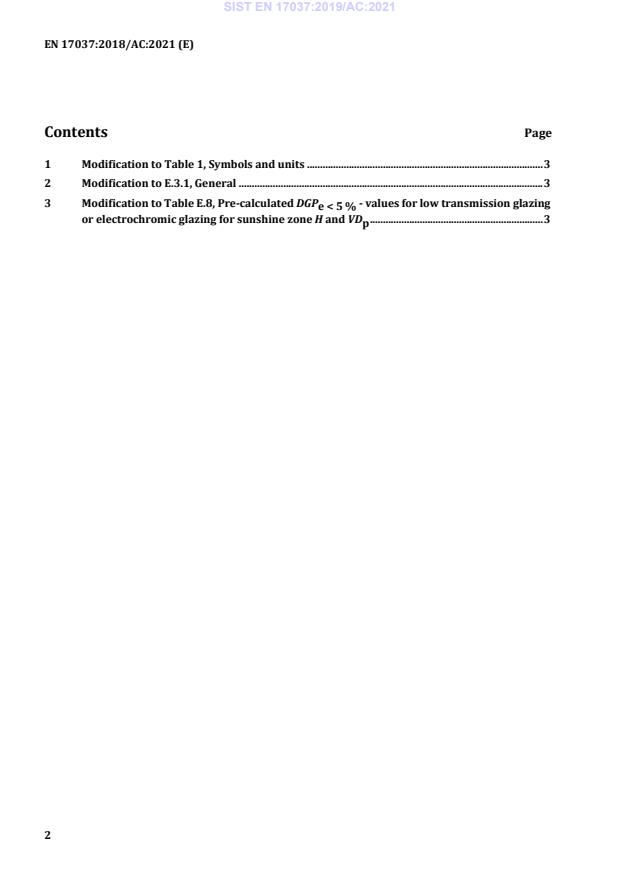
Contents Page
1 Modification to Table 1, Symbols and units . 3
2 Modification to E.3.1, General .
...
SIST EN 17037:2019/AC:2021 문서는 건축물 내 자연광 활용에 대한 명확한 지침을 제공하여 실내에서의 적절한 채광을 달성하는 데 중요한 역할을 합니다. 이 표준의 주된 범위는 자연광을 통해 실내의 주관적인 밝기 인상을 향상시키고 외부 경관을 적절히 바라볼 수 있는 환경을 제공하는 것입니다. 특히, 점유된 방에서 햇빛 노출 시간에 대한 권장 사항도 포함되어 있어, 사용자들이 쾌적함을 느낄 수 있도록 돕습니다. 이 표준의 강점은 일조량 변동성을 효과적으로 다룰 수 있는 원칙을 제시한다는 점입니다. 이를 통해 다양한 날씨와 계절의 영향을 고려하여 실내 채광 조건을 평가하는 데 필요한 메트릭을 정의하고, 계산 및 검증 방법을 제시합니다. 이러한 점은 건축가와 계획가들이 공간의 조도를 최적화하는 데 유용한 도구를 제공합니다. 또한, 직업의 성격과 역할에 따라 자연광 사용이 적합하지 않은 경우를 제외하고, 표준은 사람이 정기적으로 장시간 동안 사용할 수 있는 모든 공간에 적용될 수 있음을 명시합니다. 이는 다양한 환경에서의 활용성을 보장하며, 실내 환경을 설계하는 데 있어 실용적인 지침을 제시합니다. 종합적으로 EN 17037:2018/AC:2021 표준은 건물 내 자연광 활용을 통해 인체의 시각적 작업 요구를 충족시키고, 밝고 쾌적한 실내 환경을 조성하는 데 중요한 기반이 됩니다. 이는 주거 공간뿐만 아니라 상업시설 및 공공시설에도 널리 활용될 수 있는 매우 관련성 높은 문서입니다.
The standard EN 17037:2018/AC:2021, focusing on daylight in buildings, is a pivotal document in the realm of architectural design and building standards. Its scope emphasizes the critical role of natural light in creating environments that not only enhance the aesthetic appeal of indoor spaces but also promote the well-being of occupants. By specifying the essential elements required to achieve a favorable subjective impression of lightness and a view out, this standard serves as a comprehensive guide for architects and designers aiming to optimize daylighting in their projects. One of the standout strengths of EN 17037 is its thorough approach to the evaluation of daylighting conditions. It offers well-defined metrics and principles for calculation and verification, empowering practitioners to address the natural variability of daylight throughout the year. This makes the standard particularly relevant as it provides methods for mitigating glare and maximizing the benefits of sunlight exposure within occupied rooms. Such considerations are critical for maintaining not only aesthetic qualities but also occupant comfort and productivity. Moreover, the document specifically applies to spaces that are regularly occupied for extended periods, underscoring the importance of daylight in environments where human activity is sustained. This inclusivity ensures that a wide range of building types can benefit from its guidance, reinforcing its relevance across various sectors. In conclusion, the detailed provisions set forth in EN 17037:2018/AC:2021 highlight its significance in promoting effective daylighting strategies, ensuring that natural light is not merely an afterthought but a fundamental aspect of indoor environmental quality. Its clear recommendations and structured approach make it an essential reference for those involved in building design and indoor environment optimization.
EN 17037:2018/AC:2021は、建物における自然光の利用に関する標準化文書であり、内部空間において適切な明るさの主観的印象を得る要素と、外部の視界を提供する方法について具体的に規定しています。この標準は、 occupied rooms における日光の曝露時間に関する推奨事項も含まれており、室内環境の快適性向上に寄与しています。 この文書の強みは、自然光を利用して室内照明を効果的に提供する方法と、まぶしさを制限する手法を詳しく説明している点です。さらに、明るさの評価に用いる指標が明確に定義されており、計算と検証の原則が示されています。これにより、日照の変動性を考慮しながら様々な条件に応じた室内環境の調整が可能となります。 対象となる空間は、通常、人が長時間占有する場所であり、かつ、自然光の利用が実際の作業の性質や役割に反しない限り適用されます。このため、EN 17037は多様な使用状況において重要な役割を果たし、建築デザインや室内環境の改善において非常に重要な標準です。特に、視覚的作業に対する照明要件はEN 12464-1に記載されており、それと連携することで包括的な光環境の評価が可能になります。 総じて、EN 17037は、自然光を最大限に活用し、快適な室内環境を確保するための卓越したガイドラインを提供しており、建築家やインテリアデザイナーにとって非常に価値あるリソースとなっています。自然光の重要性を認識し、その効果的な利用を促進するための基盤として、実務における適用性も非常に高いと言えます。
Die Norm EN 17037:2018/AC:2021 behandelt das Thema Tageslicht in Gebäuden und bietet damit eine wichtige Grundlage für die Planung und Gestaltung von Innenräumen. Der Umfang dieser Norm ist klar definiert und umfasst Elemente, die dazu beitragen, durch natürliche Beleuchtung ein angemessenes subjektives Lichtempfinden zu erzeugen und gleichzeitig einen ausreichenden Ausblick zu ermöglichen. Besonders hervorzuheben sind die Empfehlungen zur Dauer der Sonnenlichtexposition in belegten Räumen, die für das Wohlbefinden der Nutzer von großer Bedeutung sind. Ein wesentlicher Vorteil der Norm liegt in ihrer Fokussierung auf die Nutzung von Tageslicht zur Lichtgestaltung innerhalb von Innenräumen. Die umfassenden Informationen zur Vermeidung von Blendung und zur erfolgreichen Implementierung von Tageslichtlösungen sind von großer Relevanz für Architekten und Planer. Die Norm definiert zudem wichtige Metriken zur Bewertung der Tageslichtverhältnisse, was die Planung erleichtert und eine objektive Überprüfung der Lichtverhältnisse ermöglicht. Ein weiterer stark ausgeprägter Aspekt der Norm ist die Berücksichtigung der Variabilität des Tageslichts über die Tage und das Jahr. Dies ist besonders wichtig, da die ändernden Lichtverhältnisse direkt Einfluss auf das Nutzererlebnis haben können. Die Norm entwickelt Prinzipien zur Berechnung und Überprüfung dieser Variabilität, was eine fundierte Planung unterstützt. Die Anwendung der Norm erstreckt sich auf alle Räume, die regelmäßig von Menschen über längere Zeiträume genutzt werden, es sei denn, dass die Nutzung von Tageslicht den Anforderungen des jeweiligen Arbeitsbereichs widerspricht. Dies unterstreicht die Flexibilität und hohe Relevanz der Norm in verschiedenen Kontexten. Es ist zu beachten, dass die Norm EN 17037 nicht die spezifischen Lichtanforderungen für Menschen in Innenarbeitsplätzen mit visuellen Aufgaben behandelt, da diese in der Norm EN 12464-1 geregelt sind. Dennoch bietet EN 17037 wertvolle Leitlinien, um damit verbundene Aspekte der Tageslichtnutzung in der Gebäudeplanung zu integrieren. Zusammenfassend lässt sich sagen, dass die Norm EN 17037:2018/AC:2021 umfassende Informationen und praxisnahe Empfehlungen zur Nutzung von Tageslicht in Gebäuden liefert, wodurch sowohl die Lichtqualität als auch das Nutzererlebnis merklich verbessert werden können.
La norme SIST EN 17037:2019/AC:2021, intitulée "Daylight in buildings", constitue un cadre essentiel pour l'optimisation de l'utilisation de la lumière naturelle dans les espaces intérieurs. Elle s'inscrit dans un contexte où l'amélioration de la qualité de vie par la conception intérieure est devenue une priorité. Le champ d'application de ce document souligne son importance : il vise à garantir une impression subjective adéquate de luminosité à l'intérieur tout en assurant une vue extérieure appropriée. Ces éléments sont cruciaux pour le bien-être des occupants, car une bonne exposition à la lumière naturelle peut avoir des effets bénéfiques sur la santé physique et mentale. Parmi les forces de cette norme, on trouve sa méthodologie rigoureuse qui traite non seulement des conditions d'éclairage naturel mais aussi de la gestion de l'éblouissement. Les recommandations concernant la durée d'exposition au soleil dans les chambres occupées sont particulièrement pertinentes, car elles prennent en compte le confort des utilisateurs. De plus, les métriques définies pour l'évaluation des conditions de lumière naturelle ajoutent une dimension scientifique à l'application pratique, facilitant ainsi la mise en œuvre de solutions éclairées. La norme aborde également la variabilité de la lumière naturelle au fil des jours et des saisons, un aspect crucial pour les concepteurs d'espaces. Cela permet d'adopter des solutions adaptatives, prenant en compte les changements environnementaux, et garantit une continuité du confort visuel au sein des bâtiments. Il est important de noter que ce document ne traite pas des exigences d'éclairage pour les tâches visuelles intérieures, qui sont couvertes par la norme EN 12464-1. Cette distinction met en lumière la spécialisation de la norme SIST EN 17037, permettant aux professionnels de se focaliser sur l’intégration de la lumière naturelle dans la conception architecturale. En résumé, la norme SIST EN 17037:2019/AC:2021 se distingue par son approche holistique de l'éclairage naturel, ses recommandations pratiques et ses principes de calcul, en faisant un outil précieux pour les architectes, designers d'intérieur, et autres parties prenantes dans le domaine de la construction et de l'aménagement d'espaces occupés.


Questions, Comments and Discussion
Ask us and Technical Secretary will try to provide an answer. You can facilitate discussion about the standard in here.
Loading comments...