


EN 15859:2010
(Main)Air Quality - Certification of automated dust arrestment plant monitors for use on stationary sources - Performance criteria and test procedures
Air Quality - Certification of automated dust arrestment plant monitors for use on stationary sources - Performance criteria and test procedures
This European Standard provides the performance criteria and test procedures for filter dust monitors and filter leakage monitors used to ensure that dust arrestment plants used on stationary sources are working satisfactorily.
A filter dust monitor is a dust arrestment plant monitor which can be calibrated in mass concentration units (e.g. mg/m3) and used for dust arrestment control purposes.
A filter leakage monitor is a dust arrestment plant monitor which indicates a possible problem with the dust arrestment plant by monitoring a change in the emissions level or a change in the magnitude of the dust pulses created by the cleaning process.
This standard is intended for use with the certification procedure for automated measuring systems described in EN 15267-1 and EN 15267-2.
Luftbeschaffenheit - Zertifizierung von automatischen Geräten zur Überwachung von Staubabscheidern an stationären Quellen - Mindestanforderungen und Prüfprozeduren
Diese Europäische Norm legt Mindestanforderungen an und Prüfprozeduren für Staubmonitore und Leckagemonitore zur Filterkontrolle fest, mit deren Hilfe sichergestellt wird, dass Staubabscheider an stationären Quellen zufrieden stellend arbeiten.
Ein Staubmonitor zur Filterkontrolle ist ein Gerät zur Überwachung von Staubabscheidern, das in Einheiten der Massenkonzentration (z. B. mg/m3) kalibriert werden kann und zur Regelung von Staubabscheidern eingesetzt wird.
Ein Leckagemonitor zur Filterkontrolle ist ein Gerät zur Überwachung von Staubabscheidern, das mögliche Probleme mit dem Staubabscheider durch Überwachung einer Änderung des Emissionsniveaus oder einer Änderung der Höhe der durch den Reinigungsprozess verursachten Staubspitzen anzeigt.
Diese Europäische Norm ist für die Anwendung mit dem Zertifizierungsverfahren für automatische Messeinrichtungen nach EN 15267 1 und EN 15267 2 vorgesehen.
Qualité de l'air - Certification des analyseurs automatiques pour la surveillance des systèmes de réduction des poussières à l'émission des sources fixes - Spécifications de performance et modes opératoires d'essai
La présente Norme européenne présente les critères de performance et les modes opératoires d’essai des analyseurs de poussières pour le contrôle du système de filtration et analyseurs pour la détection de fuites du système de filtration utilisés afin de s’assurer du bon fonctionnement du système de dépoussiérage à l'émission des sources fixes.
Un analyseur de poussières pour le contrôle du système de filtration est un système de surveillance du système de dépoussiérage qui peut être étalonné en unités de concentration massique, par exemple, en milligrammes par mètre cube (mg/m3) et utilisé pour contrôler la réduction des poussières.
Un analyseur pour la détection des fuites du système de filtration est un système de surveillance du système de dépoussiérage qui signale les problèmes éventuels liés au système de dépoussiérage. Il surveille toute modification du niveau d’émission ou de l’amplitude des pics de poussières créés par le procédé d’épuration.
La présente norme est destinée à être utilisée avec le mode opératoire de certification des systèmes automatiques de mesurage décrits dans l’EN 15267-1 et l’EN 15267-2.
Kakovost zraka - Certificiranje avtomatskih merilnih sistemov za nadzor naprav za zmanjševanje emisije prahu iz nepremičnih virov - Zahteve za delovanje in postopki preskušanja
Ta evropski standard določa zahteve za delovanje in postopke preskušanja za filtrirne merilne sisteme za nadzor emisij prahu in filtrirne merilne sisteme za nadzor uhajanja emisij prahu, ki se uporabljajo, da zagotovijo zadovoljivo delovanje naprav za zmanjševanje emisij prahu iz nepremičnih virov. Filtrirni merilni sistem za nadzor emisij prahu je naprava za nadzor zmanjševanje emisij prahu, ki je lahko kalibrirana na mg/m3 in se uporablja za namene nadzora zmanjševanja emisij prahu. Filtrirni merilni sistem za nadzor uhajanj je merilni sitem za nadzor zmanjševanja emisij prahu, ki nakazuje možni problem merilnega sistema za nadzor naprav za zmanjševanje emisij prahu z nadzorom spremembe ravni emisij ali spremembe razsežnosti impulzov, ki jih povzročijo prašni delci, povzročeni zaradi postopka čiščenja. Ta standard se uporablja s postopkom certificiranja za avtomatske merilne sisteme, opisane v EN 15267-1 in EN 15267-2.
General Information
Standards Content (Sample)
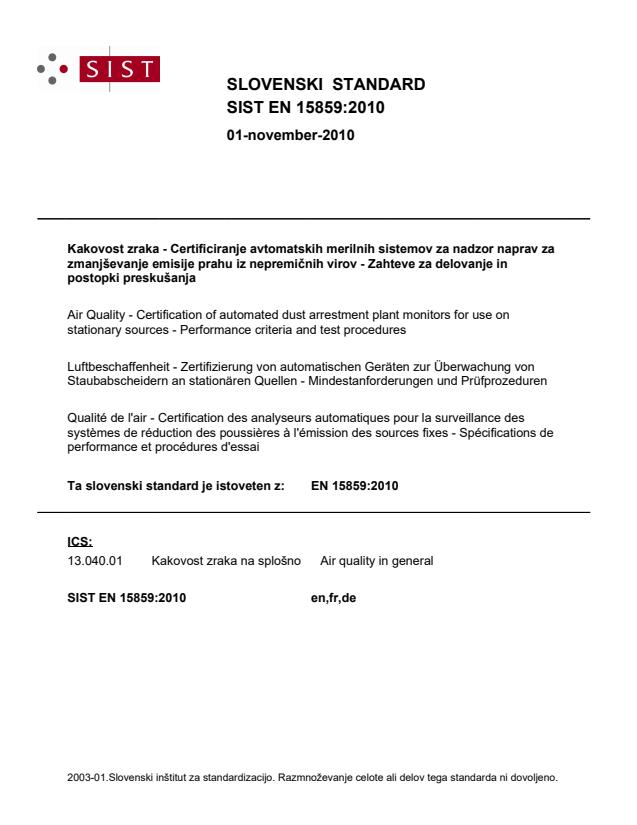
2003-01.Slovenski inštitut za standardizacijo. Razmnoževanje celote ali delov tega standarda ni dovoljeno.Luftbeschaffenheit - Zertifizierung von automatischen Geräten zur Überwachung von Staubabscheidern an stationären Quellen - Mindestanforderungen und PrüfprozedurenQualité de l'air - Certification des analyseurs automatiques pour la surveillance des systèmes de réduction des poussières à l'émission des sources fixes - Spécifications de performance et procédures d'essaiAir Quality - Certification of automated dust arrestment plant monitors for use on stationary sources - Performance criteria and test procedures13.040.01Kakovost zraka na splošnoAir quality in generalICS:Ta slovenski standard je istoveten z:EN 15859:2010SIST EN 15859:2010en,fr,de01-november-2010SIST EN 15859:2010SLOVENSKI
STANDARD
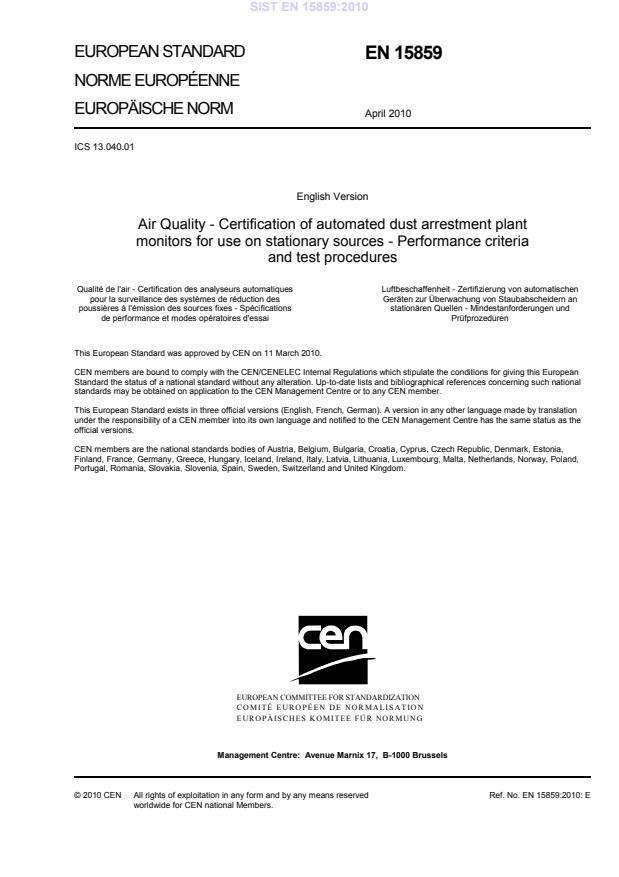
EUROPEAN STANDARD NORME EUROPÉENNE EUROPÄISCHE NORM
EN 15859
April 2010 ICS 13.040.01 English Version
Air Quality - Certification of automated dust arrestment plant monitors for use on stationary sources - Performance criteria and test procedures
Qualité de l'air - Certification des analyseurs automatiques pour la surveillance des systèmes de réduction des poussières à l'émission des sources fixes - Spécifications de performance et modes opératoires d'essai
Luftbeschaffenheit - Zertifizierung von automatischen Geräten zur Überwachung von Staubabscheidern an stationären Quellen - Mindestanforderungen und Prüfprozeduren This European Standard was approved by CEN on 11 March 2010.
CEN members are bound to comply with the CEN/CENELEC Internal Regulations which stipulate the conditions for giving this European Standard the status of a national standard without any alteration. Up-to-date lists and bibliographical references concerning such national standards may be obtained on application to the CEN Management Centre or to any CEN member.
This European Standard exists in three official versions (English, French, German). A version in any other language made by translation under the responsibility of a CEN member into its own language and notified to the CEN Management Centre has the same status as the official versions.
CEN members are the national standards bodies of Austria, Belgium, Bulgaria, Croatia, Cyprus, Czech Republic, Denmark, Estonia, Finland, France, Germany, Greece, Hungary, Iceland, Ireland, Italy, Latvia, Lithuania, Luxembourg, Malta, Netherlands, Norway, Poland, Portugal, Romania, Slovakia, Slovenia, Spain, Sweden, Switzerland and United Kingdom.
EUROPEAN COMMITTEE FOR STANDARDIZATION
COMITÉ EUROPÉEN DE NORMALISATION EUROPÄISCHES KOMITEE FÜR NORMUNG
Management Centre:
Avenue Marnix 17,
B-1000 Brussels © 2010 CEN All rights of exploitation in any form and by any means reserved worldwide for CEN national Members. Ref. No. EN 15859:2010: ESIST EN 15859:2010
Elements of recommended performance testing report . 36Bibliography . 38 SIST EN 15859:2010
a) performance testing of an AMS; b) initial assessment of the AMS manufacturer’s quality management system; c) certification; d) post certification surveillance. This European Standard defines the performance criteria and procedures for performance testing of automated dust arrestment plant monitors used on stationary sources.
The following two types of dust arrestment plant monitor are covered by this standard: a filter dust monitor which can be calibrated in mass concentration units (e.g. mg/m3) and used for dust arrestment control purposes;
a filter leakage monitor which indicates a change in the emissions level or a change in the magnitude of the dust pulses created by the cleaning process.
For the purposes of this standard, the term instrument is used to encompass both types of dust arrestment plant monitor. The terms filter dust monitor and filter leakage monitor are only used where it is necessary to distinguish between the two types.
0.2 Processes Field-testing of an instrument is ordinarily carried out on the most highly demanding industrial process in the range of applications for which a manufacturer seeks certification. The premise is that if the instrument performs acceptably on this process, then experience has shown that the instrument generally performs well on the majority of other processes. However, there are always exceptions and it is the responsibility of the manufacturer in conjunction with the user to ensure that the instrument performs adequately on a specific process. 0.3 Performance characteristics A combination of laboratory and field testing is detailed within this European Standard. Laboratory testing is designed to assess whether an instrument can meet, under controlled conditions, the technical requirements of the relevant performance criteria. Field testing, over a minimum three month period, is designed to assess whether an instrument can continue to work and meet the relevant performance criteria in a real application. Field testing is carried out on an industrial process representative of the intended application for the instrument for which the manufacturer seeks certification. The main instrument performance characteristics are:
response or detection time; influence of ambient conditions; SIST EN 15859:2010
availability and maintenance interval under field conditions; reproducibility from two instruments under identical field conditions. Measurements made by instruments certified to the requirements of this standard do not necessarily fulfil the uncertainty requirements of the EU Directives for Large Combustion Plant and Waste Incineration or the QAL3 functionality of EN 14181:2004.
EN 14181:2004, Stationary source emissions — Quality assurance of automated measuring systems
EN 15259, Air quality – Measurement of stationary source emissions — Requirements for measurement sections and sites and for the measurement objective, plan and report EN 15267-3, Air quality – Certification of automated measuring systems — Part 3: Performance criteria and test procedures for automated measuring systems for monitoring emissions from stationary sources EN 50160, Voltage characteristics of electricity supplied by public distribution networks EN 60529, Degrees of protection provided by enclosures (IP code) (IEC 60529:1989) EN ISO/IEC 17025, General requirements for the competence of testing and calibration laboratories (ISO/IEC 17025:2005) IEC 60068-1, Environmental testing — Part 1: General and guidance IEC 60068-2 (all tests), Environmental testing — Part 2: Tests 3 Terms and definitions For the purposes of this document, the following terms and definitions apply. 3.1 dust particles, of any shape, structure or density, dispersed in the gas phase at the sampling point conditions which may be collected by filtration under specified conditions after representative sampling of the gas to be analysed NOTE Adapted from EN 13284-1:2001, 3.1. SIST EN 15859:2010
filter dust monitor or filter leakage monitor and additional devices for obtaining a result NOTE Apart from the actual measuring device (the analyser), an instrument may include further components, like purge air blowers or external displays. 3.3 instrument dust arrestment plant monitor
3.4 filter dust monitor
instrument, which can be calibrated in mass concentration units and used for dust arrestment control purposes, but does not fulfil the uncertainty demands according to EN 14181, or does not have reference materials for linearity test and QAL3 procedure according to EN 14181:2004 NOTE A mass concentration unit is e.g. mg/m3. 3.5 filter leakage monitor instrument, which indicates a possible problem with the dust arrestment plant NOTE
These instruments may either monitor a change in the emissions level or a change in the magnitude of the dust pulses created by the cleaning process.
3.6 reference method RM measurement method taken as a reference by convention, which gives the accepted reference value of the measurand NOTE 1 A reference method is fully described. NOTE 2 A reference method can be a manual or an automated method. NOTE 3 Alternative methods can be used if equivalence to the reference method has been demonstrated.
[EN 15259:2007, 2.8] 3.7 standard reference method SRM reference method prescribed by European or National standard NOTE Standard reference methods are used e.g. to calibrate and validate instrument and for periodic measurements to check compliance with limit values.
[EN 15259:2007, 2.9] 3.8 measurement set of operations having the object of determining a value of a quantity [VIM:1993, 2,1] 3.9 paired measurement simultaneous recording of results of measurement at the same measurement point SIST EN 15859:2010
[EN 15259:2007, 2.6] NOTE Measured component is also called determinand. 3.12 interferent substance or phenomenon present in the waste gas under investigation, other than the measured component, that affects the response
NOTE Adapted from EN 15267-3:2007, 3.8. 3.13 calibration determination of a calibration function with (time) limited validity applicable to an instrument at a specific measurement site NOTE Adapted from EN 15267-3:2007, 3.9. 3.14 calibration function relationship between the values of the SRM and the instrument with the assumption of a constant residual standard deviation NOTE 1 Adapted from EN 15267-3:2007, 3.10. NOTE 2 The calibration function describes the statistical relationship between the starting variable (measured signal) of the measuring system and the associated result of measurement (measured value) simultaneously determined at the same point of measurement using a SRM. 3.15 automatic internal zero point output of the instrument in response to an internally generated function, intended to represent absence of the measured component
3.16 automatic internal reference point output of the instrument in response to an internally generated function, intended to represent a defined amount of the measured component
3.17 measured signal output from an instrument in analogue or digital form which is converted into the measured value with the aid of the calibration function NOTE Adapted from EN 15267-3:2007, 3.15. SIST EN 15859:2010
NOTE Adapted from EN 15267-3:2007, 3.16. 3.19 independent reading reading that is not influenced by a previous individual reading by separating two individual readings by at least four response times [EN 15267-3:2007, 3.17] 3.20 individual reading reading averaged over a time period equal to the response time of the instrument NOTE Adapted from EN 15267-3:2007, 3.18. 3.21 performance characteristic quantity assigned to an instrument in order to define its performance NOTE 1 Adapted from EN 15267-3:2007, 3.19. NOTE 2 A performance characteristic is described by values, tolerances and ranges. 3.22 accuracy
closeness of agreement between a single measured value of the measurand, and the true value (or an accepted reference value) [EN 15267-3:2007, 3.20] 3.23 availability
fraction of the total monitoring time for which data of acceptable quality have been collected [EN 15267-3:2007, 3.21] 3.24 averaging time period of time over which an arithmetic or time-weighted average of concentrations is calculated [EN 15267-3:2007, 3.22] 3.25 interference negative or positive effect that a substance or phenomenon has upon the output of the instrument, when that substance or phenomenon is not the measured component NOTE Derived from EN 15267-3:2007, 3.24. 3.26 cross-sensitivity response of the instrument to substances and phenomena other than those that it is designed to measure NOTE See interference. SIST EN 15859:2010
monotonic change of the calibration function over a stated period of unattended operation, which results in a change of the measured value [EN 15267-3:2007, 3.26] 3.28 internal zero drift change in the automatic internal zero point over a stated period of unattended operation 3.29 internal reference drift
change in the automatic internal reference point over a stated period of unattended operation 3.30 maintenance interval
maximum admissible interval of time for which the performance characteristics remain within a pre-defined range without external servicing, e.g. refill, calibration, adjustment NOTE
This is also known as the period of unattended operation. [EN 15267-3:2007, 3.29] 3.31 response time t90
time interval between the instant of a sudden change in the value of the input quantity to an instrument and the time as from which the value of the output quantity is reliably maintained above 90 % of the correct value of the input quantity NOTE 1 Adapted from EN 15267-3:2007, 3.31. NOTE The response time is also referred to as the 90 % time or t90 time. 3.32 detection time time interval between the onset of an event, and the instrument providing the defined change in output 3.33 reproducibility
Rf measure of the agreement between two identical measuring systems applied in parallel in field tests at a level of confidence of 95 % using the standard deviation of the difference of the paired measurements [EN 15267-3:2007, 3.33] NOTE Reproducibility is determined by means of two identical instruments operated side by side. It is an instrument performance characteristic for describing the production tolerance specific to that instrument. The reproducibility is calculated from the half-hour averaged output signals (raw values as analogue or digital outputs) during the three-month field test.
3.34 uncertainty parameter associated with the result of a measurement, which characterises the dispersion of the values that could reasonably be attributed to the measurand [ENV 13005:1999, B.2.18] SIST EN 15859:2010
3.36 field test
test for at least three months on a plant appropriate to the field of application of the instrument NOTE Adapted from EN 15267-3:2007, 3.38. 3.37 certification range
range over which the filter dust monitor is tested and certified for compliance with the relevant performance criteria NOTE Adapted from EN 15267-3:2007, 3.39. 3.38 emissions limit value ELV limit values given in regulations such as EU Directives, ordinances, administrative regulations, permits, licences, authorisations or consents NOTE ELV can be stated as concentration limits expressed as half-hourly, hourly and daily averaged values, or mass flow limits expressed as hourly, daily, weekly, monthly or annually aggregated values. [EN 15267-3:2007, 3.40] 3.39 plant installation industrial facility on which an instrument is installed
NOTE Adapted from EN 15267-3:2007, 3.41. 4 Symbols and abbreviations 4.1 Symbols bf sensitivity coefficient of sample gas flow bt
sensitivity coefficient of ambient temperature bv
sensitivity coefficient of supply voltage n number of measurements, number of parallel measurements r1 nominal flow rate
r2 lowest specified flow rate Rf reproducibility under field conditions SIST EN 15859:2010
sD standard deviation from paired measurements sr repeatability standard deviation of the measurement σ0 uncertainty requirement
95,0;1−nt two-sided Student t-factor at a confidence level of 95 % with a number of degrees of freedom n – 1 td is the relative difference between the response times determined in rise and fall mode tr response time determined in rise mode
tf response time determined in fall mode
to outage time ttot total operating time T temperature (absolute) Ti ith temperature U1 minimum voltage specified by the manufacturer U2 maximum voltage specified by the manufacturer V availability x measured signal xi ith measured signal; average of the measured signals for substance i x1,i ith measured signal of the first measuring system x2,i ith measured signal of the second measuring system x average of measured signals xi 4.2 Abbreviations AMS automated measuring system AST annual surveillance test CR
certification range ELV emission limit value QAL quality assurance level QAL1 first quality assurance level QAL2 second quality assurance level QAL3 third quality assurance level SIST EN 15859:2010
5.2.1 General The instrument shall be tested over a specified certification range and, if applicable, over supplementary ranges. NOTE The ranges of a filter leakage monitor can be expressed in units defined by the manufacturer. 5.2.2 Certification range for filter dust monitor The certification range over which the instrument is to be tested shall comprise minimum and maximum values and the coverage shall be fit for the intended application of the instrument.
The minimum value of the certification range shall be the detection limit certified during the test. A filter dust monitor shall be able to measure instantaneous values in a range that is at least two times the upper limit of the certification range, in order to measure the half-hour values correctly. If it is necessary to use more than one range setting of the instrument to achieve this requirement, supplementary ranges require additional testing (see 5.2.3).
NOTE Manufacturers can choose other ranges for different applications.
The certification range(s) and the performance criteria tested for each range shall be stated in the test report. The test laboratory shall choose for the field test an industrial plant with challenging measuring conditions. This means that the instrument can also be used in less demanding measuring conditions.
5.2.3 Supplementary ranges for filter dust monitors If a manufacturer wishes to demonstrate performance over one or more supplementary ranges larger than the certification range some limited additional testing is required over all the supplementary ranges. This additional testing shall at least include evaluations of the response time as specified in 10.8. The supplementary range(s) and the performance criteria tested for these ranges shall be stated on the certificate. 5.2.4 Type of arrestment plant for filter leakage monitors The manufacturer shall agree with the test laboratory the type of arrestment plant for which the certification application is made. This shall be stated on the test certificate and shall include the type of filter (e.g. electrostatic precipitator or bagfilter) and in the case of arrestment plant monitors also include whether the instrument operation requires a change in the magnitude of the dust pulses created by the cleaning process to operate or a change in the emissions level. Also for arrestment plant monitors, the manufacturer shall agree with the test laboratory the type of bagfilter cleaning mechanisms for which the instrument is applicable.
The test laboratory shall choose a field test location which reflect the type of arrestment plant. 5.2.5 Expression of performance criteria with respect to ranges The performance criteria presented in Clause 8 are expressed in terms of a percentage of the upper limit of the certification range. A performance criterion is a value that corresponds to the largest permitted deviation allowed for each test, regardless of the sign of the deviation determined in the test. 5.2.6 Ranges of optical in-situ instrument with variable optical length (cross-stack) The certification range for optical in situ instrument with variable optical length (cross-stack) shall be defined in units of the dust concentration multiplied by the length of the optical path, e.g. mg/m3·m.
The path length used for testing shall be stated on the certificate.
5.3 Manufacturing consistency and changes to instrument design Certification is specific to the instrument version, which has undergone performance testing. Subsequent design modifications that might affect the performance of the instrument can invalidate the certification. NOTE
Design modifications apply to both hardware and software. Manufacturing consistency and changes to instrument design are described in EN 15267-2. 5.4 Qualifications of test laboratories Test laboratories shall be accredited to EN ISO/IEC 17025 and the appropriate test standards for carrying out the tests defined in this standard. Test laboratories shall have knowledge on the uncertainties attributed to the individual test procedures applied during performance testing.
CEN/TS 15675 provides an elaboration of EN ISO/IEC 17025 for application to emission measurements which should be followed when using standard reference methods. 6 Performance characteristics for laboratory testing
6.1 Instrument for testing All instruments submitted for testing shall be complete. These specifications do not apply to the individual parts of an instrument. The report shall be issued for a specified instrument with all its parts listed.
6.2 CE labelling
The instrument shall comply with the requirements for CE labelling specified in applicable EU Directives. These include, for example:
Electromagnetic Compatibility Directive 2004/108/EC;
Low-voltage Directive 2006/95/EC covering electrical equipment designed for use within certain voltage limits. SIST EN 15859:2010
Analogue output shall have a live zero point. The instrument shall have a display that shows the measurement response. The display may be external to the instrument. 6.5 Additional outputs on filter leakage monitors Filter leakage monitors shall be provided with at least two alarm outputs, with alarm delay capability in addition to the data output. 6.6 Display of operational status signals The instrument shall have a means of displaying its operating status. NOTE Status signals cover, for example, normal operation, stand-by, maintenance mode, malfunctions.
The instrument shall also have a means of communicating the operational status to a data handling and acquisition system. 6.7 Degrees of protection provided by enclosures
Instruments limited to be mounted in ventilated rooms or cabinets, where any kind of precipitation cannot reach the instrument, shall meet at least IP40 specified in EN 60529:1991. Instruments limited to be mounted in areas, where some kind of shelter against precipitation is in place, e.g. a porch roof, but precipitation may reach the instrument due to wind etc., shall meet at least IP54 specified in EN 60529. Instruments which are designed to be used in the open air and without any weather protection shall at least meet the requirements of standard IP65 specified in EN 60529:1991. 6.8 Response time A filter dust monitor shall meet the performance criteria for response time specified in Table 1. 6.9 Detection time A filter leakage monitor shall meet the performance criteria for detection time specified in Table 1. 6.10 Repeatability standard deviation at automatic internal zero point The instrument shall meet the performance criteria for repeatability standard deviation at the automatic internal zero point specified in Clause 8. SIST EN 15859:2010
The test laboratory shall assess that the mechanisms for determining the automatic internal zero and reference points are as comprehensive as is practical for the measurement technique used, but does not necessarily check the complete measurement path.
The manufacturer shall provide details in the manual of how to ensure the correct operation of the parts of the measurement path not tested by the automatic internal zero and reference point checks. 6.13 Influence of ambient temperature The deviations of the instrument readings at the automatic internal zero and reference points shall not exceed the performance criteria specified in Clause 8 when the ambient temperature varies from –20 °C to +50 °C, unless assemblies are installed indoors where the temperatures do not fall below +5 °C or rise above +40 °C, in which case the test range shall be +5 °C to +40 °C.
The manufacturer submitting an instrument for testing may specify wider ambient temperature ranges to those above. NOTE Temperature ranges tested are indicated in the certificate. 6.14 Influence of sample gas flow for extractive instrument The deviation of the instrument reading at the automatic internal reference point shall not exceed the performance criterion specified in Table 1, when the sample gas flow is changed in accordance with the manufacturer's specification.
A status signal for the lower limit of the sample gas flow shall be provided. 6.15 Influence of voltage variations The deviation of the instrument reading at the automatic internal zero and reference points shall not exceed the performance criterion specified in Table 1, when the voltage supply to the instrument varies from
–15 % to +10 % from the nominal value of the supply. The instrument shall be capable of operating at a voltage which meets the requirements of EN 50160.
6.16 Influence of vibration
The instrument shall be unaffected by the levels of vibration typically expected during installation at an industrial plant. The influence of vibration is acceptable if the deviations of the instrument readings at the automatic internal zero and reference points do not exceed the performance criteria specified in Table 1.
6.17 Cross-sensitivity The manufacturer shall describe any known sources of interference. The test laboratory shall assess and report on relevant interferents.
The detection limit of the filter dust monitor shall be determined, assessed and documented in the test report.
The detection limit should be lower than 25 % of the normal emission concentration from the type of arrestment plant for which certification is requested. NOTE 1
The detection limit is two times the repeatability standard deviation at zero. NOTE 2
The quantification limit is four times the repeatability standard deviation at zero. 7 Performance characteristics for field testing 7.1 Calibration function for filter dust monitors The calibration function shall be determined by parallel measurements carried out using a SRM. The calibration function shall have at least a determination coefficient R2 of the regression as specified in Table 2. The variability attached to the calibration function and determined in accordance with EN 14181 shall meet the performance criterion in Table 2. NOTE This test involves regression analysis of 15 paired measurements at the beginning and end of the field test and an assessment of the change in the calibration function using the AST criterion. 7.2 Functional test of filter leakage monitor 7.2.1 General During the field test, instruments shall be tested after typical arrestment plant for which certification is sought. The test laboratory shall select a suitably demanding installation. Two filter leakage monitors and a particulate AMS shall be installed on the same outlet from the arrestment plant and the outputs recorded for the duration of the field test. The particulate AMS shall be certified in accordance with EN 15267-3 for the field test application conditions and adjusted to a suitably short averaging time, enabling it to follow the fast changes in dust concentration, associated with arrestment plant dynamics. 7.2.2 Plant
...
Questions, Comments and Discussion
Ask us and Technical Secretary will try to provide an answer. You can facilitate discussion about the standard in here.