


EN 14764:2005
(Main)City and trekking bicycles - Safety requirements and test methods
City and trekking bicycles - Safety requirements and test methods
This European Standard specifies safety and performance requirements for the design, assembly, and testing of bicycles and sub-assemblies intended for use on public roads, and lays down guide lines for instructions on the use and care of such bicycles.
This European Standard applies to bicycles that have a maximum saddle height of 635 mm or more and that are in-tended for use on public roads.
This standard does not apply to mountain bicycles and racing bicycles, tradesman's delivery bicycles, recumbent bicycles, tandems and bicycles designed and equipped for use in sanctioned competitive events.
NOTE For bicycles with a maximum saddle height of 435 mm see EN 71 and with a maximum saddle height of more than 435 mm and less than 635 mm see EN 14765.
City- und Trekking-Fahrräder - Sicherheitstechnische Anforderungen und Prüfverfahren
Diese Europäische Norm legt Anforderungen an die Leistung und die Sicherheitstechnik für Fahrräder zur
Benutzung im öffentlichem Verkehr hinsichtlich ihrer Konstruktion, ihrer Montage und der Prüfverfahren für diese
Fahrräder und deren Baugruppen fest und enthält Anleitungen zur Benutzung und Pflege dieser Fahrräder.
Diese Europäische Norm gilt für Fahrräder, die zur Benutzung mit einer Sattelhöhe von 635 mm oder mehr im
öffentlichem Verkehr vorgesehen sind.
Diese Norm gilt nicht für Mountainbikes und Rennräder, Lastenfahrräder, Tandem-Fahrräder und auch nicht für
Fahrräder, die im genehmigten Wettbewerb benutzt werden.
ANMERKUNG Fahrräder mit einer maximalen Sattelhöhe von 435 mm siehe EN 71 und mit einer maximalen Sattelhö-he
von mehr als 435 mm und weniger als 635 mm siehe EN 14765.
Bicyclettes de ville et tout chemin (trekking) - Exigences de sécurité et méthodes d'essai
La présente Norme européenne prescrit les exigences de sécurité et de performance à observer lors de la conception, de l’assemblage et des essais des bicyclettes destinées à une utilisation sur la voie publique et de leurs sous-ensembles, et précise les lignes directrices concernant l'utilisation et l'entretien de ceux-ci.
La présente Norme européenne s'applique aux bicyclettes destinées à une utilisation sur la voie publique sur lesquelles la selle peut être réglée pour offrir une hauteur maximale de selle supérieure ou égale à 635 mm.
La présente Norme européenne ne s'applique pas aux bicyclettes tout terrain, de course ni aux bicyclettes spécialisées telles que les vélos de livraison, vélos couchés, tandems ou les bicyclettes conçues et équipées pour être utilisées dans les compétitions réglementées.
NOTE Pour les bicyclettes dont la hauteur maximale de selle est inférieure à 435 mm, se reporter à la norme EN 71 ; pour une hauteur maximale de selle comprise entre 435 mm et 635 mm, se reporter à la norme EN 14765.
Mestna in treking kolesa – Varnostne zahteve in preskusne metode
General Information
- Status
- Withdrawn
- Publication Date
- 06-Dec-2005
- Withdrawal Date
- 10-Feb-2026
- Technical Committee
- CEN/TC 333 - Cycles
- Drafting Committee
- CEN/TC 333 - Cycles
- Current Stage
- 9960 - Withdrawal effective - Withdrawal
- Start Date
- 02-Jul-2014
- Completion Date
- 11-Feb-2026
- Directive
- 2001/95/EC - General product safety
Relations
- Effective Date
- 08-Jun-2022
- Effective Date
- 08-Jun-2022
- Effective Date
- 08-Jun-2022
- Effective Date
- 08-Jun-2022
- Effective Date
- 08-Jun-2022
- Effective Date
- 08-Jun-2022
- Effective Date
- 08-Jun-2022
- Effective Date
- 08-Jun-2022
- Effective Date
- 08-Jun-2022
- Effective Date
- 09-Feb-2026
- Effective Date
- 09-Feb-2026
- Effective Date
- 28-Jan-2026
- Effective Date
- 28-Jan-2026
- Effective Date
- 28-Jan-2026
- Effective Date
- 28-Jan-2026


Get Certified
Connect with accredited certification bodies for this standard

TÜV Rheinland
TÜV Rheinland is a leading international provider of technical services.

TÜV SÜD
TÜV SÜD is a trusted partner of choice for safety, security and sustainability solutions.

AIAG (Automotive Industry Action Group)
American automotive industry standards and training.
Sponsored listings
Frequently Asked Questions
EN 14764:2005 is a standard published by the European Committee for Standardization (CEN). Its full title is "City and trekking bicycles - Safety requirements and test methods". This standard covers: This European Standard specifies safety and performance requirements for the design, assembly, and testing of bicycles and sub-assemblies intended for use on public roads, and lays down guide lines for instructions on the use and care of such bicycles. This European Standard applies to bicycles that have a maximum saddle height of 635 mm or more and that are in-tended for use on public roads. This standard does not apply to mountain bicycles and racing bicycles, tradesman's delivery bicycles, recumbent bicycles, tandems and bicycles designed and equipped for use in sanctioned competitive events. NOTE For bicycles with a maximum saddle height of 435 mm see EN 71 and with a maximum saddle height of more than 435 mm and less than 635 mm see EN 14765.
This European Standard specifies safety and performance requirements for the design, assembly, and testing of bicycles and sub-assemblies intended for use on public roads, and lays down guide lines for instructions on the use and care of such bicycles. This European Standard applies to bicycles that have a maximum saddle height of 635 mm or more and that are in-tended for use on public roads. This standard does not apply to mountain bicycles and racing bicycles, tradesman's delivery bicycles, recumbent bicycles, tandems and bicycles designed and equipped for use in sanctioned competitive events. NOTE For bicycles with a maximum saddle height of 435 mm see EN 71 and with a maximum saddle height of more than 435 mm and less than 635 mm see EN 14765.
EN 14764:2005 is classified under the following ICS (International Classification for Standards) categories: 43.150 - Cycles. The ICS classification helps identify the subject area and facilitates finding related standards.
EN 14764:2005 has the following relationships with other standards: It is inter standard links to EN ISO 4210-3:2014, EN ISO 4210-4:2014, EN ISO 4210-5:2014, EN ISO 4210-7:2014, EN ISO 4210-9:2014, EN ISO 4210-2:2014, EN ISO 4210-8:2014, EN ISO 4210-1:2014, EN ISO 4210-6:2014, ISO 7636:1984, ISO 9633:2001, EN ISO 2818:1996, EN 4615:2005, EN ISO 11243:2023, EN 15194:2009+A1:2011. Understanding these relationships helps ensure you are using the most current and applicable version of the standard.
EN 14764:2005 is associated with the following European legislation: EU Directives/Regulations: 2001/95/EC; Standardization Mandates: M/508. When a standard is cited in the Official Journal of the European Union, products manufactured in conformity with it benefit from a presumption of conformity with the essential requirements of the corresponding EU directive or regulation.
EN 14764:2005 is available in PDF format for immediate download after purchase. The document can be added to your cart and obtained through the secure checkout process. Digital delivery ensures instant access to the complete standard document.
Standards Content (Sample)
2003-01.Slovenski inštitut za standardizacijo. Razmnoževanje celote ali delov tega standarda ni dovoljeno.City and trekking bicycles - Safety requirements and test methodsMestna in treking kolesa – Varnostne zahteve in preskusne metodeBicyclettes de ville et tout chemin (trekking) - Exigences de sécurité et méthodes d'essaiCity- und Trekking-Fahrräder - Sicherheitstechnische Anforderungen und PrüfverfahrenTa slovenski standard je istoveten z:EN 14764:2005SIST EN 14764:2006en43.150ICS:SLOVENSKI
STANDARDSIST EN 14764:200601-september-2006
EUROPEAN STANDARDNORME EUROPÉENNEEUROPÄISCHE NORMEN 14764December 2005ICS 43.150 English VersionCity and trekking bicycles - Safety requirements and testmethodsCity- und Trekking-Fahrräder - SicherheitstechnischeAnforderungen und PrüfverfahrenThis European Standard was approved by CEN on 28 October 2005.CEN members are bound to comply with the CEN/CENELEC Internal Regulations which stipulate the conditions for giving this EuropeanStandard the status of a national standard without any alteration. Up-to-date lists and bibliographical references concerning such nationalstandards may be obtained on application to the Central Secretariat or to any CEN member.This European Standard exists in three official versions (English, French, German). A version in any other language made by translationunder the responsibility of a CEN member into its own language and notified to the Central Secretariat has the same status as the officialversions.CEN members are the national standards bodies of Austria, Belgium, Cyprus, Czech Republic, Denmark, Estonia, Finland, France,Germany, Greece, Hungary, Iceland, Ireland, Italy, Latvia, Lithuania, Luxembourg, Malta, Netherlands, Norway, Poland, Portugal, Slovakia,Slovenia, Spain, Sweden, Switzerland and United Kingdom.EUROPEAN COMMITTEE FOR STANDARDIZATIONCOMITÉ EUROPÉEN DE NORMALISATIONEUROPÄISCHES KOMITEE FÜR NORMUNGManagement Centre: rue de Stassart, 36
B-1050 Brussels© 2005 CENAll rights of exploitation in any form and by any means reservedworldwide for CEN national Members.Ref. No. EN 14764:2005: E
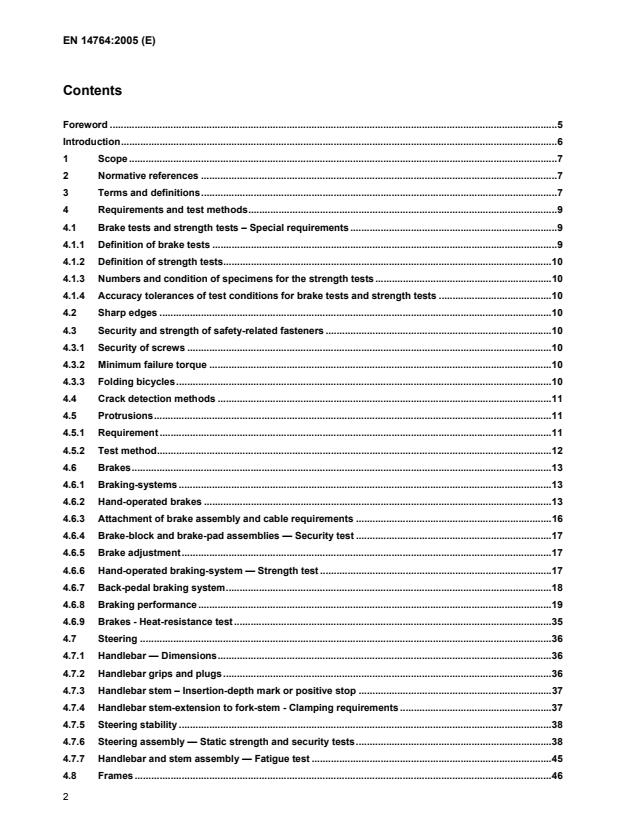
Explanation of the method of least squares for obtaining line of best fit and ± 20 % limit lines for braking performance linearity.79 Annex B (informative)
Steering geometry.82 Annex C (informative)
Structural integrity of the fully assembled bicycle.83 Annex D (informative)
Wheel/tyre assembly - Fatigue test.86 Bibliography.87
EN 14765 Bicycles for young children - Safety requirements and test methods EN 14766 Mountain bicycles – Safety requirements and test methods EN 14781 Racing bicycles - Safety requirements and test methods
prEN 14872 Bicycles - Accessories for bicycles - Luggage carriers prEN 15194 Cycles - Electrically power assisted cycles - EPAC bicycle
According to the CEN/CENELEC Internal Regulations, the national standards organizations of the following countries are bound to implement this European Standard: Austria, Belgium, Cyprus, Czech Republic, Denmark, Estonia, Finland, France, Germany, Greece, Hungary, Iceland, Ireland, Italy, Latvia, Lithuania, Luxembourg, Malta, Netherlands, Norway, Poland, Portugal, Slovakia, Slovenia, Spain, Sweden, Switzerland and United Kingdom.
Introduction This European Standard has been developed in response to demand throughout Europe, and the aim has been to ensure that bicycles manufactured in compliance with it will be as safe as is practically possible. The tests have been designed to ensure the strength and durability of individual parts as well as of the bicycle as a whole, de-manding high quality throughout and consideration of safety aspects from the design stage onwards. The scope has been limited to safety considerations, and has specifically avoided standardisation of components. If the bicycle is used on public roads national regulations apply. No requirements on lighting equipment, reflectors and warning devices are specified in this European Standard, due to the existence of several different national regulations applicable in the European Countries.
For bicycles with a maximum saddle height of 435 mm see EN 71 and with a maximum saddle height of more than 435 mm and less than 635 mm see EN 14765. 2 Normative references The following referenced documents are indispensable for the application of this European Standard. For dated references, only the edition cited applies. For undated references, the latest edition of the referenced document (including any amendments) applies. prEN 14872, Bicycles - Accessories for bicycles - Luggage carriers ISO 5775-1, Bicycle tyres and rims — Part 1: Tyre designations and dimensions ISO 5775-2, Bicycle tyres and rims — Part 2: Rims ISO 7636, Bells for bicycles and mopeds - Technical specifications ISO 9633, Cycle chains - Characteristics and test methods
3 Terms and definitions For the purposes of this European Standard, the following terms and definitions apply. 3.1 cycle any vehicle that has at least two wheels and is propelled solely or mainly by the muscular energy of the person on that vehicle, in particular by means of pedals 3.2 bicycle two-wheeled cycle 3.3 delivery bicycle bicycle designed for the primary purpose of carrying goods 3.4 tandem bicycle with saddles for two or more riders, one behind the other 3.5 fully-assembled bicycle bicycle fitted with all components necessary for its intended use
3.22 fracture unintentional separation into two or more parts 3.23 wheel assembly or combination of hub, spokes or disc, and rim, but excluding the tyre 3.24 wheel-base distance between the axes of the front and rear wheels of an unladen bicycle 3.25 quick release device device to fix or release a part without a tool 3.26 maximum inflation pressure maximum tyre pressure recommended by the tyre manufacturer for a safe and efficient performance 3.27 exposed protrusion protrusion which through its location and rigidity could present a hazard to the rider either through heavy contact with it in normal use or should the rider fall onto it in an accident 3.28 toe-clip device attached to the pedal to grip the toe end of the rider's shoe but permitting withdrawal of the shoe 3.29 highest gear the gear ratio which gives the greatest distance travelled for one rotation of the cranks 3.30 lowest gear gear ratio which gives the shortest distance travelled for one rotation of the cranks 4 Requirements and test methods 4.1 Brake tests and strength tests – Special requirements 4.1.1 Definition of brake tests Brake tests to which accuracy requirements apply, as in 4.1.4, are those specified in subclauses 4.6.2.3 to 4.6.6.2. inclusive and 4.6.8.5.1.3 and 4.6.8.5.2.
Forces and torques………………0/+5%
Masses and weights……………±1%
Dimensions…………………….±1 mm
Angles……………………………±1°
Time duration……………………±5 s
Temperatures……………………±2 °C
Pressures………………….±5%
4.2 Sharp edges Exposed edges that could come into contact with the rider's hands, legs, etc., during normal riding or normal han-dling and normal maintenance shall not be sharp. 4.3 Security and strength of safety-related fasteners 4.3.1 Security of screws Any screws used in the assembly of suspension systems or screws used to attach generators, brake-mechanisms and mud-guards to the frame or fork or handlebar, and the saddle to the seat-pillar shall be provided with suitable locking devices, e. g., lock-washers, lock-nuts, or stiff nuts. NOTE Fasteners used to assemble hub and disc brakes should have heat-resistant locking devices. 4.3.2 Minimum failure torque The minimum failure torque of bolted joints for the fastening of handle bars, handlebar-stems, bar-ends, seats and seat-pillars shall be at least 50 % greater than the manufacturer's recommended tightening torque. 4.3.3 Folding bicycles Folding bicycles shall meet all test requirements. Folding mechanisms shall be designed so that the bicycle can be locked for use in a simple, stable, safe way and when folded no damage shall occur to any cables. No locking mechanism shall contact the wheels or tyres during riding, and it shall be impossible to unintentionally loosen or unlock the folding mechanisms during riding.
NOTE For example, suitable dye-penetrant methods are specified in ISO 3452.
4.5 Protrusions 4.5.1 Requirement 4.5.1.1 Exposed protrusions Any rigid exposed protrusion longer than 8 mm (see L in Figure 1) after assembly except a) the front gear-change mechanism at the chain-wheel; b) the gear-change mechanism at the rear wheel; c) the rim-brake mechanism at the front and rear wheels; d) a lamp-bracket fitted on the head-tube; e) reflectors; f) toe-clips and toe-straps; g) clipless attachment mechanism; h) chain-wheels and spockets; i) water bottle cage; shall terminate in a radius, R (see Figure 1), of not less than 6,3 mm. Such protrusions shall have a major end di-mension, A, not less than 12,7 mm and a minor dimension, B, not less than 3,2 mm. 4.5.1.2 Exclusion zone, protective devices and screw threads There shall be no protrusions on the top tube of a bicycle frame between the saddle and a point 300 mm forward of the saddle, with the exception that control cables no greater than 6,4 mm in diameter and cable clamps made from material no thicker than 4,8 mm may be attached to the top tube. Foam pads attached to the bicycle frame to act as protective cushions are permitted, provided that the bicycle meets the requirements for protrusions when the pads are removed. A screw thread that is an exposed protrusion shall be limited to a protrusion length of one major diameter of the screw beyond the internally threaded mating part.
Key R ≥6,3 A ≥ 12,7 B ≥ 3,2 Figure 1 — Examples of minimum dimensions of exposed protrusions 4.5.2 Test method Conduct the test with a protrusion test cylinder (which simulates a limb) having the dimensions shown in Figure 2. Manoeuvre the test cylinder in all possible attitudes towards any rigid protrusion on the bicycle. If the central 75 mm long section of the cylinder contacts the protrusion, that protrusion shall be considered to be an exposed protrusion and it shall comply with 4.5.1.1. Examples of protrusions that need and do not need to comply with the requirements are shown in Figure 3. Dimensions in millimetres
Figure 2 — Exposed protrusion test cylinder
Key 1 Test cylinder
2 Protrusion shall comply 3 Protrusion need not comply Figure 3 — Examples of protrusions 4.6 Brakes 4.6.1 Braking-systems A bicycle shall be equipped with at least two independent braking-systems. At least one shall operate on the front wheel and one on the rear wheel. The braking-systems shall operate without binding and shall be capable of meet-ing the braking-performance requirements of 4.6.8. Brake-blocks containing asbestos shall not be permitted. 4.6.2 Hand-operated brakes 4.6.2.1 Brake-lever position The hand-brake levers for front and rear brakes shall be positioned according to the legislation or custom and prac-tice of the country in which the bicycle is to be sold, and the bicycle manufacturer shall state in the users instruction manual which levers operate the front and rear brakes (see also 5b)). 4.6.2.2 Brake-lever grip dimensions 4.6.2.2.1 Requirement The maximum grip dimension, d, measured between the outer surfaces of the brake-lever in the region intended for contact with the rider's fingers and the handlebar or any other covering present shall over a distance of not less than 40 mm as shown in Figure 4, conform to the following: on bicycles on which the minimum intended height of the saddle is 635 mm or more, d shall not exceed 90 mm;
Key a Distance between the last part of the lever intended for contact with the rider's fingers and the end of the lever d Maximum grip dimension Figure 4 — Handbrake-lever grip dimensions 4.6.2.2.2 Test method Fit the gauge illustrated in Figure 5 over the handlebar-grip or the handlebar (when the manufacturer does not fit a grip) and the brake-lever as shown in Figure 6 so that the face A is in contact with the handlebar or grip and the side of the brake-lever. Ensure that the face B spans an area of that part of the brake-lever which is intended for contact with the rider's fingers without the gauge causing any movement of the brake-lever towards the handlebar or grip. Measure the distance a, the distance between the last part of the lever intended for contact with the rider's fingers and the end of the lever (see 4.6.2.2.1, Figures 4 and 5, and 4.6.2.3).
Key A Face A B Face B C Rod Figure 5 — Handbrake-lever grip dimension gauge
Figure 6 — Method of fitting the gauge to the handbrake-lever and handlebar (Minimum grip length is shown)
4.6.2.3 Handbrake levers — Position of applied force For the purposes of all braking tests in this standard the test force shall be applied at a distance, b, which is equal to either dimension a (see Figure 4) as determined in 4.6.2.2.2 or 25 mm from the free end of the brake-lever, whichever is the greater (see Figure 7).
Key F Applied force b ≥ 25 mm Figure 7 — Position of applied force on the handbrake-lever
4.6.3 Attachment of brake assembly and cable requirements NOTE See 4.3 in relation to fasteners. Cable pinch-bolts shall not sever any of the cable strands when assembled to the manufacturer's instructions. In the event of a cable failing, no part of the brake mechanism shall inadvertently inhibit the rotation of the wheel. The cable end shall either be protected with a cap that shall withstand a removal force of 20 N or be otherwise treated to prevent unravelling.
The inner cable shall be protected from corrosion, e. g., by a suitable impervious liner to the outer casing. Also, ei-ther the inner cable shall have a low-friction coating or the outer casing shall have a low-friction lining. 4.6.4 Brake-block and brake-pad assemblies — Security test 4.6.4.1 Requirement The friction material shall be securely attached to the holder, backing-plate, or shoe and there shall be no failure of the assembly when tested by the method specified in 4.6.4.2. The brake system shall be capable of meeting the strength test specified in 4.6.6 and the braking performance requirements of 4.8.4, after completion of the test specified in 4.6.4.2. 4.6.4.2 Test method Conduct the test on a fully-assembled bicycle with the brakes adjusted to a correct position with a rider or equiva-lent mass on the saddle. The combined mass of the bicycle and rider (or equivalent mass) shall be 100 kg. Actuate each brake-lever with a force of 180 N applied at the point as specified in 4.6.2.3 or a force sufficient to bring the brake-lever into contact with the handlebar grip, whichever is the lesser. Maintain this force whilst subject-ing the bicycle to five forward and five rearward movements, each of which is not less than 75 mm distance. 4.6.5 Brake adjustment Each brake shall be capable of adjustment without the use of a tool to an efficient operating position until the fric-tion material has worn to the point of requiring replacement as recommended in the manufacturer's instructions. Also, when correctly adjusted, the friction material shall not contact anything other than the intended braking sur-face. The brake blocks of a bicycle with rod brakes shall not come into contact with the rim of the wheels when the steer-ing angle of the handlebars is set at 60°, nor shall the rods bend, or be twisted after the handlebars are reset to the central position. 4.6.6 Hand-operated braking-system — Strength test 4.6.6.1 Requirement When tested by the method described in 4.6.6.2, there shall be no failure of the braking-system or of any compo-nent thereof. 4.6.6.2 Test method Conduct the test on a fully-assembled bicycle. After it has been ensured that the braking system is adjusted ac-cording to the recommendations in the manufacturer's instructions, apply a force to the brake-lever at the point as specified in 4.6.2.3. This force shall be 450 N, or such lesser force as is required to bring: a) a brake-lever into contact with the handlebar grip or the handlebar where the manufacturer does not fit a grip; b) a brake extension-lever level with the surface of the handlebar or in contact with the handlebar. Repeat the test for a total of 10 times on each hand-brake lever or extension lever.
adjusted, and with the pedal cranks in a horizontal position, as shown in Figure 8, apply a vertically-downward force to the centre of the left-hand pedal spindle. Increase the force progressively to 1 500 N and maintain fully for 1 min.
Key 1 Chain 2 Hub sprocket 3 Left crank 4 Cycle chain-wheel and pedal crank 5 Point of force application 6 Pedal Figure 8 — Back-pedal brake test 4.6.8 Braking performance 4.6.8.1 General Braking performance is determined by the distance to stop (the braking distance). Two test methods are specified and experience has shown that either method is suitable and either can be used. One test method is the track test in which braking distance is measured directly with the progressive characteristics of the brakes being self-evident. The alternative test method is the machine test in which braking force is measured and, from which, braking dis-tance is calculated. The progressive characteristics of the brake are determined by linearity measurements. A final, simple track test checks for smooth, safe, stopping characteristics. Whichever method is used there shall be compliance with 4.6.8.2 and 4.6.8.3.
Conduct the braking-performance test on a fully-assembled bicycle after the brakes have been subjected to the strength test detailed in 4.6.6 and 4.6.7. Before testing the bicycle by either method, inflate the tyres and adjust the brakes all according to the manufacturer's instructions, but in the case of rim-brakes to the maximum clearance specified by the manufacturer. 4.6.8.3 Secondary brake-levers Where a bicycle is fitted with secondary brake-levers attached to handbrake-levers, bar-ends or aerodynamic ex-tensions, separate tests shall be conducted for the operation of the secondary brake-levers in addition to tests with the normal levers. 4.6.8.4 Requirements
4.6.8.4.1 Braking distance The bicycle shall fulfil the requirements shown in Table 1. Table 1 - Brake test velocities and braking distances
Condition Velocity km/h Brakes in use Braking distance m Both 7 Dry 25 Rear only 15 Both 5 Wet 16 Rear only 10
4.6.8.4.2 Smooth, safe-stop characteristics The bicycle shall show smooth, safe stop characteristics with regard to the intended use of the bicycle and the abil-ity of the expected user of the bicycle. (i) For the track test, safe-stop characteristics are defined as stopping within the required distances without occur-rence of any of the following : a) excessive juddering; b) front wheel locking; c) bicycle overturning (rear wheel lifting uncontrollably); d) rider's loss of control; e) excessive side-skid causing the rider to put his foot to the ground to retain control. With certain types of braking system, it may not be possible to avoid entirely some skidding of the rear wheel during braking; this is considered acceptable provided that d) or e) above do not occur as a result. Back pedal-brakes shall additionally comply with linearity test of subclause 4.6.8.5.2.
...
Questions, Comments and Discussion
Ask us and Technical Secretary will try to provide an answer. You can facilitate discussion about the standard in here.
Loading comments...