

EN 206-1:2026
(Main)Concrete - Specification, performance, production and conformity - Part 1: Performance, requirements, factory production control and assessment criteria for individual values
- Abstract
(1) This document applies to concrete for structures cast in situ, precast structures, and structural precast products for buildings and civil engineering structures.
(2) The concrete described by this document can be:
— normal-weight, heavy-weight and lightweight;
— mixed on site, ready-mixed or produced in a plant for precast concrete products;
— compacted or self-compacting to retain no appreciable amount of entrapped air other than entrained air.
(3) This document specifies requirements for:
— the constituents of concrete;
— the properties of fresh and hardened concrete;
— the limitations for concrete composition;
— the specification of concrete;
— the delivery of fresh concrete;
— the production control procedures;
— the assessment criteria for individual values.
(4) This document does not apply to:
— aerated concrete;
— foamed concrete;
— concrete with density less than 800 kg/m3;
— refractory concrete.
(5) This document does not cover health and safety requirements for the protection of workers during production and delivery of concrete.
- Status
- Published
- Publication Date
- 03-Mar-2026
- Technical Committee
- CEN/TC 104 - Concrete ( performance, production, placing and compliance criteria )
- Drafting Committee
- CEN/TC 104/SC 1 - Revision of ENV 206
- Current Stage
- 6060 - Definitive text made available (DAV) - Publishing
- Start Date
- 04-Mar-2026
- Due Date
- 26-Dec-2025
- Completion Date
- 04-Mar-2026
Buy Documents


Overview
EN 206-1:2026, published by CEN, establishes the primary specifications, performance criteria, production processes, and conformity assessment for concrete used in construction across Europe. Its scope encompasses concrete for structures cast in situ, precast structures, and structural precast products, targeting both buildings and civil engineering works. This standard applies to normal-weight, lightweight, and heavy-weight concrete-whether site-mixed, ready-mixed, or produced in a precast plant-and covers both compacted and self-compacting varieties.
Concrete types excluded from EN 206-1:2026 include aerated concrete, foamed concrete, concrete with density below 800 kg/m³, and refractory concrete. Worker health and safety during production and delivery are regulated separately.
Key Topics
EN 206-1:2026 provides a unified framework for all stakeholders involved in concrete specification, production, and quality control, with its key topics summarized here:
- Constituents of Concrete: Covers cement, aggregates, mixing water, admixtures, additions, and fibres.
- Properties:
- Fresh Concrete: Includes consistence, air content, viscosity, passing ability, resistance to segregation, and fibre content.
- Hardened Concrete: Focuses on compressive strength, density, resistance to water penetration, and reaction to fire.
- Limitation and Specifications: Sets boundaries for concrete composition to ensure long-term durability and performance.
- Production and Delivery:
- Controls for site-mixed, ready-mixed, and precast concrete.
- Information exchange between users and producers is detailed, including requirements for delivery tickets and documentation.
- Factory Production Control: Outlines procedural requirements for production systems, dedicated personnel, equipment, and records.
- Assessment Criteria: Details acceptance criteria for individual values, including compressive and tensile strength, and other significant properties.
National provisions and choices are permitted in certain clauses to allow for local conditions and established regional practices.
Applications
EN 206-1:2026 is applicable to a wide range of concrete uses in building and infrastructure projects, with practical value for project specifiers, producers, quality control managers, and contractors. It facilitates:
- Building Construction: Assures quality and performance for both cast-in-place and precast elements in residential, commercial, and industrial settings.
- Civil Engineering Structures: Provides guidelines for durable concrete in bridges, tunnels, dams, retaining walls, and other infrastructure.
- Precast Concrete Products: Standardizes requirements for producers of beams, slabs, columns, panels, and specialty precast items.
- Ready-Mixed Concrete Supply: Establishes uniform production and delivery controls for suppliers, ensuring consistency and traceability.
- Self-Compacting Concrete: Addresses specific properties and additional requirements for SCC applications, supporting modern construction techniques.
By complying with EN 206-1:2026, stakeholders can demonstrate conformity, support sustainability goals, and improve the lifecycle performance of concrete structures.
Related Standards
EN 206-1:2026 is part of the comprehensive EN 206 series and integrates with other European and international standards, including:
- EN 206-2:2026: Conformity assessment and certification (details requirements and processes for demonstrating compliance).
- EN 206-3:2026: Additional requirements for concrete in special geotechnical works.
- EN 1992-1-1 (Eurocode 2): Design of concrete structures, referenced for exposure classes and minimum cover requirements.
- EN 13670: Execution of concrete structures.
- EN 197 Series: Composition and specifications for cements.
- Product-specific standards: For concrete in roads (EN 13877) and sprayed concrete (EN 14487 series).
EN 206-1:2026 also references important test methods (EN 12350, EN 12390), aggregate standards (EN 12620), and various admixture and addition standards as part of its normative references.
Implementing EN 206-1:2026 ensures compliance with the latest quality and performance requirements for concrete in European construction, supporting safety, durability, and environmental responsibility.
Relations
- Effective Date
- 18-Jan-2023
- Effective Date
- 15-Apr-2026
- Effective Date
- 15-Apr-2026
- Effective Date
- 15-Apr-2026
- Effective Date
- 15-Apr-2026
- Effective Date
- 15-Apr-2026
- Effective Date
- 15-Apr-2026
- Effective Date
- 15-Apr-2026
- Effective Date
- 15-Apr-2026
- Effective Date
- 15-Apr-2026
- Refers
EN 12390-2:2019 - Testing hardened concrete - Part 2: Making and curing specimens for strength tests - Effective Date
- 15-Apr-2026
- Effective Date
- 15-Apr-2026
- Effective Date
- 15-Apr-2026
- Effective Date
- 15-Apr-2026
- Effective Date
- 15-Apr-2026
Buy Documents
Get Certified
Connect with accredited certification bodies for this standard

DIBt (Deutsches Institut für Bautechnik)
German Institute for Building Technology.
DIN CERTCO
DIN Group product certification.

Aboma Certification B.V.
Specialized in construction, metal, and transport sectors.
Sponsored listings
Frequently Asked Questions
EN 206-1:2026 is a standard published by the European Committee for Standardization (CEN). Its full title is "Concrete - Specification, performance, production and conformity - Part 1: Performance, requirements, factory production control and assessment criteria for individual values". This standard covers: (1) This document applies to concrete for structures cast in situ, precast structures, and structural precast products for buildings and civil engineering structures. (2) The concrete described by this document can be: — normal-weight, heavy-weight and lightweight; — mixed on site, ready-mixed or produced in a plant for precast concrete products; — compacted or self-compacting to retain no appreciable amount of entrapped air other than entrained air. (3) This document specifies requirements for: — the constituents of concrete; — the properties of fresh and hardened concrete; — the limitations for concrete composition; — the specification of concrete; — the delivery of fresh concrete; — the production control procedures; — the assessment criteria for individual values. (4) This document does not apply to: — aerated concrete; — foamed concrete; — concrete with density less than 800 kg/m3; — refractory concrete. (5) This document does not cover health and safety requirements for the protection of workers during production and delivery of concrete.
(1) This document applies to concrete for structures cast in situ, precast structures, and structural precast products for buildings and civil engineering structures. (2) The concrete described by this document can be: — normal-weight, heavy-weight and lightweight; — mixed on site, ready-mixed or produced in a plant for precast concrete products; — compacted or self-compacting to retain no appreciable amount of entrapped air other than entrained air. (3) This document specifies requirements for: — the constituents of concrete; — the properties of fresh and hardened concrete; — the limitations for concrete composition; — the specification of concrete; — the delivery of fresh concrete; — the production control procedures; — the assessment criteria for individual values. (4) This document does not apply to: — aerated concrete; — foamed concrete; — concrete with density less than 800 kg/m3; — refractory concrete. (5) This document does not cover health and safety requirements for the protection of workers during production and delivery of concrete.
EN 206-1:2026 is classified under the following ICS (International Classification for Standards) categories: 91.100.30 - Concrete and concrete products. The ICS classification helps identify the subject area and facilitates finding related standards.
EN 206-1:2026 has the following relationships with other standards: It is inter standard links to EN 206:2013+A2:2021, EN 12350-7:2019, EN 13263-1:2005+A1:2009, EN 12350-8:2019, EN 14216:2015, EN 12350-1:2019, EN 15804:2012+A2:2019, EN 12390-3:2019, EN 934-2:2009+A1:2012, EN 197-6:2023, EN 12390-2:2019, EN 934-1:2008, EN 12620:2002+A1:2008, EN 14889-2:2006, EN 12350-6:2019. Understanding these relationships helps ensure you are using the most current and applicable version of the standard.
EN 206-1:2026 is available in PDF format for immediate download after purchase. The document can be added to your cart and obtained through the secure checkout process. Digital delivery ensures instant access to the complete standard document.
Standards Content (Sample)
SLOVENSKI STANDARD
01-maj-2026
Beton - Specifikacija, lastnosti, proizvodnja in skladnost - 1. del: Lastnosti,
zahteve, kontrola tovarniške proizvodnje in kriteriji vrednotenja posameznih
vrednosti
Concrete - Specification, performance, production and conformity - Part 1: Performance,
requirements, factory production control and assessment criteria for individual values
Beton - Festlegung, Eigenschaften, Herstellung und Konformität - Teil 1: Eigenschaften,
Anforderungen, werkseigene Produktionskontrolle und Bewertungskriterien für einzelne
Werte
Béton - Spécification, performances, production et conformité - Partie 1 : Performances,
exigences, contrôle de la production en usine et critères d’évaluation des valeurs
individuelles
Ta slovenski standard je istoveten z: EN 206-1:2026
ICS:
91.100.30 Beton in betonski izdelki Concrete and concrete
products
2003-01.Slovenski inštitut za standardizacijo. Razmnoževanje celote ali delov tega standarda ni dovoljeno.
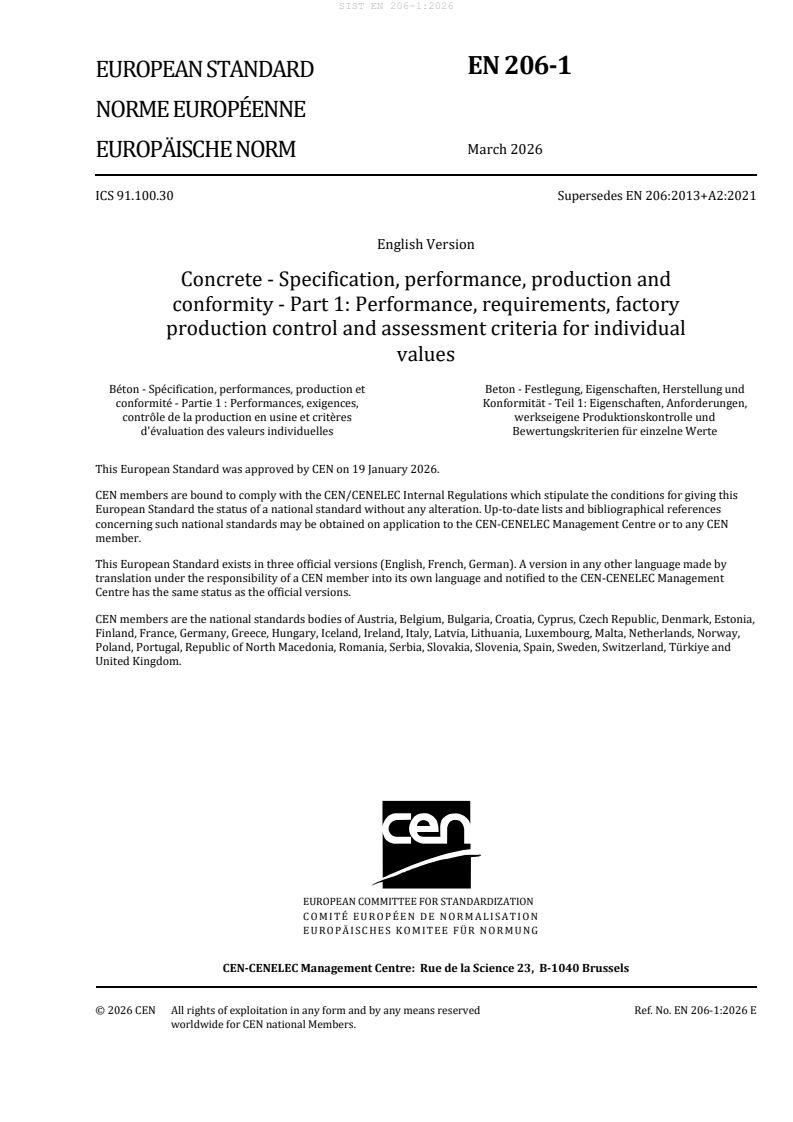
EN 206-1
EUROPEAN STANDARD
NORME EUROPÉENNE
March 2026
EUROPÄISCHE NORM
ICS 91.100.30 Supersedes EN 206:2013+A2:2021
English Version
Concrete - Specification, performance, production and
conformity - Part 1: Performance, requirements, factory
production control and assessment criteria for individual
values
Béton - Spécification, performances, production et Beton - Festlegung, Eigenschaften, Herstellung und
conformité - Partie 1 : Performances, exigences, Konformität - Teil 1: Eigenschaften, Anforderungen,
contrôle de la production en usine et critères werkseigene Produktionskontrolle und
d'évaluation des valeurs individuelles Bewertungskriterien für einzelne Werte
This European Standard was approved by CEN on 19 January 2026.
CEN members are bound to comply with the CEN/CENELEC Internal Regulations which stipulate the conditions for giving this
European Standard the status of a national standard without any alteration. Up-to-date lists and bibliographical references
concerning such national standards may be obtained on application to the CEN-CENELEC Management Centre or to any CEN
member.
This European Standard exists in three official versions (English, French, German). A version in any other language made by
translation under the responsibility of a CEN member into its own language and notified to the CEN-CENELEC Management
Centre has the same status as the official versions.
CEN members are the national standards bodies of Austria, Belgium, Bulgaria, Croatia, Cyprus, Czech Republic, Denmark, Estonia,
Finland, France, Germany, Greece, Hungary, Iceland, Ireland, Italy, Latvia, Lithuania, Luxembourg, Malta, Netherlands, Norway,
Poland, Portugal, Republic of North Macedonia, Romania, Serbia, Slovakia, Slovenia, Spain, Sweden, Switzerland, Türkiye and
United Kingdom.
EUROPEAN COMMITTEE FOR STANDARDIZATION
COMITÉ EUROPÉEN DE NORMALISATION
EUROPÄISCHES KOMITEE FÜR NORMUNG
CEN-CENELEC Management Centre: Rue de la Science 23, B-1040 Brussels
© 2026 CEN All rights of exploitation in any form and by any means reserved Ref. No. EN 206-1:2026 E
worldwide for CEN national Members.
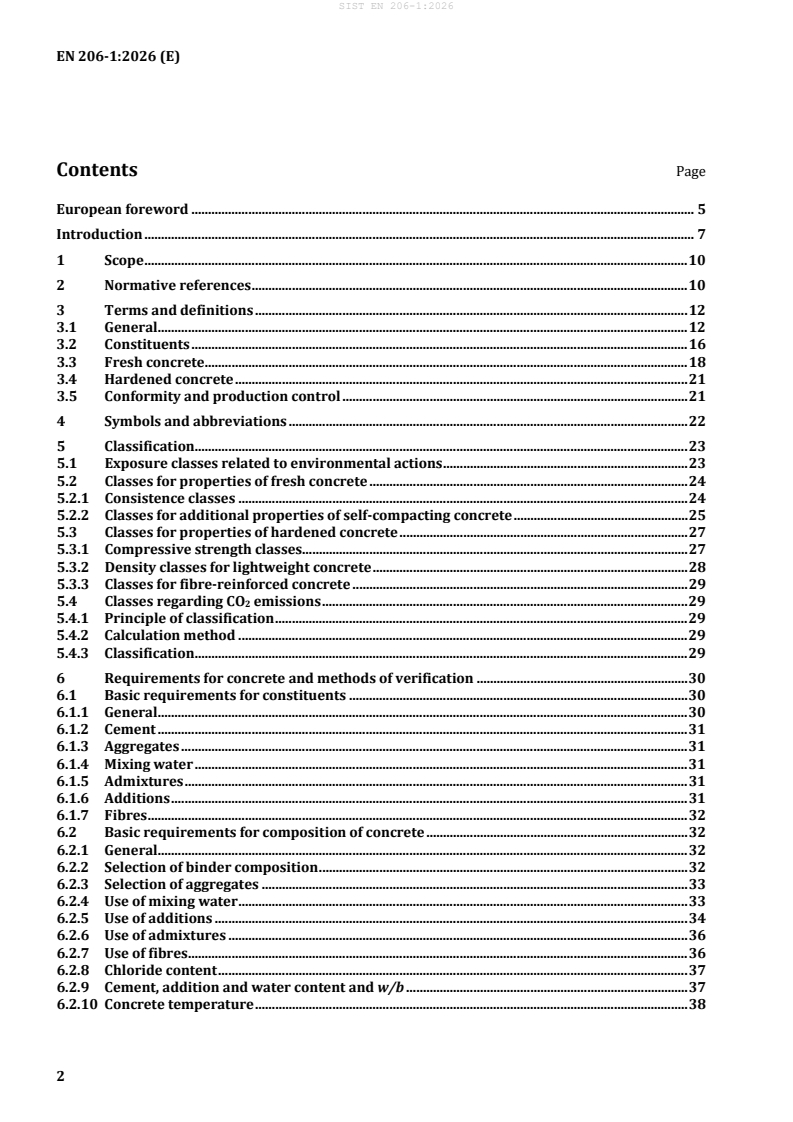
Contents Page
European foreword . 5
Introduction . 7
1 Scope . 10
2 Normative references . 10
3 Terms and definitions . 12
3.1 General . 12
3.2 Constituents . 16
3.3 Fresh concrete . 18
3.4 Hardened concrete . 21
3.5 Conformity and production control . 21
4 Symbols and abbreviations . 22
5 Classification . 23
5.1 Exposure classes related to environmental actions . 23
5.2 Classes for properties of fresh concrete . 24
5.2.1 Consistence classes . 24
5.2.2 Classes for additional properties of self-compacting concrete . 25
5.3 Classes for properties of hardened concrete . 27
5.3.1 Compressive strength classes. 27
5.3.2 Density classes for lightweight concrete . 28
5.3.3 Classes for fibre-reinforced concrete . 29
5.4 Classes regarding CO emissions . 29
5.4.1 Principle of classification . 29
5.4.2 Calculation method . 29
5.4.3 Classification . 29
6 Requirements for concrete and methods of verification . 30
6.1 Basic requirements for constituents . 30
6.1.1 General . 30
6.1.2 Cement . 31
6.1.3 Aggregates . 31
6.1.4 Mixing water . 31
6.1.5 Admixtures . 31
6.1.6 Additions . 31
6.1.7 Fibres . 32
6.2 Basic requirements for composition of concrete . 32
6.2.1 General . 32
6.2.2 Selection of binder composition . 32
6.2.3 Selection of aggregates . 33
6.2.4 Use of mixing water . 33
6.2.5 Use of additions . 34
6.2.6 Use of admixtures . 36
6.2.7 Use of fibres . 36
6.2.8 Chloride content . 37
6.2.9 Cement, addition and water content and w/b . 37
6.2.10 Concrete temperature . 38
6.3 Requirements related to exposure classes . 38
6.3.1 General . 38
6.3.2 Limiting values for concrete composition . 38
6.3.3 Performance-related methods. 39
6.4 Requirements for fresh concrete . 40
6.4.1 Consistence, viscosity, passing ability and resistance to segregation . 40
6.4.2 Air content . 40
6.4.3 Fibre content . 41
6.5 Requirements for hardened concrete . 41
6.5.1 Strength . 41
6.5.2 Density . 42
6.5.3 Resistance to water penetration . 42
6.5.4 Reaction to fire . 42
7 Specification of concrete . 42
7.1 General . 42
7.2 Specification for designed concrete . 43
7.2.1 General . 43
7.2.2 Basic requirements . 43
7.2.3 Additional requirements . 44
7.3 Specification for prescribed concrete . 45
7.3.1 General . 45
7.3.2 Basic requirements . 45
7.3.3 Additional requirements . 45
7.4 Specification of standardized prescribed concrete . 45
8 Delivery of fresh concrete . 46
8.1 Information from the user of the concrete to the producer . 46
8.2 Information from the producer of the concrete to the user . 46
8.3 Delivery ticket for ready-mixed concrete . 47
8.4 Delivery information for site-mixed concrete . 48
8.5 Mix adjustments after the main mixing process and prior to discharge . 48
9 Factory production control and initial type testing . 49
9.1 General . 49
9.2 Production control systems . 49
9.3 Recorded data and other documentation . 50
9.4 Testing . 51
9.5 Concrete composition and initial type testing . 51
9.6 Personnel, equipment and installation . 52
9.6.1 Personnel . 52
9.6.2 Equipment and installation . 52
9.7 Batching of constituents . 53
9.8 Mixing of concrete . 53
9.9 Production control procedures . 54
9.9.1 General . 54
9.9.2 Assessment of compressive strength . 54
9.9.3 Assessment of equipment . 57
9.9.4 Assessment of other properties . 57
10 Assessment criteria for individual values . 61
10.1 General . 61
10.2 Assessment criteria for compressive strength . 61
10.3 Assessment criteria for tensile strength . 61
10.4 Assessment criteria for properties other than strength . 62
11 Designation for designed concrete . 64
Annex A (normative) Initial type test . 65
Annex B (informative) Concrete families . 68
Annex C (informative) Exposure classes from EN 1992-1-1 . 70
Annex D (informative) Guidelines for self-compacting concrete requirements in the fresh
state. 75
Annex E (informative) Recommendation for the use of aggregates . 77
Annex F (informative) Limiting values of concrete composition . 80
Annex G (informative) Guidance on reference concrete regarding CO2 emissions . 82
Bibliography. 84
European foreword
This document (EN 206-1:2026) has been prepared by Technical Committee CEN/TC 104 “Concrete and
related products”, the secretariat of which is held by SN.
This European Standard shall be given the status of a national standard, either by publication of an
identical text or by endorsement, at the latest by September 2026, and conflicting national standards shall
be withdrawn at the latest by September 2026.
Attention is drawn to the possibility that some of the elements of this document may be the subject of
patent rights. CEN shall not be held responsible for identifying any or all such patent rights.
This document, together with EN 206-2:2026 and EN 206-3:2026, supersedes EN 206:2013+A2:2021.
EN 206:2013+A2:2021:
a) Moving all aspects concerning conformity assessment and certification into a separate part,
EN 206-2;
b) Annex D on concrete for geotechnical purposes has been moved to a separate part, EN 206-3;
c) Opening for national provisions on exposure resistance classes;
d) Included new terminology for binder;
e) Annex M “Guidance on provisions valid in the place of use” moved to Introduction;
f) Annex L “Additional information for specific clauses” deleted or included in main text where
appropriate;
g) Informative content in Clause 5.1 “Exposure classes” moved to Annex C;
h) New Clause 5.4 “Classes regarding CO emissions”;
i) General updates to align with revised EN 1992-1-1:2023;
j) General editorial changes.
The EN 206 series under the general title Concrete — Specification, performance, production and
conformity comprises the following parts:
— Part 1: Performance, requirements, factory production control and assessment criteria for individual
values;
— Part 2: Conformity assessment and certification;
— Part 3: Additional requirements for specification and conformity of concrete for special geotechnical
works
Any feedback and questions on this document should be directed to the users’ national standards body.
A complete listing of these bodies can be found on the CEN website.
According to the CEN-CENELEC Internal Regulations, the national standards organisations of the
following countries are bound to implement this European Standard: Austria, Belgium, Bulgaria, Croatia,
Cyprus, Czech Republic, Denmark, Estonia, Finland, France, Germany, Greece, Hungary, Iceland, Ireland,
Italy, Latvia, Lithuania, Luxembourg, Malta, Netherlands, Norway, Poland, Portugal, Republic of North
Macedonia, Romania, Serbia, Slovakia, Slovenia, Spain, Sweden, Switzerland, Türkiye and the United
Kingdom.
Introduction
0.1 Introduction to EN 206-1
(1) This document defines tasks for the specifier, producer and user of concrete.
(2) If the concrete is in conformity with this document, the concrete in the structure is deemed to satisfy
the durability requirements for the intended use in the specific environmental condition, provided:
— the appropriate exposure classes were selected;
— the concrete has the minimum cover to reinforcement in accordance with the relevant design
standard required for the specific environmental condition, e.g. EN 1992-1-1;
— the concrete is properly placed, compacted and cured, e.g. in accordance with EN 13670 or other
relevant standards;
— the appropriate maintenance is applied during the service life.
(3) Concrete conforming to this document may be assumed to satisfy the basic requirements for materials
to be used in all three Execution Classes as defined in EN 13670.
(4) This document also covers the necessary exchange of information between the different parties.
Contractual matters are not addressed. Where responsibilities are given for parties involved, these are
technical responsibilities.
(5) Further explanations and guidance on the application of this document are given in other documents,
such as CEN Technical Reports.
(6) This document is written in accordance with CEN policy based on the neutrality principle, which
requires that all documents to be written in a way such that conformity with the specified requirements
can be assessed by a producer or supplier (first party), a user or purchaser (second party), or an
independent body (third party). In particular the CEN philosophy of writing 'Product Standards' is
adopted in that the standard gives normative requirements on the product, and not on any party involved
in the manufacturing, testing or distribution of the product.
(7) Figure 1 illustrates the relationships between the EN 206 series and standards for design, execution,
constituents and test methods.
Figure 1 — Relationships between the EN 206 series and standards for design and execution,
standards for constituents and test standards
(8) Provisions for specific products e.g. precast products are given in other European standards for
specific products.
(9) Provisions for specific applications are given in other European standards, for example:
— concrete to be used in roads and other trafficked areas (e.g. concrete pavements according to
EN 13877-1);
— special technologies (e.g. sprayed concrete according to the EN 14487 series).
(10) Supplementing requirements or different testing procedures are given in some member states for
specific types of concrete and applications, for example:
— concrete for massive structures (e.g. dams);
— dry mixed concrete;
— concrete with a D of 4 mm or less (mortar);
max
— self-compacting concretes (SCC) containing lightweight or heavy-weight aggregates or fibres;
— concrete with open structure (e.g. pervious concrete for drainage).
0.2 Provisions valid in the place of use for EN 206-1
(1) This document will be applied under different climatic and geographical conditions, different levels
of protection and under different, well established, regional traditions and experience. Classes for
concrete properties have been introduced to cover these situations. Where such general solutions were
not possible, the relevant clauses contain permission for the application of provisions valid in the place
of use of the concrete.
(2) National choice is allowed in this document where explicitly stated that provisions valid in the place
of use may be given.
(3) The national standard implementing EN 206-1 can have a National Annex or complementary standard
containing all national choices to be used in the relevant country.
(4) National choice is allowed in EN 206-1 in the following:
5.3.1 (3) 5.3.1 (4) 5.3.2 (2) 5.3.3 (1)
5.4.1 (2) 5.4.1 (4) 5.4.1 (5) 6.1.1 (2)
6.1.2 (2) 6.1.3 (1) 6.1.3 (2) 6.1.3 (3)
6.1.5 (2) 6.1.6 (2) 6.1.7 (2) 6.2.1 (2)
6.2.1 (5) 6.2.3.4 (2) 6.2.3.5 (1) 6.2.5.1 (3)
6.2.5.2 (1) 6.2.5.2 (3) 6.2.5.2 (4) 6.2.5.3.3 (5)
6.2.5.3.4 (1) 6.2.5.4 (4) 6.2.8 Table 14 Footnote 6.2.8 Table 14 Footnote
a b
6.3.1 (2) 6.3.2 (3) 6.3.3 (2) 6.4.2 (4)
6.5.1.3 (1) 6.5.1.4 (1) 7.1 (3) 7.4 (2)
8.2 (4) 9.4 (2) 9.5 (4) 9.7 (2)
9.9.2 (13) 9.9.2 Table 21 Note d 9.9.4 Table 22 Line 3 10.4 (2)
10.4 Table 24 line 11 A.1 (3) A.3 (3)
(5) National choice is allowed in EN 206-1 on the application of the following informative annexes:
Annex B Annex C Annex E Annex F
Annex G
NOTE The National Annex can contain, directly or by reference, non-contradictory complementary information
for ease of implementation, provided it does not alter any provisions of this document.
1 Scope
(1) This document applies to concrete for structures cast in situ, precast structures, and structural precast
products for buildings and civil engineering structures.
(2) The concrete described by this document can be:
— normal-weight, heavy-weight and lightweight;
— mixed on site, ready-mixed or produced in a plant for precast concrete products;
— compacted or self-compacting to retain no appreciable amount of entrapped air other than entrained
air.
(3) This document specifies requirements for:
— the constituents of concrete;
— the properties of fresh and hardened concrete;
— the limitations for concrete composition;
— the specification of concrete;
— the delivery of fresh concrete;
— the production control procedures;
— the assessment criteria for individual values.
(4) This document does not apply to:
— aerated concrete;
— foamed concrete;
— concrete with density less than 800 kg/m ;
— refractory concrete.
(5) This document does not cover health and safety requirements for the protection of workers during
production and delivery of concrete.
2 Normative references
The following documents are referred to in the text in such a way that some or all of their content
constitutes requirements of this document. For dated references, only the edition cited applies. For
undated references, the latest edition of the referenced document (including any amendments) applies.
EN 197-1:2011, Cement — Part 1: Composition, specifications and conformity criteria for common cements
EN 197-5, Cement — Part 5: Portland-composite cement CEM II/C-M and Composite cement CEM VI
EN 197-6, Cement — Part 6: Cement with recycled building materials
EN 450-1, Fly ash for concrete — Part 1: Definition, specifications and conformity criteria
EN 934-1, Admixtures for concrete, mortar and grout — Part 1: Common requirements
EN 934-2, Admixtures for concrete, mortar and grout — Part 2: Concrete admixtures — Definitions,
requirements, conformity, marking and labelling
EN 934-7, Admixtures for concrete, mortar and grout — Part 7: Shrinkage reducing admixtures —
Definitions, requirements, conformity, marking and labelling
EN 1008, Mixing water for concrete — Specification for sampling, testing and assessing the suitability of
water, including water recovered from processes in the concrete industry, as mixing water for concrete
EN 1097-6:2022, Tests for mechanical and physical properties of aggregates — Part 6: Determination of
particle density and water absorption
EN 12350-1, Testing fresh concrete — Part 1: Sampling and common apparatus
EN 12350-2, Testing fresh concrete — Part 2: Slump test
EN 12350-4, Testing fresh concrete — Part 4: Degree of compactability
EN 12350-5, Testing fresh concrete — Part 5: Flow table test
EN 12350-6, Testing fresh concrete — Part 6: Density
EN 12350-7, Testing fresh concrete — Part 7: Air content — Pressure methods
EN 12350-8, Testing fresh concrete — Part 8: Self-compacting concrete — Slump-flow test
EN 12350-9, Testing fresh concrete — Part 9: Self-compacting concrete — V-funnel test
EN 12350-10, Testing fresh concrete — Part 10: Self-compacting concrete — L box test
EN 12350-11, Testing fresh concrete — Part 11: Self-compacting concrete — Sieve segregation test
EN 12350-12, Testing fresh concrete — Part 12: Self-compacting concrete — J-ring test
EN 12390-1, Testing hardened concrete — Part 1: Shape, dimensions and other requirements for specimens
and moulds
EN 12390-2, Testing hardened concrete — Part 2: Making and curing specimens for strength tests
EN 12390-3, Testing hardened concrete — Part 3: Compressive strength of test specimens
EN 12390-7, Testing hardened concrete — Part 7: Density of hardened concrete
EN 12620:2002+A1:2008, Aggregates for concrete
EN 12878, Pigments for the colouring of building materials based on cement and/or lime — Specifications
and methods of test
EN 13055, Lightweight aggregates
Note that the latest version of EN 13055:2016 is non-harmonized.
EN 13263-1, Silica fume for concrete — Part 1: Definitions, requirements and conformity criteria
EN 14216, Cement — Composition, specifications and conformity criteria for very low heat special cements
EN 14721, Test method for metallic fibre concrete — Measuring the fibre content in fresh and hardened
concrete
EN 14889-1:2006, Fibres for concrete — Part 1: Steel fibres — Definitions, specifications and conformity
EN 14889-2:2006, Fibres for concrete — Part 2: Polymer fibres — Definitions, specifications and
conformity
EN 15167-1, Ground granulated blast furnace slag for use in concrete, mortar and grout — Part 1:
Definitions, specifications and conformity criteria
EN 15804, Sustainability of construction works — Environmental product declarations — Core rules for the
product category of construction products
EN 16757, Sustainability of construction works — Environmental product declarations — Product
Category Rules for concrete and concrete elements
EN 18136, Ground limestone for use in concrete, mortar and grout — Definition, specifications and
conformity criteria
ASTM C 173, Standard Test Method for Air Content of Freshly Mixed Concrete by the Volumetric Method
3 Terms and definitions
For the purposes of this document, the following terms and definitions apply.
ISO and IEC maintain terminology databases for use in standardization at the following addresses:
— IEC Electropedia: available at https://www.electropedia.org/
— ISO Online browsing platform: available at https://www.iso.org/obp
3.1 General
3.1.1
binder
fr: liant
de: Binder
cement, or combination of cements, or combination of cement(s) and addition(s)
Note 1 to entry: Provisions related to binder are given in 6.1.2 for cement and 6.1.6 for additions
3.1.2
concrete
fr: béton
de: Beton
material formed by mixing cement, coarse and fine aggregate and water, with or without the
incorporation of admixtures, additions or fibres, which develops its properties by hydration
Under preparation. Stage at the time of publication: FprEN 18136:2026
3.1.3
concrete family
fr: famille de bétons
de: Betonfamilie
group of concrete compositions for which a reliable relationship between relevant properties is
established and documented
3.1.4
concrete specification
fr: spécification du béton
de: Festlegung
final compilation of documented technical requirements given to the producer in terms of performance
or composition
3.1.5
concrete with fibres
fr: béton avec fibres
de: Beton mit Fasern
concrete where fibres are added as one of the constituents to provide specific characteristics
Note 1 to entry: E.g. post-cracking strength, mitigation of restrained shrinkage-induced cracking, prevention of
fire-induced spalling
3.1.6
delivery
fr: livraison
de: Lieferung
process of handing over the fresh concrete by the producer
3.1.7
designed concrete
fr: béton à propriétés spécifiées
de: Beton nach Eigenschaften
concrete for which the required properties and additional characteristics if any are specified to the
producer who is responsible for providing a concrete conforming to the required properties and
additional characteristics
3.1.8
design service life
fr: durée de vie de projet
de: Bemessungslebensdauer
assumed period for which a structure or a part of it is to be used for its intended purpose with anticipated
maintenance but without major repair being necessary
3.1.9
document
fr: document
de: Dokument
information and its supporting medium, which can be paper, magnetic, electronic or optical computer
disc, photograph or reference sample or a combination thereof
3.1.10
environmental actions
fr: actions dues à l’environnement
de: Umwelteinflüsse
those chemical and physical actions to which the concrete is exposed and which result in effects on the
concrete or reinforcement or embedded metal that are not considered as loads in structural design
3.1.11
effective binder content
fr: teneur en liant équivalent
de: Bindemittelgehalt wirksamer
mass of binder per cubic metre of concrete calculated from the effective mass of the cements and
additions
Note 1 to entry: The mass of cements and additions that can be accounted for as the effective binder content
depends on which option for use of additions (see 6.2.5) is applied
3.1.12
exposure resistance classes
ERC
fr: classes de résistance à l'exposition
de: Expositionswiderstandsklassen
classes for defining the resistance of concrete against corrosion induced by carbonation (XRC) or by
chlorides (XRDS) and damage caused by freeze/thaw attack (XRF)
[SOURCE: EN 1992-1-1:2023, 3.130]
3.1.13
exposure resistance class concrete
ERC concrete
fr: béton de classes de résistance à l'exposition
de: Expositionswiderstandsklassen Beton
concrete classified in relation to exposure resistance classes (ERC)
3.1.14
fibre reinforced concrete
FRC
fr: béton renforcé de fibres
de: faserverstärkter Beton
concrete with fibres to achieve post cracking residual strength
3.1.15
precast element
fr: élément préfabriqué
de: Fertigteil
concrete element cast and cured in a place other than the final location of use (factory produced or site
manufactured)
3.1.16
precast product
fr: produit préfabriqué
de: Fertigteil
precast element manufactured in compliance with the relevant European product standard
3.1.17
prescribed concrete
fr: béton à composition prescrite
de: Beton nach Zusammensetzung
concrete for which the composition of the concrete and the constituent materials to be used are specified
to the producer who is responsible for providing a concrete with the specified composition
3.1.18
producer
fr: producteur
de: Hersteller
person or body producing fresh concrete
3.1.19
provisions valid in the place of use
fr: dispositions en vigueur sur le lieu d’utilisation du béton
de: am Ort der Verwendung geltende Regeln
national provisions given in a National Foreword or National Annex to this European Standard, or not
covered by the standard
3.1.20
ready-mixed concrete
fr: béton prêt à l’emploi
de: Transportbeton
concrete delivered in a fresh state by a person or body who is not the user
Note 1 to entry: In the sense of this document it is also:
— concrete produced off site by the user;
— concrete produced on site, but not by the user.
3.1.21
self-compacting concrete
SCC
fr: béton auto-plaçant
de: selbstverdichtender Beton
concrete that is able to flow and compact under its own weight, fill the formwork with its reinforcement,
ducts, boxouts etc., whilst maintaining homogeneity
3.1.22
site-mixed concrete
fr: béton de chantier
de: Baustellenbeton
concrete produced on the construction site by the user of the concrete
3.1.23
site
construction site
fr: chantier
fr: chantier de construction
de: Baustelle
area where the construction work is undertaken
3.1.24
specifier
fr: prescripteur
de: Verfasser der Festlegung
person or body establishing the specification for fresh and hardened concrete
3.1.25
standardized prescribed concrete
fr: béton à composition prescrite dans une norme
de: Standardbeton
prescribed concrete for which the composition is given in a standard valid in the place of use of the
concrete
3.1.26
total binder content
fr: teneur en liant total
de: Gesamt-Bindemittelgehalt
mass of binder (3.1.1) per cubic metre of concrete calculated from the total mass of the cements and
additions
3.1.27
user
fr: utilisateur
de: Verwender
person or body using fresh concrete in the execution of a construction or an element
3.2 Constituents
3.2.1
addition
fr: addition
de: Betonzusatzstoff
finely divided inorganic constituent used in concrete to improve certain properties or to achieve special
properties
3.2.2
admixture
fr: adjuvant
de: Betonzusatzmittel
constituent added during the mixing process in small quantities to modify the properties of fresh or
hardened concrete
3.2.3
aggregate
fr: granulat
de: Gesteinskörnung
natural, artificial, reclaimed or recycled granular mineral constituent suitable for use in concrete
3.2.4
all-in aggregate
fr: grave
de: Gesteinskörnungsgemisch
aggregate consisting of a mixture of coarse and fine aggregates with D greater than 4 mm and d = 0
3.2.5
aggregate size
fr: classe granulaire
de: Korngröße
designation of aggregate in terms of lower (d) and upper (D) sieve sizes expressed as d / D
3.2.6
cement
fr: ciment
de: Zement
finely ground inorganic material which, when mixed with water, forms a paste which sets and hardens
by means of hydration reactions and processes and which, after hardening, retains its strength and
stability even under water
Note 1 to entry: Provisions related to cement are given in 6.1.2
[SOURCE EN 197-1:2011, Clause 4]
3.2.7
fines
fr: fines
de: Mehlkorn
solid materials in fresh concrete with particle sizes less than or equal to 0,125 mm
3.2.8
heavy-weight aggregate
fr: granulat lourds
de: schwere Gesteinskörnung
aggregate in the oven-dry condition having a particle density ≥ 3 000 kg/m when determined according
to EN 1097-6
3.2.9
lightweight aggregate
fr: granulat légers
de: leichte Gesteinskörnung
aggregate of mineral origin in the oven-dry condition having a particle density ≤ 2 000 kg/m when
determined according to EN 1097-6 or a loose oven-dry bulk density ≤ 1 200 kg/m when determined
according to EN 1097-3
3.2.10
normal-weight aggregate
fr: granulat courant
de: normale Gesteinskörnung
3 3
aggregate in the oven-dry condition with a particle density > 2 000 kg/m and < 3 000 kg/m when
determined according to EN 1097-6
3.2.11
polymer fibres
fr: fibres polymères
de: Polymerfasern
straight or deformed pieces of extruded, orientated and cut material, which are suitable to be
homogenously mixed into concrete or mortar
[SOURCE: EN 14889-2:2006, 3.2]
3.2.12
reclaimed washed aggregate
fr: granulats récupérés par lavage
de: wiedergewonnene gewaschene Gesteinskörnung
aggregates gained by washing fresh concrete
3.2.13
reclaimed crushed aggregate
fr: granulat récupérés par concassage
de: wiedergewonnene gebrochene Gesteinskörnung
aggregate gained by crushing hardened concrete that has not been previously used in construction
3.2.14
recycled aggregate
fr: gravillon recyclé
de: grobe rezyklierte Gesteinskörnung
aggregate resulting from the processing of inorganic material previously used in construction
[SOURCE: EN 12620:2002, 3.5]
3.2.15
steel fibres
fr: fibres d’acier
de: Stahlfasern
straight or deformed pieces of cold-drawn steel wire, straight or deformed cut sheet fibres, melt extracted
fibres, shaved cold drawn wire fibres or fibres milled from steel blocks, which are suitable to be
homogeneously mixed into concrete or mortar
[SOURCE: EN 14889-1:2006, 3.1]
3.3 Fresh concrete
3.3.1
agitating equipment
fr: cuve agitatrice
de: Rührwerk
equipment generally mounted on a self-propelled chassis and capable of maintaining fresh concrete in a
homogeneous state during transport
3.3.2
batch
fr: gâchée
de: Charge
quantity of fresh concrete produced in one cycle of operations of a mixer or the quantity discharged
during 1 minute from a continuous mixer
3.3.3
consistence
fr: consistence
de: Konsistenz
measure of fresh concrete to slump, flow or slump-flow as determined by standard tests
Note 1 to entry: EN 12350-2, EN 12350-5 and EN 12350-8 are test methods for slump, flow and slump-flow
respectively
3.3.4
cubic metre of concrete
fr: mètre cube de béton
de: Kubikmeter Beton
quantity of fresh concrete which, when compacted in accordance with the procedure given in
EN 12350-6, occupies a volume of 1 m
3.3.5
effective water content
fr: teneur en eau efficace
de: wirksamer Wassergehalt
mass of total water content minus the absorbed water in the aggregate
3.3.6
entrained air
fr: air entrainé
de: künstliche Luftporen
microscopic air bubbles intentionally incorporated in concrete during mixi
...
SLOVENSKI STANDARD
01-maj-2026
Beton - Specifikacija, lastnosti, proizvodnja in skladnost - 1. del: Lastnosti,
zahteve, kontrola tovarniške proizvodnje in kriteriji vrednotenja posameznih
vrednosti
Concrete - Specification, performance, production and conformity - Part 1: Performance,
requirements, factory production control and assessment criteria for individual values
Beton - Festlegung, Eigenschaften, Herstellung und Konformität - Teil 1: Eigenschaften,
Anforderungen, werkseigene Produktionskontrolle und Bewertungskriterien für einzelne
Werte
Béton - Spécification, performances, production et conformité - Partie 1 : Performances,
exigences, contrôle de la production en usine et critères d’évaluation des valeurs
individuelles
Ta slovenski standard je istoveten z: EN 206-1:2026
ICS:
91.100.30 Beton in betonski izdelki Concrete and concrete
products
2003-01.Slovenski inštitut za standardizacijo. Razmnoževanje celote ali delov tega standarda ni dovoljeno.
EN 206-1
EUROPÄISCHE NORM
EUROPEAN STANDARD
März 2026
NORME EUROPÉENNE
ICS 91.100.30 Ersetzt EN 206:2013+A2:2021
Deutsche Fassung
Beton - Festlegung, Eigenschaften, Herstellung und
Konformität - Teil 1: Eigenschaften, Anforderungen,
werkseigene Produktionskontrolle und Bewertungskriterien
für einzelne Werte
Concrete - Specification, performance, production and Béton - Spécification, performances, production et
conformity - Part 1: Performance, requirements, factory conformité - Partie 1 : Performances, exigences,
production control and assessment criteria for contrôle de la production en usine et critères
individual values d'évaluation des valeurs individuelles
Diese Europäische Norm wurde vom CEN am 19. Januar 2026 angenommen.
Die CEN-Mitglieder sind gehalten, die CEN/CENELEC-Geschäftsordnung zu erfüllen, in der die Bedingungen festgelegt sind, unter
denen dieser Europäischen Norm ohne jede Änderung der Status einer nationalen Norm zu geben ist. Auf dem letzten Stand
befindliche Listen dieser nationalen Normen mit ihren bibliographischen Angaben sind beim CEN-CENELEC-Management-
Zentrum oder bei jedem CEN-Mitglied auf Anfrage erhältlich.
Diese Europäische Norm besteht in drei offiziellen Fassungen (Deutsch, Englisch, Französisch). Eine Fassung in einer anderen
Sprache, die von einem CEN-Mitglied in eigener Verantwortung durch Übersetzung in seine Landessprache gemacht und dem
Management-Zentrum mitgeteilt worden ist, hat den gleichen Status wie die offiziellen Fassungen.
CEN-Mitglieder sind die nationalen Normungsinstitute von Belgien, Bulgarien, Dänemark, Deutschland, Estland, Finnland,
Frankreich, Griechenland, Irland, Island, Italien, Kroatien, Lettland, Litauen, Luxemburg, Malta, den Niederlanden, Norwegen,
Österreich, Polen, Portugal, der Republik Nordmazedonien, Rumänien, Schweden, der Schweiz, Serbien, der Slowakei, Slowenien,
Spanien, der Tschechischen Republik, der Türkei, Ungarn, dem Vereinigten Königreich und Zypern.
EUROPÄISCHES KOMITEE FÜR NORMUNG
EUROPEAN COMMITTEE FOR STANDARDIZATION
COMITÉ EUROPÉEN DE NORMALISATION
CEN-CENELEC Management-Zentrum: Rue de la Science 23, B-1040 Brüssel
© 2026 CEN Alle Rechte der Verwertung, gleich in welcher Form und in welchem Ref. Nr. EN 206-1:2026 D
Verfahren, sind weltweit den nationalen Mitgliedern von CEN
vorbehalten.
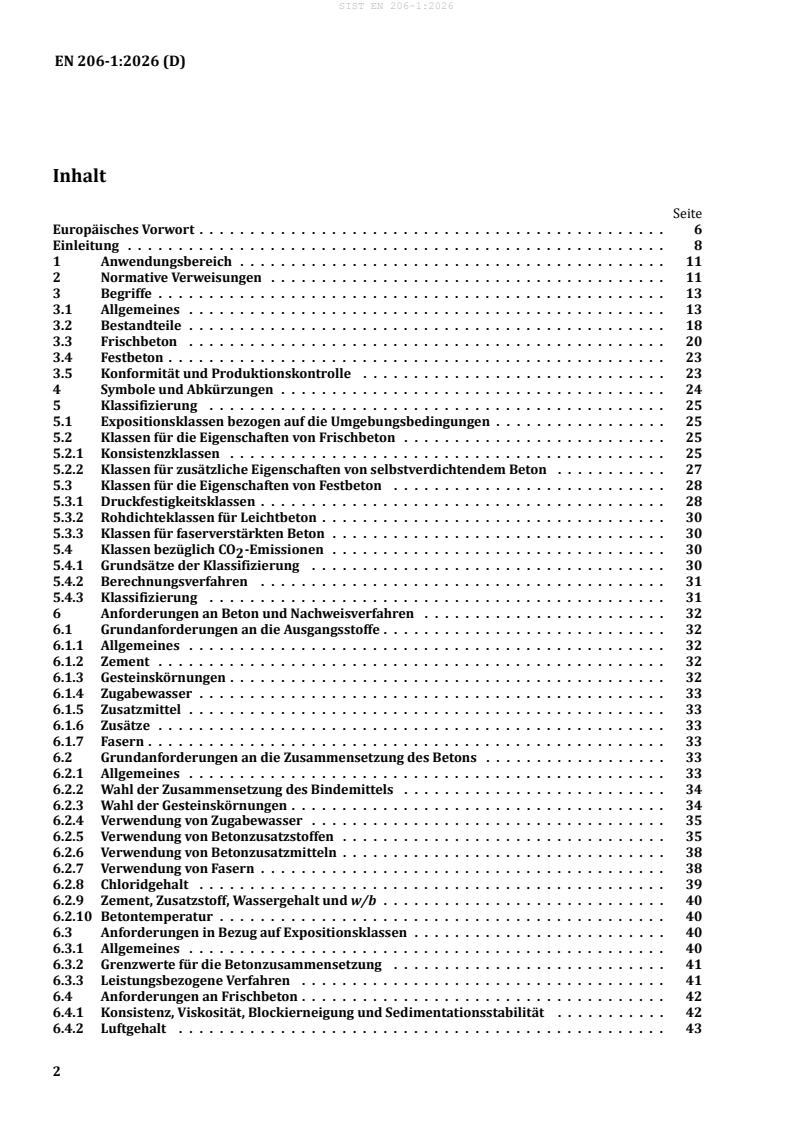
Inhalt
Seite
Europäisches Vorwort . 6
Einleitung . . . . . 8
1 Anwendungsbereich . 11
2 Normative Verweisungen . 11
3 Begriffe . . . . 13
3.1 Allgemeines . . 13
3.2 Bestandteile . . 18
3.3 Frischbeton . . 20
3.4 Festbeton . . . 23
3.5 Konformität und Produktionskontrolle . 23
4 Symbole und Abkürzungen . . 24
5 Klassifizierung . . 25
5.1 Expositionsklassen bezogen auf die Umgebungsbedingungen . 25
5.2 Klassen für die Eigenschaften von Frischbeton . 25
5.2.1 Konsistenzklassen . . 25
5.2.2 Klassen für zusätzliche Eigenschaften von selbstverdichtendem Beton . 27
5.3 Klassen für die Eigenschaften von Festbeton . 28
5.3.1 Druckfestigkeitsklassen . . 28
5.3.2 Rohdichteklassen für Leichtbeton . . 30
5.3.3 Klassen für faserverstärkten Beton . 30
5.4 Klassen bezüglich CO -Emissionen . 30
5.4.1 Grundsätze der Klassifizierung . 30
5.4.2 Berechnungsverfahren . . 31
5.4.3 Klassifizierung . . 31
6 Anforderungen an Beton und Nachweisverfahren . 32
6.1 Grundanforderungen an die Ausgangsstoffe . 32
6.1.1 Allgemeines . . 32
6.1.2 Zement . . . . 32
6.1.3 Gesteinskörnungen . . 32
6.1.4 Zugabewasser . 33
6.1.5 Zusatzmittel . . 33
6.1.6 Zusätze . . . . 33
6.1.7 Fasern . . . . 33
6.2 Grundanforderungen an die Zusammensetzung des Betons . 33
6.2.1 Allgemeines . . 33
6.2.2 Wahl der Zusammensetzung des Bindemittels . 34
6.2.3 Wahl der Gesteinskörnungen . 34
6.2.4 Verwendung von Zugabewasser . 35
6.2.5 Verwendung von Betonzusatzstoffen . 35
6.2.6 Verwendung von Betonzusatzmitteln . 38
6.2.7 Verwendung von Fasern . . 38
6.2.8 Chloridgehalt . 39
6.2.9 Zement, Zusatzstoff, Wassergehalt und w/b . 40
6.2.10 Betontemperatur . 40
6.3 Anforderungen in Bezug auf Expositionsklassen . 40
6.3.1 Allgemeines . . 40
6.3.2 Grenzwerte für die Betonzusammensetzung . 41
6.3.3 Leistungsbezogene Verfahren . . 41
6.4 Anforderungen an Frischbeton . . 42
6.4.1 Konsistenz, Viskosität, Blockierneigung und Sedimentationsstabilität . 42
6.4.2 Luftgehalt . . 43
6.4.3 Fasergehalt . . . 43
6.5 Anforderungen an Festbeton . . 43
6.5.1 Festigkeit . . 43
6.5.2 Dichte . . 44
6.5.3 Wassereindringwiderstand . 44
6.5.4 Brandverhalten . 44
7 Festlegung des Betons . 44
7.1 Allgemeines . . 44
7.2 Festlegung für Beton nach Eigenschaften . . 45
7.2.1 Allgemeines . . 45
7.2.2 Grundlegende Anforderungen . 45
7.2.3 Zusätzliche Anforderungen . 46
7.3 Festlegung für Beton nach Zusammensetzung . . 47
7.3.1 Allgemeines . . 47
7.3.2 Grundlegende Anforderungen . 47
7.3.3 Zusätzliche Anforderungen . 47
7.4 Festlegung für Standardbeton . 48
8 Lieferung von Frischbeton . 48
8.1 Informationen vom Verwender an den Betonhersteller . . 48
8.2 Informationen vom Betonhersteller an den Verwender . . 48
8.3 Lieferschein für Transportbeton . . 49
8.4 Lieferangaben für Baustellenbeton . 50
8.5 Anpassungen der Mischung nach dem Hauptmischvorgang und vor dem Entladen . 50
9 Werkseigene Produktionskontrolle und Erstprüfung . . 51
9.1 Allgemeines . . 51
9.2 Systeme der Produktionskontrolle . 52
9.3 Aufgezeichnete Daten und sonstige Dokumentation . 52
9.4 Prüfung . . . 53
9.5 Betonzusammensetzung und Erstprüfung . . 53
9.6 Personal, Ausstattung . 54
9.6.1 Personal . . 54
9.6.2 Ausstattung . . 54
9.7 Dosieren der Ausgangsstoffe . . 55
9.8 Mischen des Betons . 56
9.9 Verfahren der Produktionskontrolle . 56
9.9.1 Allgemeines . . 56
9.9.2 Bewertung der Druckfestigkeit . . 57
9.9.3 Bewertung der Ausstattung . 60
9.9.4 Bewertung anderer Eigenschaften . . 60
10 Bewertungskriterien für Einzelwerte . 65
10.1 Allgemeines . . 65
10.2 Bewertungskriterien für die Druckfestigkeit . 65
10.3 Bewertungskriterien für die Zugfestigkeit . . 66
10.4 Bewertungskriterien für andere Eigenschaften als die Festigkeit . . 66
11 Bezeichnung für Beton nach Eigenschaften . 68
AnhangA (normativ) Erstprüfung . . 69
A.1 Allgemeines . . 69
A.2 Partei, die für Erstprüfungen verantwortlich ist . . 69
A.3 Häufigkeit der Erstprüfungen . 69
A.4 Prüfbedingungen . 70
A.5 Kriterien für die Annahme von Erstprüfungen . . 71
AnhangB (informativ) Betonfamilien . . 72
B.1 Verwendung dieses Anhangs . . 72
B.2 Wahl der Betonfamilie . 72
AnhangC (informativ) Expositionsklassen aus EN1992-1-1 . 74
C.1 Verwendung dieses Anhangs . . 74
C.2 Allgemeines . . 74
AnhangD (informativ) Hinweise für Anforderungen an selbstverdichtenden Beton (SVB) im
frischen Zustand . 78
D.1 Allgemeines . . 78
D.2 Empfehlungen zur Klasseneinteilung von selbstverdichtendem Beton . 79
D.2.1 Konsistenz . . 79
D.2.2 Viskosität . . . 79
D.2.3 Blockierneigung . 79
D.2.4 Sedimentationsstabilität . 79
AnhangE (informativ) Empfehlungen für die Verwendung von Gesteinskörnungen . 80
E.1 Allgemeines . . 80
E.2 Natürliche normale Gesteinskörnungen, schwere Gesteinskörnungen und
Hochofenstückschlacke . . 80
E.3 Empfehlungen für die Verwendung von groben rezyklierten Gesteinskörnungen . 81
E.4 Empfehlungen für die Verwendung von leichten Gesteinskörnungen . 82
AnhangF (informativ) Grenzwerte der Betonzusammensetzung . 83
F.1 Verwendung dieses Anhangs . 83
F.2 Allgemeines . . 83
AnhangG (informativ) Leitlinie für Referenzbeton bezüglich CO -Emissionen . 85
G.1 Verwendung dieses Anhangs . 85
G.2 Allgemeines . . 85
G.3 Beispiele für das Format von Tabellen mit Referenzwerten . 85
Literaturhinweise . . 87
Bilder
Bild1— Beziehungen zwischen der NormenreiheEN206 und Normen für die Bemessung und
Ausführung sowie Normen für Ausgangsstoffe und Prüfnormen . 9
Tabellen
Tabelle 1— Setzmaßklassen . 26
Tabelle 2— Verdichtungsklassen . 26
Tabelle 3— Ausbreitmaßklassen . 26
Tabelle 4— Setzfließmaßklassen . 27
Tabelle 5— Viskositätsklassen— t . . 27
Tabelle 6— Viskositätsklassen— t . 27
v
Tabelle 7— Blockierneigungsklassen— L-Kasten-Versuch . 28
Tabelle 8— Blockierneigungsklassen— Blockierring-Versuch . 28
Tabelle 9— Sedimentationsstabilitätsklassen— Siebversuch . 28
Tabelle 10— Druckfestigkeitsklassen für Normal- und Schwerbeton . 29
Tabelle 11— Druckfestigkeitsklassen für Leichtbeton . 29
Tabelle 12— Rohdichteklassen für Leichtbeton . 30
Tabelle 13— Minderungsklassen . 31
Tabelle 14— Höchstzulässiger Chloridgehalt von Beton . 39
Tabelle 15— Festigkeitsentwicklung von Beton bei 20°C . 49
Tabelle 16— Aufgezeichnete Daten und gegebenenfalls andere Unterlagen . 52
Tabelle 17—Anforderungen an die Dosiereinrichtung . 54
Tabelle 18— Grenzabweichungen für den Dosiervorgang von Ausgangsstoffen . 55
Tabelle 19— Bewertungskriterium für Betone einer Betonfamilie . 58
Tabelle 20— Werte für die Verifizierung der Standardabweichung . 59
Tabelle 21— Mindesthäufigkeit der Probenahme zur Bewertung der Konformität . 60
Tabelle 22— Bewertung der Ausstattung . . 61
Tabelle 23— Bewertung der Herstellverfahren und der Betoneigenschaften . 63
Tabelle 24— Bewertung für Konsistenzklassen, Eigenschaften von selbstverdichtendem Beton,
Luftgehalt und Gleichmäßigkeit der Faserverteilung von Frischbeton am Ort der
Übergabe . . 66
Tabelle 25— Bewertungskriterien für Zielwerte von Konsistenz und Viskosität . 68
Tabelle A.1— Kriterien für nachweislich ähnliche Ausgangsstoffe . 69
Tabelle B.1— Flussdiagramm für den Nachweis der Zugehörigkeit zu und Konformität mit einer
Betonfamilie . . 73
Tabelle C.1— Expositionsklassen . . 74
Tabelle C.2— Grenzwerte für die Expositionsklassen bei chemischem Angriff durch natürliche
Böden und Grundwasser . . 77
Tabelle E.1— Empfehlungen für natürliche normale Gesteinskörnungen, schwere
Gesteinskörnungen und Hochofenstückschlacke . . 80
Tabelle E.2— Empfohlene Höchstwerte für den Austausch grober Gesteinskörnungen
(Massenanteil in Prozent) . . 81
Tabelle E.3— Empfehlungen für grobe rezyklierte Gesteinskörnungen nach EN12620 . 81
Tabelle E.4— Empfehlungen für leichte Gesteinskörnungen nach EN13055 . 82
Tabelle F.1— Leitfaden für Grenzwerte der Zusammensetzung und Eigenschaften von Beton . 84
Tabelle G.1— Beispiel für Referenzwerte nach der Druckfestigkeit . 85
Tabelle G.2— Beispiel für Referenzwerte nach Druckfestigkeit und Expositionsklassen . 86
Europäisches Vorwort
Dieses Dokument (EN206-1:2026) wurde vom Technischen Komitee CEN/TC104 „Beton und zugehörige Pro-
dukte“ erarbeitet, dessen Sekretariat von SN gehalten wird.
Diese Europäische Norm muss den Status einer nationalen Norm erhalten, entweder durch Veröffentlichung
eines identischen Textes oder durch Anerkennung bis September2026, und etwaige entgegenstehende natio-
nale Normen müssen bis September2026 zurückgezogen werden.
Es wird auf die Möglichkeit hingewiesen, dass einige Elemente dieses Dokuments Patentrechte berühren kön-
nen. CEN ist nicht dafür verantwortlich, einige oder alle diesbezüglichen Patentrechte zu identifizieren.
Dieses Dokument ersetzt zusammen mit EN206-2:2026 und EN206-3:2026EN206:2013+A2:2021.
EN206-1:2026 beinhaltet die folgenden wesentlichen technischen A�nderungen im Vergleich zu
EN206:2013+A2:2021:
a) U�berführung aller Aspekte, die Konformitätsbewertung und Zertifizierung betreffen, in einen gesonderten
Teil EN206-2;
b) AnhangD über Beton für geotechnische Zwecke wurde in einen gesonderten Teil EN206-3 überführt;
c) O�ffnung̈ fur nationale Regeln zu Expositionswiderstandsklassen;
d) neue Terminologie für Bindemittel aufgenommen;
e) AnhangM „Hinweise zu den Regeln, die am Ort der Verwendung gelten“ wurde in die Einleitung überführt;
f) AnhangL „Weitere Informationen bezüglich bestimmter Abschnitte“ wurde gelöscht oder an angemesse-
nen Stellen in den Haupttext aufgenommen;
g) der informative Inhalt in 5.1 „Expositionsklassen“ wurde in AnhangC überführt;
h) neuer Unterabschnitt5.4 „Klassen bezüglich CO-Emissionen“;
i) allgemeine Aktualisierungen zur Angleichung an die überarbeitete EN1992-1-1:2023;
j) allgemeine redaktionelle A�nderungen.
Die NormenreiheEN206 besteht unter dem allgemeinen Titel Beton— Festlegung, Eigenschaften, Herstellung
und Konformität aus den folgenden Teilen:
— Teil1: Eigenschaften, Anforderungen, werkseigene Produktionskontrolle und Bewertungskriterien für ein-
zelne Werte;
— Teil2: Konformitätsbewertung und Zertifizierung;
— Teil3: Zusätzliche Anforderungen an die Festlegung und Konformität von Beton für spezielle geotechnische
Arbeiten
Rückmeldungen oder Fragen zu diesem Dokument sollten an das jeweilige nationale Normungsinstitut des
Anwenders gerichtet werden. Eine vollständige Liste dieser Institute ist auf den Internetseiten von CEN abruf-
bar.
Entsprechend der CEN-CENELEC-Geschäftsordnung sind die nationalen Normungsinstitute der folgenden
Länder gehalten, diese Europäische Norm zu übernehmen: Belgien, Bulgarien, Dänemark, Deutschland, die
Republik Nordmazedonien, Estland, Finnland, Frankreich, Griechenland, Irland, Island, Italien, Kroatien,
Lettland, Litauen, Luxemburg, Malta, Niederlande, Norwegen, O�sterreich, Polen, Portugal, Rumänien, Schwe-
den, Schweiz, Serbien, Slowakei, Slowenien, Spanien, Tschechische Republik, Türkei, Ungarn, Vereinigtes
Königreich und Zypern.
Einleitung
0.1 Einleitung zu EN206-1
(1)Dieses Dokument legt Aufgaben für den Verfasser der Festlegung, Hersteller und Verwender von Beton fest.
(2)Bei U�bereinstimmung des Betons mit diesem Dokument gilt es als nachgewiesen, dass der Beton im Bau-
werk die Anforderungen an die Dauerhaftigkeit für die vorgesehene Verwendung unter den spezifischen Umge-
bungsbedingungen erfüllt, wobei vorausgesetzt wird, dass:
— die geeigneten Expositionsklassen ausgewählt wurden;
— die Betondeckung der Bewehrung den für die spezifischen Umgebungsbedingungen erforderlichen Min-
destwert in U�bereinstimmung mit der einschlägigen Bemessungsnorm, z.B. EN1992-1-1, aufweist;
— der Beton ordnungsgemäß, z.B. nach EN13670 oder anderen einschlägigen Normen, eingebracht, verdich-
tet und nachbehandelt wird;
— während der Nutzungsdauer eine angemessene Instandhaltung durchgeführt wird.
(3)Es darf davon ausgegangen werden, dass Beton nach diesem Dokument die grundlegenden Anforderungen
an Baustoffe zur Verwendung unter allen drei U�berwachungsklassen nach EN13670 erfüllt.
(4) Dieses Dokument behandelt auch den erforderlichen Austausch von Informationen zwischen den verschie-
denen Beteiligten. Vertragsangelegenheiten werden nicht behandelt. Wenn Verantwortlichkeiten für Beteiligte
miteinbezogen sind, handelt es sich um technische Verantwortlichkeiten.
(5)Weitere Erklärungen und eine Anleitung für die Anwendung dieses Dokuments sind in anderen Dokumen-
ten, wie z.B. in Technischen Berichten von CEN, angegeben.
(6)Dieses Dokument wurde in U�bereinstimmung mit der CEN-Leitlinie beruhend auf dem Neutralitätsgrund-
satz verfasst, welcher erfordert, dass alle Dokumente so zu verfassen sind, dass die Konformität mit den fest-
gelegten Anforderungen durch einen Hersteller oder Lieferanten (erste Stelle), den Anwendenden oder den
Erwerbenden (zweite Stelle) oder eine unabhängige Stelle (dritte Stelle) beurteilt werden kann. Insbesondere
wird die CEN-Philosophie zum Schreiben von „Produktnormen“ insofern übernommen, dass die Norm nor-
mative Anforderungen an das Produkt angibt, und keine Anforderungen an die Beteiligten an der Herstellung,
Prüfung oder Verteilung des Produkts.
(7)Bild1 stellt die Beziehungen zwischen der NormenreiheEN206 und Normen für die Bemessung, Ausfüh-
rung, Ausgangsstoffe und Prüfverfahren dar.
Bild1— Beziehungen zwischen der NormenreiheEN206 und Normen für die Bemessung und
Ausführung sowie Normen für Ausgangsstoffe und Prüfnormen
(8)Regeln für bestimmte Produkte, z.B. Betonfertigteile, sind in anderen Europäischen Normen für die jewei-
ligen Produkte angegeben.
(9)Regeln für bestimmte Anwendungen sind in anderen Europäischen Normen angegeben, zum Beispiel:
— Beton für Straßen und andere Verkehrsflächen (z.B. Fahrbahnbefestigungen aus Beton nach EN13877-1);
— besondere Techniken (z.B. Spritzbeton nach der Normenreihe EN14487).
(10)Ergänzende Anforderungen oder andere Prüfverfahren sind in einigen Mitgliedsstaaten für besondere
Betonarten und Anwendungen festgelegt, zum Beispiel für:
— Beton für massige Bauwerke (z.B. Dämme);
— Trockenbeton;
— Beton mit D von 4mm oder weniger (Mörtel);
max
— selbstverdichtenden Beton (SVB) mit leichten oder schweren Gesteinskörnungen oder mit Fasern;
— Beton mit haufwerksporigem Gefüge (z.B. Dränbeton für die Entwässerung).
0.2 Am Ort der Verwendung geltende Regeln bezüglich EN206-1
(1)Dieses Dokument wird unter verschiedenen klimatischen und geographischen Bedingungen, unter ver-
schiedenen Schutzniveaus und unter verschiedenen, gut eingeführten, regionalen Gepflogenheiten und Erfah-
rungen angewendet werden. Um diesen Bedingungen gerecht zu werden, wurden Klassen für Betoneigenschaf-
ten eingeführt. Wenn derartige allgemeine Lösungen nicht möglich waren, lassen einschlägige Abschnitte die
Anwendung von Regeln zu, die am Ort der Verwendung des Betons gelten.
(2)Nationale Festlegungen sind in diesem Dokument zulässig, wenn ausdrücklich angegeben ist, dass am Ort
der Verwendung gültige Regeln angegeben werden dürfen.
(3)Die nationale Norm zur Umsetzung von EN206-1 kann einen Nationalen Anhang oder eine ergänzende
Norm enthalten, die alle nationalen Entscheidungen beinhalten, die in dem jeweiligen Land anzuwenden sind.
N1
(4)Nationale Festlegungen werden in EN206-1 in den folgenden (Unter-)Abschnitten zugelassen:
5.3.1 (3) 5.3.1 (4) 5.3.2 (2) 5.3.3 (1)
5.4.1 (2) 5.4.1 (4) 5.4.1 (5) 6.1.1 (2)
6.1.2 (2) 6.1.3 (1) 6.1.3 (2) 6.1.3 (3)
6.1.5 (2) 6.1.6 (2) 6.1.7 (2) 6.2.1 (2)
6.2.1 (5) 6.2.3.4 (2) 6.2.3.5 (1) 6.2.5.1 (3)
6.2.5.2 (1) 6.2.5.2 (3) 6.2.5.2 (4) 6.2.5.3.3 (5)
6.2.5.3.4 (1) 6.2.5.4 (4) 6.2.8 Tabelle14 Fußnote 6.2.8 Tabelle14 Fußnote
a b
6.3.1 (2) 6.3.2 (3) 6.3.3 (2) 6.4.2 (4)
6.5.1.3 (1) 6.5.1.4 (1) 7.1 (3) 7.4 (2)
8.2 (4) 9.4 (2) 9.5 (4) 9.7 (2)
9.9.2 (13) 9.9.2 Tabelle21 9.9.4 Tabelle22 Zeile 3 10.4 (2)
Anmerkung d
10.4 Tabelle24 Zeile 11 A.1 (3) A.3 (3)
(5)Nationale Entscheidungen werden in EN206-1 bezüglich der Anwendung der folgenden informativen
Anhänge zugelassen:
AnhangB AnhangC AnhangE AnhangF
AnhangG
ANMERKUNG Der Nationale Anhang kann direkt oder durch Verweisung widerspruchsfreie ergänzende Informationen
zur Erleichterung der Umsetzung enthalten, sofern diese keine Festlegungen dieses Dokuments ändern.
N1 Nationale Fußnote: Redaktionelle Fehler in der Referenzfassung. Folgende (Unter-)Abschnitte müssen gestrichen wer-
den: 6.2.3.4 (2), 6.4.2 (4), 9.9.2 (13), 9.9.2 Tabelle 21 Anmerkung d. Folgende (Unter-)Abschnitte müssen hinzugefügt
werden: 6.1.1 (3), 6.2.3.1 (3), 6.2.9 (5), 6.2.10 (1, 9.6.1 (1), 9.9.2.1 (2), 9.9.2.4 (3), A.1 (4), A.3 (3).
1 Anwendungsbereich
(1)Dieses Dokument ist anwendbar für Beton, der für Ortbetonbauwerke, vorgefertigte Betonbauwerke sowie
für Fertigteile für Gebäude und Ingenieurbauwerke verwendet wird.
(2)Der durch dieses Dokument beschriebene Beton kann Folgendes sein:
— Normal-, Schwer- und Leichtbeton;
— Baustellenbeton, Transportbeton oder in einem Fertigteilwerk hergestellter Beton;
— verdichteter oder selbstverdichtender Beton, der, abgesehen von künstlich eingeführten Luftporen, keinen
nennenswerten Anteil an eingeschlossener Luft enthält.
(3)Dieses Dokument legt Anforderungen fest an:
— Betonausgangsstoffe;
— die Eigenschaften von Frisch- und Festbeton;
— die Einschränkungen für die Betonzusammensetzung;
— Festlegung des Betons;
— Lieferung von Frischbeton;
— die Verfahren der Produktionskontrolle;
— die Bewertungskriterien für Einzelwerte.
(4)Dieses Dokument ist nicht anwendbar für:
— Porenbeton;
— Schaumbeton;
— Beton mit einer Rohdichte von weniger als 800kg/m;
— Feuerfestbeton.
(5)Dieses Dokument enthält keine Anforderungen hinsichtlich Gesundheit und Sicherheit zum Schutz der
Arbeiter während der Herstellung und Lieferung des Betons.
2 Normative Verweisungen
Die folgenden Dokumente werden im Text in solcher Weise in Bezug genommen, dass einige Teile davon oder
ihr gesamter Inhalt Anforderungen des vorliegenden Dokuments darstellen. Bei datierten Verweisungen gilt
nur die in Bezug genommene Ausgabe. Bei undatierten Verweisungen gilt die letzte Ausgabe des in Bezug
genommenen Dokuments (einschließlich aller A�nderungen).
EN197-1:2011, Zement— Teil1: Zusammensetzung, Anforderungen und Konformitätskriterien von
Normalzement
EN197-5, Zement— Teil5: Portlandkompositzement CEM II/C-M und Kompositzement CEM VI
EN197-6, Zement— Teil 6: Zement mit rezyklierten Baustoffen
EN450-1, Flugasche für Beton— Teil1: Definition, Anforderungen und Konformitätskriterien
EN934-1, Zusatzmittel für Beton, Mörtel und Einpressmörtel— Teil1: Gemeinsame Anforderungen
EN934-2, Zusatzmittel für Beton, Mörtel und Einpressmörtel— Teil2: Betonzusatzmittel— Definitionen,
Anforderungen, Konformität, Kennzeichnung und Beschriftung
EN934-7, Zusatzmittel für Beton, Mörtel und Einpressmörtel— Teil7: Schwindreduzierer— Definitionen,
Anforderungen, Konformität, Kennzeichnung und Beschriftung
EN1008, Zugabewasser für Beton— Festlegung für die Probenahme, Prüfung und Beurteilung der Eignung von
Wasser, einschließlich bei der Betonherstellung anfallendem Wasser, als Zugabewasser für Beton
EN1097-6:2022, Prüfverfahren für mechanische und physikalische Eigenschaften von Gesteinskörnungen—
Teil6: Bestimmung der Rohdichte und der Wasseraufnahme
EN12350-1, Prüfung von Frischbeton— Teil1: Probenahme und Prüfgeräte
EN12350-2, Prüfung von Frischbeton— Teil2: Setzmaß
EN12350-4, Prüfung von Frischbeton— Teil4: Verdichtungsmaß
EN12350-5, Prüfung von Frischbeton— Teil 5: Ausbreitmaß
EN12350-6, Prüfung von Frischbeton— Teil 6: Frischbetonrohdichte
EN12350-7, Prüfung von Frischbeton— Teil7: Luftgehalt— Druckverfahren
EN12350-8, Prüfung von Frischbeton— Teil8: Selbstverdichtender Beton— Setzfließversuch
EN12350-9, Prüfung von Frischbeton— Teil9: Selbstverdichtender Beton— Auslauftrichterversuch
EN12350-10, Prüfung von Frischbeton— Teil10: Selbstverdichtender Beton— L-Kasten-Versuch
EN12350-11, Prüfung von Frischbeton— Teil11: Selbstverdichtender Beton— Bestimmung der
Sedimentationsstabilität im Siebversuch
EN12350-12, Prüfung von Frischbeton— Teil12: Selbstverdichtender Beton— Blockierring-Versuch
EN12390-1, Prüfung von Festbeton— Teil1: Form, Maße und andere Anforderungen für Probekörper und
Formen
EN12390-2, Prüfung von Festbeton— Teil2: Herstellung und Lagerung von Probekörpern für
Festigkeitsprüfungen
EN12390-3, Prüfung von Festbeton— Teil3: Druckfestigkeit von Probekörpern
EN12390-7, Prüfung von Festbeton— Teil7: Rohdichte von Festbeton
EN12620:2002+A1:2008, Gesteinskörnungen für Beton
EN12878, Pigmente zum Einfärben von zement- und/oder kalkgebundenen Baustoffen— Anforderungen und
Prüfverfahren
EN13055, Leichte Gesteinskörnungen
EN13263-1, Silikastaub für Beton— Teil1: Definitionen, Anforderungen und Konformitätskriterien
EN14216, Zement— Zusammensetzung, Anforderungen und Konformitätskriterien von Sonderzement mit sehr
niedriger Hydratationswärme
EN14721, Prüfverfahren für Beton mit metallischen Fasern— Bestimmung des Fasergehalts in Frisch- und
Festbeton
EN14889-1:2006, Fasern für Beton— Teil1: Stahlfasern— Begriffe, Festlegungen und Konformität
EN14889-2:2006, Fasern für Beton— Teil2: Polymerfasern— Begriffe, Festlegungen und Konformität
EN15167-1, Hüttensandmehl zur Verwendung in Beton, Mörtel und Einpressmörtel— Teil1: Definitionen,
Anforderungen und Konformitätskriterien
EN15804, Nachhaltigkeit von Bauwerken— Umweltproduktdeklarationen— Grundregeln für die
Produktkategorie Bauprodukte
EN16757, Nachhaltigkeit von Bauwerken—Umweltproduktdeklarationen— Produktkategorieregeln für Beton
und Betonelemente
EN18136, Gemahlener Kalkstein für Beton— Definition, Anforderungen und Konformitätskriterien
ASTMC173, Standard Test Method for Air Content of Freshly Mixed Concrete by the Volumetric Method
3 Begriffe
Für die Anwendung dieses Dokuments gelten die folgenden Begriffe.
ISO und IEC stellen terminologische Datenbanken für die Verwendung in der Normung unter den folgenden
Adressen bereit:
— IEC Electropedia: verfügbar unter https://www.electropedia.org/
— ISO Online Browsing Platform: verfügbar unter https://www.iso.org/obp
3.1 Allgemeines
3.1.1
Binder
Zement oder Kombination aus Zementen, oder Kombination aus Zement(en) und Zusatzstoff(en)
Anmerkung1 zum Begriff: Regeln zu Bindern sind in 6.1.2 für Zement und 6.1.6 für Zusatzstoffe enthalten.
fr liant
en binder
1 Es ist zu beachten, dass die letzte Fassung von EN13055:2016 nicht harmonisiert ist.
2 In Vorbereitung. Bearbeitungsstufe zum Zeitpunkt der Vorbereitung: FprEN18136:2026.
3.1.2
Beton
Baustoff, der durch Mischen von Zement, grober und feiner Gesteinskörnung und Wasser, mit oder ohne Zugabe
von Zusatzmitteln und Zusatzstoffen oder Fasern, hergestellt wird und seine Eigenschaften durch Hydratation
des Zements erhält
fr béton
en concrete
3.1.3
Betonfamilie
Gruppe von Betonzusammensetzungen, für die ein verlässlicher Zusammenhang zwischen maßgebenden
Eigenschaften nachgewiesen und dokumentiert ist
fr famille de bétons
en concrete family
3.1.4
Festlegung
endgültige Zusammenstellung dokumentierter technischer Anforderungen, die dem Hersteller als Leistung
oder Zusammensetzung vorgegeben werden
fr spécification du béton
en concrete specification
3.1.5
Beton mit Fasern
Beton, bei dem Fasern als einer der Ausgangsstoffe aufgenommen werden, damit sich besondere Eigenschaften
ergeben
Anmerkung1 zum Begriff: Z.B. Festigkeit nach Rissbildung, Abschwächung von durch behinderte Schwindung hervor-
gerufener Rissbildung, Verhinderung von durch Feuer verursachten Abplatzungen
fr béton avec fibres
en concrete with fibres
3.1.6
Lieferung
Vorgang der U�bergabe des Frischbetons durch den Hersteller
fr livraison
en delivery
3.1.7
Beton nach Eigenschaften
Beton, für den die geforderten Eigenschaften und zusätzliche Anforderungen, sofern erforderlich, gegenüber
dem Hersteller festgelegt sind, der für die Bereitstellung eines Betons, der den geforderten Eigenschaften und
den zusätzlichen Anforderungen entspricht, verantwortlich ist
fr béton à propriétés spécifiées
en designed concrete
3.1.8
Bemessungslebensdauer
angenommene Zeitspanne, während der ein Tragwerk oder ein Teil davon für den geplanten Zweck bei der
erwarteten Instandhaltung, aber ohne wesentliche Instandsetzungsmaßnahmen genutzt werden muss
fr durée de vie de projet
en design service life
3.1.9
Dokument
Information und ihr Trägermedium, das Papier, ein magnetisches, elektronisches oder optisches Speicherme-
dium, eine Fotografie, ein Bezugsmuster oder eine Kombination aus diesen sein kann
fr document
en document
3.1.10
Einwirkungen aus der Umwelt
diejenigen chemischen und physikalischen Einwirkungen, denen der Beton ausgesetzt ist und die zu Auswir-
kungen auf den Beton oder die Bewehrung oder das eingebettete Metall führen, die nicht als Lasten bei der
konstruktiven Bemessung berücksichtigt sind
fr actions dues à l’environnement
en environmental actions
3.1.11
wirksamer Bindemittelgehalt
Masse des Bindemittels je Kubikmeter Beton, berechnet aus der wirksamen Masse des Zements und der wirk-
samen Masse des Zusatzstoffs
Anmerkung1 zum Begriff: Die Masse der Zemente und Zusatzstoffe, die als wirksamer Bindemittelgehalt berücksichtigt
werden kann, hängt davon ab, welche Option für die Verwendung von Zusatzstoffen (siehe 6.2.5) angewendet wird.
fr teneur en liant équivalent
en effective binder content
3.1.12
Expositionswiderstandsklassen
ERC
Klassifizierung des Widerstands von Beton gegen Karbonatisierung (XRC) oder gegen Chloride (XRDS) sowie
gegen Schäden infolge von Frost-Tau-Wechseln (XRF)
[QUELLE: EN1992-1-1:2023, 3.1.30]
fr classes de résistance à l’exposition
en exposure resistance classes
3.1.13
Expositionswiderstandsklassenbeton
ERC-Beton
Beton, der in Bezug auf Expositionswiderstandsklassen (ERC) klassifiziert ist
fr béton de classes de résistance à l’exposition
en exposure resistance class concrete
3.1.14
faserverstärkter Beton
FRC
Beton mit Fasern, um eine Festigkeit nach Rissbildung zu erhalten
fr béton renforcé de fibres
en fibre reinforced concrete
3.1.15
Fertigteil
Betonbauteil, das an einem anderen Ort als dem endgültigen Ort der Verwendung (im Werk oder auf der Bau-
stelle) hergestellt und nachbehandelt wird
fr élément préfabriqué
en precast element
3.1.16
Fertigteil (Bauprodukt)
nach der relevanten europäischen Produktnorm hergestelltes Fertigteil
fr produit préfabriqué
en precast product
3.1.17
Beton nach Zusammensetzung
Beton, für den die Zusammensetzung und die Ausgangsstoffe, die verwendet werden müssen, dem Herstel-
ler, der für die Lieferung eines Betons mit der festgelegten Zusammensetzung verantwortlich ist, vorgegeben
werden
fr béton à composition prescrite
en prescribed concrete
3.1.18
Hersteller
Person oder Stelle, die den Frischbeton herstellt
fr producteur
en producer
3.1.19
am Ort der Verwendung geltende Regeln
nationale Regeln, die in einem Nationalen Vorwort oder in einem Nationalen Anhang zu dieser Europäischen
Norm angegeben sind oder nicht in der Norm enthalten sind
fr dispositions en vigueur sur le lieu d’utilisation du béton
en provisions valid in the place of use
3.1.20
Transportbeton
Beton, der in frischem Zustand durch eine Person oder Stelle geliefert wird, die nicht der Verwender ist
Anmerkung1 zum Begriff: Transportbeton im Sinne dieses Dokumentes ist auch:
— vom Verwender außerhalb der Baustelle hergestellter Beton;
— auf der Baustelle nicht vom Verwender hergestellter Beton.
fr béton prêt à l’emploi
en ready-mixed concrete
3.1.21
selbstverdichtender Beton
SVB
Beton, der aufgrund seines eigenen Gewichts fließt und sich selbst verdichtet sowie die Schalung mit Beweh-
rung, Kanälen, Aussparungskästen usw. ausfüllt und dabei seine Homogenität beibehält
fr béton auto-plaçant
en self-compacting concrete
3.1.22
Baustellenbeton
Beton, der auf der Baustelle vom Verwender des Betons hergestellt wird
fr béton de chantier
en site-mixed concrete
3.1.23
Standort
Baustelle
Gebiet, in dem die Bauarbeiten durchgeführt werden
fr chantier
chantier de construction
en site
construction site
3.1.24
Verfasser der Festlegung
Person oder Stelle, die die Festlegung für den Frisch- und Festbeton aufstellt
fr prescripteur
en specifier
3.1.25
Standardbeton
Beton nach Zusammensetzung, dessen Zusammensetzung in einer am Ort der Verwendung des Betons gültigen
Norm vorgegeben ist
fr béton à composition prescrite dans une norme
en standardized prescribed concrete
3.1.26
Gesamt-Bindemittelgehalt
Masse des Bindemittels (3.1.1) je Kubikmeter Beton, berechnet aus der Gesamtmasse des Zements und der
Gesamtmasse des Zusatzstoffs
fr teneur en liant total
en total binder content
3.1.27
Verwender
Person oder Stelle, die Frischbeton zur Herstellung eines Bauwerks oder eines Bauteils verwendet
fr utilisateur
en user
3.2 Bestandteile
3.2.1
Betonzusatzstoff
fein verteilter anorganischer Ausgangsstoff, der im Beton verwendet wird, um bestimmte Eigenschaften zu
verbessern oder besondere Eigenschaften zu erreichen
fr addition
en addition
3.2.2
Betonzusatzmittel
Stoff, der während des Mischvorgangs des Betons in kleinen Mengen zugegeben wird, um die Eigenschaften
des Frischbetons oder Festbetons zu verändern
fr adjuvant
en admixture
3.2.3
Gesteinskörnung
für die Verwendung in Beton geeigneter gekörnter, mineralischer Stoff, der natürlich, künstlich, wiedergewon-
nen oder rezykliert sein kann
fr granulat
en aggregate
3.2.4
Gesteinskörnungsgemisch
Gesteinskörnung, bestehend aus einem Gemisch grober und feiner Gesteinskörnungen mit D größer als 4mm
und mit d=0
fr grave
en all-in aggregate
3.2.5
Korngröße
Bezeichnung einer Gesteinskörnung mittels unterer(d) und oberer(D) Siebgröße, angegeben als d/D
fr classe granulaire
en aggregate size
3.2.6
Zement
fein gemahlener anorganischer Stoff, der, mit Wasser gemischt, Zementleim ergibt, welcher durch Hydratation
erstarrt und erhärtet und nach dem Erhärten auch unter Wasser fest und raumbeständig bleibt
Anmerkung1 zum Begriff: Regeln für Zement sind in 6.1.2 angegeben.
[QUELLE: EN197-1:2011, Abschnitt4]
fr ciment
en cement
3.2.7
Mehlkorn
feste Stoffe im Frischbeton mit Korngrößen ≤0,125mm
fr fines
en fines
3.2.8
schwere Gesteinskörnung
Gesteinskörnung im ofentrockenen Zustand mit einer Kornrohdichte ≥3 000kg/m bei Bestimmung nach
EN1097-6
fr granulat lourds
en heavy-weight aggregate
3.2.9
leichte Gesteinskörnung
Gesteinskörnung mineralischen Ursprungs im ofentrockenen Zustand mit einer Kornrohdichte≤2000kg/m
bei Bestimmung nach EN1097-6 oder einer Schüttdichte≤1200kg/m bei Bestimmung nach EN1097-3
fr granulat légers
en lightweight aggregate
3.2.10
normale Gesteinskörnung
3 3
Gesteinskörnung im ofentrockenen Zustand mit einer Kornrohdichte >2000kg/m und <3000kg/m,
bestimmt nach EN1097-6
fr granulat courant
en normal-weight aggregate
3.2.11
Polymerfasern
gerade oder verformte Fasern aus extrudiertem, orientiertem und geschnittenem Material, die für eine gleich-
mäßige Verteilung in Betonmischungen geeignet sind
[QUELLE: EN14889-2:2006, 3.2]
fr fibres polymères
en polymer fibres
3.2.12
wiedergewonnene gewaschene Gesteinskörnung
Gesteinskörnung, die durch Waschen von Frischbeton gewonnen wird
fr granulats récupérés par lavage
en reclaimed washed aggregate
3.2.13
wiedergewonnene gebrochene Gesteinskörnung
Gesteinskörnung, die durch Brechen von Festbeton, der noch nicht beim Bauen verwendet wurde, gewonnen
wird
fr granulat récupérés par concassage
en reclaimed crushed aggregate
3.2.14
rezyklierte Gesteinskörnung
Gesteinskörnung, die durch Aufbereitung von vorher beim Bauen verwendeten anorganischen Stoffen gewon-
nen wird
[QUELLE: EN12620:2002, 3.5]
fr gravillon recyclé
en recycled aggregate
3.2.15
Stahlfasern
gerade oder verformte Fasern aus kalt gezogenem Stahldraht, gerade oder verformte zugeschnittene Einzel-
fasern, aus Schmelzgut hergestellte Fasern, von kalt gezogenem Draht gespante Fasern oder aus Stahlblöcken
gehobelte Fasern, die für eine gleichmäßige Verteilung in Beton oder Mörtel geeignet sind
[QUELLE: EN14889-1:2006, 3.1]
fr fibres d’acier
en steel fibres
3.3 Frischbeton
3.3.1
Rührwerk
Ausrüstung, die im Allgemeinen auf einem Fahrgestell mit Eigenantrieb montiert ist und in der Lage ist, Frisch-
beton während des Transports in einem gleichmäßig gemischten Zustand zu halten
fr cuve agitatrice
en agitating equipment
3.3.2
Charge
Menge Frischbeton, die entweder in einem Arbeitsspiel eines Mischers hergestellt wird oder die während 1
Minute von einem Durchlaufmischer ausgestoßen wird
fr gâchée
en batch
3.3.3
Konsistenz
Maß von Frischbeton nach Setzmaß, Ausbreitmaß oder Setzfließmaß, bestimmt durch genormte Prüfungen
Anmerkung1 zum Begriff: EN12350-2, EN12350-5 and EN12350-8 enthalten Prüfverfahren zum Setzmaß, Ausbreit-
maß bzw. Setzfließmaß.
fr consistence
en consistence
3.3.4
Kubikmeter Beton
Menge Frischbeton, die bei Verdichtung nach dem in EN12350-6 angegebenen Verfahren ein Volumen von
1m einnimmt
fr mètre cube de béton
en cubic metre of concrete
3.3.5
wirksamer Wassergehalt
Masse des Gesamtwassergehalts minus dem in der Gesteinskörnung aufgenommenen Wassers
fr teneur en eau efficace
en effective water content
3.3.6
Künstlich eingeführte Luftporen
mikroskopisch kleine Luftblasen, die während des Mischens im Allgemeinen unter Verwendung eines oberflä-
chenaktiven Stoffes absichtlich im Beton erzeugt werden; typischerweise kugelförmig oder nahezu kugelför-
mig sowie mit einem Durchmesser zwischen 10µm und 300µm
fr air entrainé
en eintrained air
3.3.7
Lufteinschlüsse
Luftporen, die unbeabsichtigt in den Beton gelangen
fr air occlus
en entrapped air
3.3.8
Frischbeton
Beton, der fertig gemischt
...