

EN 14154-4:2023
(Main)Water meters - Part 4: Additional functionalities
- Abstract
This document specifies definitions, requirements and testing of additional functionalities for water meters, without metrological impact, in combination with Additional Functionality Devices (AFD) and in response to EU/EFTA Mandate M/441 EN. These AFDs are considered as “ancillary devices” as defined in EN ISO 4064-1:2017 and EN ISO 4064-4:2014.
This document does not cover the changing of metrological software within the meter or the upload/download of metrological software.
NOTE A manufacturer can claim compliance only for additional functionalities described in this document. It is not mandatory that an AFD complies with all additional functionalities described herein.
- Status
- Published
- Publication Date
- 14-Mar-2023
- Technical Committee
- CEN/TC 92 - Test methods and equipment for cold water meters
- Drafting Committee
- CEN/TC 92/WG 2 - General requirements
- Current Stage
- 6060 - Definitive text made available (DAV) - Publishing
- Start Date
- 15-Mar-2023
- Due Date
- 07-Apr-2023
- Completion Date
- 15-Mar-2023

Overview
EN 14154-4:2023 - "Water meters - Part 4: Additional functionalities" (CEN) defines definitions, requirements and tests for additional functionalities of water meters that have no metrological impact. Developed under EU/EFTA Mandate M/441, this standard applies to Additional Functionality Devices (AFDs) considered as “ancillary devices” by EN ISO 4064. It supersedes EN 14154-4:2014 and clarifies how smart features (integrated, attached or remote) must be specified, secured and verified without altering metrological software. Note: the standard does not cover changing or uploading metrological software.
Key topics and requirements
EN 14154-4:2023 covers technical and conformity requirements for additional functionalities including:
- AFD types: AFD1 (integrated), AFD2 (attached), AFD3 (remote).
- General requirements: definitions, environmental conditions, connection and interface rules.
- Security: software, data and hardware protection; firmware upgrade rules and software identification.
- Power & data: power supply, local data storage, clock requirements (synchronisation and setting).
- Marking & documentation: mandatory marking, declaration of conformity, instruction manuals.
- Display & input/output: requirements and tests for displays and AFD inputs/outputs.
- Metrological influence: prohibition of metrological impact and required verification tests.
- Functional use cases: scheduled/read on-demand, consumption history, background leak detection, burst detection, reverse flow, zero flow, tamper and battery-low alarms, presence of air, access profiles.
- Environmental considerations and test methods are specified to ensure robustness in water supply environments.
These topics are supported by normative and informative annexes (e.g., Annex A for declaration of conformity, Annex B overview of Smart Metering core functionalities).
Applications and who uses it
EN 14154-4:2023 is practical for:
- Water meter manufacturers designing AFDs or smart meters with non-metrological features.
- Utilities and metering service providers implementing leak detection, remote reading and analytics while preserving legal metrology.
- Testing and certification laboratories verifying compliance with additional functionality requirements.
- Regulators and procurement teams defining product specifications and conformity criteria.
- System integrators and IoT vendors ensuring safe firmware upgrades, clock synchronisation and secure data handling for water metering solutions.
Adopting EN 14154-4 helps ensure interoperable, secure and clearly specified smart features that do not compromise metrological integrity.
Related standards
- EN ISO 4064-1:2017, EN ISO 4064-2:2017, EN ISO 4064-4:2014, EN ISO 4064-5:2017 (water meter metrological and technical requirements)
- EN 60529 (IP Code - degrees of protection)
- EN 13757 series (meter communications - protocols and transport layers)
Keywords: EN 14154-4:2023, water meters, additional functionalities, AFD, smart metering, CEN, M/441, EN ISO 4064, metrological integrity, meter security.
Relations
- Effective Date
- 18-Jan-2023
- Effective Date
- 09-Feb-2026
- Effective Date
- 28-Jan-2026
- Effective Date
- 28-Jan-2026
- Effective Date
- 28-Jan-2026
- Effective Date
- 28-Jan-2026
Get Certified
Connect with accredited certification bodies for this standard

DIBt (Deutsches Institut für Bautechnik)
German Institute for Building Technology.
DIN CERTCO
DIN Group product certification.

Aboma Certification B.V.
Specialized in construction, metal, and transport sectors.
Sponsored listings
Frequently Asked Questions
EN 14154-4:2023 is a standard published by the European Committee for Standardization (CEN). Its full title is "Water meters - Part 4: Additional functionalities". This standard covers: This document specifies definitions, requirements and testing of additional functionalities for water meters, without metrological impact, in combination with Additional Functionality Devices (AFD) and in response to EU/EFTA Mandate M/441 EN. These AFDs are considered as “ancillary devices” as defined in EN ISO 4064-1:2017 and EN ISO 4064-4:2014. This document does not cover the changing of metrological software within the meter or the upload/download of metrological software. NOTE A manufacturer can claim compliance only for additional functionalities described in this document. It is not mandatory that an AFD complies with all additional functionalities described herein.
This document specifies definitions, requirements and testing of additional functionalities for water meters, without metrological impact, in combination with Additional Functionality Devices (AFD) and in response to EU/EFTA Mandate M/441 EN. These AFDs are considered as “ancillary devices” as defined in EN ISO 4064-1:2017 and EN ISO 4064-4:2014. This document does not cover the changing of metrological software within the meter or the upload/download of metrological software. NOTE A manufacturer can claim compliance only for additional functionalities described in this document. It is not mandatory that an AFD complies with all additional functionalities described herein.
EN 14154-4:2023 is classified under the following ICS (International Classification for Standards) categories: 91.140.60 - Water supply systems. The ICS classification helps identify the subject area and facilitates finding related standards.
EN 14154-4:2023 has the following relationships with other standards: It is inter standard links to EN 14154-4:2014, EN 60529:1991, EN ISO 4064-1:2017, EN ISO 4064-4:2014, EN ISO 4064-2:2017, EN ISO 4064-5:2017. Understanding these relationships helps ensure you are using the most current and applicable version of the standard.
EN 14154-4:2023 is associated with the following European legislation: EU Directives/Regulations: 2014/32/EU; Standardization Mandates: M/441. When a standard is cited in the Official Journal of the European Union, products manufactured in conformity with it benefit from a presumption of conformity with the essential requirements of the corresponding EU directive or regulation.
EN 14154-4:2023 is available in PDF format for immediate download after purchase. The document can be added to your cart and obtained through the secure checkout process. Digital delivery ensures instant access to the complete standard document.
Standards Content (Sample)
SLOVENSKI STANDARD
01-maj-2023
Vodomeri - 4. del: Dodatne funkcije
Water meters - Part 4: Additional functionalities
Wasserzähler - Teil 4: Zusätzliche Funktionalitäten
Compteurs d’eau - Partie 4 : Fonctionnalités additionnelles
Ta slovenski standard je istoveten z: EN 14154-4:2023
ICS:
91.140.60 Sistemi za oskrbo z vodo Water supply systems
2003-01.Slovenski inštitut za standardizacijo. Razmnoževanje celote ali delov tega standarda ni dovoljeno.
EN 14154-4
EUROPEAN STANDARD
NORME EUROPÉENNE
March 2023
EUROPÄISCHE NORM
ICS 91.140.60 Supersedes EN 14154-4:2014
English Version
Water meters - Part 4: Additional functionalities
Compteurs d'eau - Partie 4 : Fonctionnalités Wasserzähler - Teil 4: Zusätzliche Funktionalitäten
additionnelles
This European Standard was approved by CEN on 23 January 2023.
CEN members are bound to comply with the CEN/CENELEC Internal Regulations which stipulate the conditions for giving this
European Standard the status of a national standard without any alteration. Up-to-date lists and bibliographical references
concerning such national standards may be obtained on application to the CEN-CENELEC Management Centre or to any CEN
member.
This European Standard exists in three official versions (English, French, German). A version in any other language made by
translation under the responsibility of a CEN member into its own language and notified to the CEN-CENELEC Management
Centre has the same status as the official versions.
CEN members are the national standards bodies of Austria, Belgium, Bulgaria, Croatia, Cyprus, Czech Republic, Denmark, Estonia,
Finland, France, Germany, Greece, Hungary, Iceland, Ireland, Italy, Latvia, Lithuania, Luxembourg, Malta, Netherlands, Norway,
Poland, Portugal, Republic of North Macedonia, Romania, Serbia, Slovakia, Slovenia, Spain, Sweden, Switzerland, Türkiye and
United Kingdom.
EUROPEAN COMMITTEE FOR STANDARDIZATION
COMITÉ EUROPÉEN DE NORMALISATION
EUROPÄISCHES KOMITEE FÜR NORMUNG
CEN-CENELEC Management Centre: Rue de la Science 23, B-1040 Brussels
© 2023 CEN All rights of exploitation in any form and by any means reserved Ref. No. EN 14154-4:2023 E
worldwide for CEN national Members.
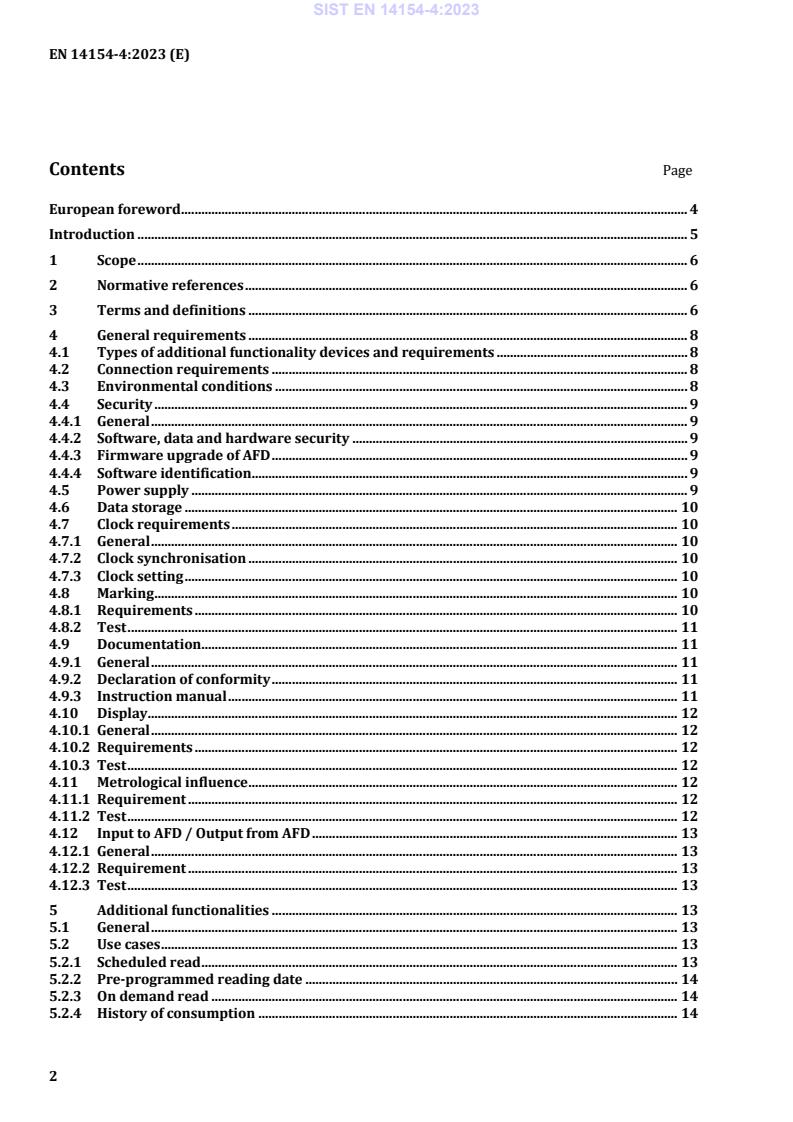
Contents Page
European foreword . 4
Introduction . 5
1 Scope . 6
2 Normative references . 6
3 Terms and definitions . 6
4 General requirements . 8
4.1 Types of additional functionality devices and requirements . 8
4.2 Connection requirements . 8
4.3 Environmental conditions . 8
4.4 Security . 9
4.4.1 General . 9
4.4.2 Software, data and hardware security . 9
4.4.3 Firmware upgrade of AFD . 9
4.4.4 Software identification . 9
4.5 Power supply . 9
4.6 Data storage . 10
4.7 Clock requirements . 10
4.7.1 General . 10
4.7.2 Clock synchronisation . 10
4.7.3 Clock setting . 10
4.8 Marking . 10
4.8.1 Requirements . 10
4.8.2 Test . 11
4.9 Documentation . 11
4.9.1 General . 11
4.9.2 Declaration of conformity . 11
4.9.3 Instruction manual . 11
4.10 Display . 12
4.10.1 General . 12
4.10.2 Requirements . 12
4.10.3 Test . 12
4.11 Metrological influence . 12
4.11.1 Requirement . 12
4.11.2 Test . 12
4.12 Input to AFD / Output from AFD . 13
4.12.1 General . 13
4.12.2 Requirement . 13
4.12.3 Test . 13
5 Additional functionalities . 13
5.1 General . 13
5.2 Use cases . 13
5.2.1 Scheduled read . 13
5.2.2 Pre-programmed reading date . 14
5.2.3 On demand read . 14
5.2.4 History of consumption . 14
5.2.5 Background leak . 14
5.2.6 Burst . 15
5.2.7 Reverse flow . 15
5.2.8 Zero flow . 16
5.2.9 Tamper of AFD . 16
5.2.10 Tamper of meter . 16
5.2.11 Battery low . 16
5.2.12 Presence of air . 17
5.2.13 Access profiles . 17
6 Environmental considerations . 17
Annex A (normative) Declaration of conformity to EN 14154-4 . 18
Annex B (informative) Smart Metering, overview, core functionalities and descriptions . 19
B.1 General . 19
B.2 M2M Gateway . 19
B.3 Clusters . 20
B.4 Primary Use Cases . 20
B.5 Secondary Use Cases . 20
B.6 Primary Actors . 20
B.7 Actors . 20
B.8 Use Cases . 20
Annex C (informative) References to EN ISO 4064-1:2017, EN ISO 4064-2:2017,
EN ISO 4064-3:2014, EN ISO 4064-4:2014, EN ISO 4064-5:2017 . 21
Bibliography . 24
European foreword
This document (EN 14154-4:2023) has been prepared by Technical Committee CEN/TC 92 “Water
meters”, the secretariat of which is held by SNV.
This European Standard shall be given the status of a national standard, either by publication of an
identical text or by endorsement, at the latest by September 2023, and conflicting national standards shall
be withdrawn at the latest by September 2023.
Attention is drawn to the possibility that some of the elements of this document may be the subject of
patent rights. CEN shall not be held responsible for identifying any or all such patent rights.
This document supersedes EN 14154-4:2014.
This document has been prepared under a Standardization Request given to CEN by the European
Commission and the European Free Trade Association.
Any feedback and questions on this document should be directed to the users’ national standards body.
A complete listing of these bodies can be found on the CEN website.
According to the CEN-CENELEC Internal Regulations, the national standards organisations of the
following countries are bound to implement this European Standard: Austria, Belgium, Bulgaria, Croatia,
Cyprus, Czech Republic, Denmark, Estonia, Finland, France, Germany, Greece, Hungary, Iceland, Ireland,
Italy, Latvia, Lithuania, Luxembourg, Malta, Netherlands, Norway, Poland, Portugal, Republic of North
Macedonia, Romania, Serbia, Slovakia, Slovenia, Spain, Sweden, Switzerland, Türkiye and the United
Kingdom.
Introduction
This document has been developed as part of the work being undertaken by the European Standards
Organizations (CEN/CENELEC/ETSI) under the Commission Mandate M/441. This document utilizes the
six functionalities agreed by the Smart Meters Coordination Group (SM-CG) (see Annex B) as the basis for
its additional functionalities. It is not required for the Additional Functionality Device (AFD) to
incorporate all functions described in this document.
Communications for water meters are outside the scope of this document and are covered by the
appropriate parts of the EN 13757 series, which provides a number of protocols and transport layers for
meter communications for Gas, Water and Thermal Energy meters. The additional functionality for water
meters can be provided by a number of methods; these are illustrated below, see Figure 1 (4.1), and
described in detail within this document. The AFD can be integrated in the meter, attached to the meter
or remote from the meter.
1 Scope
This document specifies definitions, requirements and testing of additional functionalities for water
meters, without metrological impact, in combination with Additional Functionality Devices (AFD) and in
response to EU/EFTA Mandate M/441 EN. These AFDs are considered as “ancillary devices” as defined
in EN ISO 4064-1:2017 and EN ISO 4064-4:2014.
This document does not cover the changing of metrological software within the meter or the
upload/download of metrological software.
NOTE A manufacturer can claim compliance only for additional functionalities described in this document. It
is not mandatory that an AFD complies with all additional functionalities described herein.
2 Normative references
The following documents are referred to in the text in such a way that some or all of their content
constitutes requirements of this document. For dated references, only the edition cited applies. For
undated references, the latest edition of the referenced document (including any amendments) applies.
EN ISO 4064-1:2017, Water meters for cold potable water and hot water - Part 1: Metrological and
technical requirements (ISO 4064-1:2014)
EN ISO 4064-2:2017, Water meters for cold potable water and hot water - Part 2: Test methods (ISO
4064-2:2014)
EN ISO 4064-4:2014, Water meters for cold potable water and hot water - Part 4: Non-metrological
requirements not covered in ISO 4064-1 (ISO 4064-4:2014)
EN ISO 4064-5:2017, Water meters for cold potable water and hot water - Part 5: Installation requirements
(ISO 4064-5:2014)
EN 60529:1991, Degrees of protection provided by enclosures (IP Code)
3 Terms and definitions
For the purposes of this document, the terms, definitions and symbols given in EN ISO 4064-1:2017,
EN ISO 4064-2:2017, EN ISO 4064-4:2014 and EN ISO 4064-5:2017 and the following apply.
NOTE The following terms and definitions are only related to additional functionalities.
3.1
functionality
process which constantly or at specified intervals, automatically or on demand, performs specific
activities such as sampling data, reading a data set, verifying or changing a status, or activating a switch
3.2
additional functionality
functionality that a smart meter provides, over and above the metrological functionality covered by the
Measuring Instruments Directive
3.3
additional functionality device
device providing any additional functionality
3.4
additional functionality device type 1
AFD1
additional functionality device integrated into the meter
3.5
additional functionality device type 2
AFD2
additional functionality device directly attached to the meter
3.6
additional functionality device type 3
AFD3
additional functionality device remotely connected to the meter
3.7
automatic meter reading
technology for obtaining metering data from an on-site meter by communication from a remote access
point
3.8
universal time coordinated
UTC
world time, without daylight savings
3.9
reading
primary indication of the total volume passed through the meter
3.10
metrological software
software identified during the type testing examination, which is part of the meter and is critical to its
metrological characteristics
3.11
register
indication of the specific section in the memory of the control and metering unit that records data as
determined by the programme in the unit
3.12
event
condition requiring action or to log an action
3.13
event log
temporary or mid-term memorized listing of events, containing their occurrence, actions taken and their
reset
3.14
interface
point or means of interaction between two systems
4 General requirements
4.1 Types of additional functionality devices and requirements
The additional functionality shall be provided by one of the following devices:
— AFD1; where all functions are within the same metrological enclosure as the meter;
— AFD2; where the AFD is attached directly to the meter. The manufacturer shall declare the
appropriate device compatibility;
— AFD3; where the AFD is located remotely and connected to the meter via a pulse interface or
communication interface. The manufacturer shall declare the appropriate device compatibility.
Figure 1 — Additional functionality devices
4.2 Connection requirements
The AFD2 and AFD3 shall be connected to the meter and tested as a combined unit in all the tests given
in 4.11.2 to ensure the connection of the AFD to the meter has no metrological influence.
The connection of the AFD to the meter or any labelling on the meter or the AFD shall not obscure or
damage any metrological seal of the meter or the regulatory marking.
When the AFD is connected, the consumer shall be able to read the primary indication on the meter to
units of at least cubic meters without the use of tools.
4.3 Environmental conditions
The AFD shall work with the meter at all operating conditions of the meter as required by the appropriate
standards.
Any AFD should be suitable to meet one of the environmental classes from EN ISO 4064-1:2017,
A.2 and A.3 and the related tests. An AFD3 may have a different environmental class to that of the meter.
4.4 Security
4.4.1 General
The AFD shall be constructed in such a way that any unauthorized intervention shall either cause
permanently visible damage to the AFD or its protective seals, or creates a report in the event log. Any
physical seals shall be visibly fixed, and easily accessible.
4.4.2 Software, data and hardware security
4.4.2.1 Requirement
When tested in accordance with 4.4.2.2 the requirements below shall be met.
All available connections, ports and interfaces of the AFD which can be used for unauthorized adjustment
of the AFDs characteristics and additional functionality shall be effectively secured by protective seals.
No access shall be allowed to software and firmware by unauthorised persons. Software and data shall
be protected against accidental or intentional changes by the breaking of a physical seal or by using an
electronic seal.
For electronic seals the following requirements shall be met:
a) access shall only be obtained by using a password or a code;
b) unauthorized intervention shall be registered in the event log and the type of intervention identified,
and where available date and time to be included.
In the case of intended consumer access to the AFD, it shall be ensured that the access by the consumer
cannot inadvertently drain the battery capacity, where applicable.
4.4.2.2 Test
Compliance with the above requirements shall be checked by visual inspection and evaluation of the
manufacturer’s technical documentation.
4.4.3 Firmware upgrade of AFD
This part of the document covers non-metrological upgrades only, providing there is clear separation
between the metrological and non-metrological functions.
Following any upgrade, the information/functionality of the AFD shall be as declared by the
manufacturer. Any data still present shall be the same as prior to the upgrade.
NOTE Further guidance is available in WELMEC Guide 7.2.
4.4.4 Software identification
The software (including version) shall have an unambiguous identifier that is retrievable.
4.5 Power supply
The power supply of the AFD shall comply with EN ISO 4064-1:2017, EN ISO 4064-4:2014 and shall be
tested accordingly.
For battery powered AFD, the manufacturer shall specify the minimum operational lifetime of the battery
depending on the stated functionality and operation (e.g. transmission intervals of radio communication
device).
4.6 Data storage
The AFD shall be capable of storing data such as interval and event data. The manufacturer shall declare
which data are stored and how to access the stored data.
The stored data shall be retained and retrievable in non-volatile memory in the event of power failure as
tested according to EN ISO 4064-2:2017 unless the AFD has a non-replacable battery.
4.7 Clock requirements
4.7.1 General
Stored data shall be time stamped. The time stamps shall be generated by a clock which gives:
— a relative time stamp; or
— a non-synchronized time stamp; or
— a synchr
...