

EN 17289-2:2020
(Main)Characterization of bulk materials - Determination of a size-weighted fine fraction and crystalline silica content - Part 2: Calculation method
- Abstract
This document specifies the determination of the size-weighted fine fraction (SWFF) and the size-weighted fine fraction of crystalline silica (SWFFCS) in bulk materials by calculation. The document also specifies the assumptions and preconditions to be fulfilled for this method to be valid.
The purpose of this document is to allow users to evaluate bulk materials regarding their size-weighted fine fraction and crystalline silica content.
NOTE For preparation of the sample and determination of crystalline silica by X-ray Powder Diffractometry (XRD) or Fourier Transform Infrared Spectroscopy (FT-IR), see EN 17289-1.
The calculation method is applicable only after experiments have shown that the results are accurate and consistently equal or higher than the results from sedimentation, as specified in EN 17289 3, for that particular bulk material.
A specific method for the evaluation of the SWFF for diatomaceous earth bulk materials is given in Annex A. Due to the internal porosity of diatomaceous earth, the general instructions given in this document are adapted in order to take into account the material’s effective density.
This document is applicable for crystalline silica containing bulk materials which have been fully investigated and validated for the evaluation of the size-weighted fine fraction and crystalline silica.
- Status
- Published
- Publication Date
- 22-Dec-2020
- Withdrawal Date
- 29-Jun-2021
- Technical Committee
- CEN/TC 137 - Assessment of workplace exposure
- Drafting Committee
- CEN/TC 137/WG 3 - Particulate matter
- Current Stage
- 9093 - Decision to confirm - Review Enquiry
- Start Date
- 06-Aug-2026
- Completion Date
- 14-Oct-2026



Overview
EN 17289-2:2020 (CEN) - "Characterization of bulk materials - Determination of a size-weighted fine fraction and crystalline silica content - Part 2: Calculation method" - specifies a calculation-based procedure to estimate the size-weighted fine fraction (SWFF) and the size-weighted fine fraction of crystalline silica (SWFFCS) in bulk materials. The method converts particle size distribution (PSD) data into a mass fraction of particles with the potential to reach the alveoli if airborne, and then combines that with measured crystalline silica (CS) content to estimate SWFFCS. The calculation route is intended for laboratory experts and is valid only after validation against sedimentation results (EN 17289-3) for the specific material.
Key topics and technical requirements
- Input data and PSD methods: PSD must be measured by approved methods - laser diffraction (ISO 13320) or gravitational liquid sedimentation (ISO 13317‑1/2).
- Aerodynamic diameter and density: Aerodynamic diameter calculation requires the particle equivalent diameter and particle density; particle density should be measured using a standardized method (e.g., He or liquid pycnometer per ISO 1183‑1).
- Size-weighting function: SWFF is calculated by applying the alveolar deposition probability (per EN 481) to the PSD to obtain a size-weighted mass fraction.
- Crystalline silica content: CS content must be measured by X-ray powder diffractometry (XRD) or Fourier transform infrared spectroscopy (FT‑IR) as referenced in EN 17289‑1; SWFFCS = SWFF × (CS mass fraction).
- Assumptions and preconditions:
- Dynamic form factor is neglected for non-sedimentation PSD methods.
- In mixtures, component materials must share the same PSD; otherwise use sedimentation separation.
- Subsampling must be representative (see EN 17289‑1).
- Material-specific adaptation: Annex A provides a normative calculation adaptation for diatomaceous earth (DE) to account for internal porosity and effective density.
Applications and users
- Primary users: laboratory analysts, industrial minerals producers, material scientists and occupational hygiene laboratories familiar with PSD, XRD/FT‑IR.
- Practical uses:
- Comparing bulk materials by their potential fine fraction and estimated crystalline silica mass in the fine fraction.
- Supporting material selection and risk communication within supply chains (e.g., sands, flour-like minerals, diatomaceous earth).
- Complementing dustiness testing (EN 15051‑1) - SWFF quantifies inherent fine mass in the bulk, while dustiness quantifies airborne fractions generated by handling.
- Limitations: SWFF and SWFFCS are not direct workplace exposure metrics and must not replace workplace air monitoring or exposure assessment.
Related standards
- EN 17289‑1:2020 - General information and sample preparation / analytical choices (XRD, FT‑IR).
- EN 17289‑3 - Sedimentation method (validation benchmark).
- EN 481 - Deposition probability functions / size fraction definitions.
- ISO 13320, ISO 13317‑1/2 - PSD measurement methods.
- ISO 1183‑1 - Density (pycnometer) methods.
- EN 15051‑1 - Dustiness testing (complementary).
Relations
- Effective Date
- 10-Jun-2026
- Effective Date
- 10-Jun-2026
- Effective Date
- 10-Jun-2026
- Effective Date
- 10-Jun-2026
- Effective Date
- 28-Jan-2026
- Effective Date
- 28-Jan-2026
- Effective Date
- 28-Jan-2026
- Effective Date
- 28-Jan-2026
- Refers
EN ISO 20877:2011 - Footwear - Test methods for whole shoe - Thermal insulation (ISO 20877:2011) - Effective Date
- 28-Jan-2026
- Effective Date
- 28-Jan-2026
- Effective Date
- 28-Jan-2026
Get Certified
Connect with accredited certification bodies for this standard

CIS Institut d.o.o.
Personal Protective Equipment (PPE) certification body. Notified Body NB-2890 for EU Regulation 2016/425 PPE.

Kiwa BDA Testing
Building and construction product certification.
Kmetijski inštitut Slovenije
Agricultural Institute of Slovenia. Soil testing, plant health, agricultural product analysis.
Sponsored listings
Frequently Asked Questions
EN 17289-2:2020 is a standard published by the European Committee for Standardization (CEN). Its full title is "Characterization of bulk materials - Determination of a size-weighted fine fraction and crystalline silica content - Part 2: Calculation method". This standard covers: This document specifies the determination of the size-weighted fine fraction (SWFF) and the size-weighted fine fraction of crystalline silica (SWFFCS) in bulk materials by calculation. The document also specifies the assumptions and preconditions to be fulfilled for this method to be valid. The purpose of this document is to allow users to evaluate bulk materials regarding their size-weighted fine fraction and crystalline silica content. NOTE For preparation of the sample and determination of crystalline silica by X-ray Powder Diffractometry (XRD) or Fourier Transform Infrared Spectroscopy (FT-IR), see EN 17289-1. The calculation method is applicable only after experiments have shown that the results are accurate and consistently equal or higher than the results from sedimentation, as specified in EN 17289 3, for that particular bulk material. A specific method for the evaluation of the SWFF for diatomaceous earth bulk materials is given in Annex A. Due to the internal porosity of diatomaceous earth, the general instructions given in this document are adapted in order to take into account the material’s effective density. This document is applicable for crystalline silica containing bulk materials which have been fully investigated and validated for the evaluation of the size-weighted fine fraction and crystalline silica.
This document specifies the determination of the size-weighted fine fraction (SWFF) and the size-weighted fine fraction of crystalline silica (SWFFCS) in bulk materials by calculation. The document also specifies the assumptions and preconditions to be fulfilled for this method to be valid. The purpose of this document is to allow users to evaluate bulk materials regarding their size-weighted fine fraction and crystalline silica content. NOTE For preparation of the sample and determination of crystalline silica by X-ray Powder Diffractometry (XRD) or Fourier Transform Infrared Spectroscopy (FT-IR), see EN 17289-1. The calculation method is applicable only after experiments have shown that the results are accurate and consistently equal or higher than the results from sedimentation, as specified in EN 17289 3, for that particular bulk material. A specific method for the evaluation of the SWFF for diatomaceous earth bulk materials is given in Annex A. Due to the internal porosity of diatomaceous earth, the general instructions given in this document are adapted in order to take into account the material’s effective density. This document is applicable for crystalline silica containing bulk materials which have been fully investigated and validated for the evaluation of the size-weighted fine fraction and crystalline silica.
EN 17289-2:2020 is classified under the following ICS (International Classification for Standards) categories: 13.040.30 - Workplace atmospheres. The ICS classification helps identify the subject area and facilitates finding related standards.
EN 17289-2:2020 has the following relationships with other standards: It is inter standard links to ISO 13320:2020, ISO 1183-1:2019, ISO 13317-2:2001, ISO 13317-1:2001, prEN 4165-025, EN 1540:2021, EN 10225:2001/AC:2002, EN 481:1993, EN ISO 20877:2011, EN 17289-3:2020, EN 17289-1:2020. Understanding these relationships helps ensure you are using the most current and applicable version of the standard.
EN 17289-2:2020 is available in PDF format for immediate download after purchase. The document can be added to your cart and obtained through the secure checkout process. Digital delivery ensures instant access to the complete standard document.
Standards Content (Sample)
SLOVENSKI STANDARD
01-februar-2021
Karakterizacija razsutih materialov - Določanje velikostno utežene fine frakcije in
deleža kristaliničnega kremena - 2. del: Metoda izračuna
Characterization of bulk materials - Determination of a size-weighted fine fraction and
crystalline silica content - Part 2: Calculation method
Charakterisierung von Schüttgütern - Bestimmung einer größengewichteten Feinfraktion
und des Anteils an kristallinem Quarz - Teil 2: Sedimentationsverfahren
Caractérisation des matériaux en vrac - Détermination de la fraction fine pondérée par
taille et de la teneur en silice cristalline - Partie 2 : Méthode par calcul
Ta slovenski standard je istoveten z: EN 17289-2:2020
ICS:
13.040.30 Kakovost zraka na delovnem Workplace atmospheres
mestu
2003-01.Slovenski inštitut za standardizacijo. Razmnoževanje celote ali delov tega standarda ni dovoljeno.
EN 17289-2
EUROPEAN STANDARD
NORME EUROPÉENNE
December 2020
EUROPÄISCHE NORM
ICS 13.040.30
English Version
Characterization of bulk materials - Determination of a
size-weighted fine fraction and crystalline silica content -
Part 2: Calculation method
Caractérisation des matériaux en vrac - Détermination Charakterisierung von Schüttgütern - Bestimmung
de la fraction fine pondérée par taille et de la teneur en einer größengewichteten Feinfraktion und des Anteils
silice cristalline - Partie 2 : Méthode par calcul an kristallinem Quarz - Teil 2: Berechnungsverfahren
This European Standard was approved by CEN on 4 October 2020.
CEN members are bound to comply with the CEN/CENELEC Internal Regulations which stipulate the conditions for giving this
European Standard the status of a national standard without any alteration. Up-to-date lists and bibliographical references
concerning such national standards may be obtained on application to the CEN-CENELEC Management Centre or to any CEN
member.
This European Standard exists in three official versions (English, French, German). A version in any other language made by
translation under the responsibility of a CEN member into its own language and notified to the CEN-CENELEC Management
Centre has the same status as the official versions.
CEN members are the national standards bodies of Austria, Belgium, Bulgaria, Croatia, Cyprus, Czech Republic, Denmark, Estonia,
Finland, France, Germany, Greece, Hungary, Iceland, Ireland, Italy, Latvia, Lithuania, Luxembourg, Malta, Netherlands, Norway,
Poland, Portugal, Republic of North Macedonia, Romania, Serbia, Slovakia, Slovenia, Spain, Sweden, Switzerland, Turkey and
United Kingdom.
EUROPEAN COMMITTEE FOR STANDARDIZATION
COMITÉ EUROPÉEN DE NORMALISATION
EUROPÄISCHES KOMITEE FÜR NORMUNG
CEN-CENELEC Management Centre: Rue de la Science 23, B-1040 Brussels
© 2020 CEN All rights of exploitation in any form and by any means reserved Ref. No. EN 17289-2:2020 E
worldwide for CEN national Members.
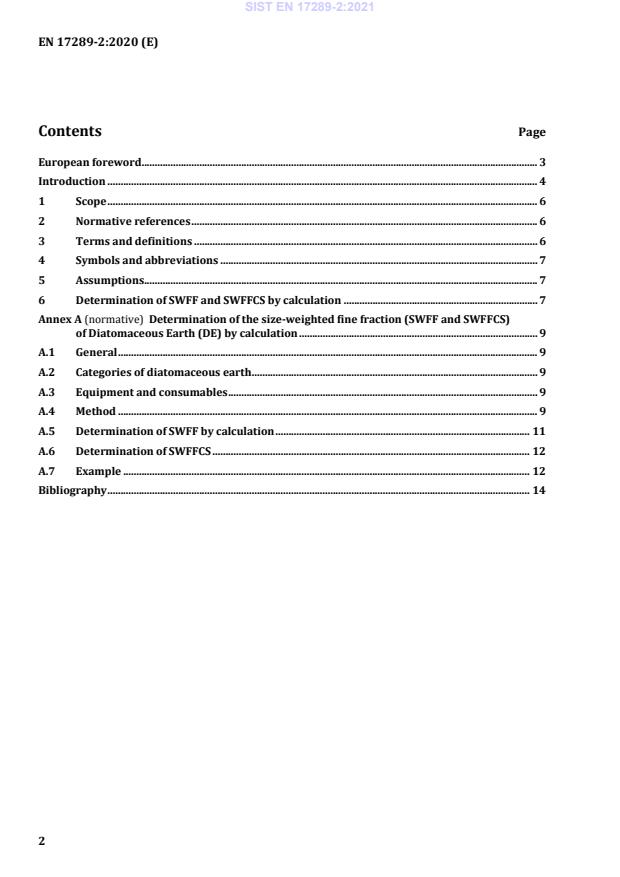
Contents Page
European foreword . 3
Introduction . 4
1 Scope . 6
2 Normative references . 6
3 Terms and definitions . 6
4 Symbols and abbreviations . 7
5 Assumptions . 7
6 Determination of SWFF and SWFFCS by calculation . 7
Annex A (normative) Determination of the size-weighted fine fraction (SWFF and SWFFCS)
of Diatomaceous Earth (DE) by calculation . 9
A.1 General . 9
A.2 Categories of diatomaceous earth . 9
A.3 Equipment and consumables . 9
A.4 Method . 9
A.5 Determination of SWFF by calculation . 11
A.6 Determination of SWFFCS . 12
A.7 Example . 12
Bibliography . 14
European foreword
This document (EN 17289-2:2020) has been prepared by Technical Committee CEN/TC 137
“Assessment of workplace exposure to chemical and biological agents”, the secretariat of which is held
by DIN.
This European Standard shall be given the status of a national standard, either by publication of an
identical text or by endorsement, at the latest by June 2021, and conflicting national standards shall be
withdrawn at the latest by June 2021.
Attention is drawn to the possibility that some of the elements of this document may be the subject of
patent rights. CEN shall not be held responsible for identifying any or all such patent rights.
According to the CEN-CENELEC Internal Regulations, the national standards organisations of the
following countries are bound to implement this European Standard: Austria, Belgium, Bulgaria,
Croatia, Cyprus, Czech Republic, Denmark, Estonia, Finland, France, Germany, Greece, Hungary, Iceland,
Ireland, Italy, Latvia, Lithuania, Luxembourg, Malta, Netherlands, Norway, Poland, Portugal, Republic of
North Macedonia, Romania, Serbia, Slovakia, Slovenia, Spain, Sweden, Switzerland, Turkey and the
United Kingdom.
Introduction
A method was developed in the industrial minerals industry for the purpose of determining the “size-
weighted relevant fine fraction” within the bulk material. This document sets out the methods which
can be used to measure and calculate the fine fraction of the bulk material and the fine fraction of the
crystalline silica, in several types of bulk materials. This information provides additional information to
users for their risk assessment and to compare bulk materials. It has been used in the industry and by
institutes previously under the acronym SWeRF. EN 17289 (all parts) is based on that industrial
method and specifies the analytical methods to determine the difference between materials with coarse
quartz and fine quartz, for example, sands versus flour.
As further activities with the material (intentional or otherwise) can change the particle size
distribution, the size-weighted fine fraction can also change. Therefore, the method reports (in terms of
the mass fraction in the bulk material in percent) both, the total crystalline silica (CS) and the estimated
size-weighted fine fraction of CS.
Conventions as specified in EN 481 can be used as input for this document. However, the output of this
document is not related to the respirable fraction at the workplace and cannot be used to replace
workplace exposure measurements.
EN 17289 (all parts) specifies two procedures that can be used to estimate the size-weighted fine
fraction (SWFF) in bulk materials. It also specifies how the SWFF, once separated, can be further
analysed to measure the content of crystalline silica (SWFFCS). The method can be used for comparing
the fine fraction in different bulk samples. EN 17289 (all parts) uses the term fine fraction to indicate
that it does not analyse airborne particles, but it evaluates the proportion of particles in a bulk material
that, based on their particle size, have a potential to be respirable if they were to become airborne.
EN 17289 (all parts) also allows for the size-weighted fine fraction of crystalline silica (SWFFCS)
particles in bulk materials to be evaluated in terms of mass fraction in percent, if the fraction separated
is subsequently analysed by a suitable method.
In a comparison of similar bulk materials, in which the particle size distribution is the only variable, the
SWFF can provide useful information to guide material selection. For example, leaving all other factors
aside, a bulk material with a lower SWFF value can pose less of a risk in terms of potential occupational
exposure. For the actual exposure at the workplace, the handling etc. of the material, will play a major
role.
Concentrations of respirable dust, or respirable crystalline silica (RCS), in the workplace air, resulting
from processing and handling of bulk materials, will depend on a wide variety of factors and these
concentrations cannot be estimated using SWFF or SWFFCS values. SWFF and SWFFCS values are not
intended for workplace exposure assessments as they have no direct relationship with occupational
exposure.
The evaluation of bulk materials using SWFF is complementary to determining the dustiness according
to EN 15051-1 [1].
The difference between EN 17289 (all parts) and EN 15051-1 is that SWFF quantifies the fine fraction in
a bulk material while dustiness quantifies the respirable, thoracic and inhalable dust made airborne
from the bulk material after a specific activity (dustiness characterizes the material with relation to the
workplace atmosphere when working with the bulk material).
EN 17289 Characterization of bulk materials — Determination of a size-weighted fine fraction and
crystalline silica content consists of the following parts:
— Part 1: General information and choice of test methods;
— Part 2: Calculation method;
— Part 3: Sedimentation method.
NOTE This document is intended for use by laboratory experts who are familiar with FT-IR, XRD methods,
PSD measurements and other analytical procedures. It is not the intention of this document to provide instruction
in the fundamental analytical techniques.
1 Scope
This document specifies the determination of the size-weighted fine fraction (SWFF) and the size-
weighted fine fraction of crystalline silica (SWFFCS) in bulk materials by calculation. The document also
specifies the assumptions and preconditions to be fulfilled for this method to be valid.
The purpose of this document is to allow users to evaluate bulk materials regarding their size-weighted
fine fraction and crystalline silica content.
NOTE For preparation of the sample and determination of crystalline silica by X-ray Powder Diffractometry
(XRD) or Fourier Transform Infrared Spectroscopy (FT-IR), see EN 17289-1.
The calculation method is applicable only after experiments have shown that the results are accurate
and consistently equal or higher than the results from sedimentation, as specified in EN 17289-3, for
that particular bulk material.
A specific method for the evaluation of the SWFF for diatomaceous earth bulk materials is given in
Annex A. Due to the internal porosity of diatomaceous earth, the general instructions given in this
document are adapted in order to take into account the material’s effective density.
This document is applicable for crystalline silica containing bulk materials which have been fully
investigated and validated for the evaluation of the size-weighted fine fraction and crystalline silica.
2 Normative references
The following documents are referred to in the text in such a way that some or all of their content
constitutes requirements of this document. For dated references, only the edition cited applies. For
undated references, the latest edition of the referenced document (including any amendments) applies.
EN 481, Workplace atmospheres — Size fraction definitions for measurement of airborne particles
EN 1540, Workplace exposure — Terminology
EN 17289-1:2020, Characterization of bulk materials — Determination of a size-weighted fine fraction
and crystalline silica content — Part 1: General information and choice of test methods
ISO 1183-1, Plastics — Methods for determining the density of non-cellular plastics — Part 1: Immersion
method, liquid pycnometer method and titration
ISO 13317-1, Determination of particle size distribution by gravitational liquid sedimentation methods —
Part 1: General principles and guidelines
ISO 13317-2, Determination of particle size distribution by gravitational liquid sedimentation methods —
Part 2: Fixed pipette method
ISO 13320, Particle size analysis — Laser diffraction methods
3 Terms and definitions
For the purposes of this document, the terms and
...