

EN 16851:2017+A1:2020
(Main + Amendment)Cranes - Light crane systems
General Information
- Abstract
This document applies to:
- light crane systems, either suspended or free-standing systems, where the rated capacity of any single lifting device is 4 t or less;
- pillar and wall-mounted jib cranes, without an operator's cabin, whose rated capacity is 10 t or less and whose overturning load moment is 500 kNm or less.
NOTE For illustration of crane types, see Annex B.
This document is not applicable to cranes covered by another product specific crane standard, e.g. EN 15011:2011+A1:2014 or EN 14985:2012.
This document is applicable to cranes and crane systems, whose structures are made of steel or aluminium, excluding aluminium structures containing welded joints.
This document gives requirements for all significant hazards, hazardous situations and events relevant to cranes, when used as intended and under conditions foreseen by the manufacturer (see Clause 4).
The specific hazards due to potentially explosive atmospheres, ionizing radiation, operation in electro-magnetic fields beyond the range of EN 61000 6 2:2016 and operation in pharmacy or food industry are not covered by this document.
This document does not cover hazards related to the lifting of persons.
This document is applicable to cranes, which are manufactured after the date of its publication by CEN as a European Standard.
This document is not applicable to cranes manufactured before the date of its publication.
- Status
- Published
- Publication Date
- 15-Dec-2020
- Withdrawal Date
- 29-Jun-2021
- Technical Committee
- CEN/TC 147 - Cranes - Safety
- Drafting Committee
- CEN/TC 147/WG 14 - Bridge and gantry cranes
- Current Stage
- 9093 - Decision to confirm - Review Enquiry
- Start Date
- 27-Mar-2023
- Completion Date
- 30-Sep-2026
- Directive
- 2006/42/EC - Directive 2006/42/EC of the European Parliament and of the Council of 17 May 2006 on machinery, and amending Directive 95/16/EC (recast)OJ Ref: L, L 366 OJ Date: 15-Oct-2021



Overview - EN 16851:2017+A1:2020 (Cranes - Light crane systems)
EN 16851:2017+A1:2020 is a European (CEN) type C standard that defines safety, design and verification requirements for light crane systems. It covers suspended and free‑standing systems where any single lifting device has a rated capacity of 4 t or less, and pillar or wall‑mounted jib cranes (no operator cabin) with rated capacity ≤ 10 t and overturning moment ≤ 500 kNm. The standard applies to steel or aluminium structures (excluding aluminium with welded joints) and includes Amendment 1 (approved November 2020). It is intended for cranes manufactured after its publication and is not applicable where other product‑specific crane standards (e.g. EN 15011, EN 14985) apply.
Key topics and technical requirements
- Scope & exclusions: defines crane types, capacities and explicit exclusions (explosive atmospheres, ionizing radiation, EM fields beyond EN 61000‑6‑2, pharmacy/food industry, lifting of persons).
- Safety requirements: addresses all significant hazards, hazardous situations and events when used as intended by the manufacturer.
- Structural requirements: provisions for steel and aluminium designs, including proof of static strength, fatigue strength and elastic stability (see Clause 5).
- Components & systems: design and safety rules for trolleys, drives, suspensions, turntables, switches, interlocks, end stops, motion limiters and power supply.
- Control & man–machine interface: rules for control stations, control devices, tandem operation, glazing/guarding and permissible horizontal speeds.
- Verification & testing: verification types including functional, static and dynamic tests and “fitness for purpose” testing (Clause 6).
- Information for use: operator’s and user’s manuals, installation and maintenance instructions, and marking of rated capacities (Clause 7).
- Noise & measurement: noise test code and declaration procedures (Annex C).
- Supporting documentation: Annex B (illustrations, actions on supporting structures), Annex D (selection of related standards), Annex ZA (relationship with Machinery Directive).
Practical applications - who uses EN 16851
- Crane manufacturers and designers - to design compliant light crane systems and select materials/verification methods.
- Safety engineers & CE/standards specialists - to demonstrate conformity with the Machinery Directive and manage risk.
- Installers and maintenance teams - to follow installation, commissioning and testing requirements.
- Specifiers, procurement and facility managers - to select appropriate light crane equipment for workshops, warehouses, production lines.
- Notified bodies and certification organizations - to assess compliance, testing and documentation.
Related standards and compliance
- Related product‑specific crane standards (e.g. EN 15011, EN 14985) supersede EN 16851 where applicable.
- EN 16851 is a type C standard per EN ISO 12100 and supports essential health and safety requirements of the EU Machinery Directive (see Annex ZA).
Keywords: EN 16851, light crane systems, crane standards, jib cranes, crane safety, verification testing, CEN, Machinery Directive.
Relations
- Merged From
EN 16851:2017 - Cranes - Light crane systems - Effective Date
- 19-Jan-2023
- Effective Date
- 21-Oct-2020
- Effective Date
- 25-Aug-2026
- Effective Date
- 25-Aug-2026
- Effective Date
- 09-Feb-2026
- Effective Date
- 09-Feb-2026
- Effective Date
- 09-Feb-2026
- Effective Date
- 09-Feb-2026
- Effective Date
- 09-Feb-2026
- Effective Date
- 28-Jan-2026
- Effective Date
- 28-Jan-2026
- Effective Date
- 28-Jan-2026
- Effective Date
- 28-Jan-2026
- Effective Date
- 28-Jan-2026
- Effective Date
- 28-Jan-2026
Frequently Asked Questions
EN 16851:2017+A1:2020 is a standard published by the European Committee for Standardization (CEN). Its full title is "Cranes - Light crane systems". This standard covers: This document applies to: - light crane systems, either suspended or free-standing systems, where the rated capacity of any single lifting device is 4 t or less; - pillar and wall-mounted jib cranes, without an operator's cabin, whose rated capacity is 10 t or less and whose overturning load moment is 500 kNm or less. NOTE For illustration of crane types, see Annex B. This document is not applicable to cranes covered by another product specific crane standard, e.g. EN 15011:2011+A1:2014 or EN 14985:2012. This document is applicable to cranes and crane systems, whose structures are made of steel or aluminium, excluding aluminium structures containing welded joints. This document gives requirements for all significant hazards, hazardous situations and events relevant to cranes, when used as intended and under conditions foreseen by the manufacturer (see Clause 4). The specific hazards due to potentially explosive atmospheres, ionizing radiation, operation in electro-magnetic fields beyond the range of EN 61000 6 2:2016 and operation in pharmacy or food industry are not covered by this document. This document does not cover hazards related to the lifting of persons. This document is applicable to cranes, which are manufactured after the date of its publication by CEN as a European Standard. This document is not applicable to cranes manufactured before the date of its publication.
This document applies to: - light crane systems, either suspended or free-standing systems, where the rated capacity of any single lifting device is 4 t or less; - pillar and wall-mounted jib cranes, without an operator's cabin, whose rated capacity is 10 t or less and whose overturning load moment is 500 kNm or less. NOTE For illustration of crane types, see Annex B. This document is not applicable to cranes covered by another product specific crane standard, e.g. EN 15011:2011+A1:2014 or EN 14985:2012. This document is applicable to cranes and crane systems, whose structures are made of steel or aluminium, excluding aluminium structures containing welded joints. This document gives requirements for all significant hazards, hazardous situations and events relevant to cranes, when used as intended and under conditions foreseen by the manufacturer (see Clause 4). The specific hazards due to potentially explosive atmospheres, ionizing radiation, operation in electro-magnetic fields beyond the range of EN 61000 6 2:2016 and operation in pharmacy or food industry are not covered by this document. This document does not cover hazards related to the lifting of persons. This document is applicable to cranes, which are manufactured after the date of its publication by CEN as a European Standard. This document is not applicable to cranes manufactured before the date of its publication.
EN 16851:2017+A1:2020 is classified under the following ICS (International Classification for Standards) categories: 53.020.20 - Cranes. The ICS classification helps identify the subject area and facilitates finding related standards.
EN 16851:2017+A1:2020 has the following relationships with other standards: It is inter standard links to EN 16851:2017, EN 16851:2017/FprA1, ISO 4309:2017, ISO 4306-1:2007, ISO 3864-2:2016, ISO 3864-1:2011, ISO 3864-3:2012, ISO 3864-4:2011, EN 60204-32:2008, EN 614-1:2006+A1:2009, EN 15011:2011+A1:2014, EN 13557:2003+A2:2008, EN ISO 3744:2010, EN 515:2017, EN 12077-2:1998+A1:2008. Understanding these relationships helps ensure you are using the most current and applicable version of the standard.
EN 16851:2017+A1:2020 is associated with the following European legislation: EU Directives/Regulations: 2006/42/EC; Standardization Mandates: M/396. When a standard is cited in the Official Journal of the European Union, products manufactured in conformity with it benefit from a presumption of conformity with the essential requirements of the corresponding EU directive or regulation.
EN 16851:2017+A1:2020 is available in PDF format for immediate download after purchase. The document can be added to your cart and obtained through the secure checkout process. Digital delivery ensures instant access to the complete standard document.
Standards Content (Sample)
SLOVENSKI STANDARD
01-april-2021
Žerjavi - Lahki žerjavni sistemi
Cranes - Light crane systems
Krane - Leichtkransysteme
Appareils de levage à charge suspendue - Systèmes de grue légère
Ta slovenski standard je istoveten z: EN 16851:2017+A1:2020
ICS:
53.020.20 Dvigala Cranes
2003-01.Slovenski inštitut za standardizacijo. Razmnoževanje celote ali delov tega standarda ni dovoljeno.
EN 16851:2017+A1
EUROPEAN STANDARD
NORME EUROPÉENNE
December 2020
EUROPÄISCHE NORM
ICS 53.020.20 Supersedes EN 16851:2017
English Version
Cranes - Light crane systems
Appareils de levage à charge suspendue - Systèmes de Krane - Leichtkransysteme
grue légère
This European Standard was approved by CEN on 14 November 2016 and includes Amendment 1 approved by CEN on 9
November 2020.
CEN members are bound to comply with the CEN/CENELEC Internal Regulations which stipulate the conditions for giving this
European Standard the status of a national standard without any alteration. Up-to-date lists and bibliographical references
concerning such national standards may be obtained on application to the CEN-CENELEC Management Centre or to any CEN
member.
This European Standard exists in three official versions (English, French, German). A version in any other language made by
translation under the responsibility of a CEN member into its own language and notified to the CEN-CENELEC Management
Centre has the same status as the official versions.
CEN members are the national standards bodies of Austria, Belgium, Bulgaria, Croatia, Cyprus, Czech Republic, Denmark, Estonia,
Finland, France, Germany, Greece, Hungary, Iceland, Ireland, Italy, Latvia, Lithuania, Luxembourg, Malta, Netherlands, Norway,
Poland, Portugal, Republic of North Macedonia, Romania, Serbia, Slovakia, Slovenia, Spain, Sweden, Switzerland, Turkey and
United Kingdom.
EUROPEAN COMMITTEE FOR STANDARDIZATION
COMITÉ EUROPÉEN DE NORMALISATION
EUROPÄISCHES KOMITEE FÜR NORMUNG
CEN-CENELEC Management Centre: Rue de la Science 23, B-1040 Brussels
© 2020 CEN All rights of exploitation in any form and by any means reserved Ref. No. EN 16851:2017+A1:2020 E
worldwide for CEN national Members.
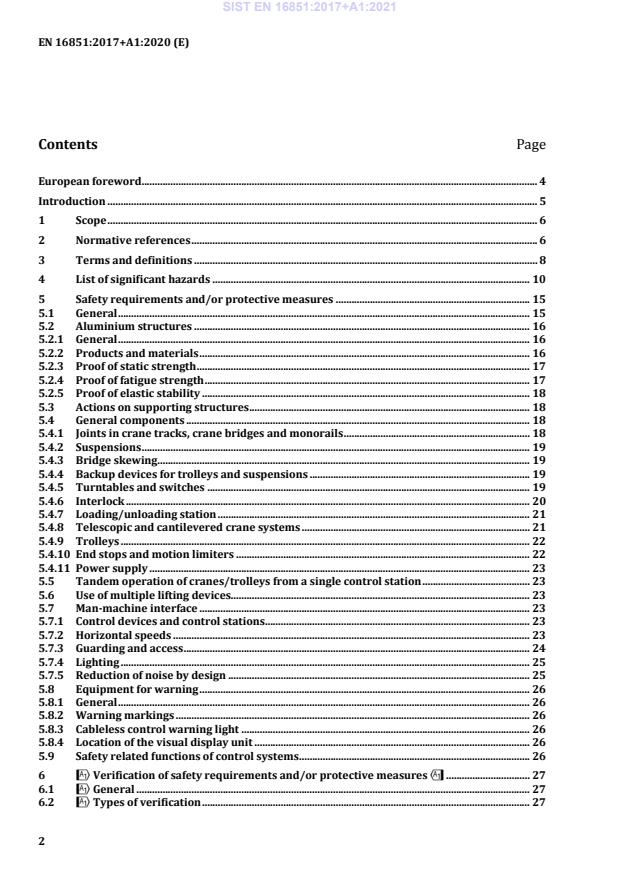
Contents Page
European foreword . 4
Introduction . 5
1 Scope . 6
2 Normative references . 6
3 Terms and definitions . 8
4 List of significant hazards . 10
5 Safety requirements and/or protective measures . 15
5.1 General . 15
5.2 Aluminium structures . 16
5.2.1 General . 16
5.2.2 Products and materials . 16
5.2.3 Proof of static strength . 17
5.2.4 Proof of fatigue strength . 17
5.2.5 Proof of elastic stability . 18
5.3 Actions on supporting structures . 18
5.4 General components . 18
5.4.1 Joints in crane tracks, crane bridges and monorails . 18
5.4.2 Suspensions . 19
5.4.3 Bridge skewing . 19
5.4.4 Backup devices for trolleys and suspensions . 19
5.4.5 Turntables and switches . 19
5.4.6 Interlock . 20
5.4.7 Loading/unloading station . 21
5.4.8 Telescopic and cantilevered crane systems . 21
5.4.9 Trolleys . 22
5.4.10 End stops and motion limiters . 22
5.4.11 Power supply . 23
5.5 Tandem operation of cranes/trolleys from a single control station . 23
5.6 Use of multiple lifting devices. 23
5.7 Man-machine interface . 23
5.7.1 Control devices and control stations. 23
5.7.2 Horizontal speeds . 23
5.7.3 Guarding and access . 24
5.7.4 Lighting . 25
5.7.5 Reduction of noise by design . 25
5.8 Equipment for warning . 26
5.8.1 General . 26
5.8.2 Warning markings . 26
5.8.3 Cableless control warning light . 26
5.8.4 Location of the visual display unit . 26
5.9 Safety related functions of control systems . 26
6 !Verification of safety requirements and/or protective measures" . 27
6.1 !General . 27
6.2 !Types of verification . 27
6.3 !Fitness for purpose testing" . 29
6.3.1 Functional test . 29
6.3.2 Static test . 29
6.3.3 Dynamic test . 29
7 Information for use . 30
7.1 General . 30
7.2 Operator’s manual . 30
7.3 User’s manual . 30
7.3.1 General . 30
7.3.2 Instructions for installation . 31
7.3.3 Instructions for maintenance . 32
7.4 Marking of rated capacities . 33
Annex A (informative) Guidance for specifying the operating duty . 34
Annex B (normative) Actions on supporting structures and installation dimensions . 35
B.1 Loads and load combinations . 35
B.2 Jib cranes . 36
B.2.1 Pillar jib crane. 36
B.2.2 Wall-mounted jib crane . 37
B.3 Suspended light crane systems . 38
B.4 Free-standing systems . 39
Annex C (normative) Noise test code . 40
C.1 General . 40
C.2 Description of machinery family . 41
C.3 Determination of a conventional emission sound pressure level by calculation . 41
C.3.1 Principle of the method . 41
C.3.2 Calculation. 41
C.4 Determination of emission sound pressure level at control stations and other
specified positions and determination of sound power level by measurement. 43
C.4.1 Measurement method and points . 43
C.4.2 Installation and mounting conditions . 44
C.4.3 Operating conditions . 45
C.5 Uncertainties . 46
C.6 Information to be recorded. 46
C.7 Information to be reported . 46
C.8 Declaration and verification of noise emission values . 46
Annex D (informative) Selection of a suitable set of European Standards for cranes in a
given application. 48
Annex ZA (informative) !Relationship between this European Standard and the essential
requirements of Directive2006/42/EC aimed to be covered . 50
Bibliography . 53
European foreword
This document (EN 16851:2017+A1:2020) has been prepared by Technical Committee CEN/TC 147
“Cranes - Safety”, the secretariat of which is held by BSI.
This European Standard shall be given the status of a national standard, either by publication of an
identical text or by endorsement, at the latest by June 2021, and conflicting national standards shall be
withdrawn at the latest by June 2021.
Attention is drawn to the possibility that some of the elements of this document may be the subject of
patent rights. CEN shall not be held responsible for identifying any or all such patent rights.
This document has been prepared under a mandate given to CEN by the European Commission and the
European Free Trade Association, and supports essential requirements of EU Directive(s).
For relationship with EU Directive(s), see informative Annex ZA, which is an integral part of this
document.
This document includes Amendment 1 approved by CEN on 9 November 2020.
!This document supersedes EN 16851:2017."
The start and finish of text introduced or altered by amendment is indicated in the text by tags !".
For relationship with other European Standards for cranes, see Annex D.
According to the CEN-CENELEC Internal Regulations, the national standards organisations of the
following countries are bound to implement this European Standard: Austria, Belgium, Bulgaria,
Croatia, Cyprus, Czech Republic, Denmark, Estonia, Finland, France, Germany, Greece, Hungary, Iceland,
Ireland, Italy, Latvia, Lithuania, Luxembourg, Malta, Netherlands, Norway, Poland, Portugal, Republic of
North Macedonia, Romania, Serbia, Slovakia, Slovenia, Spain, Sweden, Switzerland, Turkey and the
United Kingdom.
Introduction
This European Standard is a type C standard as stated in EN ISO 12100.
This European Standard has been prepared to provide one means for equipment of cranes to conform
to the essential health and safety requirements of the Machinery Directive.
The machinery concerned and the extent to which hazards, hazardous situations and hazardous events
are covered are indicated in the scope of this document (see Clause 1).
When provisions of this type C standard are different from those which are stated in type A or B
standards, the provisions of this type C standard take precedence over the provisions of the other
standards, for machines that have been designed and built according to the provisions of this type C
standard.
1 Scope
!This document applies to:
— light crane systems, either suspended or free-standing systems, where the rated capacity of any
single lifting device is 4 t or less;
— pillar and wall-mounted jib cranes, without an operator's cabin, whose rated capacity is 10 t or less
and whose overturning load moment is 500 kNm or less.
NOTE For illustration of crane types, see Annex B.
This document is not applicable to cranes covered by another product specific crane standard, e.g.
EN 15011:2011+A1:2014 or EN 14985:2012.
This document is applicable to cranes and crane systems, whose structures are made of steel or
aluminium, excluding aluminium structures containing welded joints.
This document gives requirements for all significant hazards, hazardous situations and events relevant
to cranes, when used as intended and under conditions foreseen by the manufacturer (see Clause 4).
The specific hazards due to potentially explosive atmospheres, ionizing radiation, operation in electro-
magnetic fields beyond the range of EN 61000-6-2:2016 and operation in pharmacy or food industry
are not covered by this document.
This document does not cover hazards related to the lifting of persons.
This document is applicable to cranes, which are manufactured after the date of its publication by CEN
as a European Standard.
This document is not applicable to cranes manufactured before the date of its publication."
2 Normative references
!The following documents are referred to in the text in such a way that some or all of their content
constitutes requirements of this document. For dated references, only the edition cited applies. For
undated references, the latest edition of the referenced document (including any amendments) applies.
EN 515:2017, Aluminium and aluminium alloys - Wrought products - Temper designations
EN 614-1:2006+A1:2009, Safety of machinery - Ergonomic design principles - Part 1: Terminology and
general principles
EN 755-9:2016, Aluminium and aluminium alloys - Extruded rod/bar, tube and profiles - Part 9: Profiles,
tolerances on dimensions and form
EN 795:2012, Personal fall protection equipment - Anchor devices
EN 894-1:1997+A1:2008, Safety of machinery - Ergonomics requirements for the design of displays and
control actuators - Part 1: General principles for human interactions with displays and control actuators
EN 894-2:1997+A1:2008, Safety of machinery - Ergonomics requirements for the design of displays and
control actuators - Part 2: Displays
EN 12077-2:1998+A1:2008, Cranes safety - Requirements for health and safety - Part 2: Limiting and
indicating devices
EN 12644-1:2001+A1:2008, Cranes - Information for use and testing - Part 1: Instructions
EN 12644-2:2000+A1:2008, Cranes - Information for use and testing - Part 2: Marking
EN 13001-1:2015, Cranes - General design - Part 1: General principles and requirements
EN 13001-2:2014, Crane safety - General design - Part 2: Load actions
EN 13001-3-1:2012+A2:2018, Cranes - General Design - Part 3-1: Limit States and proof competence of
steel structure
EN 13001-3-2:2014, Cranes - General design - Part 3-2: Limit states and proof of competence of wire ropes
in reeving systems
EN 13001-3-3:2014, Cranes - General design - Part 3-3: Limit states and proof of competence of wheel/rail
contacts
EN 13001-3-4:2018, Cranes - General design - Part 3-4: Limit states and proof of competence of machinery
- Bearings
EN 13001-3-5:2016, Cranes - General design - Part 3-5: Limit states and proof of competence of forged
hooks
EN 13001-3-6:2018, Cranes - General design - Part 3-6: Limit states and proof of competence of machinery
- Hydraulic cylinders
EN 13135:2013+A1:2018, Cranes - Safety - Design - Requirements for equipment
EN 13157:2004+A1:2009, Cranes - Safety - Hand powered cranes
EN 13557:2003+A2:2008, Cranes - Controls and control stations
EN 13586:2004+A1:2008, Cranes - Access
EN 14238:2004+A1:2009, Cranes - Manually controlled load manipulating devices
EN 14492-2:2019, Cranes - Power driven winches and hoists - Part 2: Power driven hoists
EN 15011:2011+A1:2014, Cranes - Bridge and gantry cranes
EN 60204-32:2008, Safety of machinery - Electrical equipment of machines - Part 32: Requirements for
hoisting machines (IEC 60204-32:2008)
EN ISO 3744:2010, Acoustics - Determination of sound power levels and sound energy levels of noise
sources using sound pressure - Engineering methods for an essentially free field over a reflecting plane
(ISO 3744:2010)
EN ISO 4871:2009, Acoustics - Declaration and verification of noise emission values of machinery and
equipment (ISO 4871:1996)
EN ISO 11201:2010, Acoustics - Noise emitted by machinery and equipment - Determination of emission
sound pressure levels at a work station and at other specified positions in an essentially free field over a
reflecting plane with negligible environmental corrections (ISO 11201:2010)
EN ISO 11202:2010, Acoustics - Noise emitted by machinery and equipment - Determination of emission
sound pressure levels at a work station and at other specified positions applying approximate
environmental corrections (ISO 11202:2010)
EN ISO 11203:2009, Acoustics - Noise emitted by machinery and equipment - Determination of emission
sound pressure levels at a work station and at other specified positions from the sound power level (ISO
11203:1995)
EN ISO 11688-1:2009, Acoustics - Recommended practice for the design of low-noise machinery and
equipment - Part 1: Planning (ISO/TR 11688-1:1995)
EN ISO 12100:2010, Safety of machinery - General principles for design - Risk assessment and risk
reduction (ISO 12100:2010)
EN ISO 13849-1:2015, Safety of machinery - Safety-related parts of control systems - Part 1: General
principles for design (ISO 13849-1:2015)
EN ISO 13854:2019, Safety of machinery - Minimum gaps to avoid crushing of parts of the human body
(ISO 13854:2017)
EN ISO 13857:2019, Safety of machinery - Safety distances to prevent hazard zones being reached by
upper and lower limbs (ISO 13857:2019)
EN ISO 14120:2015, Safety of machinery - Guards - General requirements for the design and construction
of fixed and movable guards (ISO 14120:2015)
ISO 3864 (all parts), Graphical symbols — Safety colours and safety signs
ISO 4306-1:2007, Cranes — Vocabulary — Part 1: General
ISO 4309:2017, Cranes — Wire ropes — Care and maintenance, inspection and discard"
3 Terms and definitions
For the purposes of this document, the terms and definitions given in !ISO 4306-1:2007,
EN ISO 3744:2010" and the following apply.
3.1
light crane system
assembly of lifting devices, bridges, trolleys and tracks with their suspensions for lifting operations
3.2
bridge
beam carrying lifting device(s) and supported on trolleys running on tracks
Note 1 to entry: Wording of the definition differs from that given in !ISO 4306-1:2007".
3.3
track
stationary beam on which a bridge or lifting device(s) are running
Note 1 to entry: Characteristic for tracks in light crane systems is that a track can be removed from the
supporting building structures without influence on strength of the supporting structures.
3.4
suspension
necessary clamps, hanger rods and other fittings from which a track is suspended from a building or
other supporting structure
3.5
monorail
!single track consisting of one or several sections, on which lifting devices or trolleys are running
Note 1 to entry: Monorail together with lifting devices is a particular type of a light crane system."
!3.6
pillar mounted jib crane
crane with a vertical pillar fixed on a floor, equipped with a slewing jib and lifting device(s)
3.7
wall mounted jib crane
crane fixed to a vertical structure (e.g. wall or column), equipped with a slewing jib and lifting device(s)
3.8
jib crane
generic term for both pillar mounted and wall mounted jib cranes
Note 1 to entry: This definition is different from that in ISO 4306-1:2007."
3.9
free-standing system
floor-mounted light crane system
Note 1 to entry: A free-standing system can be supported by the surrounding structures using bracings.
Note 2 to entry: Characteristic for a free-standing system is that it can be removed from the supporting building
structures without influence on strength of the supporting structures.
Note 3 to entry: For an example of free-standing system see Figure B.4.
3.10
trolley
wheel assembly running on a track or on a bridge and supporting a bridge or lifting device
Note 1 to entry: Definition differs from that specified in ISO 4306-1.
3.11
loading/unloading station
arrangement enabling a piece of track to be lowered down and lifted up together with the lifting device
or trolley
3.12
turntable
component able to rotate in a horizontal plane and containing a piece of track, enabling the lifting
device or trolley to change from one track to another
3.13
switch
component enabling the lifting device or trolley to change from one track to another
3.14
interlock
mechanism aligning a moving bridge with a stationary track or aligning two bridges and keeping this
aligned connection steady for lifting device or trolley to move through the connection
4 List of significant hazards
Table 1 contains all the significant hazards, hazardous situations and events, as far as they are dealt
with in this European Standard, identified by risk assessment as significant for this type of machinery
and which require action to eliminate or reduce the risk.
Table 1 — List of significant hazards and associated requirements
No. Type or group Origin (sources) Subclauses of this
European Standard
1 Mechanical hazards
1.1 Hazards generated by
machine parts or work
pieces, e.g. by:
1.1.1 Relative location 5.4.3, 5.4.5, 5.4.6,
5.4.7, 5.4.8, 5.4.10,
5.7.3, Clause 6, 7.2
1.1.2 Mass and stability 5.1, 5.2, 5.3, 5.4.1,
5.4.2, 5.4.3, 5.4.4,
5.4.6, 5.4.7, 5.4.8,
5.4.9, 5.4.10, Clause 6,
7.2, 7.4
1.1.3 Mass and velocity 5.1, 5.2, 5.3, 5.4.1,
5.4.2, 5.4.3, 5.4.10, 5.5,
5.7.3, Clause 6, 7.2
1.1.4 Inadequacy of mechanical strength 5.1, 5.2, 5.3, 5.4.1,
5.4.2, 5.4.3, 5.4.4,
5.4.6, 5.4.7, 5.4.9,
5.4.10, Clause 6, 7.1,
7.4
1.2 Accumulation of energy
inside the machinery,
e.g. by:
1.2.1 Fluids under pressure 5.4.11, Clause 6, 7.1,
7.2
1.3 Elementary forms of
mechanical hazards:
1.3.1 Crushing 5.7.3, 7.1
1.3.2 Shearing 5.1, 5.7.3, 7.1
1.3.3 Cutting or severing 5.7.3, 7.1
1.3.4 Drawing-in or trapping hazard 5.7.3, 7.1
- moving transmission parts
1.3.5 Impact 5.7.3, 7.1, 7.2
1.3.6 High pressure fluid injection or ejection 5.4.11, 5.7.3, 7.1
hazard
No. Type or group Origin (sources) Subclauses of this
European Standard
2 Electrical hazards due
to:
2.1 Contact of persons with live parts (direct 5.4.11, 5.7.3, 7.2
contact)
2.2 Contact of persons with parts which have 5.1
become live under faulty conditions
(indirect contact)
2.3 Approach to live parts under high voltage 5.4.11, 5.7.3, 7.2
2.5 Thermal radiation or other phenomena 5.1
such as the projection of molten particles
and chemical effects from short-circuits,
overloads, etc.
3 Thermal hazards,
resulting in:
3.1 burns and scalds, by possible contact of 5.7.3, 7.3
persons with objects or materials with an
extreme temperature, by flames, by
radiation, etc.
4 Hazards generated by
noise, resulting in:
4.1 Hearing losses 5.7.5
4.2 Interference with speech communication, 7.3.1
signals
5 Hazards generated by
vibration
5.1 Whole body vibration, particularly when
combined with poor postures
6 Radiation
6.1 External radiation 5.1
7 Processed materials
and substances, used
materials, fuels
7.1 Hazards from contact with harmful fluids, 7.1
gases, mists, fumes and dusts
7.2 Fire or explosion hazard Clause 1, 7.1
8 Neglected ergonomic
principles in machine
design, e.g. hazards
from:
8.1 Unhealthy postures or excessive efforts 5.1, 5.7.3
No. Type or group Origin (sources) Subclauses of this
European Standard
8.2 Inadequate consideration of hand-arm or 5.7.3
foot-leg anatomy
8.3 Neglected use of personal protection 5.7.3, 5.7.5, 7.2, 7.3
equipment
8.4 Inadequate local lighting 5.7.4
8.6 Human errors, human behaviour 5.7.1, 7.2, 7.3
8.7 Inadequate design, location or identification 5.1, 5.7.1
of manual controls
8.8 Inadequate design or location of visual 5.7.1, 5.8.4
display units
9 Unexpected start-up,
unexpected
overrun/over speed (or
any similar
malfunction) from:
9.1 Failure/disorder of control systems 5.1, Clause 6, 5.9
9.2 Other external influences (gravity, wind, 7.2
etc.)
9.3 Errors in the software Clause 6, 5.9
9.4 Errors made by the operator (due to 5.7.1, 5.7.2, 7.2, 7.3
mismatch of machinery with human
characteristics and abilities, see
hazard N° 8.6)
10 Impossibility of stopping the machine in 5.7.1, 5.7.2, 7.2
the best possible conditions
11 Failure of the power supply 5.4.11
12 Failure of the control circuit 5.1, 5.7.1, 5.9
13 Break-up during
operation
13.1 Thermal effect on the crane Clause 7
14 Falling or ejected object or fluid 5.1, 5.4.4, 5.4.5, 5.4.6,
5.4.7, 5.4.8, 5.4.9,
5.4.10, 5.7.3.4,
Clause 6
15 Loss of stability / overturning of machinery 5.4.9, Clause 6, 7.4
16 Slip, trip and falling of persons (related to 5.7.2
machinery)
17 Hazards relating to the
travelling function
17.1 Movement without an operator at the 5.1, 5.7.2, 5.9
driving position
No. Type or group Origin (sources) Subclauses of this
European Standard
17.2 Excessive speed of pedestrian controlled 5.7.2, 5.9
machinery
17.3 Excessive oscillations when moving 5.7.2, 7.2
17.4 Insufficient ability of machinery to be 5.4.10, 5.7.2, Clause 6
slowed down, stopped and immobilized
17.5 From derailment due to travelling 5.4.1, 5.4.5, 5.4.6,
5.4.7, 5.4.9
18 Linked to the work
position (including
driving station) on the
machine
18.1 Fall of persons during access to (or 5.7.3, 5.7.4
at/from) the work position
18.2 Mechanical hazards at the work position 5.7.3, 7.1, 7.2
18.3 Insufficient visibility from the working 5.7.4
position
18.4 Inadequate lighting 5.7.4
18.5 Inadequate seating 5.7.1
18.6 Noise at the driving position 5.7.5
18.7 Vibration at the driving position 5.7.1
19 Due to the control
system
19.1 Inadequate location of controls /control 5.1, 5.7.1, 5.7.2
devices
19.2 Inadequate design of the actuation mode 5.1, 5.7.1
and/or action mode of controls
20 From handling the machine (lack of 5.5
stability)
21 From/to third persons
21.1 Unauthorized start-up/use 7.3
21.2 Drift of a part away from its stopping 5.4.11
position
21.3 Lack or inadequacy of visual or acoustic 5.8
warning means
22 Insufficient
instructions for the
driver / operator
22.1 Movement into prohibited area 5.8, 7.2, 7.3
22.2 Tipping - Swinging 7.2, 7.3
No. Type or group Origin (sources) Subclauses of this
European Standard
22.3 Collision: machines-machine 5.4.10, 5.5, 5.6, 5.8,
7.2, 7.3
22.4 Collision: machines-persons 7.2, 7.3
22.5 Ground conditions 7.3
22.6 Supporting conditions 7.3
23 Mechanical hazards
and events
23.1 From load falls,
collision, machine
tipping caused by:
23.1.1 Lack of stability 5.1, 5.4.2, 5.4.8, 5.6,
7.2, 7.3, 7.4
23.1.2 Uncontrolled loading - overloading – 5.1, 5.4.8, 5.4.9, 5.6,
overturning moment exceeded 5.8, 5.9, Clause 6, 7.2,
7.3
23.1.3 Uncontrolled amplitude of movements 5.1, 5.6, 7.2, 7.3
23.1.4 Unexpected/unintended movement of loads 5.1, 5.4.8, 5.4.10,
Clause 6, 7.2, 7.3
23.1.5 Inadequate holding devices / accessories 5.1, Clause 6, 7.2, 7.3
23.1.6 Collision of more than one machine 5.5, 5.6, 7.2, 7.3
23.1.7 Two-block of hook to hoist 5.5, 5.6, 7.2, 7.3, 5.9
23.2 From access of persons to load support 7.2, 7.3
23.3 From derailment 5.4.1, 5.4.3, 5.4.5,
5.4.6, 5.4.7, 5.4.9
23.4 From insufficient mechanical strength of 5.1, 5.2, 5.3, 5.4.1,
parts 5.4.2, 5.4.4, 5.4.5,
5.4.6, 5.4.7, 5.4.10, 5.6,
Loss of mechanical strength, or inadequate
Clause 6, 7.4
mechanical strength
23.5 From inadequate design of pulleys, drums 5.1, Clause 6
23.6 From inadequate selection/ integration into 5.1, Clause 6, 7.2, 7.3
the machine of chains, ropes, lifting
accessories
23.7 From abnormal conditions of assembly / 5.4.10, Clause 6, 7.2,
testing / use / maintenance 7.3
23.8 Load-person interference (impact by load) 7.2, 7.3
29 Hazards generated by
neglecting ergonomic
principles
29.1 Insufficient visibility from the driving 5.7.1, 5.8.4
position
5 Safety requirements and/or protective measures
5.1 General
Light crane systems and jib cranes shall comply with the safety requirements and/or protective
measures of Clause 5. In addition, these cranes shall be designed according to the principles of
!EN ISO 12100:2010" for relevant but not significant hazards, which are not dealt with by this
European Standard.
The service conditions that are selected and used as the basis of design, in accordance with
!EN 13001-1:2015" and !EN 13001-2:2014" shall be specified in the technical file of the
crane. The design duty (classification) shall be specified in terms of classes U and Q with the average
distances of movements. See Annex A for guidance and examples of classification of typical applications.
!text deleted"
!Machinery included in light crane systems and jib cranes shall be in accordance with the following
European Standards as applicable:
— EN 14492-2:2019, Cranes — Power driven winches and hoists — Part 2: Power driven hoists;
— EN 14238:2004+A1:2009, Cranes — Manually controlled load manipulating devices;
— EN 13157:2004+A1:2009, Cranes — Safety — Hand powered cranes.
Components and parts of a light crane systems and jib cranes shall be in accordance with the following
European Standards as applicable:
— EN 13135:2013+A1:2018, Cranes - Safety - Design - Requirements for equipment;
— EN 13557:2003+A2:2008, Cranes - Controls and control stations;
— EN 12077-2:1998+A1:2008, Cranes safety — Requirements for health and safety — Part 2: Limiting
and indicating devices;
— EN 13586:2004+A1:2008, Cranes — Access;
— EN 12644-1:2001+A1:2008, Cranes — Information for use and testing — Part 1: Instructions;
— EN 12644-2:2000+A1:2008, Cranes — Information for use and testing — Part 2: Marking;
— EN 60204-32:2008, Safety of machinery - Electrical equipment of machines - Part 32: Requirements
for hoisting machines (IEC 60204-32).
Proof of competence calculations shall be in accordance with EN 13001 series as applicable, i.e.
— EN 13001-1:2015, Cranes — General design — Part 1: General principles and requirements;
— EN 13001-2:2014, Crane safety - General design - Part 2: Load actions;
— EN 13001-3-1:2012+A2:2018, Cranes — General Design — Part 3-1: Limit States and proof
competence of steel structure;
— EN 13001-3-2:2014, Cranes - General design - Part 3-2: Limit states and proof of competence of wire
ropes in reeving systems;
— EN 13001-3-3:2014, Cranes - General design - Part 3-3: Limit states and proof of competence of
wheel/rail contacts;
— EN 13001-3-4:2018, Cranes — General design — Part 3-4: Limit states and proof of competence of
machinery — Bearings;
— EN 13001-3-5:2016, Cranes - General design - Part 3-5: Limit states and proof of competence of
forged hooks;
— EN 13001-3-6:2018, Cranes — General design — Part 3-6: Limit states and proof of competence of
machinery — Hydraulic cylinders."
Local stresses in wheel supporting flanges shall be calculated in accordance with
!EN 15011:2011+A1:2014".
For aluminium structures, see additional requirements in 5.2.
Sharp edges shall be deburred in order to avoid injury during erection. A proper corrosion protection of
the crane tracks and components should be applied according to the intended use of the crane.
All connections shall be secured, so that they cannot get loose and wear of parts shall not lead to any
risk of load drop or other dangerous situation.
The design and the installation shall be such as to ensure that uncontrolled movements are avoided.
The crane shall be designed so that the operator is able to control all movements at all times.
Where hand powered trolleys or bridges are used, the force needed to move the trolley or bridge shall
not exceed 200 N.
5.2 Aluminium structures
5.2.1 General
The proof of competence shall follow the methodology given in !EN 13001-3-1:2012+A2:2018"
with the changes and setting of design parameters as specified in 5.2. The yield stress f shall be taken
y
as the 0,2 % proportional limit f specified for aluminium.
o
5.2.2 Products and materials
European Standards specify materials and their specific values. For structural members made of
aluminium, materials in accordance with the following European Standards should be used:
— extruded products: EN 755-1 and EN 755-2.
Table 2 shows a preferred selection of materials for extruded products in accordance with the
EN 755 series. Where those materials are used, the design values for strength (f , f ) shall be those listed
y u
in Table 2. The values are applicable for temperatures up to 80 °C. For more information, see the
specific European Standard.
Grades and qualities other than those mentioned in the above European Standards and in Table 2 may
be used if the mechanical properties and the chemical composition are specified in a manner
corresponding to the relevant European Standard, and if the following conditions are fulfilled:
is limited to f /1,1 for materials with f /f < 1,1;
— the design value of fy u u y
— the percentage elongation at fracture A ≥ 7 % on a gauge length LS5,65× (where S is the
0 0
original cross-sectional area);
— temper conditions shall be specified and defined in accordance with !EN 515:2017".
=
Table 2 — Design values of material strength in accordance with EN 755–2
Alloy Temper Thickness t Design strength
fy yield fu ultimate
2 2
mm N/mm N/mm
T5 t ≤ 25 100 140
T6 t ≤ 15 140 170
EN AW-6060
T64 t ≤ 15 120 180
T66 t ≤ 25 150 195
T4 t ≤ 25 110 180
EN AW-6061
T6 t ≤ 25 240 260
T5 t ≤ 25 110 160
T6 t ≤ 25 160 195
EN AW-6063
T66 t ≤ 10 200 245
T66 10 < t ≤ 25 180 225
EN AW-6005A T6 10 < t ≤ 25 200 250
EN AW-6106 T6 t ≤ 10 200 250
t ≤ 15 290 350
EN AW-7020 T6
15 < t ≤ 40 275 350
Temper designations: refer to !EN 515:2017".
5.2.3 Proof of static strength
For calculation of the limit design stress in structural members (i.e. excluding bolted and pin
connections), the general resistance factor shall be set to γ = 1,1, and the specific resistance factor for
m
all types of materials and directions of stresses shall be set to γ = 1.
sm
5.2.4 Proof of fatigue strength
Characteristic fatigue strength Δσ shall be taken in accordance with Table 3. The slope constant shall be
c
set to m = 7.
Where a member has a detail with geometric form to cause local stress concentration, the nominal
stress in the member shall be increased with the relevant stress concentration factor, when applied to
the proof of fatigue strength. Such details are e.g. holes in a member or stepped discontinuities with
edges perpendicular to the direction of normal stress.
Table 3 — Characteristic fatigue strength of aluminium structures
Description Yield stress Characteristic fatigue strength
f Δσ
y c
2 2
N/mm N/mm
Non-welded structural member
under normal stresses
- all tempers
100 ≤ f ≤ 200 63
y
- without geometric notch effects 200 < f ≤ 290 71
y
5.2.5 Proof of elastic stability
The material parameter values shall be set as follows:
— modulus of elasticity E = 70 000 N/mm ;
— Poisson's ratio ν = 0,3.
Dimensional tolerances of extruded structural members shall conform to !EN 755-9:2016".
5.3 Actions on supporting structures
Actions on supporting structures shall be given in technical documentation in accordance with Annex B.
5.4 General components
5.4.1 Joints in crane tracks, crane bridges and monorails
Joints shall ensure specified alignment of the connected parts and the continuity of the rolling surface of
trolleys.
Joints shall be designed for the maximum forces induced on the joint. The shocks against the end stops,
the buffers or any other dynamic loading shall be taken into account. If other means are not provided to
prevent the joint from opening during operation, then the joint shall be designed such it cannot open,
e.g. by means of positive locking.
The allowable distance between a joint and the nearest support (D) as well as the allowable gap (G) and
step (S) of the running surface shall be specified and documented in the installation and maintenance
instructions, see Figure 1.
Key
D distance from the joint to the nearest support
G gap at the joint
S step at the joint
Figure 1 — Joint
5.4.2 Suspensions
Means shall be provided in order to
...