

EN 14197-3:2004/A1:2005
(Amendment)Cryogenic vessels - Static non vacuum insulated vessels - Part 3: Operational requirements
- Abstract
This European Standard specifies operational requirements for static non vacuum insulated vessels for cryogenic fluids according to prEN 14197-1, designed for a maximum allowable pressure greater than 0,5 bar. It can be used as a guideline for vessels designed for a maximum allowable pressure of not more than 0,5 bar.
The scope includes installation, putting into service, inspection, filling, maintenance and emergency procedures.
This European Standard applies to vessels for cryogenic fluids as specified in prEN 14197-1.
- Status
- Published
- Publication Date
- 28-Jun-2005
- Withdrawal Date
- 30-Dec-2005
- Technical Committee
- CEN/TC 268 - Cryogenic vessels
- Drafting Committee
- CEN/TC 268 - Cryogenic vessels
- Current Stage
- 6060 - Definitive text made available (DAV) - Publishing
- Start Date
- 29-Jun-2005
- Completion Date
- 29-Jun-2005
- Directive
- 2014/68/EU - Directive 2014/68/EU of the European Parliament and of the Council of 15 May 2014 on the harmonisation of the laws of the Member States relating to the making available on the market of pressure equipmentOJ Ref: C 293/01 OJ Date: 12-Aug-2016
97/23/EC - Pressure equipmentOJ Ref: C, C 118 OJ Date: 15-Apr-2011

Overview
EN 14197-3:2004/A1:2005 is a European Standard developed by CEN that specifies the operational requirements for static non vacuum insulated vessels used for storing cryogenic fluids. Focused on safety and operational integrity, this standard is applicable to vessels with a maximum allowable pressure greater than 0.5 bar as defined in prEN 14197-1. It serves as a comprehensive guideline for managing the installation, commissioning, inspection, filling, maintenance, and emergency procedures associated with cryogenic systems.
The amendment A1 enhances Clause 11 by introducing specific requirements for handling liquid carbon dioxide (CO₂) vessels, emphasizing careful depressurization and repressurization procedures, and considering the vessel’s material properties.
Key Topics
- Scope of Application
- Applies to static non vacuum insulated cryogenic vessels handling fluids at pressures above 0.5 bar
- Can also serve as a guideline for lower pressure vessels
- Operational Requirements
- Installation and initial commissioning of cryogenic vessels
- Procedures for regular inspection and preventive maintenance
- Filling and withdrawal operations for cryogenic fluids
- Emergency procedures to mitigate hazards and ensure safety
- Maintenance and Repair
- Emphasis on written procedures for depressurization
- Specific instructions for liquid CO₂ vessels, including:
- Controlled depressurization before maintenance
- Repressurization protocols ensuring material integrity
- Compliance and Safety
- Aligns with essential health and safety directives within the EU
- Ensures standardized practices across member countries to reduce accidents and operational errors
Applications
EN 14197-3:2004/A1:2005 is crucial for a wide range of industries that store or use cryogenic fluids, such as:
- Industrial Gas Production – Storage and handling of liquefied oxygen, nitrogen, argon, or CO₂ used in manufacturing processes
- Food and Beverage Industry – Facilities using liquid nitrogen or carbon dioxide for freezing or carbonation
- Medical and Pharmaceutical Sectors – Cryogenic storage of biological samples, medical gases, or vaccines
- Laboratory and Research Facilities – Management of cryogenic liquids for scientific experimentation
- Energy and Chemicals – Storage of specialty gases used in chemical processing or alternative fuel storage
Adherence to this standard helps operators:
- Ensure the operational safety of static cryogenic storage vessels
- Maintain vessel integrity and prolong service life
- Facilitate regulatory compliance and reduce liability
- Minimize risks during filling, maintenance, or emergency events
Related Standards
Organizations and professionals working with cryogenic vessels should also reference related standards for comprehensive risk management and compatibility:
- EN 14197-1: Cryogenic vessels - General requirements
- EN 13458 Series: Cryogenic vessels - Static vacuum insulated vessels
- EN ISO 21009: Cryogenic vessels - Static vessels
- Pressure Equipment Directive (PED) 2014/68/EU: European legal framework for the design and operation of pressure vessels
By integrating the requirements outlined in EN 14197-3:2004/A1:2005 with these related standards, stakeholders ensure robust, harmonized safety and operational practices for cryogenic storage systems throughout Europe.
Keywords: Cryogenic vessels, static non vacuum insulated vessels, operational requirements, CEN, EN 14197-3, liquid CO₂ vessels, maintenance, inspection, installation, European Standard, safety procedures, cryogenic fluids, pressure vessels.
Relations
- Effective Date
- 28-Jan-2026
- Effective Date
- 28-Jan-2026
- Effective Date
- 28-Jan-2026
- Referred By
EN 415-3:1999+A1:2009 - Safety of packaging machines - Part 3: Form, fill and seal machines - Effective Date
- 28-Jan-2026
- Effective Date
- 28-Jan-2026
- Effective Date
- 28-Jan-2026
- Effective Date
- 22-Dec-2008
Get Certified
Connect with accredited certification bodies for this standard

Institut za varilstvo d.o.o. (Welding Institute)
Slovenia's leading welding institute since 1952. ISO 3834, EN 1090, pressure equipment certification, NDT personnel, welder qualification. Only IIW Au
Sponsored listings
Frequently Asked Questions
EN 14197-3:2004/A1:2005 is a amendment published by the European Committee for Standardization (CEN). Its full title is "Cryogenic vessels - Static non vacuum insulated vessels - Part 3: Operational requirements". This standard covers: This European Standard specifies operational requirements for static non vacuum insulated vessels for cryogenic fluids according to prEN 14197-1, designed for a maximum allowable pressure greater than 0,5 bar. It can be used as a guideline for vessels designed for a maximum allowable pressure of not more than 0,5 bar. The scope includes installation, putting into service, inspection, filling, maintenance and emergency procedures. This European Standard applies to vessels for cryogenic fluids as specified in prEN 14197-1.
This European Standard specifies operational requirements for static non vacuum insulated vessels for cryogenic fluids according to prEN 14197-1, designed for a maximum allowable pressure greater than 0,5 bar. It can be used as a guideline for vessels designed for a maximum allowable pressure of not more than 0,5 bar. The scope includes installation, putting into service, inspection, filling, maintenance and emergency procedures. This European Standard applies to vessels for cryogenic fluids as specified in prEN 14197-1.
EN 14197-3:2004/A1:2005 is classified under the following ICS (International Classification for Standards) categories: 23.020.40 - Cryogenic vessels. The ICS classification helps identify the subject area and facilitates finding related standards.
EN 14197-3:2004/A1:2005 has the following relationships with other standards: It is inter standard links to EN ISO 23125:2010, EN ISO 23125:2015, EN 415-8:2025, EN 415-3:1999+A1:2009, EN ISO 14120:2015, EN 1473:2021, EN 14197-3:2004. Understanding these relationships helps ensure you are using the most current and applicable version of the standard.
EN 14197-3:2004/A1:2005 is associated with the following European legislation: EU Directives/Regulations: 2014/68/EU, 97/23/EC; Standardization Mandates: M/071. When a standard is cited in the Official Journal of the European Union, products manufactured in conformity with it benefit from a presumption of conformity with the essential requirements of the corresponding EU directive or regulation.
EN 14197-3:2004/A1:2005 is available in PDF format for immediate download after purchase. The document can be added to your cart and obtained through the secure checkout process. Digital delivery ensures instant access to the complete standard document.
Standards Content (Sample)
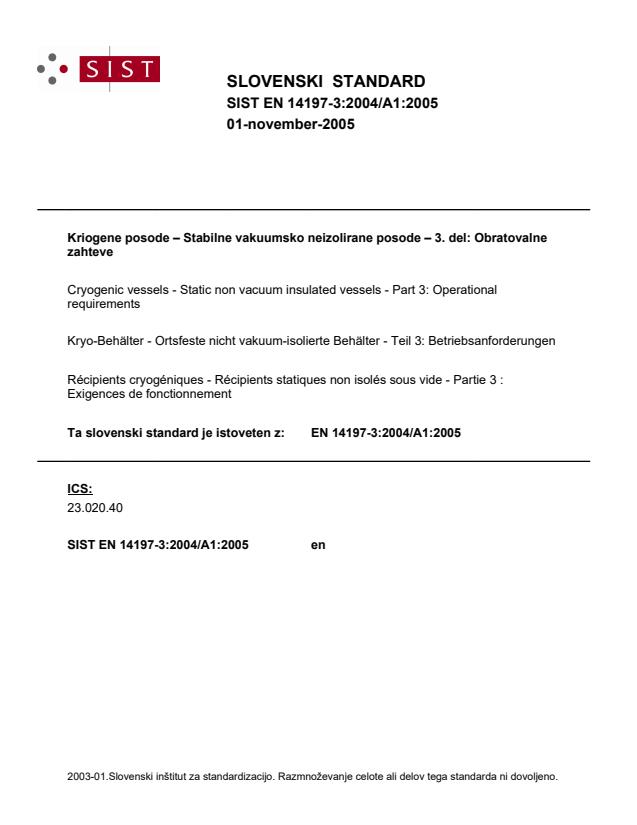
SLOVENSKI STANDARD
01-november-2005
Kriogene posode – Stabilne vakuumsko neizolirane posode – 3. del: Obratovalne
zahteve
Cryogenic vessels - Static non vacuum insulated vessels - Part 3: Operational
requirements
Kryo-Behälter - Ortsfeste nicht vakuum-isolierte Behälter - Teil 3: Betriebsanforderungen
Récipients cryogéniques - Récipients statiques non isolés sous vide - Partie 3 :
Exigences de fonctionnement
Ta slovenski standard je istoveten z: EN 14197-3:2004/A1:2005
ICS:
23.020.40
2003-01.Slovenski inštitut za standardizacijo. Razmnoževanje celote ali delov tega standarda ni dovoljeno.
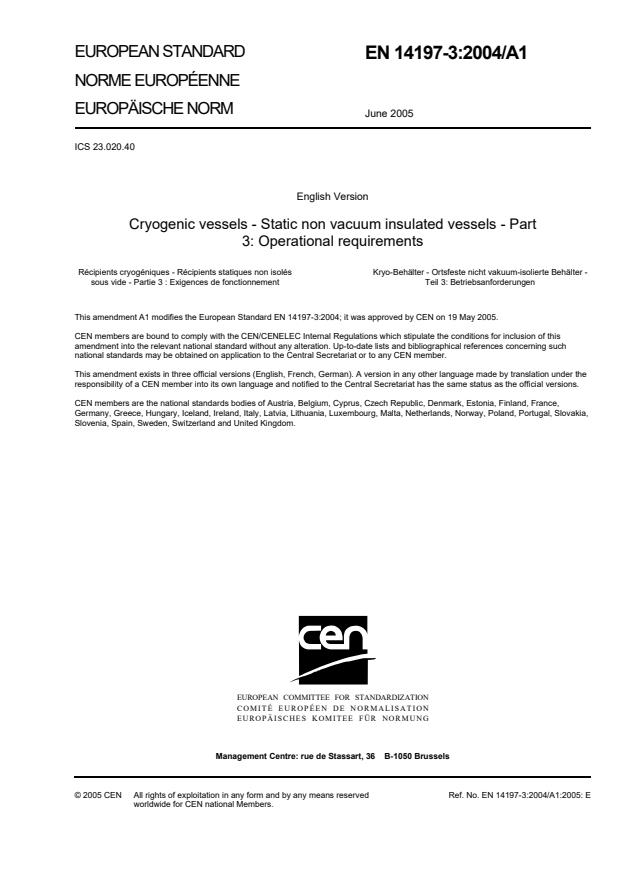
EUROPEAN STANDARD
EN 14197-3:2004/A1
NORME EUROPÉENNE
EUROPÄISCHE NORM
June 2005
ICS 23.020.40
English Version
Cryogenic vessels - Static non vacuum insulated vessels - Part
3: Operational requirements
Récipients cryogéniques - Récipients statiques non isolés Kryo-Behälter - Ortsfeste nicht vakuum-isolierte Behälter -
sous vide - Partie 3 : Exigences de fonctionnement Teil 3: Betriebsanforderungen
This amendment A1 modifies the European Standard EN 14197-3:2004; it was approved by CEN on 19 May 2005.
CEN members are bound to comply with the CEN/CENELEC Internal Regulations which stipulate the conditions for inclusion of this
amendment into the relevant national standard without any alteration. Up-to-date lists and bibliographical references concerning such
national standards may be obtained on application to the Central Secretariat or to any CEN member.
This amendment exists in three official versions (English, French, German). A version in any other language made by translation under the
responsibility of a CEN member into its own language and notified to the Central Secretariat has the same status as the official versions.
CEN members are the national standards bodies of Austria, Belgium, Cyprus, Czech Republic, Denmark, Estonia, Finland, France,
Germany, Greece, Hungary, Iceland, Ireland, Italy, Latvia, Lithuania, Luxembourg, Malta, Netherlands, Norway, Poland, Portugal, Slovakia,
Slovenia, Spain, Sweden, Switzerland and United Kingdom.
EUROPEAN COMMITTEE FOR STANDARDIZATION
COMITÉ EUROPÉEN DE NORMALISATION
EUROPÄISCHES KOMITEE FÜR
...