

EN 1729-2:2012/FprA1:2015
(Amendment)Furniture - Chairs and tables for educational institutions - Part 2: Safety requirements and test methods
- Abstract
This European Standard specifies safety requirements and test methods for chairs and tables for general educational purposes in educational institutions.
It applies to furniture for use with laptop computers or portable devices, but not to special purpose workstations, e.g. laboratories, ranked seating and workshops.
- Status
- Not Published
- Technical Committee
- CEN/TC 207 - Furniture
- Drafting Committee
- CEN/TC 207/WG 6 - Test methods for fire behaviour
- Current Stage
- 5060 - Closure of Vote - Formal Approval
- Start Date
- 16-Oct-2015
- Due Date
- 31-Jan-2016
- Completion Date
- 16-Oct-2015


Overview
EN 1729-2:2012/FprA1:2015 is a key European standard developed by CEN (European Committee for Standardization) that sets out safety requirements and test methods for chairs and tables used in general educational institutions. This standard specifically addresses furniture designed for educational purposes, including items compatible with laptop computers and portable devices used in learning environments. It excludes specialized workstations such as laboratories, ranked seating, and workshops.
This amendment to the original EN 1729-2:2012 includes important modifications to testing methods, scope clarifications, and references to updated related standards, ensuring enhanced safety, durability, and usability of educational furniture.
Key Topics
- Scope and application: Focus on general educational furniture, covering chairs and tables for schools and similar institutions, not suitable for specialized work areas.
- Safety requirements: Specifies mechanical safety, stability, strength, and durability criteria essential to prevent accidents and injuries in educational settings.
- Test methods: Incorporates state-of-the-art testing procedures aligned with updated standards EN 1728:2012 (for seating strength and durability) and EN 1730:2012 (for tables).
- Updates and amendments: Details changes including removal of Annex A, renaming of annexes, and replacement of references with latest versions of test standards.
- Furniture compatibility: Addresses furniture adaptability for new technologies used in education, like laptops and portable devices.
Applications
This standard is critical for manufacturers, designers, and educational facility managers intending to:
- Ensure the production and procurement of safe, durable, and ergonomically suitable furniture for schools and educational institutions.
- Comply with European regulations that mandate tested and certified furniture to protect students and staff against injury risks.
- Evaluate strength, stability, and safety performance through prescribed test methods that simulate real-life stress conditions found in classrooms.
- Integrate models suited for digital learning environments with proper support for laptops and portable devices without compromising safety.
- Maintain consistency and quality across furniture products used in primary, secondary, and tertiary educational facilities across Europe.
Related Standards
EN 1729-2:2012/FprA1:2015 works in conjunction with several important standards to create a comprehensive safety framework for educational furniture:
- EN 1728:2012 – Furniture - Seating - Test methods for strength, durability, and stability.
- EN 1730:2012 – Furniture - Tables - Test methods covering strength, durability, and stability.
- EN 1335-3:2009 – Office furniture - Office work chair - Part 3: Safety requirements.
- Harmonized regulations and national standards from CEN member countries supporting furniture safety compliance.
Benefits and Practical Value
- Promotes student safety by enforcing rigorous testing and safety requirements.
- Enhances furniture lifespan and durability under educational use conditions.
- Facilitates compliance with European regulations, reducing liability for manufacturers and institutions.
- Supports ergonomic design considerations important for student health and comfort.
- Provides a harmonized, widely accepted benchmark, simplifying procurement and manufacturing processes across Europe.
By adhering to EN 1729-2:2012/FprA1:2015, stakeholders uphold high safety standards in educational environments, ensuring furniture not only meets structural requirements but also supports evolving educational technology needs efficiently.
Relations
- Effective Date
- 18-Jan-2023
- Effective Date
- 21-May-2014
Frequently Asked Questions
EN 1729-2:2012/FprA1:2015 is a draft published by the European Committee for Standardization (CEN). Its full title is "Furniture - Chairs and tables for educational institutions - Part 2: Safety requirements and test methods". This standard covers: This European Standard specifies safety requirements and test methods for chairs and tables for general educational purposes in educational institutions. It applies to furniture for use with laptop computers or portable devices, but not to special purpose workstations, e.g. laboratories, ranked seating and workshops.
This European Standard specifies safety requirements and test methods for chairs and tables for general educational purposes in educational institutions. It applies to furniture for use with laptop computers or portable devices, but not to special purpose workstations, e.g. laboratories, ranked seating and workshops.
EN 1729-2:2012/FprA1:2015 is classified under the following ICS (International Classification for Standards) categories: 97.140 - Furniture. The ICS classification helps identify the subject area and facilitates finding related standards.
EN 1729-2:2012/FprA1:2015 has the following relationships with other standards: It is inter standard links to EN 1729-2:2012+A1:2015, EN 1729-2:2012. Understanding these relationships helps ensure you are using the most current and applicable version of the standard.
EN 1729-2:2012/FprA1:2015 is available in PDF format for immediate download after purchase. The document can be added to your cart and obtained through the secure checkout process. Digital delivery ensures instant access to the complete standard document.
Standards Content (Sample)
SLOVENSKI STANDARD
01-november-2015
Pohištvo - Stoli in mize za vzgojno-izobraževalne ustanove - 2. del: Varnostne
zahteve in preskusne metode
Furniture - Chairs and tables for educational institutions - Part 2: Safety requirements
and test methods
Möbel - Stühle und Tische für Bildungseinrichtungen - Teil 2: Sicherheitstechnische
Anforderungen und Prüfverfahren
Meubles - Chaises et tables pour les établissements d'enseignement - Partie 2 :
Exigences de sécurité et méthodes d'essai
Ta slovenski standard je istoveten z: EN 1729-2:2012/FprA1:2015
ICS:
97.140 Pohištvo Furniture
2003-01.Slovenski inštitut za standardizacijo. Razmnoževanje celote ali delov tega standarda ni dovoljeno.
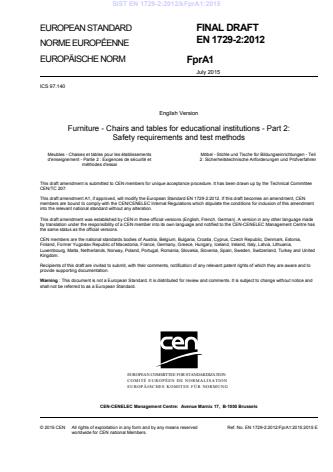
EUROPEAN STANDARD
FINAL DRAFT
EN 1729-2:2012
NORME EUROPÉENNE
EUROPÄISCHE NORM
FprA1
July 2015
ICS 97.140
English Version
Furniture - Chairs and tables for educational institutions - Part 2:
Safety requirements and test methods
Meubles - Chaises et tables pour les établissements Möbel - Stühle und Tische für Bildungseinrichtungen - Teil
d'enseignement - Partie 2 : Exigences de sécurité et 2: Sicherheitstechnische Anforderungen und Prüfverfahren
méthodes d'essai
This draft amendment is submitted to CEN members for unique acceptance procedure. It has been drawn up by the Technical Committee
CEN/TC 207.
This draft amendment A1, if approved, will modify the European Standard EN 1729-2:2012. If this draft becomes an amendment, CEN
members are bound to comply with the CEN/CENELEC Internal Regulations which stipulate the conditions for inclusion of this amendment
into the relevant national standard without any alteration.
This draft amendment was established by CEN in three official versions (English, French, German). A version in any other language made
by translation under the responsibility of a CEN member into its own language and notified to the CEN-CENELEC Management Centre has
the same status as the official versions.
CEN members are the national standards bodies of Austria, Belgium, Bulgaria, Croatia, Cyprus, Czech Republic, Denmark, Estonia,
Finland, Former Yugoslav Republic of Macedonia, France, Germany, Greece, Hungary, Iceland, Ireland, Italy, Latvia, Lithuania,
Luxembourg, Malta, Netherlands, Norway, Poland, Portugal, Romania, Slovakia, Slovenia, Spain, Sweden, Switzerland, Turkey and United
Kingdom.
Recipients of this draft are invited to submit, with their comments, notification of any relevant patent rights of which they are aware and to
provide supporting documentation.
Warning : This document is not a European Standard. It is distributed for review and comments. It is subject to change without notice and
shall not be referred to as a European Standard.
EUROPEAN COMMITTEE FOR STANDARDIZATION
COMITÉ EUROPÉEN DE NORMALISATION
EUROPÄISCHES KOMITEE FÜR NORMUNG
CEN-CENELEC Management Centre: Avenue Marnix 17, B-1000 Brussels
© 2015 CEN All rights of exploitation in any form and by any means reserved Ref. No. EN 1729-2:2012/FprA1:2015:2015 E
worldwide for CEN national Members.
Contents
Page
Foreword .3
1 Modification to the Foreword .4
2 Modifications to Clause 1, Scope .4
3 Modifications to Clause 2 .4
4 Modification to Clause 4 .4
5 Modification to 5.3.1 .4
6 Modification to 5.3.2 .4
7 Modification to 5.3.3 .4
8 Modification to 5.3.4 .4
9 Modifications to 5.3.5 .4
10 Modifications to 5.3.6 .4
11 Modification to 5.3.7 .4
12 Modification to 5.3.8 .5
13 Modifications to 5.3.9 .5
14 Modification to 5.3.10 .5
15 Modifications to 5.3.11 .
...