

EN 13322-1:2024
(Main)Transportable gas cylinders - Refillable welded steel gas cylinders - Design and construction - Part 1: Carbon steel
- Abstract
This document specifies minimum requirements concerning material, design, construction and workmanship, manufacturing processes and testing of refillable transportable welded carbon steel gas cylinders of water capacities up to and including 150 l for compressed, liquefied and dissolved gases.
For acetylene service, additional requirements for the cylinder and basic requirements for the porous material are given in EN ISO 3807. For cylinder shells for acetylene service manufactured from high frequency induction (HFI) welded steel tubes by spinning of the end, the requirements are given in Annex A.
This document is primarily applicable to industrial gases other than LPG but can also be applied for LPG. However for dedicated LPG cylinders, see EN 1442.
- Status
- Published
- Publication Date
- 14-May-2024
- Technical Committee
- CEN/TC 23 - Transportable gas cylinders
- Current Stage
- 6060 - Definitive text made available (DAV) - Publishing
- Start Date
- 15-May-2024
- Due Date
- 02-Mar-2023
- Completion Date
- 15-May-2024

Overview
EN 13322-1:2024 - Transportable gas cylinders - Refillable welded steel gas cylinders - Design and construction - Part 1: Carbon steel is the CEN European standard that sets minimum requirements for the design, materials, manufacture and testing of refillable welded carbon-steel gas cylinders with water capacities up to and including 150 l. Approved May 2024, it supersedes the 2003 edition and applies primarily to industrial gases (compressed, liquefied and dissolved gases). The document uses traditional calculation methods (not FEA) and includes normative annexes for specific manufacturing and inspection procedures.
Key topics and technical requirements
- Scope and applicability: refillable welded carbon-steel cylinders for transportable use, up to 150 l; primarily for industrial gases, can be applied to LPG but dedicated LPG cylinders are covered by EN 1442.
- Materials and heat treatment: requirements for steel grades, compatibility with gas contents, certificates of steel analysis, and permitted heat treatments (normalizing, stress relieving).
- Design: calculation methods, design stress factors, wall and end thickness considerations, shrouds and valve protection devices.
- Welding and workmanship: welding procedure qualification, welder qualification, welding consumables compatibility and strength requirements.
- Examination and testing:
- New design tests and batch tests (mechanical, tensile, ductility - including added requirements for small cylinders).
- Tests on every cylinder (hydraulic testing, visual inspection).
- Non-destructive testing (radiographic examination of welds, visual NDT), with acceptance criteria and defect evaluation.
- Quality control and records: batch traceability, test certificates, and manufacturer records.
- Marking: stamp marking and required information for traceability and regulatory compliance.
- Special cases: acetylene service-additional requirements referenced to EN ISO 3807; Annex A covers HFI-welded shells spun at the ends.
Practical applications
- Use EN 13322-1:2024 to develop or approve cylinder designs, prepare manufacturing specifications, and define production quality plans.
- Establish acceptance criteria and test regimes for production, batch release and periodic inspections.
- Ensure regulatory compliance for transport (references to ADR/RID are included in the standard’s guidance).
- Support procurement/specifications for gas cylinder manufacturers, gas suppliers, inspection bodies and testing laboratories.
Who should use this standard
- Cylinder manufacturers and design engineers
- Quality assurance and production managers
- Welding engineers and NDT personnel
- Certification bodies, inspection authorities and transport compliance officers
- Gas suppliers and industrial end-users specifying refillable cylinders
Related standards
- EN 1442 (dedicated LPG cylinders)
- EN ISO 3807 (acetylene porous material and cylinder requirements)
- EN ISO 9809-3, EN ISO 11114-1, EN ISO 17636-1/2 and other referenced standards on materials, testing and NDT techniques
Keywords: EN 13322-1:2024, transportable gas cylinders, refillable welded steel gas cylinders, carbon steel, cylinder design, manufacturing, testing, CEN.
Relations
- Effective Date
- 19-Jan-2023
- Effective Date
- 18-Jan-2023
- Effective Date
- 19-Aug-2026
- Effective Date
- 08-Jul-2026
- Refers
EN ISO 5173:2023 - Destructive tests on welds in metallic materials - Bend tests (ISO 5173:2023) - Effective Date
- 28-Jan-2026
- Effective Date
- 28-Jan-2026
- Effective Date
- 28-Jan-2026
- Effective Date
- 28-Jan-2026
- Effective Date
- 28-Jan-2026
- Effective Date
- 28-Jan-2026
- Effective Date
- 28-Jan-2026
- Effective Date
- 28-Jan-2026
- Effective Date
- 28-Jan-2026
- Effective Date
- 28-Jan-2026
- Effective Date
- 28-Jan-2026
Get Certified
Connect with accredited certification bodies for this standard

Institut za varilstvo d.o.o. (Welding Institute)
Slovenia's leading welding institute since 1952. ISO 3834, EN 1090, pressure equipment certification, NDT personnel, welder qualification. Only IIW Au
Sponsored listings
Frequently Asked Questions
EN 13322-1:2024 is a standard published by the European Committee for Standardization (CEN). Its full title is "Transportable gas cylinders - Refillable welded steel gas cylinders - Design and construction - Part 1: Carbon steel". This standard covers: This document specifies minimum requirements concerning material, design, construction and workmanship, manufacturing processes and testing of refillable transportable welded carbon steel gas cylinders of water capacities up to and including 150 l for compressed, liquefied and dissolved gases. For acetylene service, additional requirements for the cylinder and basic requirements for the porous material are given in EN ISO 3807. For cylinder shells for acetylene service manufactured from high frequency induction (HFI) welded steel tubes by spinning of the end, the requirements are given in Annex A. This document is primarily applicable to industrial gases other than LPG but can also be applied for LPG. However for dedicated LPG cylinders, see EN 1442.
This document specifies minimum requirements concerning material, design, construction and workmanship, manufacturing processes and testing of refillable transportable welded carbon steel gas cylinders of water capacities up to and including 150 l for compressed, liquefied and dissolved gases. For acetylene service, additional requirements for the cylinder and basic requirements for the porous material are given in EN ISO 3807. For cylinder shells for acetylene service manufactured from high frequency induction (HFI) welded steel tubes by spinning of the end, the requirements are given in Annex A. This document is primarily applicable to industrial gases other than LPG but can also be applied for LPG. However for dedicated LPG cylinders, see EN 1442.
EN 13322-1:2024 is classified under the following ICS (International Classification for Standards) categories: 23.020.35 - Gas cylinders. The ICS classification helps identify the subject area and facilitates finding related standards.
EN 13322-1:2024 has the following relationships with other standards: It is inter standard links to EN 13322-1:2003, EN 13322-1:2003/A1:2006, EN ISO 6892-2:2026, EN 13445-2:2026, EN ISO 5173:2023, EN 10028-3:2017, EN ISO 15607:2019, EN ISO 17637:2016, EN ISO 9809-3:2019, EN ISO 9606-1:2017, EN ISO 6892-1:2019, EN ISO 15614-1:2017, EN ISO 3183:2019, EN ISO 6892-2:2018, EN 10028-5:2017. Understanding these relationships helps ensure you are using the most current and applicable version of the standard.
EN 13322-1:2024 is available in PDF format for immediate download after purchase. The document can be added to your cart and obtained through the secure checkout process. Digital delivery ensures instant access to the complete standard document.
Standards Content (Sample)
SLOVENSKI STANDARD
01-oktober-2024
Nadomešča:
SIST EN 13322-1:2003
SIST EN 13322-1:2003/A1:2006
Premične plinske jeklenke - Ponovno polnljive varjene jeklenke iz jekla -
Konstruiranje in izdelava - 1. del: Jeklenke iz ogljičnega jekla
Transportable gas cylinders - Refillable welded steel gas cylinders - Design and
construction - Part 1: Carbon steel
Ortsbewegliche Gasflaschen - Wiederbefüllbare geschweißte Flaschen aus Stahl -
Auslegung und Herstellung - Teil 1: Flaschen aus Kohlenstoffstahl
Bouteilles à gaz transportables - Bouteilles à gaz rechargeables soudées en acier -
Conception et construction - Partie 1 : Acier au carbone
Ta slovenski standard je istoveten z: EN 13322-1:2024
ICS:
23.020.35 Plinske jeklenke Gas cylinders
2003-01.Slovenski inštitut za standardizacijo. Razmnoževanje celote ali delov tega standarda ni dovoljeno.
EN 13322-1
EUROPEAN STANDARD
NORME EUROPÉENNE
May 2024
EUROPÄISCHE NORM
ICS 23.020.35 Supersedes EN 13322-1:2003,
EN 13322-1:2003/A1:2006
English Version
Transportable gas cylinders - Refillable welded steel gas
cylinders - Design and construction - Part 1: Carbon steel
Bouteilles à gaz transportables - Bouteilles à gaz Ortsbewegliche Gasflaschen - Wiederbefüllbare
rechargeables soudées en acier - Conception et geschweißte Flaschen aus Stahl - Auslegung und
construction - Partie 1 : Acier au carbone Herstellung - Teil 1: Flaschen aus Kohlenstoffstahl
This European Standard was approved by CEN on 5 May 2024.
CEN members are bound to comply with the CEN/CENELEC Internal Regulations which stipulate the conditions for giving this
European Standard the status of a national standard without any alteration. Up-to-date lists and bibliographical references
concerning such national standards may be obtained on application to the CEN-CENELEC Management Centre or to any CEN
member.
This European Standard exists in three official versions (English, French, German). A version in any other language made by
translation under the responsibility of a CEN member into its own language and notified to the CEN-CENELEC Management
Centre has the same status as the official versions.
CEN members are the national standards bodies of Austria, Belgium, Bulgaria, Croatia, Cyprus, Czech Republic, Denmark, Estonia,
Finland, France, Germany, Greece, Hungary, Iceland, Ireland, Italy, Latvia, Lithuania, Luxembourg, Malta, Netherlands, Norway,
Poland, Portugal, Republic of North Macedonia, Romania, Serbia, Slovakia, Slovenia, Spain, Sweden, Switzerland, Türkiye and
United Kingdom.
EUROPEAN COMMITTEE FOR STANDARDIZATION
COMITÉ EUROPÉEN DE NORMALISATIO N
E U R OP ÄI S C H ES KOMITEE FÜR NORMUN G
CEN-CENELEC Management Centre: Rue de la Science 23, B-1040 Brussels
© 2024 CEN All rights of exploitation in any form and by any means reserved Ref. No. EN 13322-1:2024 E
worldwide for CEN national Members.
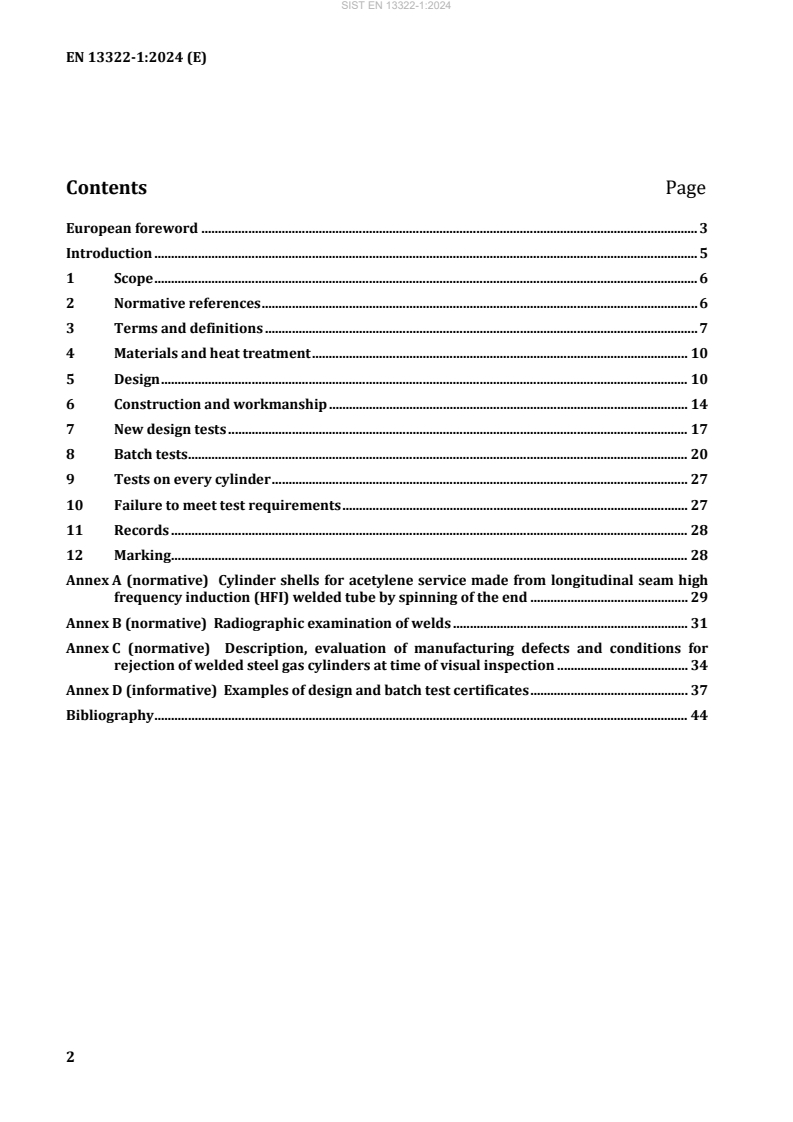
Contents Page
European foreword . 3
Introduction . 5
1 Scope . 6
2 Normative references . 6
3 Terms and definitions . 7
4 Materials and heat treatment . 10
5 Design . 10
6 Construction and workmanship . 14
7 New design tests . 17
8 Batch tests . 20
9 Tests on every cylinder . 27
10 Failure to meet test requirements . 27
11 Records . 28
12 Marking . 28
Annex A (normative) Cylinder shells for acetylene service made from longitudinal seam high
frequency induction (HFI) welded tube by spinning of the end . 29
Annex B (normative) Radiographic examination of welds . 31
Annex C (normative) Description, evaluation of manufacturing defects and conditions for
rejection of welded steel gas cylinders at time of visual inspection . 34
Annex D (informative) Examples of design and batch test certificates . 37
Bibliography . 44
European foreword
This document (EN 13322-1:2024) has been prepared by Technical Committee CEN/TC 23
“Transportable gas cylinders”, the secretariat of which is held by BSI.
This European Standard shall be given the status of a national standard, either by publication of an
identical text or by endorsement, at the latest by November 2024, and conflicting national standards
shall be withdrawn at the latest by November 2024.
Attention is drawn to the possibility that some of the elements of this document may be the subject of
patent rights. CEN shall not be held responsible for identifying any or all such patent rights.
This document supersedes EN 13322-1:2003 and EN 13322-1:2003/A1:2006.
In comparison with the previous edition, the following technical modifications have been made:
— updating of the normative references;
— removal of the limit of a minimal water capacity of 0,5 l;
— addition of a new Clause 8.4.4 “Requirements for ductility testing of small cylinders”;
— modification of term 3.1 from yield stress to yield strength;
— update according to the latest requirements on standards to be proposed for ADR;
— clarification of the verbal forms for expression of provisions;
— removal of Annex E.
This document has been submitted for reference in:
— the RID [5] and
— the technical annexes of the ADR [4].
NOTE Attention is drawn to possible national/international legislation in relation to this document. It is
emphasized that the the RID/ADR are being revised regularly at intervals of two years.
This document is one of a series of two standards concerning refillable welded steel gas cylinders of
water capacities up to and including 150 l for compressed, liquefied and dissolved gases:
— Part 1: Carbon steel
— Part 2: Stainless steel
Annexes A, B and C are normative. Annex D is informative.
Any feedback and questions on this document should be directed to the users’ national standards body.
A complete listing of these bodies can be found on the CEN website.
According to the CEN-CENELEC Internal Regulations, the national standards organisations of the
following countries are bound to implement this European Standard: Austria, Belgium, Bulgaria,
Croatia, Cyprus, Czech Republic, Denmark, Estonia, Finland, France, Germany, Greece, Hungary, Iceland,
Ireland, Italy, Latvia, Lithuania, Luxembourg, Malta, Netherlands, Norway, Poland, Portugal, Republic of
North Macedonia, Romania, Serbia, Slovakia, Slovenia, Spain, Sweden, Switzerland, Türkiye and the
United Kingdom.
Introduction
The purpose of this document is to provide a specification for the design, manufacture, and testing of
refillable, transportable, welded steel gas cylinders.
The specifications given are based on knowledge of, and experience with, materials, design
requirements, manufacturing processes and control during manufacture, of cylinders in common use in
the countries of the CEN members.
This document is based on the traditional calculation method. It does not cover other methods such as
finite element analysis (F.E.A) methods or experimental methods.
1 Scope
This document specifies minimum requirements concerning material, design, construction and
workmanship, manufacturing processes and testing of refillable transportable welded carbon steel gas
cylinders of water capacities up to and including 150 l for compressed, liquefied and dissolved gases.
For acetylene service, additional requirements for the cylinder and basic requirements for the porous
material are given in EN ISO 3807. For cylinder shells for acetylene service manufactured from high
frequency induction (HFI) welded steel tubes by spinning of the end, the requirements are given in
Annex A.
This document is primarily applicable to industrial gases other than LPG but can also be applied for LPG.
However for dedicated LPG cylinders, see EN 1442.
2 Normative references
The following documents are referred to in the text in such a way that some or all of their content
constitutes requirements of this document. For dated references, only the edition cited applies. For
undated references, the latest edition of the referenced document (including any amendments) applies.
EN 10028-1, Flat products made of steels for pressure purposes - Part 1: General requirements
EN 10028-3, Flat products made of steels for pressure purposes - Part 3: Weldable fine grain steels,
normalized
EN 10028-5, Flat products made of steels for pressure purposes - Part 5: Weldable fine grain steels,
thermomechanically rolled
EN 10120, Steel sheet and strip for welded gas cylinders
EN 13445-2, Unfired pressure vessels - Part 2: Materials
EN ISO 148-1, Metallic materials - Charpy pendulum impact test - Part 1: Test method (ISO 148-1)
EN ISO 683-1, Heat-treatable steels, alloy steels and free-cutting steels - Part 1: Non-alloy steels for
quenching and tempering (ISO 683-1)
EN ISO 683-2, Heat-treatable steels, alloy steels and free-cutting steels - Part 2: Alloy steels for quenching
and tempering (ISO 683-2)
EN ISO 3183, Petroleum and natural gas industries - Steel pipe for pipeline transportation systems
(ISO 3183)
EN ISO 5173, Destructive tests on welds in metallic materials - Bend tests
EN ISO 5817, Welding - Fusion-welded joints in steel, nickel, titanium and their alloys (beam welding
excluded) - Quality levels for imperfections (ISO 5817)
EN ISO 6892-1, Metallic materials - Tensile testing - Part 1: Method of test at room temperature
(ISO 6892-1)
EN ISO 6892-2, Metallic materials - Tensile testing - Part 2: Method of test at elevated temperature
(ISO 6892-2)
EN ISO 9606-1, Qualification testing of welders - Fusion welding - Part 1: Steels (ISO 9606-1)
EN ISO 9712, Non-destructive testing - Qualification and certification of NDT personnel (ISO 9712)
EN ISO 9809-3:2019, Gas cylinders - Design, construction and testing of refillable seamless steel gas
cylinders and tubes - Part 3: Normalized steel cylinders and tubes (ISO 9809-3:2019)
EN ISO 10675-1, Non-destructive testing of welds - Acceptance levels for radiographic testing - Part 1:
Steel, nickel, titanium and their alloys (ISO 10675-1)
EN ISO 11114-1, Gas cylinders - Compatibility of cylinder and valve materials with gas contents - Part 1:
Metallic materials (ISO 11114-1)
EN ISO 11117:2019, Gas cylinders - Valve protection caps and guards - Design, construction and tests
(ISO 11117:2019)
EN ISO 13769, Gas cylinders - Stamp marking (ISO 13769)
EN ISO 15607, Specification and qualification of welding procedures for metallic materials - General rules
(ISO 15607)
EN ISO 15609-1, Specification and qualification of welding procedures for metallic materials - Welding
procedure specification - Part 1: Arc welding (ISO 15609-1)
EN ISO 15614-1, Specification and qualification of welding procedures for metallic materials - Welding
procedure test - Part 1: Arc and gas welding of steels and arc welding of nickel and nickel alloys
(ISO 15614-1)
EN ISO 17636-1:2022, Non-destructive testing of welds - Radiographic testing - Part 1: X- and gamma-ray
techniques with film (ISO 17636-1:2022)
EN ISO 17636-2:2022, Non-destructive testing of welds - Radiographic testing - Part 2: X- and gamma-ray
techniques with digital detectors (ISO 17636-2:2022)
EN ISO 17637, Non-destructive testing of welds - Visual testing of fusion-welded joints (ISO 17637)
3 Terms, definitions and symbols
For the purposes of this document, the terms and definitions given in EN ISO 10286 and the following
apply.
ISO and IEC maintain terminological databases for use in standardization at the following addresses:
• IEC Electropedia: available at https://www.electropedia.org/
• ISO Online browsing platform: available at https://www.iso.org/obp
3.1 Terms and definitions
3.1.1
yield strength
stress corresponding to the point reached during the test at which plastic deformation occurs without
any increase in the force, in case the metallic material exhibits a yield phenomenon
3.1.2
normalizing
heat treatment in which a cylinder is heated to a uniform temperature above the upper critical point of
the steel and then cooled in a controlled atmosphere
Note 1 to entry: Upper critical point is A , as specified in EN ISO 4885.
3.1.3
stress relieving
heat treatment given to the finished cylinder, the object of which is to reduce the residual stresses
without altering the metallurgical structure of the steel, by heating to a uniform temperature below the
lower critical point of the steel and cooling in a still atmosphere
Note 1 to entry: Lower critical point is A , as specified in EN ISO 4885.
3.1.4
batch
quantity of finished cylinders made consecutively during the same or consecutive days to the same
design, size and material specifications and from the same material supplier for each pressure
containing part on the same automatic welding machines and heat-treated under the same conditions
of temperature and duration
Note 1 to entry: This definition allows different suppliers to be used for the different pressure containing parts
within a batch, e.g. one supplier for heads, another for bases.
3.1.5
design stress factor
F
ratio of equivalent wall stress at test pressure (p ) to guaranteed minimum yield strength (R )
h e
3.1.6
test valve
valve used for the drop test to qualify the shroud as a valve protection device
3.1.7
permitted mass
mass of the cylinder and valve plus its maximum contents as used in the drop test
3.1.8
shroud
integral part of a welded cylinder design for valve protection during transport, handling and storage
3.2 Symbols
a Calculated minimum thickness, in millimetres, of the cylindrical shell
a' Guaranteed minimum thickness, in millimetres, of the cylindrical shell (including any
corrosion allowance see 7.1)
a Calculated value of a used in the calculation of b (see 5.3.2)
A Percentage elongation after fracture
b Calculated minimum thickness, in millimetres, of the cylinder end (see Figure 1)
b' Guaranteed minimum thickness, in millimetres, of the cylinder end (see 7.1)
C Shape factor of dished ends
D Outside diameter, in millimetres, of the cylinder (see Figure 1)
D Diameter of former in millimetres (see Figure 11)
f
F Design stress factor (see 3.1.5)
h Height, in millimetres, of the cylindrical part of the end (see Figure 1)
H Outside height, in millimetres, of the domed part of the end (see Figure 1)
J Stress reduction factor (see Annex B)
L Length, in millimetres, of the cylinder
n Ratio of diameter of bend test former (D ) to the thickness of the test piece (t)
f
p Measured burst pressure, in bar , above atmospheric pressure, in the burst test
b
p Hydraulic test pressure, in bar, above atmospheric pressure
h
r Inside radius of knuckle end, in millimetres (see Figure 1)
R Inside radius of the dished end, in millimetres (see Figure 1)
R Yield strength, in megapascals, as defined in 3.1.1 and used for design calculation
e
R Value of the actual yield strength in megapascals determined by the tensile test
ea
R Minimum value of the upper yield strength, in megapascals, guaranteed by the cylinder
eH
manufacturer for the finished cylinder, in accordance with EN ISO 6892-1
R Minimum value of the lower yield strength, in megapascals, guaranteed by the cylinder
eL
manufacturer for the finished cylinder, in accordance with EN ISO 6892-1
R Minimum value of tensile strength, in megapascals, guaranteed by the cylinder manufacturer
g
for the finished cylinder
R Actual value of tensile strength, in megapascals, determined by the tensile test (see 8.4)
m
Original cross-sectional area of tensile test piece, in square millimetres, according to
S
o
EN ISO 6892-1
t Actual thickness of the test specimen, in millimetres (see Figure 7)
1 bar = 10 Pa = 0,1 MPa
4 Materials and heat treatment
4.1 General
4.1.1 Materials supplied for shells and end pressing shall conform to EN 10120, or EN 10028-1 and
EN 10028-3, or EN 10028-1 and EN 10028-5.
4.1.2 Materials supplied for bosses shall conform to EN ISO 683-1 and EN ISO 683-2.
4.1.3 Grades of steel used for the manufacture shall be compatible with the intended gas service (e.g.
corrosive gases, embrittling gases) in accordance with EN ISO 11114-1.
4.1.4 All parts welded to the cylinder (e.g. shroud, footring) shall be made of compatible weldable
material.
4.1.5 The welding consumables shall be such that they are capable of giving consistent welds with
minimum tensile strength at least equal to that specified for the parent material in the finished cylinder.
4.1.6 The manufacturer shall obtain and provide certificates of the ladle analysis of the steel supplied
for the construction of the pressure retaining parts of the cylinder.
4.1.7 The manufacturer shall be able to guarantee cylinder steel casting traceability for each cylinder.
4.1.8 Cylinders for acetylene service shall be manufactured with materials compatible with the
manufacturing process of the porous mass, or an internal coating shall be applied.
4.2 Heat treatment
Cylinders shall be delivered in either the normalized or the stress-relieved condition. The cylinder
manufacturer shall certify that the cylinders have been heat-treated after completion of all welding and
shall certify the process of heat treatment applied. Localized heat treatment of cylinders is not
permitted, nor in the case of repaired cylinders.
The actual temperature of heat treatment to which a type of steel is subjected for a given tensile strength
shall not deviate by more than 30 °C from the temperature specified by the manufacturer for the
cylinder type.
5 Design
5.1 General requirements
5.1.1 The calculation of the wall thickness of the pressure parts shall be related to the yield strength
of the parent material.
5.1.2 For calculation purposes, the value of the yield strength R is limited to a maximum of 0,85 R .
e g
5.1.3 The internal pressure upon which the calculation of gas cylinders is based shall be the test
pressure p .
h
5.1.4 A fully dimensioned drawing including the specification of the material shall be produced.
5.1.5 Cylinders for acetylene service shall be designed to allow for a test pressure of at least 60 bar.
5.1.6 Cylinders for acetylene service shall be designed and manufactured to ensure that conditions
are safe for the eventual filling of the porous mass, e.g. preventing sharp edges and voids.
5.2 Calculation of cylindrical wall thickness
The wall thickness of the cylindrical shell shall be not less than that calculated using the formula
10.F.J R − 3.p
D
eh
a= ⋅−1
2 10.F.J R
e
0,65
where the value of F is the lesser of or 0,77.
(RRe/ g )
R /R shall not exceed 0,85.
e g
The value of J shall be selected in accordance with Annex B.
The minimum wall thickness shall also satisfy the requirements of 5.4.
5.3 Design of convex ends (see Figure 1)
5.3.1 The shape of ends of gas cylinders shall be such that the following conditions are fulfilled:
— for torispherical ends (see Figure 1a):
R ≤ D;
r ≥ 0,1 D;
h ≥ 4b.
— for ellipsoidal ends (see Figure 1b):
H ≥ 0,192 D;
h ≥ 4b.
5.3.2 The wall thickness of the ends of gas cylinders shall be not less than that calculated using the
formula:
× C
b = a
where
a is the value of a calculated in accordance with 5.2 using J = 1,0;
C is a shape factor, whose value shall be obtained from the graphs given in Figures 2 and 3.
a) Torispherical b) Ellipsoidal
Figure 1 — Illustration of cylinder ends
Figure 2 — Values of shape factor C for H/D between 0,2 and 0,25
Figure 3 — Values of shape factor C for H/D between 0,25 and 0,5
5.4 Minimum wall thickness
5.4.1 The minimum wall thickness of the cylindrical shell a and end b shall be not less than the value
derived from the appropriate one of the following formulae:
for D ≤ 100 mm, a = b = 1,1 mm;
for 100 mm < D ≤ 150 mm, a = b = 1,1 + 0,008(D - 100) mm;
D
for D > 150 mm, a = b = + 0,7 mm, with an absolute minimum of 1,5 mm.
These formulae apply to cylindrical shells and ends irrespective of whether they are designed by
calculation under 5.2 and 5.3 or by the pressure cycling test in 7.3.2.
5.4.2 Apart from the requirements of 5.3, 5.4 and 5.5 any cylindrical part integral with an end shall,
except as qualified by 5.4.3, also satisfy the requirements given in 5.2 for the cylindrical shell.
5.4.3 Where the length of the cylindrical portion of the gas cylinder, measured between the beginning
2bD
of the domed parts of the two ends, is not more than , the wall thickness shall be not less than that
of the domed part (see 5.3.2).
NOTE For certain gases, additional corrosion allowance can be applicable.
5.5 Ends of other shapes
Ends of shapes other than those covered by 5.3 may be used provided that the adequacy of their design
is demonstrated by a pressure cycling test in accordance with 7.3.2 or by stress analysis.
5.6 Design of openings
5.6.1 The location of all openings shall be restricted to the end(s) of cylinders.
5.6.2 Each opening in the cylinder shall be reinforced, either by a valve boss or pad, of weldable and
compatible steel, securely attached by welding and so designed as to be of adequate strength and to
result in no harmful stress concentrations. This shall be confirmed by design calculations or a pressure
cycling test in accordance with 7.3.2.
5.6.3 The welds of the openings shall be separated from longitudinal and circumferential joints by a
distance not less than 3a.
6 Construction and workmanship
6.1 General
The cylinder or cylinder parts shall be produced by:
— using seamless or longitudinally welded tube with forged ends being circumferentially welded; or
— using longitudinally welded tube with spun ends; or
— using a seamless tube, followed by hot forming where the base is sealed with added weld metal; or
— using cold worked tube or plates; or
— using deep drawn parts; or
— using high frequency induction welded tube with welded ends.
6.2 Welding procedures
Each manufacturer, before proceeding with the production of a given design of cylinder, shall qualify all
welding procedures to EN ISO 15607, EN ISO 15614-1 and EN ISO 15609-1 and welders to
EN ISO 9606-1. Records of such qualification shall be kept on file by the manufacturer.
6.3 Welded joints of pressure containing parts
6.3.1 The welding of longitudinal and circumferential seams shall be by an automatic process. Manual
welding is however permitted for boss welds except when they are butt welds.
6.3.2 The longitudinal joint, of which there shall be no more than one, shall be butt-welded.
6.3.3 Circumferential joints, of which there shall be no more than two, excluding end bungs, shall be
butt-welded, joggle welded, or butt welded with a backing ring.
6.3.4 For acetylene service, the joints shall be designed in such a way as to eliminate the risk of
damaging the porous mass.
6.4 Non-pressure-containing attachments
6.4.1 Parts which are not submitted to pressure such as footrings, handles and neckrings shall be
made of steel compatible with that of the cylinder.
6.4.2 Each attachment shall be designed to permit inspection of the attachment welds, shall be clear
of longitudinal and circumferential joints, and so designed as to avoid trapping water.
6.4.3 A footring or other support shall be fitted to the cylinder when required to provide stability and
attached so as to permit inspection of the bottom circumferential weld. Permanently attached footrings
shall be drained and the space enclosed by the footring shall be ventilated.
6.5 Valve protection
If a shroud is used to protect the valve, the cylinder containing the shroud shall be drop tested at
ambient temperature specified in subclause 7.7 of EN ISO 11117:2019.
If the shroud was qualified to provide valve protection, the test report shall give the dimensions l (valve
length in fitted condition) and R (valve body radius) of the test valve as specified in Figure 2 of
EN ISO 11117:2019 and the permitted mass.
6.6 Neck threads
Cylinder neck threads shall conform to a recognized standard to permit the use of a corresponding valve
thus minimizing neck stresses following the valve torquing operation. Cylinder neck threads shall be
checked using gauges corresponding to the agreed neck thread, or by an alternative method. Particular
care shall be taken to ensure that neck threads are accurately cut, are of full form and free from any
sharp profiles, e.g. burrs.
NOTE For example, where the neck thread is specified to be in accordance with EN ISO 11363-1, the
corresponding gauges are specified in EN ISO 11363-2.
6.7 Visual examination
6.7.1 Unacceptable defects
Before assembly, the pressure containing parts of the cylinders shall be examined for uniform quality
and freedom from unacceptable defects, examples of which are given in Annex C.
6.7.2 Welds
6.7.2.1 Before the cylinders are closed, longitudinal welds shall be visually examined from both
sides. Permanent backing strips shall not be used with longitudinal welds.
6.7.2.2 All welds shall have a smooth finish without concavity and shall merge into the parent
material without under-cutting or abrupt irregularity.
6.7.2.3 Butt welds shall have full penetration. For joggle welds, the penetration shall be full on the
straight edge and shall be sufficient on the swaged edge (see Figure 4).
6.7.2.4 Radiographic examination, radioscopic examination, or NDT examination carried out using
another suitable method, shall be as specified in Annex B.
Dimensions in millimetres
a) butt welds b) joggle welds
W – 1.5xa, never less than 5 mm
Figure 4 — Illustration of welding penetration
6.7.3 Out of roundness
The out-of-roundness of the cylindrical shell shall be limited so that the difference between the
maximum and the minimum outside diameter in the same cross-section is not more than 2 % of the
mean of these diameters.
6.7.4 Straightness
Unless otherwise specified on the manufacturing drawing, the maximum deviation of the cylindrical
part of the shell from a straight line shall not exceed 0,3 % of the cylindrical length.
6.7.5 Verticality
When the cylinder is standing on its base, the cylindrical shell and concentric top opening shall be
vertical to within 1 % of the cylindrical length.
6.7.6 Tightness
Tests appropriate to the manufacturing process shall be carried out to ensure that there is no leakage
from the cylinder.
7 New design tests
7.1 General requirements
7.1.1 Testing shall be carried out for each new design of cylinder.
A cylinder shall be considered to be of a new design compared with an existing design when:
— it is manufactured in a different factory; or
— it is manufactured by a different welding process or a radical change in an existing process, e.g.
change of type of heat treatment; or
— it is manufactured from a steel of different specified chemical composition range; or
— it is given a different heat treatment outside the ranges stipulated in 4.2; or
— if there is a change in base profile, e.g. concave, convex, hemispherical, or there is a change in the
base thickness/cylinder diameter ratio; or
— the guaranteed minimum yield strength (R ) or guaranteed minimum tensile strength (R ) has
e g
changed; or
— the overall length of the cylinder has increased by more than 50 % (cylinders with a
length/diameter ratio less than 3 shall not be used as reference cylinders for any new design with
this ratio greater than 3); or
— the nominal outside diameter has changed; or
— the guaranteed minimum wall thickness (a') or the guaranteed minimum end thickness (b') has
been decreased; or
— the hydraulic test pressure has been changed (where a cylinder is used for a lower pressure duty
than that for which the cylinder was approved, it shall not be deemed a new design).
7.1.2 A technical specification of the cylinder, including design drawing, design calculations, material
details, welding and manufacturing process and heat treatment, shall be prepared by the manufacturer
and attached to the design test certificate (for an example see Annex D).
7.1.3 A minimum of 50 finished cylinders, which shall be guaranteed by the manufacturer to be
representative of a new design, shall be made available for design testing. If the total production is less
than 50 cylinders, enough cylinders shall be made to complete the tests required, in addition to the
production quantity. In this case the design test certificate is limited to the particular batch.
7.1.4 The testing process shall include the verifications and tests listed in 7.2.1 and 7.2.2 respectively.
7.2 Verifications and tests
7.2.1 Verifications
It shall be verified that:
— the requirements of Clause 4 (material) are fulfilled;
— the design conforms to the requirements of Clause 5;
— the requirements of Clause 6 and Annex B are fulfilled for all cylinders selected;
— the internal and external surfaces of the cylinders are free of any defect which could make them
unsafe for use (see Annex C).
7.2.2 List of tests
The following shall be performed on cylinders selected after the welds of the cylinders have been
visually inspected:
— the test specified in 7.3.1 (hydraulic burst test) on one cylinder, the cylinder bearing representative
stamp marking;
— the test specified in 7.3.2 (pressure cycling test) on one cylinder, the cylinder bearing
representative stamp marking;
— the tests specified in 8.4 (tensile test), 8.5 (bend test), 8.6 (impact test) where applicable and 8.7
(macroscopic examination of weld cross-sections), on one cylinder, the test pieces being
identifiable to the batch;
— radiographic examination, radioscopic examination, or NDT examination carried out using another
suitable method, as specified in Annex B.
7.3 Descriptions of tests
7.3.1 Hydraulic burst test
7.3.1.1 Cylinders subjected to this test shall bear markings in accordance with the complete stamp
markings as required for the finished cylinder. The hydraulic burst test shall be carried out with
equipment which enables the pressure to be increased at a controlled rate until the cylinder bursts and
the change in pressure with time to be recorded.
7.3.1.2 For a test pressure (p ) ≤ 60 bar the burst pressure (p ) shall be at least 9/4 times the test
h b
pressure with a minimum burst pressure of 50 bar, and for a test pressure > 60 bar the burst pressure
shall be at least twice the test pressure.
7.3.1.3 The burst test shall not cause any fragmentation of the cylinder.
7.3.1.4 The main fracture shall not show any brittleness, i.e. the edges of the fracture shall not be
radial but shall be at an angle to a diametral plane and display a reduction of area throughout their
thickness. The fracture shall be examined and shall be free of defects.
7.3.1.5 Additionally for cylinders with a test pressure (p ) ≤ 60 bar, the ratio of the volumetric
h
expansion of the cylinder to its initial volume shall be at least:
— For Rg < 480 MPa
— 20 % if the length of the cylinder is greater than the diameter, D; or
— 14 % if the length of the cylinder is equal to or less than the diameter, D.
— For Rg ≥ 480 MPa
— 15 % if the length of the cylinder is greater than the diameter, D; or
— 10 % if the length of the cylinder is equal to or less than the diameter, D.
NOTE 1 Length of the cylinder is the length of the pressure envelope including the valve boss.
NOTE 2 High volumetric expansion provides additional safety in case of overfilling or exposure to high
temperature for liquefied gases.
To measure the volumetric expansion of the cylinder, the volume of water used between the time when
the pressure starts to rise and at the time of bursting shall be considered.
7.3.2 Pressure cycling test
7.3.2.1 The pressure cycling test shall be carried out on one cylinder bearing the required stamp
markings. See Clause 12 for particular requirements concerning stamp markings on the dome ends.
7.3.2.2 This test shall be carried out with a non-corrosive liquid, subjecting the cylinder to
successive reversals at an upper cyclic pressure which is equal to the hydraulic test pressure (p ). The
h
value of the lower cyclic pressure shall not exceed 10 % of the upper cyclic pressure. The frequency of
reversals of pressure shall not exceed 0,25 Hz (15 cycles/minute). The temperature measured on the
outside surface of the cylinder shall not exceed 50 °C during the test.
7.3.2.3 The cylinder shall be subjected to 12 000 cycles without leakage or failure.
7.3.2.4 For cylinders manufactured according to Annex A or manufactured from tubes with spun
ends, after the test the bases of cylinders shall be sectioned in order to measure the thickness and to
ensure that this thickness is no more than 15 % above the minimum base thickness prescribed in the
design. The actual wall and base thickness shall be measured and recorded on the design test certificate.
7.4 Design testing certificate
If the results of the checks are satisfactory, a design test certificate shall be issued, a typical example of
which is given in Annex D.
8 Batch tests
8.1 General
For the purpose of carrying out the batch testing, a random sample of cylinders as indicated in Table 1
shall be taken from each batch, as defined in 3.1.4. A batch shall consist of a maximum of 3 000 cylinders.
All batch tests shall be carried out on finished cylinders.
Table 1 — Batch sampling
Batch size Number of cylinders to be tested
a
Number Tensile Macroscopic Burst tests (as
Impact test
of test and examination (as per 7.3.1)
(as per 8.6)
cylinders bend test per 8.7)
taken as (as per 8.4
samples and 8.5)
Up to 200 2 1 1 1 1
201 to 500 3 1 1 1 2
501 to 1 500 9 2 1 1 7
1 501 to 3 000 18 3 1 1 15
a
If required, as specified in 7.3.
8.2 Information
For the purpose of batch testing, the following shall be provided:
— the design test certificate;
— the certificates for the material of construction as required in 4.1.6 stating the cast analyses of the
steel supplied for the construction of the cylinders;
— a list of cylinders, stating serial numbers and stamp markings as required;
— a statement of the thread checking method used and the results thereof.
8.3 Checks and verifications
The following checks and verifications shall be carried out on each batch of cylinders:
— ascertain that a design test certificate has been obtained and that the cylinders conform to it;
— check whether the requirements set out in Clauses 4, 5, 6 and 12 have been met, and in particular
check by an external and internal examination of the cylinders whether the construction and checks
carried out by the manufacturer in accordance with Clause 6 are satisfactory. The visual
examination shall cover at least 10 % of the cylinders submitted. However, if an unacceptable defect
is found (as described in Annex C) 100 % of cylinders shall be visually inspected;
— carry out or witness the tests specified in 8.4 (tensile test), 8.5 (bend test), 8.6 (impact test) where
applicable, 8.7 (macroscopic examination of weld cross-sections) and 7.3.1 (hydraulic burst test)
on the number of cylinders specified in 8.1;
— check whether the information supplied by the manufacturer listed in 8.2 is correct; random checks
shall be carried out;
— assess the results of the NDT examination, as specified in Annex B.
8.4 Tensile test
8.4.1 General
The tensile test on parent metal shall be carried out on a test sample taken from the finished cylinder in
accordance with the requirements of EN ISO 6892-1. The two faces of the test sample formed by the
inside and the outside surfaces of the cylinder shall not be machined. The tensile test on welds shall be
carried out in accordance with 8.4.3. If the dimension (diameter and length) of a “small cylinder” does
not permit the test samples for the tensile test to be prepared in accordance with EN ISO 6892-1,
alternative testing as described in 8.4.4 shall be carried out.
8.4.2 Tensile test samples required from parent material
8.4.2.1 For two-part cylinders, either one tensile test sample shall be cut in the longitudinal
direction from the cylindrical portion of one end of the cylinder, or, if there is not sufficient cylindrical
length available to permit cutting the cylindrical portion, then one tensile test sample shall be taken
from one end (see Figure 6).
8.4.2.2 For three-part cylinders, one tensile test sample in the longitudinal direction from the shell
section 180° away from the weld and one tensile test sample from either of the ends shall be taken. If
the two ends are of different grades or from a different supplier of material, a tensile test sample shall
be taken from each end (see Figure 5).
8.4.2.3 The values obtained for yield strength (R ), tensile strength (R ) and elongation (A) shall
ea m
be not less than those guaranteed by the cylinder manufacturer and in accordance with those given in
EN 10120, or EN 10028-1 and EN 10028-3, or EN 10028-1 and EN 10028-5, as appropriate.
8.4.3 Tensile test samples required from welds
8.4.3.1 For two-part cylinders, one tensile test sample shall be taken (see Figure 5).
8.4.3.2 For three-part cylinders, one tensile test sample on the longitudinal weld shall be taken. If
the circumferential welds are made by a different procedure, then the same test shall also be made on
this weld (see Figure 6).
8.4.3.3 The tensile test transverse to the weld shall be carried out on a test sample having a reduced
section 25 mm wide over a length extending to 15 mm beyond each edge of the weld. Outside this
central part, the width of the test sample shall increase progressively (see Figure 7). The tolerances
specified in EN ISO 6892-1 and EN ISO 6892-2 shall apply.
8.4.3.4 All tensile tests shall be in a direction transverse to the weld. The face and root of the weld
in the test sample shall be machined flush to the plate surface.
The face and back of the parent metal shall not be machined but shall represent the surface of the
cylinder as manufactured. If ends need to be flattened, cold pressing for gripping in the test machine
shall be used. The tensile strength value obtained shall be at least equal to the minimum value specified
in 8.4.2.3 for the parent metal, regardless of the position of the fracture.
Key
1 1 tensile test piece
2 1 tensile test piece, 1 root bend test piece, 1 face bend test piece
3 1 tensile test piece
Required only if insufficient cylindrical length available
4 Impact test
Figure 5 — Test pieces from two-part cylinders
Key
1 1 tensile test piece
2 1 tensile test piece
1 root bend test piece
1 face bend test piece
3 1 tensile test piece
1 root bend test piece
1 face bend test piece
Required only if welded by a different process from longitudinal weld (see 8.4.3.2 and 8.5.5)
4 Impact test piece
5 1 tensile test piece
Figure 6 — Test pieces from three-part cylinders
Dimensions in millimetres
Key
1 Weld
Note For tolerances see EN ISO 6892-1 and EN ISO 6892-2.
Figure 7 — Dimensions of test samples
8.4.4 Requirements for ductility testing of small cylinders
8.4.4.1 General
Either of the tests specified in 8.4.4.2 or 8.4.4.3 shall be used to confirm the ductility of the small
cylinder.
8.4.4.2 Hydraulic burst test
The hydraulic burst test shall be done as specified in 7.3.1.
8.4.4.3 Flattening test
Cylinders without surface treatment (e.g. plating or painting) shall be flattened between wedge shaped
knife edges with a 60° included angle, the edges being rounded to a nominal radius of 13 mm. The length
of the wedges shall be not less than the width of the flattened cylinder. The longitudinal axis of the
cylinder shall be at an angle of approximately 90° to the knife edges.
The test cylinder shall be flattened until the distance between the knife edges is 6 times the wall
thickness of the cylinder.
No cracks shall be visible when viewed by the naked eye.
8.5 Bend test
8.5.1 The specimens for the bend test shall be taken in accordance with Figure 5 or Figure 6 with
dimensions as shown in Figures 8, with the weld dressed flush. The tolerances specified in
...