


prEN ISO 18275
(Main)Welding consumables - Covered electrodes for manual metal arc welding of high-strength steels - Classification (ISO/DIS 18275:2025)
Welding consumables - Covered electrodes for manual metal arc welding of high-strength steels - Classification (ISO/DIS 18275:2025)
This document specifies requirements for classification of covered electrodes and deposited metal in the as-welded condition and in the post-weld heat-treated condition for manual metal arc welding of high-strength steels with a minimum yield strength greater than 500 MPa or a minimum tensile strength greater than 570 MPa.
This document is a combined specification providing a classification utilizing a system based on the yield strength and an average impact energy of 47 J of the all-weld metal, or utilizing a system based on the tensile strength and an average impact energy of 27 J of the all-weld metal.
a) Subclauses and tables which carry the suffix letter "A" are applicable only to covered electrodes classified under the system based on the yield strength and an average impact energy of 47 J of the all-weld metal given in this document.
b) Subclauses and tables which carry the suffix letter "B" are applicable only to covered electrodes classified under the system based on the tensile strength and an average impact energy of 27 J of the all-weld metal given in this document.
c) Subclauses and tables which do not have either the suffix letter "A" or the suffix letter "B" are applicable to all covered electrodes classified under this document.
Schweißzusätze - Umhüllte Stabelektroden zum Lichtbogenhandschweißen von hochfesten Stählen (ISO/DIS 18275:2025)
Produits consommables pour le soudage - Électrodes enrobées pour le soudage manuel à l'arc des aciers à haute résistance - Classification (ISO/DIS 18275:2025)
Le présent document spécifie les exigences relatives à la classification des électrodes enrobées et du métal déposé à l'état brut de soudage ou traité thermiquement après soudage, en soudage manuel à l'arc des aciers à haute résistance ayant une limite d'élasticité minimale supérieure à 500 MPa ou une résistance à la traction minimale supérieure à 570 MPa.
Le présent document fournit une spécification mixte permettant une classification utilisant un système basé soit sur la limite d'élasticité et une énergie de rupture moyenne de 47 J pour le métal fondu hors dilution, soit sur la résistance à la traction et une énergie de rupture moyenne de 27 J pour le métal fondu hors dilution.
a) Les paragraphes et les tableaux qui portent le suffixe «A» sont applicables uniquement aux électrodes enrobées classifiées d'après le système basé sur la limite d'élasticité et une énergie de rupture moyenne de 47 J pour le métal fondu hors dilution donné dans le présent document.
b) Les paragraphes et les tableaux qui portent le suffixe «B» sont applicables uniquement aux électrodes enrobées classifiées d'après le système basé sur la résistance à la traction et une énergie de rupture moyenne de 27 J pour le métal fondu hors dilution donné dans le présent document.
c) Les paragraphes et les tableaux qui ne portent ni le suffixe «A» ni le suffixe «B» sont applicables à toutes les électrodes enrobées classifiées selon le présent document.
Dodajni in pomožni materiali za varjenje - Oplaščene elektrode za ročno obločno varjenje visokotrdnostnih jekel - Razvrstitev (ISO/DIS 18275:2025)
General Information
Relations
Standards Content (Sample)
SLOVENSKI STANDARD
01-november-2025
Dodajni in pomožni materiali za varjenje - Oplaščene elektrode za ročno obločno
varjenje visokotrdnostnih jekel - Razvrstitev (ISO/DIS 18275:2025)
Welding consumables - Covered electrodes for manual metal arc welding of high-
strength steels - Classification (ISO/DIS 18275:2025)
Schweißzusätze - Umhüllte Stabelektroden zum Lichtbogenhandschweißen von
hochfesten Stählen (ISO/DIS 18275:2025)
Produits consommables pour le soudage - Électrodes enrobées pour le soudage manuel
à l'arc des aciers à haute résistance - Classification (ISO/DIS 18275:2025)
Ta slovenski standard je istoveten z: prEN ISO 18275
ICS:
25.160.20 Potrošni material pri varjenju Welding consumables
2003-01.Slovenski inštitut za standardizacijo. Razmnoževanje celote ali delov tega standarda ni dovoljeno.
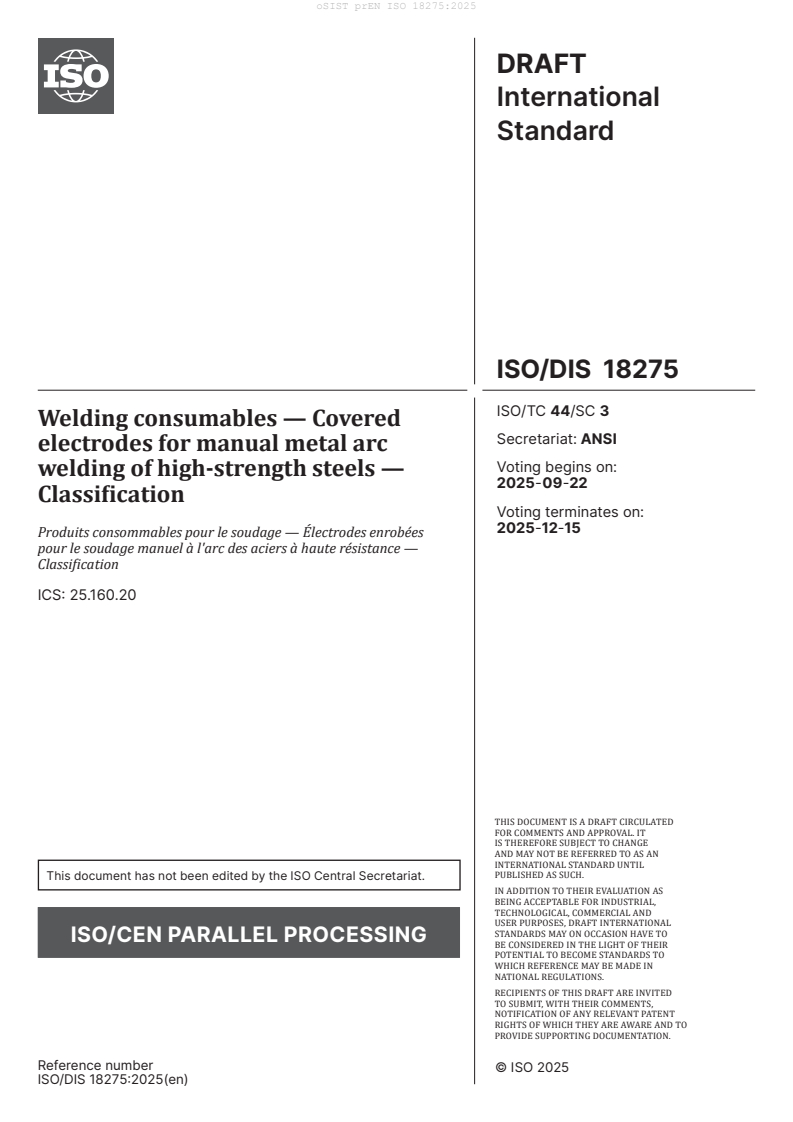
DRAFT
International
Standard
ISO/DIS 18275
ISO/TC 44/SC 3
Welding consumables — Covered
Secretariat: ANSI
electrodes for manual metal arc
Voting begins on:
welding of high-strength steels —
2025-09-22
Classification
Voting terminates on:
2025-12-15
Produits consommables pour le soudage — Électrodes enrobées
pour le soudage manuel à l'arc des aciers à haute résistance —
Classification
ICS: 25.160.20
THIS DOCUMENT IS A DRAFT CIRCULATED
FOR COMMENTS AND APPROVAL. IT
IS THEREFORE SUBJECT TO CHANGE
AND MAY NOT BE REFERRED TO AS AN
INTERNATIONAL STANDARD UNTIL
PUBLISHED AS SUCH.
This document has not been edited by the ISO Central Secretariat.
IN ADDITION TO THEIR EVALUATION AS
BEING ACCEPTABLE FOR INDUSTRIAL,
TECHNOLOGICAL, COMMERCIAL AND
USER PURPOSES, DRAFT INTERNATIONAL
STANDARDS MAY ON OCCASION HAVE TO
ISO/CEN PARALLEL PROCESSING
BE CONSIDERED IN THE LIGHT OF THEIR
POTENTIAL TO BECOME STANDARDS TO
WHICH REFERENCE MAY BE MADE IN
NATIONAL REGULATIONS.
RECIPIENTS OF THIS DRAFT ARE INVITED
TO SUBMIT, WITH THEIR COMMENTS,
NOTIFICATION OF ANY RELEVANT PATENT
RIGHTS OF WHICH THEY ARE AWARE AND TO
PROVIDE SUPPORTING DOCUMENTATION.
Reference number
ISO/DIS 18275:2025(en)
DRAFT
ISO/DIS 18275:2025(en)
International
Standard
ISO/DIS 18275
ISO/TC 44/SC 3
Welding consumables — Covered
Secretariat: ANSI
electrodes for manual metal arc
Voting begins on:
welding of high-strength steels —
Classification
Voting terminates on:
Produits consommables pour le soudage — Électrodes enrobées
pour le soudage manuel à l'arc des aciers à haute résistance —
Classification
ICS: 25.160.20
THIS DOCUMENT IS A DRAFT CIRCULATED
FOR COMMENTS AND APPROVAL. IT
IS THEREFORE SUBJECT TO CHANGE
AND MAY NOT BE REFERRED TO AS AN
INTERNATIONAL STANDARD UNTIL
PUBLISHED AS SUCH.
This document has not been edited by the ISO Central Secretariat.
IN ADDITION TO THEIR EVALUATION AS
BEING ACCEPTABLE FOR INDUSTRIAL,
© ISO 2025
TECHNOLOGICAL, COMMERCIAL AND
USER PURPOSES, DRAFT INTERNATIONAL
All rights reserved. Unless otherwise specified, or required in the context of its implementation, no part of this publication may
STANDARDS MAY ON OCCASION HAVE TO
ISO/CEN PARALLEL PROCESSING
be reproduced or utilized otherwise in any form or by any means, electronic or mechanical, including photocopying, or posting on
BE CONSIDERED IN THE LIGHT OF THEIR
the internet or an intranet, without prior written permission. Permission can be requested from either ISO at the address below
POTENTIAL TO BECOME STANDARDS TO
WHICH REFERENCE MAY BE MADE IN
or ISO’s member body in the country of the requester.
NATIONAL REGULATIONS.
ISO copyright office
RECIPIENTS OF THIS DRAFT ARE INVITED
CP 401 • Ch. de Blandonnet 8
TO SUBMIT, WITH THEIR COMMENTS,
CH-1214 Vernier, Geneva
NOTIFICATION OF ANY RELEVANT PATENT
Phone: +41 22 749 01 11
RIGHTS OF WHICH THEY ARE AWARE AND TO
PROVIDE SUPPORTING DOCUMENTATION.
Email: copyright@iso.org
Website: www.iso.org
Published in Switzerland Reference number
ISO/DIS 18275:2025(en)
ii
ISO/DIS 18275:2025(en)
Contents Page
Foreword .v
Introduction .vi
1 Scope . 1
2 Normative references . 1
3 Terms and definitions . 2
4 Classification . 2
4.1 General .2
4.2 Classification systems .2
4.3 Compulsory and optional sections .3
4.3.1 General .3
5 Symbols and requirements . 3
5.1 Symbol for the product/process .3
5.2 Symbol for tensile properties of all-weld metal .3
5.2.1 Classification by yield strength and 47 J impact energy – System A .3
5.2.2 Classification by tensile strength and 27 J impact energy – System B .3
5.3 Symbol for impact properties of all-weld metal .4
5.3.1 Classification by yield strength and 47 J impact energy – System A .4
5.3.2 Classification by tensile strength and 27 J impact energy – System B .4
5.4 Symbol for chemical composition of all-weld metal.5
5.4.1 Classification by yield strength and 47 J impact energy – System A .5
5.4.2 Classification by tensile strength and 27 J impact energy – System B .5
5.5 Symbol for type of electrode covering .7
5.5.1 Classification by yield strength and 47 J impact energy – System A .7
5.5.2 Classification by tensile strength and 27 J impact energy – System B .7
5.6 Symbol for condition of post-weld heat treatment of all-weld metal .8
5.6.1 Classification by yield strength and 47 J impact energy – System A .8
5.6.2 Classification by tensile strength and 27 J impact energy – System B .8
5.7 Symbol for electrode efficiency and type of current .8
5.7.1 Classification by yield strength and 47 J impact energy – System A .8
5.7.2 Classification by tensile strength and 27 J impact energy – System B .9
5.8 Symbol for welding position .9
5.8.1 Classification by yield strength and 47 J impact energy – System A .9
5.8.2 Classification by tensile strength and 27 J impact energy – System B .9
5.9 Symbol for diffusible hydrogen content of deposited metal .9
5.10 Mechanical property and composition requirements .10
5.10.1 Classification by yield strength and 47 J impact energy – System A .10
5.10.2 Classification by tensile strength and 27 J impact energy – System B .10
6 Mechanical property tests .15
6.1 General . 15
6.2 Preheating and interpass temperatures . 15
6.2.1 Classification by yield strength and 47 J impact energy – System A . 15
6.2.2 Classification by tensile strength and 27 J impact energy – System B . 15
6.3 Pass sequence . 15
6.3.1 General . 15
6.3.2 Classification by yield strength and 47 J impact energy – System A .16
6.3.3 Classification by tensile strength and 27 J impact energy – System B .16
7 Chemical analysis . .16
7.1 General .16
7.1.1 Classification by yield strength and 47 J impact energy – System A .16
7.1.2 Classification by tensile strength and 27 J impact energy – System B .16
8 Rounding procedure .16
iii
ISO/DIS 18275:2025(en)
9 Retests .16
10 Technical delivery conditions . 16
11 Examples of designation . 17
11.1 General .17
11.2 Example 1 – Classification by yield strength and 47 J impact energy – System A .17
11.3 Example 2 – Classification by tensile strength and 27 J impact energy – System B .17
11.4 Example 3 – Classification by yield strength and 47 J impact energy – System A .18
11.5 Example 4 – Classification by tensile strength and 27 J impact energy – System B .19
Annex A (informative) Classification systems .20
Annex B (informative) Description of types of electrode covering — Classification by yield
strength and 47 J impact energy .22
Annex C (informative) Description of types of electrode covering — Classification by tensile
strength and 27 J impact energy .23
Annex D (informative) Notes on diffusible hydrogen .25
Annex E (informative) Description of chemical composition symbols — Classification by yield
strength and 47 J impact energy .26
Annex F (informative) Description of chemical composition symbols — Classification by tensile
strength and 27 J impact energy .27
Bibliography .28
iv
ISO/DIS 18275:2025(en)
Foreword
ISO (the International Organization for Standardization) is a worldwide federation of national standards
bodies (ISO member bodies). The work of preparing International Standards is normally carried out through
ISO technical committees. Each member body interested in a subject for which a technical committee
has been established has the right to be represented on that committee. International organizations,
governmental and non-governmental, in liaison with ISO, also take part in the work. ISO collaborates closely
with the International Electrotechnical Commission (IEC) on all matters of electrotechnical standardization.
The procedures used to develop this document and those intended for its further maintenance are described
in the ISO/IEC Directives, Part 1. In particular, the different approval criteria needed for the different types
of ISO documents should be noted. This document was drafted in accordance with the editorial rules of the
ISO/IEC Directives, Part 2 (see www.iso.org/directives).
ISO draws attention to the possibility that the implementation of this document may involve the use of (a)
patent(s). ISO takes no position concerning the evidence, validity or applicability of any claimed patent
rights in respect thereof. As of the date of publication of this document, ISO had not received notice of (a)
patent(s) which may be required to implement this document. However, implementers are cautioned that
this may not represent the latest information, which may be obtained from the patent database available at
www.iso.org/patents. ISO shall not be held responsible for identifying any or all such patent rights.
Any trade name used in this document is information given for the convenience of users and does not
constitute an endorsement.
For an explanation of the voluntary nature of standards, the meaning of ISO specific terms and expressions
related to conformity assessment, as well as information about ISO's adherence to the World Trade
Organization (WTO) principles in the Technical Barriers to Trade (TBT), see www.iso.org/iso/foreword.html.
This document was prepared by Technical Committee ISO/TC 44, Welding and allied processes, Subcommittee
SC 3, Welding consumables, in collaboration with the European Committee for Standardization (CEN)
Technical Committee CEN/TC 121, Welding and allied processes, in accordance with the Agreement on
technical cooperation between ISO and CEN (Vienna Agreement).
This fourth edition cancels and replaces the third edition (ISO 18275:2018), which has been technically
revised.
The main changes are as follows:
— To be added after DIS ballot
Any feedback, question or request for official interpretation related to any aspect of this document should be
directed to the Secretariat of ISO/TC 44/SC 3 via your national standards body. A complete listing of these
bodies can be found at www.iso.org/members.html. Official interpretations, where they exist, are available
from this page: https://committee.iso.org/sites/tc44/home/interpretation.html.
v
ISO/DIS 18275:2025(en)
Introduction
This document recognizes that there are two somewhat different approaches in the global market to
classifying a given electrode, and allows for either or both to be used, to suit a particular market need.
Application of either type of classification designation (or of both, where suitable) identifies a product as
classified in accordance with this document. The classification in accordance with system A was originally
based on EN 757:1997 which has been withdrawn and replaced by this standard. The classification in
accordance with system B is mainly based on standards used around the Pacific Rim.
This document provides a classification system for covered electrodes for high-strength steels in terms
of the tensile properties, impact properties and chemical composition of the all-weld metal, as well as the
type of electrode covering. The ratio of yield strength to tensile strength of weld metal is generally higher
than that of parent metal. Users should note that matching weld metal yield strength to parent metal yield
strength does not necessarily ensure that the weld metal tensile strength matches that of the parent metal.
Therefore, where the application requires matching tensile strength, selection of the consumable should be
made by reference to column 3 of Table 3 or column 2 of Table 11.
It should be noted that the mechanical properties of all-weld metal test specimens used to classify covered
electrodes can vary from those obtained in production joints because of differences in welding procedure
such as electrode size, width of weave, welding position, and parent metal composition.
vi
DRAFT International Standard ISO/DIS 18275:2025(en)
Welding consumables — Covered electrodes for manual metal
arc welding of high-strength steels — Classification
1 Scope
This document specifies requirements for classification of covered electrodes and deposited metal in the as-
welded condition and in the post-weld heat-treated condition for manual metal arc welding of high-strength
steels with a minimum yield strength greater than 500 MPa or a minimum tensile strength greater than
570 MPa.
This document is a combined specification providing a classification utilizing a system based on the yield
strength and an average impact energy of 47 J of the all-weld metal, or utilizing a system based on the tensile
strength and an average impact energy of 27 J of the all-weld metal.
a) Clauses, subclauses and tables which carry the suffix “System A” are applicable only to covered
electrodes classified under the system based on the yield strength and an average impact energy of 47 J
of the all-weld metal given in this document.
b) Clauses, subclauses and tables which carry the suffix “System B” are applicable only to covered
electrodes classified under the system based on the tensile strength and an average impact energy of
27 J of the all-weld metal given in this document.
c) Subclauses and tables which do not have either the suffix “System A” or the suffix “System B” are
applicable to all covered electrodes classified under this document.
2 Normative references
The following documents are referred to in the text in such a way that some or all of their content constitutes
requirements of this document. For dated references, only the edition cited applies. For undated references,
the latest edition of the referenced document (including any amendments) applies.
ISO 544, Welding consumables — Technical delivery conditions for filler materials and fluxes — Type of product,
dimensions, tolerances and markings
ISO 2401:2018, Welding consumables — Covered electrodes — Determination of the efficiency, metal recovery
and deposition coefficient
ISO 2560:2020, Welding consumables — Covered electrodes for manual metal arc welding of non-alloy and fine
grain steels — Classification
ISO 3690, Welding and allied processes — Determination of hydrogen content in arc weld metal
ISO 6847, Welding consumables — Deposition of a weld metal pad for chemical analysis
ISO 6947, Welding and allied processes — Welding positions
ISO 14344, Welding consumables — Procurement of filler materials and fluxes
ISO 15792-1:2020, Welding consumables — Test methods — Part 1: Preparation of all-weld metal test pieces
and specimens in steel, nickel and nickel alloys
ISO 80000-1:2022, Quantities and units — Part 1: General
ISO/DIS 18275:2025(en)
3 Terms and definitions
No terms and definitions are listed in this document.
ISO and IEC maintain terminology databases for use in standardization at the following addresses:
— ISO Online browsing platform: available at https:// www .iso .org/ obp
— IEC Electropedia: available at https:// www .electropedia .org/
4 Classification
4.1 General
Classification designations are based on two approaches to indicate the tensile properties, and the impact
properties of the all-weld metal obtained with a given electrode. The two designation approaches include
additional designators for some other classification requirements, but not all, as will be clear from the
following subclauses. In most cases, a given commercial product can be classified in both systems. Then
either or both classification designations can be used for the product.
4.2 Classification systems
Each classification system, A and B, is split into parts as given in Table 1.
The classifications are based on an electrode diameter of 4,0 mm.
Table 1 — Parts of the classification systems, A and B
Classification system
Part of classifi-
System A System B
cation designa-
Classification by yield strength and 47 J im- Classification by tensile strength and 27 J
tion
pact energy impact energy
1 symbol indicating the product/process to be identified
symbol indicating the strength and elongation of symbol indicating the strength of the all-weld
the all-weld metal (See Table 3) metal (See Table 3)
symbol indicating the impact properties of the symbol indicating the type of electrode cover-
3 all-weld metal (See Table 4) ing, the type of current, and the welding position
(See Table 7)
symbol indicating the chemical composition of symbol indicating the chemical composition of
the all-weld metal (See Table 5) the all-weld metal (See Table 6)
symbol indicating the type of electrode covering symbol indicating the condition of the post-weld
5 (See 5.5.1) heat treatment under which the all-weld metal
test was conducted (See 5.6.2)
symbol indicating post-weld heat treatment if symbol indicating that the electrode has satis-
this is applied (See 5.6.1) fied a requirement for 47 J impact energy at the
temperature normally used for the 27 J require-
ment (See 5.3.2)
symbol indicating the nominal electrode effi- symbol indicating the diffusible hydrogen con-
ciency and type of current (See Table 8) tent of the deposited metal (See Table 10)
symbol indicating the welding position (See —
Table 9)
symbol indicating the diffusible hydrogen con- —
tent of the deposited metal (See Table 10)
ISO/DIS 18275:2025(en)
4.3 Compulsory and optional sections
4.3.1 General
In both systems, the electrode classification shall include all compulsory sections and may include optional
sections as outlined in Table 2.
The designation (see Clause 11) shall be used on packages and in the manufacturer's literature and data
sheets. Figure A.1 gives a schematic representation of the designation of electrodes classified by yield
strength and 47 J impact energy (system A). Figure A.2 gives a schematic representation of the designation
of electrodes classified by tensile strength and 27 J impact energy (system B).
Table 2 — Electrode classification – Compulsory and optional sections
Classification system
Part of classifi-
System A System B
cation designa-
Classification by yield strength and 47 J im- Classification by tensile strength and 27 J
tion
pact energy impact energy
includes the symbols for the type of product, the includes the symbols for the type of product, the
strength and elongation, the impact properties, strength, the type of covering (which includes
the chemical composition and the type of cover- the type of current and the welding position),
Compulsory
ing, i.e. the symbols defined in 5.1, 5.2.1, 5.3.1, the chemical composition and the condition of
5.4.1 and 5.5.1. heat treatment, i.e. the symbols defined in 5.1,
5.2.2, 5.4.2, 5.5.2, and 5.6.2
includes the symbols for post-weld heat treat- includes the symbol for the optional supple-
ment, the weld metal recovery, the type of mental designator for 47 J impact energy, i.e.
current, the welding positions for which the the symbol defined in 5.3.2, and the symbol for
Optional
electrode is suitable, and the symbol for diffusi- the diffusible hydrogen content, i.e. the symbol
ble hydrogen content, i.e. the symbols defined in defined in 5.9
5.6.1, 5.7.1, 5.8.1 and 5.9.
5 Symbols and requirements
5.1 Symbol for the product/process
The symbol for the covered electrode used in the manual metal arc process shall be the letter E.
5.2 Symbol for tensile properties of all-weld metal
5.2.1 Classification by yield strength and 47 J impact energy – System A
The symbols in Table 3 indicate the yield strength, tensile strength and elongation of the all-weld metal in
the as-welded condition or, if a T is added to the designation, after post-weld heat treatment as described in
5.6.1, determined in accordance with Clause 6.
NOTE Post-weld heat treatment (sometimes referred to as stress relief heat treatment) can alter the mechanical
properties of the weld from those obtained in the as-welded condition.
5.2.2 Classification by tensile strength and 27 J impact energy – System B
The symbols in Table 3 indicate the tensile strength of the all-weld metal in the as-welded condition, in
the post-weld heat-treated condition, or in both conditions, determined in accordance with Clause 6. The
yield strength and elongation requirements depend on the specific chemical composition, heat treatment
condition and covering type, as well as on the tensile strength requirements, as given for the complete
classification in Table 11.
ISO/DIS 18275:2025(en)
Table 3 — Symbol for tensile properties of all-weld metal
Classification system
System A System B
Classification by yield strength and 47 J impact Classification by tensile strength and 27 J im-
energy pact energy
Minimum tensile
Minimum Tensile Minimum
strength
b
yield strength elongation
Symbol Symbol
a
strength
MPa MPa %
MPa
55 550 610 to 780 18 59 590
62 620 690 to 890 18 62 620
69 690 760 to 960 17 69 690
79 790 880 to 16 76 760
1 080
89 890 980 to 15 78 780
1 180
96 960 1 180 min. 14 83 830
NOTE Post-weld heat treatment (sometimes referred to as stress relief heat treatment) can alter the mechanical
properties of the weld from those obtained in the as-welded condition
a
For yield strength, the lower yield strength (R ) shall be used when yielding occurs, otherwise the 0,2 % proof
eL
strength (R ) shall be used.
p0,2
b
The gauge length is equal to five times the test specimen diameter.
5.3 Symbol for impact properties of all-weld metal
5.3.1 Classification by yield strength and 47 J impact energy – System A
The symbols in Table 4 indicate the temperature at which an average impact energy of 47 J is achieved under
the conditions given in Clause 6. Three test specimens shall be tested. Only one individual value may be
lower than 47 J, but it shall not be lower than 32 J. When an all-weld metal has been classified for a certain
temperature, this automatically covers any higher temperature in Table 4.
5.3.2 Classification by tensile strength and 27 J impact energy – System B
There is no specific symbol for impact properties. The complete classification in Table 11 determines the
temperature at which an impact energy of 27 J is achieved in the as-welded condition or in the post-weld
heat-treated condition under the conditions given in Clause 6. Five test specimens shall be tested. The lowest
and highest values obtained shall be disregarded. Two of the three remaining values shall equal or exceed
the specified 27 J level, one of the three may be lower but shall not be less than 20 J. The average of the three
remaining values shall be at least 27 J.
The addition of the optional symbol U, immediately after the symbol for condition of heat treatment, indicates
that the supplemental requirement of 47 J impact energy at the normal 27 J impact test temperature has also
been satisfied. For the 47 J impact requirement, the number of specimens tested and values obtained shall
meet the requirements of 5.3.1.
ISO/DIS 18275:2025(en)
Table 4 — Symbol for impact properties of all-weld metal – System A
Temperature for minimum
Symbol average impact energy 47 J
°C
Z No requirements
A + 20
0 0
2 – 20
3 – 30
4 – 40
5 – 50
6 – 60
7 – 70
8 – 80
5.4 Symbol for chemical composition of all-weld metal
5.4.1 Classification by yield strength and 47 J impact energy – System A
The symbols in Table 5 indicate the chemical composition of the all-weld metal, determined in accordance
with Clause 7.
Table 5 — Symbol for chemical composition of all-weld metal – System A
(Classification by yield strength and 47 J impact energy)
a,b
Alloy symbol Chemical composition
% (by mass)
Mn Ni Cr Mo
MnMo 1,4 to 2,0 — — 0,3 to 0,6
Mn1Ni 1,4 to 2,0 0,6 to 1,2 — —
1NiMo 1,4 0,6 to 1,2 — 0,3 to 0,6
1,5NiMo 1,4 1,2 to 1,8 — 0,3 to 0,6
2NiMo 1,4 1,8 to 2,6 — 0,3 to 0,6
Mn1NiMo 1,4 to 2,0 0,6 to 1,2 — 0,3 to 0,6
Mn2NiMo 1,4 to 2,0 1,8 to 2,6 — 0,3 to 0,6
Mn2NiCrMo 1,4 to 2,0 1,8 to 2,6 0,3 to 0,6 0,3 to 0,6
Mn2Ni1CrMo 1,4 to 2,0 1,8 to 2,6 0,6 to 1,0 0,3 to 0,6
c
Z Any other agreed composition
a
If not specified, Mo < 0,2; Ni < 0,3; Cr < 0,2; V < 0,05; Nb < 0,05; Cu < 0,3; 0,03 ≤ C ≤ 0,10; P < 0,025; S < 0,020; Si < 0,80.
b
Single values are maxima.
c
Consumables for which the chemical composition is not listed shall be symbolized similarly and prefixed by the letter Z.
The chemical composition ranges are not specified, and it is possible that two electrodes with the same Z classification are not
interchangeable.
5.4.2 Classification by tensile strength and 27 J impact energy – System B
The symbols in Table 6 indicate the principal alloying elements, and sometimes the nominal alloy level of the
most significant alloy element, of the all-weld metal, determined in accordance with Clause 7. The symbol
for chemical composition does not immediately follow the symbol for strength but follows the symbol for
covering type. The complete compulsory classification designation, given in 5.10.2 and Table 12, determines
the exact chemical composition requirements for a particular electrode classification.
ISO/DIS 18275:2025(en)
Table 6 — Symbol for chemical composition of all-weld metal – System B
(Classification by tensile strength and 27 J impact energy)
Alloy symbol Chemical composition
% (by mass)
Principal alloy element(s) Nominal level
Mn 1,5
3 M2
Mo 0,4
Mn 2,0
4 M2
Mo 0,4
Mn 1,5
3 M3
Mo 0,5
Ni 0,5
N1M1
Mo 0,2
Ni 1,0
N2M1
Mo 0,2
N3M1 Ni 1,5
Mo 0,2
N3M2 Ni 1,5
Mo 0,4
Ni 2,0
N4M1
Mo 0,2
Ni 2,0
N4M2
Mo 0,4
Ni 2,0
N4M3
Mo 0,5
Ni 2,5
N5M1
Mo 0,2
Ni 2,5
N5M4
Mo 0,6
Ni 4,5
N9M3
Mo 0,5
N13L Ni 6,5
Ni 1,5
N3CM1 Cr 0,2
Mo 0,2
Ni 1,8
N4CM2 Cr 0,3
Mo 0,4
Ni 2,0
N4C2M1 Cr 0,7
Mo 0,3
Ni 2,0
N4C2M2 Cr 1,0
Mo 0,4
a
Consumables for which the chemical composition is not listed shall be symbolized similarly and prefixed by the letter G.
The chemical composition ranges are not specified, and it is possible that two electrodes with the same G classification are not
interchangeable.
ISO/DIS 18275:2025(en)
TTabablele 6 6 ((ccoonnttiinnueuedd))
Alloy symbol Chemical composition
% (by mass)
Principal alloy element(s) Nominal level
Ni 2,5
N5CM3 Cr 0,3
Mo 0,5
Ni 3,0
N6M4
Mo 1,0
Ni 3,5
N7CM3 Cr 0,3
Mo 0,5
Mn 1,2
P1 Ni 1,0
Mo 0,5
Mn 1,3
P2 Ni 1,0
Mo 0,5
a
G Any other agreed composition
a
Consumables for which the chemical composition is not listed shall be symbolized similarly and prefixed by the letter G.
The chemical composition ranges are not specified, and it is possible that two electrodes with the same G classification are not
interchangeable.
5.5 Symbol for type of electrode covering
5.5.1 Classification by yield strength and 47 J impact energy – System A
Most electrodes of this type have a basic covering and the symbol for this shall be B.
Cellulosic and other electrode coverings shall be in accordance with ISO 2560: 2020, 5.5A.
NOTE A description of the characteristics of each of the types of covering is given in Annex B.
5.5.2 Classification by tensile strength and 27 J impact energy – System B
The type of covering of a covered electrode depends substantially on the types of slag-forming component.
The type of covering also determines the positions suitable for welding and the type of current, in accordance
with Table 7.
ISO/DIS 18275:2025(en)
Table 7 — Symbol for type of covering – System B
(Classification by tensile strength and 27 J impact energy)
a b
Symbol Type of covering Welding positions Type of current
10 Cellulosic All DC (+)
11 Cellulosic All AC and DC (+)
c
13 Rutile All AC and DC (+)
c
15 Basic All DC (+)
c
16 Basic All AC and DC (+)
c
18 Basic + iron powder All AC and DC (+)
d
45 Basic All DC (+)
NOTE A description of the characteristics of each of the types of covering is given in Annex C.
a
The welding positions shall be in accordance with ISO 6947.
b
Alternating current = AC; direct current = DC; electrode positive = (+); electrode positive or electrode negative = (±).
c
The indication “all positions” may or may not include vertical down welding. This shall be specified in the manufacturer's
trade literature.
d
Excluding vertical up welding.
5.6 Symbol for condition of post-weld heat treatment of all-weld metal
5.6.1 Classification by yield strength and 47 J impact energy – System A
The letter T indicates that strength, elongation and impact properties in the classification of the deposited
metal are obtained after a post-weld heat treatment between 560 °C and 600 °C for 1 h +10/−0 min. The test
piece shall be left in the furnace to cool down to 300 °C.
5.6.2 Classification by tensile strength and 27 J impact energy – System B
If the electrode has been classified in the as-welded condition, the symbol A shall be added to the
classification. If the electrode has been classified in the post-weld heat-treated condition the post-weld heat
treatment shall be 620 °C ± 15 °C for 1 h +15/−0 min except for E6218-N4M2 P which shall be 8 h ± 10 min or
580 °C ± 15 °C for 1 h +10/−0 min in the case of chemical composition N13L, and the symbol P shall be added
to the classification. If the electrode has been classified in both conditions, the symbol AP shall be added to
the classification. See Table 12 for the use of A and P in specific classifications.
The furnace shall be at a temperature not higher than 300 °C when the test assembly is placed in it. The
heating rate, from that point to the specified holding temperature, shall not exceed 300 °C/h. When the
holding time has been completed, the assembly shall be allowed to cool in the furnace to a temperature below
300 °C at a rate not exceeding 200 °C/h. The assembly may be removed from the furnace at any temperature
below 300 °C and allowed to cool in still air to room temperature.
5.7 Symbol for electrode efficiency and type of current
5.7.1 Classification by yield strength and 47 J impact energy – System A
The symbols in Table 8 indicate the electrode efficiency, determined in accordance with ISO 2401:2018 with
the type of current shown in Table 8.
ISO/DIS 18275:2025(en)
Table 8 — Symbol for nominal electrode efficiency and type of current – System A
(Classification by yield strength and 47 J impact energy)
Electrode efficiency
a
Symbol Type of current
%
1 ≤ 105 AC and DC
2 ≤ 105 DC
3 > 105 ≤ 125 AC and DC
4 > 105 ≤ 125 DC
5 > 125 ≤ 160 AC and DC
6 > 125 ≤ 160 DC
7 >160 AC and DC
8 >160 DC
a
If an electrode is suitable for both DC and AC operation, the electrode efficiency shall be based on AC testing only.
5.7.2 Classification by tensile strength and 27 J impact energy – System B
There is no specific symbol for electrode efficiency and type of current. Type of current is included in the
symbol for type of covering (Table 4B). Electrode efficiency is not addressed.
5.8 Symbol for welding position
5.8.1 Classification by yield strength and 47 J impact energy – System A
The symbols in Table 9 for welding positions indicate the positions for which the electrode is suitable.
Table 9 — Symbol for welding position – System A
(Classification by yield strength and 47 J impact energy)
Symbol Welding positions according to ISO 6947
1 PA, PB, PC, PD, PE, PF, PG
2 PA, PB, PC, PD, PE, PF
3 PA, PB
4 PA
5 PA, PB, PG
5.8.2 Classification by tensile strength and 27 J impact energy – System B
There is no specific symbol for welding position. The welding position requirements are included with the
symbol for type of covering (Table 7).
5.9 Symbol for diffusible hydrogen content of deposited metal
The symbols in Table 10 indicate the diffusible hydrogen content determined in the metal deposited from an
electrode of size 4,0 mm in accordance with the method given in ISO 3690. The current used shall be 70 % to
90 % of the maximum value recommended by the manufacturer. Electrodes recommended for use with AC
shall be tested using AC. Electrodes recommended for DC only shall be tested using DC with the electrode
positive [DC(+)].
The manufacturer shall provide information on the recommended type of current and drying conditions for
achieving the diffusible hydrogen levels.
ISO/DIS 18275:2025(en)
Table 10 — Symbol for diffusible hydrogen content of deposited metal
Diffusible hydrogen content
Symbol max.
ml/100 g of deposited weld metal
H5 5
H10 10
H15 15
See Annex D for additional information about diffusible hydrogen.
5.10 Mechanical property and composition requirements
5.10.1 Classification by yield strength and 47 J impact energy – System A
The mechanical property and chemical composition requirements are determined from the symbols with
reference to Tables 3, 4, and 5. No additional information is required.
5.10.2 Classification by tensile strength and 27 J impact energy – System B
The mechanical property and chemical composition requirements are only determined from the complete
compulsory section of the electrode designation. Mechanical property requirements are specified in
Table 11. Chemical composition requirements are specified in Table 12.
Table 11 — Mechanical property requirements – System B
(Classification by tensile strength and 27 J impact energy)
a,b
Tensile streng- Yield strength Minimum Temperature of
a c
Classification, th elongation Charpy V notch
e
compulsory section determination
MPa MPa % °C
E5916-3 M2 A and/or P 590 490 16 −20
E5916-N1M1 A and/or P 590 490 16 −20
E5916-N5M1 A and/or P 590 490 16 −60
E5918-N1M1 A and/or P 590 490 16 −20
E6210-G A and/or P 620 530 15 —
E6210-P1 A 620 530 15 −30
E6211-G A and/or P 620 530 15 —
E6213-G A and/or P 620 530 12 —
E6215-G A and/or P 620 530 15 —
E6216-G A and/or P 620 530 15 —
E6218-G A and/or P 620 530 15 —
E6215-N13L P 620 530 15 −115
E6215-3 M2 P 620 530 15 −50
E6216-3 M2 A and/or P 620 530 15 −20
E6216-N1M1 A and/or P 620 530 15 −20
E6216-N2M1 A and/or P 620 530 15 −20
a
Single values are minima.
b
For yield strength, the lower yield strength, R , shall be used when yielding occurs. Otherwise, the 0,2 % proof strength,
eL
R , shall be used.
p0,2
c
The gauge length is equal to five times the specimen diameter.
d
For 2,4 mm electrodes, the upper limit may be 35 MPa greater.
e
Not specified = —.
ISO/DIS 18275:2025(en)
TTabablele 1 111 ((ccoonnttiinnueuedd))
a,b
Tensile streng- Yield strength Minimum Temperature of
a c
Classification, th elongation Charpy V notch
e
compulsory section determination
MPa MPa % °C
E6216-N4M1 A and/or P 620 530 15 −40
E6216-N5M1 A and/or P 620 530 15 −60
E6218-3 M2 P 620 530 15 −50
E6218-
...
Questions, Comments and Discussion
Ask us and Technical Secretary will try to provide an answer. You can facilitate discussion about the standard in here.
Loading comments...