


EN 12467:2012+A2:2018
(Main)Fibre-cement flat sheets - Product specification and test methods
Fibre-cement flat sheets - Product specification and test methods
This European Standard specifies the technical requirements and establishes methods of inspection and test as well as acceptance conditions for fibre-cement flat sheets, siding shingles and planks (referred to as sheets later in this document) for one or more of the following uses:
- internal wall and ceiling finishes;
- external wall and ceiling finishes.
Products covered by this European Standard can be used for other purposes provided they comply with the relevant application standard, e.g. rigid underlays.
This European Standard covers sheets reinforced with fibres of different types as specified in 5.1.1.
This European Standard does not cover sheets for fire protection purposes.
This European Standard does not include calculations with regard to works, design requirements, installation techniques, wind uplift or rain proofing of the installed sheets.
Faserzement-Tafeln - Produktspezifikation und Prüfverfahren
Diese Europäische Norm legt die technischen Anforderungen an und die Verfahren zur Kontrolle und Prüfung sowie die Abnahmebedingungen für Faserzement Tafeln, Fassadenschindeln und Schalungen (nachfolgend in diesem Dokument als Tafeln bezeichnet) für einen oder mehrere der folgenden Verwendungszwecke fest:
- Wand und Deckenbekleidungen für Innenräume;
- Wand und Deckenbekleidungen für den Außenbereich.
Produkte, die unter diese Europäische Norm fallen, können auch für andere Zwecke eingesetzt werden, voraus¬gesetzt, dass sie mit der betreffenden Anwendungsnorm übereinstimmen, z. B. steife Unterdeckplatten.
Diese Europäische Norm erstreckt sich auf Tafeln, die mit Fasern unterschiedlicher Art, wie in 5.1.1 festgelegt, bewehrt sind.
Diese Europäische Norm gilt nicht für Tafeln, die für den Brandschutz vorgesehen
Diese Europäische Norm keine Berechnungen zu Bauleistungen, Anforderungen an die Ausführung, Verlege /Einbauverfahren, Windsogsicherheit oder Regensicherheit der verlegten/eingebauten Tafeln.
Plaques planes en fibres-ciment - Spécifications du produit et méthodes d'essai
La présente Norme européenne spécifie les exigences techniques et détermine les méthodes de contrôle et d'essai ainsi que les conditions d'acceptation pour les plaques planes en fibres- ciment, bardeaux et clins (dénommés ci-après « plaques ») pour une ou plusieurs des applications suivantes :
- revêtements intérieurs pour murs et plafonds ;
- revêtements extérieurs pour murs et plafonds.
Les produits couverts par la présente Norme européenne peuvent être utilisés pour d'autres applications à la condition que celles-ci soient conformes à la norme, par exemple comme substrats rigides.
La présente Norme européenne s'applique aux plaques renforcées par des fibres de différents types comme spécifié en 5.1.1.
La présente Norme européenne ne s'applique pas aux plaques conçues pour la protection contre le feu.
La présente Norme européenne n'inclut pas les calculs relatifs aux travaux, aux exigences de conception, aux techniques de pose, aux soulèvements par le vent ou à l'étanchéité à la pluie des produits déjà posés.
Vlaknato-cementne ravne plošče - Specifikacija za izdelek in preskusne metode
Ta evropski standard določa tehnične zahteve in metode za pregled ter preskusne metode in pogoje za sprejem za vlaknato-cementne ravne plošče, fasadne skodle in deske (v nadaljnjem besedilu plošče) za eno ali več navedenih vrst uporabe:
– zaključke notranjih sten in stropov;
– zaključke zunanjih sten in stropov.
Izdelke, zajete v tem evropskem standardu, je mogoče uporabiti za druge namene v skladu z ustreznim standardom o uporabi (npr. toge podložne folije).
Ta evropski standard zajema plošče, ojačane z različnimi vrstami vlaken, kot je določeno v točki 5.1.1.
Ta evropski standard ne zajema plošč za namene protipožarne zaščite.
Ta evropski standard ne vključuje izračunov v zvezi z izdelavo, oblikovnih zahtev, montažnih tehnik in preverjanja odpornosti nameščenih plošč proti vetru ali dežju.
General Information
- Status
- Published
- Publication Date
- 24-Apr-2018
- Withdrawal Date
- 30-Jan-2020
- Technical Committee
- CEN/TC 128 - Roof covering products for discontinuous laying and products for wall cladding
- Drafting Committee
- CEN/TC 128/SC 4/WG 3 - Fibre cement flat sheets
- Current Stage
- 9092 - Decision on results of review/2YR ENQ - revise - Review Enquiry
- Start Date
- 08-Feb-2023
- Completion Date
- 14-Apr-2025
Relations
- Merged From
EN 12467:2012+A1:2016/prA2 - Fibre-cement flat sheets - Product specification and test methods - Effective Date
- 18-Jan-2023
- Merged From
EN 12467:2012+A1:2016 - Fibre-cement flat sheets - Product specification and test methods - Effective Date
- 28-Feb-2018
Overview
EN 12467:2012+A2:2018 - issued by CEN - is the European standard for fibre‑cement flat sheets (including siding shingles and planks). It defines the product specification and test methods for sheets intended primarily for internal and external wall and ceiling finishes. The standard sets technical requirements, inspection and test methods, acceptance conditions, factory production control (FPC) and assessment rules (AVCP). It applies to sheets reinforced with different fibre types (see Clause 5.1.1) and explicitly does not cover sheets designed for fire‑protection applications or design/installation requirements (e.g., wind uplift or rain‑proofing).
Key Topics
- Scope and classification: Product categories (A, B, C, D), groups of sizes and permitted uses.
- Composition and appearance: Requirements for materials, surface finish and visible quality.
- Dimensions and tolerances: Nominal length, width, thickness, shape tolerances and measurement procedures.
- Physical performance:
- Bending strength (MOR) and modulus of elasticity (MOE)
- Apparent density
- Water impermeability and water vapour permeability (category‑dependent)
- Moisture movement characteristics (Annex C)
- Durability/climatic tests: Freeze–thaw, heat‑rain, warm water and soak‑dry cycles to verify long‑term performance.
- Reaction to fire and release of dangerous substances requirements (not for fire‑protection use).
- Assessment & control: Type testing, factory production control (FPC), consignment inspection, statistical methods for correlating wet/dry test results (Annex B).
- Test methods: Detailed procedures for specimen preparation, apparatus, test execution and result interpretation (Clause 7).
- Marking, labelling and packaging requirements and the relationship to EU Construction Products Regulation (Annex ZA).
Applications
EN 12467 is used to ensure consistent quality and performance of fibre‑cement flat sheets in building products such as:
- External wall cladding and facades
- Internal wall and ceiling finishes
- Siding shingles and planks
- As rigid underlays where compatible with specific application standards
Who uses it:
- Manufacturers and product developers for compliance and CE marking
- Test laboratories and quality control personnel
- Architects, specifiers and contractors selecting façade and cladding materials
- Certification bodies and regulatory authorities
Related standards
- EU Regulation No. 305/2011 (Construction Products Regulation) - referenced via Annex ZA for AVCP alignment
- Other application or installation standards (design, wind uplift, waterproofing) - EN 12467 does not replace these and should be used together with relevant design/installation standards.
This standard is essential when specifying, testing or certifying fibre‑cement sheets to ensure durability, dimensional conformity and safe performance in building envelope and interior applications.



Frequently Asked Questions
EN 12467:2012+A2:2018 is a standard published by the European Committee for Standardization (CEN). Its full title is "Fibre-cement flat sheets - Product specification and test methods". This standard covers: This European Standard specifies the technical requirements and establishes methods of inspection and test as well as acceptance conditions for fibre-cement flat sheets, siding shingles and planks (referred to as sheets later in this document) for one or more of the following uses: - internal wall and ceiling finishes; - external wall and ceiling finishes. Products covered by this European Standard can be used for other purposes provided they comply with the relevant application standard, e.g. rigid underlays. This European Standard covers sheets reinforced with fibres of different types as specified in 5.1.1. This European Standard does not cover sheets for fire protection purposes. This European Standard does not include calculations with regard to works, design requirements, installation techniques, wind uplift or rain proofing of the installed sheets.
This European Standard specifies the technical requirements and establishes methods of inspection and test as well as acceptance conditions for fibre-cement flat sheets, siding shingles and planks (referred to as sheets later in this document) for one or more of the following uses: - internal wall and ceiling finishes; - external wall and ceiling finishes. Products covered by this European Standard can be used for other purposes provided they comply with the relevant application standard, e.g. rigid underlays. This European Standard covers sheets reinforced with fibres of different types as specified in 5.1.1. This European Standard does not cover sheets for fire protection purposes. This European Standard does not include calculations with regard to works, design requirements, installation techniques, wind uplift or rain proofing of the installed sheets.
EN 12467:2012+A2:2018 is classified under the following ICS (International Classification for Standards) categories: 91.100.40 - Products in fibre-reinforced cement. The ICS classification helps identify the subject area and facilitates finding related standards.
EN 12467:2012+A2:2018 has the following relationships with other standards: It is inter standard links to EN 12467:2012+A1:2016/prA2, EN 12467:2012+A1:2016. Understanding these relationships helps ensure you are using the most current and applicable version of the standard.
EN 12467:2012+A2:2018 is associated with the following European legislation: EU Directives/Regulations: 305/2011; Standardization Mandates: M/121, M/122. When a standard is cited in the Official Journal of the European Union, products manufactured in conformity with it benefit from a presumption of conformity with the essential requirements of the corresponding EU directive or regulation.
You can purchase EN 12467:2012+A2:2018 directly from iTeh Standards. The document is available in PDF format and is delivered instantly after payment. Add the standard to your cart and complete the secure checkout process. iTeh Standards is an authorized distributor of CEN standards.
Standards Content (Sample)
2003-01.Slovenski inštitut za standardizacijo. Razmnoževanje celote ali delov tega standarda ni dovoljeno.Faserzement-Tafeln - Produktspezifikation und PrüfverfahrenPlaques planes en fibres-ciment - Spécifications du produit et méthodes d'essaiFibre-cement flat sheets - Product specification and test methods91.100.40YODNQLProducts in fibre-reinforced cementICS:Ta slovenski standard je istoveten z:EN 12467:2012+A2:2018SIST EN 12467:2013+A2:2018en,fr,de01-junij-2018SIST EN 12467:2013+A2:2018SLOVENSKI
STANDARDSIST EN 12467:2013+A1:20161DGRPHãþD
EUROPEAN STANDARD NORME EUROPÉENNE EUROPÄISCHE NORM
EN 12467:2012+A2
April
t r s z ICS
{ sä s r rä v r Supersedes EN
s t v x yã t r s t ªA sã t r s xEnglish Version
Fibreæcement flat sheets æ Product specification and test methods Plaques planes en fibresæciment æ Spécifications du produit et méthodes d 5essai
FaserzementæTafeln æ Produktspezifikation und Prüfverfahren This European Standard was approved by CEN on
t v November
t r s w and includes Amendment
t approved by CEN on
{ November
t r s yä
egulations which stipulate the conditions for giving this European Standard the status of a national standard without any alterationä Upætoædate lists and bibliographical references concerning such national standards may be obtained on application to the CENæCENELEC Management Centre or to any CEN memberä
translation under the responsibility of a CEN member into its own language and notified to the CENæCENELEC Management Centre has the same status as the official versionsä
CEN members are the national standards bodies of Austriaá Belgiumá Bulgariaá Croatiaá Cyprusá Czech Republicá Denmarká Estoniaá Finlandá Former Yugoslav Republic of Macedoniaá Franceá Germanyá Greeceá Hungaryá Icelandá Irelandá Italyá Latviaá Lithuaniaá Luxembourgá Maltaá Netherlandsá Norwayá Polandá Portugalá Romaniaá Serbiaá Slovakiaá Sloveniaá Spainá Swedená Switzerlandá Turkey and United Kingdomä
EUROPEAN COMMITTEE FOR STANDARDIZATION COMITÉ EUROPÉEN DE NORMALISATION EUROPÄISCHES KOMITEE FÜR NORMUNG
CEN-CENELEC Management Centre:
Rue de la Science 23,
B-1040 Brussels
t r s z CEN All rights of exploitation in any form and by any means reserved worldwide for CEN national Membersä Refä Noä EN
s t v x yã t r s t ªA tã t r s z ESIST EN 12467:2013+A2:2018
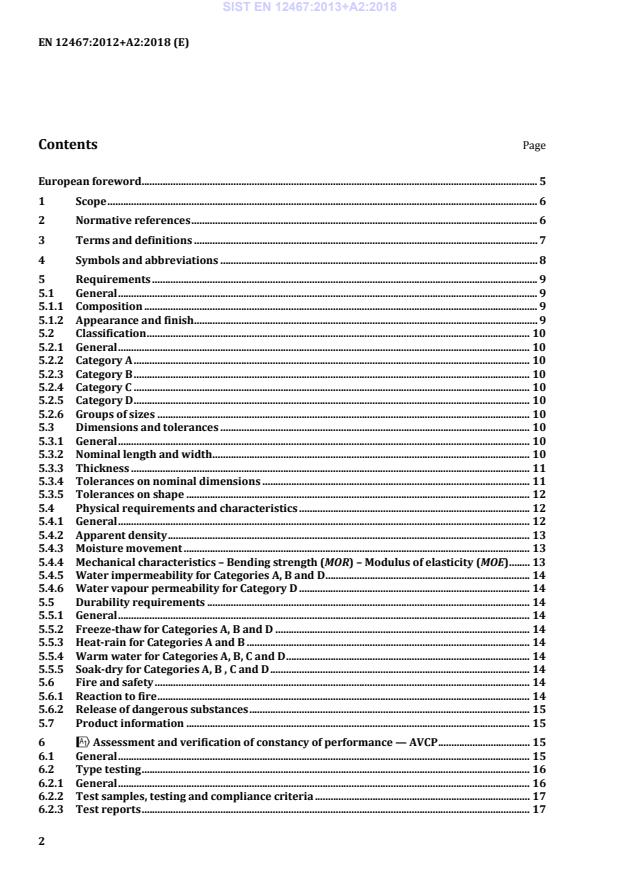
European foreword . 5 1 Scope . 6 2 Normative references . 6 3 Terms and definitions . 7 4 Symbols and abbreviations . 8 5 Requirements . 9 5.1 General . 9 5.1.1 Composition . 9 5.1.2 Appearance and finish . 9 5.2 Classification . 10 5.2.1 General . 10 5.2.2 Category A . 10 5.2.3 Category B . 10 5.2.4 Category C . 10 5.2.5 Category D . 10 5.2.6 Groups of sizes . 10 5.3 Dimensions and tolerances . 10 5.3.1 General . 10 5.3.2 Nominal length and width . 10 5.3.3 Thickness . 11 5.3.4 Tolerances on nominal dimensions . 11 5.3.5 Tolerances on shape . 12 5.4 Physical requirements and characteristics . 12 5.4.1 General . 12 5.4.2 Apparent density . 13 5.4.3 Moisture movement . 13 5.4.4 Mechanical characteristics – Bending strength (MOR) – Modulus of elasticity (MOE) . 13 5.4.5 Water impermeability for Categories A, B and D . 14 5.4.6 Water vapour permeability for Category D . 14 5.5 Durability requirements . 14 5.5.1 General . 14 5.5.2 Freeze-thaw for Categories A, B and D . 14 5.5.3 Heat-rain for Categories A and B . 14 5.5.4 Warm water for Categories A, B, C and D . 14 5.5.5 Soak-dry for Categories A, B , C and D . 14 5.6 Fire and safety . 14 5.6.1 Reaction to fire . 14 5.6.2 Release of dangerous substances . 15 5.7 Product information . 15 6 !Assessment and verification of constancy of performance — AVCP . 15 6.1 General . 15 6.2 Type testing . 16 6.2.1 General . 16 6.2.2 Test samples, testing and compliance criteria . 17 6.2.3 Test reports . 17 SIST EN 12467:2013+A2:2018
(E) 3 6.3 Factory production control (FPC) . 17 6.3.1 General . 17 6.3.2 Requirements . 18 6.3.3 Product specific requirements . 20 6.3.4 Initial inspection of factory and of FPC . 21 6.3.5 Continuous surveillance of FPC . 21 6.3.6 Procedure for modifications . 21 6.4 Inspection of a consignment of finished products . 22 7 Test methods . 22 7.1 General . 22 7.2 Dimensional and geometrical tests . 22 7.2.1 Preparation of specimen . 22 7.2.2 Apparatus . 22 7.2.3 Procedure . 22 7.2.4 Expression and interpretation of results . 25 7.3 Tests for physical performance and characteristics . 26 7.3.1 Apparent density . 26 7.3.2 Mechanical characteristics - Bending strength – Modulus of elasticity (Bending modulus) . 26 7.3.3 Water impermeability . 31 7.3.4 Water vapour permeability . 32 7.3.5 Warm water . 32 7.3.6 Soak-dry . 33 7.3.7 Moisture movement test . 34 7.4 Tests for climatic performance. 34 7.4.1 Freeze-thaw . 34 7.4.2 Heat-rain . 36 7.5 Test for reaction to fire performance . 37 7.5.1 Sheets satisfying the requirements for the fire reaction Class A1 without the need for testing . 37 7.5.2 Other sheets . 37 8 Marking, labelling and packaging . 45 Annex A (normative)
Consignment inspection sampling . 46 Annex B (normative)
Statistical method for determining the corresponding wet values or revised dry specifications for the MOR when carrying out the dry method of test or when tested prior to coating for quality control purposes . 47 B.1 Procedure . 47 B.2 Determination of the correlation between the results of testing wet and dry specimens . 47 B.3 Determination of the regression line . 48 B.4 Determination of a value for wet testing from an obtained value for dry testing . 48 B.5 Determination of the minimum value specified for dry testing xstd corresponding to the minimum value specified for wet testing in this document ystd . 49 Annex C (normative)
Test method for the determination of moisture movement characteristic of fibre-cement sheets . 51 C.1 General . 51 C.2 Principle . 51 C.3 Apparatus . 51 C.4 Specimen preparation . 51 C.5 Test procedure . 51 C.6 Calculation of results . 52 C.7 Test report . 52 SIST EN 12467:2013+A2:2018
#Relationship of this European Standard with Regulation [EU] No. 305/2011 . 53 ZA.1 Scope and relevant characteristics . 53 ZA.2 System of Assessment and Verification of Constancy of Performance [AVCP] . 54 ZA.3 Assignment of AVCP tasks . 54 Bibliography . 57
(E) 5 European foreword This document (EN 12467:2012+A2:2018) has been prepared by Technical Committee CEN/TC 128 “Roof covering products for discontinuous laying and products for wall cladding”, the secretariat of which is held by NBN. This European Standard shall be given the status of a national standard, either by publication of an identical text or by endorsement, at the latest by October 2018, and conflicting national standards shall be withdrawn at the latest by January 2020. Attention is drawn to the possibility that some of the elements of this document may be the subject of patent rights. CEN shall not be held responsible for identifying any or all such patent rights. This document includes Amendment 1, approved by CEN on 24 November 2015 and Amendment 2, approved by CEN on 9 November 2017. This document supersedes #EN 12467:2012+A1:2016$. The start and finish of text introduced or altered by amendment is indicated in the text by tags !" and #$. !In comparison with EN 12467:2004, the following sections in EN 12467:2012 had been changed or added:" 3.9, 3.10, 4, 5.1.1, 5.4.3, 5.4.4, Table 7, Table 8, 7.3.2, 7.3.2.4.2, 7.3.3.3, 7.3.3.4, 7.3.7, 7.5.2.2 and Annex C.
Annex ZB concerning the EC Directive 76/769/EEC !had been deleted". This document has been prepared under a mandate given to CEN by the European Commission and the European Free Trade Association. For relationship with #EU Regulation No 305/2011", see informative Annex ZA, which is an integral part of this document. A distinction !had been made" between product appraisal (type tests) and factory production control requirements (acceptance tests). The performance of a building part constructed with these sheets depends not only on the properties of the product as required by this document, but also on the design, construction and installation of the component as a whole in relation to the environment and conditions of use. According to the CEN/CENELEC Internal Regulations, the national standards organizations of the following countries are bound to implement this European Standard: Austria, Belgium, Bulgaria, Croatia, Cyprus, Czech Republic, Denmark, Estonia, Finland, Former Yugoslav Republic of Macedonia, France, Germany, Greece, Hungary, Iceland, Ireland, Italy, Latvia, Lithuania, Luxembourg, Malta, Netherlands, Norway, Poland, Portugal, Romania, Serbia, Slovakia, Slovenia, Spain, Sweden, Switzerland, Turkey and the United Kingdom. SIST EN 12467:2013+A2:2018
(E) 7 3 Terms and definitions For the purposes of this document, the following terms and definitions apply. 3.1 acceptance test test to establish whether a batch of sheets conforms to a specification and which is performed on samples drawn either from continuous production or from a consignment Note 1 to entry: Test methods, specifications and limit values are specified in this document. Sampling levels and acceptance criteria are specified in 6.3.2. 3.2 initial type test test carried out to demonstrate conformity with the requirements of this document or for the approval of a new product and/or when a fundamental change is made in formulation and/or #manufacturing process$, the effects of which cannot be predicted on the basis of previous experience Note 1 to entry: The test is performed on the as delivered product, but is not required for each production batch. 3.3 acceptable quality level (AQL) quality level which in a sampling plan corresponds to a specified, relatively high probability of acceptance Note 1 to entry: It is the maximum percent defective (or maximum number of defects per 100 units) that for purposes of sampling inspection can be considered satisfactory as a process average. Note 2 to entry: A sampling scheme with an AQL of 4 % means that batches containing up to 4 % defective items have a high probability of acceptance. 3.4 apparent density density based on the external dimensions of the sample to calculate the volume Note 1 to entry: This is an average density of material and pores. 3.5 as delivered same condition as the producer intends to supply the product after completing all aspects of the process including maturing and, when appropriate, painting 3.6 upper face face normally exposed 3.7 under face reverse of upper face 3.8 textured sheets sheets which have a relief pattern embossed or applied as a coating on their upper face before delivery SIST EN 12467:2013+A2:2018
2. one of the coefficients of the regression line (see Annex B) d apparent density of the sheet in grams per cubic centimetre e thickness of the sheet, in millimetres F breaking load, in newtons l length, in millimetres ls span between the centres of the test machine supports in the bending strength test, in millimetres m mass of the specimen after drying, in grams n
number of paired specimens MOE modulus of elasticity, in Gigapascals or megapascals MOR modulus of rupture, in megapascals MORfi modulus of rupture of the ith exposed specimen after the type test MORfci
modulus of rupture of the ith unexposed reference specimen MRi individual ratio of the modulus of rupture of the ith pair of exposed and unexposed specimens R average ratio of the modulus of rupture of exposed and unexposed specimens RL lower estimate of the mean of the ratios at 95 % confidence level of the modulus of rupture of exposed and unexposed specimens s standard deviation of the values in the appropriate calculation
water vapour resistance value V volume of the specimen, in cubic centimetres SIST EN 12467:2013+A2:2018
(E) 9 w width, in millimetres xi individual value of the ith specimen tested dry xstd minimum value to be used as the specification for the dry method of test. This value is calculated at the 97,5 % lower confidence level from the value specified for the wet method of test in this document (see B.5) ystd minimum value specified in the standard for wet testing (see B.5) xo actual result obtained when dry testing (see B.4) x mean of the values of xi for i = 1 to n yi individual value of the ith specimen tested wet yo value calculated from the value obtained from a specimen tested dry, which is the estimate at the 97,5 % lower confidence level of the value expected from a specimen tested wet (see B.4) y
mean of the values of yi for i = 1 to n 5 Requirements 5.1 General 5.1.1 Composition Sheets shall consist essentially of cement or a calcium silicate formed by a chemical reaction of a siliceous and a calcareous material, reinforced by fibres. The cement shall comply with EN 197-1 or with technical specifications relevant in the country of use. #The cement shall comply with EN 197-1 or an agreed technical specification relevant in the country of use provided the cement compound composition is in accordance with EN 197-1.$ This European Standard covers fibre-reinforced cement flat sheets of type NT. The reinforcing fibres shall be one or more of the following forms: — discrete elements randomly dispersed; — continuous strands or tapes; — nets or webs. Process aids, fillers, aggregates and pigments may be added. 5.1.2 Appearance and finish The exposed face of the sheets can be with or without texture. The sheets can be coloured or left in their natural colour. The sheets can also receive adherent coloured or uncoloured coatings on their surface. Variations of the surface appearance which do not impair the fitness for purpose of the sheets are permitted. The sheets may be supplied with holes for fixing and/or cut to size. SIST EN 12467:2013+A2:2018
¶ 3. 5.2.6.2 Large size sheets Sheets which do not correspond to indicators for small size sheets. Large sheets may be declared as "small size sheets" provided tolerances for small size sheets apply and are specified in the manufacturer's literature. 5.3 Dimensions and tolerances 5.3.1 General There are two levels of tolerances for length, width, straightness and squareness of edges. Sheets shall comply with the requirements of the same level for the four sets of tolerances. 5.3.2 Nominal length and width The manufacturer shall specify the nominal length and width of the sheets. SIST EN 12467:2013+A2:2018
(E) 11 NOTE Sheets are normally available in nominal lengths up to 3 000 mm and nominal width up to 1 250 mm. Greater nominal lengths and widths can be supplied. 5.3.3 Thickness The manufacturer shall specify the nominal thickness of the sheets. For non-textured sheets, the nominal thickness refers to the average thickness. For textured sheets, the nominal thickness refers to the maximum thickness. NOTE 1 The nominal thickness of textured sheets cannot be used for the calculation of mechanical performance. Sheets are normally available in thickness from 3 mm to 30 mm. NOTE 2 Thicker sheets can be supplied. 5.3.4 Tolerances on nominal dimensions1) 5.3.4.1 Tolerances on length and width Tolerances on length and width shall be in accordance with Table 1, for the appropriate level. Table 1 — Tolerances on nominal dimensions in accordance with value and level Nominal dimension aa Level I Level II a

x r r mm ± 3 mm ± 4 mm 600 mm < a

s
r r r mm ± 3 mm ± 5 mm 1 000 mm < a

s
x r r mm ± 0,3% a ± 0,5% a 1 600 mm < a ± 5 mm ± 8 mm a a is the nominal width or length.
These tolerances are not applicable to oversize sheets. The method of measurement is given in 7.2.3.1. 5.3.4.2 Tolerances on thickness For non-textured sheets, tolerances shall be in accordance with Table 2. Table 2 — Tolerances on thickness for non-textured sheets e

x mm ± 0,6 mm 6 mm < e

t r mm ± 10 % e e > 20 mm ± 2 mm
For sheets without texture, the maximum difference between extreme values of the thickness measurements within one sheet shall not exceed 10 % of the maximum measured value. For textured sheets, tolerances shall be in accordance with Table 3.
1) For certain applications, tighter tolerances could be demanded. SIST EN 12467:2013+A2:2018

x mm - 0,6 mm + 0,9 mm 6 mm < e

t r mm - 10 % e + 15 % e e > 20 mm - 2 mm + 3 mm
For textured sheets, the maximum difference between extreme values of the eight thickness measurements within one sheet shall not exceed 15 % of the maximum measured value. The method of measurement is given in 7.2.3.2. 5.3.5 Tolerances on shape2) 5.3.5.1 Straightness of edges Tolerances are applicable only to large size sheets. The tolerances on the straightness of edges are defined as a percentage of the length of the edge of the relevant dimensions (length or width), and shall be in accordance with Table 4 for the appropriate level. Table 4 — Tolerances on straightness of edges Level I Level II 0,1 % 0,3 %
The method of measurement is given in 7.2.3.3. These tolerances are not applicable for oversize sheets. 5.3.5.2 Squareness of edges The tolerances on squareness of sheets shall be in accordance with Table 5 for the appropriate level. Table 5 — Tolerances on squareness of edges Level I Level II 2 mm/m 4 mm/m
The method of measurement is given in 7.2.3.4. These tolerances are not applicable for oversize sheets. 5.4 Physical requirements and characteristics 5.4.1 General Mechanical and material properties are normally determined on sheets as delivered. The results shall be identified as applying to coated or uncoated material. NOTE See Annex B for statistic interpretation.
2) For certain applications, tighter tolerances are demanded and should be agreed on between the manufacturer and the purchaser. SIST EN 12467:2013+A2:2018
(E) 13 5.4.2 Apparent density The manufacturer shall specify in his literature the minimum apparent density for each category and each class of sheet. When tested in accordance with the method specified in 7.3.1, the density shall be not less than this value. 5.4.3 Moisture movement The manufacturer's literature shall state the percentage value of linear sheet moisture movement measured when the sheet is exposed to a relative humidity change from 30 % to 90 %. The stated value shall be determined in accordance with 7.3.7 using the test method given in Annex C. 5.4.4 Mechanical characteristics – Bending strength (MOR) – Modulus of elasticity (MOE) When tested as specified in 7.3.2, the minimum modulus of rupture of the sheets, expressed in megapascals, shall be as specified in Table 6. The MOR shall be the average of the values obtained from testing the samples in both directions. NOTE For non-homogeneous e.g. coated sheets, Table 6 refers to the apparent MOR. Category A and B sheet strengths are specified in the wet condition (see Table 10). Category C and D sheet strengths are specified in the ambient condition (see Table 10). The manufacturer shall specify the characteristic value for mechanical strength. Characteristic values of bending strength are based on statistical data on results of tests in ambient conditions. The statistical interpretation of test results is based on the procedure prescribed in EN 1990:2002, Eurocode — Basis of structural design, Table D.1, Vx, unknown). If a correlation has been established (see Annex B) between the MOR from production control and the MOR from products as delivered, the k-value of V x,known can be used. The minimum modulus of rupture of the sheets in the weaker direction shall be not less than 70 % of the specified value in Table 6 for the average of the two directions. This requirement does not apply to textured sheets. The modulus of elasticity of the sheets, expressed in Giga- or Megapascals, shall be specified on test results of tests in ambient conditions. The MOE shall be the average of the values obtained from testing the sampling in both directions with indication of the standard deviation. It is up to the manufacturer to determine the MOE for information purposes, i.e. with type testing. Table 6 — Minimum modulus of rupture (MOR) min. MOR in the wet condition MPa min. MOR in the ambient laboratory conditions MPa Classes 1 2 3 4 5 Category A & B 4 7 13 18 24 Classes 1 2 3 4 5 Category C & D 4 7 10 16 22 Where manufacturers state minimum product MOR this should be at the 4 % acceptable quality level (AQL). NOTE For textured sheets, the MOR cannot be used for calculating mechanical performance.
shall be determined according to 7.3.4 and shall be specified in the manufacturer's literature. The
value obtained from the test shall not be higher than the value specified by the manufacturer. 5.5 Durability requirements 5.5.1 General Mechanical and material properties are normally determined for sheets as delivered. The results shall be identified as applying to coated or uncoated material. The performance of the coating in the following tests shall not be considered in the assessment of the product. 5.5.2 Freeze-thaw for Categories A, B and D When tested in accordance with 7.4.1, after 100 freeze-thaw cycles for Category A and 25 cycles for Category B and D, the ratio RL as defined in 7.4.1.4 shall be not less than 0,75. 5.5.3 Heat-rain for Categories A and B When tested in accordance with 7.4.2, after 50 heat-rain cycles for Category A and 25 cycles for Category B, any visible cracks, delamination, warping and bowing or other defects in the sheets shall not be of such a degree as to affect their performance in use. a) Water tightness is tested according to 5.4.4. b) Warping and bowing are visually assessed. 5.5.4 Warm water for Categories A, B, C and D When tested in accordance with 7.3.5, after 56 days at 60 °C, the ratio RL as defined in 7.3.5.4 shall be not less than 0,75. 5.5.5 Soak-dry for Categories A, B , C and D When tested in accordance with 7.3.6, after 50 soak-dry cycles for Category A and 25 cycles for Categories B, C and D the ratio RL as defined in 7.3.6.4 shall be not less than 0,75. 5.6 Fire and safety 5.6.1 Reaction to fire When subject to regulatory requirements, the reaction to fire of the sheets shall be declared in accordance with 7.5. SIST EN 12467:2013+A2:2018
(E) 15 5.6.2 Release of dangerous substances !National regulations on dangerous substances may require verification and declaration on release, and sometimes content, when construction products covered by this standard are placed on those markets. In the absence of European harmonized test methods, verification and declaration on release/content should be done taking into account national provisions in the place of use. NOTE An informative database covering European and national provisions on dangerous substances is available at the Construction web site on EUROPA accessed through: http://ec.europa.eu/enterprise/construction/cpd-ds/." 5.7 Product information The manufacturer shall include the following in his literature: a) designation of the sheet: 1) type of product: NT (see 5.1.1); 2) name of the sheet; 3) category; 4) class; 5) level of tolerances. b) nominal values for: 1) thickness; 2) length and width. c) minimum apparent density; d) instructions relevant to the handling and installation. 6 !Assessment and verification of constancy of performance — AVCP 6.1 General The compliance of fibre-cement flat sheets with the requirements of this standard and with the performances declared by the manufacturer in the DoP shall be demonstrated by: — determination of the product type; — factory production control by the manufacturer, including product assessment. The manufacturer shall always retain the overall control and shall have the necessary means to take responsibility for the conformity of the product with its declared performance(s). SIST EN 12467:2013+A2:2018
Category
A B C D Water impermeability Warm water Soak-dry Freeze-thaw Heat-rain Water vapour permeability Reaction to fire Release of dangerous substances yes yes 50 cycles 100 cycles 50 cycles n.a. a yes yes
yes yes 25 cycles 25 cycles 25 cycles n.a. a yes
yes
n.a. a yes 25 cycles n.a. a n.a. a n.a a yes
yes
yes yes 25 cycles 25 cycles n.a. a yes yes
yes
a
Not applicable.
(E) 17 Table 8 — Number of samples and compliance criteria Characteristic Requirement Assessment method Number of samples Compliance criteria Mechanical resistance 5.4.4 7.3.2 at least 10 samples 5.4.4 Table 6 apply 4 % AQL Density 5.4.2 7.3.1 Inspection by variable; method
or s 5.4.2 Reaction to fire 5.6.1 7.5.2 7.5.2 7.5 Water impermeability 5.4.5 7.3.3 3 test sheets 5.4.5 Water vapour permeability 5.4.6 7.3.4 3 test sheets 5.4.6 Dimensional variations 5.3 7.2 at least 10 samples 5.3.4 and 5.3.5 Release of dangerous substances 5.6.2 5.6.2
5.6.2 Warm water 5.5.4 7.3.5 10 samples 5.5.4 and 7.3.5.4 Soak-dry 5.5.5 7.3.6 10 samples 5.5.5 and 7.3.6.4 Freeze-thaw 5.5.2 7.4.1 10 samples 5.5.2 and 7.4.1.4 Heat rain 5.5.3 7.4.2 7.4.2.4 5.5.3 and 7.4.2.5
6.2.2 Test samples, testing and compliance criteria The number of samples of fibre-cement flat sheets to be tested / assessed shall be in accordance with Table 8 of this standard. 6.2.3 Test reports The results of the determination of the product type shall be documented in the test reports. All test reports shall be retained by the manufacturer for at least 10 years after the last date of production of the fibre-cement flat sheets to which they relate. 6.3 Factory production control (FPC) 6.3.1 General The manufacturer shall establish, document and maintain a FPC system to ensure that the products placed on the market comply with the declared performance of the essential characteristics. The FPC system shall consist of procedures, regular inspections and tests and/or assessments and the use of the results to control raw and other incoming materials or components, equipment, the #manufacturing process$ and the product.
All the elements, requirements and provisions adopted by the manufacturer shall be documented in a systematic manner in the form of written policies and procedures.
This factory production control system documentation shall ensure a common understanding of the evaluation of the constancy of performance and enable the achievement of the required product performances and the effective operation of the production control system to be checked. Factory SIST EN 12467:2013+A2:2018
...
La norme EN 12467:2012+A2:2018 se distingue par sa portée précise et son importance dans l’industrie des matériaux de construction, en particulier pour les feuilles plates en ciment-fibre. Elle précise les exigences techniques ainsi que les méthodes d'inspection et de test, ce qui permet de garantir que les produits, notamment les feuilles, les bardeaux de revêtement et les planches, répondent à des standards de qualité élevés. L'un des points forts de cette norme est sa large applicabilité pour diverses finitions intérieures et extérieures. En définissant clairement les produits qui peuvent être utilisés pour des parois et plafonds internes ainsi qu'externes, la norme EN 12467:2012+A2:2018 assure aux utilisateurs une certaine liberté tout en maintenant un niveau de conformité rigoureux. Ce cadre assure non seulement la sécurité des utilisateurs, mais améliore également la durabilité des constructions utilisant ces matériaux. De plus, la norme aborde les aspects de renforcement à l'aide de fibres, spécifiant les types de fibres éligibles pour garantir la résistance et la longévité des produits. Cette particularité renforce la pertinence de la norme dans un marché où les exigences de performances des matériaux sont en constante évolution. Cependant, il est important de noter que cette norme ne couvre pas certains aspects comme les feuilles destinées à des fins de protection incendie ni les calculs liés à l'œuvre, aux exigences de conception, ni aux techniques d'installation. Cela pourrait limiter sa portée pour des applications spécifiques, mais la norme se concentre sur des usages clairement définis, assurant ainsi une spécification claire et sans ambiguïté pour les fabricants et les utilisateurs. En résumé, la EN 12467:2012+A2:2018 reste une norme essentielle pour le secteur des feuilles en ciment-fibre, offrant des garanties sur la qualité et la conformité des produits, tout en laissant la possibilité d’adaptations pour des utilisations spécifiques telles que les sous-couches rigides. Sa rigueur et sa précision font d'elle une référence incontournable pour les professionnels du bâtiment et des travaux publics.
Die Norm EN 12467:2012+A2:2018 für Faserzementflachplatten bietet einen umfassenden Rahmen für die Produktklassifizierung und Testmethoden, die für Faserzementflachplatten, Faserzement-Verkleidungen und -Bretter von entscheidender Bedeutung sind. Der Anwendungsbereich dieser europäischen Norm deckt sich sowohl mit Innen- als auch Außenanwendungen, was ihre Vielseitigkeit unterstreicht. Zu den spezifischen Verwendungszwecken zählen unter anderem Innenwand- und Deckenverkleidungen sowie Außenverkleidungen, wobei die Norm auch die Möglichkeit bietet, diese Platten für andere Zwecke zu verwenden, solange die entsprechenden Anwendungsstandards eingehalten werden. Die Stärke der EN 12467 liegt in den klaren technischen Anforderungen und den festgelegten Prüfmethoden, die eine einheitliche Qualitätssicherung für die in der Bauwirtschaft eingesetzten Materialien gewährleisten. Dies fördert nicht nur die Sicherheit der Konstruktionen, sondern auch Vertrauen in die Verwendung von Faserzementflachplatten für verschiedene bauliche Anwendungen. Besonders hervorzuheben ist, dass die Norm in Abschnitt 5.1.1 die Verwendung von Faserzementplatten, die mit unterschiedlichen Fasertypen verstärkt sind, detailliert beschreibt. Dies ermöglicht eine breite Anwendung und Anpassungsfähigkeit der Materialien an spezifische Bedürfnisse im Bauwesen. Die Tatsache, dass die Norm keine Berechnungen bezüglich der Arbeitsanforderungen, Gestaltungsanforderungen, Montages Techniken oder der Widerstandsfähigkeit gegen Winddruck und Wetterbedingungen umfasst, verdeutlicht ihren Fokus auf die Produktspezifikation und Qualitätssicherung. Insgesamt stellt die EN 12467:2012+A2:2018 einen wichtigen standardisierten Leitfaden dar, um Faserzementprodukte zu spezifizieren und deren Qualität zu prüfen. Die Relevanz dieser Norm zeigt sich nicht nur in der Einhaltung europäischer Richtlinien, sondern auch in der Förderung von Innovation und Sicherheit innerhalb der Bauindustrie.
SIST EN 12467:2013+A2:2018 표준은 섬유 시멘트 평판의 제품 사양 및 시험 방법에 대한 중요한 기술적 요구사항을 규정하고 있습니다. 이 표준의 범위는 내부 벽 및 천장 마감, 외부 벽 및 천장 마감에 대한 다양한 응용에 초점을 맞추고 있으며, 이는 섬유 시멘트 평판이 다목적 용도로 사용될 수 있음을 나타냅니다. 이 표준은 섬유로 보강된 평판을 다루며, 5.1.1 항목에서 명시된 다양한 섬유의 유형을 포함합니다. 이러한 보강 재료는 제품의 내구성 및 성능을 향상시키는 데 중요한 역할을 합니다. 특히, SIST EN 12467:2013+A2:2018 표준은 검사 방법 및 수용 조건을 세부적으로 규정하여 제품의 품질을 보장합니다. 또한, 이 표준의 강점 중 하나는 물리적 품질과 성능 측정에 대한 명확한 지침을 제공한다는 것입니다. 이는 제조업체가 시장의 요구에 부합하는 고품질의 제품을 생산할 수 있도록 돕습니다. 하지만 화재 보호를 위한 평판이나 설치 기술에 대한 지침은 포함되어 있지 않다는 점에서 이 표준의 적용 범위는 제한적일 수 있습니다. 결론적으로, SIST EN 12467:2013+A2:2018 표준은 섬유 시멘트 평판의 기술적 요구사항과 시험 방법을 명확히 규명하여 해당 제품의 안전성과 효율성을 높이는 데 큰 기여를 합니다. 이러한 표준은 건축 자재 산업에 신뢰성을 제공하며, 지속 가능한 건축 솔루션을 위한 필수 요소로 자리잡고 있습니다.
The standard EN 12467:2012+A2:2018 establishes a comprehensive framework for the product specification and testing of fibre-cement flat sheets, ensuring that these materials meet consistent quality benchmarks critical for both internal and external applications. This standard covers a wide range of products, including fibre-cement flat sheets, siding shingles, and planks, allowing for versatile use across different construction and building scenarios. One of the standard's strengths lies in its thorough technical requirements and well-defined methods of inspection and testing. By specifying acceptance conditions, it provides manufacturers, builders, and contractors with clear guidance on the quality criteria that fibre-cement sheets must meet. This ensures not only compliance with safety and performance expectations but also facilitates market confidence in the durability and reliability of these materials. The inclusion of various types of fibre reinforcement as outlined in section 5.1.1 of the document underscores the versatility and adaptability of the fibre-cement sheets. This flexibility allows for a range of applications beyond just internal and external wall and ceiling finishes, as long as they conform to the relevant application standards. However, it is important to note that the standard does not cover sheets intended for fire protection purposes, which should be considered when selecting materials for specific projects. Moreover, the EN 12467 standard remains relevant in today’s construction landscape by providing a critical benchmark for performance. The exclusion of calculations related to installation techniques and environmental factors such as wind uplift or rain proofing directs users to assess these variables separately, promoting a comprehensive approach to project execution. In summary, EN 12467:2012+A2:2018 is a vital standard for the construction industry, particularly for those working with fibre-cement flat sheets. Its detailed specifications and testing methods enhance product quality, ensuring that manufacturers and consumers alike can rely on these materials for safe and effective use in a variety of building applications.
EN 12467:2012+A2:2018は、繊維セメントフラットシートに関する欧州規格であり、その技術的要件や検査方法、受け入れ条件を定めています。この規格は、内部および外部の壁面や天井の仕上げに使用するための繊維セメントシート、サイディングシングル、プランクに適用されます。 この標準の強みは、さまざまなタイプの繊維で補強されたシートに関する規定が明確に記載されている点です(5.1.1に指定)。これにより、業界における製品の品質と一貫性が確保されます。また、内部と外部の両方の仕上げに対応しているため、建築分野における広範な用途に適しています。 重要なのは、EN 12467は他の用途に使用する際も、その関連する適用標準を遵守すれば利用可能である点です。これにより、特定の条件下で多様な使用法が考慮され、柔軟性が提供されます。 ただし、この規格は火災防護目的のシートや設計要求、設置技術、風圧や雨の防止に関する計算についてはカバーしていないため、注意が必要です。そのため、利用者は本規格の範囲を理解しつつ、他の関連標準と組み合わせて使用することが推奨されます。 総じて、EN 12467:2012+A2:2018は、繊維セメントフラットシートの製品仕様と試験方法を明確に定義した重要な規格であり、建設業界における製品の品質向上に寄与しています。この標準の適用により、安全で高品質な建材の使用が促進され、持続可能な建築の実現にも寄与することでしょう。
Questions, Comments and Discussion
Ask us and Technical Secretary will try to provide an answer. You can facilitate discussion about the standard in here.
Loading comments...