

FprEN 17728
(Main)Organic soil improvers - Methods for the determination of pH, electrical conductivity, organic carbon content and organic nitrogen content
- Abstract
This document specifies references to methods to be used for the determination of specific parameters in organic soil improvers, but does not contain the methods themselves. The specific parameters in this document are:
— pH;
— electrical conductivity;
— organic carbon content;
— organic nitrogen content.
This document is applicable to the fertilizing product blends where a blend is a mix of two or more fertilising products belonging to the categories of fertilizers, liming material, soil improvers, growing media, inhibitors and plant biostimulants, and where organic soil improvers are the components with the highest percentage in the blend by mass or volume, or in the case of products in liquid form by dry mass. If the organic soil improvers are not the components with the highest percentage in the blend, the European Standard relevant to the component with the highest percentage in the blend applies. In case a blend is composed of fertilising products mixed in equal quantities, the user of the standard decides which standard to apply.
NOTE An organic soil improver consists of a single bulky (volume-building) component or a mix of bulky (volume-building) components (for example peat, wood fibres, coconut coir, compost).
- Status
- Not Published
- Publication Date
- 31-Jan-2027
- Technical Committee
- CEN/TC 223 - Soil improvers and growing media
- Drafting Committee
- CEN/TC 223/WG 6 - Harmonization
- Current Stage
- 4599 - Dispatch of FV draft to CMC - Finalization for Vote
- Start Date
- 19-Aug-2026
- Due Date
- 26-Aug-2026
- Completion Date
- 19-Aug-2026
- Mandate
- M/XXX - M/XXX

FprEN 17728 is a CEN draft European Standard for organic soil improvers. It specifies which referenced methods are to be used to determine pH, electrical conductivity, organic carbon content and organic nitrogen content, mainly for manufacturers, laboratories and others checking organic soil improvers and certain fertilizing product blends.
What does FprEN 17728 specify?
FprEN 17728 specifies a set of references to test methods for four parameters in organic soil improvers, but it does not reproduce the methods themselves. In practice, the document tells the user which separate standards to apply for sampling, sample preparation and each determination.
The document is organized into a short front matter, an Introduction, Clause 1 Scope, Clause 2 Normative references, Clause 3 Terms and definitions, Clause 4 Sampling and sample preparation, Clause 5 Determination, one informative annex and a bibliography.
The scope also extends the document to fertilizing product blends when organic soil improvers and/or growing media are the components with the highest percentage in the blend by mass or volume, or by dry mass for liquid products. If another component is dominant, the standard for that component applies instead. That matters because the user must select the right method standard before testing.
What are the key requirements of FprEN 17728?
FprEN 17728 is mainly a routing document: it assigns each required measurement to a specific referenced standard and clause. The practical task is to follow the right sample route and then apply the correct method for the parameter being checked.
Scope and applicability
- The scope covers pH, electrical conductivity, organic carbon content and organic nitrogen content.
- The document applies to blends only when organic soil improvers and/or growing media are the dominant components.
- If the dominant component is different, the relevant European Standard for that component applies.
- For equal blends, the user decides which standard to apply.
This is important in procurement and lab work because it determines whether FprEN 17728 is the right reference for the product in front of you.
Sampling and sample preparation
- Clause 4.1 requires sampling for quality control purposes to be carried out in accordance with EN 12579:2024.
- Clause 4.2 requires sample preparation for chemical and physical tests to follow prEN 13040-1:2025, Clauses 6 to 10.
In practice, this means the analysis starts with a controlled sampling route and a defined preparation route before any measurement is made.
Determination of the four parameters
- Clause 5.1 sends pH determination to prEN 13037:2025, Clause 9.
- Clause 5.2 sends electrical conductivity determination to prEN 13038:2025, Clause 9.
- Clause 5.3 sends organic carbon content determination to prEN 18253:2025, Clause 8.
- Clause 5.4 sends organic nitrogen content determination to prEN 18255:2025, Clause 5.
This is the core of the document: it standardizes which test method to use, so different labs can assess the same product against the same technical route.
EU regulatory link
- The Introduction places organic soil improvers in PFC 3A under Regulation (EU) 2019/1009.
- Annex ZA links the standard’s clauses to essential requirements in that Regulation.
- When cited in the Official Journal of the European Union, the normative clauses in Table ZA.1 can support presumption of conformity within the scope of the standard.
That matters for compliance work on EU fertilising products, where the test result may be used in a regulatory file or conformity assessment.
What terms does FprEN 17728 define?
Clause 3 points the reader to prEN 17732:2025 for terms and definitions, so the document relies on the shared vocabulary of the soil improvers and growing media field.
- Organic soil improver - a single bulky, volume-building component or a mix of such components, such as peat, wood fibres, coconut coir, compost or expanded perlite.
- Fertilizing product blend - a mix of two or more fertilising products from the categories fertilizers, liming material, soil improvers, growing media, inhibitors and plant biostimulants.
- PFC 3A - the product function category for organic soil improvers in Regulation (EU) 2019/1009.
- pH - one of the four parameters covered by FprEN 17728, measured through the referenced pH method.
- Electrical conductivity - one of the four parameters covered by FprEN 17728, measured through the referenced conductivity method.
- Organic carbon content - one of the specified parameters, determined by the referenced total organic carbon method.
- Organic nitrogen content - one of the specified parameters, determined by the referenced organic nitrogen method.
Who uses FprEN 17728?
FprEN 17728 is used by manufacturers and suppliers of organic soil improvers, laboratories performing quality control testing, and organizations checking compliance for EU fertilising products. It is also relevant to buyers, specifiers and conformity assessment bodies working with soil improvers, growing media and fertilizing product blends.
What changed in FprEN 17728 from the previous edition?
FprEN 17728 will supersede CEN/TS 17728:2022. Compared with that edition, the document revises the title, removes quantity requirements from the Introduction, adds an applicability statement in the Scope, updates Clause 2, adds Clause 5.3 on organic carbon content, adds Clause 5.4 on organic nitrogen content, and adds Annex ZA.
Which standards are used with FprEN 17728?
| Standard | What it contributes |
|---|---|
| EN 12579:2024 | Sampling for quality control purposes |
| prEN 13037:2025 | pH determination |
| prEN 13038:2025 | Electrical conductivity determination |
| prEN 13040-1:2025 | Sample preparation for chemical and physical tests |
| prEN 17732:2025 | Terms and definitions for the field |
| prEN 18253:2025 | Determination of total organic carbon by dry combustion |
| prEN 18255:2025 | Determination of organic nitrogen |
What does the FprEN 17728 document contain?
FprEN 17728 is a reference document rather than a full test method. It gives the route from sampling to preparation to the correct external standard for each measurement, and it does so in a compact structure with Clauses 4 and 5 doing most of the technical work.
Annex ZA is the compliance bridge to Regulation (EU) 2019/1009. It includes Table ZA.1, which links the clauses on pH, electrical conductivity, organic carbon content and organic nitrogen content to the relevant essential requirements. The bibliography cites the EU Regulation that frames the product category context.
Relations
- Effective Date
- 20-Nov-2024
Get Certified
Connect with accredited certification bodies for this standard

Control Union Certifications
Global certification for agriculture and sustainability.

ECOCERT
Organic and sustainability certification.

FSC International
Forest Stewardship Council certification.
Sponsored listings
Frequently Asked Questions
FprEN 17728 is a draft published by the European Committee for Standardization (CEN). Its full title is "Organic soil improvers - Methods for the determination of pH, electrical conductivity, organic carbon content and organic nitrogen content". This standard covers: This document specifies references to methods to be used for the determination of specific parameters in organic soil improvers, but does not contain the methods themselves. The specific parameters in this document are: — pH; — electrical conductivity; — organic carbon content; — organic nitrogen content. This document is applicable to the fertilizing product blends where a blend is a mix of two or more fertilising products belonging to the categories of fertilizers, liming material, soil improvers, growing media, inhibitors and plant biostimulants, and where organic soil improvers are the components with the highest percentage in the blend by mass or volume, or in the case of products in liquid form by dry mass. If the organic soil improvers are not the components with the highest percentage in the blend, the European Standard relevant to the component with the highest percentage in the blend applies. In case a blend is composed of fertilising products mixed in equal quantities, the user of the standard decides which standard to apply. NOTE An organic soil improver consists of a single bulky (volume-building) component or a mix of bulky (volume-building) components (for example peat, wood fibres, coconut coir, compost).
This document specifies references to methods to be used for the determination of specific parameters in organic soil improvers, but does not contain the methods themselves. The specific parameters in this document are: — pH; — electrical conductivity; — organic carbon content; — organic nitrogen content. This document is applicable to the fertilizing product blends where a blend is a mix of two or more fertilising products belonging to the categories of fertilizers, liming material, soil improvers, growing media, inhibitors and plant biostimulants, and where organic soil improvers are the components with the highest percentage in the blend by mass or volume, or in the case of products in liquid form by dry mass. If the organic soil improvers are not the components with the highest percentage in the blend, the European Standard relevant to the component with the highest percentage in the blend applies. In case a blend is composed of fertilising products mixed in equal quantities, the user of the standard decides which standard to apply. NOTE An organic soil improver consists of a single bulky (volume-building) component or a mix of bulky (volume-building) components (for example peat, wood fibres, coconut coir, compost).
FprEN 17728 is classified under the following ICS (International Classification for Standards) categories: 65.080 - Fertilizers. The ICS classification helps identify the subject area and facilitates finding related standards.
FprEN 17728 has the following relationships with other standards: It is inter standard links to CEN/TS 17728:2022. Understanding these relationships helps ensure you are using the most current and applicable version of the standard.
FprEN 17728 is associated with the following European legislation: EU Directives/Regulations: 2003/2003, 2019/1009; Standardization Mandates: M/564, M/564 AMD 1, M/564 AMD 2, M/XXX. When a standard is cited in the Official Journal of the European Union, products manufactured in conformity with it benefit from a presumption of conformity with the essential requirements of the corresponding EU directive or regulation.
FprEN 17728 is available in PDF format for immediate download after purchase. The document can be added to your cart and obtained through the secure checkout process. Digital delivery ensures instant access to the complete standard document.
Standards Content (Sample)
SLOVENSKI STANDARD
01-april-2026
Organski izboljševalci tal - Metode za določanje pH, električne prevodnosti,
organskega ogljika in organskega dušika
Organic soil improvers - Methods for the determination of pH, electrical conductivity,
organic carbon content and organic nitrogen content
Organische Bodenverbesserungsmittel - Bestimmung spezifischer Parameter
Amendements organiques - Vue d'ensemble des méthodes pour la détermination du pH,
de la conductivité électrique, de la teneur en carbone organique et de la teneur en azote
organique
Ta slovenski standard je istoveten z: prEN 17728
ICS:
65.080 Gnojila Fertilizers
2003-01.Slovenski inštitut za standardizacijo. Razmnoževanje celote ali delov tega standarda ni dovoljeno.
DRAFT
EUROPEAN STANDARD
prEN 17728
NORME EUROPÉENNE
EUROPÄISCHE NORM
January 2026
ICS 65.080 Will supersede CEN/TS 17728:2022
English Version
Organic soil improvers - Methods for the determination of
pH, electrical conductivity, organic carbon content and
organic nitrogen content
Amendements du sol organiques - Méthodes pour la Organische Bodenverbesserungsmittel - Methoden zur
détermination du pH, de la conductivité électrique, de Bestimmung von pH-Wert, elektrischer Leitfähigkeit,
la teneur en carbone organique et de la teneur en azote organischem Kohlenstoffgehalt und organischem
organique Stickstoffgehalt
This draft European Standard is submitted to CEN members for enquiry. It has been drawn up by the Technical Committee
CEN/TC 223.
If this draft becomes a European Standard, CEN members are bound to comply with the CEN/CENELEC Internal Regulations
which stipulate the conditions for giving this European Standard the status of a national standard without any alteration.
This draft European Standard was established by CEN in three official versions (English, French, German). A version in any other
language made by translation under the responsibility of a CEN member into its own language and notified to the CEN-CENELEC
Management Centre has the same status as the official versions.
CEN members are the national standards bodies of Austria, Belgium, Bulgaria, Croatia, Cyprus, Czech Republic, Denmark, Estonia,
Finland, France, Germany, Greece, Hungary, Iceland, Ireland, Italy, Latvia, Lithuania, Luxembourg, Malta, Netherlands, Norway,
Poland, Portugal, Republic of North Macedonia, Romania, Serbia, Slovakia, Slovenia, Spain, Sweden, Switzerland, Türkiye and
United Kingdom.
Recipients of this draft are invited to submit, with their comments, notification of any relevant patent rights of which they are
aware and to provide supporting documentation.
Warning : This document is not a European Standard. It is distributed for review and comments. It is subject to change without
notice and shall not be referred to as a European Standard.
EUROPEAN COMMITTEE FOR STANDARDIZATION
COMITÉ EUROPÉEN DE NORMALISATION
EUROPÄISCHES KOMITEE FÜR NORMUNG
CEN-CENELEC Management Centre: Rue de la Science 23, B-1040 Brussels
© 2026 CEN All rights of exploitation in any form and by any means reserved Ref. No. prEN 17728:2026 E
worldwide for CEN national Members.
prEN 17728:2026 (E)
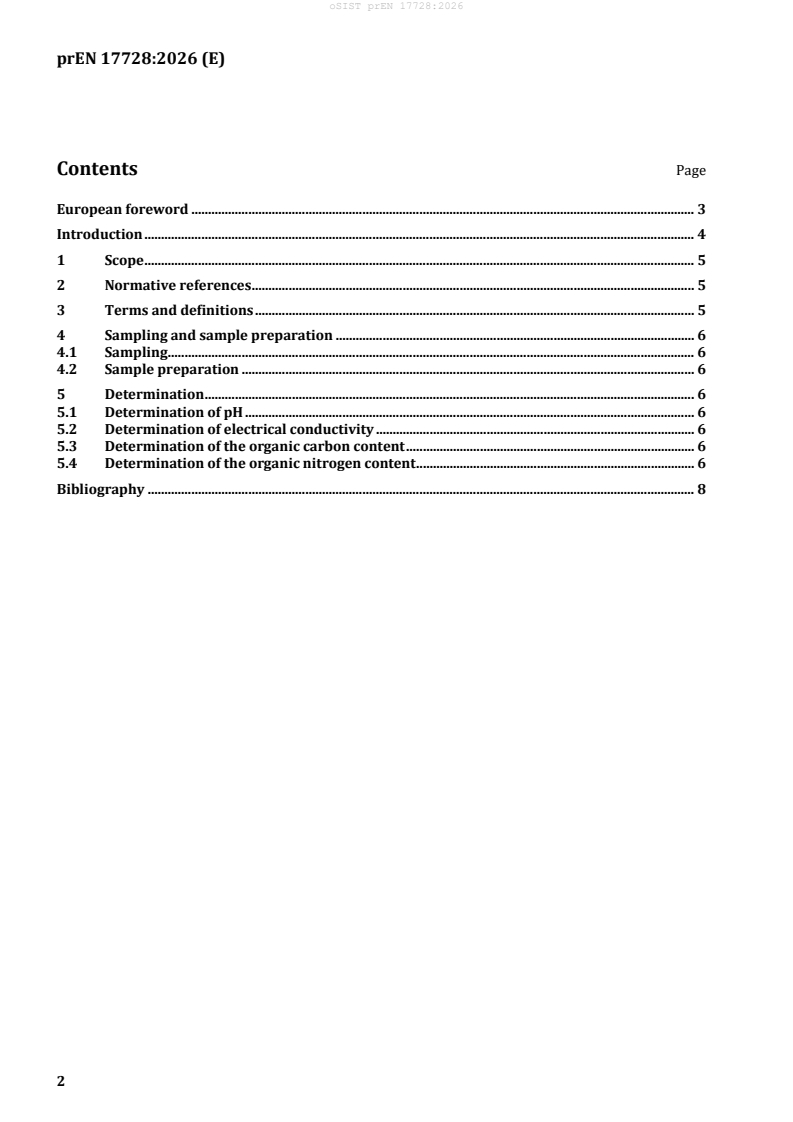
Contents Page
European foreword . 3
Introduction . 4
1 Scope . 5
2 Normative references . 5
3 Terms and definitions . 5
4 Sampling and sample preparation . 6
4.1 Sampling . 6
4.2 Sample preparation . 6
5 Determination . 6
5.1 Determination of pH . 6
5.2 Determination of electrical conductivity . 6
5.3 Determination of the organic carbon content . 6
5.4 Determination of the organic nitrogen content . 6
Bibliography . 8
prEN 17728:2026 (E)
European foreword
This document (prEN 17728:2026) has been prepared by Technical Committee CEN/TC 223 “Soil
improvers and growing media”, the secretariat of which is held by NEN.
This document is currently submitted to the CEN Enquiry.
This document will supersede CEN/TS 17728:2022.
prEN 17728:2026 includes the following significant technical changes with respect to
CEN/TS 17728:2022:
— The title has been revised;
— The quantity requirements have been removed from the Introduction;
— An applicability statement has been included in the Scope;
— Clause 2, Normative references, has been updated;
— Clause 5.3, Determination of the organic carbon content, and Clause 5.4, Determination of the organic
nitrogen content, have been added;
— Annex ZA has been added.
This document has been prepared under a standardization request addressed to CEN by the European
Commission. The Standing Committee of the EFTA States subsequently approves these requests for its
Member States.
For the relationship with EU Legislation, see informative Annex ZA, which is an integral part of this
document.
...