

EN 14604:2005
(Main)Smoke alarm devices
- Abstract
This document specifies requirements, test methods, performance criteria, and manufacturer's instructions for smoke alarms that operate using scattered light, transmitted light or ionization, intended for household or similar residential application.
This document includes additional requirements for smoke alarms, which are also suitable for use in leisure accommodation vehicles.
For the testing of other types of smoke alarms, or smoke alarms working on different principles, this document should only be used for guidance. Special features of smoke alarms, such as radio interlinking or special characteristics and developed for specific risks, are not covered by this document.
This document allows, although it does not require, the inclusion within the smoke alarm of facilities for interconnection with other similar smoke alarms and/or accessories, and for alarm silencing. Where such facilities are included, this document specifies applicable requirements.
This document does not cover devices intended for incorporation in systems using separate control and indicating equipment.
NOTE Certain types of smoke alarms contain radioactive materials. The national requirements for radiation protection differ from country to country and they are not specified in this document. Such smoke alarms should, however, comply with the applicable national requirements.
- Status
- Published
- Publication Date
- 26-Jul-2005
- Withdrawal Date
- 30-Jan-2006
- Technical Committee
- CEN/TC 72 - Fire detection and fire alarm systems
- Drafting Committee
- CEN/TC 72/WG 14 - Self-contained smoke alarms
- Current Stage
- 9093 - Decision to confirm - Review Enquiry
- Start Date
- 22-Apr-2009
- Completion Date
- 22-Apr-2009
- Directive
- 305/2011 - Regulation (eu) No 305/2011 of the European Parliament and of the Council of 9 march 2011 laying down harmonised conditions for the marketing of construction products and repealing council directive 89/106/eecOJ Ref: C, C 259 OJ Date: 08-Aug-2014
89/106/EEC - Construction productsOJ Ref: C, C 319 OJ Date: 14-Dec-2005
- Ref Project
SIST EN 14604:2005 - Smoke alarm devices

Overview
EN 14604:2005 is the European (CEN) standard that specifies requirements, test methods and performance criteria for domestic smoke alarm devices. It applies to alarms operating by scattered light, transmitted light or ionization and covers manufacturer instructions, power supplies (mains and standby), electrical safety and marking. Additional requirements exist where alarms are intended for leisure accommodation vehicles (LAVs). The standard is intended for household and similar residential applications; other smoke alarm types or special features (e.g., radio interlinking, system control panels) are outside its scope and only referenced for guidance.
Key topics and technical requirements
- Detection principles covered: scattered-light (optical/photocell), transmitted-light, and ionization devices. Other principles are not fully standardized here.
- Performance and sensitivity testing: defined test methods for initial sensitivity, repeatability, directional dependence and response thresholds in a smoke tunnel (see normative Annexes).
- Environmental and durability tests: heat, cold, damp, vibration (operational and endurance), impact, sulphur dioxide corrosion and EMC immunity.
- Fire scenario tests: several fire types (smouldering, glowing, flaming plastics, flaming liquid) and associated test rooms or apparatus (normative annexes).
- Power and battery requirements: normal/standby sources, battery capacity, battery fault/battery removal indication and back-up power conditions.
- Acoustic performance: sound output and sounder durability requirements (references to EN 54‑3).
- Optional features: interconnection facilities, alarm-silence function - if provided, the standard sets applicable requirements for these features.
- Safety, marking and documentation: electrical safety, user-replaceable parts, user instructions, and CE/Construction Products Directive interfaces (informative Annex ZA).
- Special considerations: notes on smoke alarms containing radioactive materials - national radiation protection laws apply.
Practical applications and users
Who uses EN 14604:
- Manufacturers developing household smoke alarms to meet EU/national market requirements.
- Test laboratories and certification bodies conducting conformity, type and performance tests.
- Regulators and procurement teams specifying minimum safety and performance criteria for residential alarms.
- Product designers and R&D teams using standardized test methods to validate detection performance, EMC immunity and environmental robustness.
- Installers and specifiers who need to understand marked performance, power and interconnection capabilities for domestic installations and leisure vehicles.
Related standards
- EN 54-3 (fire alarm sounders)
- EN 60065 / EN 60950 (electronic safety standards)
- EN 50130-4 (EMC immunity)
- EN ISO 9001 (quality management)
- Applicable national radiation protection regulations for ionization-type alarms
Keywords: EN 14604, smoke alarm devices, household smoke alarms, ionization, optical smoke detectors, CEN standard, smoke alarm testing, alarm interconnection, leisure accommodation vehicles.
Relations
- Effective Date
- 25-Aug-2026
- Effective Date
- 25-Mar-2026
- Effective Date
- 09-Feb-2026
- Effective Date
- 09-Feb-2026
- Effective Date
- 09-Feb-2026
- Effective Date
- 09-Feb-2026
- Effective Date
- 09-Feb-2026
- Effective Date
- 09-Feb-2026
- Effective Date
- 28-Jan-2026
- Effective Date
- 28-Jan-2026
- Corrected By
EN 14604:2005/AC:2008 - Smoke alarm devices - Effective Date
- 22-Dec-2008
- Effective Date
- 18-Jan-2023
Get Certified
Connect with accredited certification bodies for this standard

CIS Institut d.o.o.
Personal Protective Equipment (PPE) certification body. Notified Body NB-2890 for EU Regulation 2016/425 PPE.

Kiwa BDA Testing
Building and construction product certification.
Kmetijski inštitut Slovenije
Agricultural Institute of Slovenia. Soil testing, plant health, agricultural product analysis.
Sponsored listings
Frequently Asked Questions
EN 14604:2005 is a standard published by the European Committee for Standardization (CEN). Its full title is "Smoke alarm devices". This standard covers: This document specifies requirements, test methods, performance criteria, and manufacturer's instructions for smoke alarms that operate using scattered light, transmitted light or ionization, intended for household or similar residential application. This document includes additional requirements for smoke alarms, which are also suitable for use in leisure accommodation vehicles. For the testing of other types of smoke alarms, or smoke alarms working on different principles, this document should only be used for guidance. Special features of smoke alarms, such as radio interlinking or special characteristics and developed for specific risks, are not covered by this document. This document allows, although it does not require, the inclusion within the smoke alarm of facilities for interconnection with other similar smoke alarms and/or accessories, and for alarm silencing. Where such facilities are included, this document specifies applicable requirements. This document does not cover devices intended for incorporation in systems using separate control and indicating equipment. NOTE Certain types of smoke alarms contain radioactive materials. The national requirements for radiation protection differ from country to country and they are not specified in this document. Such smoke alarms should, however, comply with the applicable national requirements.
This document specifies requirements, test methods, performance criteria, and manufacturer's instructions for smoke alarms that operate using scattered light, transmitted light or ionization, intended for household or similar residential application. This document includes additional requirements for smoke alarms, which are also suitable for use in leisure accommodation vehicles. For the testing of other types of smoke alarms, or smoke alarms working on different principles, this document should only be used for guidance. Special features of smoke alarms, such as radio interlinking or special characteristics and developed for specific risks, are not covered by this document. This document allows, although it does not require, the inclusion within the smoke alarm of facilities for interconnection with other similar smoke alarms and/or accessories, and for alarm silencing. Where such facilities are included, this document specifies applicable requirements. This document does not cover devices intended for incorporation in systems using separate control and indicating equipment. NOTE Certain types of smoke alarms contain radioactive materials. The national requirements for radiation protection differ from country to country and they are not specified in this document. Such smoke alarms should, however, comply with the applicable national requirements.
EN 14604:2005 is classified under the following ICS (International Classification for Standards) categories: 13.220.20 - Fire protection; 13.320 - Alarm and warning systems. The ICS classification helps identify the subject area and facilitates finding related standards.
EN 14604:2005 has the following relationships with other standards: It is inter standard links to ISO 1402:1994, EN 573-3:2026, EN 50130-4:1995, EN 60950-1:2001, EN 60065:2002, EN 60068-1:1994, EN 61672-1:2003, EN 60068-2-42:2003, EN ISO 9001:2000, EN 573-3:2019+A2:2023, EN 14604:2005/AC:2008, prEN 14604. Understanding these relationships helps ensure you are using the most current and applicable version of the standard.
EN 14604:2005 is associated with the following European legislation: EU Directives/Regulations: 305/2011, 89/106/EEC; Standardization Mandates: M/109. When a standard is cited in the Official Journal of the European Union, products manufactured in conformity with it benefit from a presumption of conformity with the essential requirements of the corresponding EU directive or regulation.
EN 14604:2005 is available in PDF format for immediate download after purchase. The document can be added to your cart and obtained through the secure checkout process. Digital delivery ensures instant access to the complete standard document.
Standards Content (Sample)
2003-01.Slovenski inštitut za standardizacijo. Razmnoževanje celote ali delov tega standarda ni dovoljeno.Smoke alarm devicesJavljalniki dimaDispositifs d'alarme de fuméeRauchwarnmelderTa slovenski standard je istoveten z:EN 14604:2005SIST EN 14604:2005en13.32013.220.20ICS:SLOVENSKI
STANDARDSIST EN 14604:200501-december-2005
EUROPEAN STANDARDNORME EUROPÉENNEEUROPÄISCHE NORMEN 14604July 2005ICS 13.220.20; 13.320 English VersionSmoke alarm devicesDispositif d'alarme de fuméeRauchwarnmelderThis European Standard was approved by CEN on 21 March 2005.CEN members are bound to comply with the CEN/CENELEC Internal Regulations which stipulate the conditions for giving this EuropeanStandard the status of a national standard without any alteration. Up-to-date lists and bibliographical references concerning such nationalstandards may be obtained on application to the Central Secretariat or to any CEN member.This European Standard exists in three official versions (English, French, German). A version in any other language made by translationunder the responsibility of a CEN member into its own language and notified to the Central Secretariat has the same status as the officialversions.CEN members are the national standards bodies of Austria, Belgium, Cyprus, Czech Republic, Denmark, Estonia, Finland, France,Germany, Greece, Hungary, Iceland, Ireland, Italy, Latvia, Lithuania, Luxembourg, Malta, Netherlands, Norway, Poland, Portugal, Slovakia,Slovenia, Spain, Sweden, Switzerland and United Kingdom.EUROPEAN COMMITTEE FOR STANDARDIZATIONCOMITÉ EUROPÉEN DE NORMALISATIONEUROPÄISCHES KOMITEE FÜR NORMUNGManagement Centre: rue de Stassart, 36
B-1050 Brussels© 2005 CENAll rights of exploitation in any form and by any means reservedworldwide for CEN national Members.Ref. No. EN 14604:2005: E
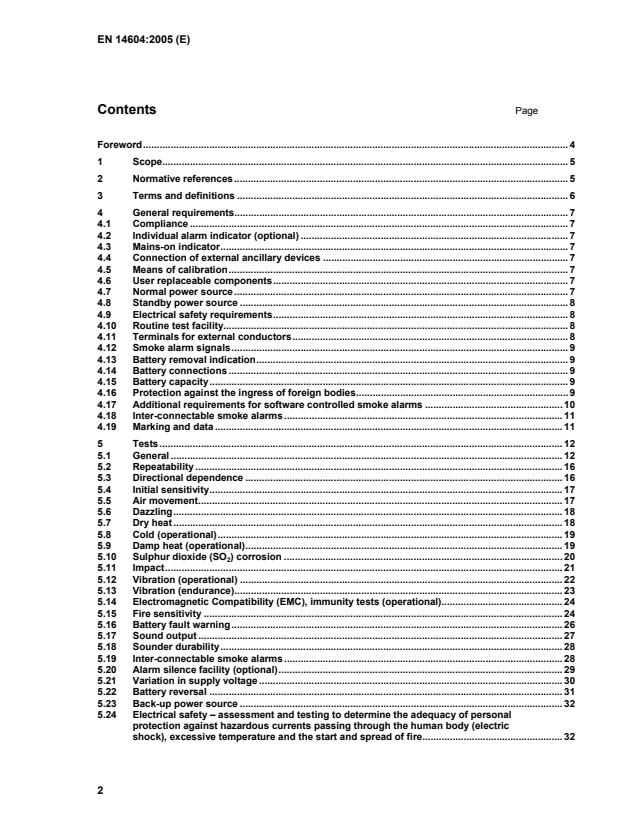
Smoke tunnel for response threshold value measurements.35 Annex B (normative)
Test aerosol for response threshold value measurements.36 Annex C (normative)
Smoke measuring instruments.37 C.1 Obscuration meter.37 C.2 Measuring ionization chamber (MIC).38 Annex D (normative)
Apparatus for dazzling test.41 Annex E (informative)
Apparatus for impact test.42 Annex F (normative)
Fire test room.44 Annex G (normative)
Smouldering pyrolysis wood fire (TF2).46 G.1 Fuel.46 G.2 Hotplate.46 G.3 Arrangement.46 G.4 Heating rate.47 G.5 End of test condition.47 G.6 Test validity criteria.47 Annex H (normative)
Glowing smouldering cotton fire (TF3).49 H.1 Fuel.49 H.2 Arrangement.49 H.3 Ignition.50 H.4 End of test condition.50 H.5 Test validity criteria.50 Annex I (normative)
Flaming plastics (polyurethane) fire (TF4).51 I.1 Fuel.51 I.2 Arrangement.51 I.3 Ignition.51 I.4 End of test condition.51 I.5 Test validity criteria.51 Annex J (normative)
Flaming liquid (n-heptane) fire (TF5).53 J.1 Fuel.53 J.2 Arrangement.53 J.3 Ignition.53 J.4 End of test condition.53 J.5 Test validity criteria.53 Annex K (informative)
Information concerning the construction of the smoke tunnel.55 Annex L (normative)
Alarms suitable for installation in leisure accommodation vehicles (LAVs).57 L.1 Temperature cycle test.57 Annex M (informative)
Information concerning the construction of the measuring ionization chamber.58 Annex ZA (informative)
Clauses addressing the provisions of the EU Construction Products Directive (89/106/EEC).60 ZA.1 Scope and relevant clauses.60 ZA.2 Procedures for the attestation of conformity of smoke alarms covered by this standard.61 ZA.3 CE Marking and labelling and accompanying documentation.66 ZA.4 EC certificate and declaration of conformity.68
For the testing of other types of smoke alarms, or smoke alarms working on different principles, this document should only be used for guidance. Smoke alarms with special features, such as radio interlinking or special characteristics and developed for specific risks, are not covered by this document. This document allows, although it does not require, the inclusion within the smoke alarm of facilities for interconnection with other similar smoke alarms and/or accessories, and for alarm silencing. Where such facilities are included, this document specifies applicable requirements. This document does not cover devices intended for incorporation in systems using separate control and indicating equipment. NOTE Certain types of smoke alarms contain radioactive materials. The national requirements for radiation protection differ from country to country and they are not specified in this document. Such smoke alarms should, however, comply with the applicable national requirements. 2 Normative references The following referenced documents are indispensable for the application of this document. For dated references, only the edition cited applies. For undated references, the latest edition of the referenced document (including any amendments) applies. EN 54-3, Fire detection and fire alarm systems — Part 3: Fire alarm devices — Sounders EN 573-3, Aluminium and aluminium alloys — Chemical composition and form of wrought products — Part 3: Chemical composition EN 573-4, Aluminium and aluminium alloys — Chemical composition and form of wrought products — Part 4: Forms of products EN 50130-4:1995, Alarm systems — Part 4: Electromagnetic compatibility — Product family standard: Immunity requirements for components of fire, intruder and social alarm systems EN 60065:2002, Audio, video and similar electronic apparatus — Safety requirements (IEC 60065:2001, modified) EN 60068-1:1994, Environmental testing — Part 1: General and guidance (IEC 60068-1:1988 + Corrigendum 1988 + A1:1992) EN 60068-2-6:1995, Environmental testing — Part 2:Tests — Test Fc: Vibration (sinusoidal) (IEC 60068-2-6:1995 + Corrigendum 1995) EN 60068-2-42:2003, Environmental testing — Part 2-42:Tests — Test Kc: Sulphur dioxide test for contacts and connections (IEC 60068-2-42:2003) EN 60950-1:2001, Information technology equipment — Safety — Part 1: General requirements (IEC 60950-1:2001, modified)
4.11 Terminals for external conductors The smoke alarm or base, as appropriate, if intended to have external connections, shall provide for the connection of conductors by means of screws, nuts or equally effective devices. For mains-powered smoke alarms which utilize a "flying lead"–type connector, this connector shall be regarded as a conductor. If terminals are provided, they shall allow the connection of conductors having nominal cross-sectional areas of between 0,4 mm2 and 1,5 mm2. Disconnection of the conductors, or access to the conductors for disconnection, shall not be possible without the use of a tool. Terminals shall be designed so that they clamp the conductor between metal surfaces without rotation of those surfaces but with sufficient contact pressure and without damage to the conductor. Flying lead type connectors shall be subjected to a pull test, such that when the connector is subjected to a pull of 20 N without jerks for 1 min in any direction allowed by the design, the connector does not become detached.
10 s test, for at least 1 year before the battery fault warning is given. At the point when the battery fault warning commences, the batteries shall have sufficient capacity to give an alarm signal as specified in 5.17 for at least 4 min in the event of fire, or in the absence of fire a battery fault warning for at least 30 days. In the absence of suitable test procedures to verify battery capacity, data concerning the smoke alarm loads and the battery characteristics shall be used to indicate that the above requirement can be met. 4.16 Protection against the ingress of foreign bodies The smoke alarm shall be so designed that a sphere of diameter (1,3 ± 0,05) mm cannot pass into the sensor chamber(s).
c) full source code listings, as hard copy or in machine-readable form (e.g. ASCII-code), including all global and local variables, constants and labels used, and sufficient comment for the program flow to be recognized; d) details of any software tools used in the design and implementation phase (e.g. CASE-tools, compilers).
EN 60068-1:1994 as follows: a) temperature
15 °C to 35 °C;
25 % to 75 %; c) air pressure
86 kPa to 106 kPa. If variations in these parameters have a significant effect on a measurement, then such variations shall be kept to a minimum during a series of measurements carried out as part of one test on one specimen. 5.1.2 Operating conditions for tests If a test method requires a specimen to be operational, then the specimen shall be connected to, or provided with, a suitable power source with characteristics as required by the manufacturer's data. Unless otherwise specified in the test method, the power source parameters applied to the specimen shall be set within the manufacturer's specified range(s) and shall remain substantially constant throughout the tests. The value chosen for each parameter shall normally be the nominal value, or the mean of the specified range. 5.1.3 Mounting arrangements The specimen shall be mounted by its normal means of attachment in accordance with the manufacturer's instructions. If these instructions describe more than one method of mounting then the method considered to be most unfavourable shall be chosen for each test. 5.1.4 Tolerances If a specific tolerance or limit is not specified in a requirement or test procedure, a tolerance of ± 5 % shall be applied. 5.1.5 Measurement of response threshold value The specimen, for which the response threshold value is to be measured, shall be installed in the
smoke tunnel, described in Annex A, in its normal operating position, by its normal means of attachment. The orientation of the specimen, relative to the direction of airflow, shall be the least sensitive orientation, as determined in the directional dependence test, unless otherwise specified in the test procedure. Before commencing each measurement, the smoke tunnel shall be purged with clean air to ensure that the tunnel and the specimen are free from the test aerosol. The air velocity in the proximity of the specimen shall be (0,2 ± 0,04) ms-1 during the measurement, unless otherwise specified in the test procedure. Unless otherwise specified in the test procedure, the air temperature in the tunnel shall be (23 ± 5) °C and shall not vary by more than 5 °C for all the measurements on a particular smoke alarm type. The specimen shall be connected to its power source as described in 5.1.2, and shall be allowed to stabilize for at least 15 min, unless otherwise specified by the manufacturer. The test aerosol, as described in Annex B, shall be introduced into the tunnel such that the rate of increase of aerosol density is as follows: 1,0tm015,0≤∆∆≤ dB m-1min-1
for smoke alarms using scattered or transmitted light; 3,0ty05,0≤∆∆≤ min-1
for smoke alarms using ionization.
Table 1 — Test schedule Test Clause Specimen number(s) Repeatability 5.2 One chosen arbitrarily Directional dependence 5.3 One chosen arbitrarily Initial sensitivity 5.4 All specimens Air movement 5.5 10 Dazzling 5.6 2 Dry heat 5.7 3 Cold (operational) 5.8 4 Damp heat (operational) 5.9 5 Sulphur dioxide (SO2) corrosion 5.10 6, 7 Impact 5.11 8 Vibration (operational) 5.12 9 Vibration (endurance) 5.13 9 Mains supply voltage dips and short interruptions 5.14 2 Electrostatic discharge 5.14 10 Radiated electromagnetic fields 5.14 11 Conducted disturbances induced by electromagnetic field 5.14 2 Fast transient bursts 5.14 12 Slow high energy transients 5.14 13 Fire sensitivity 5.15 17, 18, 19, 20 Battery fault warning 5.16 1,15 Sound output 5.17 1,15 Sounder durability 5.18 15 Inter-connectable smoke alarms 5.19 14 Alarm silence facility 5.20 16 Variation in supply voltage 5.21 2 Polarity reversal 5.22 16 Back-up power source 5.23 Additional specimens (as required) Electrical safety 5.24 Additional specimens (as required) Alarms for leisure accommodation vehicles Annex L 9 NOTE The test specified in 5.6 is only applied to detectors using scattered light or transmitted light, as detectors using ionization are considered unlikely to be influenced.
...