

prEN ISO 17234-2
(Main)Leather - Chemical tests for the determination of certain azo colorants in dyed leathers - Part 2: Determination of 4-aminoazobenzene (ISO/DIS 17234-2:2026)
- Abstract
ISO 17234-2:2011 is supplementary to ISO 17234-1 and describes a special procedure to detect the use of certain azo colorants in commodities, which can release 4-aminoazobenzene. The procedure also detects 4-aminoazobenzene (Solvent Yellow 1) which is already available as free amine in commodities without reducing pretreatment.
Azo colorants that are able to form 4-aminoazobenzene generate, under the conditions of ISO 17234‑1, the amines aniline and 1,4-phenylenediamine. The presence of these 4-aminoazobenzene colorants cannot be reliably ascertained without additional information (e.g. the chemical structure of the colorant used) or without a special procedure.
- Status
- Not Published
- Publication Date
- 21-Feb-2028
- Technical Committee
- CEN/TC 289 - Leather
- Drafting Committee
- CEN/TC 289/WG 1 - Chemical test methods
- Current Stage
- 4020 - Submission to enquiry - Enquiry
- Start Date
- 03-Sep-2026
- Completion Date
- 03-Sep-2026
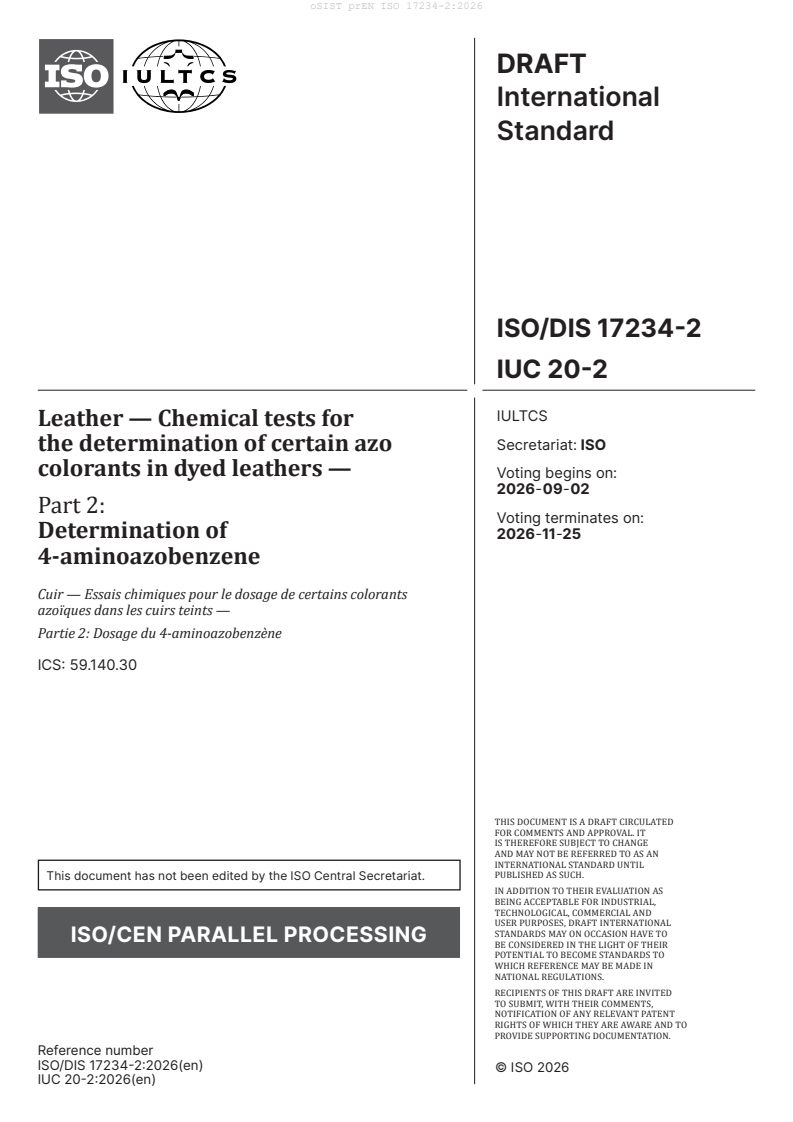

prEN ISO 17234-2 is a CEN draft standard for chemical testing of dyed leather. It specifies a special procedure for detecting 4-aminoazobenzene and azo colorants that can release it, so laboratories can check whether a leather commodity has been treated with this substance or with a colorant that can form it.
What does prEN ISO 17234-2 specify?
prEN ISO 17234-2 is supplementary to ISO 17234-1 and focuses on the detection of 4-aminoazobenzene in dyed leathers and related commodities. It also covers 4-aminoazobenzene already present as a free amine, which means the method is relevant both for dyed material and for material that may contain the analyte directly.
The document is organized into general requirements, a test principle, safety precautions, apparatus, reagents, sampling, procedure, evaluation, and test reporting. It then adds three informative annexes that support chromatographic analysis, method reliability, and result interpretation.
| Annex | What it covers |
|---|---|
| Annex A | Chromatographic analyses, including HPLC, GC/MS, CE/DAD, TLC and HPTLC conditions |
| Annex B | Reliability of the method, based on interlaboratory trials |
| Annex C | Assessment guide for interpreting analytical results |
What are the key requirements of prEN ISO 17234-2?
prEN ISO 17234-2 requires a controlled extraction and confirmation workflow: degrease the leather, perform reductive cleavage under specified alkaline conditions, transfer the released analyte into an organic phase, and identify or quantify it by a chromatographic method. In practice, the method matters because timing, temperature, phase separation and confirmation all affect whether a result can be trusted.
Sample preparation and sampling
Clause 9 requires sampling in accordance with ISO 2418 and grinding in accordance with ISO 4044. For finished products where ISO 2418 sampling is not possible, the test report has to state how sampling was done.
The clause also requires removal of adhesive traces and separate analysis of different colours or different leather qualities where possible. For a buyer or quality manager, this means mixed or patchy articles need careful subdivision before testing, or the result may not represent the whole item.
Extraction and chemical release of 4-aminoazobenzene
Clause 10.1 requires degreasing with n-hexane before the test specimen is treated further. Clause 10.2 then calls for reductive cleavage with sodium hydroxide and freshly prepared sodium dithionite at 40 °C in a closed vessel for exactly 30 minutes.
Clause 10.3 transfers the released 4-aminoazobenzene into tert-butyl methyl ether, with sodium chloride added to promote phase separation. This is important in practice because the method notes that poor separation or solvent loss can reduce the measured amount.
Instrumental detection and confirmation
Clause 5 allows detection by high-performance liquid chromatography with a diode array detector or mass selective detector (HPLC/DAD or HPLC/MS), capillary gas chromatography with mass-selective detector (GC/MS), capillary electrophoresis with diode array detector (CE/DAD), or qualitative thin-layer chromatography (TLC) or high-performance thin-layer chromatography (HPTLC). If one chromatographic method detects the analyte, confirmation has to be made with one or more alternative methods.
Clause 10.6 states that quantification is performed by HPLC/DAD or GC/MS, and that GC uses appropriate internal standards. In practice, this means laboratories need a confirmatory setup, not just a single screening run.
Calibration, system check and calculation
Clause 10.4 requires at least three calibration solutions over the range from 2 µg/ml to 30 µg/ml. Clause 10.5 requires a recovery check using the calibration solution, and the recovery rate has to be at least 60 %.
Clause 11 gives calculation routes with and without an internal standard, and the result is expressed as a mass fraction in milligrams per kilogram of specimen. This matters because the reported value is tied to the specimen mass and final extract volume, so the lab must track both carefully.
Reporting and interpretation
Clause 12 requires the report to identify the standard used, the specimen, the sampling procedure, the detection and quantification methods, and the result with the detection limit. It also points users to Annex C for interpreting results around 30 mg/kg.
Annex C explains how to treat results at or below 30 mg/kg and above 30 mg/kg. For decision-making, that threshold is the point at which the standard links the analytical result to a statement about the likely use of prohibited azo colorants.
What terms does prEN ISO 17234-2 define?
prEN ISO 17234-2 uses technical terms as part of the method, and these are the most important ones for readers of the document.
- 4-aminoazobenzene - The target analyte in this method; the standard also notes it as Solvent Yellow 1 when present as a free amine.
- Test specimen - The prepared leather portion that is degreased, cleaved and extracted for analysis.
- Internal standard (IS) - A reference compound added to improve GC-based quantification and reduce variation during measurement.
- High-performance liquid chromatography with diode array detector (HPLC/DAD) - A quantitative chromatographic method used for measuring 4-aminoazobenzene.
- Gas chromatography with mass-selective detector (GC/MS) - A quantitative chromatographic method used with internal standards for the same analyte.
- Capillary electrophoresis with diode array detector (CE/DAD) - One of the listed instrumental options for detecting 4-aminoazobenzene.
- High-performance thin-layer chromatography (HPTLC) - A qualitative or semi-quantitative confirmation technique listed in the procedure.
Who uses prEN ISO 17234-2?
prEN ISO 17234-2 is used by leather testing laboratories, quality control teams, and compliance staff who need to check dyed leather for 4-aminoazobenzene-related colorants. It is also relevant to manufacturers, importers, and buyers of leather goods when they need documented analytical evidence for finished products such as shoes, garments, or patchwork items.
The document is especially useful when different leather colours or qualities must be tested separately, or when a finished commodity needs a traceable report for regulatory or customer requirements. In practice, it supports both routine screening and confirmatory laboratory work.
What changed in prEN ISO 17234-2 from the previous edition?
The foreword says this second edition cancels and replaces the first edition and that it was technically revised as follows:
- all occurrences of “sample” were replaced by “test specimen”
- the reference to ISO 2418 was modified
- subclauses 7.2 and 9.4 were modified
- the last sentence in clause 9 was deleted
Which standards are used with prEN ISO 17234-2?
prEN ISO 17234-2 refers to ISO 2418 for specimen position and preparation, and ISO 4044 for preparation of chemical test samples. It is also described as supplementary to ISO 17234-1, which is the companion part that provides the related method framework.
What does the prEN ISO 17234-2 document contain?
prEN ISO 17234-2 contains the full laboratory method structure, from scope and principle through to reporting. The main text gives the required apparatus, reagents, sampling rules, the degreasing and reductive cleavage steps, extraction conditions, calibration approach, analytical system check, and the two calculation routes.
Annex A provides practical chromatographic conditions and example chromatograms and spectra for HPLC/DAD, HPLC/MS, GC/MS, CE/DAD, and TLC or HPTLC. Annex B gives interlaboratory data on repeatability and reproducibility, which helps users judge how stable the method is in routine work. Annex C gives an interpretation guide for analytical results, including how to read findings around the 30 mg/kg threshold.
Relations
- Effective Date
- 15-Apr-2026
Get Certified
Connect with accredited certification bodies for this standard

Control Union Certifications
Global certification for agriculture and sustainability.

Hohenstein Institut
Textile testing and certification.

Bureau Veritas Bangladesh
Bureau Veritas certification services in Bangladesh.
Sponsored listings
Frequently Asked Questions
prEN ISO 17234-2 is a draft published by the European Committee for Standardization (CEN). Its full title is "Leather - Chemical tests for the determination of certain azo colorants in dyed leathers - Part 2: Determination of 4-aminoazobenzene (ISO/DIS 17234-2:2026)". This standard covers: ISO 17234-2:2011 is supplementary to ISO 17234-1 and describes a special procedure to detect the use of certain azo colorants in commodities, which can release 4-aminoazobenzene. The procedure also detects 4-aminoazobenzene (Solvent Yellow 1) which is already available as free amine in commodities without reducing pretreatment. Azo colorants that are able to form 4-aminoazobenzene generate, under the conditions of ISO 17234‑1, the amines aniline and 1,4-phenylenediamine. The presence of these 4-aminoazobenzene colorants cannot be reliably ascertained without additional information (e.g. the chemical structure of the colorant used) or without a special procedure.
ISO 17234-2:2011 is supplementary to ISO 17234-1 and describes a special procedure to detect the use of certain azo colorants in commodities, which can release 4-aminoazobenzene. The procedure also detects 4-aminoazobenzene (Solvent Yellow 1) which is already available as free amine in commodities without reducing pretreatment. Azo colorants that are able to form 4-aminoazobenzene generate, under the conditions of ISO 17234‑1, the amines aniline and 1,4-phenylenediamine. The presence of these 4-aminoazobenzene colorants cannot be reliably ascertained without additional information (e.g. the chemical structure of the colorant used) or without a special procedure.
prEN ISO 17234-2 is classified under the following ICS (International Classification for Standards) categories: 59.140.30 - Leather and furs. The ICS classification helps identify the subject area and facilitates finding related standards.
prEN ISO 17234-2 has the following relationships with other standards: It is inter standard links to EN ISO 17234-2:2011. Understanding these relationships helps ensure you are using the most current and applicable version of the standard.
prEN ISO 17234-2 is available in PDF format for immediate download after purchase. The document can be added to your cart and obtained through the secure checkout process. Digital delivery ensures instant access to the complete standard document.
Standards Content (Sample)
SLOVENSKI STANDARD
01-november-2026
Usnje - Kemični preskusi za ugotavljanje določenih azo barvil na barvanem usnju -
2. del: Ugotavljanje 4-aminoazobenzena (ISO/DIS 17234-2:2026)
Leather - Chemical tests for the determination of certain azo colorants in dyed leathers -
Part 2: Determination of 4-aminoazobenzene (ISO/DIS 17234-2:2026)
Leder - Chemische Prüfungen zur Bestimmung bestimmter Azofarbstoffe in gefärbten
Ledern - Teil 2: Bestimmung von 4-Aminoazobenzol (ISO/DIS 17234-2:2026)
Cuir - Essais chimiques pour le dosage de certains colorants azoïques dans les cuirs
teints - Partie 2: Dosage du 4-aminoazobenzène (ISO/DIS 17234-2:2026)
Ta slovenski standard je istoveten z: prEN ISO 17234-2
ICS:
59.140.30 Usnje in krzno Leather and furs
2003-01.Slovenski inštitut za standardizacijo. Razmnoževanje celote ali delov tega standarda ni dovoljeno.
DRAFT
International
Standard
ISO/DIS 17234-2
IUC 20-2
IULTCS
Leather — Chemical tests for
Secretariat: ISO
the determination of certain azo
colorants in dyed leathers —
Voting begins on:
2026-09-02
Part 2:
Voting terminates on:
Determination of 2026-11-25
4-aminoazobenzene
Cuir — Essais chimiques pour le dosage de certains colorants
azoïques dans les cuirs teints —
Partie 2: Dosage du 4-aminoazobenzène
ICS: 59.140.30
THIS DOCUMENT IS A DRAFT CIRCULATED
FOR COMMENTS AND APPROVAL. IT
IS THEREFORE SUBJECT TO CHANGE
AND MAY NOT BE REFERRED TO AS AN
INTERNATIONAL STANDARD UNTIL
PUBLISHED AS SUCH.
This document has not been edited by the ISO Central Secretariat.
IN ADDITION TO THEIR EVALUATION AS
BEING ACCEPTABLE FOR INDUSTRIAL,
TECHNOLOGICAL, COMMERCIAL AND
USER PURPOSES, DRAFT INTERNATIONAL
STANDARDS MAY ON OCCASION HAVE TO
ISO/CEN PARALLEL PROCESSING
BE CONSIDERED IN THE LIGHT OF THEIR
POTENTIAL TO BECOME STANDARDS TO
WHICH REFERENCE MAY BE MADE IN
NATIONAL REGULATIONS.
RECIPIENTS OF THIS DRAFT ARE INVITED
TO SUBMIT, WITH THEIR COMMENTS,
NOTIFICATION OF ANY RELEVANT PATENT
RIGHTS OF WHICH THEY ARE AWARE AND TO
PROVIDE SUPPORTING DOCUMENTATION.
Reference number
ISO/DIS 17234-2:2026(en)
IUC 20-2:2026(en)
DRAFT
ISO/DIS 17234-2:2026(en)
International
IUC 20-2:2026(en)
Standard
ISO/DIS 17234-2
IUC 20-2
IULTCS
Leather — Chemical tests for
Secretariat: ISO
the determination of certain azo
colorants in dyed leathers —
Voting begins on:
Part 2:
Voting terminates on:
Determination of
4-aminoazobenzene
Cuir — Essais chimiques pour le dosage de certains colorants
azoïques dans les cuirs teints —
Partie 2: Dosage du 4-aminoazobenzène
ICS: 59.140.30
THIS DOCUMENT IS A DRAFT CIRCULATED
FOR COMMENTS AND APPROVAL. IT
IS THEREFORE SUBJECT TO CHANGE
AND MAY NOT BE REFERRED TO AS AN
INTERNATIONAL STANDARD UNTIL
PUBLISHED AS SUCH.
This document has not been edited by the ISO Central Secretariat.
IN ADDITION TO THEIR EVALUATION AS
BEING ACCEPTABLE FOR INDUSTRIAL,
© ISO 2026
TECHNOLOGICAL, COMMERCIAL AND
USER PURPOSES, DRAFT INTERNATIONAL
All rights reserved. Unless otherwise specified, or required in the context of its implementation, no part of this publication may
STANDARDS MAY ON OCCASION HAVE TO
ISO/CEN PARALLEL PROCESSING
be reproduced or utilized otherwise in any form or by any means, electronic or mechanical, including photocopying, or posting on
BE CONSIDERED IN THE LIGHT OF THEIR
the internet or an intranet, without prior written permission. Permission can be requested from either ISO at the address below
POTENTIAL TO BECOME STANDARDS TO
WHICH REFERENCE MAY BE MADE IN
or ISO’s member body in the country of the requester.
NATIONAL REGULATIONS.
ISO copyright office
RECIPIENTS OF THIS DRAFT ARE INVITED
CP 401 • Ch. de Blandonnet 8
TO SUBMIT, WITH THEIR COMMENTS,
CH-1214 Vernier, Geneva
NOTIFICATION OF ANY RELEVANT PATENT
Phone: +41 22 749 01 11
RIGHTS OF WHICH THEY ARE AWARE AND TO
PROVIDE SUPPORTING DOCUMENTATION.
Email: copyright@iso.org
Website: www.iso.org
Reference number
Published in Switzerland ISO/DIS 17234-2:2026(en)
IUC 20-2:2026(en)
ii
ISO/DIS 17234-2:2026(en)
IUC 20-2:2026(en)
Contents Page
Foreword .iv
1 Scope . 1
2 Normative references . 1
3 Terms and definitions . 1
4 General . 1
5 Principle . 2
6 Safety precautions. 2
7 Apparatus . 2
8 Reagents . 3
9 Sampling . 4
10 Procedure . 4
10.1 Degreasing.4
10.2 Reductive cleavage .4
10.3 Separation and concentration of 4-aminoazobenzene .4
10.4 Calibration solution .5
10.5 Check of the analytical system .5
10.6 Chromatographic analyses .5
11 Evaluation . 5
11.1 Calculation with internal standard .5
11.2 Calculation without internal standard .5
11.3 Reliability of the method .6
12 Test report . 6
Annex A (informative) Chromatographic analyses. 7
Annex B (informative) Reliability of the method . 14
Annex C (informative) Assessment guide — Interpretation of analytical results .15
Bibliography .16
iii
ISO/DIS 17234-2:2026(en)
IUC 20-2:2026(en)
Foreword
ISO (the International Organization for Standardization) is a worldwide federation of national standards
bodies (ISO member bodies). The work of preparing International Standards is normally carried out through
ISO technical committees. Each member body interested in a subject for which a technical committee
has been established has the right to be represented on that committee. International organizations,
governmental and non-governmental, in liaison with ISO, also take part in the work. ISO collaborates closely
with the International Electrotechnical Commission (IEC) on all matters of electrotechnical standardization.
The procedures used to develop this document and those intended for its further maintenance are described
in the ISO/IEC Directives, Part 1. In particular, the different approval criteria needed for the different types
of ISO documents should be noted. This document was drafted in accordance with the editorial rules of the
ISO/IEC Directives, Part 2 (see www.iso.org/directives).
ISO draws attention to the possibility that the implementation of this document may involve the use of (a)
patent(s). ISO takes no position concerning the evidence, validity or applicability of any claimed patent
rights in respect thereof. As of the date of publication of this document, ISO had not received notice of (a)
patent(s) which may be required to implement this document. However, implementers are cautioned that
this may not represent the latest information, which may be obtained from the patent database available at
www.iso.org/patents. ISO shall not be held responsible for identifying any or all such patent rights.
Any trade name used in this document is information given for the convenience of users and does not
constitute an endorsement.
For an explanation of the voluntary nature of standards, the meaning of ISO specific terms and expressions
related to conformity assessment, as well as information about ISO's adherence to the World Trade
Organization (WTO) principles in the Technical Barriers to Trade (TBT), see www.iso.org/iso/foreword.html.
This document was prepared by the Chemical Test Commission of the International Union of Leather
Technologists and Chemists Societies (IUC Commission, IULTCS) in collaboration with the European
Committee for Standardization (CEN) Technical Committee CEN/TC 289, Leather, the secretariat of which
is held by UNI, in accordance with the agreement on technical cooperation between ISO and CEN (Vienna
Agreement).
IULTCS, originally formed in 1897, is a world-wide organization of professional leather societies to further
the advancement of leather science and technology. IULTCS has three Commissions, which are responsible
for establishing international methods for the sampling and testing of leather. ISO recognizes IULTCS as an
international standardizing body for the preparation of test methods for leather.
This second edition cancels and replaces the first edition (ISO 17234-1:2011), which has been technically
revised as follows:
— all the words “sample” are replaced by “test specimen”;
— the reference of ISO 2418 has been modified;
— the subclauses 7.2 and 9.4 have been modified;
— the last sentence in clause 9 has been deleted.
A list of all parts in the ISO 17234 series can be found on the ISO website.
Any feedback or questions on this document should be directed to the user’s national standards body. A
complete listing of these bodies can be found at www.iso.org/members.html.
iv
ISO/DIS 17234-2:2026(en)
DRAFT International Standard
IUC 20-2:2026(en)
Leather — Chemical tests for the determination of certain azo
colorants in dyed leathers —
Part 2:
Determination of 4-aminoazobenzene
1 Scope
This part of ISO 17234 is supplementary to ISO 17234-1 and describes a special procedure to detect the use
of certain azo colorants in commodities, which can release 4-aminoazobenzene. The procedure also detects
4-aminoazobenzene (Solvent Yellow 1) which is already available as free amine in commodities without
reducing pretreatment.
Azo colorants that are able to form 4-aminoazobenzene generate, under the conditions of ISO 17234-1, the
amines aniline and 1,4-phenylenediamine. The presence of these 4-aminoazobenzene colorants cannot be
reliably ascertained without additional information (e.g. the chemical structure of the colorant used) or
without a special procedure.
The use of certain azo colorants, which may release, by reductive cleavage of their azo group(s), one or
more of the other aromatic amines listed in Annex XVII of Regulation (EC) No. 1907/2006 of the European
Parliament and of the Council on the Registration, Evaluation, Authorisation and Restriction of Chemicals
(REACH), except 4-aminoazobenzene, cannot be determined quantitatively with this method.
2 Normative references
The following documents are referred to in the text in such a way that some or all of their content constitutes
requirements of this document. For dated references, only the edition cited applies. For undated references,
the latest edition of the referenced document (including any amendments) applies.
ISO 2418, Leather — Chemical, physical, mechanical and fastness tests — Position and preparation of specimens
for testing
ISO 4044, Leather — Chemical tests — Preparation of chemical test samples
3 Terms and definitions
No terms and definitions are listed in this document.
ISO and IEC maintain terminology databases for use in standardization at the following addresses:
— ISO Online browsing platform: available at https:// www .iso .org/ obp
— IEC Electropedia: available at https:// www .electropedia .org/
4 General
Certain azo colorants may release by reductive cleavage of their azo group(s), 4-aminoazobenzene, which
is proscribed under Annex XVII of Regulation (EC) No. 1907/2006 of the European Parliament and of the
Council on the Registration, Evaluation, Authorisation and Restriction of Chemicals (REACH).
ISO/DIS 17234-2:2026(en)
IUC 20-2:2026(en)
Table 1 — 4-aminoazobenzene proscribed under Regulation REACH 1907/2006/Annex XVII
No. CAS number Index number EC number Substance
22 60-09-3 611-008-00-4 200-453-6 4-aminoazobenzene
5 Principle
After degreasing, the leather test specimen is treated with sodium dithionite in an alkaline solution at 40 °C
in a closed vessel. 4-Aminoazobenzene, which is released in the process, is transferred to a tert-butyl methyl
ether phase by means of liquid/liquid extraction. An aliquot of the tert-butyl methyl ether phase is used for
analysis.
The detection and determination of 4-aminoazobenzene is performed using high-performance liquid
chromatography (HPLC) with a diode array detector (DAD) or mass selective detector (HPLC/MS), capillary
gas chromatography with a mass-selective detector (GC/MS) or capillary electrophoresis with a diode array
detector (CE/DAD), or qualitatively with thin-layer chromatography (TLC, HPTLC).
If 4-aminoazobenzene is detected by one chromatographic method, confirmation shall be made using one or
more alternative methods. Amine quantification is performed by HPLC/DAD.
6 Safety precautions
6.1 The compound 4-aminoazobenzene is classified as a substance suspected to be a human carcinogen.
Any handling and disposal of this substance shall be in strict accordance with the appropriate national
health and safety regulations.
6.2 It is the user's responsibility to use safe and proper techniques when handling materials in this
test method. Consult manufacturers for specific details, such as material safety data sheets and other
recommendations.
6.3 Good laboratory practice should be followed. Wear safety glasses in all laboratory areas, and a dust
respirator and single-use gloves while handling powder colorants and 4-aminoazobenzene.
6.4 Users should comply with any national and local safety regulations.
7 Apparatus
Usual laboratory equipment and, in particular, the following.
7.1 Suitable reaction vessel, of temperature-resistant glass with a gastight closure.
7.2 Heating source, that generates a temperature of (40 ± 2) °C.
7.3 Separator, with a revolution speed of more than 3 000 r/min.
7.4 Vacuum rotary evaporator.
7.5 Pipettes, in required or varia
...