

oSIST prEN ISO 17234-2:2026
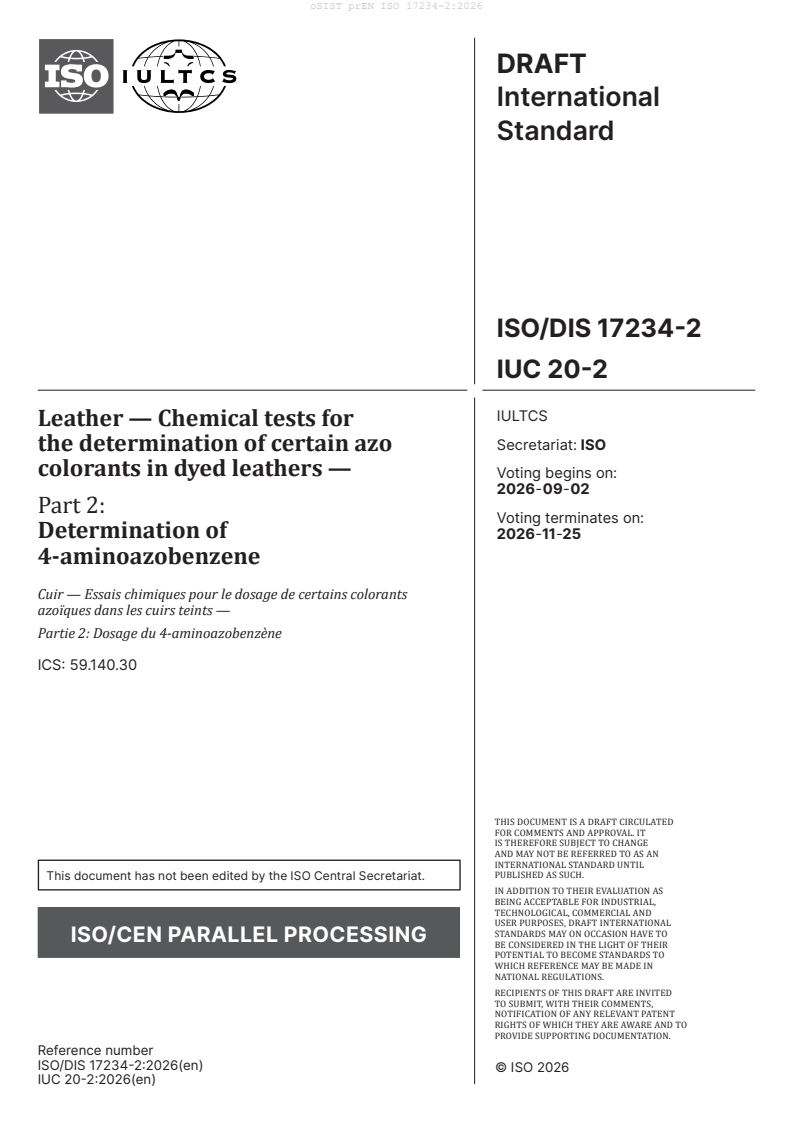
(Main)Leather - Chemical tests for the determination of certain azo colorants in dyed leathers - Part 2: Determination of 4-aminoazobenzene (ISO/DIS 17234-2:2026)
- Abstract
ISO 17234-2:2011 is supplementary to ISO 17234-1 and describes a special procedure to detect the use of certain azo colorants in commodities, which can release 4-aminoazobenzene. The procedure also detects 4-aminoazobenzene (Solvent Yellow 1) which is already available as free amine in commodities without reducing pretreatment.
Azo colorants that are able to form 4-aminoazobenzene generate, under the conditions of ISO 17234‑1, the amines aniline and 1,4-phenylenediamine. The presence of these 4-aminoazobenzene colorants cannot be reliably ascertained without additional information (e.g. the chemical structure of the colorant used) or without a special procedure.
- Status
- Not Published
- Public Enquiry End Date
- 19-Nov-2026
- Technical Committee
- IUSN - Leather
- Current Stage
- 4020 - Public enquire (PE) (Adopted Project)
- Start Date
- 02-Oct-2026
- Due Date
- 19-Feb-2027
- Completion Date
- 20-Nov-2026

oSIST prEN ISO 17234-2:2026 is a CEN draft standard for chemical testing of dyed leather. It specifies a special procedure for detecting 4-aminoazobenzene and azo colorants that can release it, so laboratories can check whether a leather commodity has been treated with this substance or with a colorant that can form it.
What does oSIST prEN ISO 17234-2:2026 specify?
oSIST prEN ISO 17234-2:2026 is supplementary to ISO 17234-1 and focuses on the detection of 4-aminoazobenzene in dyed leathers and related commodities. It also covers 4-aminoazobenzene already present as a free amine, which means the method is relevant both for dyed material and for material that may contain the analyte directly.
The document is organized into general requirements, a test principle, safety precautions, apparatus, reagents, sampling, procedure, evaluation, and test reporting. It then adds three informative annexes that support chromatographic analysis, method reliability, and result interpretation.
| Annex | What it covers |
|---|---|
| Annex A | Chromatographic analyses, including HPLC, GC/MS, CE/DAD, TLC and HPTLC conditions |
| Annex B | Reliability of the method, based on interlaboratory trials |
| Annex C | Assessment guide for interpreting analytical results |
What are the key requirements of oSIST prEN ISO 17234-2:2026?
oSIST prEN ISO 17234-2:2026 requires a controlled extraction and confirmation workflow: degrease the leather, perform reductive cleavage under specified alkaline conditions, transfer the released analyte into an organic phase, and identify or quantify it by a chromatographic method. In practice, the method matters because timing, temperature, phase separation and confirmation all affect whether a result can be trusted.
Sample preparation and sampling
Clause 9 requires sampling in accordance with ISO 2418 and grinding in accordance with ISO 4044. For finished products where ISO 2418 sampling is not possible, the test report has to state how sampling was done.
The clause also requires removal of adhesive traces and separate analysis of different colours or different leather qualities where possible. For a buyer or quality manager, this means mixed or patchy articles need careful subdivision before testing, or the result may not represent the whole item.
Extraction and chemical release of 4-aminoazobenzene
Clause 10.1 requires degreasing with n-hexane before the test specimen is treated further. Clause 10.2 then calls for reductive cleavage with sodium hydroxide and freshly prepared sodium dithionite at 40 °C in a closed vessel for exactly 30 minutes.
Clause 10.3 transfers the released 4-aminoazobenzene into tert-butyl methyl ether, with sodium chloride added to promote phase separation. This is important in practice because the method notes that poor separation or solvent loss can reduce the measured amount.
Instrumental detection and confirmation
Clause 5 allows detection by high-performance liquid chromatography with a diode array detector or mass selective detector (HPLC/DAD or HPLC/MS), capillary gas chromatography with mass-selective detector (GC/MS), capillary electrophoresis with diode array detector (CE/DAD), or qualitative thin-layer chromatography (TLC) or high-performance thin-layer chromatography (HPTLC). If one chromatographic method detects the analyte, confirmation has to be made with one or more alternative methods.
Clause 10.6 states that quantification is performed by HPLC/DAD or GC/MS, and that GC uses appropriate internal standards. In practice, this means laboratories need a confirmatory setup, not just a single screening run.
Calibration, system check and calculation
Clause 10.4 requires at least three calibration solutions over the range from 2 µg/ml to 30 µg/ml. Clause 10.5 requires a recovery check using the calibration solution, and the recovery rate has to be at least 60 %.
Clause 11 gives calculation routes with and without an internal standard, and the result is expressed as a mass fraction in milligrams per kilogram of specimen. This matters because the reported value is tied to the specimen mass and final extract volume, so the lab must track both carefully.
Reporting and interpretation
Clause 12 requires the report to identify the standard used, the specimen, the sampling procedure, the detection and quantification methods, and the result with the detection limit. It also points users to Annex C for interpreting results around 30 mg/kg.
Annex C explains how to treat results at or below 30 mg/kg and above 30 mg/kg. For decision-making, that threshold is the point at which the standard links the analytical result to a statement about the likely use of prohibited azo colorants.
What terms does oSIST prEN ISO 17234-2:2026 define?
oSIST prEN ISO 17234-2:2026 uses technical terms as part of the method, and these are the most important ones for readers of the document.
- 4-aminoazobenzene - The target analyte in this method; the standard also notes it as Solvent Yellow 1 when present as a free amine.
- Test specimen - The prepared leather portion that is degreased, cleaved and extracted for analysis.
- Internal standard (IS) - A reference compound added to improve GC-based quantification and reduce variation during measurement.
- High-performance liquid chromatography with diode array detector (HPLC/DAD) - A quantitative chromatographic method used for measuring 4-aminoazobenzene.
- Gas chromatography with mass-selective detector (GC/MS) - A quantitative chromatographic method used with internal standards for the same analyte.
- Capillary electrophoresis with diode array detector (CE/DAD) - One of the listed instrumental options for detecting 4-aminoazobenzene.
- High-performance thin-layer chromatography (HPTLC) - A qualitative or semi-quantitative confirmation technique listed in the procedure.
Who uses oSIST prEN ISO 17234-2:2026?
oSIST prEN ISO 17234-2:2026 is used by leather testing laboratories, quality control teams, and compliance staff who need to check dyed leather for 4-aminoazobenzene-related colorants. It is also relevant to manufacturers, importers, and buyers of leather goods when they need documented analytical evidence for finished products such as shoes, garments, or patchwork items.
The document is especially useful when different leather colours or qualities must be tested separately, or when a finished commodity needs a traceable report for regulatory or customer requirements. In practice, it supports both routine screening and confirmatory laboratory work.
What changed in oSIST prEN ISO 17234-2:2026 from the previous edition?
The foreword says this second edition cancels and replaces the first edition and that it was technically revised as follows:
- all occurrences of “sample” were replaced by “test specimen”
- the reference to ISO 2418 was modified
- subclauses 7.2 and 9.4 were modified
- the last sentence in clause 9 was deleted
Which standards are used with oSIST prEN ISO 17234-2:2026?
oSIST prEN ISO 17234-2:2026 refers to ISO 2418 for specimen position and preparation, and ISO 4044 for preparation of chemical test samples. It is also described as supplementary to ISO 17234-1, which is the companion part that provides the related method framework.
What does the oSIST prEN ISO 17234-2:2026 document contain?
oSIST prEN ISO 17234-2:2026 contains the full laboratory method structure, from scope and principle through to reporting. The main text gives the required apparatus, reagents, sampling rules, the degreasing and reductive cleavage steps, extraction conditions, calibration approach, analytical system check, and the two calculation routes.
Annex A provides practical chromatographic conditions and example chromatograms and spectra for HPLC/DAD, HPLC/MS, GC/MS, CE/DAD, and TLC or HPTLC. Annex B gives interlaboratory data on repeatability and reproducibility, which helps users judge how stable the method is in routine work. Annex C gives an interpretation guide for analytical results, including how to read findings around the 30 mg/kg threshold.
Relations
- Effective Date
- 15-Apr-2026
Get Certified
Connect with accredited certification bodies for this standard

Control Union Certifications
Global certification for agriculture and sustainability.

Hohenstein Institut
Textile testing and certification.

Bureau Veritas Bangladesh
Bureau Veritas certification services in Bangladesh.
Sponsored listings
Frequently Asked Questions
oSIST prEN ISO 17234-2:2026 is a draft published by the Slovenian Institute for Standardization (SIST). Its full title is "Leather - Chemical tests for the determination of certain azo colorants in dyed leathers - Part 2: Determination of 4-aminoazobenzene (ISO/DIS 17234-2:2026)". This standard covers: ISO 17234-2:2011 is supplementary to ISO 17234-1 and describes a special procedure to detect the use of certain azo colorants in commodities, which can release 4-aminoazobenzene. The procedure also detects 4-aminoazobenzene (Solvent Yellow 1) which is already available as free amine in commodities without reducing pretreatment. Azo colorants that are able to form 4-aminoazobenzene generate, under the conditions of ISO 17234‑1, the amines aniline and 1,4-phenylenediamine. The presence of these 4-aminoazobenzene colorants cannot be reliably ascertained without additional information (e.g. the chemical structure of the colorant used) or without a special procedure.
ISO 17234-2:2011 is supplementary to ISO 17234-1 and describes a special procedure to detect the use of certain azo colorants in commodities, which can release 4-aminoazobenzene. The procedure also detects 4-aminoazobenzene (Solvent Yellow 1) which is already available as free amine in commodities without reducing pretreatment. Azo colorants that are able to form 4-aminoazobenzene generate, under the conditions of ISO 17234‑1, the amines aniline and 1,4-phenylenediamine. The presence of these 4-aminoazobenzene colorants cannot be reliably ascertained without additional information (e.g. the chemical structure of the colorant used) or without a special procedure.
oSIST prEN ISO 17234-2:2026 is classified under the following ICS (International Classification for Standards) categories: 59.140.30 - Leather and furs. The ICS classification helps identify the subject area and facilitates finding related standards.
oSIST prEN ISO 17234-2:2026 has the following relationships with other standards: It is inter standard links to SIST EN ISO 17234-2:2011. Understanding these relationships helps ensure you are using the most current and applicable version of the standard.
oSIST prEN ISO 17234-2:2026 is available in PDF format for immediate download after purchase. The document can be added to your cart and obtained through the secure checkout process. Digital delivery ensures instant access to the complete standard document.
Standards Content (Sample)
Contents
- 1 Scope
- 2 Normative references
- 3 Terms and definitions
- 4 General
- 5 Principle
- 6 Safety precautions
- 7 Apparatus
- 7.9 Instrumental equipment
- 8 Reagents
- 8.9 Standard solutions
- 9 Sampling
- 10 Procedure
- 10.1 Degreasing
- 10.2 Reductive cleavage
- 10.3 Separation and concentration of 4-aminoazobenzene
- 10.4 Calibration solution
- 10.5 Check of the analytical system
- 10.6 Chromatographic analyses
- 11 Evaluation
- 11.1 Calculation with internal standard
- 11.2 Calculation without internal standard
- 11.3 Reliability of the method
- 12 Test report
- Annex A
- 1 DAD A, Sig = 240 nm
- 3 DAD B, Sig = 380 nm
- Annex B
- Annex C
- Bibliography
1 Scope
This part of ISO 17234 is supplementary to ISO 17234-1 and describes a special procedure to detect the use of certain azo colorants in commodities, which can release 4-aminoazobenzene. The procedure also detects 4-aminoazobenzene (Solvent Yellow 1) which is already available as free amine in commodities without reducing pretreatment.
Azo colorants that are able to form 4-aminoazobenzene generate, under the conditions of ISO 17234-1, the amines aniline and 1,4-phenylenediamine. The presence of these 4-aminoazobenzene colorants cannot be reliably ascertained without additional information (e.g. the chemical structure of the colorant used) or without a special procedure.
The use of certain azo colorants, which may release, by reductive cleavage of their azo group(s), one or more of the other aromatic amines listed in Annex XVII of Regulation (EC) No. 1907/2006 of the European Parliament and of the Council on the Registration, Evaluation, Authorisation and Restriction of Chemicals (REACH), except 4-aminoazobenzene, cannot be determined quantitatively with this method.
2 Normative references
The following documents are referred to in the text in such a way that some or all of their content constitutes requirements of this document. For dated references, only the edition cited applies. For undated references, the latest edition of the referenced document (including any amendments) applies. ISO 2418, Leather — Chemical, physical, mechanical and fastness tests — Position and preparation of specimens for testing ISO 4044, Leather — Chemical tests — Preparation of chemical test samples
3 Terms and definitions
No terms and definitions are listed in this document.
ISO and IEC maintain terminology databases for use in standardization at the following addresses:
- ISO Online browsing platform: available at https:// www .iso .org/ obp
- IEC Electropedia: available at https:// www .electropedia .org/
4 General
Certain azo colorants may release by reductive cleavage of their azo group(s), 4-aminoazobenzene, which is proscribed under Annex XVII of Regulation (EC) No. 1907/2006 of the European Parliament and of the Council on the Registration, Evaluation, Authorisation and Restriction of Chemicals (REACH).
oSIST prEN ISO 17234-2:2026 ISO/DIS 17234-2:2026(en) IUC 20-2:2026(en) Table 1 — 4-aminoazobenzene proscribed under Regulation REACH 1907/2006/Annex XVII No. CAS number Index number EC number Substance 22 60-09-3 611-008-00-4 200-453-6 4-aminoazobenzene
5 Principle
After degreasing, the leather test specimen is treated with sodium dithionite in an alkaline solution at 40 °C in a closed vessel. 4-Aminoazobenzene, which is released in the process, is transferred to a tert-butyl methyl ether phase by means of liquid/liquid extraction. An aliquot of the tert-butyl methyl ether phase is used for analysis.
The detection and determination of 4-aminoazobenzene is performed using high-performance liquid chromatography (HPLC) with a diode array detector (DAD) or mass selective detector (HPLC/MS), capillary gas chromatography with a mass-selective detector (GC/MS) or capillary electrophoresis with a diode array detector (CE/DAD), or qualitatively with thin-layer chromatography (TLC, HPTLC). If 4-aminoazobenzene is detected by one chromatographic method, confirmation shall be made using one or more alternative methods. Amine quantification is performed by HPLC/DAD.
6 Safety precautions
6.1 The compound 4-aminoazobenzene is classified as a substance suspected to be a human carcinogen. Any handling and disposal of this substance shall be in strict accordance with the appropriate national health and safety regulations.
6.2 It is the user's responsibility to use safe and proper techniques when handling materials in this test method. Consult manufacturers for specific details, such as material safety data sheets and other recommendations.
6.3 Good laboratory practice should be followed. Wear safety glasses in all laboratory areas, and a dust respirator and single-use gloves while handling powder colorants and 4-aminoazobenzene. 6.4 Users should comply with any national and local safety regulations.
7 Apparatus
Usual laboratory equipment and, in particular, the following.
7.1 Suitable reaction vessel, of temperature-resistant glass with a gastight closure. 7.2 Heating source, that generates a temperature of (40 ± 2) °C. 7.3 Separator, with a revolution speed of more than 3 000 r/min. 7.4 Vacuum rotary evaporator.
7.5 Pipettes, in required or variable sizes.
7.6 Ultrasonic bath, at least 160 W, with controllable heating. −1 7.7 Horizontal shaker, with a sufficient frequency of 5 s , path length 2 cm to 5 cm.
oSIST prEN ISO 17234-2:2026 ISO/DIS 17234-2:2026(en) IUC 20-2:2026(en) 7.8 Polypropylene or polyethylene syringe, 2 ml.
7.9 Instrumental equipment
7.9.1 Gas chromatography (GC), with mass-selective detector (MS).
7.9.2 High-performance liquid chromatography (HPLC), with gradient elution and diode array
detector (DAD) or mass-selective detector (MS).
7.9.3 Thin-layer chromatography (TLC), or high-performance thin-layer chromatography (HPTLC)
equipment, including relevant detection.
7.9.4 Capillary electrophoresis (CE) with DAD.
NOTE A description of the equipment is given in Annex A.
8 Reagents
Unless otherwise specified, analytical grade chemicals shall be used. 8.1 Sodium hydroxide.
1) 8.2 Aqueous sodium dithionite solution, ρ = 200 mg/ml freshly prepared: rest the solution in a closed vessel for (55 ± 1) min, transfer it into an open glass beaker, rest for 5 min (−0 min, + 5 min) and then use within 10 min.
2) 8.3 Sodium hydroxide solution, w = 2 % .
8.4 n-Hexane.
8.5 tert-Butyl methyl ether.
8.6 Sodium chloride.
8.7 4-Aminoazobenzene, highest purity.
8.8 Internal standards for gas chromatography (IS), e.g.:
- IS1: naphthalene-d8 (CAS No.: 1146-65-2);
- IS2: 2,4,5-trichloroaniline (CAS No.: 636-30-6);
- IS3: benzidine-d8 (CAS No.: 92890-63-6);
- IS4: anthracene-d10 (CAS No.: 1719-06-8).
8.9 Standard solutions
8.9.1 Internal standard solution (IS), in tert-butyl methyl ether, ρ = 10,0 μg/ml. 1) ρ = mass concentration 2) w = mass fraction (percentage by mass)
oSIST prEN ISO 17234-2:2026 ISO/DIS 17234-2:2026(en) IUC 20-2:2026(en) 8.9.2 4-Aminoazobenzene calibration solution, for checking the experimental procedure and preparation of calibration solutions, 4-aminoazobenzene in methanol, ρ = 500 μg/ml.
9 Sampling
Sample in accordance with ISO 2418 and grind the leather in accordance with ISO 4044. If sampling in accordance with ISO 2418 is not possible (e.g. in the case of leathers from finished products like shoes, garments, etc.), details about sampling shall be given in the test report. Any traces of adhesives shall be removed mechanically.
In the case of leather patchwork fabrics with varicoloured patterns, the various colours have to be taken into account separately as far as possible. For commodities consisting of various leather qualities, specimens of the various qualities shall be analysed separately.
10 Procedure
10.1 Degreasing
Treat more than 1,0 g of leather cut into pieces (25 mm ) or a ground leather test specimen in a closed 50 ml vessel (7.1) with 20 ml of n-hexane (8.4) in an ultrasonic bath (7.6) at (40 ± 2) °C for 20 min. Decant the n-hexane layer from the leather test specimen. Any loss of leather particles during decanting shall be avoided. Directly after decanting, treat the test specimen in the same way as before with 20 ml of n-hexane. Evaporate the residual n-hexane at least overnight in the open vessel.
...