

FprEN 17152-1
(Main)Plastics piping systems for non-pressure underground conveyance and storage of surface water - Boxes used for infiltration, attenuation and storage systems - Part 1: Specifications for boxes made of PP and PVC-U
- Abstract
This document gives the definitions and specifies the minimum requirements for injection moulded, extruded and thermoformed thermoplastics boxes, including integral components, used in underground systems for infiltration, attenuation and storage of surface water (e.g. storm water) and manufactured from polypropylene (PP) or unplasticized polyvinylchloride (PVC-U).
NOTE Non load bearing component(s) of boxes can be manufactured by various methods e.g. extrusion, injection moulding, rotational moulding, thermoforming and low-pressure injection moulding.
Product properties are determined by a combination of material specifications, design and manufacturing process.
Boxes are intended for use in landscape, pedestrian or vehicular traffic areas.
Boxes can either be factory assembled, or site assembled from different components.
Boxes are intended to be used as elements in a modular system where the manufacturer states in the documentation how the boxes are assembled to create a complete infiltration, attenuation or storage system.
- Status
- Not Published
- Publication Date
- 03-Feb-2027
- Technical Committee
- CEN/TC 155 - Plastics piping systems and ducting systems
- Drafting Committee
- CEN/TC 155/WG 26 - Storm Water Management
- Current Stage
- 4599 - Dispatch of FV draft to CMC - Finalization for Vote
- Start Date
- 07-Aug-2026
- Due Date
- 07-Jul-2027
- Completion Date
- 07-Aug-2026

Overview
FprEN 17152-1: Plastics piping systems for non-pressure underground conveyance and storage of surface water specifies the minimum requirements for cuboid-shaped thermoplastic boxes made of polypropylene (PP) and unplasticized polyvinyl chloride (PVC-U). These boxes are designed for use in modular underground systems for infiltration, attenuation, and storage of surface water such as stormwater. The standard, developed by CEN/TC 155, also defines key terms, general characteristics, and the necessary product documentation for these systems.
This European standard targets manufacturers and suppliers of plastics piping systems, civil engineering professionals, and municipal authorities implementing sustainable surface water management solutions. It aims to ensure durability, reliable performance, and interoperability of thermoplastic boxes regardless of manufacturing method (injection molding, extrusion, or thermoforming).
Key Topics
- Material Requirements: The document establishes requirements for using PP or PVC-U, which may include specified additives or minerals, and lays out rules regarding the use of virgin, reworked, or recycled materials.
- Design and Assembly: Boxes can be factory-assembled or site-assembled and must be suitable for modular construction, as defined by the manufacturer’s documentation.
- Product Characteristics:
- Dimensional tolerances, porosity, and color
- Mechanical properties, including short-term and long-term compression strength
- Physical properties for injection molded units, such as resistance to heating and delamination
- Testing and Compliance: The standard references test methods for verifying mechanical and physical characteristics, including resistance to internal pressure, creep behavior, and sensitivity to non-rigid loading.
- Documentation & Marking: Manufacturers must provide clear information about materials, intended use, mechanical properties, porosity, and assembly instructions. Durable marking on boxes is mandatory for traceability.
Applications
FprEN 17152-1 boxes are widely used in various fields of urban and rural surface water management, including:
- Stormwater Infiltration and Storage: These boxes form the core components of modular infiltration and attenuation systems, allowing controlled recharge of groundwater or temporary storage of excess surface water.
- Landscape and Urban Projects: Suitable for installation under green areas, pedestrian walkways, and vehicular traffic zones due to stringent mechanical strength requirements.
- Sustainable Drainage Systems (SuDS): The standard supports the design of modular tanks for rainwater harvesting, reducing peak flow rates and mitigating flooding risks.
- Infrastructure Modernization: Municipalities and land developers use these systems as an alternative or complement to traditional drainage networks.
The modular design and comprehensive marking requirements ensure that these systems can be flexibly integrated, assembled, and maintained according to local regulations and project specifications.
Related Standards
- EN 17150:2019: Test method for determining short-term compression strength of boxes.
- prEN 17151-1:2025: Test method for determining long-term compression strength.
- prEN 17151-2:2025: Test method for evaluating creep behavior in plastics boxes.
- CEN/TS 17152-4:2025: Provides guidance on the structural design of modular infiltration, attenuation, and storage systems.
- EN ISO 472:2013: Plastics vocabulary for clear terminology.
- EN ISO 1167 and EN ISO 527 series: Referenced for material mechanical testing.
For best practice on installation, consult CEN/TR 17179 and national standards regarding piping components and external water conveyance systems.
By adhering to FprEN 17152-1, manufacturers, engineers, and installers help ensure the safety, performance, and longevity of underground modular systems for the conveyance and storage of surface water using PP and PVC-U boxes. This supports efficient urban water management and compliance with contemporary European standards for plastics piping systems.
Relations
- Effective Date
- 08-Oct-2025
Get Certified
Connect with accredited certification bodies for this standard

Institut za varilstvo d.o.o. (Welding Institute)
Slovenia's leading welding institute since 1952. ISO 3834, EN 1090, pressure equipment certification, NDT personnel, welder qualification. Only IIW Au
Sponsored listings
Frequently Asked Questions
FprEN 17152-1 is a draft published by the European Committee for Standardization (CEN). Its full title is "Plastics piping systems for non-pressure underground conveyance and storage of surface water - Boxes used for infiltration, attenuation and storage systems - Part 1: Specifications for boxes made of PP and PVC-U". This standard covers: This document gives the definitions and specifies the minimum requirements for injection moulded, extruded and thermoformed thermoplastics boxes, including integral components, used in underground systems for infiltration, attenuation and storage of surface water (e.g. storm water) and manufactured from polypropylene (PP) or unplasticized polyvinylchloride (PVC-U). NOTE Non load bearing component(s) of boxes can be manufactured by various methods e.g. extrusion, injection moulding, rotational moulding, thermoforming and low-pressure injection moulding. Product properties are determined by a combination of material specifications, design and manufacturing process. Boxes are intended for use in landscape, pedestrian or vehicular traffic areas. Boxes can either be factory assembled, or site assembled from different components. Boxes are intended to be used as elements in a modular system where the manufacturer states in the documentation how the boxes are assembled to create a complete infiltration, attenuation or storage system.
This document gives the definitions and specifies the minimum requirements for injection moulded, extruded and thermoformed thermoplastics boxes, including integral components, used in underground systems for infiltration, attenuation and storage of surface water (e.g. storm water) and manufactured from polypropylene (PP) or unplasticized polyvinylchloride (PVC-U). NOTE Non load bearing component(s) of boxes can be manufactured by various methods e.g. extrusion, injection moulding, rotational moulding, thermoforming and low-pressure injection moulding. Product properties are determined by a combination of material specifications, design and manufacturing process. Boxes are intended for use in landscape, pedestrian or vehicular traffic areas. Boxes can either be factory assembled, or site assembled from different components. Boxes are intended to be used as elements in a modular system where the manufacturer states in the documentation how the boxes are assembled to create a complete infiltration, attenuation or storage system.
FprEN 17152-1 is classified under the following ICS (International Classification for Standards) categories: 23.040.01 - Pipeline components and pipelines in general. The ICS classification helps identify the subject area and facilitates finding related standards.
FprEN 17152-1 has the following relationships with other standards: It is inter standard links to EN 17152-1:2019. Understanding these relationships helps ensure you are using the most current and applicable version of the standard.
FprEN 17152-1 is available in PDF format for immediate download after purchase. The document can be added to your cart and obtained through the secure checkout process. Digital delivery ensures instant access to the complete standard document.
Standards Content (Sample)
SLOVENSKI STANDARD
01-marec-2026
Cevni sistemi iz polimernih materialov, ki delujejo po težnostnem principu in so
položeni v zemljo, za transport in shranjevanje nepitne vode - Zaboji za sisteme
infiltriranja, reduciranja in hrambe - 1. del: Specifikacije za zaboje, iz PP in PVC-U
Plastics piping systems for non-pressure underground conveyance and storage of
surface water - Boxes used for infiltration, attenuation and storage systems - Part 1:
Specifications for boxes made of PP and PVC-U
Kunststoff-Rohrleitungssysteme für die drucklose unterirdische Entwässerung für Nicht-
Trinkwasser - Versickerungsblöcke zur Verwendung in Infiltrations-, Zwischenspeicher-
und Speichersystemen - Teil 1: Festlegungen für Regenwasserabfluss-
Versickerungsblöcke aus PP und PVC-U
Systèmes de canalisations en plastique pour le transport et le stockage souterrains sans
pression des eaux de surface - Structures alvéolaires ultra-légères pour les systèmes
d’infiltration, de rétention et de stockage - Partie 1 : Spécifications relatives aux
structures alvéolaires ultra-légères fabriquées à partir de PP et de PVC-U
Ta slovenski standard je istoveten z: prEN 17152-1
ICS:
23.040.03 Cevovodi za zunanje sisteme Pipeline and its parts for
transporta vode in njihovi deli external water conveyance
systems
2003-01.Slovenski inštitut za standardizacijo. Razmnoževanje celote ali delov tega standarda ni dovoljeno.
DRAFT
EUROPEAN STANDARD
prEN 17152-1
NORME EUROPÉENNE
EUROPÄISCHE NORM
December 2025
ICS 23.040.01 Will supersede EN 17152-1:2019
English Version
Plastics piping systems for non-pressure underground
conveyance and storage of surface water - Boxes used for
infiltration, attenuation and storage systems - Part 1:
Specifications for boxes made of PP and PVC-U
Systèmes de canalisations en plastique pour le Kunststoff-Rohrleitungssysteme für die drucklose
transport et le stockage souterrains sans pression des unterirdische Entwässerung für Nicht-Trinkwasser -
eaux de surface - Structures alvéolaires ultra-légères Versickerungsblöcke zur Verwendung in Infiltrations-,
pour les systèmes d'infiltration, de rétention et de Zwischenspeicher- und Speichersystemen - Teil 1:
stockage - Partie 1 : Spécifications relatives aux Festlegungen für Regenwasserabfluss-
structures alvéolaires ultra-légères fabriquées à partir Versickerungsblöcke aus PP und PVC-U
de PP et de PVC-U
This draft European Standard is submitted to CEN members for enquiry. It has been drawn up by the Technical Committee
CEN/TC 155.
If this draft becomes a European Standard, CEN members are bound to comply with the CEN/CENELEC Internal Regulations
which stipulate the conditions for giving this European Standard the status of a national standard without any alteration.
This draft European Standard was established by CEN in three official versions (English, French, German). A version in any other
language made by translation under the responsibility of a CEN member into its own language and notified to the CEN-CENELEC
Management Centre has the same status as the official versions.
CEN members are the national standards bodies of Austria, Belgium, Bulgaria, Croatia, Cyprus, Czech Republic, Denmark, Estonia,
Finland, France, Germany, Greece, Hungary, Iceland, Ireland, Italy, Latvia, Lithuania, Luxembourg, Malta, Netherlands, Norway,
Poland, Portugal, Republic of North Macedonia, Romania, Serbia, Slovakia, Slovenia, Spain, Sweden, Switzerland, Türkiye and
United Kingdom.
Recipients of this draft are invited to submit, with their comments, notification of any relevant patent rights of which they are
aware and to provide supporting documentation.
Warning : This document is not a European Standard. It is distributed for review and comments. It is subject to change without
notice and shall not be referred to as a European Standard.
EUROPEAN COMMITTEE FOR STANDARDIZATION
COMITÉ EUROPÉEN DE NORMALISATION
EUROPÄISCHES KOMITEE FÜR NORMUNG
CEN-CENELEC Management Centre: Rue de la Science 23, B-1040 Brussels
© 2025 CEN All rights of exploitation in any form and by any means reserved Ref. No. prEN 17152-1:2025 E
worldwide for CEN national Members.
prEN 17152-1:2025 (E)
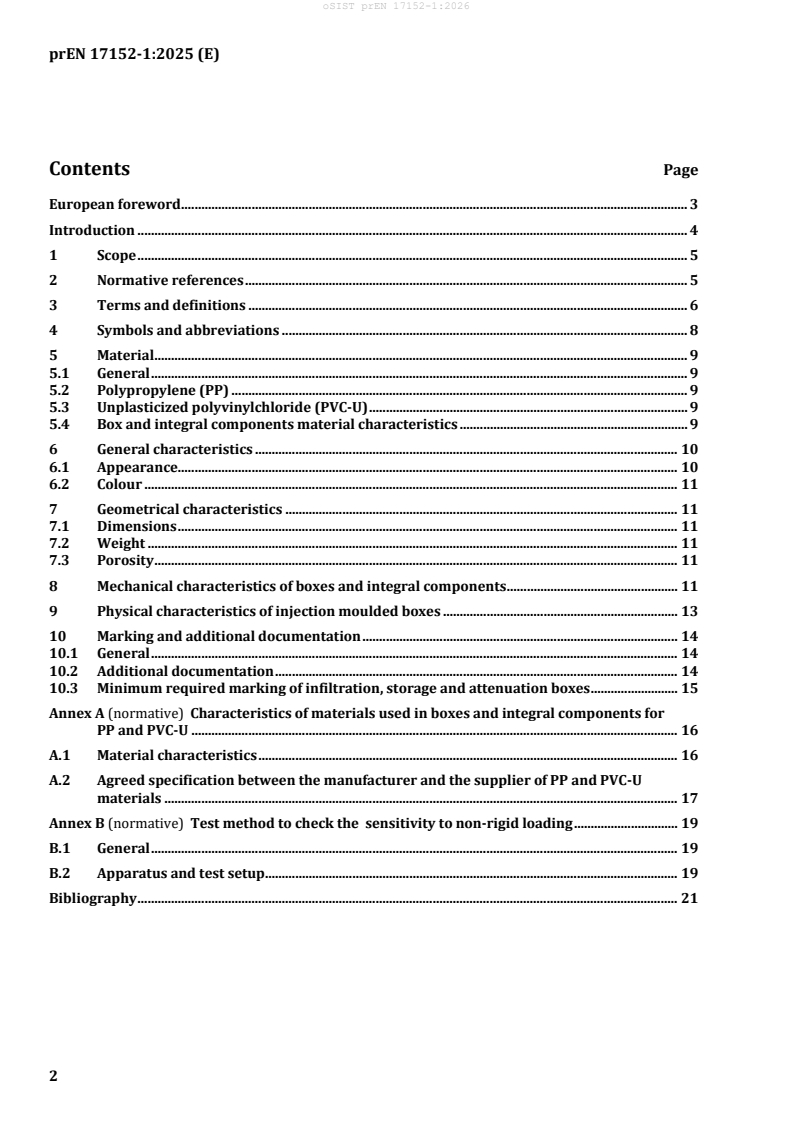
Contents Page
European foreword . 3
Introduction . 4
1 Scope . 5
2 Normative references . 5
3 Terms and definitions . 6
4 Symbols and abbreviations . 8
5 Material . 9
5.1 General . 9
5.2 Polypropylene (PP) . 9
5.3 Unplasticized polyvinylchloride (PVC-U) . 9
5.4 Box and integral components material characteristics . 9
6 General characteristics . 10
6.1 Appearance . 10
6.2 Colour . 11
7 Geometrical characteristics . 11
7.1 Dimensions . 11
7.2 Weight . 11
7.3 Porosity . 11
8 Mechanical characteristics of boxes and integral components . 11
9 Physical characteristics of injection moulded boxes . 13
10 Marking and additional documentation . 14
10.1 General . 14
10.2 Additional documentation . 14
10.3 Minimum required marking of infiltration, storage and attenuation boxes . 15
Annex A (normative) Characteristics of materials used in boxes and integral components for
PP and PVC-U . 16
A.1 Material characteristics . 16
A.2 Agreed specification between the manufacturer and the supplier of PP and PVC-U
materials . 17
Annex B (normative) Test method to check the sensitivity to non-rigid loading . 19
B.1 General . 19
B.2 Apparatus and test setup . 19
Bibliography . 21
prEN 17152-1:2025 (E)
European foreword
This document (prEN 17152-1:2025) has been prepared by Technical Committee CEN/TC 155 “Plastics
piping systems and ducting systems”, the secretariat of which is held by NEN.
This document is currently submitted to the CEN Enquiry.
This document supersedes EN 17152-1:2019+AC:2020.
The main changes with respect to EN 17152-1:2019+AC:2020 are listed below:
— Table A.1 added minimum number of test specimen;
— Table 2 new optional tests added;
— Clause 3 new definitions added (e.g. reference value and declared value);
— reference to new improved prEN 17151-1;
— subclause 10.2 improved with more information;
— editorial improvements through the document.
This standard is supported by separate standards on test methods to which normative references are
made.
EN 17152-series consists of the following parts under the general title Plastics piping systems for non-
pressure underground conveyance and storage of surface water - Boxes used for infiltration, attenuation
and storage systems:
— Part 1: Specifications for boxes made of PP and PVC-U [this document];
— Part 3: Assessment of conformity (CEN/TS);
— Part 4: Guidance for structural design of modular systems (CEN/TS).
Recommended practices for installation are described in CEN/TR 17179 [1].
These products are always used in a modular system consisting of multiple boxes.
National standards for pipes and fittings for the transport of surface water are not considered to be
conflicting with this standard and can thus be allowed to coexist.
prEN 17152-1:2025 (E)
Introduction
The products covered by this document are part of surface water management system.
This document is intended to reflect the current state of knowledge of determining and predicting the
long-term lifetime of product groups mentioned in the scope while maintaining reasonable testing times
for producers and developers of these systems.
prEN 17152-1:2025 (E)
1 Scope
This document gives the definitions and specifies the minimum requirements for injection moulded,
extruded and thermoformed thermoplastics cuboid shaped boxes, including integral components, used
in underground systems for infiltration, attenuation and storage of surface water (e.g. storm water) and
manufactured from polypropylene (PP) or unplasticized polyvinylchloride (PVC-U).
Product properties are determined by a combination of material specifications, design and
manufacturing process.
These boxes are intended for buried underground use, e.g. in landscape, pedestrian or vehicular traffic
areas.
A box can either be factory assembled, or site assembled from different components.
These boxes are intended to be used as elements in a modular system where the manufacturer states in
the documentation how the components are assembled to create a complete infiltration, attenuation or
storage system.
NOTE Non load bearing component(s) can be manufactured by various methods e.g. extrusion, injection
moulding, rotational moulding, thermoforming and low-pressure injection moulding.
2 Normative references
The following documents are referred to in the text in such a way that some or all of their content
constitutes requirements of this document. For dated references, only the edition cited applies. For
undated references, the latest edition of the referenced document (including any amendments) applies.
EN 17150:2019, Plastics piping systems for non-pressure underground conveyance and storage of non-
potable water — Test method for determination of short-term compression strength of boxes
prEN 17151-1:2025, Plastics piping systems for non-pressure underground conveyance and storage of
surface water — Part 1: Test method for determination of long-term compression strength of boxes
prEN 17151-2:2025, Plastics piping systems for non-pressure underground conveyance and storage of
surface water — Part 2: Test method for determination of creep behaviour of boxes
CEN/TS 17152-4:2025, Plastics piping systems for non-pressure underground conveyance and storage of
non-potable water — Boxes used for infiltration, attenuation and storage systems — Part 4: Guidance for
structural design of modular systems
EN ISO 179-1, Plastics — Determination of Charpy impact properties — Part 1: Non-instrumented impact
test (ISO 179-1)
EN ISO 306, Plastics — Thermoplastic materials — Determination of Vicat softening temperature (VST)
(ISO 306)
EN ISO 472:2013, Plastics — Vocabulary (ISO 472/2013)
EN ISO 527-1, Plastics — Determination of tensile properties — Part 1: General principles (ISO 527-1)
EN ISO 527-2, Plastics — Determination of tensile properties — Part 2: Test conditions for moulding and
extrusion plastics (ISO 527-2)
EN ISO 527-3, Plastics — Determination of tensile properties — Part 3: Test conditions for films and sheets
(ISO 527-3)
prEN 17152-1:2025 (E)
EN ISO 580:2005, Plastics piping and ducting systems — Injection-moulded thermoplastics fittings -
Methods for visually assessing the effects of heating (ISO 580:2005)
EN ISO 899-1, Plastics — Determination of creep behaviour — Part 1: Tensile creep (ISO 899-1)
EN ISO 899-2, Plastics — Determination of creep behaviour — Part 2: Flexural creep by three-point loading
(ISO 899-2)
EN ISO 1043-1:2011, Plastics — Symbols and abbreviated terms — Part 1: Basic polymers and their
special characteristics (ISO 1043-1:2011)
EN ISO 1133-1, Plastics — Determination of the melt mass-flow rate (MFR) and melt volume-flow rate
(MVR) of thermoplastics — Part 1: Standard method (ISO 1133-1)
EN ISO 1167-1, Thermoplastics pipes, fittings and assemblies for the conveyance of fluids — Determination
of the resistance to internal pressure — Part 1: General method (ISO 1167-1)
EN ISO 1167-2, Thermoplastics pipes, fittings and assemblies for the conveyance of fluids — Determination
of the resistance to internal pressure — Part 2: Preparation of pipe test pieces (ISO 1167-2)
EN ISO 1183-1, Plastics — Methods for determining the density of non-cellular plastics — Part 1: Immersion
method, liquid pyknometer method and titration method (ISO 1183-1)
EN ISO 3126, Plastics piping systems — Plastics components — Determination of dimensions (ISO 3126)
EN ISO 3451-1, Plastics — Determination of ash — Part 1: General methods (ISO 3451-1)
EN ISO 3451-5, Plastics — Determination of ash — Part 5: Poly(vinyl chloride) (ISO 3451-5)
EN ISO 11357-3, Plastics — Differential scanning calorimetry (DSC) — Part 3: Determination of
temperature and enthalpy of melting and crystallization (ISO 11357-3)
EN ISO 11357-6, Plastics — Differential scanning calorimetry (DSC) — Part 6: Determination of oxidation
induction time (isothermal OIT) and oxidation induction temperature (dynamic OIT) (ISO 11357-6)
EN ISO 11358-1, Plastics — Thermogravimetry (TG) of polymers — Part 1: General principles
(ISO 11358-1)
EN ISO 13229, Thermoplastics piping systems for non-pressure applications — Unplasticized poly(vinyl
chloride) (PVC-U) pipes and fittings — Determination of the viscosity number and K-value (ISO 13229)
3 Terms and definitions
For the purposes of this document, the terms and definitions given in EN ISO 472:2013, EN ISO 1043-
1:2011 and the following apply.
ISO and IEC maintain terminological databases for use in standardization at the following addresses:
— IEC Electropedia: available at https://www.electropedia.org/
— ISO Online browsing platform: available at https://www.iso.org/obp
As impacted by EN ISO 1043-1:2011/A1:2016.
prEN 17152-1:2025 (E)
3.1
box
thermoplastic cuboid shaped element, with or without sidewalls, used to create a modular system
3.2
integral component
load bearing component contributing to the overall strength of the box
3.3
modular system
system made of repeating boxes
3.4
attenuation system
modular system designed to reduce the peak flow from a given site by providing a temporary
underground surface water storage facility
3.5
infiltration system
modular system designed to provide a temporary underground storage facility from which surface water
soaks into the surrounding ground
3.6
storage system
modular system designed to provide an underground storage facility for surface water
3.7
porosity
total available volume for water storage divided by the total envelope cuboid volume for a box
3.8
long-term compression strength
95 % lower confidence limit (LCL) of the applied stress for which the sample would survive 50 years
without creep rupture, in kN/m
3.9
material
material specified for a particular component in a box
3.10
virgin material
plastics material in the form of pellets, granules, powder, floc, etc. that has not been subjected to use or
processing other than that required for its initial manufacture
Note 1 to entry: Does not contain any reworked plastics material and/or plastics recyclate.
Note 2 to entry: Sometimes also referred to as “primary material” or “primary plastics feedstock”.
Note 3 to entry: It is understood that the addition of additives such as stabilizers and pigments is still resulting
into a virgin (plastics) material.
[SOURCE: EN 14541-1:2022]
...