

EN ISO 14155:2026
(Main)Clinical investigation of medical devices for human subjects - Good clinical practice (ISO 14155:2026)
- Abstract
This document specifies good clinical practice (GCP) for the design, conduct, recording and reporting of clinical investigations carried out in human subjects to assess the clinical performance or effectiveness and safety of medical devices.
For post-market clinical investigations, the principles set forth in this document are intended to be followed as far as relevant, considering the nature of the clinical investigation (see Annex I).
This document specifies the general requirements intended to
protect the rights, safety and well-being of human subjects, users or other persons,
ensure the scientific conduct of the clinical investigation and the credibility of the clinical investigation results,
define the responsibilities of the sponsor and principal investigator, and
assist sponsors, investigators, ethics committees, regulatory authorities and other bodies involved in the conformity assessment of medical devices.
Other standards or national requirements can also apply to the investigational device(s) under consideration or the clinical investigation(s).
NOTE For Software as a Medical Device (SaMD), where appropriate, demonstration of the analytical validity (the SaMD’s output is accurate for a given input), the scientific validity (the SaMD’s output is associated to the intended clinical condition/physiological state), and clinical performance (the SaMD’s output yields a clinically meaningful association to the target use) of the SaMD, the requirements of this document apply as far as relevant (see Reference [5]). Justifications for exemptions from this document can consider the uniqueness of indirect contact between subjects and the SaMD.
This document does not apply to in vitro diagnostic medical devices. However, there can be situations, dependent on the device and national or regional requirements, where users of this document can consider whether either specific sections or requirements of this document, or both, can be applicable.
- Status
- Published
- Publication Date
- 21-Apr-2026
- Technical Committee
- CEN/TC 206 - Biocompatibility of medical and dental materials and devices
- Current Stage
- 6060 - Definitive text made available (DAV) - Publishing
- Start Date
- 22-Apr-2026
- Completion Date
- 22-Apr-2026


Overview
EN ISO 14155:2026, titled Clinical investigation of medical devices for human subjects - Good clinical practice (ISO 14155:2026), is an essential European and international standard developed by CEN and ISO. The document provides a comprehensive framework for applying good clinical practice (GCP) in the design, conduct, recording, and reporting of clinical investigations involving medical devices in human subjects. Its primary goal is to ensure ethical standards, credible results, and regulatory compliance in medical device clinical investigations.
Adherence to EN ISO 14155:2026 is critical for protecting the rights, safety, and well-being of clinical investigation participants. The standard defines the general principles and key responsibilities for sponsors, investigators, ethics committees, and regulatory bodies. While EN ISO 14155:2026 does not apply to in vitro diagnostic devices, its principles may be referenced depending on national regulations or the clinical study's nature.
Key Topics
EN ISO 14155:2026 covers several vital topics to ensure comprehensive and ethical clinical investigation processes:
- Protection of Human Subjects: Clear provisions to safeguard rights, safety, and welfare of study participants.
- Scientific Validity: Ensuring study design and execution result in robust, credible, and scientifically sound outcomes.
- Roles and Responsibilities: Detailed definition of duties for sponsors, principal investigators, ethics committees, and contract research organizations (CROs).
- Risk Management: Addresses device- and procedure-related risks, including disclosure, assessment, and management.
- Informed Consent and Ethics: Requirements on obtaining legally valid, fully informed consent and ethical review procedures.
- Documentation and Data Control: Best practices for handling study records, data integrity, electronic systems, and traceability.
- Study Planning and Conduct:
- Clinical Investigation Plan (CIP)
- Investigator’s Brochure (IB)
- Case Report Forms (CRF)
- Monitoring, auditing, and site selection
- Event Management: Procedures for adverse event reporting, device deficiencies, and ongoing subject safety monitoring.
- Suspension & Termination: Guidelines for appropriate responses to study suspension, premature termination, or closure.
- Applicability to Software as a Medical Device (SaMD): Guidance on the unique aspects and validation requirements for SaMD clinical investigations.
Applications
EN ISO 14155:2026 is widely applicable in the development and market approval process for medical devices. Key practical uses include:
- Pre-market and Post-market Clinical Investigations: Ensures that safety and performance claims are backed by scientifically valid clinical data, supporting regulatory submissions.
- Regulatory Compliance: Facilitates conformity assessment with key regulations such as the EU Medical Device Regulation (MDR, Regulation (EU) 2017/745).
- Clinical Trial Oversight: Assists sponsors and investigators in planning, initiating, monitoring, and reporting clinical trials that align with GCP.
- Ethics and Subject Protection: Helps ethics committees and review boards systematically assess study protocols and ensure participant protection.
- Documentation Support: Provides templates and recommendations for essential documents, including CIPs, IBs, and clinical investigation reports.
Organizations involved in the development, approval, or oversight of medical devices benefit from understanding and applying EN ISO 14155:2026 to ensure global acceptance and patient safety.
Related Standards
When implementing EN ISO 14155:2026, consideration of other relevant standards and guidelines is critical for comprehensive compliance:
- ISO 14971: Medical devices - Application of risk management to medical devices
- ISO/IEC 27001: Information security management practices for electronic clinical data
- EN ISO 13485: Quality management systems for medical device manufacturers
- ISO 20916: Clinical performance studies for in vitro diagnostic devices (for comparative reference)
- Regulation (EU) 2017/745 (MDR): European legislation governing medical devices
- National regulations and regional requirements: May impose additional requirements or more stringent safeguards
For clinical investigations involving Software as a Medical Device (SaMD), reference should also be made to sector-specific guidance on analytical validity, scientific validity, and clinical performance demonstration.
Keywords: EN ISO 14155:2026, medical device clinical investigation, good clinical practice, GCP, medical device regulation, clinical trial, ethics committee, sponsor responsibilities, risk management, conformity assessment, patient safety.
Relations
- Effective Date
- 29-Apr-2026
- Effective Date
- 21-Dec-2022
- Effective Date
- 06-May-2026
- Effective Date
- 29-Apr-2026
- Effective Date
- 29-Apr-2026
- Effective Date
- 29-Apr-2026
- Effective Date
- 29-Apr-2026
- Effective Date
- 29-Apr-2026
- Effective Date
- 29-Apr-2026
- Effective Date
- 29-Apr-2026
- Effective Date
- 29-Apr-2026
- Effective Date
- 29-Apr-2026
- Consolidated By
ISO 14155:2026 - Clinical investigation of medical devices for human subjects — Good clinical practice - Effective Date
- 12-Feb-2026
Get Certified
Connect with accredited certification bodies for this standard

BSI Group
BSI (British Standards Institution) is the business standards company that helps organizations make excellence a habit.

TÜV Rheinland
TÜV Rheinland is a leading international provider of technical services.

TÜV SÜD
TÜV SÜD is a trusted partner of choice for safety, security and sustainability solutions.
Sponsored listings
Frequently Asked Questions
EN ISO 14155:2026 is a standard published by the European Committee for Standardization (CEN). Its full title is "Clinical investigation of medical devices for human subjects - Good clinical practice (ISO 14155:2026)". This standard covers: This document specifies good clinical practice (GCP) for the design, conduct, recording and reporting of clinical investigations carried out in human subjects to assess the clinical performance or effectiveness and safety of medical devices. For post-market clinical investigations, the principles set forth in this document are intended to be followed as far as relevant, considering the nature of the clinical investigation (see Annex I). This document specifies the general requirements intended to protect the rights, safety and well-being of human subjects, users or other persons, ensure the scientific conduct of the clinical investigation and the credibility of the clinical investigation results, define the responsibilities of the sponsor and principal investigator, and assist sponsors, investigators, ethics committees, regulatory authorities and other bodies involved in the conformity assessment of medical devices. Other standards or national requirements can also apply to the investigational device(s) under consideration or the clinical investigation(s). NOTE For Software as a Medical Device (SaMD), where appropriate, demonstration of the analytical validity (the SaMD’s output is accurate for a given input), the scientific validity (the SaMD’s output is associated to the intended clinical condition/physiological state), and clinical performance (the SaMD’s output yields a clinically meaningful association to the target use) of the SaMD, the requirements of this document apply as far as relevant (see Reference [5]). Justifications for exemptions from this document can consider the uniqueness of indirect contact between subjects and the SaMD. This document does not apply to in vitro diagnostic medical devices. However, there can be situations, dependent on the device and national or regional requirements, where users of this document can consider whether either specific sections or requirements of this document, or both, can be applicable.
This document specifies good clinical practice (GCP) for the design, conduct, recording and reporting of clinical investigations carried out in human subjects to assess the clinical performance or effectiveness and safety of medical devices. For post-market clinical investigations, the principles set forth in this document are intended to be followed as far as relevant, considering the nature of the clinical investigation (see Annex I). This document specifies the general requirements intended to protect the rights, safety and well-being of human subjects, users or other persons, ensure the scientific conduct of the clinical investigation and the credibility of the clinical investigation results, define the responsibilities of the sponsor and principal investigator, and assist sponsors, investigators, ethics committees, regulatory authorities and other bodies involved in the conformity assessment of medical devices. Other standards or national requirements can also apply to the investigational device(s) under consideration or the clinical investigation(s). NOTE For Software as a Medical Device (SaMD), where appropriate, demonstration of the analytical validity (the SaMD’s output is accurate for a given input), the scientific validity (the SaMD’s output is associated to the intended clinical condition/physiological state), and clinical performance (the SaMD’s output yields a clinically meaningful association to the target use) of the SaMD, the requirements of this document apply as far as relevant (see Reference [5]). Justifications for exemptions from this document can consider the uniqueness of indirect contact between subjects and the SaMD. This document does not apply to in vitro diagnostic medical devices. However, there can be situations, dependent on the device and national or regional requirements, where users of this document can consider whether either specific sections or requirements of this document, or both, can be applicable.
EN ISO 14155:2026 is classified under the following ICS (International Classification for Standards) categories: 11.100.20 - Biological evaluation of medical devices. The ICS classification helps identify the subject area and facilitates finding related standards.
EN ISO 14155:2026 has the following relationships with other standards: It is inter standard links to EN ISO 14155:2020/A11:2024, EN ISO 14155:2020, ISO 14971:2019, EN IEC 60335-2-113:2023, EN 12182:2012, EN 1642:2011, EN IEC 60335-2-115:2023, CEN/TS 15277:2006, EN 1639:2009, EN 1641:2009, EN 1640:2009, EN 1060-4:2004, ISO 14155:2026. Understanding these relationships helps ensure you are using the most current and applicable version of the standard.
EN ISO 14155:2026 is associated with the following European legislation: EU Directives/Regulations: 2017/745; Standardization Mandates: M/575, M/575 Amd 2. When a standard is cited in the Official Journal of the European Union, products manufactured in conformity with it benefit from a presumption of conformity with the essential requirements of the corresponding EU directive or regulation.
EN ISO 14155:2026 is available in PDF format for immediate download after purchase. The document can be added to your cart and obtained through the secure checkout process. Digital delivery ensures instant access to the complete standard document.
Standards Content (Sample)
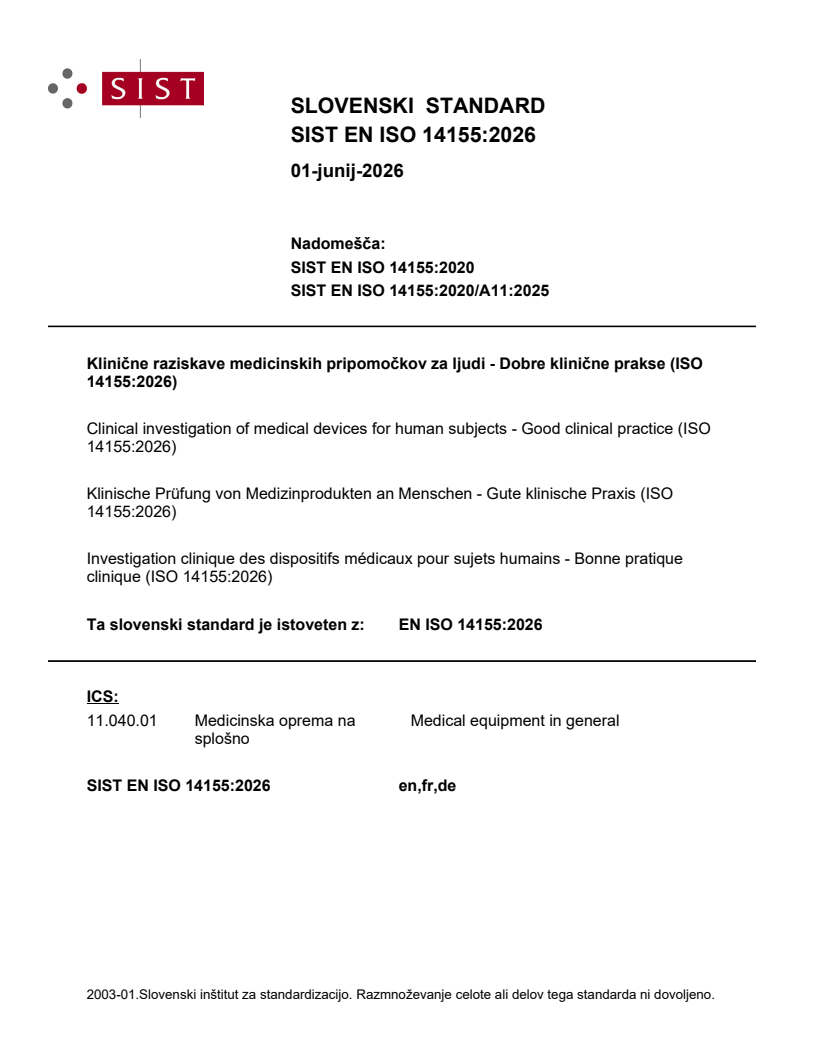
SLOVENSKI STANDARD
01-junij-2026
Nadomešča:
SIST EN ISO 14155:2020
SIST EN ISO 14155:2020/A11:2025
Klinične raziskave medicinskih pripomočkov za ljudi - Dobre klinične prakse (ISO
14155:2026)
Clinical investigation of medical devices for human subjects - Good clinical practice (ISO
14155:2026)
Klinische Prüfung von Medizinprodukten an Menschen - Gute klinische Praxis (ISO
14155:2026)
Investigation clinique des dispositifs médicaux pour sujets humains - Bonne pratique
clinique (ISO 14155:2026)
Ta slovenski standard je istoveten z: EN ISO 14155:2026
ICS:
11.040.01 Medicinska oprema na Medical equipment in general
splošno
2003-01.Slovenski inštitut za standardizacijo. Razmnoževanje celote ali delov tega standarda ni dovoljeno.
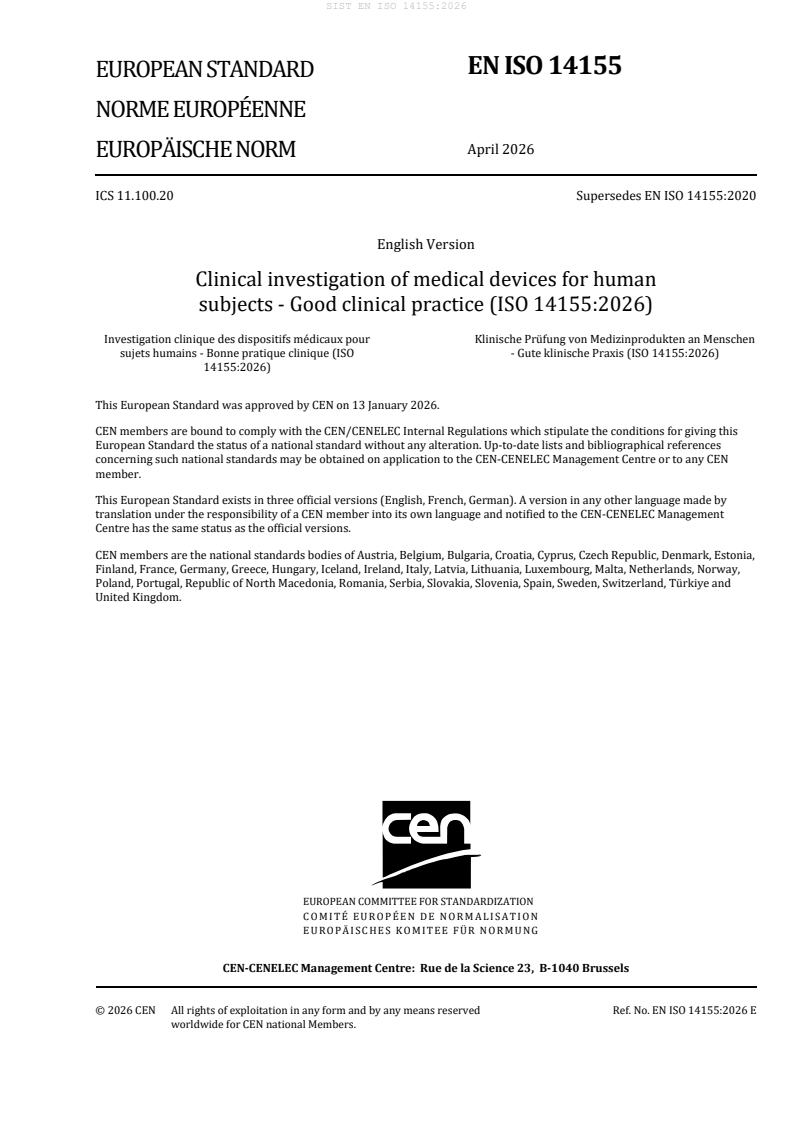
EN ISO 14155
EUROPEAN STANDARD
NORME EUROPÉENNE
April 2026
EUROPÄISCHE NORM
ICS 11.100.20 Supersedes EN ISO 14155:2020
English Version
Clinical investigation of medical devices for human
subjects - Good clinical practice (ISO 14155:2026)
Investigation clinique des dispositifs médicaux pour Klinische Prüfung von Medizinprodukten an Menschen
sujets humains - Bonne pratique clinique (ISO - Gute klinische Praxis (ISO 14155:2026)
14155:2026)
This European Standard was approved by CEN on 13 January 2026.
CEN members are bound to comply with the CEN/CENELEC Internal Regulations which stipulate the conditions for giving this
European Standard the status of a national standard without any alteration. Up-to-date lists and bibliographical references
concerning such national standards may be obtained on application to the CEN-CENELEC Management Centre or to any CEN
member.
This European Standard exists in three official versions (English, French, German). A version in any other language made by
translation under the responsibility of a CEN member into its own language and notified to the CEN-CENELEC Management
Centre has the same status as the official versions.
CEN members are the national standards bodies of Austria, Belgium, Bulgaria, Croatia, Cyprus, Czech Republic, Denmark, Estonia,
Finland, France, Germany, Greece, Hungary, Iceland, Ireland, Italy, Latvia, Lithuania, Luxembourg, Malta, Netherlands, Norway,
Poland, Portugal, Republic of North Macedonia, Romania, Serbia, Slovakia, Slovenia, Spain, Sweden, Switzerland, Türkiye and
United Kingdom.
EUROPEAN COMMITTEE FOR STANDARDIZATION
COMITÉ EUROPÉEN DE NORMALISATION
EUROPÄISCHES KOMITEE FÜR NORMUNG
CEN-CENELEC Management Centre: Rue de la Science 23, B-1040 Brussels
© 2026 CEN All rights of exploitation in any form and by any means reserved Ref. No. EN ISO 14155:2026 E
worldwide for CEN national Members.
Contents Page
European foreword . 3
Annex ZA (informative) Relationship between this European standard and the
requirements of Regulation (EU) 2017/745 aimed to be covered . 4
European foreword
This document (EN ISO 14155:2026) has been prepared by Technical Committee ISO/TC 194
"Biological and clinical evaluation of medical devices" in collaboration with Technical Committee
CEN/TC 206 “Biological and clinical evaluation of medical devices” the secretariat of which is held by
DIN.
This European Standard shall be given the status of a national standard, either by publication of an
identical text or by endorsement, at the latest by October 2026, and conflicting national standards shall
be withdrawn at the latest by October 2026.
Attention is drawn to the possibility that some of the elements of this document may be the subject of
patent rights. CEN shall not be held responsible for identifying any or all such patent rights.
This document supersedes EN ISO 14155:2020.
This document has been prepared under a standardization request addressed to CEN by the European
Commission. The Standing Committee of the EFTA States subsequently approves these requests for its
Member States.
For the relationship with EU Legislation, see informative Annex ZA, which is an integral part of this
document.
Any feedback and questions on this document should be directed to the users’ national standards
body/national committee. A complete listing of these bodies can be found on the CEN website.
According to the CEN-CENELEC Internal Regulations, the national standards organizations of the
following countries are bound to implement this European Standard: Austria, Belgium, Bulgaria,
Croatia, Cyprus, Czech Republic, Denmark, Estonia, Finland, France, Germany, Greece, Hungary, Iceland,
Ireland, Italy, Latvia, Lithuania, Luxembourg, Malta, Netherlands, Norway, Poland, Portugal, Republic of
North Macedonia, Romania, Serbia, Slovakia, Slovenia, Spain, Sweden, Switzerland, Türkiye and the
United Kingdom.
Endorsement notice
The text of ISO 14155:2026 has been approved by CEN as EN ISO 14155:2026 without any modification.
Annex ZA
(informative)
Relationship between this European standard and the requirements of
Regulation (EU) 2017/745 aimed to be covered
This European standard has been prepared under M/575 to provide one voluntary means of
conforming to Annex XV of Regulation (EU) 2017/745 of 5 April 2017 concerning clinical investigations
of medical devices [OJ L 117].
Once this standard is cited in the Official Journal of the European Union under that Regulation,
compliance with the normative clauses of this standard given in Table ZA.1 and application of the
edition of the normatively referenced standards as given in Table ZA.2 confers, within the limits of the
scope of this standard, a presumption of conformity with the corresponding requirements of that
Regulation, and associated EFTA Regulations.
This Annex ZA covers the relationship of this European standard with Annex XV of Regulation (EU)
2017/745 (Table ZA.1). Where requirements laid down in that Annex XV refer to Article 62 of this
Regulation, the related requirements laid down in the section of Article 62 cited have also been
considered when establishing the relationship of the clauses of this European standard with Annex XV
in Table ZA.1.
Where a definition in this harmonized standard differs from a definition of the same term set out in
Regulation (EU) 2017/745, the differences shall be indicated in the Annex Z. For the purpose of using
this standard in support of the requirements set out in Regulation (EU) 2017/745, the definitions set
out in this Regulation prevail.
Where the European standard is an adoption of an International Standard, the scope of this document
can differ from the scope of the European Regulation that it supports. As the scope of the applicable
regulatory requirements differ from nation to nation and region to region the standard can only
support European regulatory requirements to the extent of the scope of the European Regulation for
medical devices ((EU) 2017/745).
NOTE 1 Where a reference from a clause of this standard to the risk management process is made, the risk
management process needs to be in compliance with Regulation (EU) 2017/745. This means that risks have to be
‘reduced as far as possible’, ‘reduced to the lowest possible level’, ‘reduced as far as possible and appropriate’,
‘removed or reduced as far as possible’, ‘eliminated or reduced as far as possible’, ’removed or minimized as far as
possible’, or ‘minimized’, according to the wording of the corresponding General Safety and Performance
Requirement.
NOTE 2 The manufacturer’s policy for determining acceptable risk must be in compliance with General Safety
and Performance Requirements 1, 2, 3, 4, 5, 8, 9, 10, 11, 14, 16, 17, 18, 19, 20, 21 and 22 of the Regulation.
For all requirements related to clinical investigations contained in Regulation (EU) 2017/745 and
referred to in the following table, obligations attributed to the “sponsor” under ISO 14155 shall be
incumbent under the Regulation to the Sponsor if located in the Union; When established, the Legal
Representative is responsible for ensuring compliance with the sponsor’s obligations pursuant to
Regulation (EU) 2017/745.
Table ZA.1 — Correspondence between this European Standard and Annex XV
of Regulation (EU) 2017/745 [OJ L 117]
Clinical Investigation
Clause(s)/subclause(s) of
Requirements of Regulation Remarks/Notes
this EN
(EU) 2017/745
Covered by a general reference to
the Declaration of Helsinki;
however, the latest edition of the
Declaration should be used.
Annex XV, Chapter I, 1 4 a) National/regional requirements
for ethics in clinical research and
for protecting the safety, wellbeing,
health and rights of subjects must
be observed.
6.2 of this document covers risk
management considerations for
risks related to the use of the
investigational device and their
disclosure, risks related to clinical
procedures required by the clinical
investigation plan that are outside
routine clinical practice, as well as
risks related to the clinical
investigation process.
6.3 of this document refers to the
literature review of the standard of
care, as a basis to define the
appropriate study design as well as
the requirement to take into
consideration and relevant pre-
6.2, 6.3, 6.4, 7.4.4, 7.4.5 and
clinical data.
Annex XV, Chapter I, 2.1
Annex A
6.4 of this document combined
with Annex A provides a detailed
outline on the study design and
statistical considerations required
to obtain scientific valid data on
safety, performance and clinical
benefits.
Note: This document covers the
risk assessment process for
potentially unacceptable risks.
Aspect relating to benefit-risk of
devices as referred to in
Article 62(1) of Regulation (EU)
2017/745 are covered in this
standard by referring to ISO
14971.
6.3, 6.4, A.2 i), A.3, A.4, A.5, A.6
Annex XV, Chapter I, 2.2
and A.7
Clinical Investigation
Clause(s)/subclause(s) of
Requirements of Regulation Remarks/Notes
this EN
(EU) 2017/745
6.3, 6.4, A.3, A.4, A.5, A.6 and
Annex XV, Chapter I, 2.3
A.7
Partially covered - this document
does not cover the requirements of
the clinical evaluation plan as this
6.3, 6.4, 6.8, 9.2.1 b) to e), 10.2, is not part of the clinical
Annex XV, Chapter I, 2.4
10.3, A.2 h), A.3, A.6 and A.7 investigation. However, 6.3 does
refer to the appropriate literature
review required prior to designing
a clinical investigation.
6.2, 6.3, A.2 e), f) and g), A.3,
Annex XV, Chapter I, 2.5
A.4, A.6, A.7 and B.2
Annex XV, Chapter I, 2.6 6.3, A.6 and A.7
6.5, 9.2.1 g), 9.2.2, 10.2, A.2 h)
Annex XV, Chapter I, 2.7
and Annex B
Annex XV, Chapter I, 2.8 8.4, 9.2.6, 10.6 r) and Annex D
Annex XV, Chapter II, 2.1 B.2, B.4 a)
Annex XV, Chapter II, 2.2 B.2 f) to h)
Annex XV, Chapter II, 2.3 B.3
Partially covered – this document
requires a prior assessment of
relevant scientific literature but
does not specifically require its
incorporation into the
Investigator’s Brochure except for
Annex XV, Chapter II, 2.4,
6.3, B.2 a), B.4 what is mentioned in B.2 a). Also,
first indent
this document requires a prior
assessment of relevant scientific
literature and available data on the
same or similar devices but is not
specific on safety, performance and
clinical benefits.
Partially covered – this document
requires a prior assessment of
relevant scientific literature and
Annex XV, Chapter II, 2.4,
6.3, B.2 a), B.4 a) and b) available data on the same or
second indent
similar devices but is not specific
on safety, performance and clinical
benefits.
Annex XV, Chapter II, 2.5 B.5
Partially covered – this document
Annex XV, Chapter II, 2.6 B.2 c)
does not specifically refer to a
particular regulatory system. The
Clinical Investigation
Clause(s)/subclause(s) of
Requirements of Regulation Remarks/Notes
this EN
(EU) 2017/745
document does not include the
added value of incorporation of
such constituents in relation to the
clinical benefit and/or safety of the
device.
Partially covered-this document
Annex XV, Chapter II, 2.7 B.6 does not specifically refer to a
particular regulatory system.
Annex XV, Chapter II, 3.1.1 A.1.2 b)
Covered - the document outlines
that a local representative shall be
selected if the sponsor is not
resident in the country (countries)
in which the clinical investigation
is to be carried out. Article 62(2) of
the Regulation specifies that when
the sponsor is not established in
Annex XV, Chapter II, 3.1.2 9.2.1 b), A.1.3
the Union, its legal representative
is responsible for ensuring
conformance with the sponsor’s
obligations pursuant to the
Regulation and shall be the
addressee for all communications
with the sponsor provided for in
the Regulation.
Annex XV, Chapter II, 3.1.3 A.1.4
Annex XV, Chapter II, 3.1.4 A.12 f)
Partially covered – in the
document, the language used for
Annex XV, Chapter II, 3.1.5 A.1.5 the synopsis is not specified as this
is considered as a country specific
regulatory requirement.
Background literature review and
current state of the art are not
covered as part of the
identification of the device but as
Annex XV, Chapter II, 3.2 6.3, A.2, A.3 a) and b), A.4 a)
part of the justification of the
design which is derived from
literature review as outlined in 6.3
of the document.
Annex XV, Chapter II, 3.3 A.4
Annex XV, Chapter II, 3.5 A.5
Annex XV, Chapter II, 3.6 6.3, A.6.1 a) to e), A.7
Clinical Investigation
Clause(s)/subclause(s) of
Requirements of Regulation Remarks/Notes
this EN
(EU) 2017/745
Annex XV, Chapter II, 3.6.1 A.6.1 a), A.6.1 c)
Annex XV, Chapter II, 3.6.2 A.2 a), A.6.2 a) and b)
To fully cover requirement 3.6.3,
the information provided should
also include immuno-compromised
and elderly subjects, if applicable.
However, Clause A.5 of this
document does require the study
Annex XV, Chapter II, 3.6.3 A.5, A.6.3 j), A.15
design to be relevant for the target
population as well as A.6.3 j)
requiring clarification of the
relationship of the investigation
population to the target
population.
Annex XV, Chapter II, 3.6.4 A.6.1 b), A.7 j), A.7 k) and A.7 l)
Annex XV, Chapter II, 3.6.5 A.6.4
Annex XV, Chapter II, 3.6.6 A.6.5
Annex XV, Chapter II, 3.7 A.7
Annex XV, Chapter II, 3.8 A.8
Annex XV, Chapter II, 3.9 A.9
Annex XV, Chapter II, 3.10 A.10
Annex XV, Chapter II, 3.11 A.11
Annex XV, Chapter II, 3.12 A.12
Annex XV, Chapter II, 3.13 A.13
Annex XV, Chapter II, 3.14 A.14
Traceability for implantable
Annex XV, Chapter II, 3.15 A.16, A.7 f) 6), A.7 n)
devices is not covered.
To fully cover requirement 3.16,
information should be provided on
the additional care required that
Annex XV, Chapter II, 3.16 A.6.4 h) to j), A.16 c)
differs from that normally
expected for the medical condition
in question.
Annex XV, Chapter II, 3.17 A.17
Annex XV, Chapter II, 3.18 A.2, A.5
Annex XV, Chapter II, 3.19 A.18
Annex XV, Chapter II, 4.2 7.1, 9.2.2 i) and j), A.12 c)
Annex XV, Chapter II, 4.3 5.3, 9.2.2 f) and h), A.12 e)
Clinical Investigation
Clause(s)/subclause(s) of
Requirements of Regulation Remarks/Notes
this EN
(EU) 2017/745
Annex XV, Chapter II, 4.4 5.8
Annex XV, Chapter II, 4.5 5.8.4 e), 7.7
Annex XV, Chapter II, 4.5,
5.8.4 e), 5.8.5 f) and g), 7.7
first indent
Annex XV, Chapter II, 4.5, 5.8.4 e), 5.8.5 f) and g), 7.7,
second indent 7.8.2 c), 7.8.3 g)
Annex XV, Chapter III, 2 6.9, 9.2.1 a), 10.8
Annex XV, Chapter III, 4 9.2.1 g), 9.2.3, 9.2.4
Annex XV, Chapter III, 5 8.1, 9.2.3 f), 9.2.4.5
Annex XV, Chapter III, 6 7.11, 9.1 c)
To fully conform to this
requirement, the signature page
must be part of the clinical
Annex XV, Chapter III, 7, investigation report. Note 1 of 8.4
8.4, D.2, D.4, D.12
first indent does refer to national
requirements regarding the clinical
report which may be different
worldwide.
Annex XV, Chapter III, 7,
8.4, D.2 i) and j)
second indent
Annex XV, Chapter III, 7,
8.4, D.4
third indent
Annex XV, Chapter III, 7,
D.6.1
fourth indent
This document in addition to the
clinical investigation plan
Annex XV, Chapter III, 7,
D.6.2, D.13 summary of D.6.2 does also require
fifth indent
the full plan to be in the Annex of
the report.
Justification and rationale for the
Annex XV, Chapter III, 7, D.7 e), D.7 f), D.7 g) 1), D.7 g)
analysis is required in Clause D.7
sixth indent 4), D.7 g) 5)
g) of the document.
Annex XV, Chapter III, 7,
D.7 g) 2) and 3)
seventh indent
The discussion includes the clinical
relevance and importance of the
Annex XV, Chapter III, 7,
D.8 results in light of other existing
eighth indent
data which should be understood
including standard of care.
Table ZA.2 — Normative references from clause 2 of this document and their corresponding
European publications
Column 1 Column 2 Column 3 Column 4
Reference in International Title Corresponding European
Clause 2 Standard Edition Standard Edition
ISO 14971 ISO 14971:2019 Medical devices — Application of EN ISO 14971:2019
risk management to medical
EN ISO
devices
14971:2019/A11:2021
The documents listed in the Column 1 of Table ZA.2, in whole or in part, are normatively referenced in
this document, i.e. are indispensable for its application. The achievement of the presumption of
conformity is subject to the application of the edition of Standards as listed in Column 4 or, if no
European Standard Edition exists, the International Standard Edition given in Column 2 of Table ZA.2.
Table ZA.3 — Prevailing terms of Regulation (EU) 2017/745 for the use of this European
standard under that Regulation
Term used in Clause(s)/subclause Article in (EU) Differences/Consequences
this EN (s) of this EN 2017/745 that
defines or uses
this term
adverse event 3.2 Article 2(57) Both definitions are substantially
equivalent. The definition in this
AE
document specifies that an adverse
event may be whether anticipated
or unanticipated. A note specifies
that the definition includes events
related to the investigational
medical device or the comparator. A
note specifies that the definition
includes events related to the use of
the investigational medical device
and the clinical procedure(s)
required by the CIP that are outside
to routine clinical practice but not
related to the use of the device.
clinical 3.9 Article 2(45) Both definitions are substantially
investigation equivalent. The definition in this
document specifies an investigation
undertaken to assess the clinical
performance, effectiveness or safety
of a medical device. In the
Regulation, the definition is an
investigation undertaken to assess
the safety or performance of a
device. Effectiveness is defined in
this document and introduced as the
term is used in regulations outside
Europe.
clinical 3.10 Article 2(47) Both definitions are substantially
Term used in Clause(s)/subclause Article in (EU) Differences/Consequences
this EN (s) of this EN 2017/745 that
defines or uses
this term
investigation equivalent. In the Regulation, the
plan definition includes statistical
considerations. However, per
CIP
Clause A.7 of Annex A of this
document, a statistical design and
analysis is expected in the content
of the CIP. In this document, the
definition includes “record-
keeping”.
clinical 3.12 Article 2(52) Both definitions are substantially
performance equivalent. In this document, a note
specifies that not all clinical
investigations have clinical benefits
to subjects e.g; healthy volunteers,
clinical investigations only
gathering data etc.
device deficiency 3.19 Article 2(59) Both definitions are substantially
equivalent. The definition in this
document includes the inadequacy
of a medical device with respect to
its usability. A note also specifies
that the definition includes device
deficiencies related to the
investigational medical device or
the comparator.
ethics committee 3.25 Article 2(56) Both definitions are substantially
equivalent. In the Regulation, the
EC
definition specifies that the EC is
empowered to give opinions taking
into account the views of
laypersons.
informed consent 3.28 Article 2(55) Both definitions are substantially
equivalent. Per section 5.8.1 of this
document informed consent is
obtained in writing from the subject
or where applicable, the subject’s
legally designated representative. In
the Regulation, the definition
specifies an authorization or
agreement from the legally
designated representative in the
case of minors and of incapacitated
subjects.
investigational 3.30 Article 2(46) Both definitions are substantially
medical device equivalent. The definition in this
document specifies that the device
Term used in Clause(s)/subclause Article in (EU) Differences/Consequences
this EN (s) of this EN 2017/745 that
defines or uses
this term
is assessed in a clinical investigation
for safety, clinical performance or
effectiveness. It also includes notes
specifying that this includes medical
devices already on the market.
investigator 3.31 Article 2(54) The definition in this document
distinguishes between the terms
principal investigator and
investigator, whereas the Regulation
only defines the role of the
investigator which corresponds to
the definition of principal
investigator in this document.
medical device 3.35 Article 2(1) Both definitions are substantially
equivalent. In the Regulation,
the definition also specifies:
A medical device can be used for
one or more medical purposes
where the standard does not
specify medical
Under medical purposes, the
Regulation adds in the first
bullet point prediction and
prognosis,
The Regulation second bullet point
also adds disability in addition
to injury,
The third bullet point ads
pathological process or state,
The fourth bullet has additional
specification including organ,
blood and tissue donations
The Regulation however does not
include devices supporting or
sustaining life as medical purpose.
serious adverse 3.46 Article 2(58) Both definitions are substantially
event equivalent. The criterion v) chronic
disease in the definition of the
SAE
Regulation is part of the permanent
impairment criterion in the
definition of this document.
serious health 3.47 Article 2(66) Both definitions are similar but used
threat in a different target population. The
definition in the Regulation includes
the full target population of a
Term used in Clause(s)/subclause Article in (EU) Differences/Consequences
this EN (s) of this EN 2017/745 that
defines or uses
this term
market released product ‘public’
health threat, where the definition
in this document has been adapted
to target the clinical investigation
population and is considered as a
signal amongst reported serious
adverse events rather than a
different definition of adverse event.
sponsor 3.50 Article 2(49) Both definitions are substantially
equivalent. The definition in this
document specifies that the sponsor
assumes liability. A note indicates
that when an investigator initiates,
implements and takes full
responsibility for the clinical
investigation, the investigator also
assumes the role of the sponsor and
is identified as the sponsor-
investigator.
subject 3.51 Article 2(50) Both definitions are substantially
equivalent. In this document, the
definition specifies that a subject is
a participant in a clinical
investigation either as a recipient of
the investigational medical device
or a comparator. A note indicates
that the definition includes healthy
volunteers.
WARNING 1 Presumption of conformity stays valid only as long as a reference to this European
standard is maintained in the list published in the Official Journal of the European Union. Users of this
standard should consult frequently the latest list published in the Official Journal of the European
Union.
WARNING 2 Other Union legislation may be applicable to the product(s) falling within the scope of
this standard.
International
Standard
ISO 14155
Fourth edition
Clinical investigation of medical
2026-03
devices for human subjects — Good
clinical practice
Investigation clinique des dispositifs médicaux pour sujets
humains — Bonne pratique clinique
Reference number
ISO 14155:2026(en) © ISO 2026
ISO 14155:2026(en)
© ISO 2026
All rights reserved. Unless otherwise specified, or required in the context of its implementation, no part of this publication may
be reproduced or utilized otherwise in any form or by any means, electronic or mechanical, including photocopying, or posting on
the internet or an intranet, without prior written permission. Permission can be requested from either ISO at the address below
or ISO’s member body in the country of the requester.
ISO copyright office
CP 401 • Ch. de Blandonnet 8
CH-1214 Vernier, Geneva
Phone: +41 22 749 01 11
Email: copyright@iso.org
Website: www.iso.org
Published in Switzerland
ii
ISO 14155:2026(en)
Contents Page
Foreword .vi
Introduction .viii
1 Scope . 1
2 Normative references . 1
3 Terms and definitions . 1
4 Summary of good clinical practice principles . 9
5 Ethical considerations . 10
5.1 General .10
5.2 Improper influence or inducement .10
5.3 Compensation and additional health care .10
5.4 Registration in publicly accessible database .11
5.5 Responsibilities .11
5.6 Communication with the ethics committee .11
5.6.1 General .11
5.6.2 Initial EC submission .11
5.6.3 Information to be obtained from the EC . 12
5.6.4 Continuing communication with the EC . . 12
5.6.5 Continuing information to be obtained from the EC . 12
5.7 Vulnerable populations . 12
5.8 Informed consent . 13
5.8.1 General . 13
5.8.2 Process of obtaining informed consent . 13
5.8.3 Special circumstances for informed consent .14
5.8.4 Information to be provided to the subject . 15
5.8.5 Informed consent signature .16
5.8.6 New information.17
6 Clinical investigation planning . 17
6.1 General .17
6.2 Risk management .17
6.2.1 General .17
6.2.2 Risks related to the use of the investigational device and their disclosure .18
6.2.3 Risks related to clinical procedures required by the CIP outside routine clinical
practice .18
6.2.4 Risks related to the clinical investigation process .19
6.3 Justification for the design of the clinical investigation .19
6.4 Clinical investigation plan .19
6.5 Investigator's brochure. 20
6.6 Case report forms . 20
6.7 Monitoring plan . 20
6.8 Investigation site selection .21
6.9 Agreement(s) . 22
6.10 Labelling . 22
6.11 Data monitoring committee . 22
6.12 Clinical events committee . 22
7 Clinical investigation conduct .23
7.1 General . 23
7.2 Investigation site initiation . 23
7.3 Investigation site monitoring . 23
7.4 Adverse events and device deficiencies . 23
7.4.1 Signals requiring immediate action . 23
7.4.2 Adverse events . 23
7.4.3 Device deficiencies .24
iii
ISO 14155:2026(en)
7.4.4 Risk assessment process for potentially unacceptable risks related to the use of
the investigational device .24
7.4.5 Management of risks related to clinical procedures required by the CIP outside
routine clinical practice . 25
7.5 Clinical investigation documents and documentation . 25
7.5.1 Amendments . 25
7.5.2 Subject identification log . 25
7.5.3 Source documents . 26
7.6 Additional members of the investigation site team. 26
7.7 Subject privacy and confidentiality of data . 26
7.8 Document and data control . 26
7.8.1 Traceability of documents and data . 26
7.8.2 Recording of data . 26
7.8.3 Electronic clinical data systems .27
7.9 Investigational device accountability . 28
7.10 Accounting for subjects . 28
7.11 Auditing . 28
8 Suspension, termination and close-out of the clinical investigation .29
8.1 Completion of the clinical investigation. 29
8.2 Suspension or premature termination of the clinical investigation . 29
8.2.1 General . 29
8.2.2 Procedure for suspension . 29
8.2.3 Procedure for premature termination . 30
8.2.4 Procedure for resuming the clinical investigation after suspension . 30
8.3 Routine close-out .31
8.4 Clinical investigation report.31
8.5 Risk assessment and conclusions .32
8.6 Document retention .32
9 Responsibilities of the sponsor .32
9.1 Clinical quality management .32
9.2 Clinical investigation planning and conduct . 33
9.2.1 Selection and training of clinical personnel. 33
9.2.2 Preparation of documents and materials. 34
9.2.3 Conduct of clinical investigation . 34
9.2.4 Monitoring . 35
9.2.5 Safety evaluation and reporting .37
9.2.6 Clinical investigation close-out . 38
9.3 Outsourcing of duties and functions . 38
9.4 Communication with regulatory authorities . 39
10 Responsibilities of the principal investigator .39
10.1 General . 39
10.2 Qualification of the principal investigator . 39
10.3 Qualification of investigation site. 39
10.4 Communication with the
...