

EN 4800-005:2025
(Main)Aerospace series - Titanium and titanium alloys - Part 005: Forging stock - Technical specification
- Abstract
This document specifies the requirements for the ordering, manufacture, testing, inspection and delivery of titanium and titanium alloy forging stock. It is intended to be applied when referred to and in conjunction with the European material standard unless otherwise specified on the drawing, order or inspection schedule.
- Status
- Published
- Publication Date
- 18-Feb-2025
- Technical Committee
- ASD-STAN - Aerospace
- Drafting Committee
- ASD-STAN/D 4/S 1 - Aluminium
- Current Stage
- 6060 - Definitive text made available (DAV) - Publishing
- Start Date
- 19-Feb-2025
- Completion Date
- 19-Feb-2025

Overview
EN 4800-005:2025 - Aerospace series: Titanium and titanium alloys - Part 005: Forging stock - Technical specification defines the requirements for ordering, manufacture, testing, inspection and delivery of titanium and titanium-alloy forging stock for aerospace use. It is intended to be applied when referenced together with the relevant European material standard and updates/supersedes the 2010 edition. The standard is part of the EN aerospace metallic materials series and sets out practical rules for traceability, release testing, qualification and documentation of forging stock.
Key topics and technical requirements
- Scope and application: Applies to titanium and titanium alloy forging stock used in aerospace components; to be used in conjunction with the applicable material standard.
- Wording of order: Defines mandatory order information (quantities, delivery dates, material standard number, delivery condition/metallurgical code, dimensions/tolerances, packing, special tests).
- Health & safety: Products must comply with applicable local health and safety laws; a product safety data sheet must be available.
- Manufacture and manufacturing schedule: Production must follow the relevant material standard and EN 2078 manufacturing/inspection schedule requirements.
- Qualification requirements: Qualification is required where invoked by the material standard or order; unless otherwise agreed the qualification phase runs on the first three batches.
- Release testing and inspection: Manufacturer responsibility for release tests; customer may witness or perform inspections; representative samples required; tables in the standard define line-by-line test requirements.
- Retests, rejection, and remedies: Procedures for retesting, partial or full re-heat treatment, 100% retest, cut-back and rejection criteria, and limits on re-heat treatment frequency.
- Special tests & capability clause: Customers may request special tests; capability/statistical evidence can reduce required testing but does not relieve manufacturer responsibility.
- Statistical process control: Reduction of release testing may be negotiated based on SPC and historical data.
- Inspection and test report: Delivery must include an inspection and test report per EN 2078 with manufacturer, order, material standard, batch/cast numbers, test results and heat treatment condition.
- Traceability: Full traceability to cast, production batch and/or heat-treatment batch throughout manufacture, testing and delivery.
Applications and users
Who uses EN 4800-005:2025:
- Aerospace OEMs and tier suppliers specifying titanium forging stock for structural and engine parts.
- Forging manufacturers and mills producing titanium and titanium-alloy billets, bars and preforms.
- Quality, inspection and procurement teams managing material certification, release testing and traceability.
- Certification bodies and auditors verifying compliance with aerospace material standards.
Practical value:
- Ensures consistent quality, traceability and testability of titanium forging stock.
- Reduces supply-chain risk by standardizing order content, qualification and reporting.
- Enables negotiated testing reductions through documented statistical capability.
Related standards
Normative references include (selection):
- EN 2078 - Manufacturing/inspection schedules and reports
- EN 2002 series - Tensile and test methods for metallic materials
- EN 2954-002 - Macrostructure of forging stock and forgings
- EN 4050-1 / EN 4050-4 - Ultrasonic inspection methods and acceptance criteria
- EN 4259 - Definition of general terms
Keywords: EN 4800-005:2025, titanium forging stock, aerospace titanium standards, forging stock specification, titanium alloys forging, material specification, traceability, release testing, qualification requirements.
Relations
- Effective Date
- 05-Jul-2023
- Effective Date
- 25-Aug-2026
- Effective Date
- 08-Apr-2026
- Effective Date
- 28-Jan-2026
- Effective Date
- 28-Jan-2026
- Effective Date
- 28-Jan-2026
- Effective Date
- 28-Jan-2026
- Effective Date
- 28-Jan-2026
- Refers
EN ISO 643:2024 - Steels - Micrographic determination of the apparent grain size (ISO 643:2024) - Effective Date
- 28-Jan-2026
- Effective Date
- 28-Jan-2026
- Effective Date
- 28-Jan-2026
- Effective Date
- 28-Jan-2026
- Effective Date
- 28-Jan-2026
- Effective Date
- 28-Jan-2026
- Effective Date
- 28-Jan-2026
Get Certified
Connect with accredited certification bodies for this standard

BUREAU VERITAS Certification Germany
Bureau Veritas certification in Germany.

Element Materials Technology
Materials testing and product certification.

AQMS Ltd.
AQMS provides ISO certification to SMEs across the UK.
Sponsored listings
Frequently Asked Questions
EN 4800-005:2025 is a standard published by the European Committee for Standardization (CEN). Its full title is "Aerospace series - Titanium and titanium alloys - Part 005: Forging stock - Technical specification". This standard covers: This document specifies the requirements for the ordering, manufacture, testing, inspection and delivery of titanium and titanium alloy forging stock. It is intended to be applied when referred to and in conjunction with the European material standard unless otherwise specified on the drawing, order or inspection schedule.
This document specifies the requirements for the ordering, manufacture, testing, inspection and delivery of titanium and titanium alloy forging stock. It is intended to be applied when referred to and in conjunction with the European material standard unless otherwise specified on the drawing, order or inspection schedule.
EN 4800-005:2025 is classified under the following ICS (International Classification for Standards) categories: 49.025.30 - Titanium. The ICS classification helps identify the subject area and facilitates finding related standards.
EN 4800-005:2025 has the following relationships with other standards: It is inter standard links to EN 4800-005:2010, ISO 12135:2021, EN 2002-002:2026, EN 2002-002:2005, EN 2078:2001, EN 2957:2019, EN 2955:2025, EN 3987:2009, EN ISO 643:2024, EN 4050-1:2012, EN 3684:2007, EN 2002-005:2007, EN 3873:2010, EN 2032-001:2014, EN 18140:2026. Understanding these relationships helps ensure you are using the most current and applicable version of the standard.
EN 4800-005:2025 is available in PDF format for immediate download after purchase. The document can be added to your cart and obtained through the secure checkout process. Digital delivery ensures instant access to the complete standard document.
Standards Content (Sample)
SLOVENSKI STANDARD
01-april-2025
Aeronavtika - Titan in titanove zlitine - Tehnična specifikacija - 005. del: Material za
kovanje
Aerospace series - Titanium and titanium alloys - Technical specification - Part 005:
Forging stock
Luft- und Raumfahrt - Titan und Titanlegierungen - Technische Lieferbedingungen - Teil
005: Schmiedevormaterial
Série aérospatiale - Titane et alliages de titane - Spécification technique - Partie 005 :
Produits destinés à la forge
Ta slovenski standard je istoveten z: EN 4800-005:2025
ICS:
49.025.30 Titan Titanium
2003-01.Slovenski inštitut za standardizacijo. Razmnoževanje celote ali delov tega standarda ni dovoljeno.
EN 4800-005
EUROPEAN STANDARD
NORME EUROPÉENNE
February 2025
EUROPÄISCHE NORM
ICS 49.025.30 Supersedes EN 4800-005:2010
English Version
Aerospace series - Titanium and titanium alloys - Part 005:
Forging stock - Technical specification
Série aérospatiale - Titane et alliages de titane - Partie Luft- und Raumfahrt - Titan und Titanlegierungen -
005 : Produits destinés à la forge - Spécification Teil 005: Schmiedevormaterial - Technische
technique Lieferbedingungen
This European Standard was approved by CEN on 25 November 2024.
CEN members are bound to comply with the CEN/CENELEC Internal Regulations which stipulate the conditions for giving this
European Standard the status of a national standard without any alteration. Up-to-date lists and bibliographical references
concerning such national standards may be obtained on application to the CEN-CENELEC Management Centre or to any CEN
member.
This European Standard exists in three official versions (English, French, German). A version in any other language made by
translation under the responsibility of a CEN member into its own language and notified to the CEN-CENELEC Management
Centre has the same status as the official versions.
CEN members are the national standards bodies of Austria, Belgium, Bulgaria, Croatia, Cyprus, Czech Republic, Denmark, Estonia,
Finland, France, Germany, Greece, Hungary, Iceland, Ireland, Italy, Latvia, Lithuania, Luxembourg, Malta, Netherlands, Norway,
Poland, Portugal, Republic of North Macedonia, Romania, Serbia, Slovakia, Slovenia, Spain, Sweden, Switzerland, Türkiye and
United Kingdom.
EUROPEAN COMMITTEE FOR STANDARDIZATION
COMITÉ EUROPÉEN DE NORMALISATION
EUROPÄISCHES KOMITEE FÜR NORMUNG
CEN-CENELEC Management Centre: Rue de la Science 23, B-1040 Brussels
© 2025 CEN All rights of exploitation in any form and by any means reserved Ref. No. EN 4800-005:2025 E
worldwide for CEN national Members.
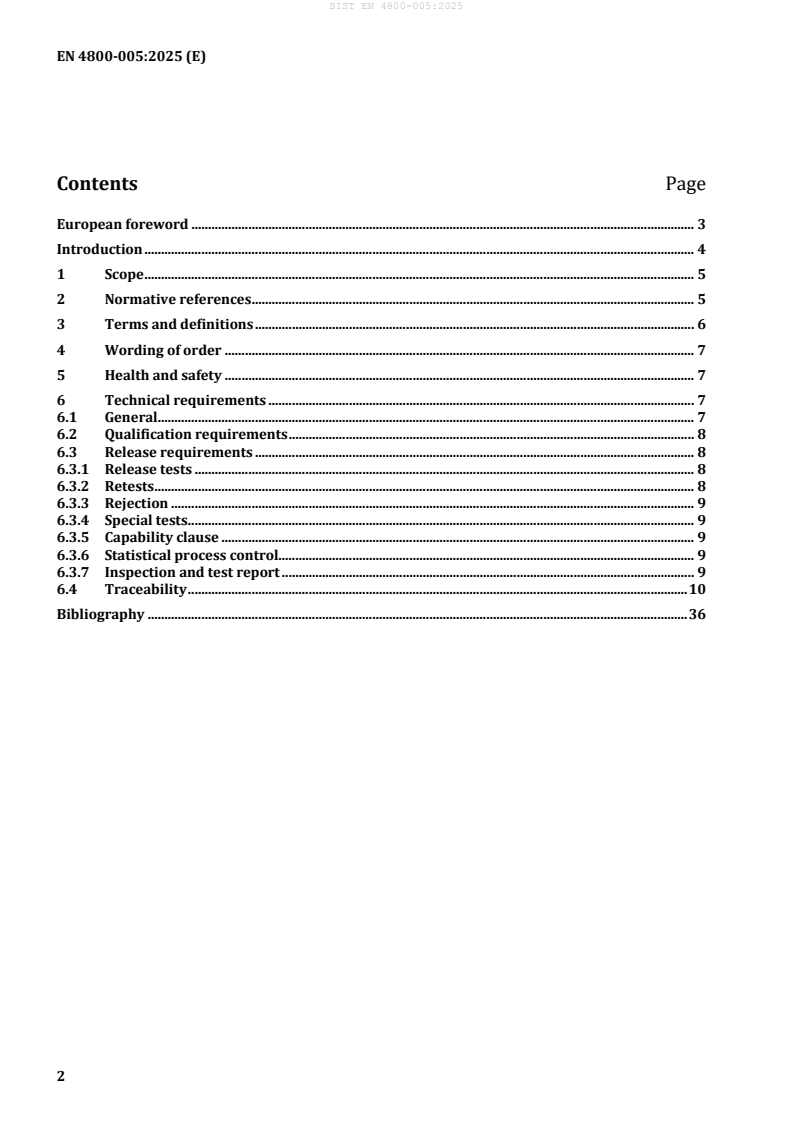
Contents Page
European foreword . 3
Introduction . 4
1 Scope . 5
2 Normative references . 5
3 Terms and definitions . 6
4 Wording of order . 7
5 Health and safety . 7
6 Technical requirements . 7
6.1 General. 7
6.2 Qualification requirements . 8
6.3 Release requirements . 8
6.3.1 Release tests . 8
6.3.2 Retests . 8
6.3.3 Rejection . 9
6.3.4 Special tests . 9
6.3.5 Capability clause . 9
6.3.6 Statistical process control. 9
6.3.7 Inspection and test report . 9
6.4 Traceability . 10
Bibliography . 36
European foreword
This document (EN 4800-005:2025) has been prepared by ASD-STAN.
After enquiries and votes carried out in accordance with the rules of this Association, this document has
received the approval of the National Associations and the Official Services of the member countries of
ASD-STAN, prior to its presentation to CEN.
This document shall be given the status of a national standard, either by publication of an identical text
or by endorsement, at the latest by August 2025, and conflicting national standards shall be withdrawn
at the latest by August 2025.
Attention is drawn to the possibility that some of the elements of this document may be the subject of
patent rights. CEN shall not be held responsible for identifying any or all such patent rights.
This document supersedes EN 4800-005:2010.
The main changes with respect to the previous edition are as follows:
— EN 4800-005:2010-11:
o editorial improvements;
o update of Clause 2;
o update of the paragraph “Method of melting” in Table 1; and
o addition of a bibliography.
According to the CEN-CENELEC Internal Regulations, the national standards organizations of the
following countries are bound to implement this document: Austria, Belgium, Bulgaria, Croatia, Cyprus,
Czech Republic, Denmark, Estonia, Finland, France, Germany, Greece, Hungary, Iceland, Ireland, Italy,
Latvia, Lithuania, Luxembourg, Malta, Netherlands, Norway, Poland, Portugal, Republic of North
Macedonia, Romania, Serbia, Slovakia, Slovenia, Spain, Sweden, Switzerland, Türkiye and the
United Kingdom.
Introduction
This document is part of the series of EN metallic material standards for aerospace applications.
The general organization of this series is described in EN 4258.
1 Scope
This document specifies the requirements for the ordering, manufacture, testing, inspection and
delivery of titanium and titanium alloy forging stock. It is applicable when referred to and in
conjunction with the European material standard unless otherwise specified on the drawing, order or
inspection schedule.
2 Normative references
The following documents are referred to in the text in such a way that some or all of their content
constitutes requirements of this document. For dated references, only the edition cited applies. For
undated references, the latest edition of the referenced document (including any amendments) applies.
EN 2002-001, Aerospace series — Metallic materials — Test methods — Part 001: Tensile testing at
ambient temperature
EN 2002-002, Aerospace series — Metallic materials — Test methods — Part 002: Tensile testing at
elevated temperature
EN 2002-005, Aerospace series — Test methods for metallic materials — Part 005: Uninterrupted creep
and stress-rupture testing
EN 2003-009, Aerospace series — Test methods — Titanium and titanium alloys — Part 009:
Determination of surface contamination
EN 2032-001, Aerospace series — Metallic materials — Part 001: Conventional designation
EN 2032-2, Aerospace series — Metallic materials — Part 2: Coding of metallurgical condition in delivery
condition
EN 2078, Aerospace series — Metallic materials — Manufacturing schedule, inspection schedule,
inspection and test report — Definition, general principles, preparation and approval
EN 2954-002, Aerospace series — Macrostructure of titanium and titanium alloy wrought products —
Part 002: Macrostructure of bar, section, forging stock and forgings
EN 2955, Aerospace series — Recycling of titanium and titanium alloy scrap
EN 2957, Aerospace series — Method of preparation of forged samples
EN 3114-001, Aerospace series — Test method — Microstructure of (α + β) titanium alloy wrought
products — Part 001: General requirements
EN 3114-002, Aerospace series — Test method — Microstructure of (α + β) titanium alloy wrought
products — Part 002: Microstructure of bars, sections, forging stock and forgings
EN 3683, Aerospace series — Test methods — Titanium alloy wrought products — Determination of
primary α content — Point count method and line intercept method
EN 3684, Aerospace series — Test methods — Titanium alloy wrought products — Determination of β
transus temperature — Metallographic method
Published as ASD-STAN prEN at the date of publication of this document, available at:
https://www.asd-stan.org/.
EN 3873, Aerospace series — Test methods for metallic materials — Determination of fatigue crack
growth rates using Corner-Cracked (CC) test pieces
EN 3874, Aerospace series — Test methods for metallic materials — Constant amplitude force-controlled
low cycle fatigue testing
EN 3976, Aerospace series — Titanium and titanium alloys — Test method — Chemical analysis for the
determination of hydrogen content
EN 3987, Aerospace series — Test methods for metallic materials — Constant amplitude force-controlled
high cycle fatigue testing
EN 3988, Aerospace series — Test methods for metallic materials — Constant amplitude strain-
controlled low cycle fatigue testing
EN 4050-1, Aerospace series — Test method for metallic materials — Ultrasonic inspection of bars, plates,
forging stock and forgings — Part 1: General requirements
EN 4050-4, Aerospace series — Test method for metallic materials — Ultrasonic inspection of bars, plates,
forging stock and forgings — Part 4: Acceptance criteria
EN 4259, Aerospace series — Metallic materials — Definition of general terms
EN ISO 643, Steels — Micrographic determination of the apparent grain size (ISO 643)
ISO 12135, Metallic materials — Unified method of test for the determination of quasistatic fracture
toughness
TR 2410, Aerospace series — Metallic materials — Relationship between dimensional standards and
material standards
AMS 2750, Pyrometry
3 Terms and definitions
For the purposes of this document, the terms and definitions given in EN 4259 apply.
ISO and IEC maintain terminological databases for use in standardization at the following addresses:
— ISO Online browsing platform: available at https://www.iso.org/obp
— IEC Electropedia: available at https://www.electropedia.org/
Published as ASD-STAN TR, available at: https://www.asd-stan.org/.
Published by Society of Automotive Engineers (SAE), available at: https://www.sae.org/.
4 Wording of order
The order shall clearly indicate:
a) quantities to be supplied;
b) dates of delivery;
c) material standard number;
d) delivery condition and metallurgical code of products;
e) dimensions and tolerances or reference to an appropriate dimensional standard;
f) product designation, when required;
g) forwarding address;
h) nature and type of packing, if required;
i) definition and frequency of any special tests and their retest procedures, if required.
5 Health and safety
a) The products in the delivery condition shall fulfil the current health and safety laws of the area of
the country when and where it is to be delivered.
b) A product safety data sheet shall be available.
6 Technical requirements
6.1 General
a) The product shall be manufactured in accordance with the requirements of the relevant material
standard and the applicable requirements of this document.
b) A manufacturing schedule shall be established and applied in accordance with EN 2078.
c) The product shall satisfy the requirements of the material standard and/or order and shall be free
from irregularities prejudicial to the subsequent manufacture or use of this product.
d) Notwithstanding previous acceptance complying with this material standard, any product that is
found, at a later stage, to contain such defects shall be rejected.
e) Unless otherwise specified, the requirements in Table 1 and Table 2 shall apply in conjunction with
those of the relevant material standard. Table 1 relates to lines 1 to 29 (inclusive) of the material
standard and Table 2 relates to lines 30 onwards in which the sub-line format is also used. Lines 2
to 98 may also be opened in line 100 if the material standard details specific qualification
requirements.
f) If a specific line number is not shown in Table 1 and Table 2, the requirement is stated in the
material standard and/or order.
g) The requirements of the order and/or material standard shall override the requirements of the
technical specification.
6.2 Qualification requirements
Qualification requirements, when invoked by the material standard and/or order, are detailed in
Table 1 and Table 2.
Unless otherwise agreed between the manufacturer and customer, the qualification phase shall be run
on the first three batches.
6.3 Release requirements
6.3.1 Release tests
a) Release testing shall be the responsibility of the manufacturer.
b) The customer reserves the right to perform any of the inspections and/or tests required by the
material standard and/or order.
c) The test samples shall be representative of the product.
d) When required, the manufacturer shall inform the customer of the planned dates for extraction of
samples and release testing in order that these operations may be witnessed.
e) Table 1 and Table 2 detail the requirements for each line of the material standard.
f) Unless otherwise specifically requested by the customer, a particular inspection and/or test for
release shall be carried out if corresponding acceptance criteria and/or values are stated in the
applicable material standard, but see also in 6.3.5.
6.3.2 Retests
a) If the test procedure or test piece preparation is faulty, testing shall be re-applied at the original
frequency after rectification of the original cause of failure.
b) When failure cannot be attributed to faulty testing, or test piece preparation, further test samples
shall be selected at twice the original frequency from the product, one of which shall be that on
which the original results were obtained unless already withdrawn by the manufacturer after
suitable identification of the cause of failure.
c) If all retest results are satisfactory, the batch shall be accepted.
d) If one or more tests are unsatisfactory, the batch shall be:
1) rejected; or
2) 100 % retested and the conforming products accepted; or
3) partially or fully re-heat treated if heat treatment can rectify the cause of the failure and tested
as a completely new batch except for chemical composition, for which redetermination of
hydrogen content is required; or
4) cut back and 100 % retested.
e) No product or test sample shall be re-heat treated more than twice.
6.3.3 Rejection
Any failure to meet the requirements of the material standard shall be cause for rejection.
6.3.4 Special tests
Special tests may be required by the customer. In such cases, the nature of the test, method, frequency
and technical requirements shall be specified on the order or inspection schedule and shall be mutually
agreed by the manufacturer and customer.
6.3.5 Capability clause
a) Where capability clause is invoked and where sufficient statistical evidence exists, the test shall not
be carried out (unless specifically requested by the customer).
b) However, this in no way reduces the obligations of the manufacturer to fulfil the requirements.
c) If subsequent testing indicates that the product does not comply with the requirements, the batch
shall be rejected.
d) If sufficient statistical evidence does not exist, the test shall be carried out at a frequency agreed
between the manufacturer and the customer.
6.3.6 Statistical process control
Reduction in the extent of release testing, other than that specified in 6.3.5 above, may be negotiated
with the customer on the basis of appropriate statistical process control and/or statistical data.
6.3.7 Inspection and test report
With each delivery, a report shall be furnished which conforms to the requirements of EN 2078 and
states the following:
a) manufacturer's name and address and, if appropriate, identification of the plant;
b) order number;
c) material standard number;
d) delivery condition and metallurgical code of the product;
e) quantity and dimensions;
f) manufacturing and inspection schedule reference;
g) cast and batch number;
h) batch and/or test samples heat treatment condition;
i) results of the tests and retests if any.
6.4 Traceability
Each product shall be traceable to the cast, production batch and/or heat treatment batch at all stages
of manufacture, testing and delivery.
Table 1 — Technical requirements for lines 1 to 29, where appropriate
Material standard line Requirements Frequency of testing
reference
No. Title Qualification Release
1 Material designation Shall refer to EN 2032-001. — —
2 Chemical composition The test samples used for chemical analysis shall be representative of the 2 per cast 2 per cast
product and shall be taken from location corresponding to top and bottom of
each ingot produced after the final melting stage. The method of chemical
analysis shall be at the discretion of the manufacturer unless otherwise stated in
the material standard or order. In cases of dispute, the method of chemical
analysis shall be agreed between the manufacturer and customer preferably
using existing chemical analysis standards. The measured chemical composition
shall be stated on the inspection certificate.
Specific requirements for hydrogen content: 1 per batch 1 per batch
The hydrogen content shall be determined on each batch in the delivery
condition in accordance with EN 3976.
3 Method of melting Method of melting shall consist of cold hearth (electron beam or plasma arc) — —
and/or consumable electrode vacuum arc melting. An initial non-consumable
electrode melt is allowed provided a water-cooled electrode is used. Some of the
following requirements depend on whether the melting method includes
cold hearth.
1 Raw material:
Raw materials shall be purchased only from suppliers approved by the
manufacturer and registered in their list of approved suppliers.
Approval of suppliers shall be made in accordance with written procedures
contained within the quality assurance system of the manufacturer.
Material standard line Requirements Frequency of testing
reference
No. Title Qualification Release
2 Titanium sponge and alloying elements:
The requirements shall be specified and the following procedures shall be
established for the evaluation and acceptance testing of each batch:
— titanium sponge: manufacturing method, level of impurities, particle size,
freedom from foreign particles;
— alloying elements: chemical composition including level of impurities,
particle size, freedom from foreign particles.
Recycling of scrap:
Shall refer to EN 2955.
The categories and sub-categories of scrap which may be used by the
manufacturer are given in the following table:
Scrap categories and Melting method which VAR-only melt method
sub-categories includes cold hearth
(EN 2955)
1.1 allowed allowed
1.2 allowed allowed
2.1 allowed allowed
2.2 allowed allowed
3.1 allowed allowed
3.2 allowed allowed
4.1 allowed allowed
4.2 allowed allowed
4.3 allowed allowed
Material standard line Requirements Frequency of testing
reference
No. Title Qualification Release
4.4 allowed not allowed
5.1 allowed allowed
5.2 allowed allowed
5.3 not allowed not allowed
6.1 allowed allowed
6.2 allowed allowed
7.1 allowed not allowed
7.2 allowed not allowed
A list of approved scrap processors shall be maintained. The list shall indicate
the categories of scrap for which the processors are approved.
Each order for scrap shall refer to EN 2955, specify the category and, if
necessary, the sub-category of the scrap.
3 Charge preparation:
The melter shall establish procedures for the charge make up which shall
include, if appropriate:
— scrap categories and sub-categories to be used;
— amount of recycled scrap;
— charge composition;
— requirements for recording the constitution of each charge;
— compaction.
The scrap shall be of the same alloy, or compatible with the final alloy composition.
Material standard line Requirements Frequency of testing
reference
No. Title Qualification Release
4 Electrode constitution (if appropriate):
Build-up of electrodes and attachment of their stubs shall be carried out under a
vacuum or inert gas atmosphere in accordance with the procedure specified by
the manufacturer.
5 Welding:
Welds produced outside the melting furnace shall be visually examined for
unacceptable discolouration in accordance with the standard specified by
the manufacturer.
The welding method to be used for fabricating electrodes, joining electrodes and
joining stubs to the electrode shall be Metal Inert Gas (MIG) or Plasma in an inert
gas atmosphere or Electron Beam (EB) under vacuum. In addition, stubs may be
attached to electrodes by electric arc in a VAR furnace.
6 Melting:
Melting process
...